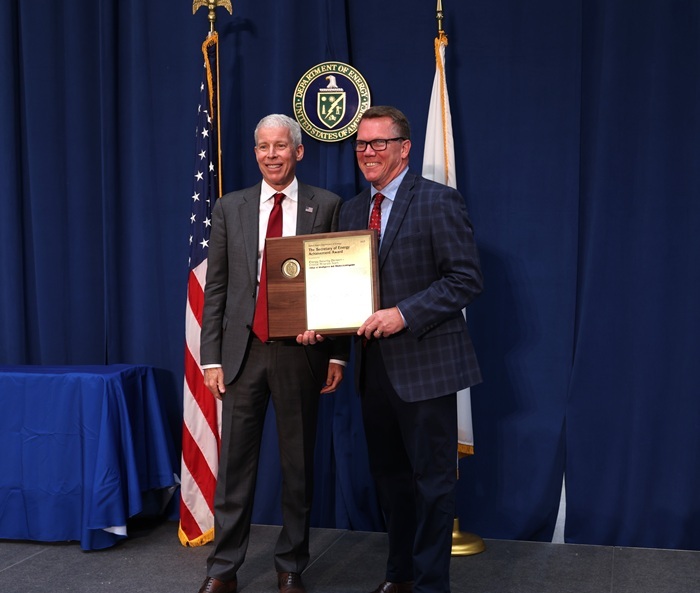
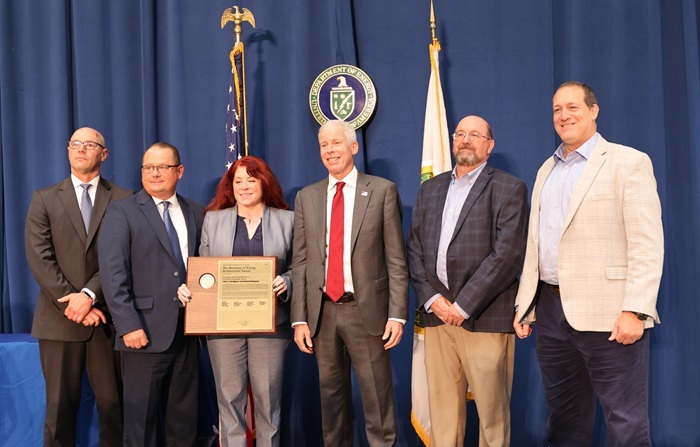
 Energy Secretary Chris Wright honors the Oak Ridge Office of Environmental Management and Portsmouth Paducah Project Office Reindustrialization Team with the Secretary of Energy Achievement Award during the Secretary’s Honor Awards ceremony. At right is John Patterson, president and CEO of Strata-G, a Knoxville, Tennessee-based company that provides services to government and commercial clients. Patterson accepted the award on behalf of the team.
The U.S. Department of Energy (DOE) recently bestowed Office of Environmental Management (EM) employees and teams with seven Secretary’s Honor Awards, recognizing their exceptional leadership, innovation and commitment to restoring and revitalizing sites as DOE cleans the legacy of the past to power America’s future.
The awards recognize individuals and teams whose exceptional service and contributions have made a lasting impact on both DOE and the nation.
Oak Ridge Office of Environmental Management and Portsmouth Paducah Project Office Reindustrialization Team
This team received the Secretary of Energy Achievement Award for its trailblazing work propelling new nuclear development at DOE sites, exemplifying the golden era of American energy dominance. The team’s efforts have transformed the Oak Ridge, Portsmouth and Paducah sites into major hubs of nuclear industry growth to meet America’s need for affordable energy. These American Energy Hubs are attracting billions in private investment, creating thousands of good-paying jobs and growing the economy in communities that served the nation for decades.
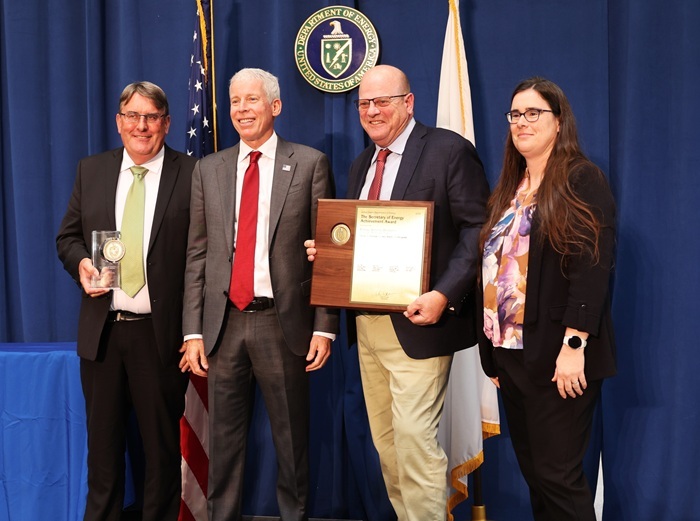 Energy Secretary Chris Wright honors members of the Hanford Site Waste Treatment and Immobilization Integrated Project Team with the Secretary of Energy Achievement Award.
Hanford Site Waste Treatment and Immobilization Integrated Project Team
DOE honored this team with the Secretary of Energy Achievement Award for startup of the Low-Activity Waste Facility, a key component of the Waste Treatment and Immobilization Plant. Their work enabled EM to begin solidifying Hanford tank waste in glass for the first time, meeting a legal commitment to the state of Washington.
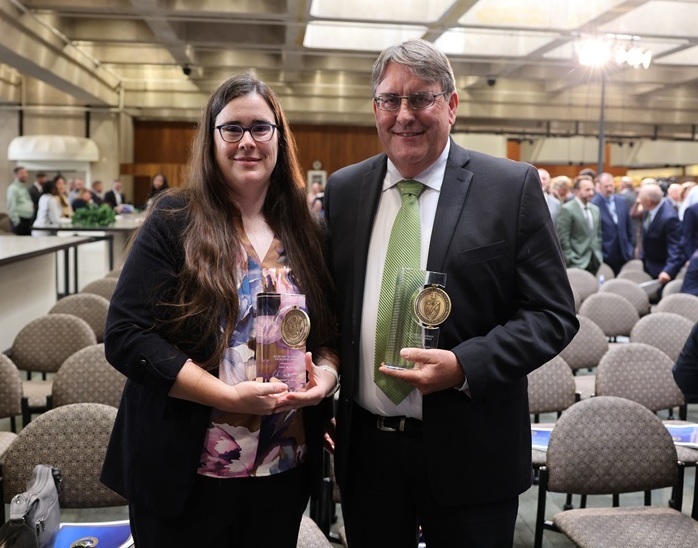 Kelly A. Ebert, director of Hanford Field Office Project and Facilities Division, and Mat Irwin, assistant manager for Hanford Field Office Tank Waste Operations, are pictured with their Secretary of Energy Excellence Awards.
Mat Irwin, assistant manager for Hanford Field Office Tank Waste Operations
DOE awarded Irwin the Secretary of Energy Excellence Award for outstanding leadership in advancing the Hanford Site mission, including successful startup of the Low-Activity Waste Facility and development of the High-Level Waste Facility. His skills in project management, budgeting and facility operation have been pivotal to major progress at Hanford.
Kelly A. Ebert, director of Hanford Field Office Project and Facilities Division
Ebert received the Secretary of Energy Excellence Award in recognition of her exceptional leadership and accomplishments, which have set new benchmarks for operational excellence for the Hanford Site’s transuranic waste program. Ebert spearheaded an initiative that addressed operational gaps, and will save American taxpayers $20 million in waste repackaging costs. She improved waste shipment planning, avoided the need for a $600 million facility and streamlined waste certification.
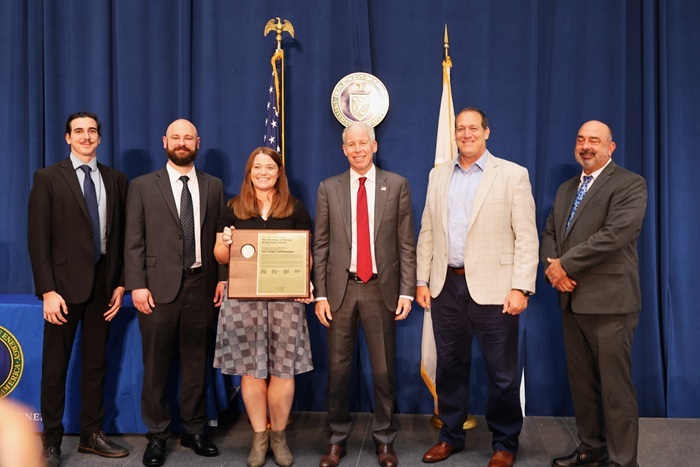
 Members of the Savannah River Site Waste Tank Closure Team accept the Secretary of Energy Achievement Award from Energy Secretary Chris Wright.
Savannah River Site Waste Tank Closure Team
Setting a powerful example for tackling complex challenges, the Savannah River Site Waste Tank Closure Team received the Secretary of Energy Achievement Award for exceptional progress in accelerating the high-level waste mission at the Savannah River Site. Since 2022, the team has removed more than 48 million curies of radiation and processed more than 15 million gallons of salt waste. Their forward-thinking strategies, including drone inspections, offsite laboratory partnerships and a 3D printed sampling tool, accelerated tank closures, saved American taxpayers millions in costs and set new standards for safety and efficiency.
 Energy Secretary Chris Wright honors Savannah River Mission Completion Drone Team members with the Secretary of Energy Achievement Award.
Savannah River Mission Completion Drone Team
This team received the Secretary of Energy Achievement Award for accelerating the liquid waste mission by deploying drones inside radioactive waste tanks for the first time. The technology expands inspection coverage, speeds assessments and generates precise 3D scans. Along with advanced sampling tools, these innovations supported the removal of waste from eight high-level waste tanks in under two years, achieving regulatory milestones ahead of schedule.
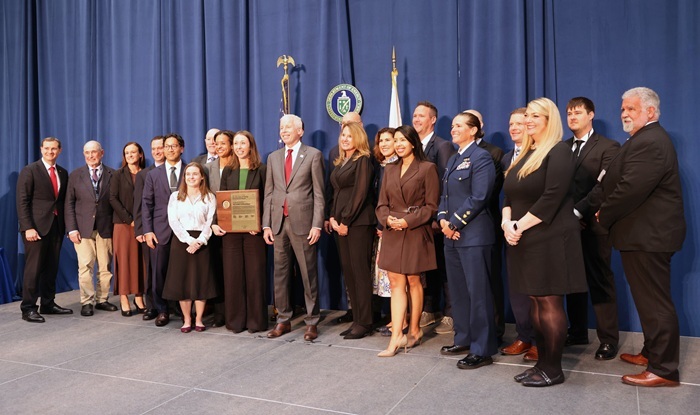 Energy Secretary Chris Wright recognizes the Japan High-Assay Low-Enriched Uranium Removal Team with the Secretary of Energy Achievement Award. Team member Rosa R. Elmetti, a U.S. Department of Energy Office of Environmental Management federal program manager, is pictured front row, third from right.
Rosa R. Elmetti, EM federal program manager, supporting the Japan High-Assay Low-Enriched Uranium Removal Team
DOE recognized the Japan High-Assay Low-Enriched Uranium (HALEU) Removal Team with the Secretary of Energy Achievement Award. Team member Elmetti worked with the National Nuclear Security Administration on an agreement that brought $20 million worth of much-needed Japanese HALEU into the United States to strengthen the domestic fuel supply chain for advanced nuclear and showcases DOE’s leadership in enabling America’s nuclear future.
-Contributors: Jordan Anderson, Hayley Long
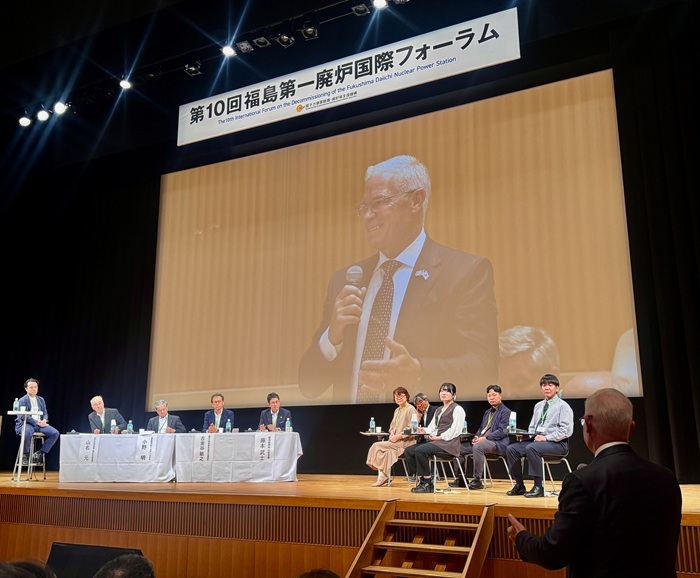 U.S. Department of Energy Office of Environmental Management Assistant Secretary Tim Walsh addresses the 10th International Forum on the Decommissioning of the Fukushima Daiichi Nuclear Power Station, highlighting ongoing cleanup cooperation between the United States and Japan.
Walsh-led delegation participates in forum on Fukushima Daiichi Nuclear Power Station decommissioning, engages American and Japanese officials to strengthen cooperation across nuclear energy sector
JAPAN — U.S. Department of Energy Office of Environmental Management (EM) Assistant Secretary Tim Walsh reinforced America’s longstanding partnership with Japan during a recent visit focused on nuclear cleanup, energy security and diplomacy, nuclear cooperation and economic development.
Walsh’s trip advanced President Donald Trump and Energy Secretary Chris Wright’s diplomatic initiatives to usher in a new golden age of United States-Japan relations as both nations work to advance nuclear cleanup missions, expand access to affordable and reliable power, increase partnership on nuclear energy, grow economic opportunity and strengthen cooperation across the Indo-Pacific.
A centerpiece of Walsh’s visit was the EM delegation’s tour of the Fukushima Daiichi Nuclear Power Station to see ongoing tremendous progress in Tokyo Electric Power Company’s cleanup work and participation in the 10th International Forum on the Decommissioning of the Fukushima Daiichi Nuclear Power Station. View EM Update coverage of last year's forum here.
Walsh, Principal Deputy Assistant Secretary Joel Bradburne and Hanford Field Office Manager Ray Geimer shared lessons in managing complex nuclear cleanup missions across the U.S., including experiences in long-term planning, using new technologies, ensuring strong safety performance and engaging in open and transparent communication with surrounding communities.
“Japan is one of America’s strongest and most trusted allies. Our continued engagement reflects a shared commitment to advancing safe and innovative nuclear cooperation that is essential to the successful future of both our nations,” said Walsh. “When it comes to building a better world filled with innovation, scientific discovery, affordable energy and economic vitality, we are all in it together.”
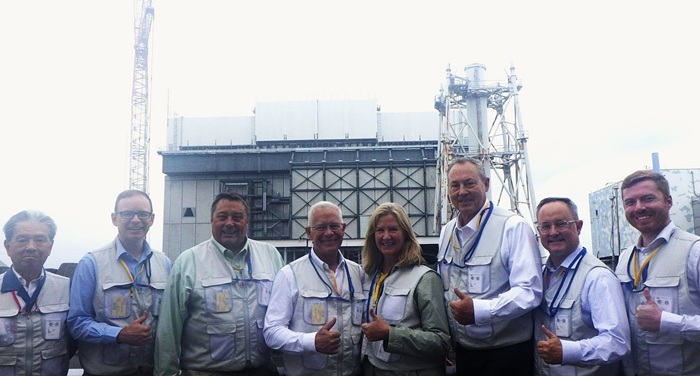 U.S. Department of Energy Office of Environmental Management (EM) Assistant Secretary Tim Walsh and the EM delegation tour the Fukushima Daiichi cleanup site and receive an update on current and future cleanup activities. From left: Tokyo Electric Power Company Executive Vice President and Chief Decommissioning Officer Akoya Ono; U.S. Department of Energy Japan Office Director Cameron Salony, who also serves as energy attaché, U.S. Embassy, Tokyo; Hanford Field Office Manager Ray Geimer; Walsh; Lisa Walsh; EM Principal Deputy Assistant Secretary Joel Bradbourne; EM Deputy Chief of Staff John Howard; and EM Director of Communications Justin Doil.
Following the Fukushima forum, Walsh and the EM delegation met with officials at the U.S. Embassy in Tokyo, including Chargé d'affaires Aaron D. Snipe, for an update on fulfilling Trump’s work to deepen bilateral relations between the American and Japanese people.
Their meetings connected EM’s cleanup and nuclear mission with the Trump administration’s broader goals of strengthening energy dominance and security, expanding commercial opportunities and creating high-quality jobs. Walsh also visited the Japanese Language and Area Training Center in Yokohama, where he met with U.S. foreign service officers and discussed their important work to advance the president’s energy security and cooperation mission with Japan.
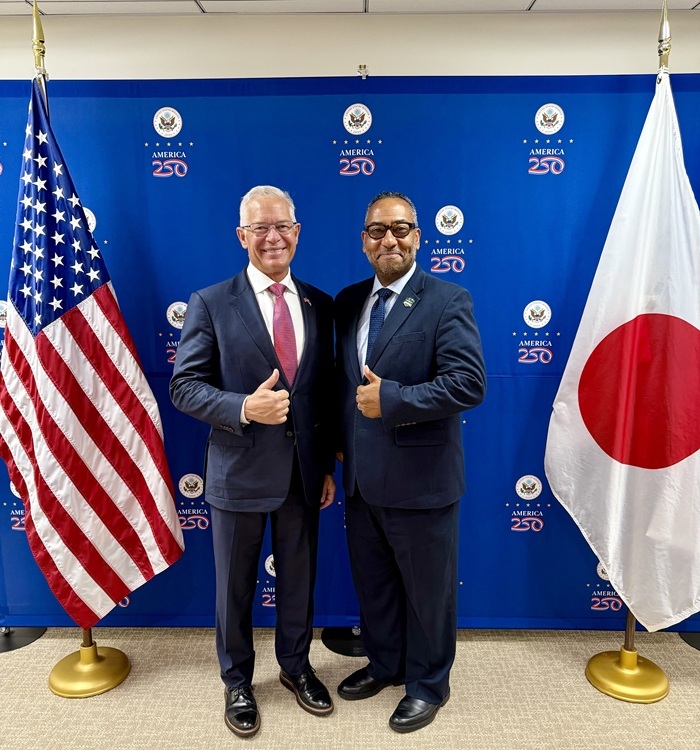 U.S. Department of Energy Office of Environmental Management Assistant Secretary Tim Walsh and Chargé d'affaires Aaron D. Snipe, U.S. Embassy, Tokyo, met to discuss fulfilling President Donald Trump’s golden age of U.S.-Japan relations and how U.S.-Japanese cooperation is securing a safe, prosperous and peaceful Indo-Pacific region.
 |
|
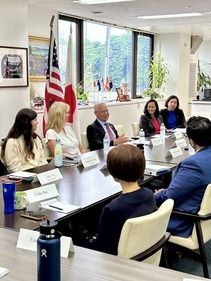
U.S. Department of Energy Office of Environmental Management Assistant Secretary Tim Walsh addresses U.S. foreign service officers to thank them for the work they carry out daily to implement policies to strengthen U.S.-Japan cooperation on cleanup, energy security and economic growth. |
The EM delegation also met with Japanese government officials, including representatives of the Ministry of Education, Culture, Sports, Science and Technology, Ministry of Economy, Trade and Industry and Nuclear Damage Compensation and Decommissioning Facilitation Corporation (NDF). The meetings built on an already active energy and scientific partnership resulting from Trump’s U.S.-Japan Strategic Trade and Investment Agreement, including the $33.3 billion investment by SB Energy, a SoftBank Group Company, at EM’s Portsmouth Site to build 9.2 gigawatts of new affordable energy generation that will lower energy prices throughout the Ohio region, and construction of a new advanced computing campus that will create thousands of new jobs.
Walsh and the EM delegation also took part in follow-up meetings with the NDF and its president, Hajimu Yamana, for further discussions on nuclear cleanup cooperation between the U.S. and Japan and how both countries could learn from each other to accelerate cleanup progress, save taxpayer dollars and safely put human health and the environment first at legacy cleanup sites.
Closing out the trip, to strengthen Trump and Wright’s efforts to close the nuclear fuel cycle and power America’s ongoing nuclear renaissance, Walsh and the EM delegation visited Japan Nuclear Fuel Limited’s (JNFL) Rokkasho Reprocessing Plant led by President and CEO Naohiro Masuda. JNFL’s operations span uranium enrichment, used fuel reprocessing and mixed oxide fuel fabrication. The visit gave Walsh a firsthand look at capabilities relevant to closing the nuclear fuel cycle, nuclear-material management and the reliable supply of nuclear fuel.
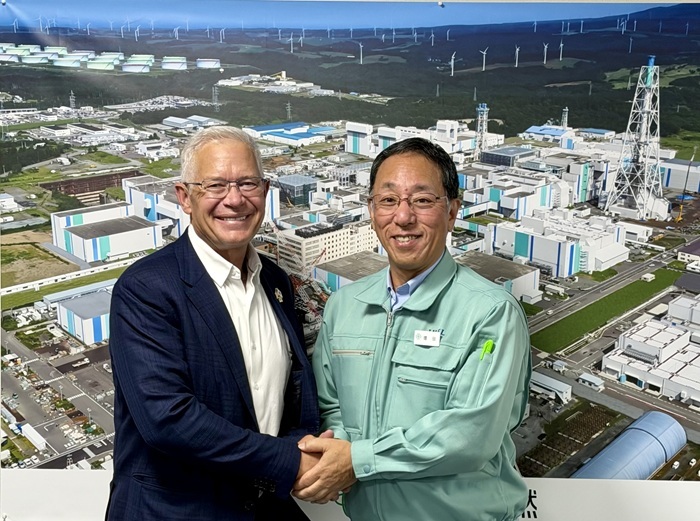 U.S. Department of Energy Office of Environmental Management Assistant Secretary Tim Walsh poses with Japan Nuclear Fuel Limited President and CEO Naohiro Masuda after a tour and briefing on Japan’s used nuclear fuel reprocessing capabilities. Cooperation on reprocessing is a cornerstone of America’s ongoing nuclear renaissance.
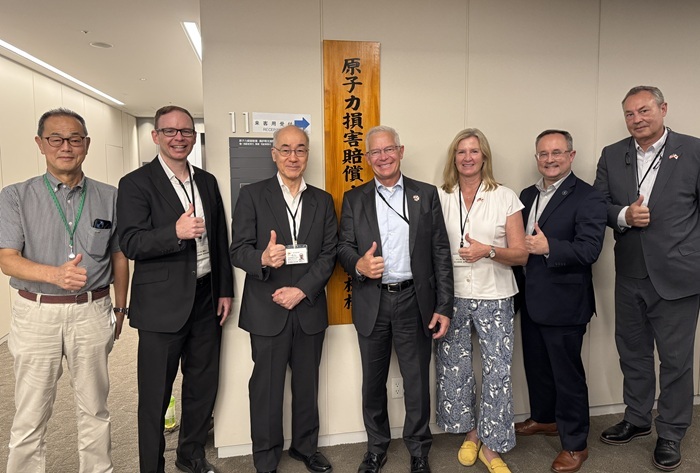 U.S. Department of Energy Office of Environmental Management (EM) Assistant Secretary Tim Walsh and the EM delegation meet with Nuclear Damage Compensation and Decommissioning Facilitation Corporation President Hajimu Yamana for closing conversations on cleanup at the Fukushima Daiichi site and how lessons learned from the United States and Japan’s nuclear cleanup sites can apply to both countries to carry out safe, effective and efficient cleanup work.
“Together, under the leadership of President Trump and Japan’s Prime Minister Sanae Takaichi, we are building a deeper and more connected relationship between our two nations that will benefit the United States and Japan, and the rest of the free world,” said Walsh. “By working together, strengthening our diplomatic ties, and increasing cooperation on nuclear cleanup, energy, and technologies, we will build a peaceful and prosperous world for ourselves, our children and our grandchildren.”
CARLSBAD, N.M. — As Tommy Cash marks more than 3.6 million safe miles as a professional truck driver over the past 43 years, his extraordinary career as a Waste Isolation Pilot Plant (WIPP) team member is drawing national recognition in 2026 — again.
Cash, a WIPP waste shipment driver of 23 years, was selected as the 2026 Commercial Vehicle Safety Alliance International Driver Excellence Award recipient.
The honor comes just months after his impeccable record — safely driving a distance comparable to more than seven round trips to the moon — led the Truckload Carriers Association to recognize Cash with one of its 2026 Professional Drivers of the Year awards.
"Tommy represents what professional driving is supposed to be," said Michael Savage, director of safety for CAST Specialty Transportation, WIPP's transportation contractor. "His record is extraordinary, but the number of miles doesn't tell the whole story. It's the consistency, professionalism, discipline and willingness to teach other drivers that makes Tommy so special."
 |
|
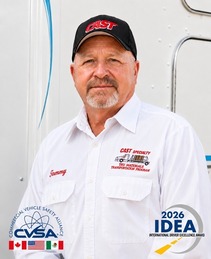
Tommy Cash, Waste Isolation Pilot Plant waste shipment driver. |
Cash’s latest award from the alliance recognizes commercial motor vehicle drivers who demonstrate exceptional commitment to public safety, professionalism and excellence throughout their careers. The alliance described Cash as an example of those qualities, citing his more than four decades of safe driving, mentorship of other drivers and more than 3.6 million safe miles.
According to the alliance, Cash is one of only 36 elite, professional drivers in the United States entrusted with transporting transuranic radioactive waste from U.S. Department of Energy (DOE) sites around the country to the DOE Office of Environmental Management’s WIPP underground repository for permanent disposal. He has also successfully completed more than 1,000 inspections from the alliance during his career transporting radioactive material.
Cash's influence extends beyond the driver's seat. He serves as a lead driver and mentor for WIPP, road-testing applicants, training newly hired drivers and coaching other professional drivers. Savage told the alliance that Cash has set such a high standard that CAST has had to adapt its hiring and training standards to keep pace with his performance.
Cash’s accomplishments have also been recognized at the national level outside the transportation industry. In September, Rep. Gabe Evans of Colorado presented Cash with a certificate of special congressional recognition honoring his 2026 national transportation awards. Cash also received a congressional challenge coin.
"To have Congress recognize Tommy's accomplishments is an incredible honor," Savage said. "Tommy has spent his career representing the very best of professional transportation, and we're proud that his work is receiving recognition.”
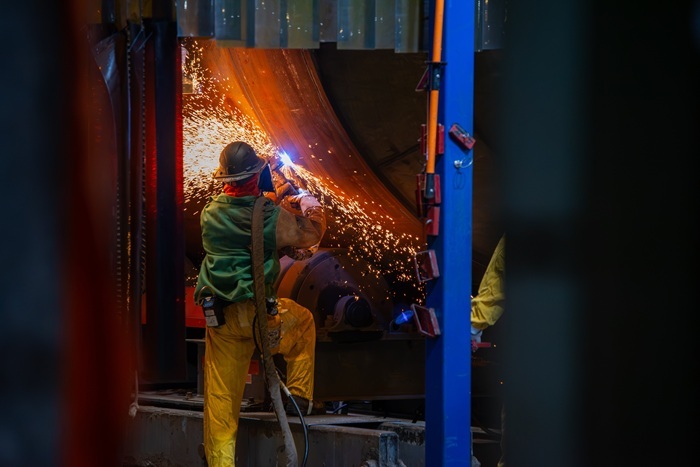 A crew member safely segments a converter from the Paducah C-337 Process Building, one of the first pieces of process gas equipment removed from its installed location in the facility since fissile operations recently began.
PADUCAH, Ky. — Building on the successful removal of 497 converters from the C-333 Process Building earlier this year, workers effectively segmented the first fissile converter from the second of four former uranium enrichment facilities undergoing deactivation at the U.S. Department of Energy’s (DOE) Paducah Site.
The milestone showcases growing cleanup momentum as crews tackle the segmentation of close to 500 fissile converters in the C-337 Process Building. Each converter is nearly two times the size of a standard cement mixer drum. The converters served as the workhorse in legacy uranium enrichment operations. Segmentation is a process in which team members remove, cut and downsize a converter.
"Reaching this point in the C-337 Process Building demonstrates the skill and dedication of the workforce," Paducah Site Federal Project Director William Wessel said. "Safely initiating the segmentation of fissile converters along with the removal of certain process gas equipment from their installed location moves us one step closer to fulfilling our cleanup mission and positioning the site for future opportunities."
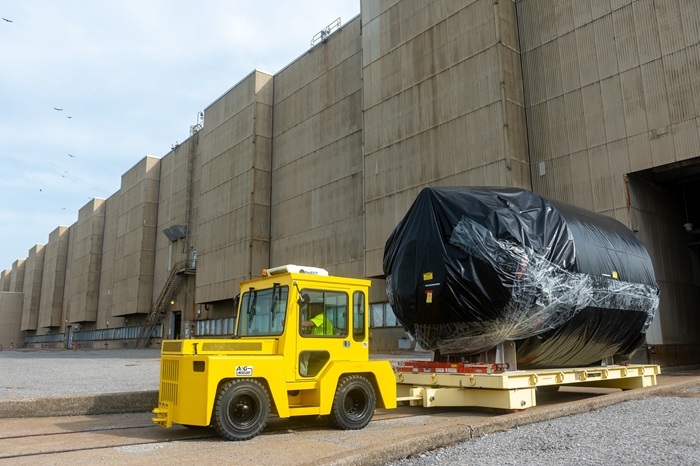 A converter is towed from the Paducah C-337 Process Building for segmentation, a process in which it will be cut and downsized. Nearly 500 converters will be removed and segmented from the facility to prepare for demolition.
Unlike nonfissile equipment contained in C-333, handling fissile components in C-337 introduces greater complexity. It requires enhanced monitoring, strict containment, specialized safety measures to prevent accidental reactions and highly trained workers. Experienced personnel help bridge generational knowledge while building on lessons learned from the C-333 deactivation.
The Paducah team’s deactivation work also benefited from cross-site collaboration. Representatives from the cleanup contractor at the Portsmouth Site in Ohio shared expertise as they deactivate the third and final process building at Portsmouth.
Deactivation of C-337 is key to implementing the site’s Decision 2029 holistic cleanup strategy. Preparing massive facilities more than 1 million square feet in size for demolition paves the way for eventual reindustrialization and economic development at the Paducah Site.
Four Rivers Nuclear Partnership (FRNP), the Paducah Site deactivation and remediation contractor, is tasked with deactivating C-337.
“The team continues to adapt innovative technologies and new, proven field methods to execute complex deactivation safely and efficiently,” FRNP Program Manager Myrna Redfield said. “Every converter segmented from the C-337 Process Building brings the site one step closer to the overall cleanup goals.”
-Contributors: Nick Henley, Dylan Nichols
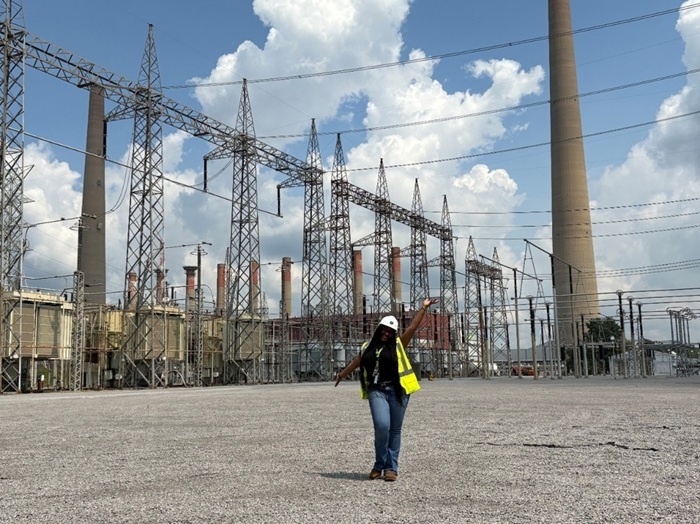 Darian Moulden visits the Tennessee Valley Authority Shawnee Fossil Plant during her internship with the Paducah Gaseous Diffusion Plant.
The U.S. Department of Energy’s Office of Environmental Management (EM) University Programs are building a workforce pipeline to help complete the legacy nuclear cleanup mission.
A cornerstone of that effort is the Success Through Academic Research Scholarship (STARS) program. A unique pathway for undergraduate students to gain hands-on experience and contribute to vital science, technology, engineering and math (STEM) fields, STARS fosters the next generation of technical experts needed to carry out EM’s cleanup mission.
“The STARS program is a testament to DOE EM's commitment to cultivating the next generation of STEM professionals,” said Latrincy Bates, manager of the EM STARS program. “By investing in these talented students, we are ensuring a highly skilled workforce is ready to meet the complex challenges of tomorrow's environmental cleanup initiatives.”
STARS provides scholarships and paid summer internships to students pursuing STEM degrees that align with EM's research and operational goals in soil and groundwater remediation, deactivation and decommissioning, tank waste management, robotics, machine learning, artificial intelligence, cybersecurity and advanced manufacturing.
Supporting scholars throughout their academic and early career journeys, STARS offers financial support, professional development and mentorship. Scholars participate in a 10-week paid summer internship for two consecutive summers, gaining hands-on experience at EM sites and national laboratories across the nation. Upon completion, they can pursue a master's degree with continued program support or seek employment in EM and partner organizations.
Students from the 2024 STARS cohort are already contributing to EM's mission. Darian Moulden from Tennessee State University obtained a bachelor’s in electrical engineering and completed two internships at the Paducah Gaseous Diffusion Plant (PGDP) before securing an engineering position with Savannah River Site (SRS) contractor Savannah River Nuclear Solutions.
“The people at PGDP encouraged me, invested in my growth and truly believed in my future as an engineer. During one of the toughest semesters of pursuing my electrical engineering degree, it was comforting to know I had encouragement and support from people who believed in me,” Moulden said. “That experience reminded me of the importance of resilience, perseverance and community.”
 |
|
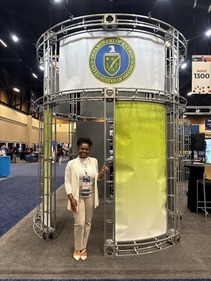
The Success Through Academic Research Scholarship program provides funding for scholars to attend the Waste Management Symposia in Phoenix, Arizona. Xana Lee, a 2024 cohort member, stopped by the U.S. Department of Energy booth at the conference this year. |
Another 2024 cohort member, Xana Lee, received her bachelor’s and master’s in civil engineering from Arizona State University and completed two internships at the Portsmouth Site before launching her career as a nuclear facility engineer at Los Alamos National Laboratory over the summer.
“One of the most impactful parts of my experience was spending time in Piketon, where I faced challenges that strengthened my resilience and perspective,” Lee said of her internships. “I learned how to navigate unfamiliar environments, remain focused on my goals and continue pushing forward through difficult situations. Those experiences taught me independence, patience and the importance of staying grounded in who I am.”
Eleven students joined the 2026 cohort, pursuing degrees in fields such as computer science, environmental engineering, nuclear engineering and earth sciences. The scholars completed internships at the Hanford Site, SRS and Environmental Management Consolidated Business Center.
For more information, or to volunteer as a mentor for the 2027 cohort, contact Latrincy Bates at latrincy.bates@em.doe.gov.
-Contributor: Lauren Zack
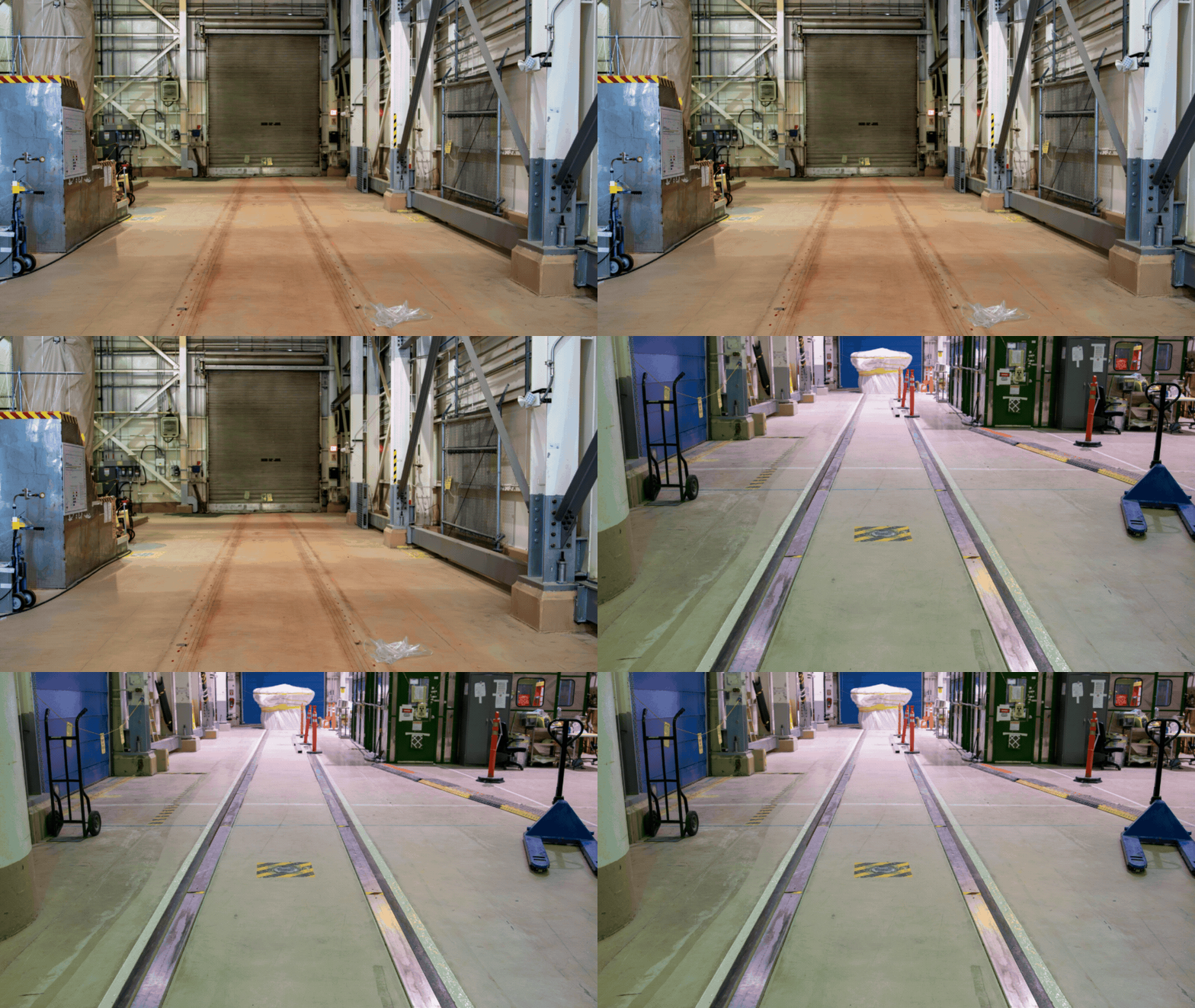 Crews are recovering historic rail infrastructure inside the Irradiated Fuel Storage Facility at the Idaho National Laboratory Site for use in getting used nuclear fuel “road ready” for future shipment out of state according to the Idaho Settlement Agreement.
IDAHO FALLS, Idaho — Idaho Cleanup Project crews recovered more than 200 feet of rail within a Cold War-era facility that will aid in future used nuclear fuel packaging and transportation efforts.
The rails, reclaimed from the Irradiated Fuel Storage Facility, are integral to the Idaho Cleanup Project’s Road Ready Demonstration Project. In that initiative, crews retrieve the fuel from storage at the facility and package it into a transportable “road ready” system, including U.S. Department of Energy (DOE) standard canisters. Next, they store the canisters in protective containers known as overpacks for eventual shipment and removal from Idaho when a disposal path is available.
Removing the used nuclear fuel from Idaho is being completed in accordance with an agreement between DOE and the state of Idaho. This work also extends the life of the Irradiated Fuel Storage Facility at the Idaho Nuclear Technology and Engineering Center, which stores fuel from the Idaho National Laboratory’s Advanced Test Reactor, a research reactor onsite.
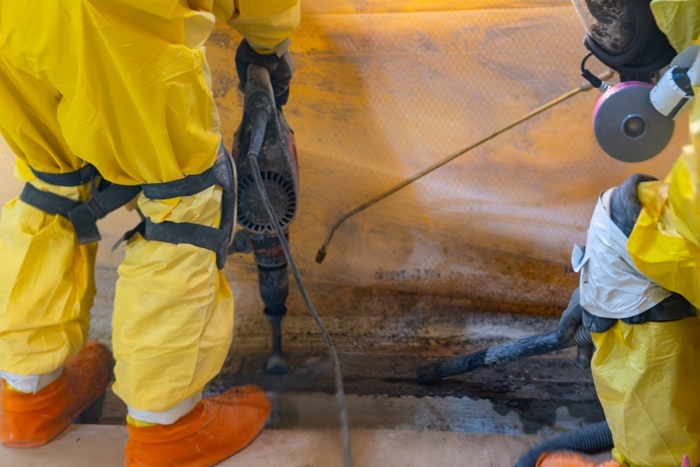 Personal protective equipment, containment tents and specialized tools allow workers to complete the rail recovery project safely and efficiently.
The rail will play an important role in moving fuel packages weighing as much as 120 tons, in tandem with a low-profile transport car, from the legacy facility’s storage area to a staging pad to be constructed nearby.
Since June, crews have carefully chipped away at the grouting over the rails, using specialized tools and personal protective equipment to safely complete the work. Tents constructed over work areas ensure no risk of contamination from potential hazards to the workforce, allowing other work inside the facility to continue seamlessly.
Used nuclear fuel packages historically moved to storage in the facility on rails, and restoring this infrastructure will prevent unnecessary wear and tear to the facility’s overhead crane.
-Contributor: Carter Harrison
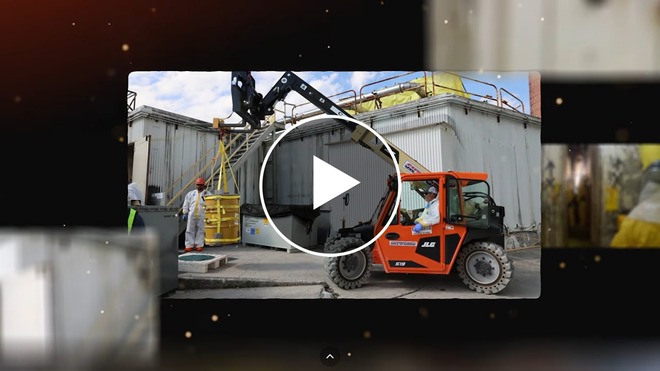
OAK RIDGE, Tenn. — The U.S. Department of Energy’s mission to clean up legacy facilities is moving faster and smarter at the Oak Ridge Reservation. Through innovation and efficiency, the Oak Ridge Office of Environmental Management and cleanup contractor United Cleanup Oak Ridge worked to save millions of dollars in cost savings in the fiscal year ending Sept. 30 to pave the way for the future. Watch this video to learn more about how the team is achieving these goals.
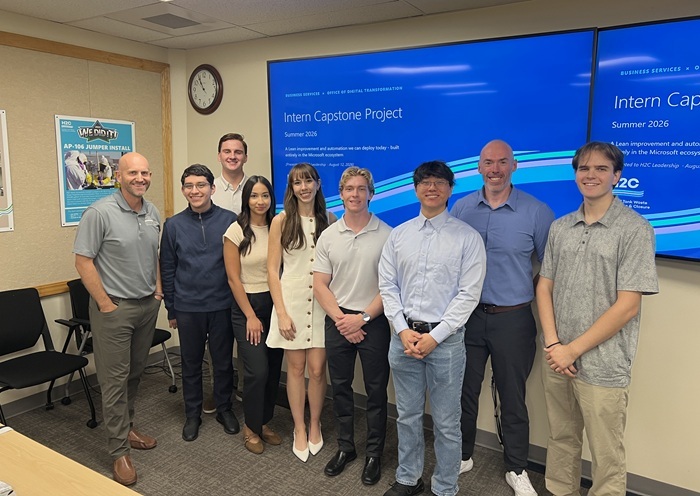 Summer interns at Hanford Tank Waste Operations & Closure (H2C) developed an automated tool to improve contract reviews. From left, Business Services Director Corey Chun, Miguel Morales-Chavez, Tanner Schuster, Yaneli Guerrero, Kati Piper, Clay Bower, Timothy Le, H2C Office of Digital Transformation Director Jordan Davis and Greyden Rebich.
RICHLAND, Wash. — Interns at the Hanford Site helped improve how contract reviews are assigned, creating a tool that saves time, reduces errors and makes the process more consistent.
The interns with tank operations contractor Hanford Tank Waste Operations & Closure (H2C) developed an automated system called INTERN, short for Integrated Next-to-Evaluate Reviewer Nominator. The tool assigns qualified reviewers in rotation, sends automatic reminders and tracks progress in one place.
Before the new system was created, review assignments were often made by hand. That could lead to uneven workloads. The new process helps spread work more evenly and gives H2C staff better information to manage reviews.
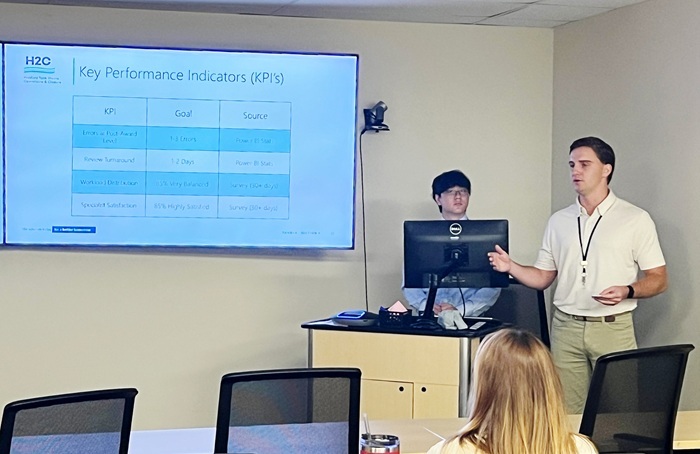 Tanner Schuster, Acquisition Management intern for Hanford Tank Waste Operations & Closure, presents a portion of the intern improvement project to company leaders.
The project used software H2C already had, turning existing resources into a practical solution for a long-running challenge. By improving a support process behind the scenes, the interns helped strengthen the work process.
“This project is a great example of how innovation can strengthen the Hanford cleanup mission,” said Rob Chase, Hanford Field Office director for Tank Waste Business Operations. “By applying commercially available technology in a new way, these interns identified an opportunity to improve efficiency, make better use of resources and build skills that will benefit the cleanup mission well into the future.”
The new system also collects data that can help identify future improvements. That added visibility can help H2C continue improving how work is assigned and completed.
“They didn’t just build a tool. They worked together to solve a real challenge for H2C, and did it with professionalism and creativity,” said Business Services Director Corey Chun. “This is exactly the kind of teamwork we hope to see from future leaders.”
The project shows how simple, practical ideas can improve efficiency, support cleanup work and deliver better value for taxpayers.
|