This issue of the weekly EM Update focuses on the 12th National Cleanup Workshop, held Sept. 14-16 in Arlington, Virginia. Featuring the theme, "Powering and Securing the Future Through Restoration and Revitalization," the event was hosted by Energy Communities Alliance with the cooperation of the U.S. Department of Energy (DOE) Office of Environmental Management and the Energy Facility Contractors Group. About 600 people attended the workshop to hear from senior DOE leaders, local government officials, industry leaders and others.
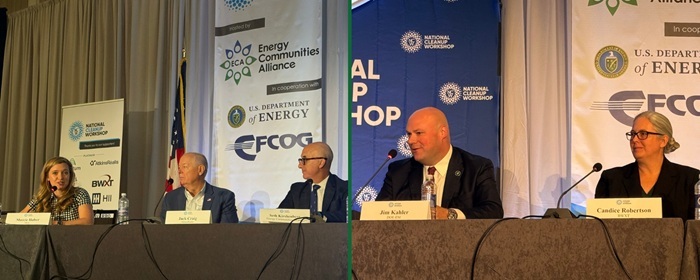 Panelists, from left: Marcie Haber, director of federal affairs, Oklo Inc.; Jack Craig, senior vice president, Federal Energy & Environment, AtkinsRéalis US Nuclear; panel moderator Seth Kirshenberg, executive director, Energy Communities Alliance; Jim Kahler, senior advisor, U.S. Department of Energy Office of Environmental Management; and Candice Robertson, deputy for Environment, Energy & New Missions, BWXT.
ARLINGTON, Va. — U.S. Department of Energy (DOE) Office of Environmental Management (EM) Senior Advisor Jim Kahler joined private sector partners on a National Cleanup Workshop panel to share insight on the thriving new energy developments taking root across EM sites since the White House issued executive orders last year to transform the nation’s energy landscape to unlock American resources, technology and ingenuity.
"It's a really exciting time at EM," Kahler said. "One of the reasons why these projects will be durable is that these are not political projects. We are really trying to respond to what's happening in the energy markets right now."
Earlier at the workshop in his keynote address, Assistant Secretary for Environmental Management Tim Walsh highlighted more than $650 billion in private sector investments at or adjacent to cleanup sites for research, affordable energy production, computing power and innovation through DOE’s American Energy Hub initiative.
Panelist Marcie Haber, director of federal affairs with Oklo Inc., detailed the company’s plans for its flagship powerhouse and fuel fabrication project at the Idaho National Laboratory Site and an advanced nuclear fuel recycling facility at Oak Ridge.
“We went through a two-year site-selection process. We were incredibly thorough, and the best option was a DOE site in Tennessee,” Haber said of Oak Ridge. “There’s a lot of great opportunities to be located on these sites; the workforce is one of them. A welcoming community is another, an understanding of nuclear, an openness, a willingness.”
The panelists detailed lessons learned and EM’s blueprint for success in redeveloping former cleanup sites. They said the current revamped process is efficient; EM listens to industry demand and responds quickly; obtaining community buy-in is important; and an emphasis on repurposing and revitalization has grown from a past singular focus on site closure.
"It's a different moment in time,” said Jack Craig, senior vice president, Federal Energy & Environment with AtkinsRéalis US Nuclear. “The need for energy, the data center siting and the leadership of the department have really driven and encouraged that development."
Added Candice Robertson, deputy for Environment, Energy & New Missions at BWXT: "I think this administration also did a great job of getting it started at the beginning."
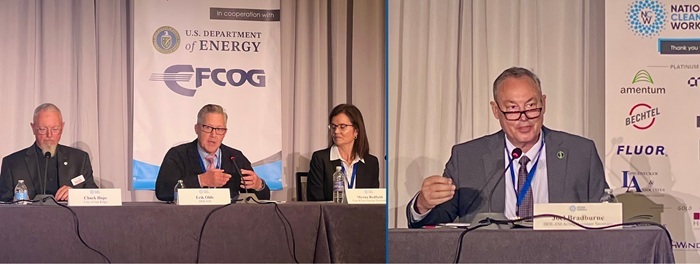 Panel participants included, from left, Chuck Hope, council member, City of Oak Ridge, Tennessee, and chair, Energy Communities Alliance; Erik Olds, manager, Oak Ridge Office of Environmental Management, and acting manager, Portsmouth Paducah Project Office; Myrna Redfield, president and program manager, Paducah Site deactivation and remediation contractor Four Rivers Nuclear Partnership; and Joel Bradburne, principal deputy assistant secretary, U.S. Department of Energy Office of Environmental Management.
ARLINGTON, Va. — Leaders from the nation’s gaseous diffusion plant (GDP) complex participated in the “Enriching Communities – A Renewed Purpose for America’s GDP Complex” panel at the National Cleanup Workshop.
Joel Bradburne, principal deputy assistant secretary, U.S. Department of Energy Office of Environmental Management (EM), moderated the panel of federal, contractor and community representatives from the Oak Ridge, Tennessee; Portsmouth, Ohio; and Paducah, Kentucky sites. Panelists shared their roles at the respective sites as well as upcoming redevelopment activities.
Erik Olds, manager of the Oak Ridge Office of Environmental Management and acting manager of the Portsmouth Paducah Project Office, discussed how the synergy between the sites is building a coalition to propel cleanup and revitalization successes.
-Contributor: Kelly Rhodes
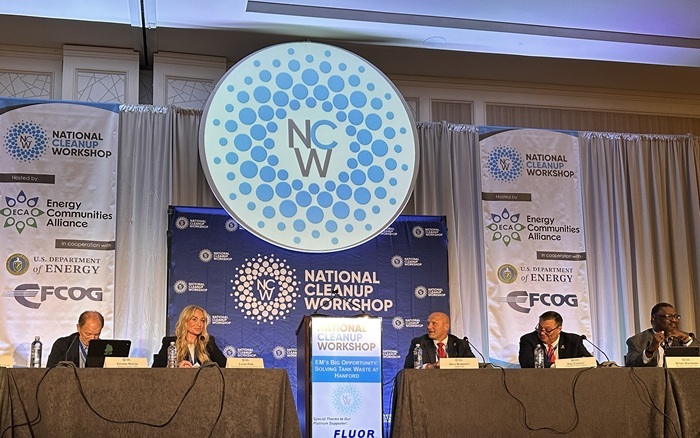 Panelists included, from left, Jerome Delvin, county commissioner for Benton County, Washington state; panel moderator Cerise Peck, director of Hanford Mission Integrated Solutions Communications and One Hanford Services; Dave Brunnert, chief operating officer, U.S. Department of Energy Office of Environmental Management; Ray Geimer, manager, Hanford Field Office; and Brian Hartman, project director for the Waste Treatment and Immobilization Plant, Bechtel National Inc.
ARLINGTON, Va. — U.S. Department of Energy Office of Environmental Management (EM) and Hanford Site leaders highlighted cleanup progress and the path forward during a panel discussion at the National Cleanup Workshop.
EM Chief Operating Officer David Brunnert and Hanford Field Office Manager Ray Geimer joined contractor and community leaders to discuss how recent accomplishments at Hanford are creating new opportunities to advance the cleanup mission.
The discussion focused on Hanford’s tank waste mission and the momentum created by the start of waste treatment operations. Panelists highlighted a glass-plus-grout strategy that pairs vitrification and grout as complementary waste treatment pathways, providing opportunities to accelerate tank waste cleanup.
Panelists also discussed the broader evolution underway as Hanford looks beyond individual cleanup projects and toward its future. That shift — from restoration to revitalization — reflects an opportunity to build on cleanup progress, modernize infrastructure and position assets to support future opportunities while continuing to deliver the environmental cleanup mission.
The conversation reflected upon an important inflection point — through the glass-plus-grout approach, continued innovation and a focus on moving from restoration to revitalization, the One Hanford team is building on today’s momentum to accelerate cleanup and prepare the site for the future.
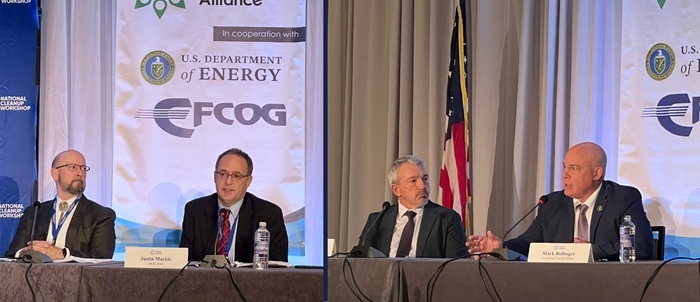 Panelists included, from left, Brad Smith, president and general manager of Newport News Nuclear BWXT Los Alamos LLC; Justin Marble, acting deputy assistant secretary for Waste & Materials Management, U.S. Department of Energy Office of Environmental Management (EM); Ken Harrawood, president and program manager, Salado Isolation Mining Contractors; and Mark Bollinger, manager, EM Carlsbad Field Office.
ARLINGTON, Va. — U.S. Department of Energy Office of Environmental Management (EM) headquarters and field site officials joined Waste Isolation Pilot Plant (WIPP) and EM Los Alamos Field Office contractor leadership, a New Mexico Environment Department representative and Los Alamos County councilor for a National Cleanup Workshop panel titled, “All Roads Lead to WIPP: The Importance of Disposal to Cleanup.”
The discussion focused on EM efforts to safely and efficiently manage radioactive waste and accelerate environmental cleanup across the DOE complex, including transuranic waste shipments to WIPP.
Among the key themes: EM is increasing waste shipments and making progress on disposing of legacy waste, particularly at Los Alamos National Laboratory; and improved characterization, sorting, treatment and coordination can ensure waste is sent to the appropriate disposal facility while preserving WIPP capacity.
Overall, EM is working toward a more coordinated, efficient and sustainable approach to radioactive waste management while investing in infrastructure and maintaining safety as the central priority.
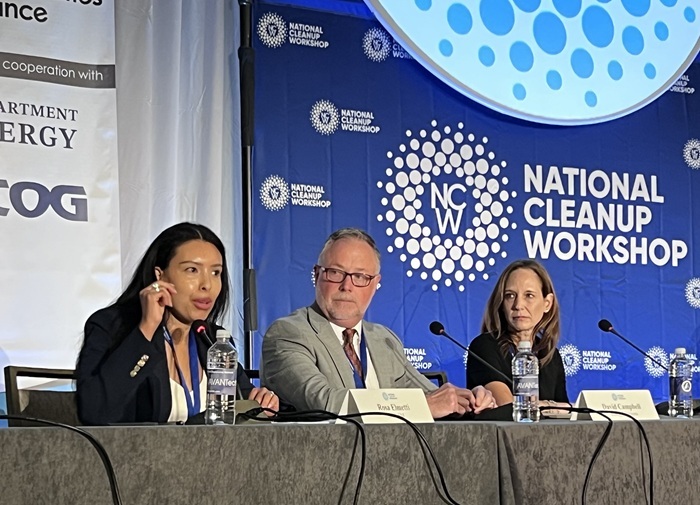 Panelists included, from left, Rosa Elmetti, lead federal program manager for nuclear materials and used nuclear fuel, U.S. Department of Energy Office of Environmental Management Office of Nuclear Materials; David Campbell, executive vice president, EnergySolutions; and panel moderator Kara Colton, director, Nuclear Energy Programs, Energy Communities Alliance.
ARLINGTON, Va. — Leaders from the U.S. Department of Energy’s (DOE) offices of Environmental Management (EM) and Nuclear Energy, Savannah River National Laboratory and the companies EnergySolutions and Orano discussed how government, industry and national laboratories can work together to advance recycling, strengthen domestic nuclear capabilities and tackle long-term waste challenges during a National Cleanup Workshop panel on Nuclear Lifecycle Innovation Campuses and the back end of the nuclear fuel cycle.
Rosa Elmetti, EM’s lead federal program manager for nuclear materials and used nuclear fuel, challenged the audience to think differently about DOE’s legacy inventories — not simply as liabilities to manage, but as strategic assets with value waiting to be unlocked.
“The back end does not have to be the end,” Elmetti said. “It can be where America’s next nuclear chapter begins.”
Elmetti highlighted EM’s work to advance next-generation recycling and conditioning capabilities to address challenging used fuels, recover uranium, strategic materials and valuable isotopes, and design smarter disposal into the process from the beginning.
“Recover the value. Put resources back to work. Optimize what remains,” Elmetti said. “That’s how cleanup becomes an enabler.”
The message from the panel was clear: The science exists, industry is ready to innovate and DOE brings materials, facilities and decades of experience to the table. The opportunity now is to turn that momentum into capability.
“The pieces are on the table,” Elmetti said. “Now it’s time to put them together — and build.”
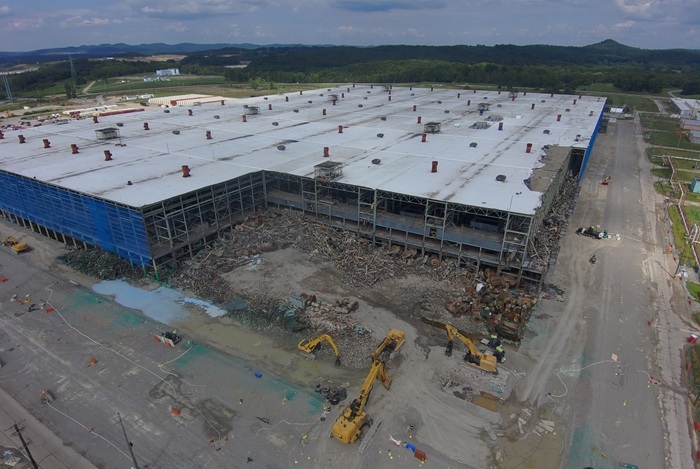 Demolition of 66,000 square feet of the X-333 Process Building removed the building’s southwest corner and created an area for storage and staging for large process gas valves to be removed during future demolition activities.
PIKETON, Ohio —The U.S. Department of Energy’s Portsmouth Site reached a significant milestone in the X-333 Process Building demolition when crews safely took down the 66,000-square-foot southwest corner of the 33-acre facility.
“Safety has been the top priority throughout demolition, and our record of zero recordable injuries is proof,” Federal Project Director Christy Brown said. “With the right people, tools and leadership, the X-333 project demonstrates how strategic preparation and teamwork delivers tangible results to best utilize federal funding.”
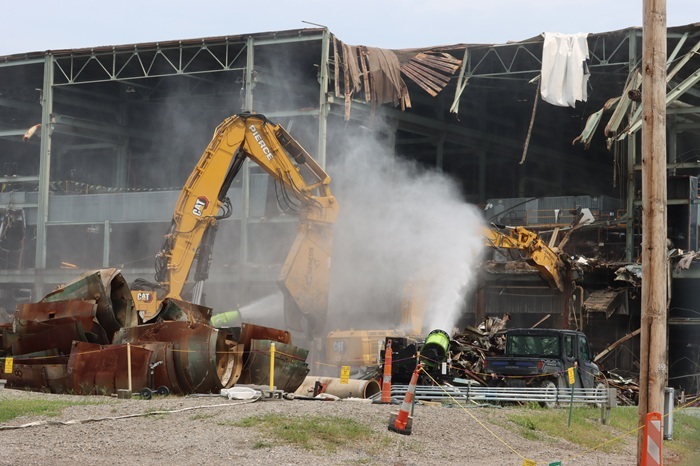 Water is added as a dust-suppression safety measure while demolition equipment dismantles the X-333 Process Building.
Representing 4.55% of the total structural demolition, the achievement enabled DOE’s Office of Environmental Management (EM) to check off a fiscal year priority ahead of schedule and under budget. The work also generated nearly 10,000 cubic yards of debris downsized for disposal in the On-Site Waste Disposal Facility.
Beginning the teardown at the building’s southwest corner created an essential storage and staging area for large process gas valves to be removed during demolition, helping avoid work interruptions caused by handling specialized materials.
“We reached the demolition target more than a month early because of effective teamwork, careful planning and the right mix of skilled people and specialized equipment,” said Carl Williams, X-333 deputy director at EM contractor Southern Ohio Cleanup Company.
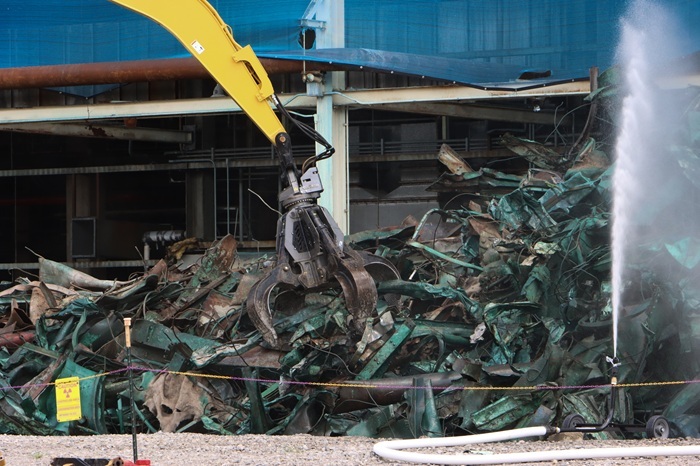 Heavy equipment with a grapple picks up, organizes and loads debris from the west side of the X-333 Process Building into trucks for disposal.
“A unique, highly modified piece of equipment known as ‘The Empress’ has outperformed initial productivity assumptions,” Williams said of the excavator. “The early completion of this milestone provides a firm foundation for the next phase of demolition in the fiscal year that begins this October.”
A landmark project spurring future redevelopment, demolition of X-333 — the site’s largest facility — began in April last year and is expected to be completed in 2031. Team members will look for opportunities to accelerate the project.
-Contributor: Michelle Teeters
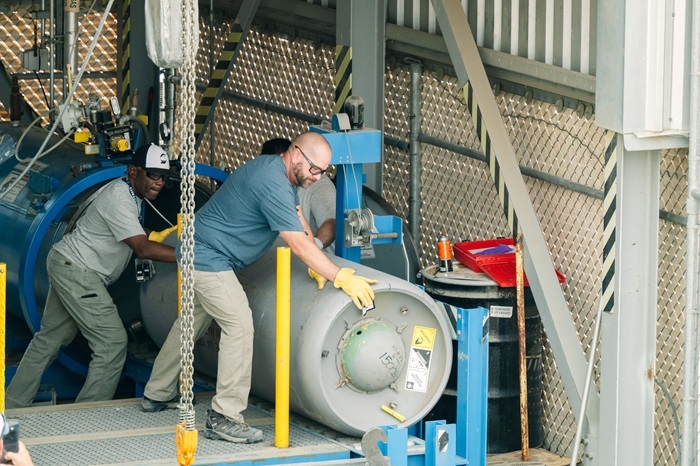 Crews with Hanford Field Office contractor Hanford Mission Integration Solutions work to remove a chlorine canister from its protective encasement at the 283W water treatment plant.
RICHLAND, Wash. — After serving the Hanford Site’s water system for more than eight decades, the 283W water treatment plant is now officially offline. The facility treated and delivered about 2 million gallons of water daily for site operations.
As part of their work to close down the 283W facility, crews with Hanford Field Office contractor Hanford Mission Integration Solutions safely removed the plant’s chlorine gas cylinders, eliminating a longtime potential risk to worker safety.
“This is a tremendous accomplishment when it comes to the safety of our workforce,” said Vanessa Turner, Hanford Field Office assistant manager for mission support. “For decades, all Hanford workers have had to complete annual safety training to ensure they’re prepared for a potential chlorine gas emergency. Now, that threat is gone.”
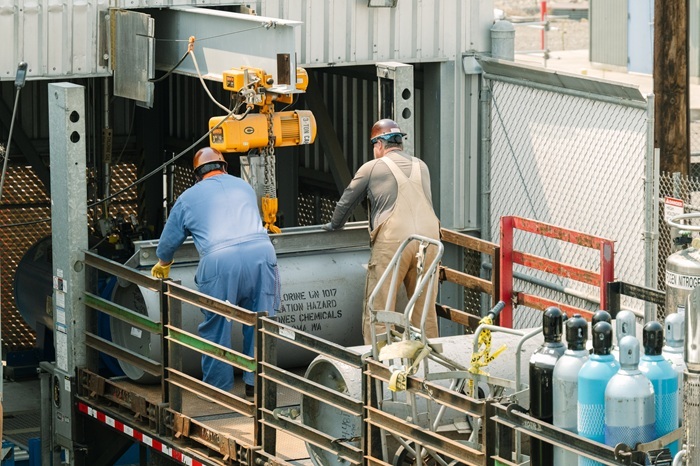 Crews load one of the 283W plant’s chlorine canisters onto a truck for transportation to an offsite facility.
Removal of the chlorine cylinders also eliminates the need for several Hanford Site emergency preparedness requirements in place for decades.
As part of ongoing efforts to modernize infrastructure on the Hanford Site, the new Central Plateau Water Treatment Facility started delivering water to Hanford’s water system in January, in tandem with the 283W plant. The new facility has steadily ramped up production, using an innovative microfiltration method to efficiently deliver up to 3.5 million gallons of water a day, with the ability to expand to 5 million gallons, if demand warrants.
The 10,000-square-foot facility automates much of the water treatment process and provides all potable water to the cleanup hub of the Hanford Site, the Central Plateau, and supports tank waste treatment operations. The Central Plateau is home to former processing facilities, underground waste tanks, groundwater treatment facilities, a disposal facility and the Waste Treatment and Immobilization Plant.
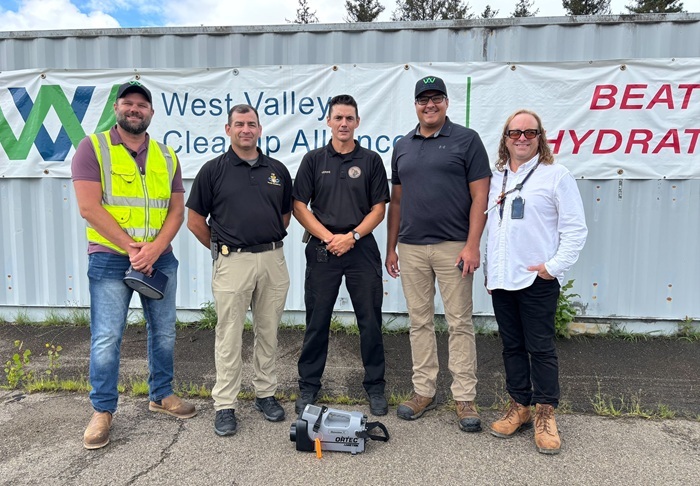 From left, West Valley Cleanup Alliance (WVCA) Radiation Support Manager Jonathan Nehl; FBI Buffalo Field Office Special Agent Aaron Allen; Cattaraugus County Deputy Sheriff Joe Yerpe; WVCA Jr. Radiation Engineer J.P. O’Connell; and WVCA Radiation Control Qualifications Manager Duane Gills pose for a photo after a West Valley Demonstration Project tour.
WEST VALLEY, N.Y. — Local law enforcement, fire protection and emergency medical services personnel recently met with West Valley Demonstration Project team members as part of an ongoing partnership to strengthen coordination and ensure employees are prepared to act quickly and safely in the unlikely event of an emergency.
FBI Buffalo Field Office Special Agent Aaron Allen and Cattaraugus County Deputy Sheriff Joe Yerpe shared best practices and reviewed tools that support operations during an emergency.
Employees with the Radiation Training Department of U.S. Department of Energy Office of Environmental Management contractor West Valley Cleanup Alliance (WVCA) organized the visit to build strong working relationships, exchange operational expertise and confirm joint emergency response capabilities.
“We understand the importance and benefit of partnering with outside agencies that have additional experience, expertise and technology,” said Jennifer Dundas, assistant director of West Valley’s Office of Technical Services. “It benefits our employees and the site as well as the surrounding community.”
West Valley team members took the visitors on a site tour, presented a brief site history and held demonstrations of radiological monitoring equipment used onsite and offsite. They shared that radiation can’t be seen, smelled or felt; specialized equipment, strict procedures and ongoing training and certifications ensure hazards are identified early and managed correctly.
This past summer, Kevin Murray, WVCA’s senior emergency management specialist, hosted West Valley regional partners, including Bertrand Chaffee Hospital, West Valley Volunteer Hose Company, Cattaraugus County Sheriff’s Office, New York State Police, Cattaraugus County Emergency Response Office, Mercy Flight, Erie County Medical Center and others. These agencies provide critical support if needed, and the West Valley visit helped familiarize them with the site layout, current work activities, safety protocols, emergency procedures and potential hazards.
“Together, these engagements reinforce a shared commitment to readiness and prevention — keeping workers safe, protecting neighboring communities and safeguarding the environment through strong partnerships, clear communication and coordinated response planning,” Dundas added.
-Contributor: Joseph Pillittere
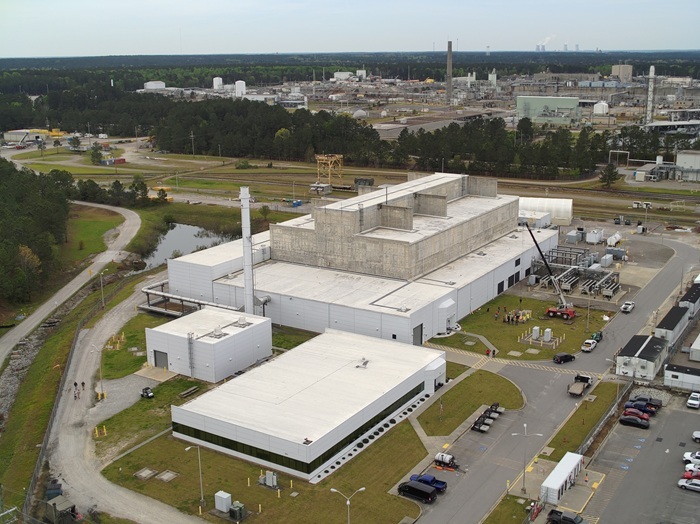 Savannah River Mission Completion is maximizing the runtime of the Salt Waste Processing Facility at the Savannah River Site by safely bypassing a piece of equipment, called the strip effluent coalescer, that used to cause downtime for frequent maintenance.
AIKEN, S.C. — The U.S. Department of Energy’s (DOE) Office of Environmental Management (EM) is operating a key radioactive waste processing facility more efficiently after making a breakthrough process change.
EM and Savannah River Mission Completion (SRMC), the liquid waste contractor at DOE’s Savannah River Site (SRS), are maximizing the runtime of the Salt Waste Processing Facility (SWPF) by safely bypassing a piece of equipment, called the strip effluent coalescer, that used to cause downtime for frequent maintenance. SWPF treats salt waste from the SRS waste tanks by removing cesium and other radionuclides.
The strip effluent coalescer is a small stainless steel vessel within SWPF that recovers the solvent used in the initial treatment step to separate the radioactive material from the waste. The coalescer media combines the solvent into large droplets so it can be easily removed from the waste stream, recovered and reused.
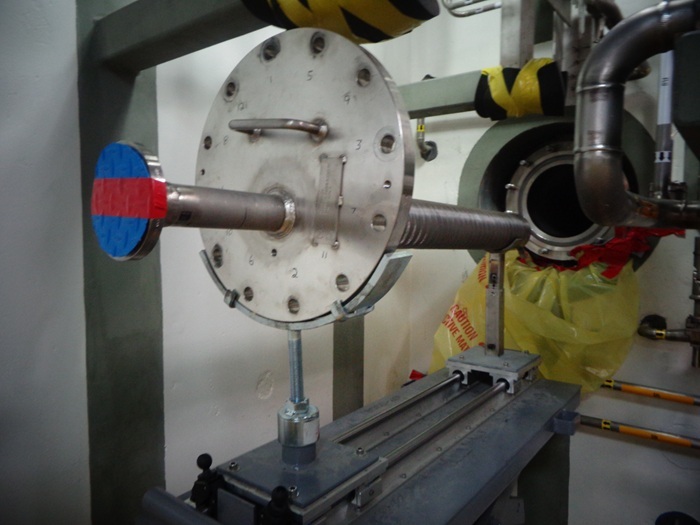 Pictured is the only part of the coalescer — the flange and coalescer media — that is visible; the coalescer vessel is inside a radiological cell.
Early in SWPF design, there was limited real‑world performance data for solvent management in the treatment process, so the facility designers added multiple layers of controls, one of which is using the coalescer to manage the solvent stream.
However, bypassing the strip effluent coalescer is possible now because actual operating data shows the required function is being met through other upstream controls. It’s the hardware that is bypassed, not the function.
Because of this improvement, the three-month average facility availability has jumped from 75% to 96%. Availability is the time that the system is “open for business” to process waste. The frequency of coalescer fouling-related maintenance has extended from approximately every 30 days to over 90 days, with the added benefit for planning quarterly integrated SRMC facility outages.
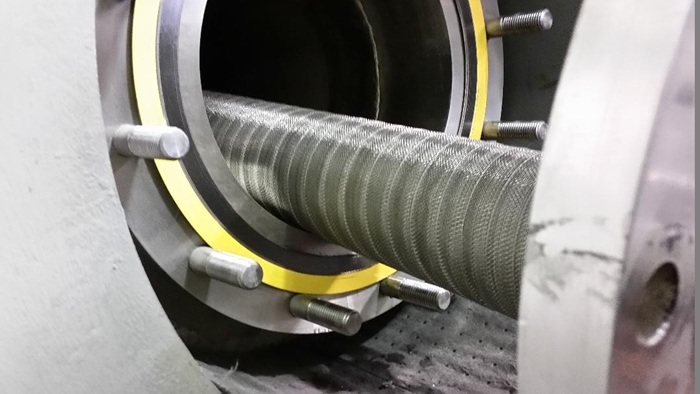 A close-up of the coalescer media.
SRMC President and Program Manager Thomas Burns Jr. said SRMC decided to bypass a design component to increase productivity after conducting the appropriate analysis and testing.
“This team is great at figuring out how to challenge the status quo, and optimize and streamline our process,” Burns said. “With that bias for action though comes the right amount of due diligence. Our nuclear engineers made sure the core functions of the strip effluent — managing solvent carryover and recovering solvent where practical — are still safely and reliably being met.”
-Contributor: Colleen Hart
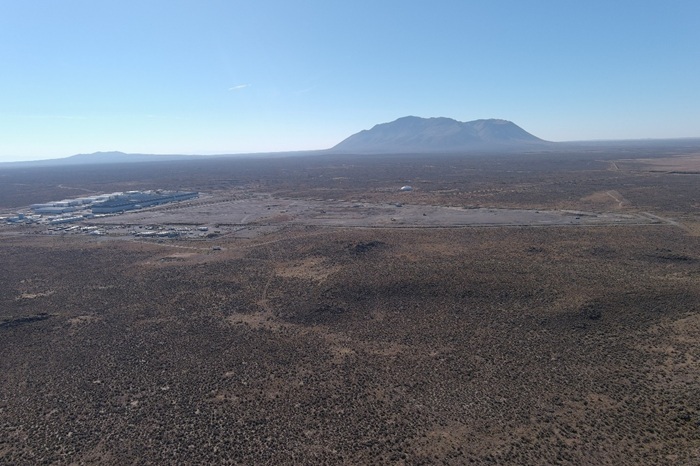 An aerial view of the future Subsurface Disposal Area cap location, foreground, within the surrounding landscape of the Idaho National Laboratory Site.
IDAHO FALLS, Idaho — Idaho Cleanup Project (ICP) workers are making final preparations to begin building an engineered cap over a 97-acre Cold War-era landfill known as the Subsurface Disposal Area.
The multilayer evapotranspiration cap, designed to mimic natural soil and vegetation, will limit moisture infiltration into the landfill at the Idaho National Laboratory (INL) Site, minimize wind and water erosion and inhibit the transport of contamination. The long-term protective measure safeguards the Snake River Plain Aquifer beneath the site — an essential water source for communities and farms across the state of Idaho.
Crews are currently upgrading the roadways to ensure safe and efficient transportation of materials and equipment. Field preparations and cultural and environmental reviews are complete, and preconstruction documentation has been approved.
“The U.S. Department of Energy (DOE) is committed to fulfilling its agreement with the state of Idaho,” ICP Acting Manager Nick Balsmeier said. “This work reflects our mission to reduce risk, restore contaminated areas and ensure legacy nuclear sites remain safe for future generations.”
Crews completed significant work that sets the stage for cap construction to begin under 2008 regulatory agreements among the DOE, U.S. Environmental Protection Agency and state of Idaho.
That work included removing the highest-risk materials from select pits and trenches, packaging the materials for offsite disposal, and decontamination and demolition of 10 soft-sided buildings that supported the targeted buried waste exhumation. Crews demolished more than 520,000 square feet of building space, representing the single largest demolition project in ICP history.
“This cap represents a generational commitment to protecting the Snake River Plain Aquifer,” said Jason Chapple, director of Accelerated Retrieval Project Operations and Remediation at ICP cleanup contractor Idaho Environmental Coalition. “Our team has worked thoughtfully and deliberately to ensure we are ready to build the cap safely, efficiently and to the highest standard of long-term environmental stewardship.”
Construction of the cap is expected to take six years. Following completion, DOE’s Office of Environmental Management will conduct long-term operations and maintenance, including vegetation monitoring, lysimeter checks and subsidence monitoring. Lysimeter checks help measure water movement through the soil to ensure the cap stays protective, and subsidence monitoring watches for ground settling that could affect the cap’s performance.
The landfill accepted INL Site-generated radioactive and hazardous waste beginning in 1952, and waste from the former Rocky Flats Plant near Denver, Colorado, and other waste generator sites from 1954 to 1970.
-Contributor: Ryan Christensen
|