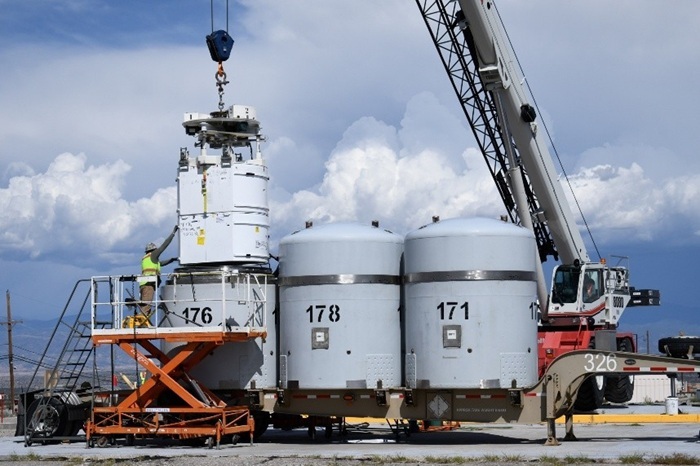
 Newport News Nuclear BWXT-Los Alamos LLC waste operations crews load U.S. Nuclear Regulatory Commission-approved transportation casks, which are used to safely transport transuranic waste to the Waste Isolation Pilot Plant — the only permanent repository for transuranic waste in the United States.
LOS ALAMOS, N.M. — The U.S. Department of Energy’s (DOE) Environmental Management Los Alamos Field Office (EM-LA) has completed a record number of transuranic (TRU) waste shipments under the Los Alamos Legacy Cleanup Contract.
In fiscal year (FY) 2026 to date, EM-LA and Newport News Nuclear BWXT-Los Alamos LLC (N3B), the Los Alamos National Laboratory (LANL) legacy cleanup contractor, have finished 82 transuranic waste shipments to EM’s Waste Isolation Pilot Plant (WIPP) in New Mexico. This marks an 91% increase over 43 shipments in FY 2025.
“N3B is making great strides in the LANL legacy cleanup,” said Brad Smith, N3B president and general manager. “Not only have we completed a record number of transuranic waste shipments for the year, but we are also meeting or exceeding established targets for low-level and mixed low-level waste shipments.”
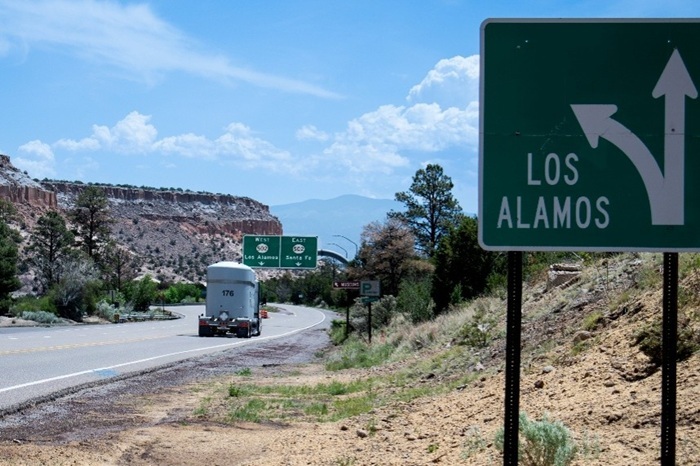 A transuranic waste shipment departs Los Alamos, New Mexico, for the Waste Isolation Pilot Plant — the nation's only deep geologic transuranic waste repository. The waste will be permanently disposed of safely a half mile underground in an ancient salt formation.
FY 2026 shipments to WIPP included approximately 370 cubic meters of transuranic waste, equivalent to about 46 standard dump trucks. This is the largest volume shipped since N3B began its contract in 2018.
Transuranic waste consists of materials contaminated with human-made radioactive elements — primarily plutonium — with atomic numbers greater than uranium. Legacy waste refers to radioactive and hazardous materials generated before October 1999.
A major contributor to this year’s progress is the shipment of corrugated metal pipe (CMP) waste formerly buried at Technical Area 54, Area G, at LANL. The CMPs contain cemented radioactive liquid waste generated between 1975 and 1978. In 2024, N3B retrieved and reduced the size of the CMPs, enabling safe packaging and shipment.
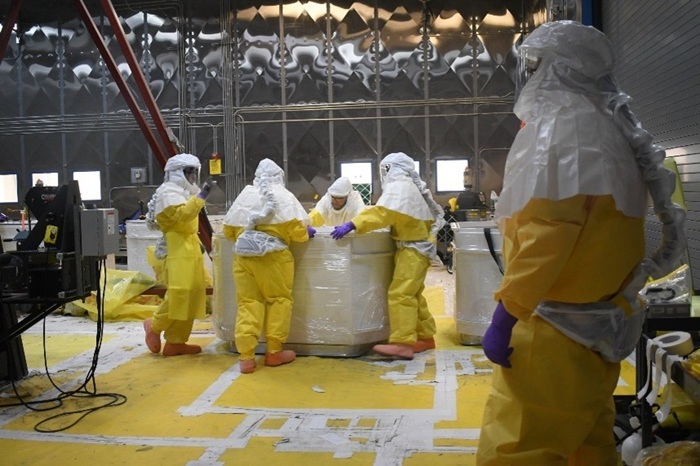 Newport News Nuclear BWXT-Los Alamos LLC waste operations crew members wear personal protective equipment while packaging corrugated metal pipes containing transuranic waste for shipment to the Waste Isolation Pilot Plant.
EM-LA and N3B work with the WIPP Central Characterization Program to characterize and certify the transuranic waste for shipment to WIPP. This partnership is essential to ensure every waste container meets WIPP requirements for disposal.
In addition to transuranic waste, N3B has shipped more than 480 cubic meters of low-level and mixed low-level waste offsite for permanent disposal — enough to fill roughly 50 standard dump trucks.
“We look forward to building upon our success and meeting our obligations as part of the LANL legacy cleanup,” Smith said. “I am proud of our employees and their accomplishments.”
-Contributor: Donavan Mager
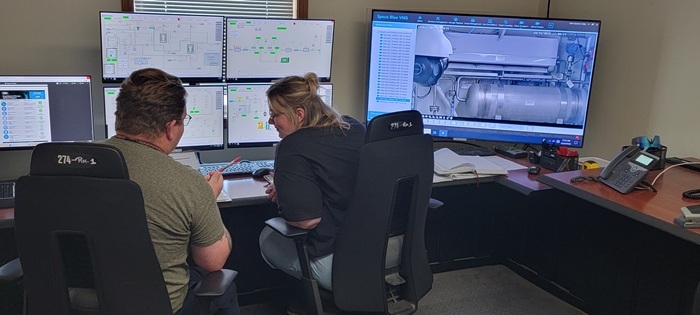 Hanford Tank Waste Operations & Closure Nuclear Chemical Operators James Sachse and Sarah Arneson-Rock monitor operations in the Tank-Side Cesium Removal System control room as the system resumes waste pretreatment.
RICHLAND, Wash. — For the first time since February, the Hanford Site’s Tank-Side Cesium Removal (TSCR) System is back in operation, pretreating radioactive tank waste.
The system paused operations Feb. 25 after finishing its previous batch. Crews with Hanford Tank Waste Operations & Closure (H2C) can usually prepare the system for the next batch in about two weeks, but this restart was delayed because Tank AP-106 was too full to receive more pretreated waste. There are currently about 1 million gallons of TSCR pretreated waste stored in AP-106, staged there until it is sent to the Waste Treatment and Immobilization Plant (WTP) to be turned into glass for disposal.
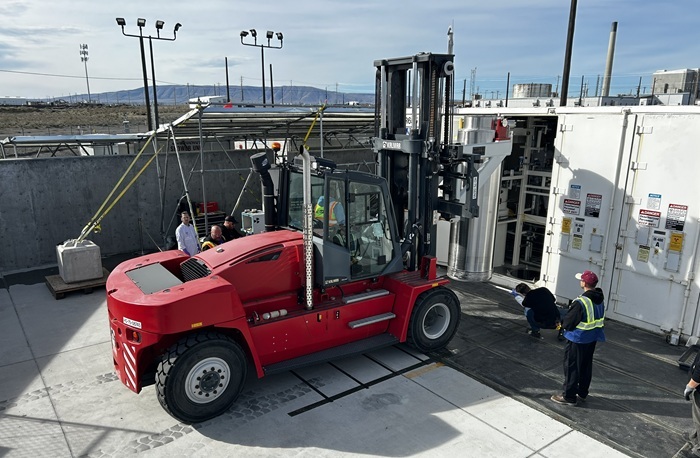 A used ion exchange column is removed from the Tank-Side Cesium Removal System process enclosure in March after completion of the last batch.
Since the plant began hot commissioning in October 2025, more than 242,000 gallons of TSCR pretreated waste have been transferred from AP-106 to WTP — about the amount TSCR processes in one batch. In hot commissioning, the waste combines with glass-forming materials and is heated to 2,100 degrees Fahrenheit. This process, called vitrification, transforms the waste into a stable glass form, which is then sealed in stainless steel containers for safe disposal.
“The restart underscores why Hanford is advancing a dual glass-plus-grout approach for appropriate treated waste streams,” said Mat Irwin, assistant manager for tank waste operations. “Glass remains central to the mission, while grout could add another disposal path to reduce bottlenecks and support continued cleanup progress.”
 |
|
A worker performs maintenance inside the Hanford Site’s Tank-Side Cesium Removal System. |
That added flexibility could also help reduce costs over time by shortening schedules and improving operational efficiency.
“The One Hanford team is doing something never done before — reducing the amount of waste in underground tanks through vitrification,” said Ken Langdon, H2C president and program manager. “We are retrieving and pretreating waste faster than it can be immobilized through vitrification alone, so we are focused on supporting DFLAW’s path of continuous improvement plus grouting low-activity waste to accelerate progress on our mission.”
During the extended pause, H2C workers completed maintenance, equipment upgrades, training and other project work, including installing a new weather enclosure to better protect workers and equipment.
The current batch is expected to run through September and produce about 230,000 gallons of pretreated waste destined for treatment and disposal.
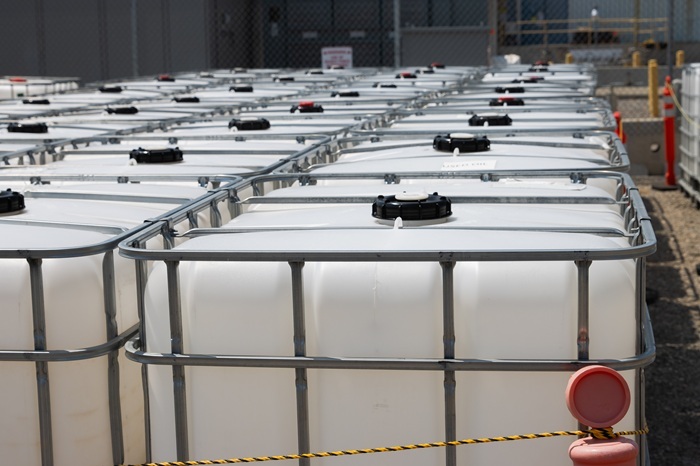 Crews collect and store condensate in 250-gallon totes before it is processed through the condensate evaporator. The Idaho Cleanup Project previously shipped the totes offsite for disposal.
IDAHO FALLS, Idaho — The Integrated Waste Treatment Unit (IWTU) is deploying new equipment to eliminate the cost of disposing of a byproduct of radioactive liquid waste cleanup at the Idaho National Laboratory (INL) Site.
Idaho Cleanup Project (ICP) and contractor Idaho Environmental Coalition (IEC) constructed an onsite nitrogen gas generation plant to provide a reliable source of the inert gas and ensure steady operations at IWTU.
Generating nitrogen creates a significant amount of condensate, and the collection, shipment and offsite disposal of it was costly, according to IEC IWTU Senior Operations Manager Jarred Chaney.
“We would collect condensate from the nitrogen plant in 250-gallon totes and produced 240 of these totes through multiple liquid sodium-bearing waste processing runs,” said Chaney. “Shipping nearly 200 of the totes cost the IWTU project just under $1 million.”
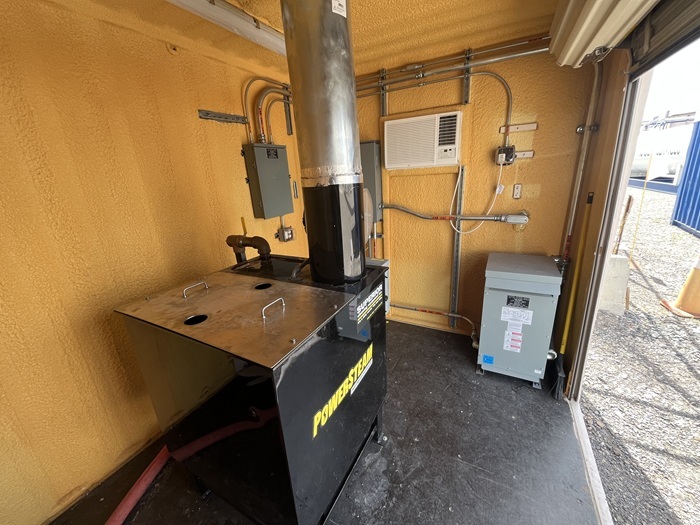 New equipment known as a condensate evaporator reduces the cost of managing, shipping and disposing of a byproduct generated by the nitrogen plant at the Integrated Waste Treatment Unit.
IWTU engineers and the project environmental lead explored opportunities to more effectively manage the condensate and acquired a condensate evaporator for the nitrogen plant.
To date, the evaporator has processed over 6,000 gallons of collected condensate, saving nearly $100,000, Chaney estimates.
“Shipping and disposal of the condensate would have been a recurring cost over the life of our project,” said Chaney. “Though a small victory, this effort is underscored by a greater commitment to continual improvement and finding a way to do things more effectively and efficiently.”
The ICP built IWTU to process 900,000 gallons of a radioactive liquid waste stored in underground tanks on the INL Site, converting the liquid to a more stable granular solid. Liquid waste treatment at the IWTU is expected to take three to seven years to complete, accounting for planned maintenance of the facility.
-Contributor: Carter Harrison
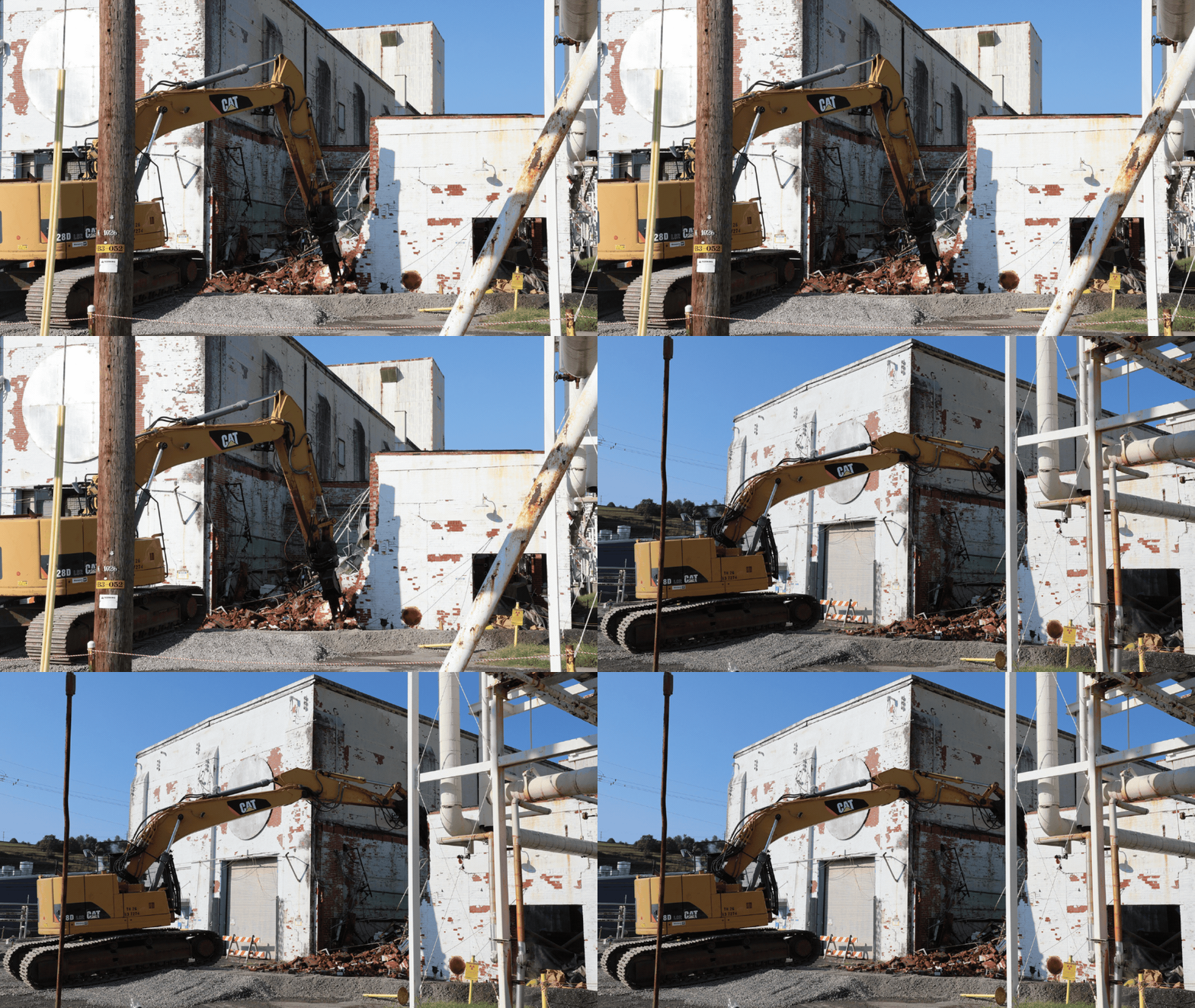 Crews recently began demolishing the Old Steam Plant, the Oak Ridge Office of Environmental Management’s latest project to remove aging infrastructure to enable modernization at the Y-12 National Security Complex.
OAK RIDGE, Tenn. — In a first, the Oak Ridge Office of Environmental Management (OREM) and cleanup contractor United Cleanup Oak Ridge (UCOR) have conducted demolition on two facilities at the Y-12 National Security Complex in a single fiscal year.
This project continues to transform and modernize Y-12, highlighting the impact of thoughtful planning and sequencing.
“Every excess facility we remove changes the Y-12 skyline for the National Nuclear Security Administration,” said Erik Olds, OREM manager. “We are reducing risks, eliminating congestion and creating valuable space to support national security capabilities our nation will depend on well into the future.”
UCOR recently began demolishing the 13,000-square-foot Old Steam Plant, also known as Building 9401-1. Crews transitioned to this project after completing the teardown of Alpha-2, a former Manhattan Project-era uranium enrichment facility that spanned 2.5 acres of land at Y-12, earlier this year. The fiscal year ends Sept. 30.
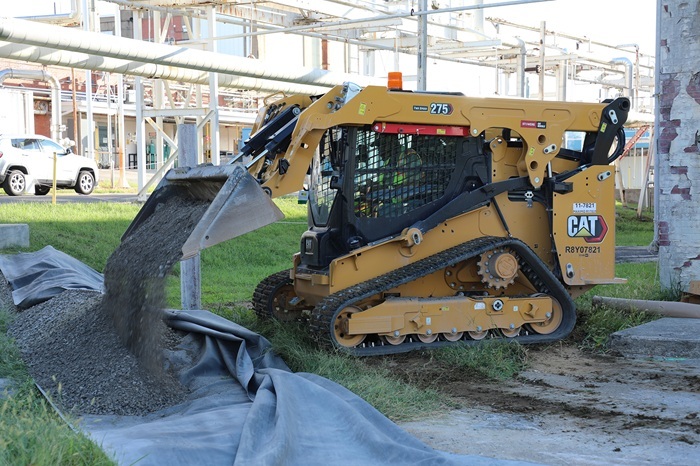 Workers install a berm to protect the surrounding site during demolition activities at the Old Steam Plant at the Y-12 National Security Complex.
Built in 1943, the Old Steam Plant supported Y-12 operations for decades, including uranium enrichment support activities and fuels testing. After workers finished deactivating the facility in 2021, it continued to be used for maintenance and storage.
Teardown of the building was designated a “flywheel project” — a strategically timed effort positioned between larger cleanup campaigns to maintain workforce momentum and make efficient use of available resources. As teams demolish the plant and advance progress at Y-12, others are deactivating other structures.
“Taking down two facilities at Y-12 in a single fiscal year demonstrates the momentum UCOR has established and our commitment to finishing what we start,” said UCOR President and Program Manager Jim Blankenhorn. “We are strategically sequencing this work so the expertise and resources we have built can continue moving the cleanup mission forward, positioning our workforce for the larger challenges ahead.”
Each excess facility removal eliminates costs associated with maintaining aging buildings.
Since major cleanup began at Y-12 in 2020, OREM and UCOR have completed demolition of Alpha 2, the former Criticality Experiment Laboratory and the former Biology Complex. Together, these projects have eliminated hazards and cleared more than 20 acres of land for reuse.
Cleanup momentum is building toward even bigger efforts.
Following demolition of the Old Steam Plant, teams will shift to Beta 1, a 210,000-square-foot former Manhattan Project uranium enrichment facility. Crews will complete mobilization and site preparations necessary to begin demolition early next year.
Work is also continuing at other major Y-12 facilities. Crews are making progress to enable full-scale deactivation at two other massive Manhattan Project-era uranium enrichments buildings, including the 315,000-square-foot Beta 4 facility and 510,000-square-foot Alpha 4 facility.
-Contributor: Ryan Getsi
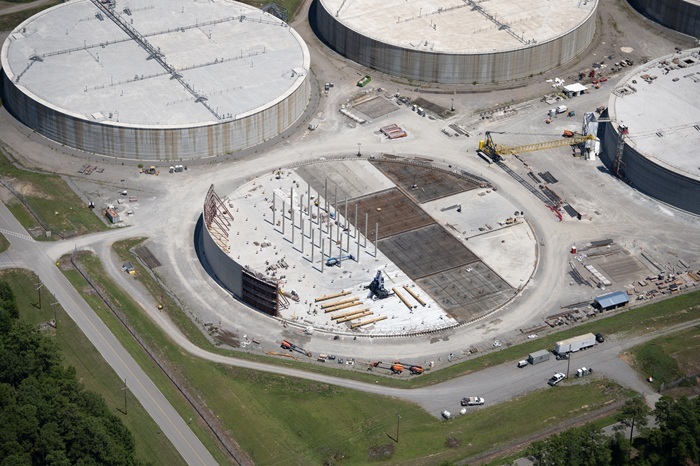 Saltstone Disposal Unit 12, the final mega-unit to be constructed at the Savannah River Site, represents the culmination of a decade-long initiative to support the U.S. Department of Energy’s mission to safely manage and stabilize liquid radioactive waste.
Seven massive disposal units are critical to site’s legacy nuclear waste disposal mission
AIKEN, S.C. — Construction is underway on the final Saltstone Disposal Unit (SDU), marking a historic milestone in the Savannah River Site (SRS) radioactive waste-tank cleanup mission.
The massive aboveground disposal units are integral to the U.S. Department of Energy’s (DOE) Office of Environmental Management (EM) mission to safely dispose of legacy nuclear waste at SRS, according to Chuck Comeau, DOE Savannah River Operations Office federal project director.
“Legacy waste cleanup is a priority for EM, and the SDUs play a key role in the SRS cleanup mission, especially now that the Salt Waste Processing Facility (SWPF) is treating waste at record levels,” Comeau said. “SWPF has greatly accelerated processing the waste, which means the SDUs must be ready to store the final product.”
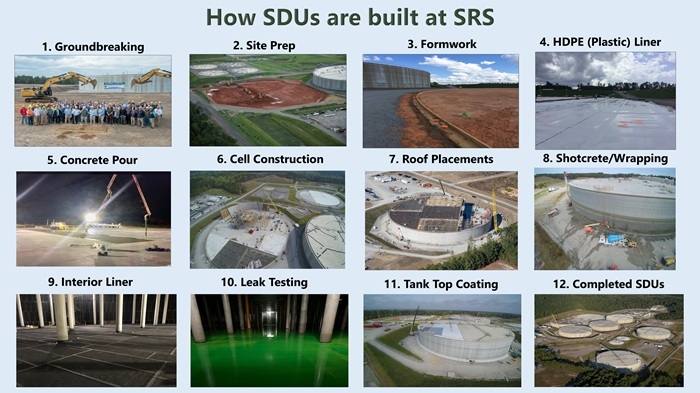 The SDUs are the end of the salt waste processing path. SWPF decontaminates the salt waste from the site’s underground waste tanks. The high-activity radionuclides are transferred to the Defense Waste Processing Facility for vitrification and the decontaminated salt solution is pumped to the Saltstone Production Facility, where it is mixed with dry materials to make a cement-like grout. The grout is pumped into the SDUs, where it solidifies into a monolithic, nonhazardous form.
SDU 12 will measure 43 feet in height and 375 feet in diameter, just like its six mega-size predecessors, and has a total capacity of 34.5 million gallons. The liquid waste program team has continuously improved the design of the units throughout the SDU program. Enhancements, such as moving column footers from the base of the column to the top, optimized storage capacity without sacrificing structural durability. There are also six smaller cylindrical SDUs at the site in addition to the mega-size units.
SRS liquid waste contractor Savannah River Mission Completion (SRMC) manages construction and operation of the SDUs.
Thomas Burns Jr., SRMC president and program manager, lauded the collaboration that drives the success of the SDU work over the years.
“The SDU program is a phenomenal construction project, and it requires the teamwork of construction workers, subcontractors, engineers, safety professionals, planners, procurement and more to get the job done,” Burns said. “SDU 12 stands as a testament to the innovative engineering and tenacious teamwork driving the liquid waste mission.”
The initial construction phase has been completed. Crews installed a multilayer foundation comprised of a geosynthetic clay liner and high-density plastic liner sandwiched between two concrete layers called mud mats.
The formwork to prepare for concrete pours and rebar installation is underway for the floor sections. Construction of the walls and columns are also underway. Once the 14 floor sections, 25 walls and 208 columns are complete, construction will progress to the installation of the seven roof sections. The tank’s interior is lined with a chemical-resistant rubber liner to provide secure containment.
-Contributor: Colleen Hart
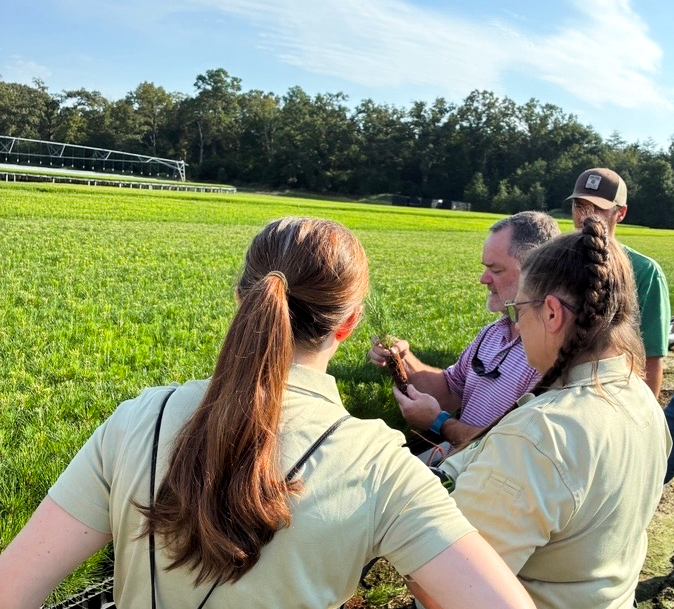 U.S. Forest Service employees from the Savannah River Site inspect loblolly pine seedlings at the PRT Nursery in Windsor, S.C.
NEW ELLENTON, S.C. — On a humid Carolina morning, U.S. Forest Service staff from the Savannah River Site (SRS) Forest walked the rows of seedling beds at a nursery in nearby Windsor, inspecting the next generation of trees destined to take root across one of the most actively managed forests in the South.
For more than 75 years, the 310-square-mile SRS has been a proving ground for large-scale forest restoration. The nursery visit was a chance to see the future, thousands of pine seedlings grown from carefully selected seed sources, including longleaf cones collected on the SRS Forest.
Reforestation is a cornerstone of the Forest Service’s work to restore resilience on a landscape to support wildlife, withstand storms and meet the unique demands of the site’s national security and environmental cleanup missions. Each regeneration harvest kicks off a sequence of treatments: site preparation to knock back competitive hardwoods, prescribed fire to clean up debris and prepare fresh seedbeds, and hand and machine planting to ensure each stand is stocked with the right species at the right density. It’s intensely hands-on work — but it is that hard work that defines long-term stewardship.
The cones collected by staff each fall go to specialized extractories to process seeds and test viability. The seed is then stored and sent to nurseries for sowing each spring, based on future planting needs. Nurseries grow high-quality seedlings that are delivered to the site throughout the planting season. Seedling survival is checked in the first and third years, with foresters hiking plot lines to confirm that the new generation is alive and thriving.
“These seedlings will be ready for delivery later this winter, and we’ll start planting them as soon as soil moisture and temperatures line up,” Forest Silviculturist Eileen Eck said. “We will ensure seedlings are planted properly to avoid transplant shock and maximize their potential for healthy establishment and growth.”
-Contributor: Josef Orosz
|