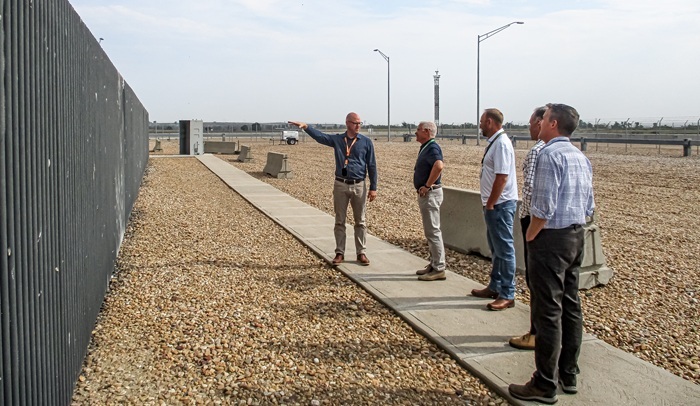
 Assistant Secretary for Environmental Management Tim Walsh, second from left, tours the Fort St. Vrain used nuclear fuel storage facility in northern Colorado. Also pictured from left are Facility Manager Dave Martin, Idaho Cleanup Project Acting Manager Nick Balsmeier, Idaho Environmental Coalition (IEC) Chief Operations Officer Bill Kirby and IEC Nuclear Regulatory Commission Licensed Facilities Program Manager Jeff Long.
PLATTEVILLE, Colo. — Assistant Secretary for Environmental Management (EM) Tim Walsh recently visited a used nuclear fuel storage facility in northern Colorado managed by the U.S. Department of Energy’s (DOE) Idaho Cleanup Project and contractor Idaho Environmental Coalition (IEC).
Walsh toured the facility and several support buildings to better understand the Fort St. Vrain mission and its history. The facility safely stores used nuclear fuel generated by the former Fort St. Vrain Generating Station, a gas-cooled reactor that operated from 1979 to 1989. It was later shut down and decommissioned, and the site was converted to a natural gas-powered generating station.
The Fort St. Vrain used nuclear fuel storage facility is one of two such facilities owned by DOE and licensed by the U.S. Nuclear Regulatory Commission. The other, also managed by ICP and IEC, is located at the Idaho National Laboratory (INL) Site.
“EM has a longstanding history of safely and securely managing and storing used nuclear fuel,” said Walsh. “The members of the workforce managing Fort St. Vrain are no exception, bringing their best to help DOE meet its cleanup responsibilities and ensuring our communities are safe and prosperous.”
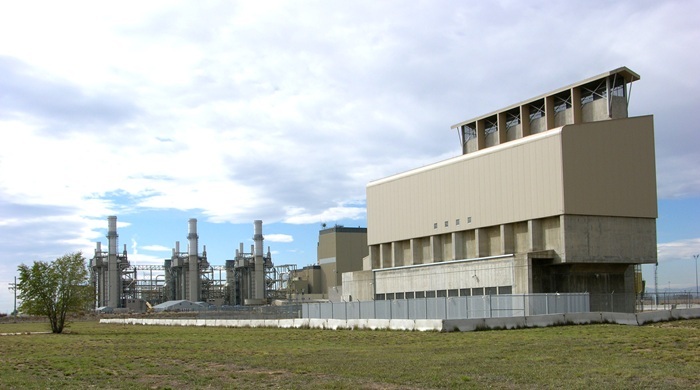 A view of the Fort St. Vrain used nuclear fuel storage facility in northern Colorado. It’s managed by the U.S. Department of Energy’s Idaho Cleanup Project and contractor Idaho Environmental Coalition.
Walsh saw firsthand how upgrades in recent years support the safety, security and preparedness of the Fort St. Vrain storage facility. ICP and IEC completed improvements to roadways, grounds, support buildings and structures, and security equipment — part of EM work to address the legacy of the past while supporting national security.
An EM protective force guards the Fort St. Vrain facility 24/7. In the past few years, crews improved the working areas and training equipment for security police officers, including upgrading a training facility equipped with a virtual simulator.
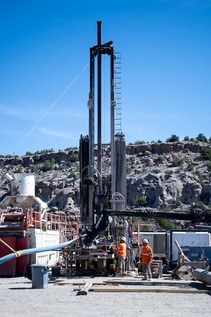
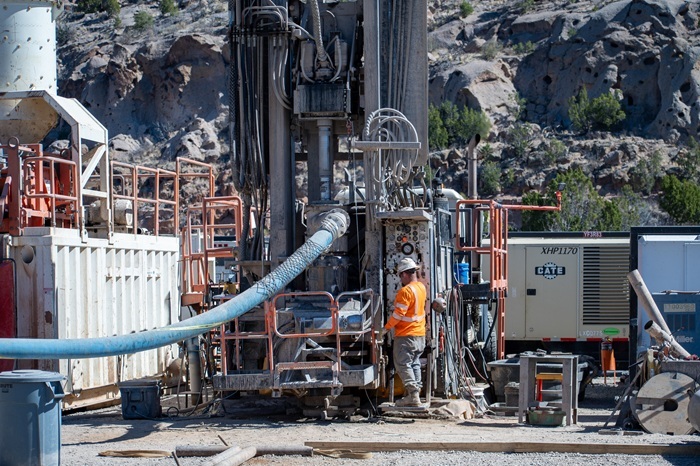 Crews adjust equipment during drilling for a new groundwater monitoring well, which will further characterization efforts in the northeast portion of the hexavalent chromium plume at Los Alamos National Laboratory.
LOS ALAMOS, N.M. — The U.S. Department of Energy (DOE) Environmental Management Los Alamos Field Office (EM-LA) continues work to further characterization and inform decision-making for remediating a hexavalent chromium plume at Los Alamos National Laboratory (LANL).
EM-LA legacy cleanup contractor Newport News Nuclear BWXT-Los Alamos LLC (N3B) has completed drilling a borehole — about 1,030 feet below land surface — for a new groundwater monitoring well. Drilling the Regional Aquifer Monitoring Well R-80 completes a fiscal year 2026 Consent Order milestone for the Hexavalent Chromium Campaign. The well will support additional characterization in the northeast portion of the hexavalent chromium plume and evaluation of alternatives for remediation.
“Protecting human health and the environment is our top priority,” said Vince Rodriguez, N3B program manager for Environmental Remediation. “R-80 is central to our overall strategy for monitoring, treating and containing the plume.”
 |
|
The U.S. Department of Energy Environmental Management Los Alamos Field Office and legacy cleanup contractor Newport News Nuclear BWXT-Los Alamos LLC completed drilling the borehole for a new groundwater monitoring well. It was drilled to a depth of approximately 1,030 feet below land surface — about the distance from the main observation deck of the Empire State Building to street level. |
The primary goal of the Hexavalent Chromium Campaign is to monitor the hexavalent chromium plume and minimize and reduce risk to human health and the environment. The plume is currently estimated to be approximately 1 mile long by 0.5 mile wide, 1,000 feet beneath Mortandad and Sandia canyons at LANL.
Rodriguez noted that since 2018, N3B has used pump-and-treat technology to help mitigate and contain the hexavalent chromium plume until a remedy is selected and implemented. The pump-and-treat process pumps contaminated groundwater from four extraction wells to a facility in Mortandad Canyon, where it is treated to remove chromium using ion-exchange technology.
In November 2025, the New Mexico Environment Department (NMED) directed EM-LA and N3B to cease all injection for the hexavalent chromium plume pump-and-treat operations, also referred to as interim measures (IM). Given the design of the IM and limited alternative water discharge options, ceasing injection under the IM necessarily drives cessation of all IM operations.
Operating the IM in a partial configuration supports the purpose of the IM and enables adaptation based on new data. This is consistent with the Chromium Expert Technical Review team’s conclusion in its December 2024 final report: “The single most important recommendation … is to restart the IM — using a portion of the original system — while other studies and field investigations move forward.” EM-LA and NMED convened the review team.
Groundwater well sampling data shows that the IM have a positive effect: injection establishes a hydraulic barrier in the area of injection, which helps to control and reduce the plume, while also preserving aquifer water, a precious natural resource. Increases in hexavalent chromium concentration were observed in most monitoring wells within the first few months of the IM shutdown. EM-LA and NMED agree there is no immediate threat to public or private drinking water wells.
EM-LA and N3B continue to work collaboratively with NMED, the State Engineer’s Office, Los Alamos County and Pueblo de San Ildefonso to determine a path forward.
From 1956 to 1972, workers at a non-nuclear power plant at LANL periodically flushed chromium-contaminated water from the plant’s cooling towers into Sandia Canyon. At the time, potassium dichromate, with active ingredient hexavalent chromium, was commonly used as a corrosion inhibitor. The water flowed down Sandia Canyon as surface water penetrated the underlying rock layers, and in time seeped into the regional aquifer beneath Sandia and Mortandad canyons. Potassium dichromate has not been used at LANL since the 1970s.
-Contributors: Stephanie Gallagher, Donavan Mager
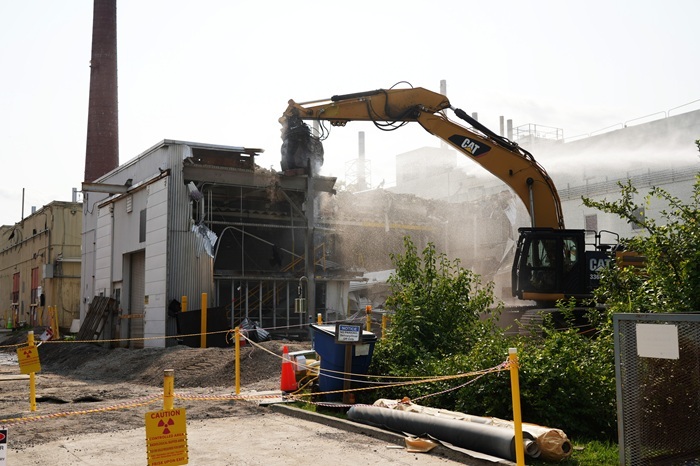 The first building in Isotope Row to come down was the Isotope Area Storage and Service Building, also known as Building 3036.
New chapter awaits for valuable land in heart of lab’s central campus
OAK RIDGE, Tenn. — An Oak Ridge Office of Environmental Management (OREM) team has begun demolishing a tight cluster of highly contaminated buildings on one of the most challenging footprints at Oak Ridge National Laboratory (ORNL).
The aging, contaminated infrastructure presents risks within its tight quarters in the heart of the laboratory’s central campus. With each teardown OREM eliminates hazards, enables modernization and provides land for new facilities to advance research and innovation.
Located in ORNL’s central campus, Isotope Row consists of 10 facilities constructed from the late 1940s to early 1960s to support the laboratory’s isotopes program. For decades, employees at the facilities produced, processed and researched chemical elements used in medical, industrial, scientific and national defense applications.
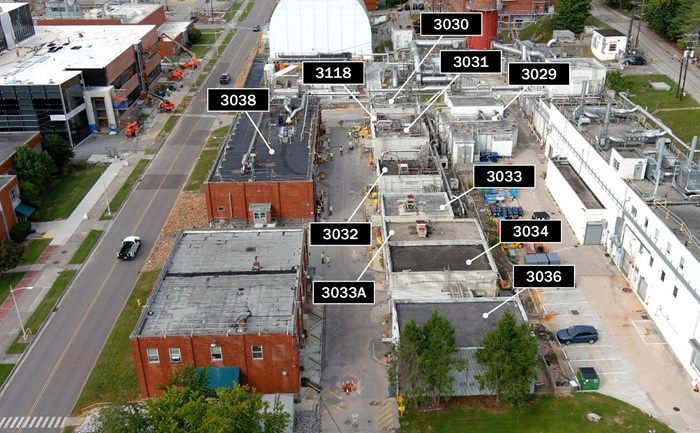 Located in Oak Ridge National Laboratory’s central campus, Isotope Row consists of 10 facilities constructed between the late 1940s and early 1960s to support the laboratory’s isotopes program. Cleanup crews are set to demolish all the facilities by the end of the year.
As the U.S. Department of Energy’s largest multiprogram national lab expanded over the decades, the aging isotope facilities remained in place following the discontinuation of their operations in the early 1990s.
What was left behind were contaminated ventilation systems, hot cells, process equipment and legacy radioactive materials requiring specialized cleanup approaches. Addressing those complex tasks and deactivating the facilities was a six-year effort.
“Beginning demolition on Isotope Row is a significant milestone that reflects years of careful planning, technical expertise and disciplined execution by our workforce,” said Jim Blankenhorn, president and program manager for OREM cleanup contractor United Cleanup Oak Ridge. “Our crews systematically reduced radiological and industrial hazards to safely reach this point, and now we’re taking the next step in transforming ORNL’s central campus.”
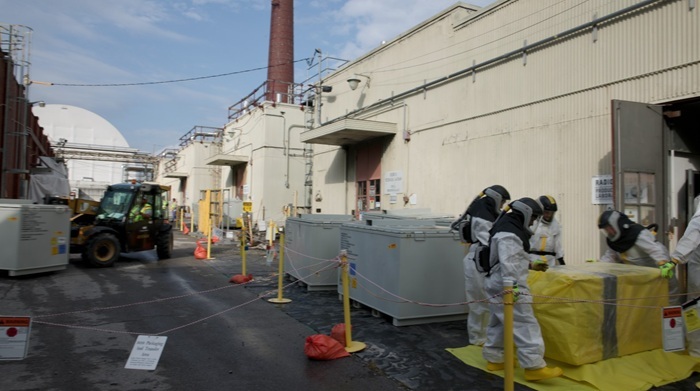 Removing contaminated ventilation systems, hot cells, process equipment and legacy radioactive materials from Isotope Row posed a complex task requiring six years of work by deactivation crews.
The first of the 10 buildings to come down was the Isotope Area Storage and Service Building, also known as Building 3036.
During demolition, workers are taking added steps to ensure smooth progress. Teams are conducting the teardowns in the late afternoon — outside normal operating hours — to avoid impacting ongoing missions near the footprint.
Crews expect to complete demolition on all 10 Isotope Row buildings by the end of the year.
-Contributor: Ryan Getsi
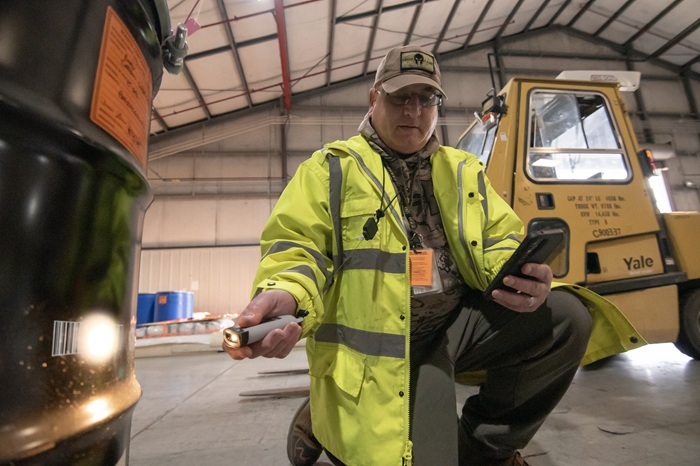 Container Management Supervisor Jonathan Tucker scans a waste container for tracking, demonstrating one of the many uses of the Paducah Site’s barcode tracking system.
PADUCAH, Ky. — Pens, paper and clipboards are becoming things of the past at the U.S. Department of Energy’s (DOE) Paducah Site as employees use barcode scanning technology to swiftly inventory thousands of pieces of equipment in a 2.1-million-square-foot legacy facility being prepared for demolition, leading to more efficient cleanup.
DOE Office of Environmental Management (EM) deactivation and remediation contractor Four Rivers Nuclear Partnership (FRNP) originally employed the barcode scanning system to collect necessary information to track the inventory of waste containers, speeding up the process by eliminating manual paper input. Now, employees rely on the system to track components during deactivation of the C-337 Process Building.
"The expanded use of barcode technology is a significant step forward for inventory and data management at the site," Federal Project Director William Wessel said. "Using this technology to quickly and accurately capture information digitally, we not only reduce the potential for human error but also simplify our ability to manage and retrieve data in real time across various organizations at the site."
Going paperless with barcode scanning comes after the Paducah Site embraced a new technology at C-337 that enables workers to efficiently scan equipment for uranium deposits as they deactivate the former uranium enrichment process building. Both initiatives demonstrate how EM incorporates innovation and efficiency into cleanup, focusing on priorities and reining in costs without sacrificing safety or effectiveness.
The barcode scanning technology improves accuracy and streamlines processes by eliminating the transfer of data from paper to digital input. Data is collected in the field in real time, then uploaded into a database. Workers can easily gather information via digital applications or hand-held scanners.
Through an initiative in which contractors collaborate on lessons learned and best practices, FRNP shared the barcode scanning technology with operations and site mission support contractor Mission Conversion Services Alliance (MSCA) as a cost-savings tool. MSCA is evaluating its potential use in tracking the 43,000 remaining depleted uranium hexafluoride cylinders stored at the site, key to DOE’s work to transform liabilities into assets for the nuclear renaissance and future reindustrialization.
"Investing in technologies, collaborative knowledge and resource sharing is crucial for advancing the mission at the Paducah Site," Portsmouth Paducah Project Office Acting Deputy Manager April Ladd said. "It's about empowering the workforce to use new technology in the field to enhance efficiency, ensure accuracy and maintain the highest standards of safety and compliance across our operations."
-Contributor: Dylan Nichols
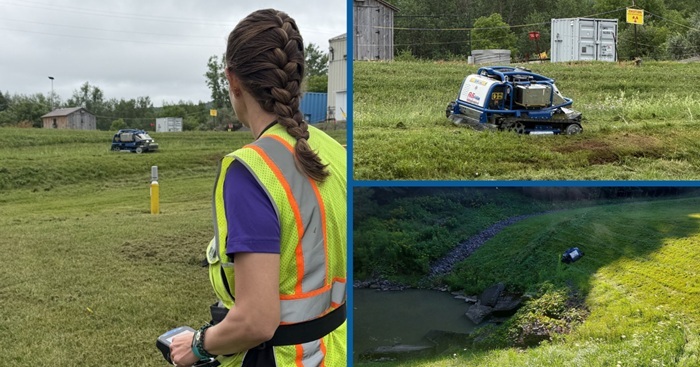
WEST VALLEY, N.Y. — The U.S. Department of Energy’s Office of Environmental Management (EM) recently took another step to enhance safety at the West Valley Demonstration Project by adding a new remote-controlled lawn mower to help workers navigate steep terrains that can be hazardous with traditional mowing equipment.
“This new equipment allows my crew to maintain the site without encountering unnecessary dangerous situations,” said Laura Lucey, plant surveillance and maintenance manager with EM contractor West Valley Cleanup Alliance (WVCA). “I am grateful that the team at West Valley continues to invest in the safety of its employees.”
The mower allows the operator to work from as far as 650 feet away, remaining on safe ground while cutting vegetation on steep slopes. It features a 38-inch cutting deck equipped with guards and chains to help control debris during operation.
Before employees are authorized to operate the mower, they must complete hands-on training with an experienced operator, including reading the manual and multiple supervised operating sessions.
Safety practices extend beyond the addition of new equipment. Crew members work together to ensure prompt assistance in the event of an emergency. The remote control also vibrates when it detects unsafe operating angles or potentially hazardous situations.
“Our employees are the reason we get to do the work that we do,” WVCA President and Program Manager Jason Casper said. “We are always looking for ways to enhance worker safety. If a new opportunity presents itself in the form of tools and processes, we will evaluate and look for ways to effectively implement.”
-Contributor: Sarah Morris
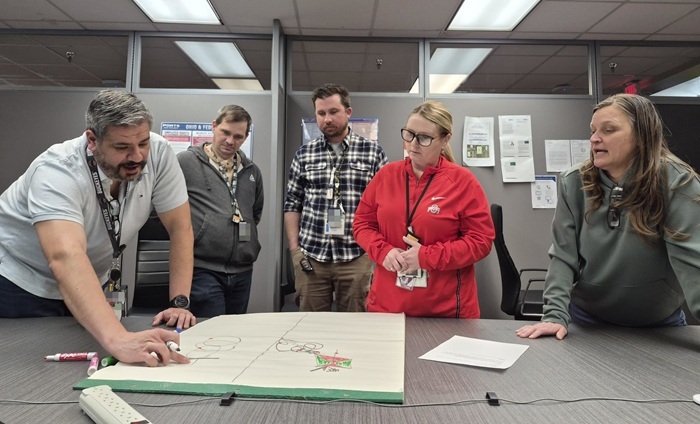 Members of the winning team huddle to plan their next move during one of six sessions of the Portsmouth Site's teambuilding event.
PIKETON, Ohio — What happens when information technology (IT) professionals from different organizations are placed on the same team with a shared goal?
Participants from four IT contractors randomly grouped together put that question to the test as they tackled challenges at a recent collaborative teambuilding event held by U.S. Department of Energy Portsmouth Site infrastructure support services contractor North Wind Dynamics (NWD).
“IT is the heart of any organization,” IT Cyber Security Specialist James Woods said. “If a system goes down, it has the potential to disrupt work for nearly every department. A strong IT team that can quickly solve problems helps every person in the organization work more efficiently and effectively.”
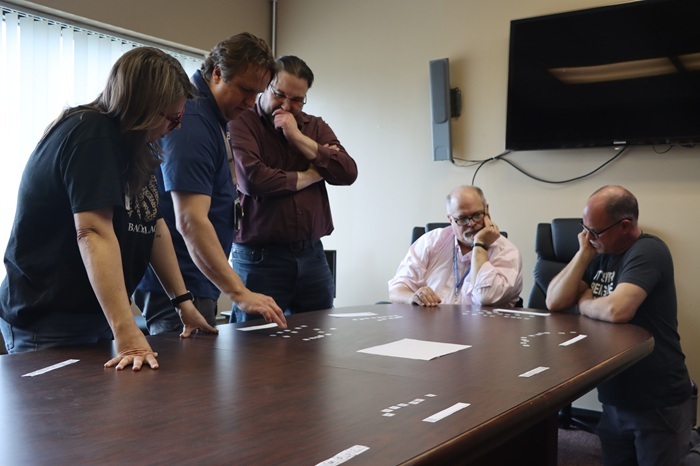 Through randomized pairings and problem-solving challenges, participants build new relationships, sharpen communication and practice strategic thinking.
The event was organized to create better cohesion and coordination among the various IT groups on the Portsmouth Site supporting more than 2,000 employees who rely on IT services on over 170 servers. IT is integral to keeping all projects at the site running smoothly.
The teambuilding activities pushed individuals beyond organizational boundaries into new, fast-paced partnerships, demonstrating how people who do not normally work together can come together to achieve a shared goal. Team members established roles, shared knowledge and developed strategies under deadline.
“By focusing on common goals rather than individual organizational priorities, participants experienced how alignment can accelerate progress,” Woods said. “This unified mindset encouraged teams to think beyond their usual boundaries.”
They took part in a “jellyfish string” challenge using strings to maneuver a central ring together, highlighting the fragility of team cohesion when connections are lost.
“This event’s success reflects the exceptional teamwork and leadership of all participating contractors,” NWD IT Manager Ryan Porter said. “We’re grateful for the enthusiastic engagement, energy and commitment that helped strengthen partnerships and build a sense of community.”
-Contributor: Rachel Stroth
|