Paducah Plant Begins Enrichment Operations after Five Parties Strike Agreement
PADUCAH, Ky. – On this Friday, June 1, the first of about 1,100 14-ton cylinders filled with depleted uranium tails will be re-fed into the Paducah Gaseous Diffusion Plant, officially marking the start of a project that will extend enrichment operations there for a year.
“I am proud to have been a part of an agreement that helps the workers, community and electric ratepayers in Energy Northwest and TVA regions while avoiding cost to DOE and ensuring a supply of nuclear fuel essential for national security missions,” Portsmouth Paducah Project Office Manager Bill Murphie said. “This has been the most complicated agreement I have worked on in over 30 years with DOE and it took a lot of committed professionals across many organizations coming together to pull it off in such a short time.”
DOE is providing tails material to EN, which has contracted with USEC to re-enrich the tails into low-enriched uranium. EN will utilize a portion of the low-enriched uranium for its Columbia Nuclear Generating Station near Richland, Wash. and will sell the remainder of the U.S.-origin low-enriched uranium to TVA for use in its reactors, including those used to produce tritium for the National Nuclear Security Administration. TVA will sell power to USEC to operate the Paducah plant for the re-enrichment project. BPA purchases electric power from EN.
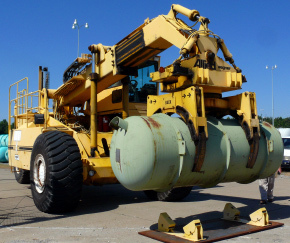
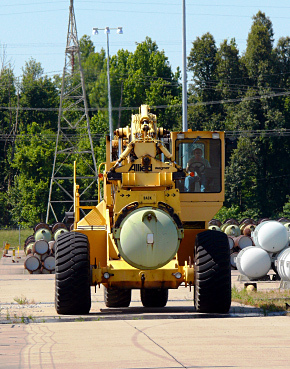
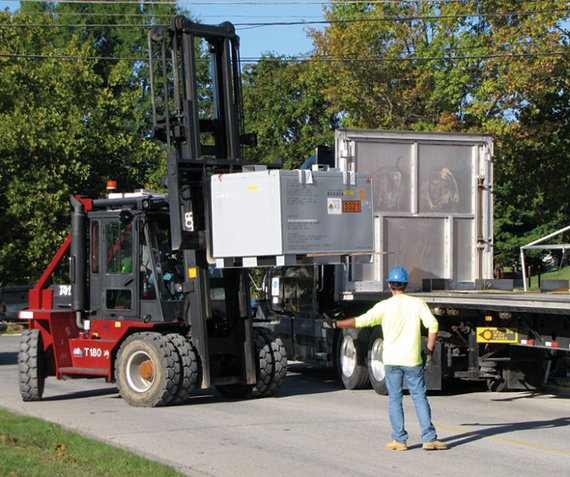
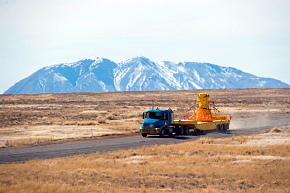
This cylinder hauler at Paducah’s Babcock & Wilcox Conversion Services plant delivers the first of DOE’s 14-ton depleted uranium cylinders to USEC for re-enrichment as part of a five-party agreement that is extending enrichment operations at the 60-year-old plant for another year, delaying increased costs at the site for DOE.
The transfer of depleted uranium to EN will benefit U.S. national security and the Department’s cleanup missions. For example, the potential benefits to DOE from transferring the depleted uranium include the reduced costs of producing tritium through alternative methods, as well as the costs that were avoided by needing to maintain the facility in safe shutdown for one less year than would have otherwise been necessary. In addition, the transfer provides commercial benefits to the other parties in the agreement.
USEC notified DOE last December that it might be forced to begin shutting down the 60-year-old gaseous diffusion plant at the end of May 2012, when its previous power contract with TVA was set to end. A combination of climbing power prices, aging technology and a Separative Work Units (SWU) market depressed by the lingering nuclear effects of the Japanese earthquakes and tsunami posed an economic challenge to USEC's Paducah plant and set the stage for the publicly-traded subsidiary of USEC Inc. to begin the process of de-leasing portions of the plant back to DOE. SWU is a unit of measurement applied to the enrichment process.
This June marks the start of work to feed about 1,100 14-ton cylinders filled with depleted uranium tails into the Paducah Gaseous Diffusion Plant.
The potential value that can be extracted in a relatively small subset of the nearly 40,000 DOE tails cylinders stored at the site offered a temporary solution, helping protect the 1,200 USEC jobs at Paducah and delaying DOE’s need to increase its investment in maintaining and security the huge facility. These high-assay tails contain a somewhat greater percentage of the valuable U-235 isotopes than do the others, enough to justify a second trip through the enrichment process before they re-join the other tails waiting to be processed as waste at the depleted uranium conversion facility.
Over the course of the year, USEC will feed the contents of the 1,100 tails cylinders directly into the plant, placing them inside large autoclaves where they will be heated, turning the solid contents into a gas that will move through a series of the converters where the U-235 isotopes are separated from the more numerous U-238, finally emerging from the process in a dual stream of low-enriched uranium and residual depleted uranium tails.
Continuing operations of the plant will provide an extra year for EM to plan for the eventual decommissioning and cleanup of the plant.
Los Alamos National Laboratory Transuranic Waste Program Exceeds Planned Shipping Goal
LOS ALAMOS, N.M. – Los Alamos National Laboratory’s (LANL) Transuranic (TRU) Waste Program is looking at another record-setting month for the amount of TRU waste leaving Area G, headed to the Waste Isolation Pilot Plant (WIPP) for permanent disposal.
LANL exceeded its planned removal of TRU waste from Area G in April, shipping more than 91 cubic meters of waste to WIPP — more than the Lab has ever shipped there in a single month.
The Lab is headed for an even more successful May, with 99 cubic meters shipped to WIPP as of May 22.
“Our shipping performance reflects the acceleration that began last fall,” said Pete Maggiore, environmental programs manager for DOE’s Los Alamos Site Operations Office. “And we shipped even more waste than planned.”
LANL surpassed the planned removal of 78 cubic meters of TRU waste in April by more than 13 cubic meters, shipping 91.4 cubic meters of the waste to WIPP, which is located near Carlsbad, N.M. The volume was three times as much as was shipped during March.
The effort to accelerate removal of TRU waste stored above ground at Area G was spurred by the Las Conchas fire in 2011. After the fire, DOE and the state of New Mexico forged a framework agreement that calls for the removal of 3,706 cubic meters of waste stored above ground at Area G by June 30, 2014.
“This is a significant first step that reflects our workers’ commitment to this important project, and to doing the work safely,” said Dan Cox, deputy associate director of environmental programs at the Lab.
Most of the waste shipped in April was equipment stored in large fiberglass reinforced plywood boxes (FRPs), which was repackaged into WIPP-compliant containers.
“We are working with our partners at the state of New Mexico and WIPP to address this challenge,” said DOE Federal Project Manager Lee Bishop. “This early sign of success bodes well for the future of the project.”
TRU waste consists of clothing, tools, rags, debris, soil and other items contaminated with radioactive elements, mostly plutonium. Each of these man-made elements has an atomic number greater than uranium, so they are labeled transuranic, for “beyond uranium” on the periodic table of elements. About 90 percent of the current TRU waste inventory is a result of decades of nuclear research and weapons production at the Lab.
Savannah River Site Retires Coal-Fired D-Area Powerhouse after Nearly 60 Years of Service
Large 1950s-era power and steam generating plant ends mission
AIKEN, S.C. – The Savannah River Site (SRS) has shut down the massive, coal-powered D-Area powerhouse as the site turns to new, clean and highly efficient power generation technology.
“The recent startup of three new wood-chip burning (biomass) steam plants at SRS means we no longer need this facility. But I humbly thank the mechanics and operators whose skill, dedication, and creativity kept this facility operating for nearly 60 years,” DOE-Savannah River Assistant Manager for Infrastructure and Environmental Stewardship Karen Guevara said.
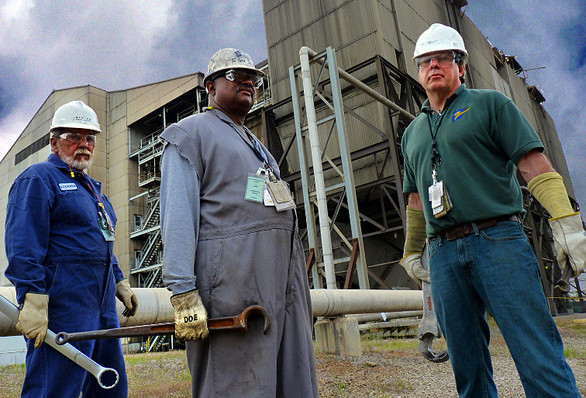
SRNS Maintenance Supervisor Steve Cooper, left to right, Control Room Operator Robert Dicks, and Deputy Operations Manager Ren Hatfield stand near a boiler unit of the D-Area powerhouse. The three workers have a combined experience of 83 years at the facility.
In the late 1950s, nine powerhouses and steam plants were operating across the 310-square-mile nuclear reservation. All were small compared to the mammoth D-Area facility whose four giant boilers required 35 to 45 million gallons of water each day from nearby Savannah River. At one time, the five-story, 280-square-foot D-Area powerhouse was capable of generating 75 million watts of power, enough electricity to support a small city such as Aiken.
The steam produced within D Area was used for a variety of SRS industrial and process related needs. At the powerhouse’s peak operation, three of the facility’s four boiler units, each more than 100 feet tall, individually produced about 350,000 pounds of steam per hour.
Dwayne Wilson, president and CEO of Savannah River Nuclear Solutions (SRNS), the SRS management and operations contractor, detailed the financial and environmental benefits from the D-Area powerhouse shutdown. SRS will no longer need to purchase about 160,000 tons of coal each year for the facility’s operation, and annual carbon dioxide emissions will be reduced by about 100,000 tons, he said.
Wilson said SRNS employees are committed to creating safe, innovative and effective solutions for SRS, the nation and world through Enterprise.SRS. In that initiative, SRS will utilize its nuclear materials workforce, knowledge and assets to help the nation address critical missions in the key areas of environmental stewardship, clean energy and national security.
“We offer knowledge and expertise to make the future of our site and country secure, energy independent and environmentally responsible,” Wilson said. “The safe deactivation of this once-vital support facility is another step in that direction.”
For 59 years, D Area was operated by three generations of largely local employees who supplied reliable power and steam to SRS facilities with few outages.
“I can remember being hired on at the plant site back in the 1980s as a coal handler in D Area,” SRNS Utility and Services Operations Manager Wayne Gleaton said. “First thing I said was, ‘I didn’t know SRS had a coal mine.’ My supervisor laughed and said, ‘We don’t. You won’t be digging coal. You’ll be unloading coal from railroad cars.”
A D-Area employee for more than 20 years, Brad Harrelson has always been impressed by his co-workers who go the extra mile to keep the plant running.
"I'm leaving behind many good friends and taking with me many fond memories," Harrelson said.
Oak Ridge Removes Laboratory’s Greatest Source of Groundwater Contamination
OAK RIDGE, Tenn. – This month, Oak Ridge’s EM program bid farewell to the last shipment of waste from the Tank W-1A project.
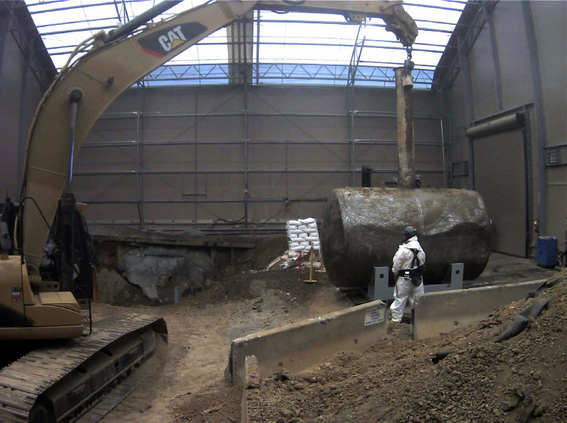
When operational, the former waste storage tank slowly leaked its contents, becoming the Oak Ridge National Laboratory’s (ORNL) greatest source of groundwater contamination. The high-priority EM cleanup project involved extensive characterization, removal of contaminated soil and excavation of the 4,000-gallon stainless steel tank.
Workers remove the 4,000-gallon Tank W-1A, which was ORNL’s greatest source of groundwater contamination.
“The completion of the Tank W-1A project is a significant sign to regulators about the importance and attention we are placing on soil and groundwater contamination removal,” said Sue Cange, acting assistant manager for EM. “These measures also encourage future investment and expansion at one of our nation’s most important research centers.”
Tank W-1A was commissioned in 1951 to collect and store liquid waste from radiochemical separations and high-radiation analytical facilities at ORNL. During its operation, a transfer line to the tank was suspected of leaking near the tank intake, causing significant soil and groundwater contamination in the vicinity of the tank. It was emptied and removed from service in 1986 after the leak was discovered. In 1995, a system was installed to pump and treat the groundwater plume that originated from the tank, helping lessen environmental impacts to the groundwater.
Workers load boxes containing contaminated soil that surrounded Tank W-1A.
In September 2011, Oak Ridge’s prime cleanup contractor, URS | CH2M Oak Ridge (UCOR), launched the project’s $19.5 million final phase. In January, workers excavated the 6,500-pound tank buried 10 feet below ground. In addition to removing the tank, workers shipped hundreds of boxes of contaminated soil and other materials associated with the tank offsite for disposal.
“I want to congratulate the managers and workers on the project for a job well done,” said Leo Sain, UCOR president and project manager. “Tank removal and subsequent handling and shipping required the utmost care and skill, and all those who worked on the project deserve our thanks for doing this work safely and efficiently.”
The 6,500-pound Tank W-1A is shipped away from ORNL.
After the tank’s removal and size reduction, workers excavated the remainder of the contaminated soil and backfilled the cleanup site with grout, gravel and clean soil.
Georgia Hosts Multi-Agency Waste Isolation Pilot Plant Transportation Exercise
COVINGTON, Ga. – Emergency personnel throughout the U.S. who respond in the event of a potential accident involving radioactive waste shipments take part in mock training scenarios to help them prepare for an actual incident.
One such scenario for the Waste Isolation Pilot Plant (WIPP) Transportation Exercise (WIPPTREX) occurred last month. In the staged event, a truck hauling transuranic (TRU) waste from the Savannah River Site in South Carolina to WIPP in New Mexico was rerouted onto a Georgia highway due to a fog-related traffic accident on an interstate. As the truck proceeded on the alternate route, it became involved in a vehicle pileup. The WIPP truck and cargo sustained minor damage, but the simulated chain-reaction event resulted in four fatalities and more than 40 people injured. Calls started rolling in to the local 911 dispatch center.
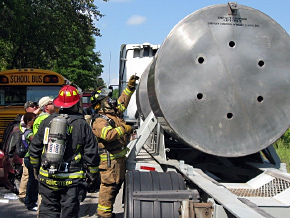
A firefighter trained to respond to radiological events performs a radiological survey of the WIPP shipping package as part of a WIPP transportation exercise in Morgan County, Georgia.
“This is an exercise,” dispatchers told responders in the field. That phrase was echoed hundreds of times before the day was over. Georgia’s Emergency Management Agency hosted the full-scale WIPPTREX in Morgan County to test the integrated response skills of state and federal agencies to a mass casualty scenario involving a WIPP truck.
“This was an impressive full-scale exercise with more than 60 response organizations playing a role,” said Bill Mackie, DOE Carlsbad Field Office (CBFO) National TRU Program Institutional Affairs Manager. “Georgia Emergency Management Agency personnel did a great job of planning the exercise and pulling the resources together to effectively respond.” Mackie monitors the WIPP external emergency management program.
The CBFO National TRU Program assists in training first responders along WIPP transportation corridors.
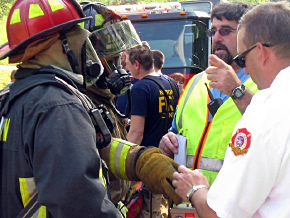
The on-scene incident commander briefs a responder during an April 17 WIPP transportation exercise in Georgia.
The WIPP external emergency management group has trained more than 30,000 first responders since 1988. The DOE-funded training and exercises prepare emergency personnel to respond effectively in the event of a WIPP transportation accident. The benefits, according to responders, go beyond WIPP transportation. The training better prepares them to deal with hazardous material accidents and other large-scale transportation emergencies.
WIPP’s emergency response training is thorough and its transportation system is one of the safest on the nation’s highways. WIPP drivers have logged more than 12.5 million loaded miles — equivalent to 26 roundtrips from the earth to the moon — to deliver 10,500 shipments safely to WIPP.
In addition, TRU waste shipments are tracked by satellite and monitored around the clock from a secure control center at WIPP. Designated federal, state and Tribal officials can monitor shipments.
A byproduct of the nation’s nuclear defense programs, TRU waste is contaminated with radioactive elements that have atomic numbers greater than uranium. The waste is shipped to WIPP for disposal in rooms mined out of an ancient salt formation more than 2,100 feet below the surface.
Idaho Site Achieves Successful Nuclear Shipment on Newly Constructed Haul Road
IDAHO FALLS, Idaho – Close coordination among operations, security and transportation teams at the Idaho site helped ensure the recent success of the first nuclear shipment on a newly constructed haul road. The new road is about 10 miles long and located between the Critical Infrastructure Test Range Complex (CITRC) and the Materials and Fuels Complex (MFC). It's expected to help save significant time and cost over the life of the project by avoiding traffic disruptions on the public highway and increased cost associated with Department of Transportation regulatory requirements.
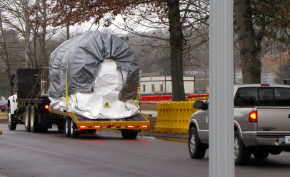
The HFEF-6 cask is transported on the haul road.
Fuel from the Experimental Breeder Reactor-II (EBR-II) was shipped on the road in a Hot Fuel Examination Facility-6 (HFEF) fuel cask, the first of several shipments scheduled during fiscal year 2012. The EBR-II fuel shipment campaign is part of a multiyear project to return the used fuel to MFC for evaluation and treatment to remove the sodium bonded to the fuel.
“It was great that the very first use of the new haul road was for one of our spent nuclear fuel moves,” said Jim Floerke, Vice President at cleanup contractor CH2M-WG Idaho’s (CWI) Idaho Nuclear Technology and Engineering Center (INTEC) Cleanup Project. “The haul road will be getting a lot of use over the next several years because we have a significant amount of material to ship. Our fuel operators and maintenance workers are great at what they do and seeing this EBR-II fuel and cask going safely down the road is another feather in their cap. They do good work and I am really proud of them.” Savings from the new road should extend beyond the EBR-II fuel shipment campaign, allowing for safer, more efficient transport of nuclear and other shipments between research and other facilities at the Idaho site. There are more than 3,500 elements of EBR-II fuel in a storage pool at INTEC that will require at least 220 shipments using the HFEF-6 casks for transport. Construction of the road is part of the Idaho National Laboratory Ten Year Site Plan. Funded by $6.5 million from the American Recovery and Reinvestment Act, the road will help accelerate the removal of used fuel from the wet storage pool at INTEC. The road was built under a small-business contract with Doyon Limited. Used fuel from the EBR-II reactor was shipped from MFC to INTEC for storage in the late 1970s and 1980s. Under DOE’s 1995 agreement with the state of Idaho, all used fuel is set to be removed from the state by 2035. Because of its unique characteristics as a sodium-bonded metallic fuel, the EBR-II spent fuel must first be treated in MFC’s Fuel Conditioning Facility before it can be placed in offsite interim storage or permanent disposal.