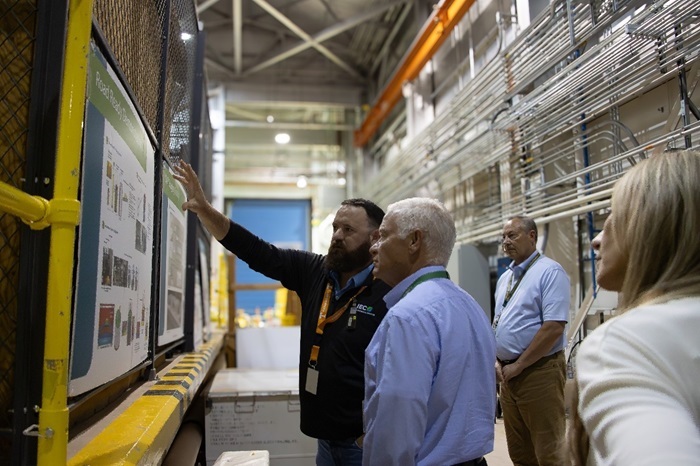
 Assistant Secretary of Environmental Management Tim Walsh tours used nuclear fuel storage facilities at the Idaho National Laboratory Site, including the Irradiated Fuel Storage Facility, pictured, where crews will retrieve and package fuel for its eventual shipment offsite.
IDAHO FALLS, Idaho — Assistant Secretary of Environmental Management (EM) Tim Walsh and his leadership team visited the Idaho Cleanup Project (ICP) last week, emphasizing ICP’s critical role in advancing both cleanup and nuclear missions at the Idaho National Laboratory (INL) Site and across the U.S. Department of Energy (DOE) complex.
Their visit underscored the connected efforts protecting people and the environment while driving cutting-edge nuclear research and development to fuel America’s energy future.
“My visit to Idaho reaffirmed the efficiency, innovation and technical expertise demonstrated by the ICP team,” said Walsh. “Their commitment to safe, effective cleanup operations not only allows DOE to fulfill our obligations to Idaho but also creates new opportunities for the Idaho National Laboratory to lead the way in nuclear energy research and development that will power America’s future.”
Walsh toured several prominent cleanup facilities, including the Idaho Nuclear Technology and Engineering Center (INTEC), Integrated Waste Treatment Unit (IWTU), Radioactive Waste Management Complex (RWMC), and Naval Reactors Facility (NRF) decommissioning and demolition (D&D) areas. The tour also stopped at the INL’s Advanced Test Reactor (ATR), Materials and Fuels Complex (MFC) and NRF’s operating areas.
Each stop on the tour highlighted the workforce’s ability to effectively and efficiently tackle cleanup challenges while meeting obligations to the state of Idaho, ensure safe long-term management of complex waste streams, protect the Snake River Plain Aquifer and transform cleanup sites for the future.
At the INL Site, successfully meeting cleanup milestones established by the state of Idaho is directly tied to new research opportunities at the INL, the nation’s premiere nuclear laboratory.
Notably, beginning and sustaining liquid waste treatment operations at the IWTU allowed INL to receive research quantities of fuel for the first time in decades. Those IWTU operations satisfied conditions of the 1995 Idaho Settlement Agreement, a legal cleanup framework that restricted used nuclear fuel (UNF) shipments to the state. Since 2023, the IWTU has treated nearly 400,000 gallons of liquid waste stored on the INL Site, reducing risk to the environment and meeting commitments to the state.
INTEC crews receive and store UNF, including ATR and other fuels approved in a 2025 waiver to the agreement to support the DOE Office of Nuclear Energy. Storing and managing UNF ensures critical operational space is available for research activities at ATR, as well as continued research and development at MFC and university research reactors across the country.
At NRF, ICP D&D crews are safely and effectively demolishing three legacy Navy nuclear propulsion prototypes ahead of schedule and under budget. Removing the prototypes reduces environmental liabilities and creates space for future opportunities at NRF.
The ICP team at RWMC recently processed and shipped a glovebox from Los Alamos National Laboratory to the DOE Office of Environmental Management’s Waste Isolation Pilot Plant (WIPP), demonstrating ICP’s technical expertise and ability to drive operational efficiencies across the DOE complex. A glovebox is an enclosure designed to protect personnel from hazards when handling radioactive materials.
-Contributor: Carter Harrison
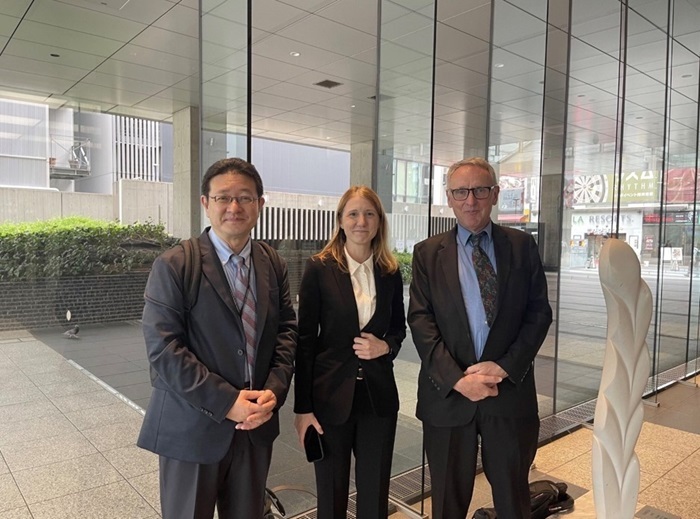 The U.S. Department of Energy Office of Environmental Management’s Paul Murray, far right, is pictured with Koichi Uchida and Lauren Boyd with the U.S. Embassy in Japan.
JAPAN — A U.S. Department of Energy (DOE) Office of Environmental Management (EM) official highlighted EM’s leadership in advancing next-generation used nuclear fuel solutions when he met with representatives with leading Japanese government, research and nuclear organizations recently.
During the visit, Paul Murray, EM senior advisor for used nuclear fuel and high-level waste, gathered with officials from Japan’s Ministry of Economy, Trade and Industry (METI), Ministry of Education, Culture, Sports, Science and Technology (MEXT), and other organizations. Murray discussed EM’s vision for establishing a next-generation recycling and conditioning capability built on decades of experience, expertise and accomplishments in the management of used nuclear fuel and the recovery of strategic nuclear materials.
“Japan remains one of America’s strongest and most trusted allies, and our continued engagement reflects a shared commitment to advancing safe and innovative nuclear solutions that will help meet growing energy demands while strengthening the longstanding partnerships between both nations,” Murray said.
The Japan visit comes after EM participated in the 13th U.S.-Japan Technical Meeting of the Civil Nuclear Energy Research and Development Working Group earlier this year. There, officials discussed continued cooperation on used nuclear fuel management and advanced fuel cycle technologies. Hosted by Los Alamos National Laboratory, the meeting brought together representatives from DOE and several Japanese government organizations, including METI, MEXT and the Japan Atomic Energy Agency.
In the latest Japan meetings, Murray emphasized the breadth of capabilities across the DOE complex and how DOE’s technical foundation positions the United States to accelerate deployment of a robust domestic recycling and conditioning capability that maximizes the value of DOE’s legacy nuclear materials inventory while strengthening domestic supply chains.
EM is laying the foundation for a recycling and conditioning capability that will unlock the value of legacy nuclear materials, strengthen America’s nuclear supply chain, reduce long-term environmental liabilities and establish the capabilities needed to enable America’s nuclear renaissance.
As part of the visit, Murray participated in the 15-Year Fukushima Daiichi International Workshop, jointly hosted by the Nuclear Damage Compensation and Decommissioning Facilitation Corporation, Nuclear Regulation Authority and the Organization for Economic Cooperation and Development ’s Nuclear Energy Agency. The workshop brought together international experts to discuss progress in Fukushima Daiichi decommissioning and the continued advancement of nuclear technologies and capabilities.
-Contributors: Rosa Elmetti, Kyle Hendrix
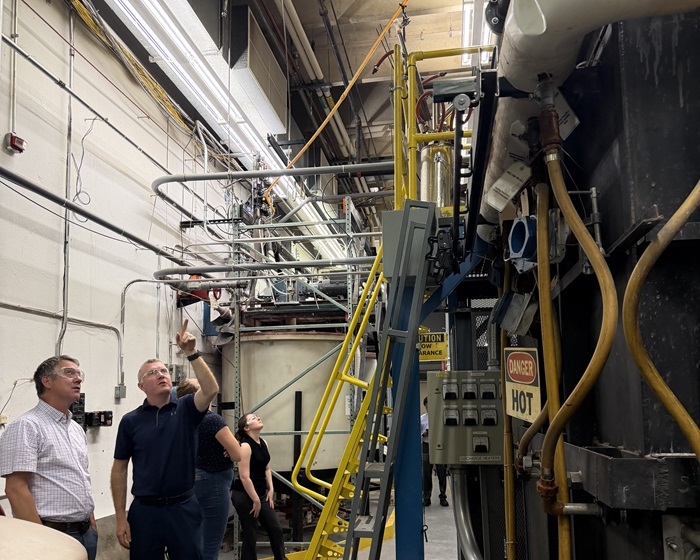 Team members from the Hanford Site’s High-Level Waste Facility are pictured at the Vitreous State Laboratory, where they observe a one-third scale melter like the High-Level Waste Facility will use at Hanford.
WASHINGTON, D.C. — The Hanford Waste Treatment and Immobilization Plant’s (WTP) High-Level Waste (HLW) Facility Research and Technology team completed an important test two months ahead of the milestone schedule at The Catholic University of America’s Vitreous State Laboratory (VSL) in Washington, D.C.
The test brought together teams from the U.S. Department of Energy (DOE) Office of Environmental Management’s Hanford Field Office, WTP prime contractor Bechtel National Inc., AtkinsRéalis, and VSL to assess melter and emissions treatment system challenges and provide insights for ongoing HLW Facility engineering design.
“This test highlights how strategic partnerships are shaping the future of the Hanford cleanup mission,” said Mat Irwin, Hanford’s assistant manager for the WTP. “By partnering with technical and industry experts, we are able to accelerate progress, identify potential challenges and ensure that the HLW Facility is ready to safely and efficiently treat high-level waste when operations begin.”
The team performed the test over five days at VSL, which operates the largest collection of waste glass melters in the United States, including a one-third scale of the melter and emissions treatment system like what the HLW Facility will use. It was the second of six tests to be performed to validate melter and emissions treatment system design.
“Partnerships strengthen our ability to deliver safe and reliable operations for DOE, the environment and the surrounding communities depending on this cleanup,” said Mark Johnson, HLW Facility project manager for Bechtel. “They have been invaluable to WTP, both for the Low-Activity Waste Facility and HLW.”
Bechtel is advancing the design for direct-feed high-level waste to 90% complete while enclosing the HLW Facility.
Like Hanford’s Low-Activity Waste Facility, the HLW Facility will mix tank waste with glass-forming materials in two large melters operating at 2,100 degrees Fahrenheit. The mixture will be poured into stainless steel containers for interim safe storage prior to disposal.
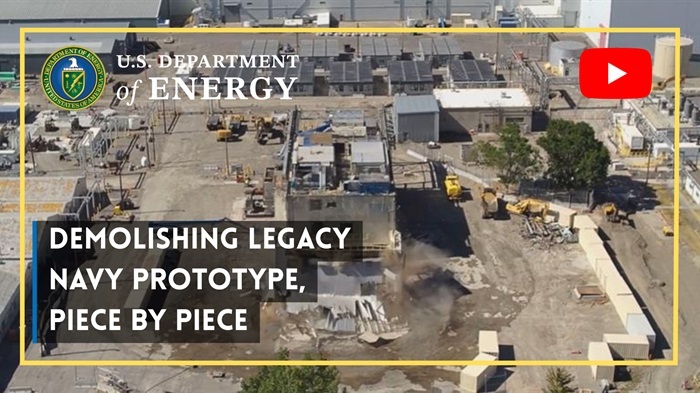 EMTV: Watch the Idaho Cleanup Project's demolition of the Aircraft Carrier 1st Generation Westinghouse prototype Crane House.
IDAHO FALLS, Idaho — Idaho Cleanup Project crews safely removed a crane house from atop a historic Naval Nuclear Propulsion Program prototype recently, marking an important step toward completing above-ground demolition of the facility. The crane house, a tall arched portion of the Aircraft Carrier 1st Generation Westinghouse (A1W) prototype, was a mobile structure connected to the facility on rails, previously used for refueling and maintenance. The A1W served as a testing and training ground at the Naval Reactors Facility at the Idaho National Laboratory Site, where Navy and civilian personnel learned and tested technologies to support the operation of the first nuclear-powered aircraft carrier, the USS Enterprise.
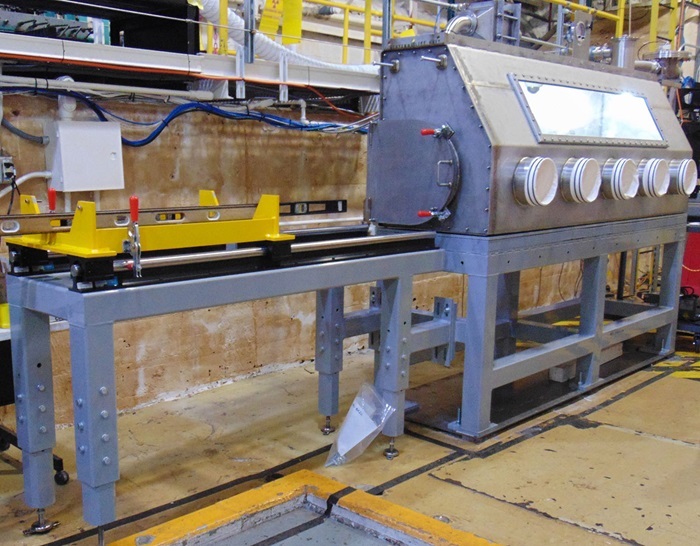 A view of Isotek’s glovebox being installed in the uranium-233 storage facility at Oak Ridge National Laboratory.
OAK RIDGE, Tenn. — An innovative workaround enables the U.S. Department of Energy’s (DOE) Oak Ridge Office of Environmental Management (OREM) to advance its highest priority cleanup project at Oak Ridge National Laboratory (ORNL) and save taxpayers $175 million.
OREM contractor Isotek is working to eliminate the nation’s inventory of uranium-233 (U-233) stored at ORNL in the world’s oldest operating nuclear facility. In the project’s latest phase, crews will process large canisters of U-233 in a separate nuclear facility.
That facility required costly retrofitting and increased security to accommodate the larger canisters. Completing those changes would have delayed the project by two years.
However, Isotek employees came up with a solution to avoid meeting those costly requirements and begin processing this portion of the U-233 inventory earlier. They designed a new glovebox to segment the canisters into a size that the processing facility can receive for workers to begin downblending the material. A glovebox is a sealed, stainless steel box with windows and attached gloves. It protects workers as they address the materials.
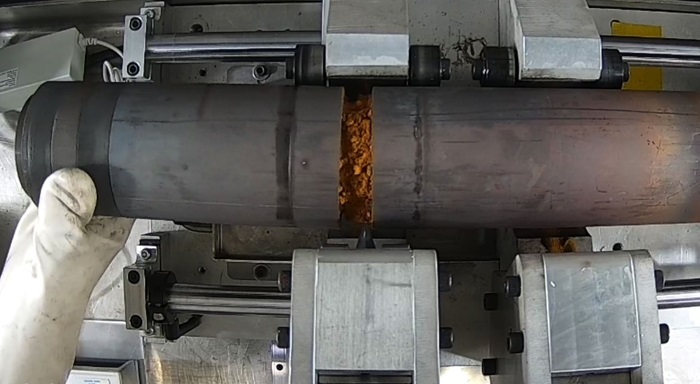 Operators use the new glovebox to segment a larger uranium-233 canister.
“This innovative glovebox design is the synthesis of the Isotek team’s experience, incorporating lessons learned and best practices from previous operations,” said Sarah Schaefer, Isotek president and project manager. “The result of the collaboration and commitment is a safe and secure path forward handling larger U-233 canisters that ultimately delivers significant savings to DOE.”
This cleanup project removes a major risk, avoids significant costs to taxpayers associated with keeping the inventory safe and secure and enables demolition of the storage facility to transform ORNL’s central campus and open space for important research and innovation missions.
U-233 was created in the 1950s and 1960s for potential use as fuel for nuclear reactors but proved unviable. The material was sent to ORNL for storage. Crews directly disposed of approximately half of the inventory, while the remainder requires processing to convert it into a form safe for transportation and disposal out of state.
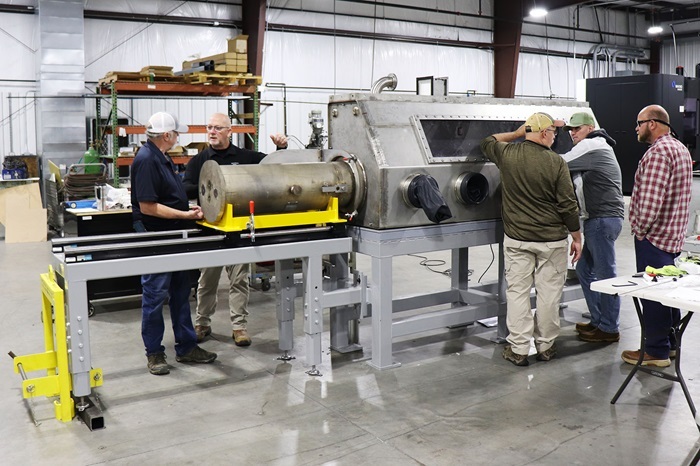 Isotek employees practice using the glovebox at the manufacturer’s shop. They provided input before the final product was installed at the uranium-233 storage facility.
Isotek completed the glovebox design in 2025, and a local firm, Tennessee Tool and Engineering, fabricated the equipment.
Workers practiced using the glovebox in the manufacturer’s shop. They provided input for the final product before it was installed at the U-233 storage facility.
“Using full scale mock-ups and doing practice runs allowed us to hit the ground running,” said Karl Thomas, Isotek senior technical advisor and team lead for glovebox implementation. “Tennessee Tool deserves a lot of credit, too, because they were able to make changes to the glovebox as we needed them and were crucial to our success.”
The new glovebox operation began in late June, and work has already begun to segment the larger U-233 canister for processing.
To date, Isotek has disposed of 75% of the U-233 inventory.
-Contributor: John Gray
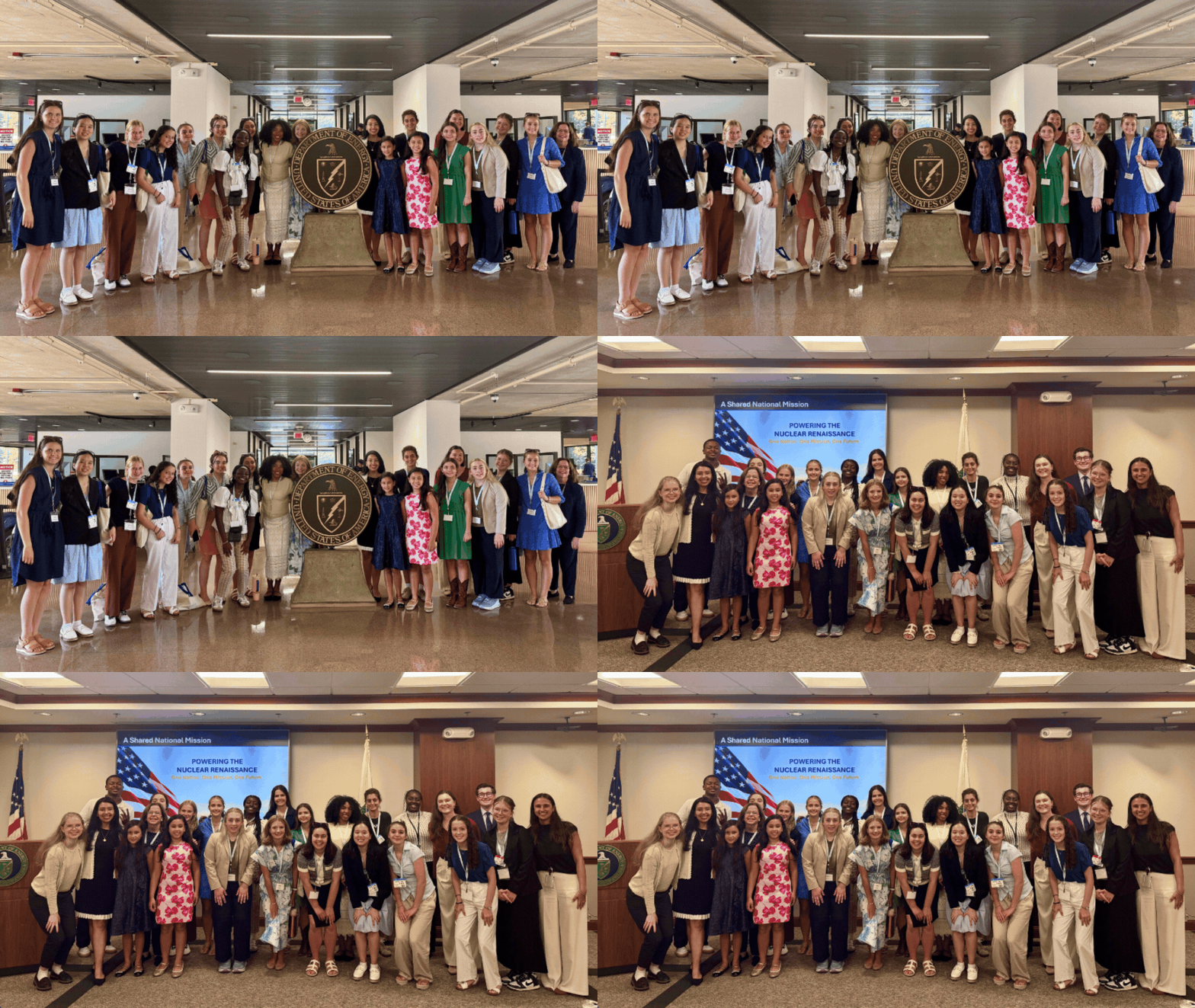 High school students from across the United States and Canada gather for photos at the U.S. Department of Energy’s Office of Environmental Management (EM) headquarters. They recently took part in Washington Week, a leadership program hosted by Yuma Center that introduces students to government, public policy and national leadership through visits across Washington, D.C.
WASHINGTON, D.C. — Eighteen high school students from across the United States and Canada recently visited the U.S. Department of Energy’s Office of Environmental Management (EM) headquarters for an inside look at how public service, innovation and nuclear energy are shaping America’s future.
The students, from Virginia, Illinois, Pennsylvania, Texas, Georgia, Maryland, Nebraska, New York, and Quebec, participated in Washington Week, a leadership program hosted by Yuma Center that introduces students to government, public policy and national leadership through visits across Washington, D.C. EM interns joined them for the discussion.
EM Acting Associate Principal Deputy Assistant Secretary Jack Zimmerman welcomed the students and shared his excitement about the opportunities emerging as America enters a new era of nuclear innovation.
“As a nuclear engineer by training, I can honestly say there has never been a more exciting time to be in this field,” Zimmerman said. “America’s nuclear renaissance is creating extraordinary opportunities for the next generation to innovate, lead and help shape our nation’s future.”
Hosted by Rosa Elmetti, EM's lead program manager for Nuclear Materials and Used Fuels, the visit explored how EM is helping enable America’s nuclear renaissance by applying decades of scientific and engineering expertise to help provide the reliable energy needed to power the technologies driving America’s future. Students also heard from EM professionals representing a variety of disciplines, gaining firsthand insight into careers in engineering, law, communications and policy.
“America has always been built by people who believed anything was possible,” Elmetti told the students. “Our country needs dreamers who are willing to solve hard problems, serve with purpose and help write the next chapter of American innovation.”
Students also reflected on America’s enduring legacy of nuclear leadership as the foundation to build a more prosperous future. The message was clear: The future isn’t something we wait for, it is something we build.
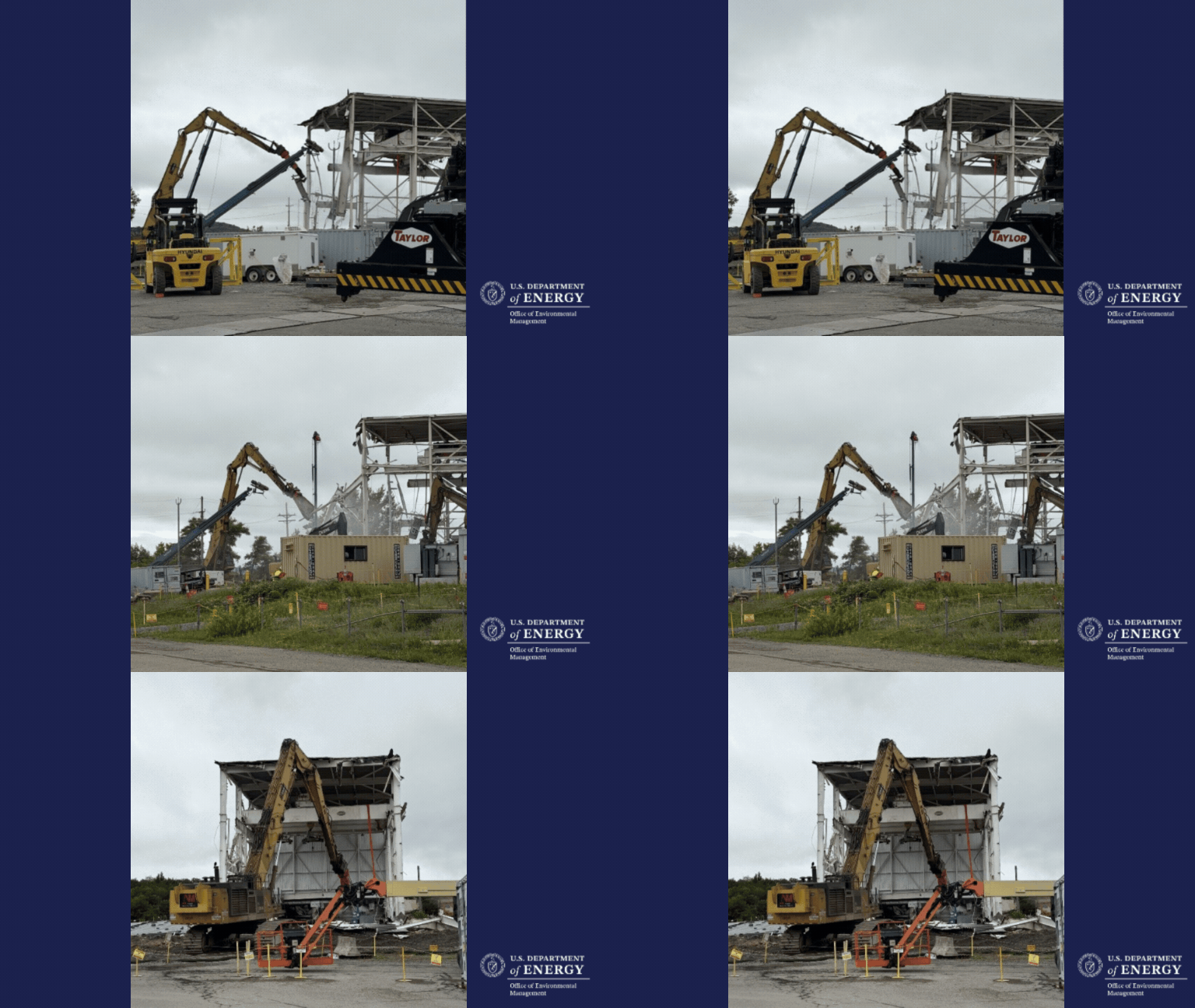 Views of the early stages of demolition of the Fuel Receiving and Storage Facility at the West Valley Demonstration Project.
WEST VALLEY, N.Y. — The U.S. Department of Energy’s Office of Environmental Management (EM) recently launched the demolition of a facility used in historic nuclear fuel reprocessing operations at the West Valley Demonstration Project.
Crews prepared for the teardown of the nearly 9,000-square-foot Fuel Receiving and Storage Facility over the past year by isolating utilities, removing hazardous materials and other tasks.
The project comes one year after workers safely completed the largest, most complex demolition of a radioactively contaminated facility at the site — the 35,100-square-foot Main Plant Process Building.
The Fuel Receiving and Storage Facility received and stored used nuclear fuel for reprocessing. The site served as the only commercial used nuclear fuel reprocessing plant in the U.S. from 1966 to 1972.
Inside the facility is a 100-ton crane that hoisted and lowered used fuel casks into a storage pool. In 2001, crews removed all fuel assemblies from the pool and processed the water.
Crews began the demolition by removing the facility’s metal exterior. They loaded the debris into intermodal containers for shipment offsite by rail for safe disposal. They will remove the crane before demolishing the remaining structure.
“Planning and preparation are crucial to ensuring a safe, compliant demolition,” West Valley Project Management Assistant Director Stephen Bousquet said. “It is important that our team doesn’t rush any step of the process, so we don’t risk our safety values in any way.”
He noted that a safe and compliant demolition allows for a safe environment and community. EM implemented a variety of safety measures to protect workers and the environment throughout the removal process. Machines continuously spray water to help eliminate dust and the spread of any potential contamination. Barriers and signs help ensure only authorized personnel are on the worksite. Radiation control technicians monitor the work area, including continuous air monitors that detect radioactive activity.
“Our employees have worked hard to reach this point,” said Jason Casper, president and program manager for EM contractor West Valley Cleanup Alliance. “It is exciting to see the workforce approaching another cleanup milestone.”
-Contributor: Sarah Morris
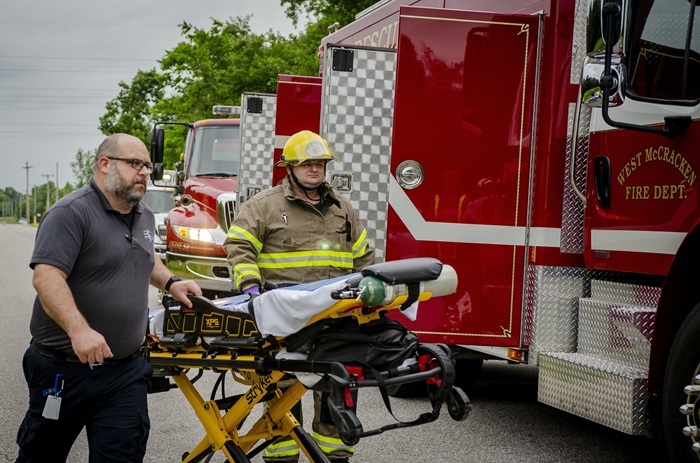 Paducah Site and West McCracken Fire Department firefighters work together during a mutual aid drill. Their working relationship proves valuable to responding to emergency situations on the Paducah Site and in the broader community.
PADUCAH, Ky. — The U.S. Department of Energy’s (DOE) Office of Environmental Management Paducah Site and the West McCracken Fire Department (WMFD) have benefited from a mutual aid agreement to enhance emergency response capabilities since 2019.
By sharing labor and resources and partnering in training exercises, the collaboration refines the skills of Paducah Site Fire Services personnel and expands the local team to ensure a safer community.
“Together, the members of West McCracken and Paducah fire services routinely train, support first response and share lessons to respond in the best possible way to calls for help,” Portsmouth Paducah Project Office (PPPO) Safety System Oversight Brad Pont said. “This working relationship proves valuable for on-scene management of an active emergency or drill.”
 |
|
Training drill: West McCracken Fire Department Ladder 59 responds to a simulated fire at the Paducah Site. |
Mission Conversion Services Alliance (MCSA), the PPPO operations and site mission support contractor, manages emergency services at the Paducah Site. The mutual aid agreement supports WMFD — an all-volunteer organization — through MCSA’s ability to respond with full-time, highly trained service personnel providing firefighting, rescue and first-responder medical services.
“In addition to providing assistance to WMFD, it is beneficial in keeping fire services personnel sharp on skills such as structural firefighting, victim extrication from vehicle accidents, first-responder emergency medical care and brush firefighting,” Paducah Site Fire Chief and Fire Protection Program Manager Darrell Howard said. “It is a win-win, no doubt.”
The Paducah Site has responded to about 20 requests for assistance from WMFD so far this year. Last year, the site responded to 115 requests from West McCracken.
“We are experiencing a time when volunteer recruitment and retention are proving more difficult nationwide,” said Corey Howard, an MCSA employee who recently began serving as the new WMFD chief. “Access to these additional resources and manpower is effectively helping us overcome that challenge.”
WMFD Capt. Chuck Bean added, “As an all-volunteer staff, we never know who’s going to be able to show up.”
Bean, a retired fire commander from Paducah Site deactivation and remediation contractor Four Rivers Nuclear Partnership, is grateful to DOE for helping enable the mutual aid partnership.
“Without the support of DOE, we couldn’t be as available as we are,” he said.
-Contributor: Katherine Mueller-White
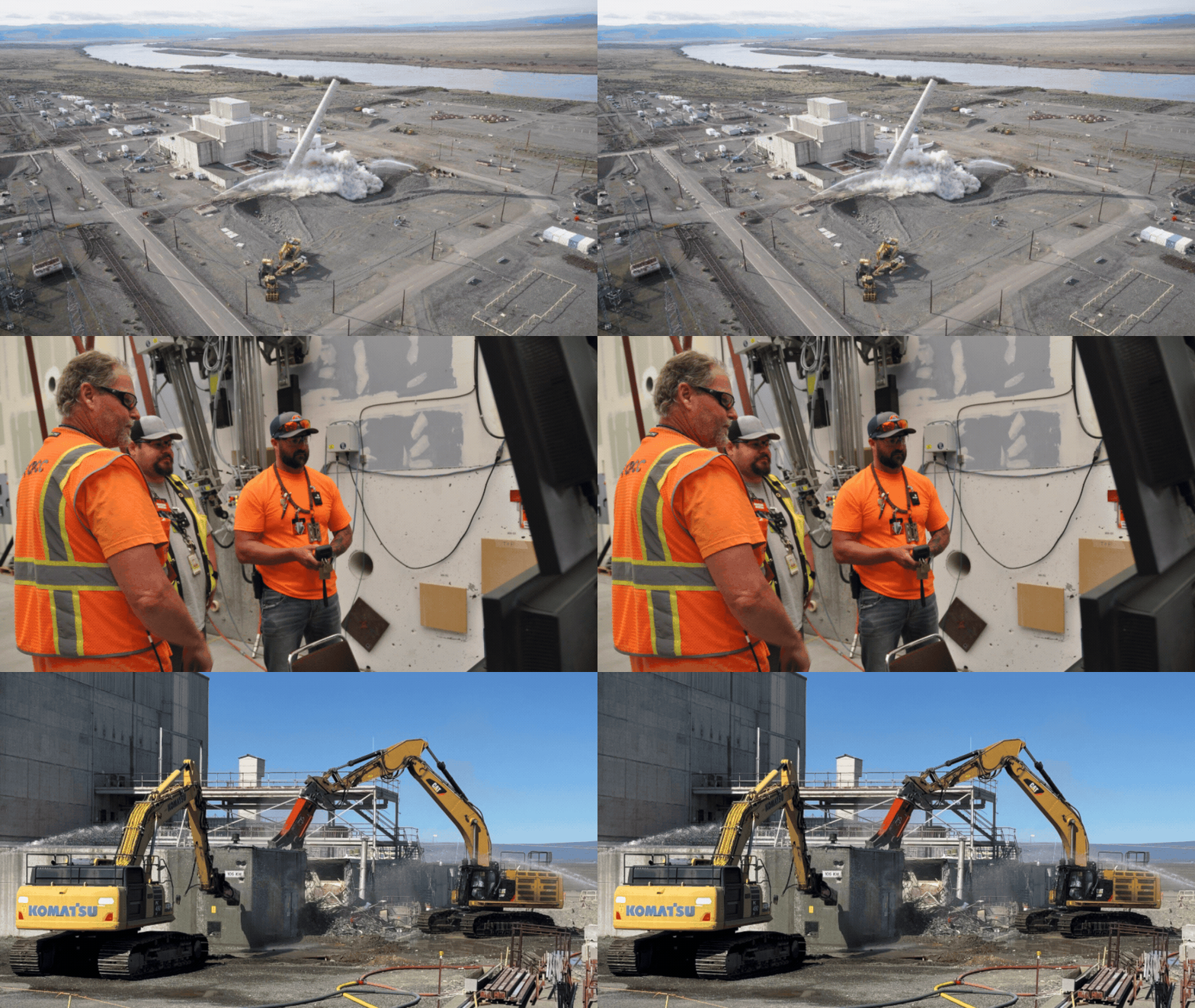 A new Hanford Site cleanup planning structure addresses several risk-reduction projects along the Columbia River and on the Central Plateau. The revised approach is designed to provide greater flexibility and improved alignment between the U.S. Department of Energy and its regulatory partners as the agencies manage the site’s complex and evolving cleanup mission.
RICHLAND, Wash. — The U.S. Department of Energy (DOE) and its regulatory partners have launched a new planning framework that reshapes how cleanup work at the Hanford Site is prioritized and delivered.
This approach is designed to provide greater flexibility, clearer expectations and improved alignment among the agencies as they manage the site’s complex and evolving cleanup mission.
Formally adopted with the signing of a new Tri-Party Agreement (TPA) milestone series, the approach replaces several older sets of cleanup deadlines with a single, integrated structure that collectively addresses the remediation of soil, groundwater and legacy facilities.
This streamlined framework supports continued collaboration among the DOE, U.S. Environmental Protection Agency and Washington Department of Ecology while focusing on achievable near-term commitments and consistent annual schedule reviews to maintain realistic progress across key cleanup areas.
“This is about management of priorities, challenges and opportunities — technical, regulatory or financial,” said Jason Capron, senior technical advisor with DOE’s Office of Environmental Management (EM) Hanford Field Office. “Instead of being locked into deadlines created under past assumptions, we can work together to plan and implement effective cleanup progress based on the most current information available.”
The new approach grew from early discussions that began several years ago, when the parties recognized that long-range TPA milestones no longer aligned with site conditions. Formal negotiations began in 2024, with a tentative agreement package released in 2025 for public comment. The milestone revisions were finalized this spring.
Under the new framework, DOE and Hanford’s regulators will meet each year to evaluate progress, update schedules and align near-term enforceable deadlines with available funding and program needs. A more comprehensive five-year review will guide long-range planning and ensure the structure continues to respond effectively to changing conditions at the site.
The early success of the new approach is already evident. Hanford completed the first enforceable milestone — demolition of the 116KW exhaust stack — several months ahead of schedule, demonstrating how flexibility and shared planning can improve execution and predictability.
“This strategy gives us the ability to match our cleanup commitments with current priorities that can actually be done in the field,” said Jeff Lerch, Groundwater Remediation and Regulatory Strategy deputy director with EM contractor Central Plateau Cleanup Company. “We finally have a process that adapts to the complexity of the mission and provides a framework to deliver on our obligations now and well into the future.”
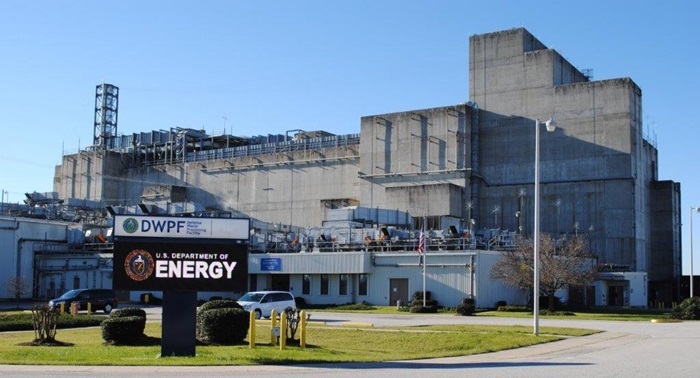 The latest iteration of the Savannah River Site (SRS) Liquid Waste System Plan results in fewer high-level waste canisters to pour to complete the legacy waste cleanup mission at SRS.
AIKEN, S.C. — About 300 fewer high-level waste canisters will need to be poured at the Savannah River Site (SRS) to complete the legacy cleanup mission, thanks to more waste being added per canister and a processing opportunity realized.
SRS Liquid Waste System Plan Revision 24.1 includes two changes that have a cumulative benefit of 300 fewer canisters of glassified high-level waste expected to be poured at the Defense Waste Processing Facility (DWPF). Handling and storing fewer canisters lowers the overall environmental and safety risks to workers and the public.
The plan noted several potential opportunities for efficiencies, two of which have come to fruition since it was published earlier this year, prompting the update. The system plan documents production goals and the strategies in place to meet those goals.
The first of the two changes implemented by SRS liquid waste contractor Savannah River Mission Completion (SRMC) will result in 150 fewer canisters due to a process improvement that allows for more waste to be poured in each canister.
Essentially, this change improves the sludge batch process that feeds DWPF by sending a portion of the waste directly to the tank used to create the batches instead of sending it to a holding tank at DWPF. This improvement not only streamlines the transfer process but also produces a more consistent sludge batch composition. A consistent batch means more waste can be poured into a canister — 5.5% more with this advancement. More waste per canister means fewer canisters in the DWPF lifecycle.
The process improvement also alleviates previous operational constraints between the Salt Waste Processing Facility (SWPF) and DWPF and frees up valuable space within DWPF for additional feed storage, maximizing facility resources and enhancing overall operational flexibility. SWPF and DWPF work together to treat the waste.
Senior Vice President and Optimization and Integration Director Steve Howell said the SRMC team continues to find optimizations that accelerate the U.S. Department of Energy (DOE) Office of Environmental Management mission.
“Continuous improvement is a core value of our mission — whether it’s enhancing safety, streamlining processes or maximizing resources,” Howell said. “Every advancement we make brings us closer to our cleanup goals and ensures we deliver the best possible results for the site, the community and the environment.”
In the second change, DOE's decision to restart uranium recovery at H Canyon discontinues the Accelerated Basin Deinventory program. That change will also result in 150 fewer canisters through DWPF.
-Contributor: Colleen Hart
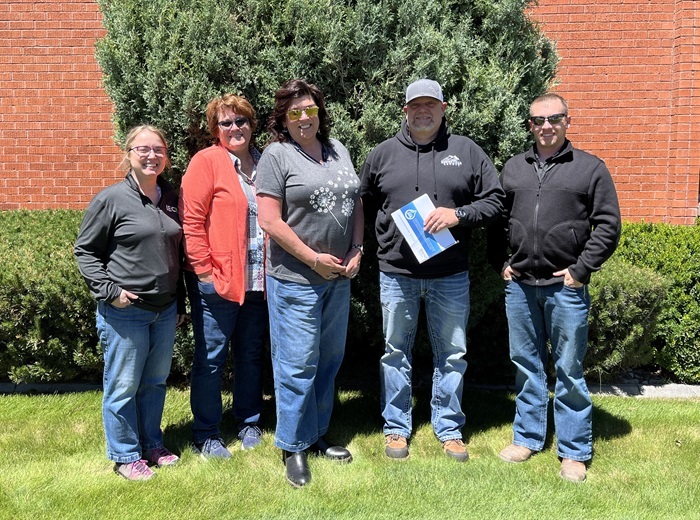 From left, Idaho Environmental Coalition (IEC) Small Business Liaison Elisabeth Warn, MarCom Contracts Manager Sara Moore, MarCom President Marcella Medor, Rivers West Construction President Richard Kennedy, and IEC Supply Chain Inspector Jason Johansen.
IDAHO FALLS, Idaho — Partnerships with two Idaho Falls-based small businesses through the U.S. Department of Energy’s (DOE) Mentor-Protégé Program benefit the Idaho Cleanup Project (ICP) and contractor Idaho Environmental Coalition (IEC) by helping maintain a highly skilled, qualified workforce trained in radiological safety.
Managed by DOE's Office of Small Business Programs, the Mentor-Protégé Program seeks to foster long-term business relationships between small businesses and DOE prime contractors and increase the number of small businesses that receive DOE prime contracts and subcontracts.
In 2023, IEC signed its inaugural agreement under the program with MarCom, whose employees commonly support ICP projects as radiological control technicians. MarCom also provides support in compliance, environmental management, safety and health, and nuclear operations at ICP and other DOE sites across the country.
“Our workforce has expertise in a number of skilled disciplines to support the ICP mission, and the mentorship agreement helps ensure we properly prepare them for these roles,” said MarCom President Marcella Medor. “This ultimately allows us to remain competitive as we bid for projects across the DOE complex.”
IEC signed the second of two agreements with Rivers West Construction in July last year. The Rivers West workforce supports operations at the Radioactive Waste Management Complex at the Idaho National Laboratory (INL) Site. Its crews removed large rocks and boulders to prepare for eventual construction of an earthen cap over a Cold War-era landfill. Additionally, Rivers West assists with general maintenance work across the Advanced Mixed Waste Treatment Project at the INL Site.
“Through the Mentor-Protégé Program, our team at Rivers West Construction has gained invaluable insights in management, business planning and marketing,” said Rivers West Construction President Richard Kennedy. “Working alongside IEC has given us a real partnership, helping us grow and achieve our goals together.”
Under the agreements, IEC serves as the mentor, providing employees with MarCom and Rivers West, the protégés, onsite work experience and business development expertise to enhance the companies' ability to bid on future federal contracts.
“For IEC, MarCom and Rivers West Construction, it has enabled a partnership where we gain from shared expertise,” said IEC Small Business Liaison Elisabeth Warn. “This program builds lasting relationships between DOE prime contractors and small businesses, which bring significant economic value to the communities we serve.”
-Contributor: Carter Harrison
|