 EMTV: At the 24th Annual Intergovernmental Working Group meeting, Assistant Secretary of Environmental Management Tim Walsh presented a video announcing American Energy Hubs, a bold initiative that's transforming former Manhattan Project and Cold War era sites into hubs for affordable energy production, innovation, and advanced manufacturing.
ARLINGTON, Va. — Representatives of states, tribal nations, local governments and communities joined leaders of the U.S. Department of Energy’s Office of Environmental Management (EM) headquarters and field sites for the 24th Annual Intergovernmental Working Group meeting, where Assistant Secretary of Environmental Management Tim Walsh presented a video announcing American Energy Hubs, a bold initiative that's transforming former Manhattan Project and Cold War era sites into hubs for affordable energy production, innovation, and advanced manufacturing.
Stakeholders attending the meeting received updates from Walsh and other members of EM leadership and site representatives on cleanup progress, future priorities and opportunities for collaboration. For many attendees, the meeting marked their first opportunity to hear directly from Walsh regarding his vision for EM’s future. He emphasized the importance of accelerating cleanup while supporting the long-term revitalization of communities surrounding EM sites.
The meeting opened with a tribal invocation delivered by Yakama Nation Councilman JoDe Goudy, who welcomed participants with a prayer and traditional song in his native language.
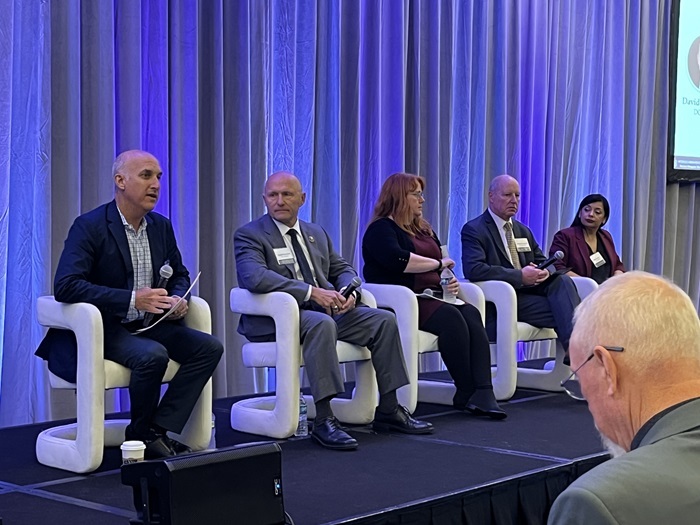 Officials from the U.S. Department of Energy's offices of Environmental Management, Nuclear Energy and Legacy Management, and the National Nuclear Security Administration discuss how their missions intersect during the 24th Annual Intergovernmental Working Group meeting.
Marla Morales, acting deputy secretary for NE, provided an update on DOE’s Energy Innovation Campus initiative, sharing insights into the evaluation process currently underway. Morales noted that of the 28 proposals submitted by states and communities, DOE remains actively engaged in discussions with nine finalists.
Attendees emphasized the importance of maintaining a strong focus on EM’s core cleanup mission. Participants highlighted cleanup achievements and future site opportunities during the session, “Site Transformation: Progressing Cleanup and Preparing for the Future.”
Participants also received updates on Natural Resource Damage Assessment activities at the Oak Ridge, Hanford and Fernald sites. The assessments are processes led by DOE to identify the extent of injuries to natural resources caused by historic operations and to compensate the public for those lost resources. Attendees also received briefings on budget priorities and transportation-related initiatives.
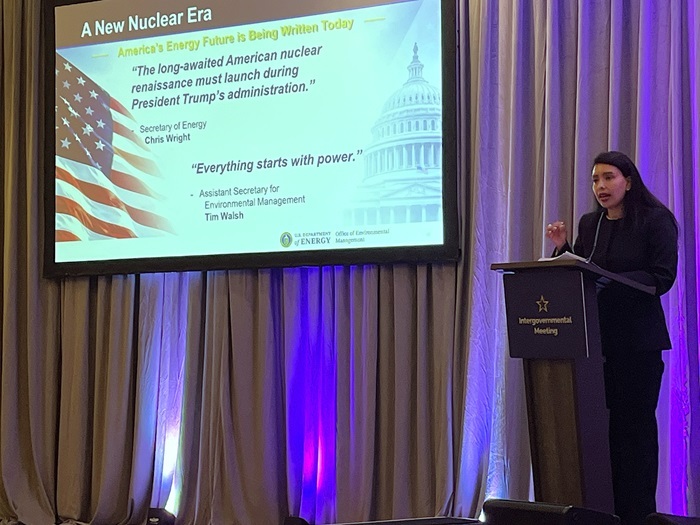 Rosa Elmetti, lead program manager for Nuclear Materials and Used Fuels with the U.S. Department of Energy’s Office of Environmental Management, presents during the session, “Enabling the Nuclear Renaissance and Nuclear Fuel Cycle,” at the 24th Annual Intergovernmental Working Group meeting.
A featured panel brought together leaders from EM, DOE’s offices of Nuclear Energy (NE) and Legacy Management, and the National Nuclear Security Administration to discuss ongoing collaboration across DOE on issues of mutual interest.
The meeting concluded with an interactive roundtable exercise that challenged participants to work through a hypothetical regulatory scenario, encouraging constructive dialogue and collaboration among federal, state, tribal and local partners.
“The conversations and relationships built through the Combined Intergovernmental Working Group are critical to achieving EM’s mission,” said Joceline Nahigian, director of EM’s Office of Intergovernmental and Stakeholder Programs. “By working collaboratively with states, tribal nations, local governments, and communities, we can accelerate cleanup progress, address complex challenges, and support the long-term success of the communities that have hosted DOE missions for decades as we execute the EM mission.”
-Contributor: Jill Conrad
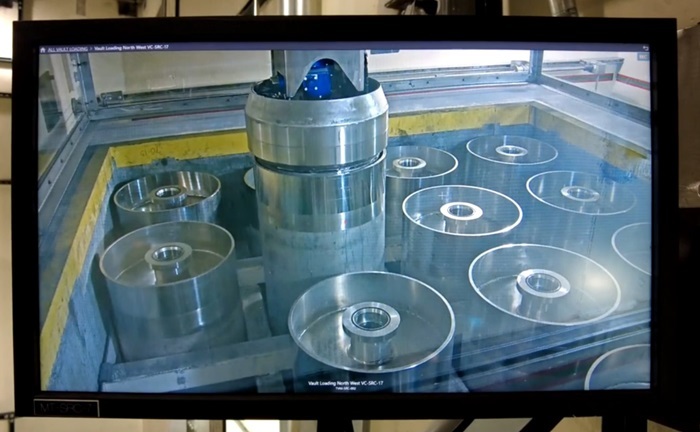 Canisters containing processed sodium-bearing waste are placed and stored in concrete vaults onsite.
IDAHO FALLS, Idaho — Crews have exceeded an important milestone set by the state of Idaho by treating more than 130,000 gallons of radioactive liquid waste during their current processing run at the Idaho National Laboratory (INL) Site.
That brings the Idaho Cleanup Project’s (ICP) total waste processed at the Integrated Waste Treatment Unit (IWTU) to nearly 400,000 gallons to date.
ICP Acting Manager Nick Balsmeier recognized IWTU’s recent accomplishment, emphasizing the facility's progress since commencing radiological operations in 2023.
“Everyone associated with IWTU has consistently demonstrated the dedication and expertise that enables them to achieve and surpass important milestones,” said Balsmeier. “Their efforts are making a significant impact and bring us one step closer to completing the mission.”
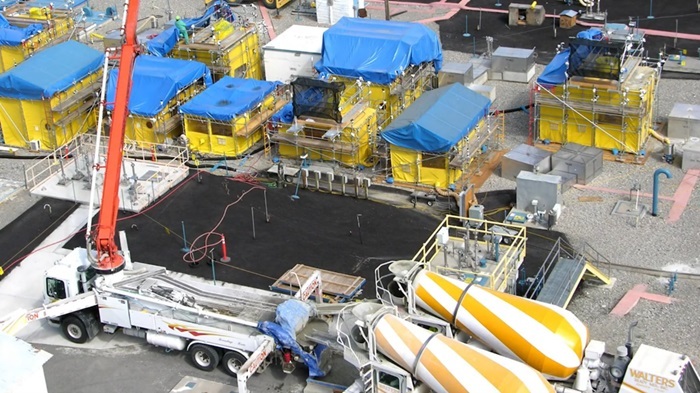 Three underground storage tanks, pictured here, contained liquid sodium-bearing waste at the Idaho National Laboratory Site. The U.S. Department of Energy's Office of Environmental Management crews have since ceased use of one of the three tanks, reducing risk to workers, the public and the environment.
In anticipation of the beginning of radiological operations at IWTU in 2023, the state’s INL Site Treatment Plan required the facility to process 15% of the waste annually based on a three-year rolling average.
“We are incredibly proud of our team at IWTU,” said Dan Coyne, president of ICP contractor Idaho Environmental Coalition. “This achievement underscores their commitment to the mission and their ability to overcome challenges.”
IWTU was constructed to process 900,000 gallons of sodium-bearing waste stored in nearby underground tanks and generated during used nuclear fuel recycling efforts that ended in 1992. The treatment facility converts the liquid waste into a safer granular form, which is placed in stainless steel canisters and stored onsite.
The treatment facility has also achieved other key milestones by processing sodium-bearing waste, meeting conditions of the 1995 Idaho Settlement Agreement after its first run in 2023. That agreement, signed by the U.S. Department of Energy and Idaho, established cleanup priorities for INL. Fulfilling conditions tied to IWTU allowed the INL to accept used nuclear fuel shipments for research.
The process to complete treatment of the liquid waste is expected to take five to seven years, including routine maintenance. Once the waste is fully processed, crews will clean, grout and permanently close the underground storage tanks.
-Contributor: Carter Harrison
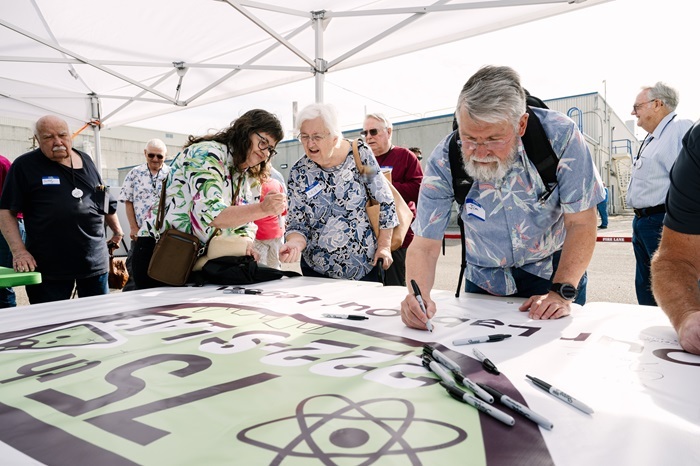 Attendees of the ceremony included special guests, such as staff members of Washington state’s congressional delegation and the Washington State Department of Ecology, along with many retired 222 S Laboratory employees. Some of the retirees are pictured here signing a banner marking the laboratory's 75th anniversary.
RICHLAND, Wash. — The U.S. Department of Energy’s (DOE) Hanford Field Office and contractor Navarro-ATL recently hosted a celebration recognizing the 75th anniversary of the 222-S Laboratory, bringing together employees, nearly 40 retired laboratory alumni, union leadership, regulatory partners, local business representatives, One Hanford organizations and members of Washington state’s congressional delegation to honor the Hanford Site’s longest-serving scientific institution.
Attendees heard remarks from Ricky Bang, deputy assistant manager for Hanford Field Office Tank Waste Operations; Shawn Bills, state director for Sen. Patty Murray; and Ashley Stubbs, deputy chief of staff and district director for Rep. Dan Newhouse. Participation from staff members for Murray and Newhouse underscored the national significance of the laboratory’s role in supporting Hanford cleanup and environmental stewardship.
Bang also read a letter from Assistant Secretary for Environmental Management Tim Walsh.
“On behalf of Environmental Management, I extend my sincere congratulations to the entire 222-S Laboratory team on this remarkable 75-year milestone,” Walsh wrote. “The lab’s longstanding commitment to scientific excellence, innovation and safe operations has been essential to advancing the Hanford cleanup mission and strengthening environmental stewardship across the DOE complex.”
 |
|
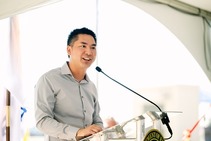
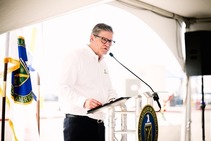
Ricky Bang, deputy assistant manager for Hanford Field Office Tank Waste Operations, addresses participants at the 75th anniversary celebration for the 222-S Laboratory. |
Mark Hughey, general manager of Hanford Field Office contractor Navarro-ATL, speaks during the 75th anniversary celebration for the 222-S Laboratory. |
|
 |
For 75 years, the laboratory has served as the analytical backbone of Hanford’s evolving cleanup mission, providing scientific data that informs critical decisions related to tank waste management, treatment and environmental restoration. Today, the laboratory also helps shape the future of cleanup through innovations that improve efficiency, accelerate decision-making and reduce long-term mission costs.
Long viewed as a small but essential operation at Hanford, the laboratory is emerging from the shadows as Navarro-ATL modernizes its infrastructure and scientific capabilities to build the “Lab of the Future.” This initiative comes as DOE’s Office of Environmental Management advances its dual-path strategy to grout over 3 million gallons of tank waste and ship it out of Washington state for disposal by the end of next year.
“The 222-S Laboratory is one of the most important scientific assets supporting the Hanford cleanup mission,” said Mark Hughey, Navarro-ATL general manager. “We are transforming the laboratory into a modern, high-performing scientific organization that delivers faster analytical results, supports mission-critical cleanup activities and helps reduce risk, schedule and cost for taxpayers.”
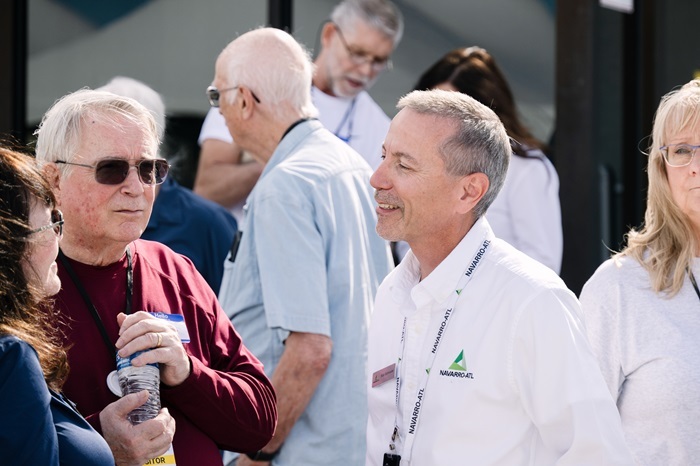 Rob Schroeder, Navarro ATL Analytical Services director, catches up with retired 222 S Laboratory employees during the 75th anniversary celebration.
Bang emphasized that the success of the laboratory is rooted in generations of dedicated employees whose work has supported Hanford’s mission for decades.
“Your efforts and contributions — from scientists and analysts to technicians, finance, safety, quality and environmental professionals — have established the foundation and backbone for what we know about Hanford and how we operate and clean up the site,” Bang said.
Highlighting innovation at the laboratory, Bang pointed to the Twister Stir Bar method Navarro-ATL developed and accredited at the laboratory, which reduced organic sample analysis times from 180 days to 90 days.
“When you save 90 days on every year of work we do here at Hanford, you’re not just improving efficiency, you’re shortening the overall cleanup mission by years and saving billions of dollars in lifecycle costs,” he said. “The same will be true as they support future work in the West Area, where tank waste will be grouted.”
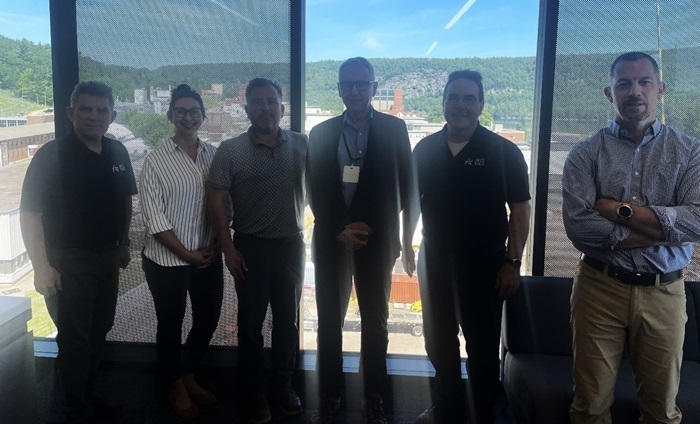
A recent visit to Canada by a senior representative from the U.S. Department of Energy’s (DOE) Office of Environmental Management (EM) facilitated enhanced partnerships between the United States and Canada in the field of nuclear energy. The engagement provided opportunities for both nations to exchange insights on managing used nuclear fuel and highlighted the importance of an integrated fuel cycle as the U.S. enters a new phase of nuclear energy development.
Paul Murray, EM’s senior advisor for used nuclear fuel and high-level waste, met with key organizations including Atomic Energy of Canada Limited and the Canadian Nuclear Laboratories at Chalk River. Through these discussions, Murray emphasized EM’s commitment to recycling and conditioning used nuclear fuel, recovering strategic materials, and developing next-generation capabilities by leveraging extensive technical expertise within the DOE complex to maximize the value of legacy nuclear assets.
Collaborative efforts across borders are essential for advancing nuclear innovation, fostering the sharing of best practices and lessons learned, and expediting the adoption of advanced technologies.
“Partnerships with trusted allies like Canada enable continued dialogue on shared priorities while showcasing the depth of U.S. expertise and EM’s vision for next-generation capabilities in support of the American nuclear renaissance,” said Joceline Nahigian, EM director for intergovernmental and stakeholder programs.
As global expansion of nuclear energy accelerates to bolster energy security, drive economic growth, and meet increasing electricity demands, international cooperation remains indispensable. Partnerships with trusted allies such as Canada reinforce the technical, operational, and strategic foundations required to support the American nuclear renaissance.
Paul Murray is shown fourth from left alongside Canadian officials.
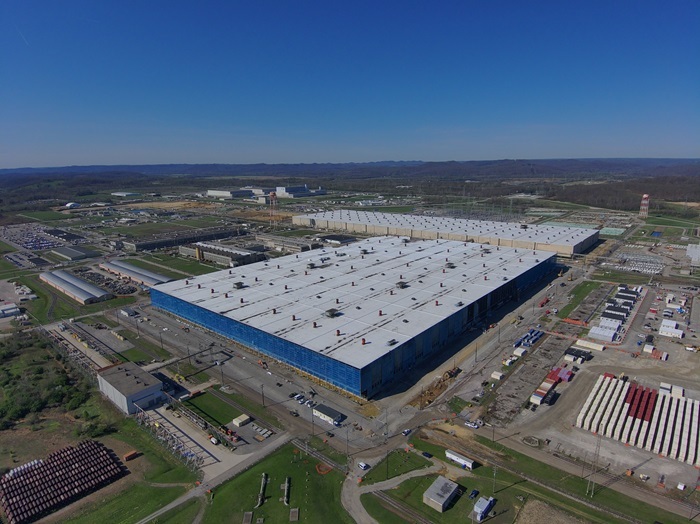 Part of the Portsmouth Site skyline turns blue as the east side of the X-333 Process Building is completely covered in netting. Crews put the material in place piece by piece as they removed transite panels from the building exterior.
PIKETON, Ohio — Heavy equipment and engineered design plans are not the only aspects of facility demolition at the U.S. Department of Energy’s (DOE) Portsmouth Site. Nearly 5,000 linear feet of blue netting stands out against the skyline as a vital safety component in knocking down X-333, the second of the site’s three process buildings set for teardown.
Crews completed many safety measures to prepare for demolition of the 33-acre X-333, among the largest in the DOE complex. They completed facility deactivation; installed fencing; removed above-grade structures and pads around the building; put in a perimeter liner, berm, and water collection and treatment system; added air monitors around the building; and applied fixative to maintain dust suppression.
The first step in structural demolition was removing nearly 15,000 transite panels that contained asbestos. As crews took down panels on the building’s exterior piece by piece, they installed the high-tenacity, flexible-plastic netting.
The netting is used alongside fixative and water applications for dust suppression during demolition, adding to the many safety measures in place to protect the workforce, community and environment.
“This building is so large, in some cases the transite will be removed more than a year before an area is demolished, so the netting keeps any remaining loose material, verified safe to remain inside the building during demolition, from blowing out of the building before an area is brought down,” Federal Project Director Christy Brown said.
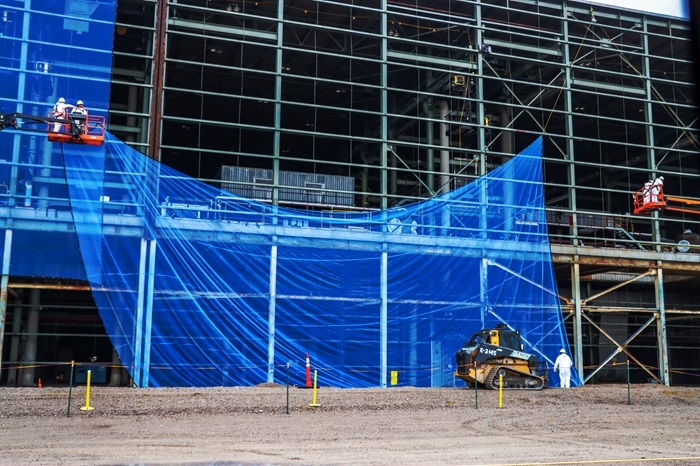 Crews use an aerial lift and pulley system to raise a panel of netting where it will stay until that portion of the X-333 facility is brought down. After demolition, the netting is placed in the On-Site Waste Disposal Facility with the rest of the building debris.
The netting comes in panels 100 feet wide and 60 feet long. It takes around 50 panels to cover the two-story X-333. Crews use an aerial lift and pulley system to raise a panel of netting where it will stay until the area is torn down. After demolition, the netting is placed in the On-Site Waste Disposal Facility with the rest of the building debris.
Covering the building with netting was found to be a best practice after it was used during the demolition of the X-326 Process Building. The additional layer of protection proved effective in that project.
“Our main goal is to clean up the site as safely and efficiently as possible,” Portsmouth Paducah Project Office Acting Deputy Manager April Ladd said. “Safety measures, like the netting, ensure we are protecting our workers and neighbors as we prepare the site for the next generation of energy.”
Demolition of X-333 is set to be completed in 2031.
-Contributor: Cindi Remy
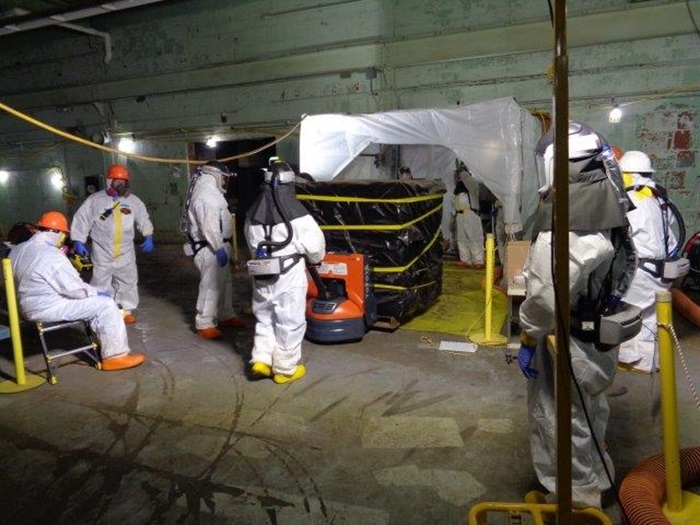 Crews began cleanup efforts inside Alpha-4 in 2022. One of the first tasks involved removing packaged legacy waste from the facility. They completed that work this year.
OAK RIDGE, Tenn. — The Oak Ridge Office of Environmental Management (OREM) has wrapped up a four-year risk reduction effort at a legacy facility after contractor United Cleanup Oak Ridge (UCOR) removed 447 containers of legacy waste from it, moving crews closer to the start of full-scale deactivation and eventual demolition.
One of the largest structures at the Y-12 National Security Complex, Alpha-4 covers nearly 13 acres of land. It was first used for uranium separation during the Manhattan Project and later supported lithium separation before it was shut down permanently in the 1960s.
Crews began cleanup inside the facility in 2022. In one of their first major tasks there, they emptied hundreds of legacy containers and sorted their contents to identify contaminants and determine an appropriate disposal path.
 |
|
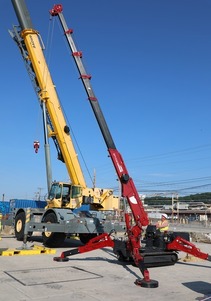
The Oak Ridge Office of Environmental Management is using a spydercrane, or miniaturized crane, for the first time. The crane will remove installed process equipment weighing up to a half ton in confined and low-access areas in the Alpha-4 facility’s high-bay. It is pictured next to a traditional crane for comparison. |
The containers had been stored at Alpha-4 since the 1990s, originating from multiple facilities across the site. They contained a wide range of materials, including piping, valves, personal protective equipment, sludge and other legacy waste from Cold-war era activities.
“Sorting each container and contaminant individually was a lengthy but crucial process as materials inside were unknown since records from previous facility operations did not exist,” said UCOR Alpha-4 Project Manager Brian Hutson. “The lack of records required each container to go through extensive characterization, sorting, segregation, inspection, venting and repackaging into Department of Transportation-compliant containers before it could be safely shipped.”
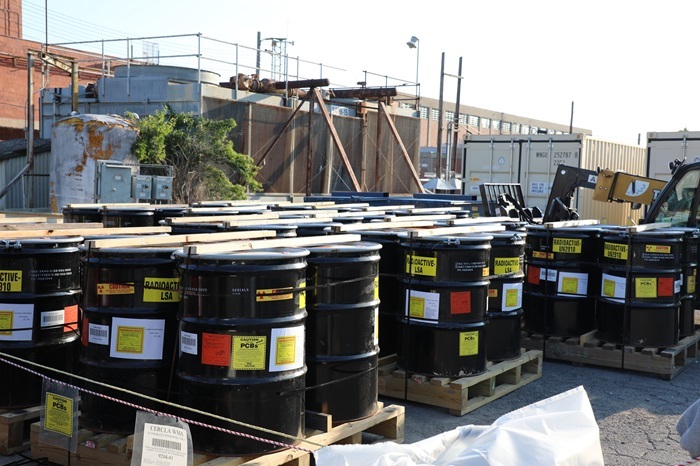 The Oak Ridge Office of Environmental Management has wrapped up a four-year risk reduction effort that involved removing 447 containers of legacy waste from the Alpha-4 facility at the Y-12 National Security Complex.
If crews had not conducted the extensive effort, unknown materials could have complicated future deactivation activities and created difficult-to-manage waste streams without disposal paths that could have prolonged the project and increased costs.
Crews completed this work while also performing sanitization — another crucial step prior to deactivation that involves removing classified items. Workers have already packaged and removed nearly 300 classified items from the facility. Those efforts are 72% complete.
Removing the legacy containers eliminates potential risks and opens space inside the facility to store future sanitization shipments. This is helping accelerate the sanitization process and the deactivation and characterization necessary to complete it.
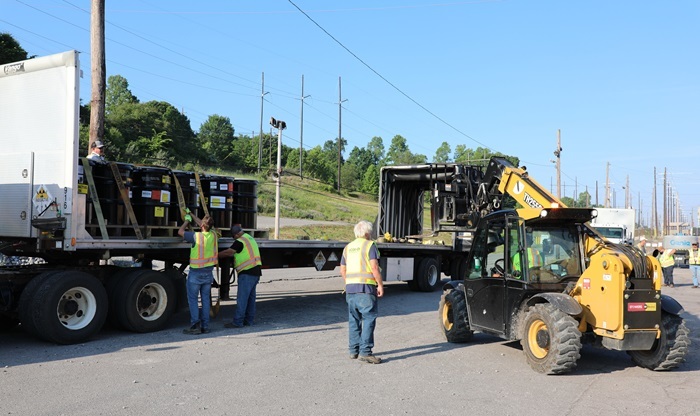 Crews load one of the final shipments of legacy containers from the Alpha-4 facility for disposal.
Next, crews focus sanitization efforts inside Alpha-4’s high-bay using a spydercrane, a miniaturized crane deployed for the first time by UCOR. This equipment will remove process equipment weighing up to a half ton in confined and low-access areas.
With the legacy containers removed and sanitization efforts picking up speed, Alpha-4 teams are moving closer to the next phase of cleanup at one of OREM’s largest and most complex cleanup projects that will transform Y-12 and provide crucial space to support national security missions.
-Contributor: Ryan Getsi
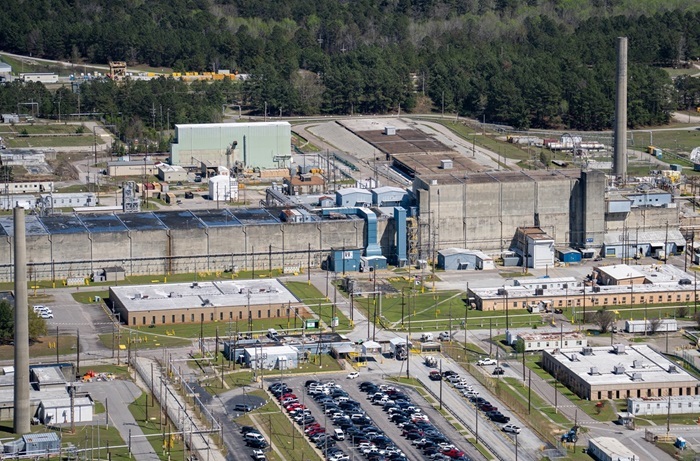 The Savannah River Site’s H Canyon facility.
AIKEN, S.C. — The U.S. Department of Energy (DOE) Office of Environmental Management (EM) is launching a new pilot program at the Savannah River Site (SRS) that shifts maintenance work planning and control processes from a one-size-fits-all nuclear standard to a graded, risk-based approach.
The pilot is in step with a DOE and National Nuclear Security Administration (NNSA) emphasis on urgency and acceleration of work.
It also follows a broader modernization effort to advance non-nuclear, non-complex construction projects by adopting commercial requirements paired with safety standards of Occupational Safety and Health Administration+. That framework is a graded and tailored approach authorized by DOE to align requirements of a federal regulation focused on worker safety and health with commercial construction practices.
EM and SRS contractor Savannah River Nuclear Solutions (SRNS) are working to streamline maintenance and construction requirements while reducing cost and schedule impacts.
For decades, SRS maintenance activities have operated under a work-control procedure that applied uniform, rigorous nuclear-facility standards to every job, no matter how small or regardless of risk. The newly issued procedure addendum introduces fit-for-purpose work packages based on whether a job is classified as low, medium or high risk.
The new approach is projected to cut work package planning cycle times by 65% to 75%, enabling maintenance teams to respond with greater speed and precision, according to Andy Tisler, SRNS senior vice president of Infrastructure Modernization and Sustainment.
“NNSA has emphasized responsiveness and proactive solutions across the Nuclear Security Enterprise, urging teams to anticipate needs and act swiftly,” Tisler said. “With the expected reductions in planning cycle times, this means increasing efficiency where it matters most — supporting mission operations safely and without delay.”
The pilot will initially focus on maintenance activities at the site’s H Canyon, the nation’s only operating, production‑scale, radiologically shielded chemical separations facility. Earlier this year, EM announced the decision to restart operations at the site’s HB Line, which is integral to H Canyon.
“Implementing these new processes will significantly improve our efficiency and effectiveness,” said Kevin Moeller, SRNS H Canyon Facility manager. “In H Canyon, where operational tempo is high and legacy infrastructure requires constant attention, the ability to streamline work preparation without compromising safety is a major step forward for mission readiness.”
-Contributor: Mackenzie McNabb
|