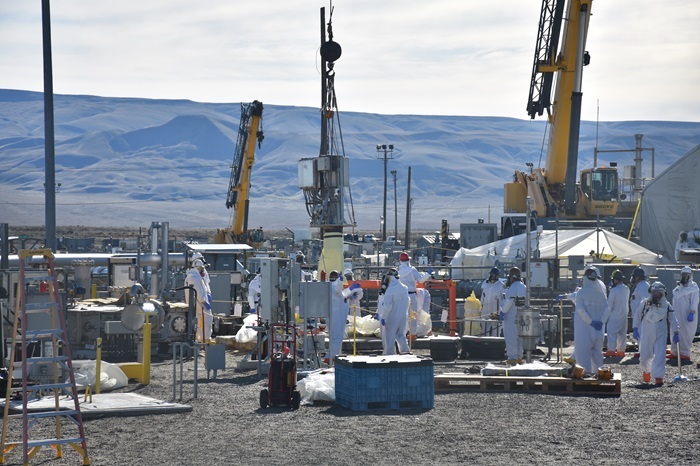
 Workers remove a portion of an old pump in Tank SY-101 in the Hanford Site’s 200 West Area.
RICHLAND, Wash. — The U.S. Department of Energy’s (DOE) Office of Environmental Management is taking a big step forward in its tank waste cleanup effort in the 200 West Area of the Hanford Site.
Contractors are upgrading infrastructure, utilities, offices and other essential equipment as they prepare to remove radioactive and chemical tank waste left from decades of national security missions.
The 200 West Area has seven groups of underground waste storage tanks called tank farms. For years, most cleanup and retrieval activities focused on the 200 East Area, where the largest and most radioactive amount of Hanford’s tank waste is stored. Now, work is shifting west, where the other large volume of this waste remains. Crews are starting from scratch in 200 West, upgrading and installing the infrastructure needed to retrieve and treat waste in an area that hasn’t seen large-scale progress before.
“The work happening now in 200 West moves us from planning to putting real solutions in action,” said Ricky Bang, the Hanford Field Office’s deputy assistant manager for Tank Waste Operations. “By updating infrastructure and using technology that’s already proven effective elsewhere at Hanford, we’re making sure the site is ready for safe waste retrieval and treatment.”
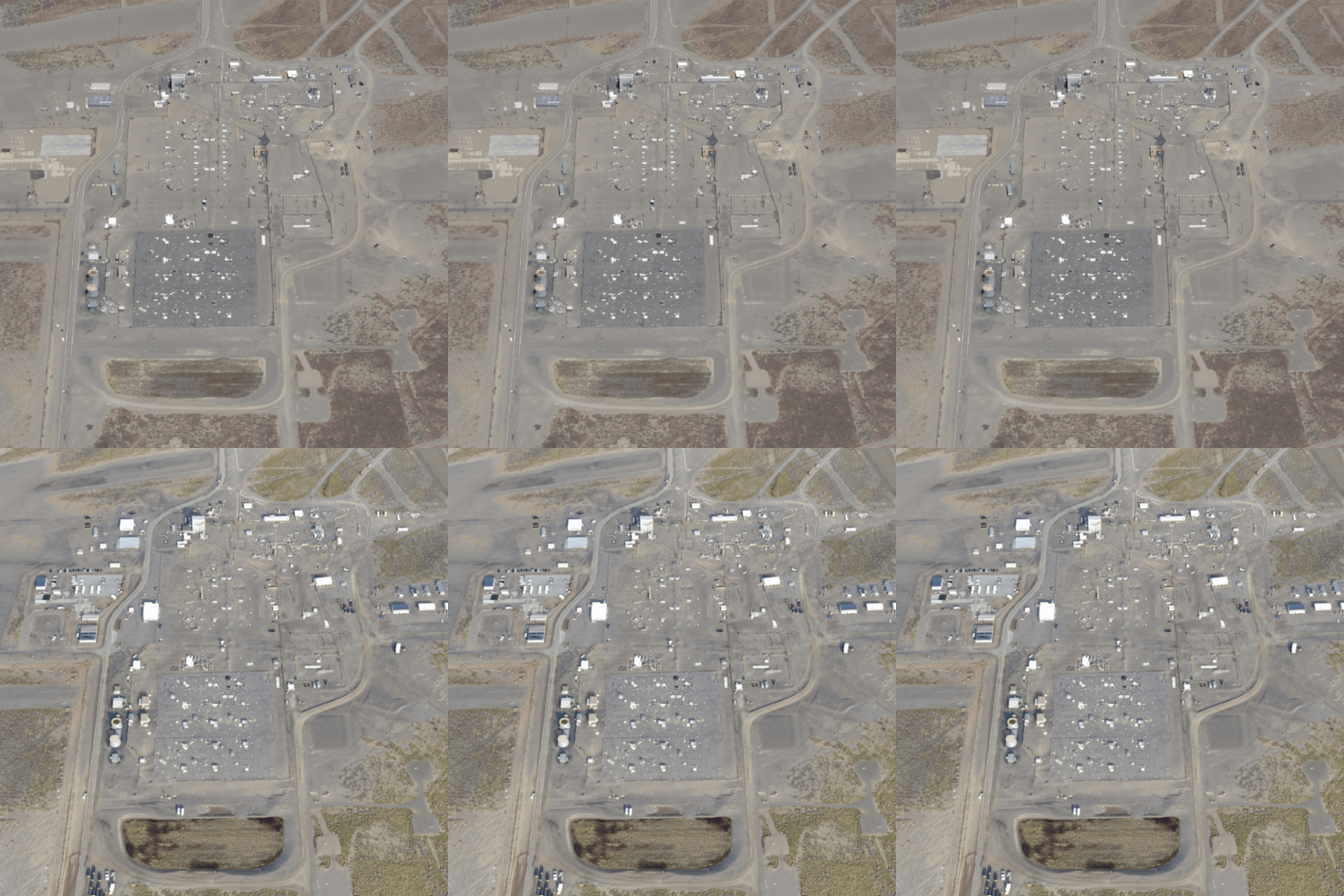 Aerial views of the Hanford Site’s 200 West Area in 2024 and 2026. The S, SX and SY tank farms are visible. In 2026, new office trailers and support buildings for SY Farm can be seen in the upper right.
Crews with contractor Hanford Tank Waste Operations & Closure (H2C) are constructing major upgrades at SY Farm, the only double-shell tank location in 200 West. Some of the projects include improving ventilation, removing outdated equipment and testing a seven-mile pipeline connecting SY Farm to the 200 East Area, making sure waste can be moved if needed.
A major focus is the West Area Risk Management System. This new system will treat waste using modular technology proven in the 200 East Area as a key step before safe disposal. An option for disposal is to stabilize waste in grout, much like the recent Test Bed Initiative project demonstrated. This approach is outlined in the 2025 Holistic Agreement between DOE, the state of Washington and U.S. Environmental Protection Agency.
“We’re proud to help turn plans into progress,” said Max Ehrhardt, project manager for H2C. “By putting the right systems in place, we’re getting 200 West ready for cleanup and keeping the mission moving forward.”
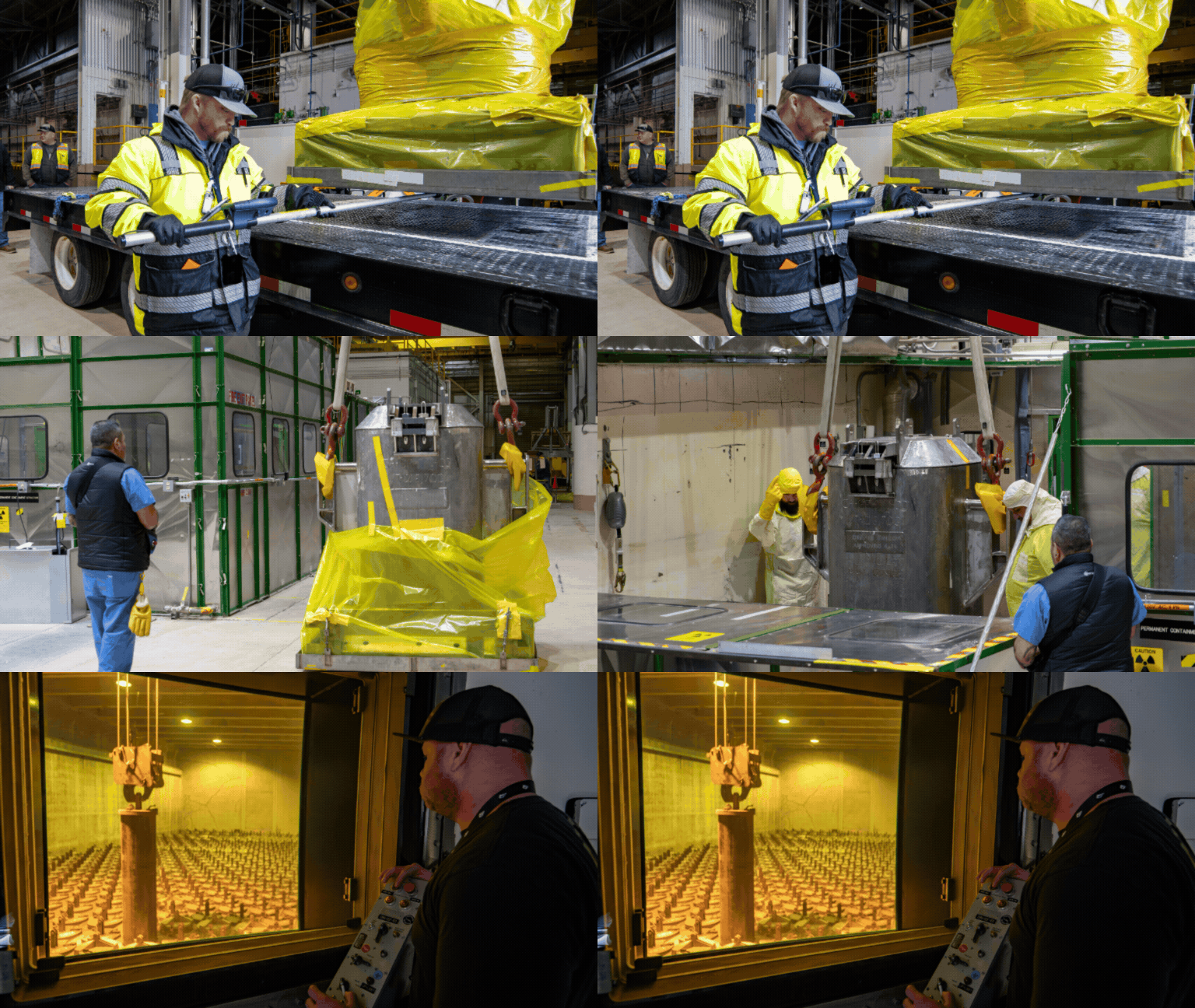 Advanced Test Reactor used nuclear fuel casks are shipped to the Idaho Nuclear Technology and Engineering Center, surveyed and loaded into a containment structure where operators can remotely place the fuel into dry storage.
IDAHO FALLS, Idaho — Idaho Cleanup Project (ICP) crews have received all 10 used nuclear fuel shipments for the current fiscal year from the Advanced Test Reactor (ATR) at the Idaho National Laboratory (INL) Site.
This work is part of a long-standing effort by the U.S. Department of Energy Office of Environmental Management to ensure safe long-term storage of the fuel and support the INL’s research mission.
ATR fuel has been sent to the Idaho Nuclear Technology and Engineering Center (INTEC) for storage since the reactor became operational in 1967. For most of the last 59 years, the fuel was placed in INTEC’s large storage pool. However, starting in 2019, ATR fuel casks have been received, dried and placed into dry storage at INTEC’s Irradiated Fuel Storage Facility (IFSF), in compliance with the 1995 Idaho Settlement Agreement.
IFSF maintains unique infrastructure, including large cranes and containment structures, allowing crews to safely move the casks and remotely place the fuel into storage.
By receiving these shipments, the ICP not only ensures the safe long-term management of used nuclear fuel but supports the INL by ensuring critical operational space is available at the ATR and its cooling canal.
-Contributor: Carter Harrison
ARLINGTON, Va. — The U.S. Department of Energy's (DOE) Office of Environmental Management (EM) will showcase its crucial role in shaping America's energy future at the 2026 National Cleanup Workshop.
This year’s event, scheduled for Sept. 14-16 at the Crystal Gateway Marriott in Arlington, Virginia, will highlight how EM's mission to address the legacy of past defense and nuclear research programs contributes to an affordable, reliable and secure energy landscape for the United States.
The central theme of this year's workshop is “Powering and Securing the Future Through Restoration and Revitalization.” Distinguished speakers from EM's leadership team will present during the workshop, including:
- Assistant Secretary of Environmental Management Tim Walsh
- Principal Deputy Assistant Secretary Joel Bradburne
- Chief Operating Officer David Brunnert
Key topics to be explored at the workshop include how EM's cleanup efforts strategically position the U.S. for future energy leadership by enabling the reuse of valuable land and resources, opportunities for EM to contribute to DOE’s Genesis Mission and the intersection of legacy cleanup and DOE efforts to modernize the U.S. nuclear deterrent.
By addressing the complex challenges of nuclear waste and contaminated sites, EM is creating tangible benefits for communities, fostering scientific research and supporting economic development — all integral to a robust national energy strategy.
The 12th annual workshop is hosted by Energy Communities Alliance in cooperation with the Energy Facility Contractors Group and EM.
Click here for more information on the workshop.
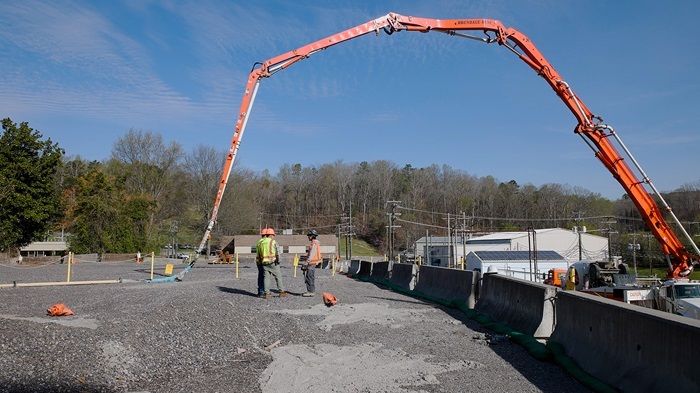 A pump truck, stationed outside a high-security area in the heart of the Oak Ridge National Laboratory central campus, uses 400 feet of piping to fill underground ducts with a cement mixture. This task isolates Building 3002 from neighboring facilities for safe demolition.
OAK RIDGE, Tenn. — Cleanup crews in the Oak Ridge National Laboratory (ORNL) central campus have filled 120 feet of underground ductwork connecting multiple facilities with a cement mixture to isolate them for safe demolition and avoid potential impacts to neighboring buildings.
The Oak Ridge Office of Environmental Management and cleanup contractor United Cleanup Oak Ridge (UCOR) completed the project to prepare for demolition of Building 3002, a former filter house used to clean exhaust from the nearby historic Graphite Reactor. The two buildings are connected by the concrete ductwork, which posed a potential pathway for contaminants when the demolition begins.
The work at Building 3002 is part of a broader cleanup that’s steadily removing risks and transforming the heart of the ORNL central campus to enable future modernization.
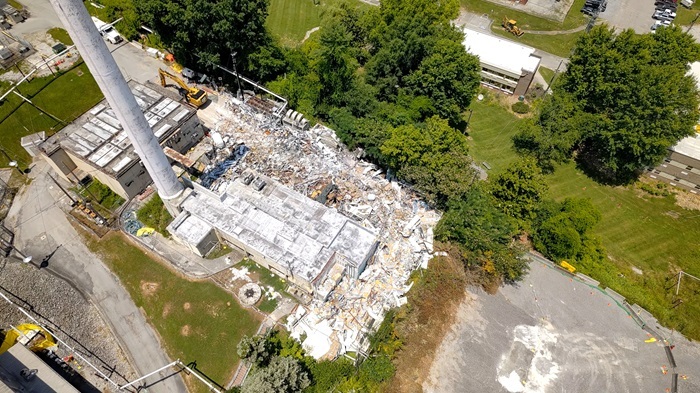 An aerial view of the Graphite Reactor support facilities, which are comprised of Building 3002, at left, and Building 3018, a 200-foot-tall stack, at center. Crews took down Building 3003, at right, last year.
Crews previously demolished Building 3003 — a fan house that provided essential ventilation to the Graphite Reactor — opening 10,000 square feet to prepare for this next demolition.
Constructed in only nine months, the Graphite Reactor achieved criticality in 1943, and it was the world’s first continuously operating nuclear reactor. Its initial mission involved showing plutonium could be extracted from irradiated uranium. After the Manhattan Project, it supported nuclear energy and medical research missions.
The reactor was shut down in 1963, and it was designated a national historic landmark in 1965. Today, the facility is part of the Manhattan Project National Historical Park at Oak Ridge.
“The team’s ability to safely isolate these facilities protects a nationally significant historic landmark while advancing cleanup in a complex operating environment,” said Steve Clemons, ORNL portfolio federal project director. “This work moves us another step closer to our next project that will continue ORNL’s transformation.”
Conducting the concrete mixture pours presented challenges, including a steep hillside that complicated equipment placement and identifying alternate routes for concrete trucks through nearby high-security areas.
The solution involved crews assembling 400 feet of piping and connecting it to a pump truck staged outside the protected area. This approach enabled precise placement of 200 cubic yards of the concrete mixture while avoiding disruption to the historic facility and minimizing security challenges.
“This innovative approach allowed our crews to safely execute complex work while maintaining security boundaries and protecting critical infrastructure,” said UCOR Project Manager Zachary Dew. “It’s a strong example of how we’re solving challenges in the field to keep cleanup moving forward.”
-Contributor: Ryan Getsi
WEST VALLEY, N.Y. — Workers safely and successfully replaced 36 filters in a ventilation system for an underground waste-tank vault at the West Valley Demonstration Project, ensuring continued removal of airborne contaminants.
The ventilation system, made of mostly high-efficiency particulate air filters each 4 square feet in size and weighing up to 60 pounds, controls moisture and works in concert with a drying system to reduce humidity and corrosion.
U.S. Department of Energy Office of Environmental Management crews have removed more than 98% of persistent radioactivity from the two 760,000-gallon tanks and two 14,300-gallon tanks, which once held high-level waste from commercial used fuel recycling operations decades ago. Workers vitrified that waste, or solidified it in glass, into 278 canisters for permanent disposal. They processed most residual liquid, and about 4,000 gallons of liquid and sludge remain in one of the tanks, targeted for removal in upcoming years. West Valley is also evaluating tank closure alternatives.
 |
|
Workers remove one of 36 filters for a ventilation system in the underground waste-tank vault at West Valley Demonstration Project. The system provides ventilation to reduce humidity and corrosion in the four tanks. |
Workers safely placed a filter for the ventilation system in a box and transported it on a cart to a location where it was packaged inside a waste container for disposal. |
|
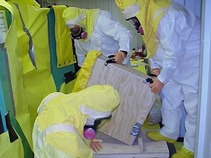 |
Before beginning the filter changeout, employees built a mock-up to identify hazards, refine techniques, determine equipment needs and strengthen safety measures.
“The mock-up allowed us to practice the removal and replacement of filters to gain insight and experience,” said Bill Freaney, Waste and Site Operations supervisor. “Time spent practicing helped us design the tools, develop a strong work instruction package, and determine the safest and most effective techniques.”
To complete the project, crews used a specially designed tool to pull each filter into a box, which they sealed. A radiation control technician checked for contamination. If none was detected, workers packaged the filters for offsite disposal with the help of a forklift.
“The preplanning for this work activity was excellent,” said Stephen Bousquet, assistant director for West Valley’s Office of Project Management. “This is how the U.S. Department of Energy Office of Environmental Management will continue to advance safe, compliant progress at the site — by applying lessons learned to enhance safety, improve efficiency and reduce exposure to potential hazards.”
-Contributor: Joseph Pillittere
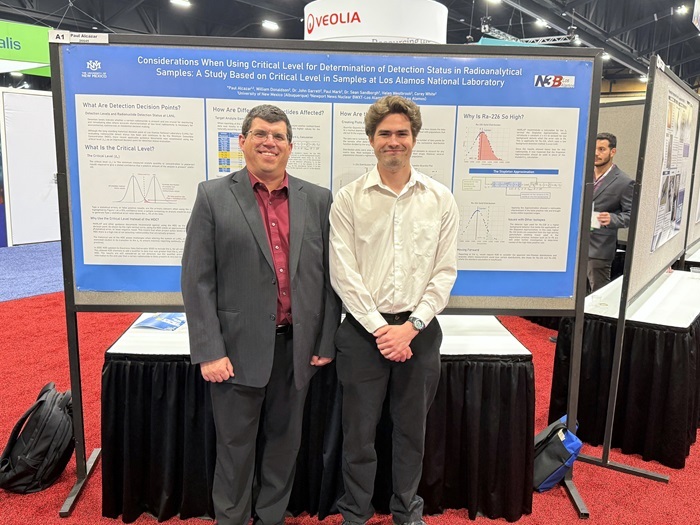 Paul Alcazar, right, an intern with Newport News Nuclear BWXT-Los Alamos LLC, poses with his winning poster, along with mentor and supervisor Sean Sandborgh, during the 2026 Waste Management Symposia in Phoenix, Arizona.
LOS ALAMOS, N.M. — Companies are constantly searching for ways to attract the best and brightest people. It is no different for Newport News Nuclear BWXT-Los Alamos LLC (N3B), as the legacy cleanup contractor for the U.S. Department of Energy’s Environmental Management Los Alamos Field Office recruits top talent and implements strategies to retain its current employees.
N3B conducts the cleanup of legacy contamination and waste resulting from nuclear weapons production and research during the Manhattan Project and Cold War at Los Alamos National Laboratory.
“We are constantly competing for talent,” said Jessica Pascual, N3B chief human resources officer. “Recruiting and hiring the best candidates is a challenge. Equally important is developing our current employees, ensuring they are valued and have challenging and fulfilling work.”
Paul Alcazar is an example of how this strategy benefits N3B and its employees. In March 2025, N3B awarded Alcazar the Danny Nichols and Dennis Huddleston Memorial Scholarship, which helped him attend the University of New Mexico-Los Alamos, where he studies chemistry.
In June 2025, N3B hired Alcazar as an intern. Soon thereafter, his supervisor, Sean Sandborgh, sample and data management director, and colleagues recognized his talent and ambition.
During his internship, Alcazar submitted a technical research paper to the 2026 Waste Management Symposia in Phoenix, Arizona. Based on his research, Alcazar’s poster presentation, “Considerations When Using Critical Level for Determination of Detection Status in Radioanalytical Samples,” was selected by the conference organizers as the winner of the Undergraduate Student Technical Poster Competition.
Since 2020, N3B has awarded 21 scholarships worth an estimated $200,000. Many recipients have joined N3B as interns and employees.
“Investing in talent development programs can be a highly effective strategy for addressing recruitment challenges,” Pascual said. “By offering professional development to existing employees, N3B supports the advancement of people in their careers. This approach fosters employee loyalty, reduces turnover and allows for the organic growth of talent at N3B.”
-Contributor: Donavan Mager
|