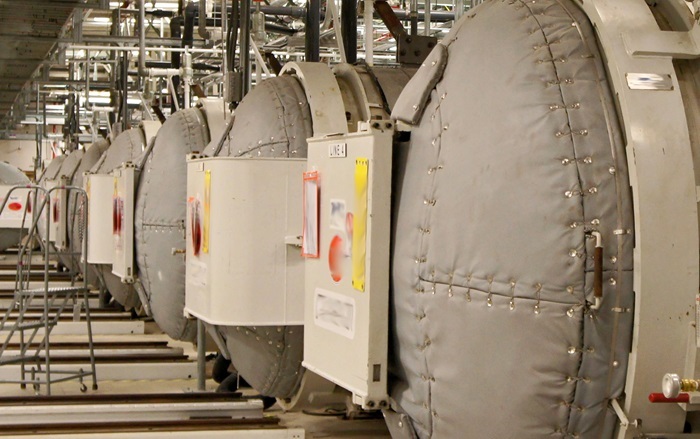
 Autoclaves, part of the equipment used in the depleted uranium hexafluoride (DUF6) conversion process, stand in the Paducah Site’s DUF6 conversion facility.
LEXINGTON, Ky. — Decades of uranium enrichment operations at two former gaseous diffusion plants yielded thousands of cylinders of depleted uranium hexafluoride (DUF6) that accumulated in storage yards. Now, with a nuclear renaissance underway, opportunities to reuse that material are on the horizon.
“We’ve been looking at this for more than decade because we know DUF6 is a valuable material and this focus on nuclear revitalization helps us get there,” Portsmouth Paducah Project Office (PPPO) Operations and Site Mission Support Acting Lead Chris Richards said. “Our ultimate goal is to decrease inventory, but we must be strategic in how we do that.”
Inventory reduction occurs when cylinders are processed through conversion facilities at the Portsmouth, Ohio, and Paducah, Kentucky, sites or reused by other U.S. Department of Energy (DOE) organizations, such as the National Nuclear Security Administration (NNSA), and private sector entities.
That’s where the cylinder management database proves to be critical. Records kept from decades of uranium enrichment operations provide valuable information about the more than 67,000 cylinders stored at the sites, such as their size and the assay of the material inside them. Assay is the concentration of a specific isotope within a material. In this case, it’s the percentage of uranium-235, the isotope needed for fission in nuclear reactors.
“There’s a delicate balance we go through,” Richards said. “We want to be good stewards of the taxpayer dollars and work in the best interests of the government and support the local communities. We need to ensure we have an inventory of cylinders to process through the conversion plants.”
 |
|
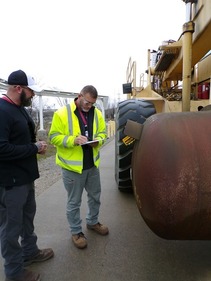
Depleted Uranium Hexafluoride (DUF6) Cylinder Yard Operator Scott Chandler, left, and Operations Shift Supervisor Dan Whitley complete paperwork to accept a cylinder entering the conversion process at the Portsmouth Site’s DUF6 facility. |
A team from contractor Mission Conversion Services Alliance manages the database. Team members look for a specific type of cylinder, based on the material or quantity of material inside the cylinder, to be processed in the conversion plants. Next, they dig through the records to provide characterization of the cylinders.
General Matter and Global Laser Enrichment are interested in reusing a portion of the cylinders. PPPO teams worked with the companies to determine their needs.
“The database became a one-stop shop,” Richards said. “We filtered out criteria to identify what cylinders could be made available to General Matter and Global Laser Enrichment based on their requests.”
As part of a lease agreement, PPPO is providing General Matter with a minimum of 7,600 cylinders to supply fuel for future uranium re-enrichment operations. PPPO plans to provide approximately 25,000 cylinders to Global Laser Enrichment as feedstock for a laser enrichment facility to be built adjacent to the Paducah Site.
Richards said such partnerships are a perfect example of transitioning from nuclear remediation to nuclear revitalization, a key priority for DOE’s Office of Environmental Management.
When a DUF6 cylinder is processed, it generates two coproducts: uranium oxide, which is stored for eventual disposal or reuse, and hydrofluoric acid, which has many reuse opportunities, including the metal processing and glass industry.
-Contributor: Sarah Marko
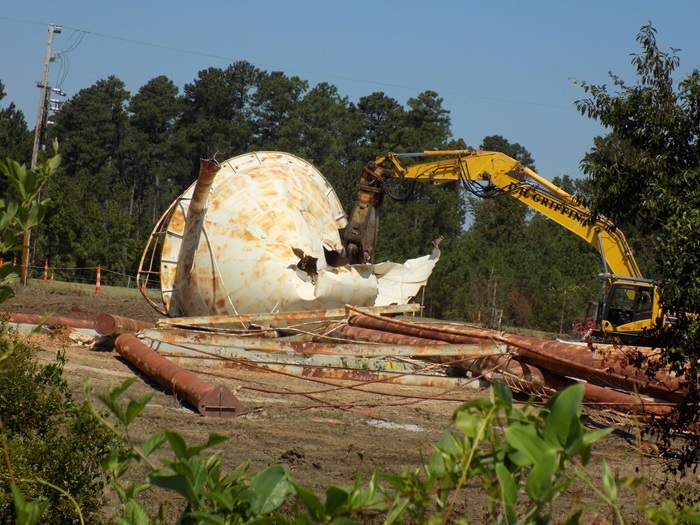 Crews shred an obsolete water tower for scrap metal in the D Area of Savannah River Site.
AIKEN, S.C. — U.S. Department of Energy (DOE) Office of Environmental Management (EM) teams are tackling extensive decommissioning and demolition efforts, transforming an area of the Savannah River Site (SRS) into an asset for future development.
Since 2021, crews have been conducting decommissioning and demolition work in the site’s D Area to reduce hazards and prepare for reuse of land.
In a recent milestone, teams in D Area removed over 640 tons of scrap metal and 617 tons of asbestos, making significant strides toward reducing the cleanup footprint. Clearing out old pipelines in D Area has also been a key step in readying the area for future projects.
“The collaborative work of the team has not only enhanced safety and efficiency but has also set a high standard for integrating environmental stewardship with long-term development opportunities,” DOE-Savannah River Office of Closure and Project Management Director Karen Morrow said. “As SRS continues its work, the transformative efforts in D Area are an example of fostering a successful vision of responsible sustainability, revitalization and innovation.”
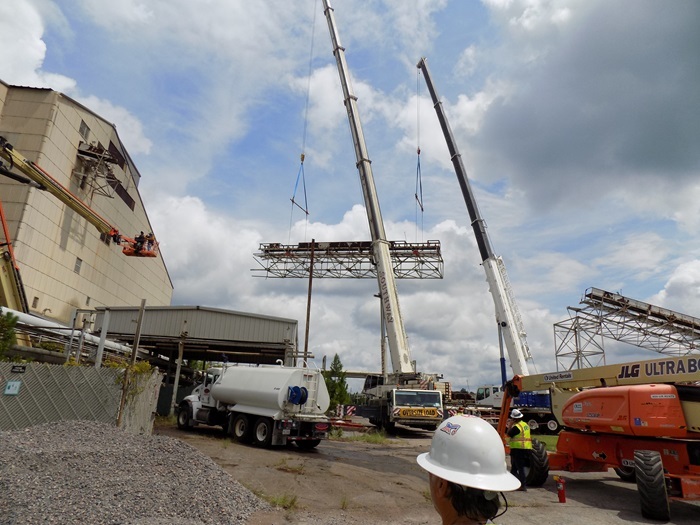 Workers remove a conveyor belt once used to transport coal to the D Area powerhouse at Savannah River Site.
EM contractor Savannah River Nuclear Solutions (SRNS) has successfully navigated the challenges of permits, regulations and jobsite coordination to bring a vision of new development to life, with plans to install meteorological equipment to monitor weather patterns underway.
D Area facilities once produced heavy water for nuclear reactors and generated steam and electricity to support much of what was previously known as the Savannah River Plant, which was developed in the 1950s.
-Contributor: Fallan Flatow
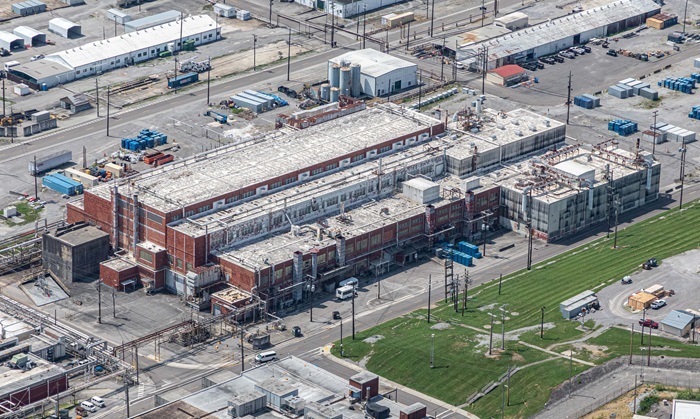 Constructed in 1945, the Beta-4 facility takes up 360,000 square feet of space at the Y-12 National Security Complex.
OAK RIDGE, Tenn. — Oak Ridge crews are deactivating Beta-4, which spans the equivalent of nearly seven football fields, as similar preparations for demolition draw to a close at another former Manhattan Project-era uranium enrichment facility, Beta-1, at the Y-12 National Security Complex.
This marks a significant step forward in the Oak Ridge Office of Environmental Management’s (OREM) effort to remove legacy hazards, enable modernization and open space for important national security missions at Y-12.
The National Nuclear Security Administration (NNSA) enabled this latest milestone by transferring operational responsibility of the 360,000-square-foot Beta-4 to OREM for the characterization, deactivation and demolition work.
Following demolition, the footprint will be returned to NNSA to support critical mission needs.
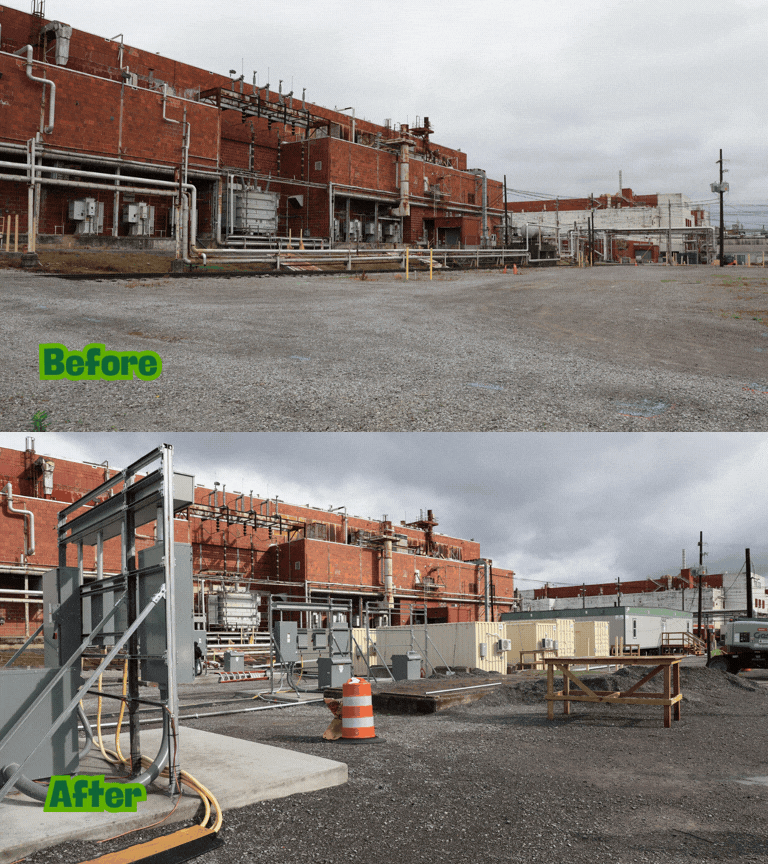 Before-and-after views of Beta-4’s footprint. Workers installed temporary structures and prep areas to support cleanup crews working on the facility’s deactivation.
Some United Cleanup Oak Ridge (UCOR) crews are performing characterization work at Beta-4 — sampling equipment and materials to support safe waste removal, packaging and disposal — while others are busy with “cold and dark” activities — isolating utilities, removing hazards and verifying systems are safely shut down.
The crews are already a step ahead after completing a major infrastructure project laying the groundwork for the current phase of cleanup at Beta-4. They built several temporary structures to position craft professionals and support teams closer to the facility, reducing travel time across the site for equipment and resources. This infrastructure will also support other major cleanup projects nearby.
“This infrastructure is the work before the work that will allow our teams to be closer to cleanup,” said Tanner Holsomback, UCOR project manager for Special Partnership Programs. “By reducing time spent away from the jobsite, we’re increasing productivity and setting the stage for successful deactivation and demolition at Beta-4.”
This next phase of cleanup highlights the broader momentum happening across Y-12 as crews reduce risk and help transform the site for new uses.
-Contributor: Ryan Getsi
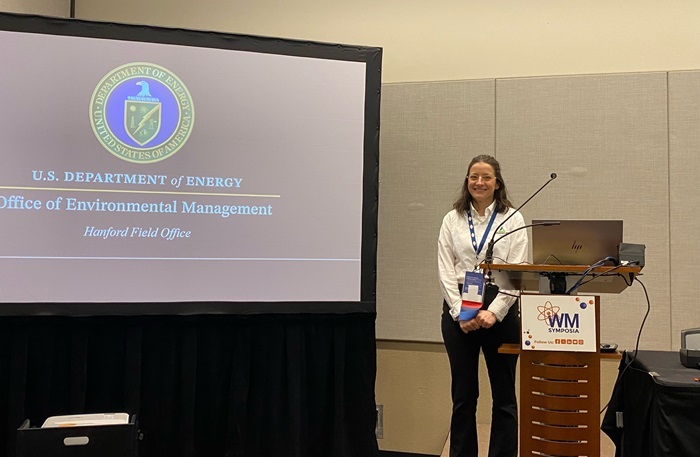 Chemist Bojana Leonard presents her iodine-129 research at Waste Management Symposia earlier this year.
Advancing Cleanup, Protecting the Environment and Building the Lab of the Future
RICHLAND, Wash. — The U.S. Department of Energy’s (DOE) Hanford Field Office (HFO) is applying scientific innovation to accelerate cleanup progress.
At the Hanford 222-S Laboratory, scientists with contractor Navarro-ATL are tackling some of the site’s most complex chemistry challenges, helping improve cleanup safety, efficiency and predictability.
Their work — from advancing radioactive iodine analysis to preventing chemical conditions that slow tank waste retrieval — supports the DOE’s Office of Environmental Management mission to reduce risks and protect the environment.
Two recent research efforts highlight the impact of this innovation. One focuses on improving the detection of iodine-129 in tank by-product, while the other helps prevent phosphate gelling during saltcake retrieval. Together, they demonstrate the high caliber of scientific capabilities within the laboratory.
“Innovation is a big part of how we keep the lab relevant and help move the cleanup mission forward,” said Mark Hughey, general manager for Navarro-ATL. “Our team is always looking for smarter, more precise, and more efficient ways to deliver the data the Hanford Site depends on.”
Understanding Iodine-129
Iodine-129 is a long-lasting radioactive by-product from past plutonium production at Hanford. It exists in underground tanks and moves easily through the environment, creating unique treatment challenges.
Shortly after chemist Bojana Leonard joined the laboratory, she was asked to help improve understanding of iodine quantities and chemical forms in tank by-product — information essential for predicting its behavior during treatment and ensuring effective disposal and emissions management.
Leonard developed a more precise method that gives operators clearer insight into how iodine behaves during filtration, evaporation and vitrification. Her work strengthens the laboratory’s ability to support a faster pace of by-product treatment at Hanford and reflects the lab’s technical expertise.
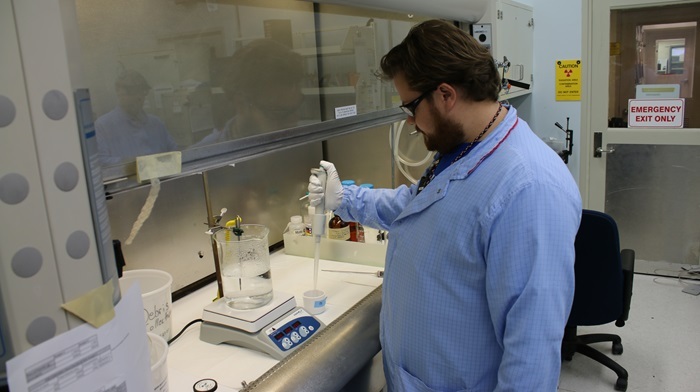 Scientist Caleb Mortensen conducts saltcake retrieval testing at 222-S Laboratory.
Preventing Gel Formation During Retrieval
Tank waste retrieval depends on the chemicals remaining flowable. In some older single-shell tanks, certain chemicals can form a thick gel-like mass during saltcake retrieval, clogging pumps, interrupting operations and prolonging time hazardous materials remain in aging tanks.
Navarro-ATL chemists Caleb Mortensen and Thomas Ely are leading a multiphase study to identify chemicals that prevent this gel formation. Early laboratory results show strong potential to reduce retrieval interruptions, limit worker risk and decrease water use, which supports cost savings.
Why It Matters
As Hanford accelerates by-product retrieval and treatment for long-term disposal, Navarro-ATL’s research enhances the predictability, efficiency and safety of operations. More accurate and timely measurements help avoid costly downtime, reduce by-product-handling uncertainties and strengthen stewardship of public resources, proving that stronger science leads to better cleanup outcomes.
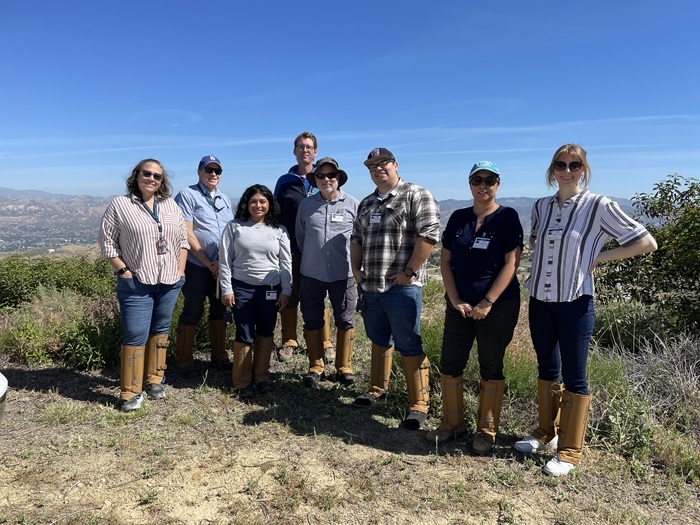 A group from Ventura County Air Pollution Control District’s Planning, Rules and Incentives Division tours Area IV at the Santa Susana Field Laboratory. Pamela Hartman, deputy federal project director for Energy Technology Engineering Center (ETEC), is pictured at left, and Josh Mengers, federal project director for ETEC, is second from left.
SIMI VALLEY, Calif. — The U.S. Department of Energy’s (DOE) Energy Technology Engineering Center (ETEC) team boosted its recent engagement efforts with visits to local volunteer groups and a tour of the Santa Susana Field Laboratory (SSFL) for Ventura County officials.
SSFL is a 2,850-acre former rocket engine and nuclear research facility comprised of four operational areas. DOE’s Office of Environmental Management (EM) is charged with remediation in Area IV, where ETEC previously operated.
ETEC staff attended the Chatsworth Community Coordinating Council, gave a presentation to the Simi Valley Kiwanis Club and did an on-air interview as part of a segment for a local TV news outlet.
At all of these events, ETEC staff shared about the new Community Outreach, Neighbor Notifications, Engagement, Collaboration and Training (CONNECT) Series, and encouraged the public’s attendance to learn more about the cleanup and ask their questions.
“We want to listen to the community, and engaging with them is important as we complete our portion of the cleanup,” said Josh Mengers, EM’s federal project director for ETEC. “Attending events like this is a great way to do that and it also allows us to connect with different groups we may not have reached before.”
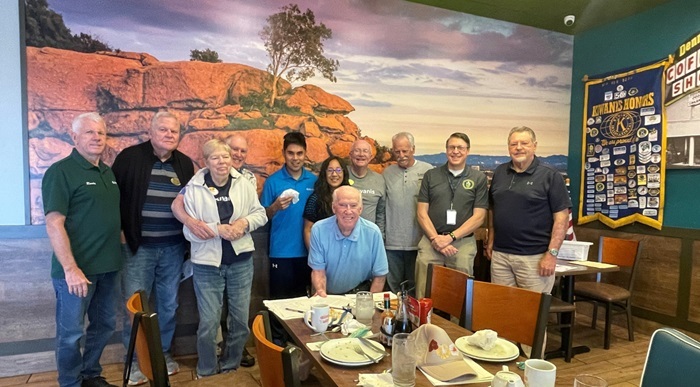 Josh Mengers, federal project director for the Energy Technology Engineering Center, shares an overview of the Santa Susana Field Laboratory and the U.S. Department of Energy’s cleanup efforts with the Simi Valley Kiwanis Club.
Local engagement continued earlier this month with a tour of DOE’s Area IV at SSFL for members from the Ventura County Air Pollution Control District’s Planning, Rules and Incentives Division.
Mengers and Pamela Hartman, EM’s deputy federal project director for ETEC, provided a site overview on historical operations and the cleanup, and also answered questions on the air monitoring program, the Sodium Reactor Experiment and the automated groundwater pump system at the Hazardous Materials Storage Area.
The ETEC team has more engagements planned for the weeks ahead.
The team will once again have a booth at the Simi Valley Street Fair on May 2, where the public can meet staff, ask questions and learn about activities at SSFL. There will also be a hands-on activity to build a spectroscope, an optical instrument that splits light into its component colors for analysis.
On May 13, they will host the second CONNECT session in the ETEC office at 980 Enchanted Way, Suite 108, Simi Valley, California, 93065. The public will have the opportunity to engage with staff following a short presentation and suggest ideas for future session topics.
For more information about CONNECT or to reach DOE’s ETEC team, email etec@emcbc.doe.gov.
-Contributor: Melissa Simon
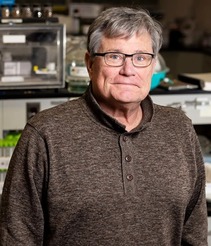
AIKEN, S.C. — The University of Georgia (UGA) has named Savannah River Ecology Laboratory (SREL) Director Olin E. Rhodes Jr. as a 2025–2026 University Professor, recognizing his contributions to research, teaching and service.
SREL is a UGA research unit located on the U.S. Department of Energy’s (DOE) Savannah River Site (SRS). SREL operates under a cooperative agreement with DOE to provide independent evaluation of the environmental impacts of nuclear activities to both the agency and the public, supporting DOE Office of Environmental Management cleanup efforts.
During his 14-year tenure as director, Rhodes has expanded SREL’s research programs and workforce. He increased staff from 46 to 202, grew the number of graduate students from six to 82 and expanded faculty from seven to 19. Under his leadership, SREL strengthened its working relationship with DOE, contributing to increased external funding and research activity.
“I am thrilled and honored to be recognized by UGA as a University Professor,” Rhodes said. “I have a long history with this great academic institution over my career, and this recognition is both personally and professionally rewarding to me as a faculty member and administrator.”
University Professors receive a permanent $10,000 salary increase and $5,000 in annual academic support. Nominations are submitted by school and college deans and reviewed by a committee, which makes recommendations to UGA’s senior vice president for academic affairs and provost.
-Contributor: Tyjaha Steele
|
|