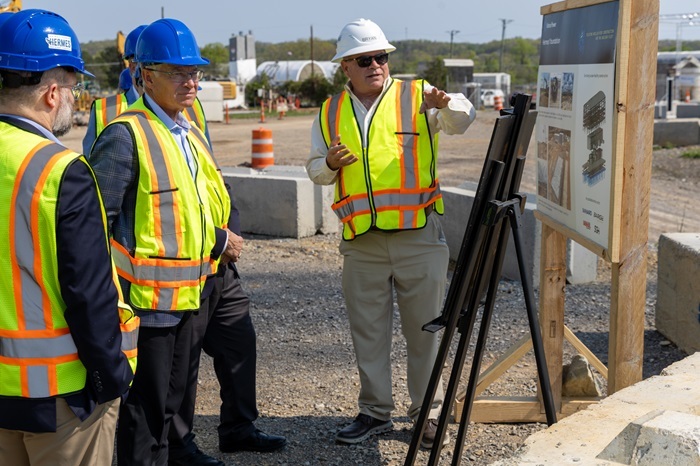
 Marty Bryan, right, director of Kairos Power Tennessee Site Integration, details construction activities underway for the company’s Hermes 1 demonstration reactor to Assistant Secretary of Environmental Management Tim Walsh at Oak Ridge.
OAK RIDGE, Tenn. — In his first trip to Oak Ridge last week, Assistant Secretary for Environmental Management (EM) Tim Walsh witnessed firsthand the reach and impact of the U.S. Department of Energy’s (DOE) cleanup mission, including how progress generates opportunities for DOE programs and the community.
Walsh and his team toured all major cleanup projects underway at Oak Ridge and met with state and local officials, business leaders and stakeholders to discuss partnerships and developments on the horizon.
“Oak Ridge stands out as one of EM and DOE’s exemplary sites. From advancing our national security and nuclear deterrence to driving America’s nuclear renaissance and positioning the U.S. to lead the AI race, Oak Ridge remains central to EM and DOE’s mission of making America both energy dominant and prosperous,” Walsh said. “As we continue ongoing nuclear remediation and revitalization efforts, Oak Ridge serves as a roadmap for EM’s future.”
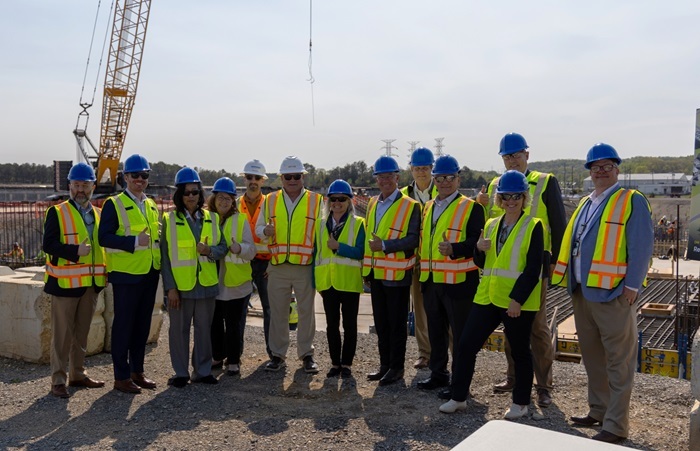 U.S. Department of Energy Office of Environmental Management (EM) officials and Kairos Power employees stand in front of the company’s construction site for the Hermes 1 demonstration reactor. The project is located on the footprint of the former K-33 uranium enrichment facility that EM cleared for economic reuse.
At the Y-12 National Security Complex, the Oak Ridge Office of Environmental Management (OREM) and contractor UCOR showed open footprints in the dense campus where recent demolitions removed legacy facilities. Crews have cleared away 20 acres of former Manhattan Project-era research and enrichment buildings to remove hazards and provide space for new facilities to advance national security missions.
Crews are removing the final portions of debris from the Alpha-2 demolition project, while other teams prepare for the next major demolition of a former uranium enrichment facility at Beta-1, slated to begin later this year.
Stops at Oak Ridge National Laboratory showcased how cleanup is transforming the central campus area, making way for modernization by removing old, contaminated infrastructure and eliminating inventories of nuclear material.
Walsh toured the world’s oldest operating nuclear facility, currently a storehouse for the nation’s inventory of uranium-233. OREM and contractor Isotek are processing and disposing of the material to eliminate risks and strike ongoing costs to taxpayers required to keep the material safe and secure.
Another facet of that project involves an innovative partnership with nuclear innovation company TerraPower to extract rare medical isotopes from the uranium-233 to power next-generation cancer treatment research.
OREM’s cleanup has also created space for new industry.
The team traveled to the East Tennessee Technology Park (ETTP) where they saw EM’s largest completed cleanup effort to date.
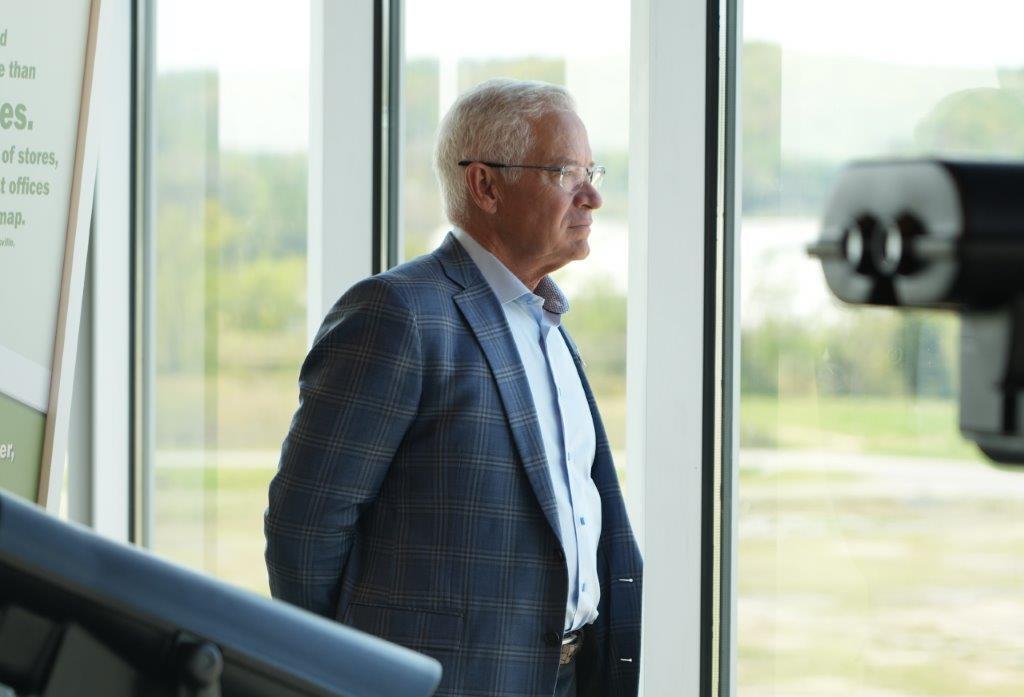 Assistant Secretary of Environmental Management Tim Walsh stands stories above the K-25 building’s 44-acre footprint from the observation deck in the K-25 Interpretive Center. The building was the largest in the world when it was constructed, and it was one of five former uranium enrichment buildings demolished at the site.
Walsh stood stories above the 44-acre footprint of the former K-25 building, now the main attraction of the Manhattan Project National Historical Park site. The building was the largest in the world when it was constructed, and among the 500 buildings crews demolished there.
Workers finished soil remediation at ETTP in 2024, opening the door for major redevelopment. Today, it is home to more than 20 businesses that have announced billions of dollars in investments that will create thousands of new jobs in the nuclear sector.
Kairos Power, one of the first major nuclear companies to announce locating at ETTP, provided a tour of the construction of its new demonstration reactor. The company is progressing quickly on its $100 million development on the footprint of a former uranium enrichment building.
OREM has transferred more than 2,500 acres to the community for economic reuse, and much of that land is targeted for redevelopment by nuclear companies that support numerous stages in the fuel cycle, from enrichment to recycling.
Walsh and his team met with state and local officials to hear input that can result in EM accelerating cleanup, boosting opportunities and strengthening partnerships with private industry.
-Contributor: Ben Williams
 U.S. Department of Energy (DOE) team members join local officials and others to celebrate the Moab Uranium Mill Tailings Remedial Action Project's milestone removal of 16 million tons of uranium mill tailings from the banks of the Colorado River at an April 9 event in Moab, Utah. Pictured from left: Adán Ortega Jr., chair, Metropolitan Water District of Southern California; Lara Beasley, deputy director, DOE Office of Legacy Management; Matt Udovitsch, federal cleanup director, Moab Project; Joette Langianese, mayor, City of Moab; Grace F. Napolitano, retired U.S. representative, California; Mary McGann, chair, Moab Tailings Project Steering Committee; Jack Zimmerman, acting associate principal deputy assistant secretary, DOE Office of Environmental Management (EM); Melody Bell, acting director, EM Consolidated Business Center; and Melodie McCandless, chair, Grand County Commission.
MOAB, Utah — The Moab Uranium Mill Tailings Remedial Action Project last week celebrated a landmark milestone: removal of a cumulative 16 million tons of residual radioactive material and the complete disposal of the uranium mill tailings pile away from the Colorado River, enabling future beneficial reuse of the cleanup site.
U.S. Department of Energy (DOE) team members commemorated the achievement at a community ceremony, celebrating strong partnership and collaboration among federal, state and local partners.
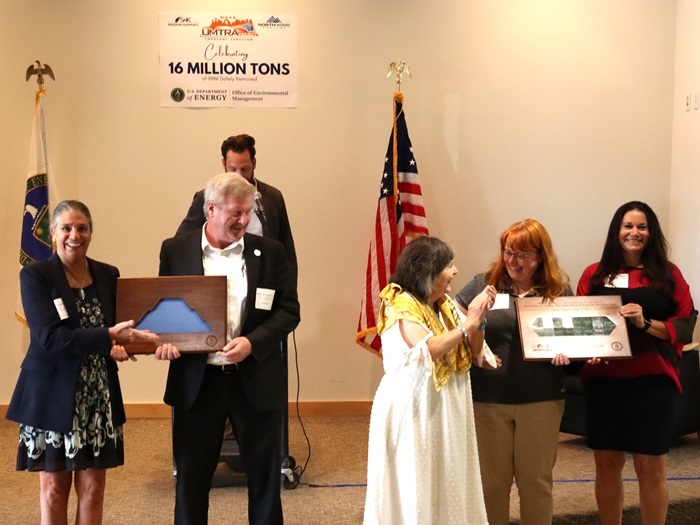 The Moab Uranium Mill Tailings Remedial Action Project celebrated the removal of 16 million tons of uranium mill tailings from its Moab, Utah, site by transferring the final tile from one commemorative plaque — depicting the Moab tailings pile — to another, representing the disposal cell in Crescent Junction, Utah. Pictured from left, foreground: Moab Mayor Joette Langianese; U.S. Department of Energy (DOE) Office of Environmental Management Acting Associate Principal Deputy Assistant Secretary Jack Zimmerman; Moab Tailings Project Steering Committee Chair Mary McGann; DOE Office of Legacy Management Deputy Director Lara Beasley; and Grand County Commission Chair Melodie McCandless. Moab Project Federal Cleanup Director Matt Udovitsch is pictured in the background.
A main attraction at the ceremony was a set of commemorative plaques commissioned at the start of the Moab Project in 2009. One plaque once depicted the tailings pile with 16 movable tiles — each representing 1 million tons of tailings.
Each of those tiles has been transferred to the plaque depicting the Crescent Junction, Utah, disposal cell, where the radioactive material was safely relocated throughout the years. The placement of the final tile at the ceremony signified both the complete disposal of the pile and the achievement of the 16‑million‑ton cumulative milestone.
Since 2009, DOE Office of Environmental Management (EM) crews have transported the tailings by rail to the disposal cell, 30 miles to the north of the Moab Site.
"It's been an honor to work alongside our committed stakeholder groups and local workforce to reach these incredible milestones," said Matt Udovitsch, federal cleanup director. "Achieving the complete removal of the tailings pile and the 16-million-ton milestone reflects DOE's commitment to safety and environmental protection."
With the tailing pile relocated, the project now enters its final phase, which includes:
- Finalizing and implementing a groundwater compliance action plan
- Removing remaining contaminated soils
- Completing radiological verification of cleanup
- Disposing of remaining equipment and infrastructure
- Completing an evapotranspiration cover, which will be the upper-most layer or “cap” on the disposal cell, designed to minimize water infiltration
- Restoring and stabilizing the site, including regrading and revegetating
EM will work with DOE’s Office of Legacy Management to close the Moab Site, which is expected in 2029.
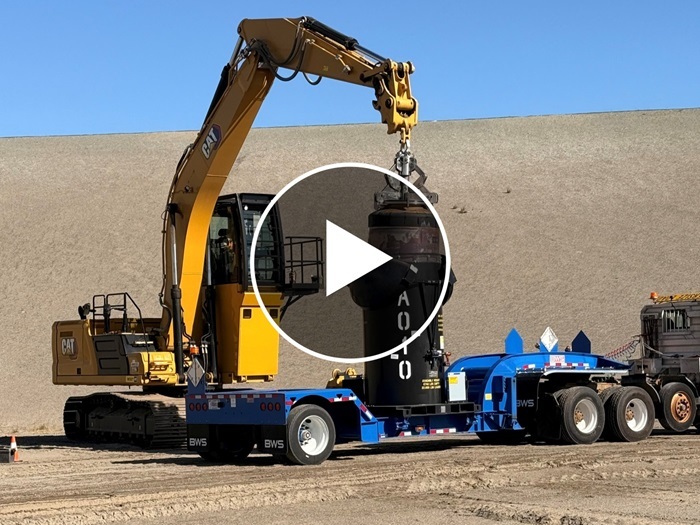 EMTV: Crews used a flatbed truck to drive the containers of vitrified low-activity waste down to the disposal cell at the Integrated Disposal Facility. Then, using a specialized grapple, they remove the stainless steel containers holding vitrified tank waste from their black protective sleeves, which will be used for future shipments from the Waste Treatment and Immobilization Plant.
RICHLAND, Wash. — The U.S. Department of Energy’s (DOE) Hanford Site and its contractor, Central Plateau Cleanup Company (CPCCo), achieved key progress last week with permanent disposal of the first containers of vitrified low-activity tank waste. This is a pivotal step in the nation’s tank waste cleanup mission and demonstrates progress toward steady-state Direct Feed Low Activity Waste (DFLAW) operations, permanent disposal, reducing risks and delivering results for the American people.
The stainless steel containers filled with vitrified, or glass-solidified, low-activity tank waste produced at the Waste Treatment and Immobilization Plant represent the first waste ever placed in the onsite Integrated Disposal Facility (IDF). This achievement reflects coordination of engineering, regulatory preparation, construction and readiness activities to safely begin disposal operations.
“This is a proud and meaningful achievement for the entire Hanford team,” said Hanford Site Manager Ray Geimer. “Safely beginning disposal shows that the systems, facilities and people needed to support tank waste treatment are working together. Each container placed in the IDF reduces long term environmental risk and moves us forward on DOE’s commitment to protect the community and the environment.”
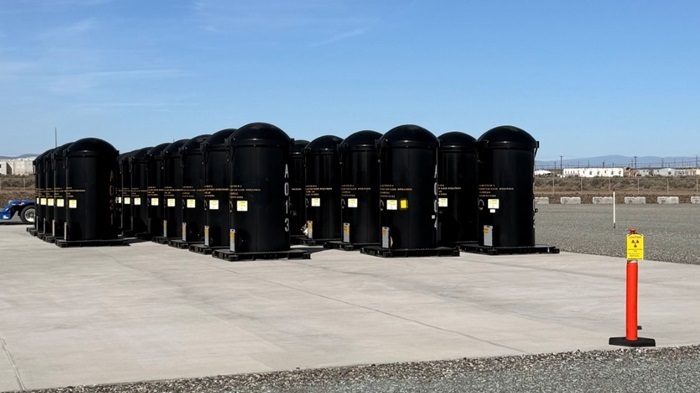 After staging them on concrete pads since last fall, the first of 30 containers are ready to be moved into the disposal cell.
The IDF received the first containers last fall, staging them on a nearby concrete pad to prepare them for disposal. About 30 containers are ready to be moved into the disposal cell.
“Starting disposal at IDF demonstrates our shared commitment to mission progress,” said CPCCo President Bob Wilkinson. “Every immobilized low-activity waste container safely placed in the disposal facility is another step in addressing Hanford’s tank waste legacy and reducing the footprint of risk on the Central Plateau.”
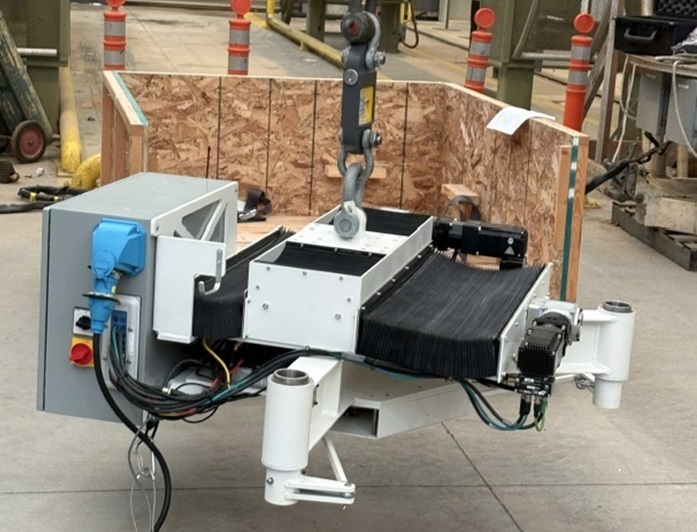
AIKEN, S.C. — A new fixture for loading and unloading transuranic waste shipping containers will be used across the U.S. Department of Energy’s nuclear cleanup complex after employees of the Waste Isolation Pilot Plant (WIPP) in New Mexico visited the Savannah River Site (SRS) to test the equipment.
Funded by SRS, the fixture, called an Adjustable Center of Gravity Lifting Fixture-Next Generation, is used to balance unbalanced loads caused by transuranic waste containers with different weights being loaded or unloaded into the shipping containers. The waste is sent to WIPP, the nation's only deep geologic repository for nuclear waste, for permanent disposal.
“The old style of the fixture has been in use across the complex for decades,” said Trey Black, Solid Waste engineer with SRS management and operations contractor Savannah River Nuclear Solutions (SRNS). “Because of its age, replacement parts are now difficult to find or obsolete.”
During their visit, the WIPP employees tested the capability of the next-generation fixture. The results were positive, enabling WIPP to certify use of the equipment and build additional fixtures for use across the complex.
“SRNS employees are constantly looking for new, improved and more efficient ways to get work done,” said Janice Lawson, SRNS senior vice president of Environmental Management Operations. “We are proud of playing a role in improving transuranic waste loading and unloading operations across the complex.”
-Contributor: Lindsey MonBarren
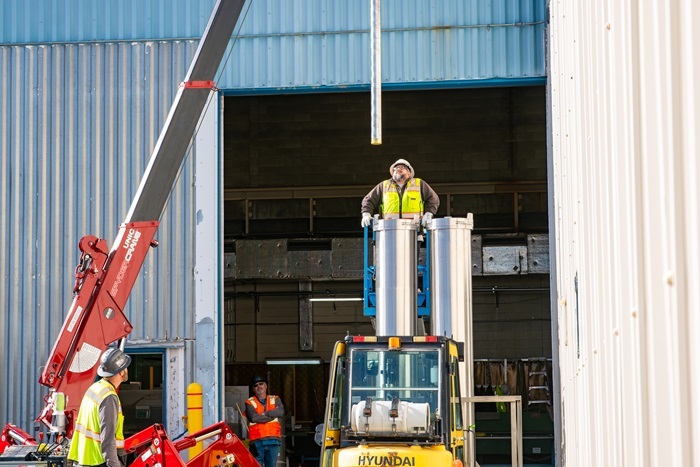 Crew members place heavy metal rods into large stainless steel Training, Research, Isotope, General Atomics used nuclear fuel canisters to test load-bearing capabilities.
IDAHO FALLS, Idaho — Idaho Cleanup Project (ICP) crews recently fabricated and tested four stainless steel storage canisters to prepare for a used nuclear fuel (UNF) shipment from a reactor at Penn State University this year, ensuring the safe long term management of the material at the Idaho National Laboratory (INL) Site and enabling critical U.S. Department of Energy (DOE) research opportunities.
In April 2025, DOE and the state of Idaho signed a waiver to the 1995 Idaho Settlement Agreement, a legal framework that establishes cleanup milestones at the INL Site, to allow receipt and storage of the material, called Training, Research, Isotope, General Atomics (TRIGA) fuel, in Idaho for the first time in decades.
Commonly found in U.S. university research reactors, TRIGA fuel supports advancements in nuclear energy and medical research. Through the Atoms for Peace program, research reactor fuel is eligible for return to DOE facilities once it is no longer needed.
The waiver resulted from DOE’s Office of Environmental Management meeting some of the milestones, including the transfer of all Idaho UNF into dry storage canisters. The waiver supports continued research at the INL Site that advances American energy, jobs and security.
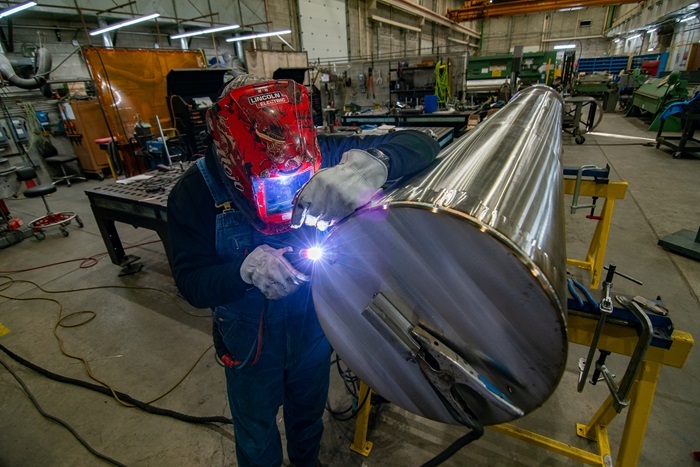 Idaho Cleanup Project crews use specialized tools to fabricate canisters designed to safely store Training, Research, Isotope, General Atomics used nuclear fuel.
At the Idaho Nuclear Technology and Engineering Center (INTEC) fabrication shop, crews with ICP contractor Idaho Environmental Coalition (IEC) used specialized tools to roll stainless steel sheets and form the body of the canisters, and craft their bases and lids.
“I’m proud of our team and their effort. Completing these canisters is crucial to ultimately receiving and safely storing future TRIGA fuel shipments,” said Kasey Baisch, an IEC manager.
Crews also performed load-bearing tests to ensure each canister could be handled safely while containing TRIGA fuel.
“Their work not only supports the safe storage of TRIGA fuel but also reinforces our commitment to advancing cleanup and critical research at the INL Site and at universities across the country,” IEC Used Nuclear Fuel Project Manager Carla Ellsworth said.
-Contributors: Leslie Dal Lago, Carter Harrison
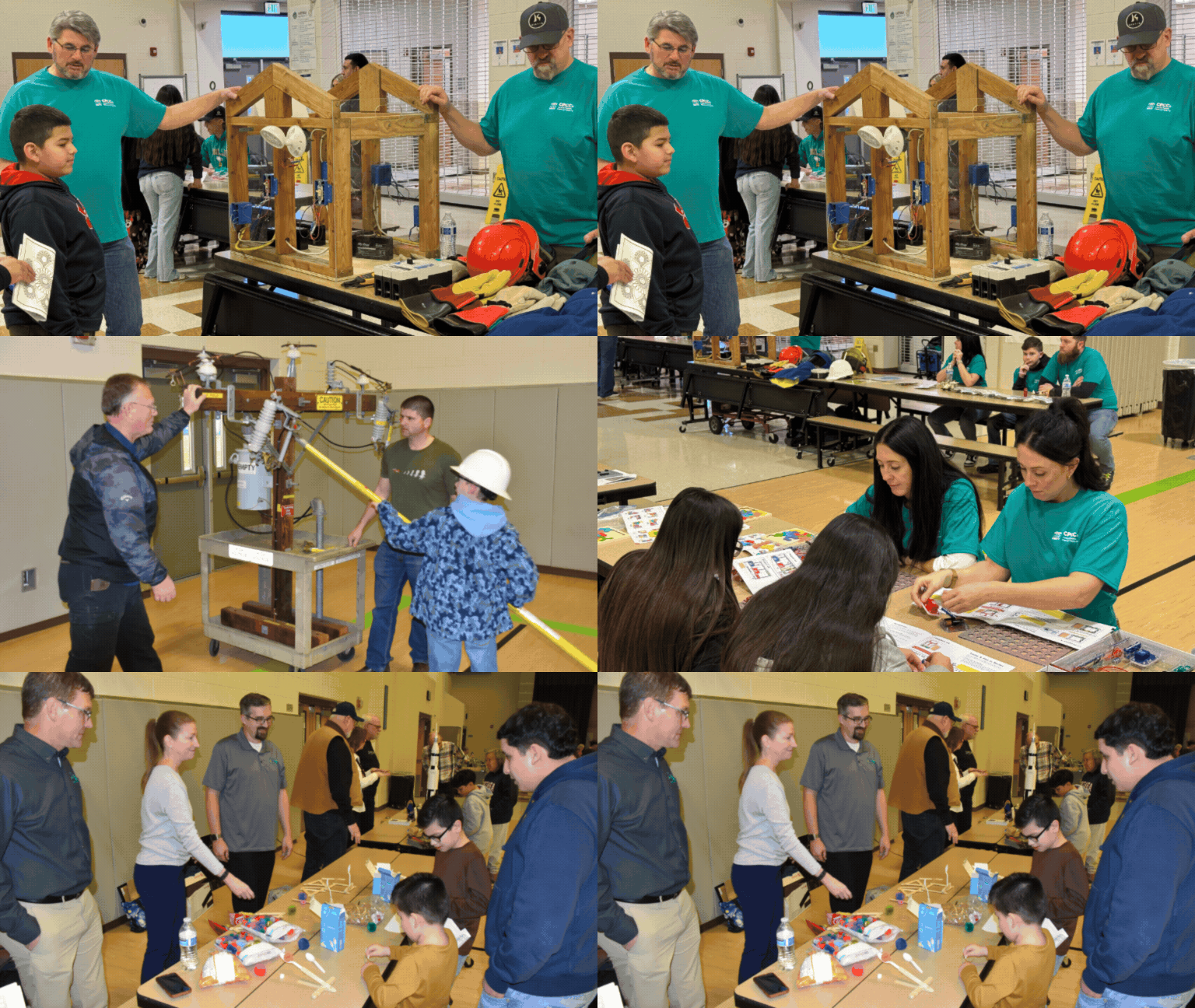
RICHLAND, Wash. — Two of the Hanford Site’s prime contractors teamed up with other community members to help educate, motivate and inspire students about the exciting possibilities in the fields of science, technology, engineering and math, or STEM.
More than a dozen employees from Hanford Field Office contractors Central Plateau Cleanup Company (CPCCo) and Hanford Mission Integration Solutions (HMIS) participated in the Student and Family STEM Night at Marie Curie STEM Elementary.
HMIS’ Electrical Utilities team demonstrated how their field equipment works, while HMIS engineers worked with students to create catapults out of rubber bands and popsicle sticks. CPCCo employees also coordinated several hands-on activities and demonstrations to highlight various engineering and technology principles.
By sharing their experiences and knowledge, these Hanford employees helped students discover the opportunities available in technical and utility careers while planting seeds of confidence and curiosity — encouraging them to dream big and believe in their potential.
|