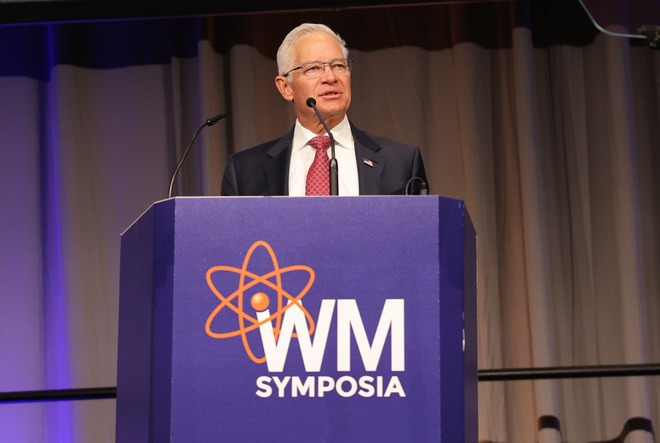
 U.S. Department of Energy Office of Environmental Management Assistant Secretary Tim Walsh delivers plenary remarks at the Waste Management Symposia.
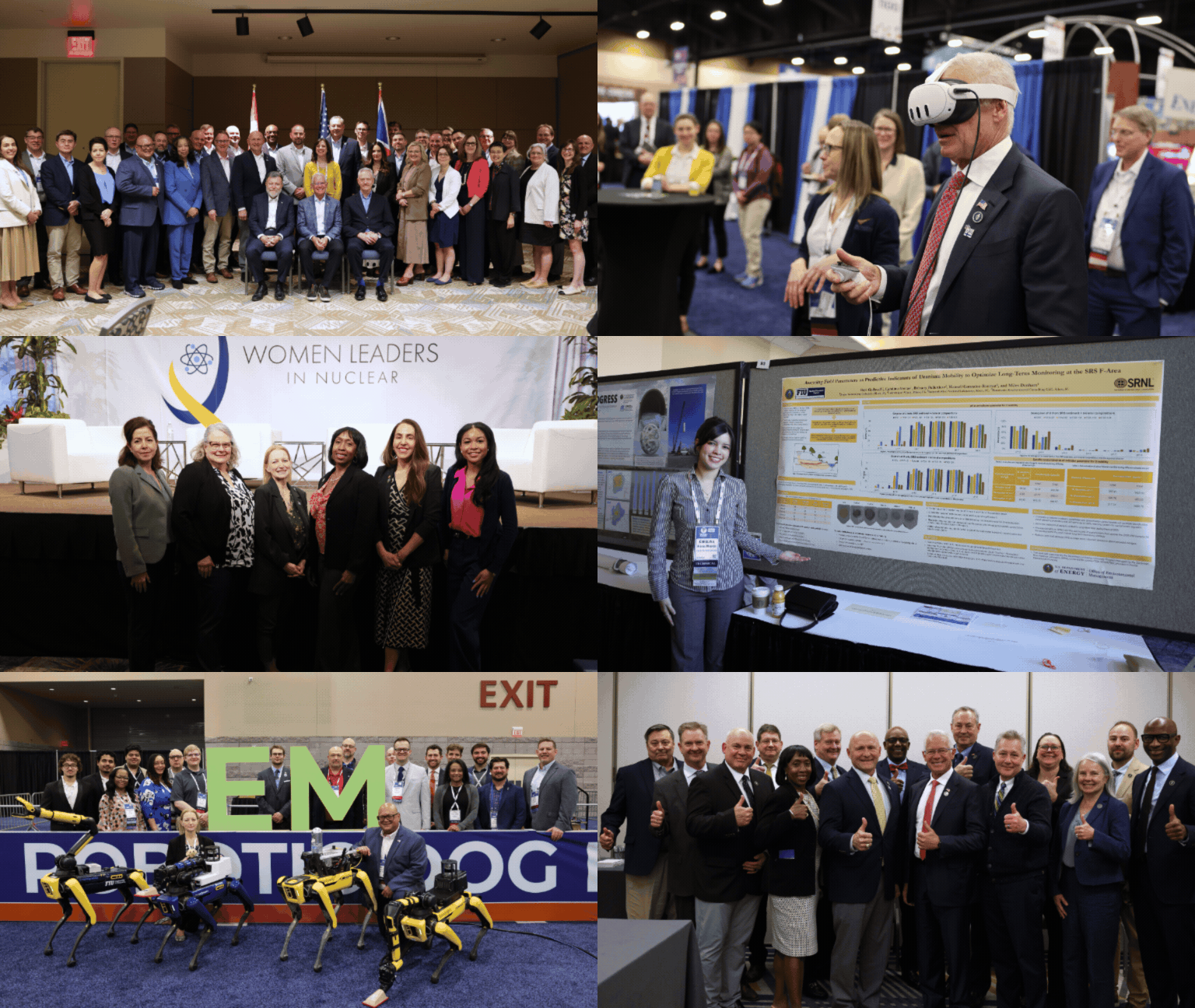
PHOENIX — The Office of Environmental Management (EM) participated in the 52nd annual Waste Management Symposia (WMS) from March 8-12 where Assistant Secretary Tim Walsh introduced an inspiring new vision for EM.
Throughout the symposia Assistant Secretary Walsh and other EM leaders highlighted how the cleanup program is aligning with a broader all-of-government strategy to deliver affordable, reliable, and secure energy while advancing America’s leadership in artificial intelligence (AI).
The WMS brought together over 2,500 participants from 900 organizations representing 30 countries. Experts convened to share knowledge on radioactive materials, decommissioning nuclear facilities and innovative solutions to increase worker safety and project efficiency. Hanford was the featured site, and Finland was highlighted as the featured country.
EM led numerous panels and roundtable discussions that covered a wide range of priorities and initiatives ranging from uranium enrichment to support advanced nuclear reactors to streamlining processes for more cost-effective project completion through efficiencies.
Assistant Secretary Walsh took center stage Monday morning to kick off the conference. Addressing attendees, he described a renewed focus on accelerating cleanup progress while transforming former weapons production sites into economic and energy assets. “We aren’t just managing the past; we are powering the future.”
He highlighted EM’s essential role in U.S. Department of Energy (DOE) Secretary Wright’s three-pillared vision: modernizing America’s nuclear deterrent, igniting U.S. innovation, and restoring affordable, reliable and secure energy. Central to this vision is the Genesis Mission, a nationwide effort to use AI and advanced computing to accelerate American scientific breakthroughs. Savannah River National Laboratory, EM’s sole sponsored national laboratory, plays a critical role in this DOE priority.
"Our innovative partnerships are bringing together the brightest minds America has to offer to win the global AI race,” Assistant Secretary Walsh said.
He outlined EM’s approach to evaluating each cleanup site potential by 2040, aiming to transform cleanup sites into hubs for nuclear energy, advanced manufacturing, and AI infrastructure — laying the foundation for lasting long-term economic opportunity and leadership in the energy and technology sectors.
 The 2026 Waste Management Symposia demonstrated EM’s commitment to safeguarding the environment and protecting human health while shaping the future of American energy and innovation.
Assistant Secretary Walsh pointed to major accomplishments set for completion by year 2040, including completing radioactive tank waste treatment at Savannah River and Idaho, demolishing additional former gaseous diffusion plants at Portsmouth and Paducah, and redeveloping portions of those sites for new energy infrastructure.
At the Hanford Site in Washington state, DOE’s largest and most complex cleanup project, Assistant Secretary Walsh said the department is evaluating a dual glass-plus-grout approach to treat low-activity tank waste more efficiently.
“We will save tens of billions of dollars, if not more, by taking a dual ‘glass-plus-grout’ approach,” Assistant Secretary Walsh said, adding the strategy could allow most of the mission to be completed by 2040 while meeting legal obligations.
EM plans to achieve these objectives by simplifying operations, boosting efficiency, using AI technology, cutting out repetitive tasks, reinforcing accountability, and applying scientific cleanup methods to help avoid delays.
“We are evolving into a future-focused organization laser-focused on outcomes,” Assistant Secretary Walsh said. “Our core mission is to protect the environment and reduce risks to human health, and to do that we need to move with urgency.”
Redevelopment of former cleanup sites will create long-term economic opportunities for surrounding communities while helping meet the nation’s growing demand for power.
“Where there is energy, there is prosperity,” Assistant Secretary Walsh said.
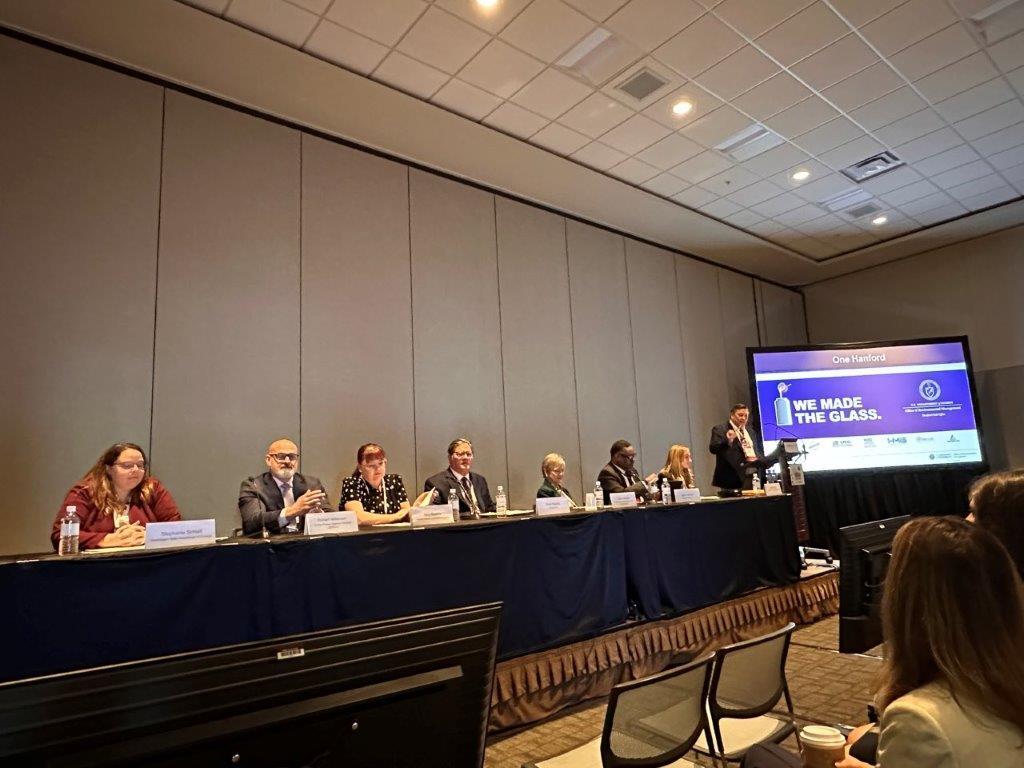 Ray Geimer, Hanford Field Office Manager, leads Hanford Site and Washington state leaders in a panel discussion about recent site progress. Panel participants to Geimer’s right, Cerise Peck, panel co-chair, Manager for Hanford Mission Integration Solutions, Brian Hartman, Project Director, Bechtel National, Inc., Carol Johnson, President & Program Manager, Hanford Tank Waste Operations & Closure, Mark Hughey, General Manager, Navarro-ATL, Amy Basche, President, Hanford Mission Integration Solutions, Bob Wilkinson, President, Central Plateau Cleanup Company, and Stephanie Schleif, Nuclear Waste Program Manager, Washington State Department of Ecology.
PHOENIX — Hanford leadership joined industry partners and federal officials at the Waste Management Symposia to discuss the site’s cleanup progress and the path forward for one of the nation’s most complex environmental remediation missions. The panel conversations focused on the scale of work underway across the site, recent operational milestones, and the coordinated efforts required to advance cleanup while preparing for the next phase of the mission.
During the discussion, Hanford Field Office Manager Ray Geimer emphasized that Hanford is entering a new stage after decades of preparation and infrastructure development. “For many years, this mission was about building the capability to treat waste and address some of the most complex environmental challenges in the country,” he said. “Today we are beginning to see that investment pay off as we move into sustained cleanup operations that reduce risk and deliver real progress.”
Geimer also highlighted several recent milestones that demonstrate the momentum building across the site. The start of waste vitrification represents a major turning point for Hanford, allowing crews to begin immobilizing tank waste in glass for safe long-term disposal. At the same time, crews recently began transferring the first of the cesium capsules from the Waste Encapsulation and Storage Facility to dry storage, an important risk-reduction effort that further strengthens the site’s safety posture.
Looking ahead, Geimer noted that Hanford is preparing for the next chapter of the cleanup mission while continuing to accelerate current work. “What you’re seeing now is the result of decades of engineering, planning, and workforce commitment,” he said. “We are building on those successes to move the mission forward, continue reducing risk, and deliver meaningful progress for the region, the community, and the nation.”
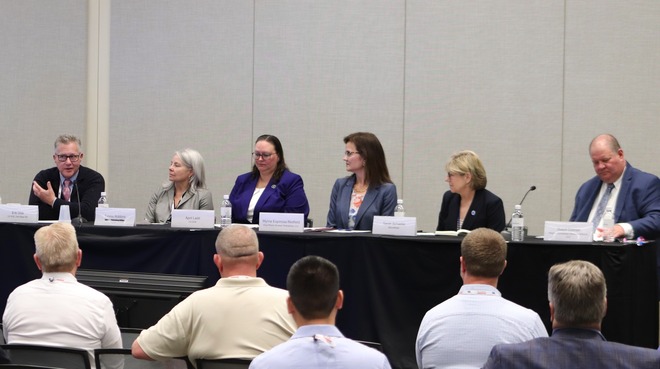 From left, Oak Ridge Office of Environmental Management (OREM) and Acting Portsmouth Paducah Project Office (PPPO) Manager Erik Olds, OREM Deputy Manager Teresa Robbins, Acting PPPO Deputy Manager April Ladd, Four Rivers Nuclear Partnership Program Manager Myrna Redfield, Isotek President and Project Manager Sarah Schaefer, and Mission Conversion Services Alliance President Dutch Conrad participated in a joint panel titled “Enriching America — How Oak Ridge, Paducah and Portsmouth are Helping Power EM’s Most Ambitious Vision Yet.”
PHOENIX — Successful cleanup and reuse efforts underway at the Oak Ridge, Paducah, and Portsmouth sites are vividly illustrating the Office of Environmental Management’s (EM) ability to successfully deliver its vision of nuclear restoration and revitalization across the U.S. Department of Energy (DOE) complex, federal and contractor leaders said last week.
The three sites were initially home to the nation’s first uranium enrichment plants. Today, through EM’s cleanup progress, these sites are still “enriching America” by making land and materials available for reuse and supporting DOE’s goals of ensuring American energy dominance and national security.
“One of the great things is that we are able to learn from the other gaseous diffusion plants in Oak Ridge and Portsmouth,” said April Ladd, acting deputy manager for the Portsmouth Paducah Project Office, during a panel session at this year’s Waste Management Symposia. “We looked at what went well at the sites and followed it.”
Of the three sites, Oak Ridge is the furthest into the reindustrialization process. Thanks to successful cleanup of the former East Tennessee Technology Park, companies pursuing advanced nuclear reactor technologies, nuclear fuel development and enrichment are investing more than $10 billion to locate at the site.
Paducah and Portsmouth are quickly gaining momentum. At Paducah, innovative leases are allowing construction of a $1.5 billion uranium enrichment facility on DOE land, while Portsmouth is leading the way on leasing efforts for an AI data center.
The need for strong collaboration among DOE, regulators and communities to achieve mutual benefits was a common theme expressed by panelists. Regulatory decisions are being streamlined to accelerate cleanup progress, and that progress is supporting more transfers and leases to the community that are generating new economic development opportunities.
 |
|
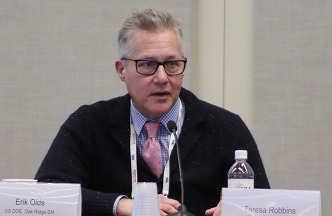
During the panel, Oak Ridge Office of Environmental Management and Acting Portsmouth Paducah Project Office Manager Erik Olds discussed how master planning and having a strong, clear outcome-based vision have been key to EM’s successful reuse initiatives. |
The conversation extended beyond land reuse, as panelists from the sites also discussed initiatives underway to reuse materials that offer major benefits to the nation.
For instance, Isotek, EM’s contractor tasked with eliminating the nation’s inventory of uranium-233 stored at Oak Ridge National Laboratory, is also extracting an extremely rare medical isotope from the uranium-233 before it undergoes processing and disposal, according to Isotek President and Project Manager Sarah Schaefer. The isotope is a crucial ingredient for a promising form of cancer treatment currently in clinical trials. The first treatments using this material are expected to enter the market next year.
The Portsmouth and Paducah sites are home to stockpiles of depleted uranium hexafluoride (DUF6) that resulted from previous enrichment operations at the sites.
While work is underway to process this material for eventual disposal, EM has also worked to identify quantities to provide to companies working to build new enrichment facilities near the Paducah Site, according to Dutch Conrad, president of Mission Conversion Services Alliance LLC, which operates the DUF6 conversion plants at the two sites.
Together, the sites originally built to help power the nation have a bold vision for an encore that is becoming a reality through cleanup and reuse.
-Contributor: Sonya Johnson
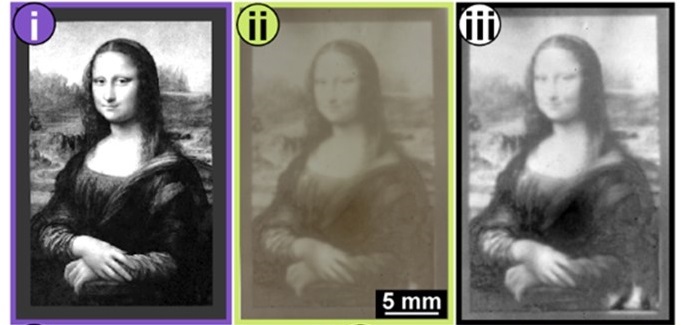 A digital image of Leonardo da Vinci's Mona Lisa was used to create printed copies where the shades of gray represent different levels of crystallinity, showing how the CRAFT method can precisely control a material’s physical properties. Credit: Sandia National Laboratories.
Breakthrough research enables precise control of material properties during manufacturing
AIKEN, S.C. — Savannah River National Laboratory (SRNL) researchers, along with university and other national laboratory partners, invented a new technology that uses light to fine-tune material properties such as strength, flexibility and durability during the 3D printing process. Typically, 3D printed parts share the same set of characteristics throughout.
“We've never had this level of control over these materials before,” said Sam Leguizamon, SRNL researcher and project lead for the technology, called CRAFT, or Lithographic Crystallinity Regulation in Additive Fabrication of Thermoplastics. “Being able to direct how polymers form during printing gives us a powerful new tool not just for manufacturing, but for advancing the entire field of polymer science.”
 |
|
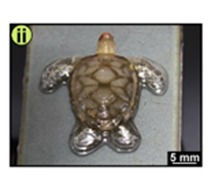
Using the CRAFT method, a soft-bodied turtle was 3D printed with varying degrees of flexibility and physical properties. Credit: Sandia National Laboratories. |
SRNL, the sole national laboratory sponsored by the U.S. Department of Energy Office of Environmental Management, hopes to leverage its new Advanced Manufacturing Collaborative facility to further develop CRAFT and other related additive manufacturing technologies alongside academic and industry partners.
Leguizamon played a pivotal role in uncovering the groundbreaking science behind CRAFT during his tenure at Sandia National Laboratories. There, his team made a remarkable discovery: by changing light intensity during printing, they could produce materials with varying levels of clarity. Looking deeper, Leguizamon found that these changes in clarity align with shifts in the material’s molecular structure, which normally required chemical methods or high-temperature processing.
Leguizamon continued his work on the CRAFT project after arriving at SRNL. He drafted a clear narrative to refine CRAFT’s mechanics and to optimize the process. He also formed partnerships with the University of Texas at Austin, Lawrence Livermore National Laboratory and Sandia National Laboratories.
“CRAFT represents a shift in how we think about manufacturing plastic parts,” said Patrick Garcia, SRNL associate lab director. “Instead of accepting materials as they come off the printer, we can now design them with specific material properties for a specific purpose from the very beginning of the process.”
The University of Texas team recently demonstrated a real-world application of CRAFT by printing a detailed model of a human hand. The printed hand mimics the characteristics of skin, bones, ligaments, and tendons, all using a single material. Models like this could be used to teach medical students or to help develop advanced protective gear.
CRAFT offers a new pathway for creating advanced thermoplastics tailored to specific applications. Industries such as aerospace, biomedicine and energy systems could use this technology designed directly into 3D printed parts.
This research was supported by the National Nuclear Security Administration Office of Engineering and Technology Maturation, which develops and matures advanced manufacturing capabilities for the nuclear security enterprise.
-Contributor: Federica Staton
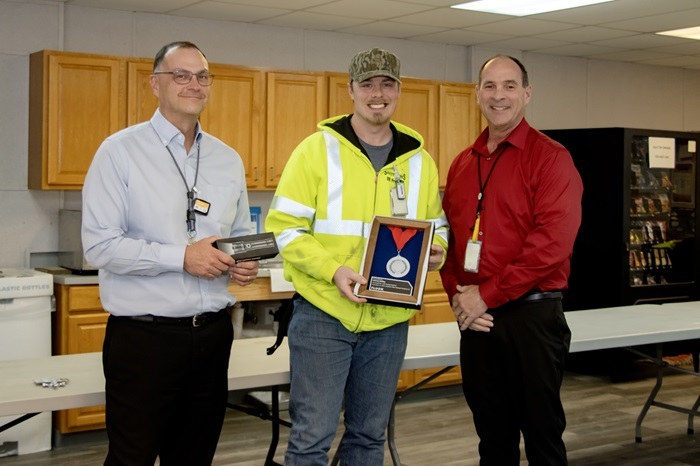 Portsmouth Site Radiation Technician Camron Griffey is recognized with the Fluor Silver Medallion Award for Safety. From left, Southern Ohio Cleanup Company Program Manager Pat Timbes, Griffey and Deputy Program Manager Mike Furner.
PIKETON, Ohio — Radiation Technician Camron Griffey demonstrated that always being prepared can save a life.
He and his co-workers were on lunch break at the U.S. Department of Energy’s Portsmouth Site when he heard someone choking at the table behind him.
“When I asked him if he was choking and he couldn’t answer, I jumped up and hit him in the back really hard, but that didn’t work,” Griffey said.
Griffey wasted no time and immediately started the Heimlich Maneuver. After just a couple attempts, the food causing his co-worker to choke was dislodged.
“My instinct just kicked in when I heard him in trouble and I just did it,” Griffey said.
Griffey was awarded the Fluor Silver Medallion Award for Safety for his quick action. It was established in 1992 as the company’s highest safety award. Fluor is a parent company of the Southern Ohio Cleanup Company, the deactivation and demolition contractor at the Portsmouth Site. Griffey is employed by the contractor.
His supervisor, Travis Wright, said it all happened in a matter of seconds.
“There was no hesitation. Camron was quick to react. As soon as he heard his co-worker was in trouble, he jumped to action. By the time I finished dialing 911, he had saved his life,” Wright said.
Last year, Griffey took advantage of a first aid course offered to all workers on the Portsmouth Site that includes CPR, Heimlich Maneuver and automated external defibrillator training.
“Camron’s instinct and training is a great example of the safety culture at the Portsmouth Site,” Acting Portsmouth Site Lead Jud Lilly said. “He took those classes on his own. It wasn’t a requirement, and that desire to be ready in an emergency made the difference in what could have been a tragic outcome that day.”
-Contributor: Cindi Remy
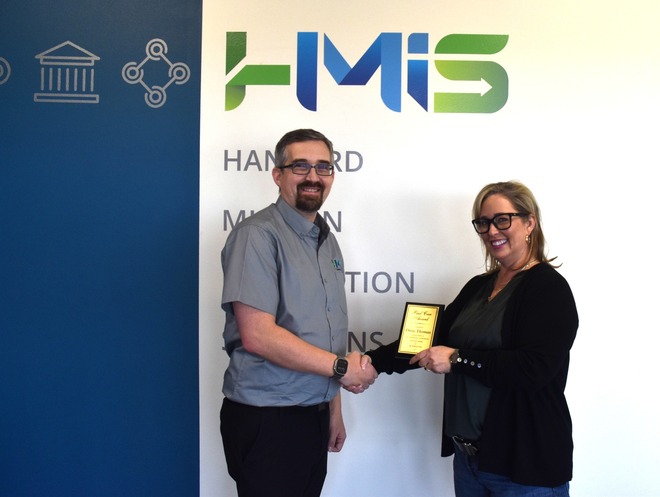 Jennifer Martin, right, Pacific Northwest National Laboratory Authority Having Jurisdiction and Hanford Electrical Codes Board Chair, presents the Paul Case Award to Hanford Mission Integrations Solutions Chief Engineer Drew Thomas.
RICHLAND, Wash. – The chief engineer with the Hanford Site's essential services prime contractor has been recognized with a sitewide honor for his commitment to electrical safety.
Drew Thomas, chief engineer with Hanford Mission Integration Solutions (HMIS), recently received the Paul Case Award, which recognizes Hanford workers who demonstrate an unselfish commitment to ensuring the site is safe from electrical hazards.
“Drew’s outstanding leadership and dedication to safety have driven major improvements at Hanford, especially in electrical operations,” said James Oakes, an electrical engineer with the Hanford Field Office. “He established the Electrical Safety Forum, which evaluates and addresses important sitewide electrical safety challenges. His active engagement with national safety organizations inspires collaboration across our team.”
To further support electrical safety, Thomas recently became a certified electrical inspector and Certified Electrical Safety Compliance Professional. As HMIS' Authority Having Jurisdiction, Thomas is responsible for ensuring electrical work meets safety requirements and for approving work practices, equipment, inspections and condition reports. Additionally, he performs electrical assessments at other DOE sites, including Lawrence Berkeley National Laboratory and Idaho National Laboratory, and regularly shares lessons learned from Hanford while bringing back best practices from other locations.
“At Hanford, safety goes beyond the requirements to creating a culture we continually strengthen together to ensure everyone goes home safely,” Thomas shared. “I am honored to receive the Paul Case Award and proud to work alongside so many dedicated engineers, electricians and safety professionals committed to protecting our team.”
The award is named after the late Paul Case, who helped build Hanford’s electrical safety program. He is remembered for his expertise and dedication, and for sharing his knowledge with others. The award was first presented in 2009.
|