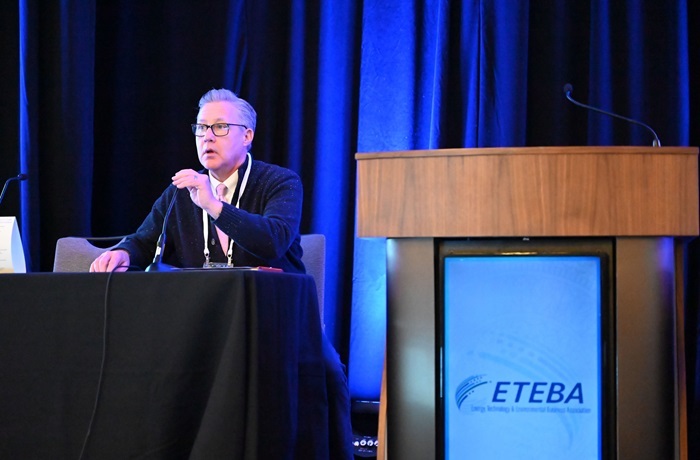
 Portsmouth Paducah Project Office Acting Manager Erik Olds speaks to attendees at the Energy, Technology and Environmental Business Association Kentucky Business Opportunities Exchange in Lexington, Kentucky.
LEXINGTON, Ky. — Erik Olds, who serves dual-hatted as the Portsmouth Paducah Project Office (PPPO) acting manager and the Oak Ridge Office of Environmental Management manager, laid out how the two organizations contribute to the U.S. Department of Energy’s (DOE) priorities during a recent regional business opportunities exchange held by the Energy, Technology and Environmental Business Association.
“We are becoming the recognized model for nuclear remediation to nuclear renaissance,” Olds told a crowd of more than 200 people representing companies that provide environmental, technology, energy, engineering, construction and related services to government and commercial clients.
 |
|
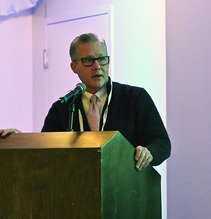
“There is so much potential to build jobs, support defense and lower energy costs,”
-Erik Olds, at Kentucky Business Opportunities Exchange
|
Olds shared information about Energy Secretary Chris Wright’s three-pillar vision for DOE, including modernizing America’s nuclear deterrent, igniting American innovation and unleashing American energy dominance and affordability. He added that DOE’s Office of Environmental Management (EM) plays a vital role, with PPPO and Oak Ridge at the nexus of the vision.
“I feel the momentum every day coming to work,” said Olds. “There’s an effort to maximize the speed of nuclear energy opportunities across the country. So, what does that mean for us? Cleanup is going to go faster.”
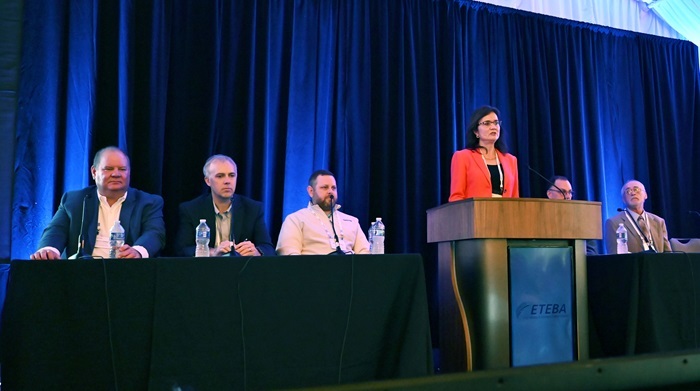 Four Rivers Nuclear Partnership Program Manager Myrna Redfield, at the podium, provides information about the Paducah Site deactivation and remediation contractor during the Energy, Technology and Environmental Business Association Kentucky Business Opportunities Exchange in Lexington, Kentucky. Representatives from Portsmouth Paducah Project Office contractors Mission Conversion Services Alliance and Southern Ohio Cleanup Company also participated on the panel.
Olds emphasized safety, common sense and accountability in cleanup during his remarks.
“It’s not just about taking down buildings,” said Olds. “We can make our communities safer. We can do something with that land and change the course of the communities around the sites.”
The next generation of nuclear technology is coming, Olds told the attendees. He also mentioned representatives from Centrus, General Matter and Global Laser Enrichment would be speaking during the conference, showing how the future of the Portsmouth and Paducah sites is already evident. Those companies have projects underway or planned at the Portsmouth and Paducah sites.
“Our sites have already been selected for nuclear and AI infrastructure. We also want to leverage executive orders to reuse nickel and other metals,” he said. “There is so much potential to build jobs, support defense and lower energy costs.”
Throughout the day, attendees received updates regarding cleanup progress at PPPO, procurement and business opportunities, economic development initiatives of the local communities in Ohio and Kentucky and information about private-sector activities at the sites. Additionally, the EM Consolidated Business Center provided acquisition, small business and Office of Naval Reactors project updates during the conference.
-Contributor: Sarah Marko
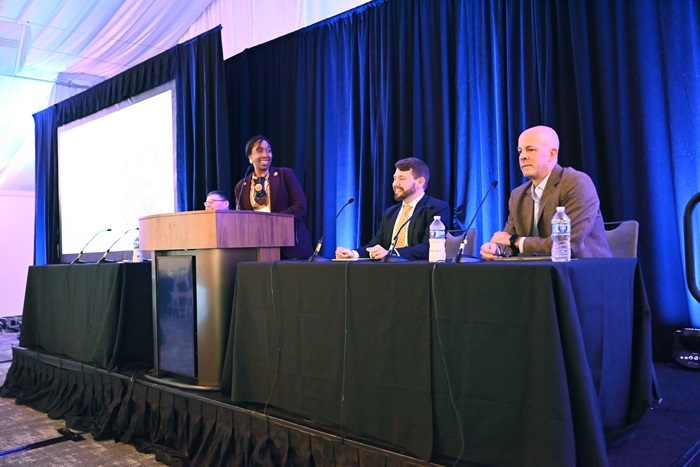
LEXINGTON, Ky. — Federal team members from the U.S. Department of Energy’s Environmental Management Consolidated Business Center (EMCBC) briefed attendees at the recent Kentucky Business Opportunities Exchange on cleanup progress at EMCBC-managed and supported sites and the center’s critical capabilities to support sites to closure. The event was held by the Energy, Technology and Environmental Business Association.
EMCBC Deputy Director Melody Bell is pictured at the podium, with EM Small Business Program Manager Ken Johnson at right of Bell and EMCBC Procurement Director Aaron Deckard at far right. The trio discussed upcoming procurement opportunities, emphasizing the innovation and creativity that small business partnerships bring to EM’s mission-critical work.
Also pictured at far left is EMCBC Program Manager Matt Young, who shared an update on the DOE Office of Environmental Management’s partnership with the Office of Naval Reactors and recent project successes at the Knolls Atomic Power Laboratory in Niskayuna, New York; Kesselring Site in West Milton, New York; and Bettis Atomic Power Laboratory in West Mifflin, Pennsylvania.
-Contributors: Sarah Marko, Stephanie Shewmon
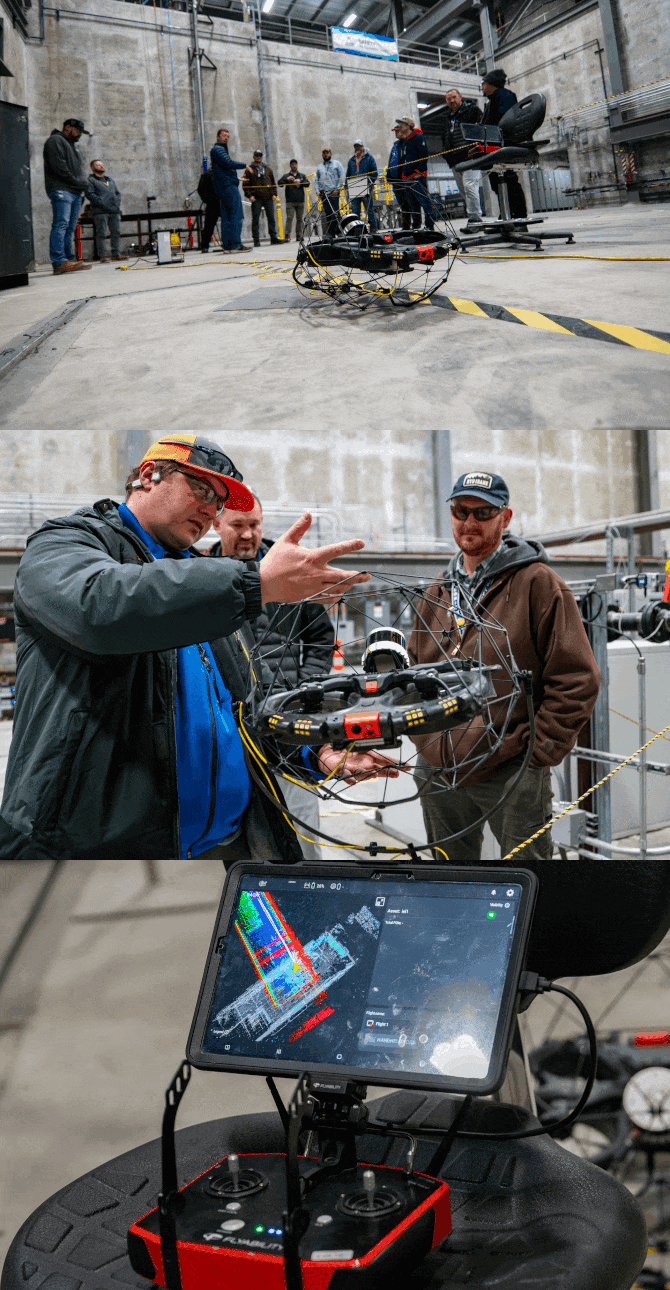 Engineers demonstrate the enhanced Elios3 drone, showcasing its tethered power configuration and real-time light detection and ranging data visualization during testing at an Idaho National Laboratory Site facility.
IDAHO FALLS, Idaho — The Idaho Cleanup Project (ICP) is preparing for new drone missions to collect detailed 3D images and radiation measurements in two high-level radioactive waste storage areas to help engineers verify conditions and guide placement of equipment to safely retrieve calcine, a byproduct of used nuclear fuel recycling, for disposition outside Idaho.
The granular byproduct is stored in six concrete bin sets resembling silos at the Idaho National Laboratory Site. Under the 1995 Idaho Settlement Agreement, the U.S. Department of Energy must retrieve, package and remove the 4,400 cubic meters of calcine from Idaho by 2035.
The ICP’s Calcine Disposition Project is drawing from advanced technology to expand on the success of its historic 2022 drone flight — the first known operation inside a high-level radioactive waste storage vault.
“Some of the biggest risks and schedule impacts to a project are the unknowns,” said Valerie Kimbro, senior project manager. “The extended flight capabilities of the drone and updated 3D imaging technology reduce these unknowns, helping the project move forward while meeting regulatory commitments.”
In December, team members tested an upgraded Elios3 drone at an onsite test facility that includes a full-scale mock-up of a storage bin set. Enhancements include an optional tethered power source, larger battery packs and an updated system for the light detection and ranging technology. It features a scan rate that’s 25 times faster than previous versions, improving the resolution of data collected. It allows for more detailed imagery in the same amount of scanning time and enables detection of smaller details difficult to identify with earlier equipment.
“The extended flight capabilities and updated light detection and ranging technology ensure needed data can be collected with subcentimeter accuracy, reducing overall project risks and keeping workers safe,” said Kimbro.
The test flights evaluated the drone’s ability to navigate around obstacles while tethered, measure flight durations and manage cables. These upgrades will allow for longer missions and more efficient data collection.
The Calcine Disposition Project has also implemented other innovations, such as a recently installed instrument control system at the test facility. These tools complement the drone’s capabilities, ensuring safe and efficient progress toward calcine retrieval.
-Contributors: Ryan Christensen, Leslie Dal Lago
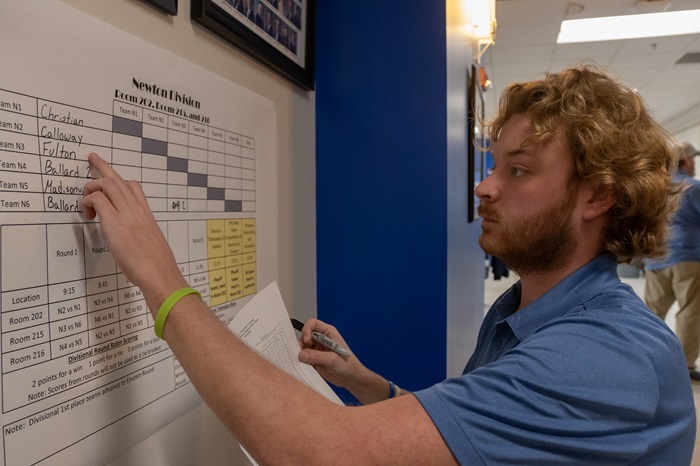 U.S. Department of Energy (DOE) Office of Environmental Management General Engineer Mitchell Guthrie enters the score for a team participating in the DOE West Kentucky Regional Science Bowl. Guthrie spent two years volunteering for the event before becoming the lead organizer for the competition at the Paducah Site.
PADUCAH, Ky. — The Paducah Site is cultivating the next generation of its leaders by linking young professionals with local education initiatives.
Mitchell Guthrie, a third-year engineer at the Paducah Site, is currently in his “rookie” campaign as the lead organizer for the U.S. Department of Energy (DOE) West Kentucky Regional Science Bowl and the Student Annual Site Environmental Report (ASER) programs.
Guthrie, 25, has found himself at the forefront of guiding these two programs that work directly with middle and high school students. The initiatives aim to generate the next talent pool for potential science, technology, engineering and math (STEM) careers at the Paducah Site.
Guthrie began his career at the Portsmouth Paducah Project Office (PPPO) under the DOE Pathways Recent Graduates Program. He was then hired for his current position and quickly picked up new roles and responsibilities along the way.
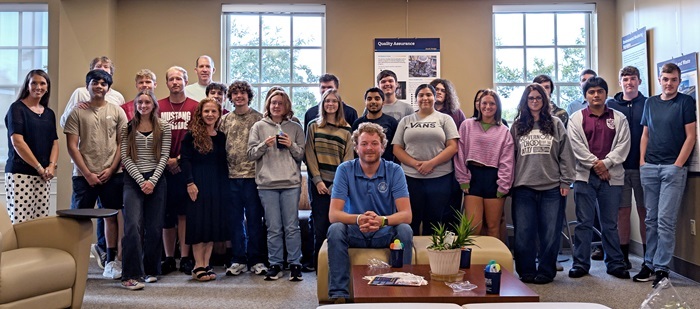 U.S. Department of Energy Office of Environmental Management General Engineer Mitchell Guthrie, front center, gathers with McCracken County High School students, teachers and administrators to discuss the Student Annual Site Environmental Report (ASER). The 2025-2026 academic year was Guthrie’s first year leading the Student ASER program.
“Mitchell embraced every task he was given, quickly establishing himself as an emerging leader,” PPPO Interim Acting Deputy Manager and Paducah Site Lead April Ladd said. “As a young professional, he was an obvious choice to take charge of the Science Bowl and Student ASER programs, helping bridge the gap between DOE and local students.”
Guthrie, a local resident who graduated from McCracken County High School and the University of Kentucky College of Engineering – Paducah Campus, brings fresh, new energy and perspective to the programs. He understands connecting with youth is instrumental in bringing the pipeline of talent to the Paducah Site.
“When I was growing up, the site was always a mystery,” Guthrie said. “I was always curious about what happened behind the gates. These programs, particularly the Student ASER, break down those barriers, allowing students to understand DOE’s cleanup program and identify future career opportunities."
Touted as the region’s most prominent science competition for high school students, the Science Bowl recently concluded its 18th annual event. Meanwhile, this year's Student ASER is close to completion. The educational outreach program educates local high school students about cleanup activities while they learn about potential career opportunities.
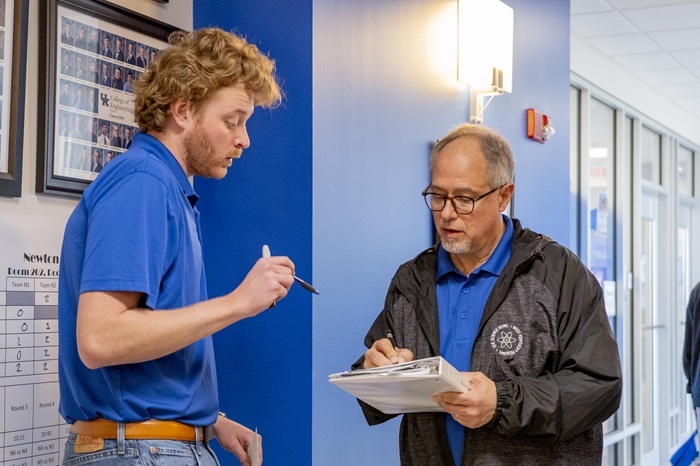 U.S. Department of Energy (DOE) Office of Environmental Management General Engineer Mitchell Guthrie, left, works with Steve Christmas, community relations specialist with Paducah Site deactivation and remediation contractor Four Rivers Nuclear Partnership, on event logistics during a DOE West Kentucky Regional Science Bowl competition.
In his first year as lead organizer, Guthrie hopes to see continued steady growth in both programs under his supervision.
“When the Science Bowl first began, we had difficulty attracting teams in the region. This year, we were at capacity but still receiving interest from other local schools. This opens an opportunity to potentially expand the event as soon as next year,” he said. “Meanwhile, last year’s Student ASER group had a handful of participants as this year’s participation ballooned to nearly 30 students.”
Building the next generation of Paducah Site leaders is the long term payoff for Guthrie as local students continue to familiarize themselves with cleanup activities and other operations.
“Seeing the kids show interest and ask questions is the most rewarding part of leading these programs,” Guthrie said. “You can tell they want to learn more each time you speak with them. My goal is to build these programs as a springboard for local students. In 10 years, I hope to see some of these kids here at the site, in my position.”
-Contributor: Zachary Boyarski
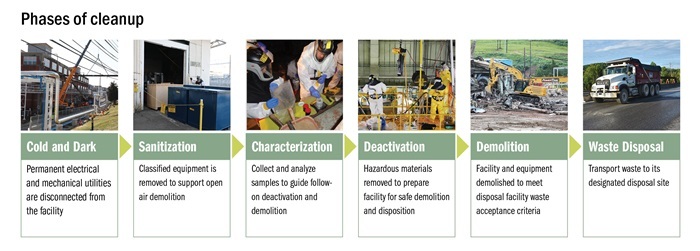 Steps the Oak Ridge Office of Environmental Management and United Cleanup Oak Ridge are taking to address the Alpha-4 facility at the Y-12 National Security Complex.
OAK RIDGE, Tenn. — The Oak Ridge Office of Environmental Management and cleanup contractor United Cleanup Oak Ridge (UCOR) are making significant headway preparing one of the most challenging facilities at the Y-12 National Security Complex for demolition.
Alpha-4, a 510,000-square-foot structure covering 13 acres of land, enriched uranium during the Manhattan Project and processed lithium during the Cold War. Past operations inside the facility led to heavy mercury contamination.
"Preparing a facility for demolition is always the lengthiest part of the process,” said Alpha-4 Federal Project Director Morgan Carden. "It takes time to remove the hazards from inside the facility so crews can take it down safely and efficiently. At Alpha-4, our crews have much more to account for and it’s at a much larger scale than recent projects.”
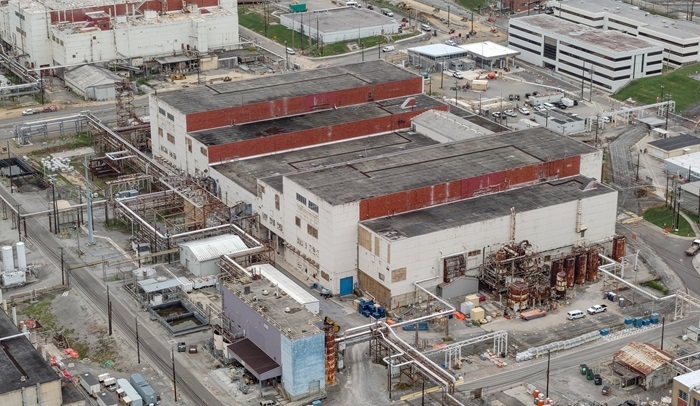 The Alpha-4 facility covers 13 acres of land at the Y-12 National Security Complex.
Teams have already completed placing the facility in "cold and dark" status — meaning they disconnected all utilities from the building.
Now, the teams are in the sanitization stage, which involves removing classified equipment to pave the way for other crews to enter and begin full deactivation.
They’re also addressing elemental mercury in the facility. The presence of mercury poses many challenges. Experts estimate nearly 450,000 pounds of the element to be in the equipment, facility and surrounding area. Its retrieval will continue to be a focus for project teams.
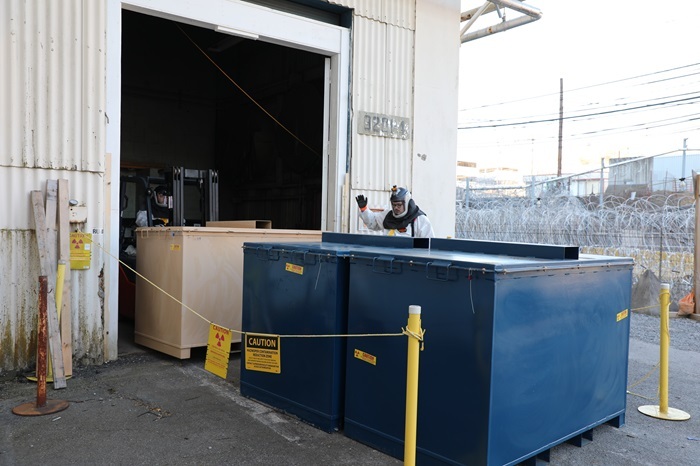 Teams have sorted and segmented 447 legacy containers from the Alpha-4 facility for transport and disposal.
Crews have sorted and segmented 447 legacy containers inside the building for transport and disposal ahead of schedule.
After sanitization concludes in 2028, crews will begin characterization, waste removal, venting and purging process lines, and full scale deactivation.
Although Alpha-4’s cleanup is set to be a lengthy process, team members have identified solutions that have accelerated the timeline by nearly two years and saved $16.3 million.
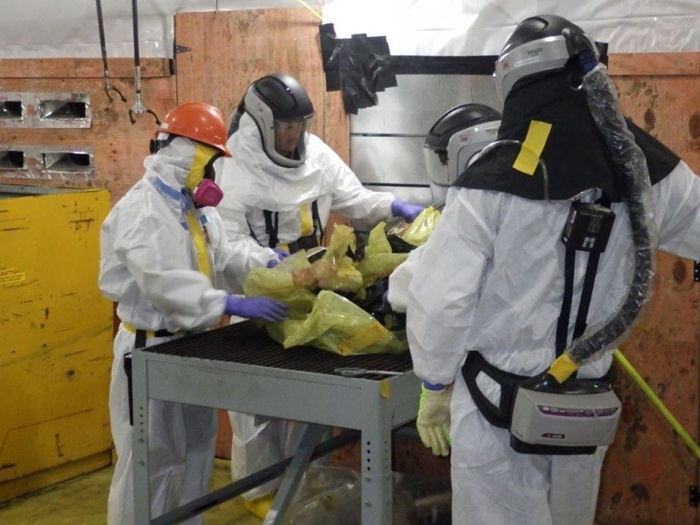 Crews package and remove classified materials from the Alpha-4 facility as part of the sanitation stage.
Crews began using a new drum crusher that speeds work to reduce the size of legacy drums for disposal, avoids risk associated with performing the task manually, and yields substantial cost savings. An effort that reduced the number of items needing to be declassified has also shortened the sanitation stage.
"Thoughtful planning and a proactive questioning attitude are paramount in a project of this scale and complexity," said Wayne Sproles, UCOR’s Y-12 deactivation and demolition manager. "We are constantly evaluating our approaches to ensure the safest and most cost-effective methods."
-Contributor: Ryan Getsi
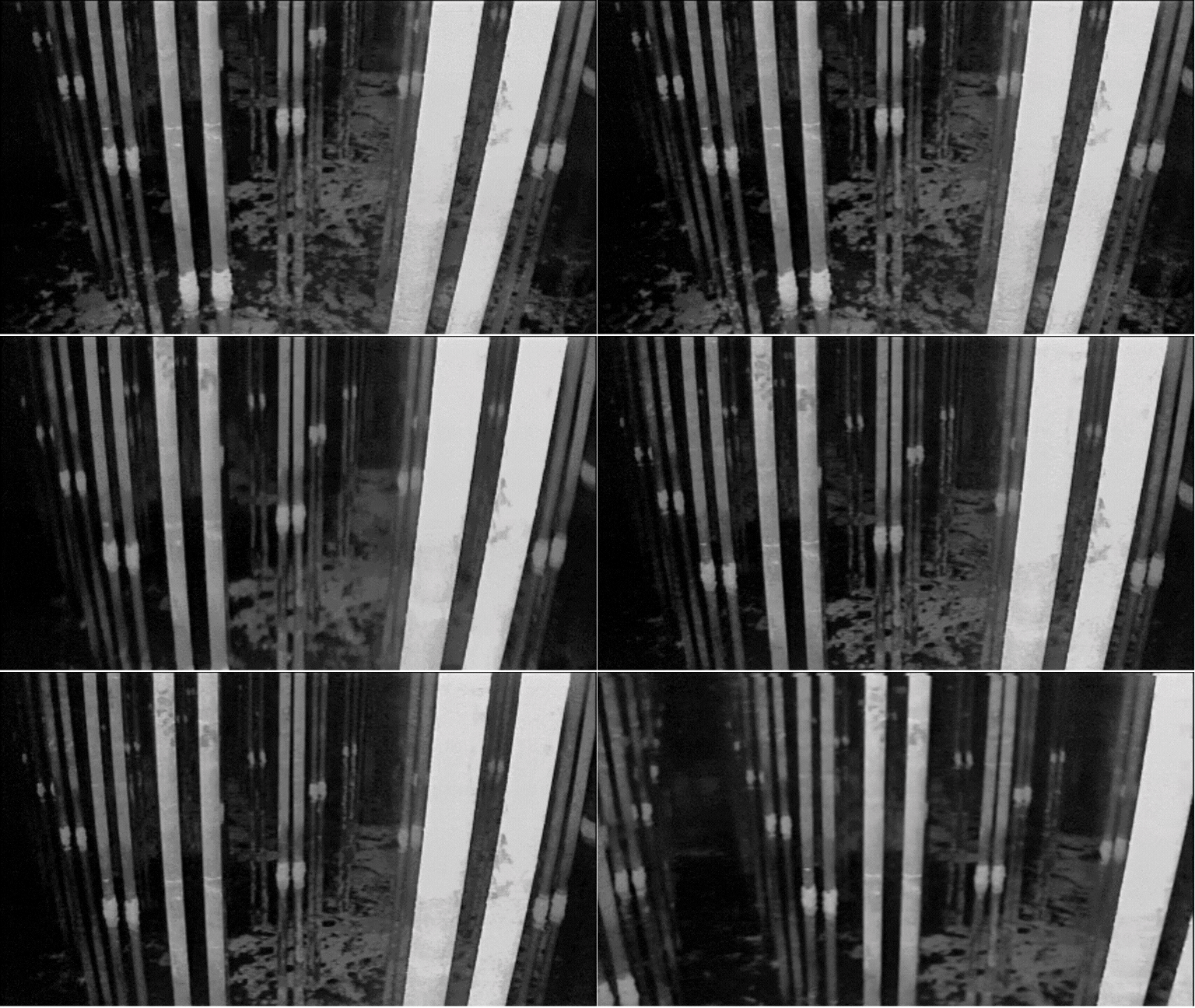 This tank inspection video was livestreamed during a transfer of waste from a tank at Savannah River Site to monitor the liquid level for exposed salt as well as inspect visible equipment.
AIKEN, S.C. — The U.S. Department of Energy (DOE) Office of Environmental Management (EM) and its liquid waste contractor at the Savannah River Site (SRS) are reconfiguring camera systems used to make inspections of waste tanks, diversion boxes and pump pits available in a matter of minutes.
Tank waste at SRS was generated as byproduct from processing nuclear materials for national defense, research, medical programs and missions in outer space. About 33 million gallons remain stored between two tank farms, which are groupings of underground tanks.
Previously, footage from cameras lowered into process areas could only be viewed in the field and downloaded to discs for later distribution and viewing — a process that could take up to 24 hours. Now, crews are installing specialized video transmission equipment and servers in the tank farms to provide streaming capabilities to remotely view the tank footage instantaneously and share it across the facility in minutes.
Livestreaming of tank inspections will streamline distribution of information to aid in making informed decisions more quickly. This efficiency means faster execution of activities, less downtime and an increase in the number of additional activities that can be performed. Each of these efficiencies will enable better use of workers’ time and reduced delays in the performance of activities needed for tank closure, resulting in overall cost savings.
Using a streaming service in 2026 may seem ordinary until you consider the context, according to Savannah River Mission Completion (SRMC) Executive Vice President and Chief Engineer Cliff Conner. SRMC is EM’s contractor managing the tank waste at SRS.
“Streaming video footage is nothing new, but when it’s coming from inside a highly radioactive waste tank, it’s an extremely innovative feat,” Conner said. “By engineering our camera infrastructure to provide streaming video, the tank footage is accessible almost immediately, reducing costs as well as operational delays. This impressive improvement is important to our mission’s acceleration, because it offers real time collaboration to answer important processing questions.”
Tony Robinson, DOE’s acting assistant manager for waste disposition at SRS, said implementing this new technology means informed decisions can be made sooner in the tank closure process.
“Improving access to important camera inspections benefits us greatly as we work to accelerate the SRS liquid waste mission and deliver on our legacy waste cleanup commitments,” said Robinson.
Camera inspections provide valuable information on waste transfer progress, locations of salt and sludge waste, estimations of remaining tank volumes and more.
Streaming inspections also allow users to monitor inspections from anywhere, including live-feed monitoring in the tank farm control room for shift management.
-Contributor: Jim Beasley
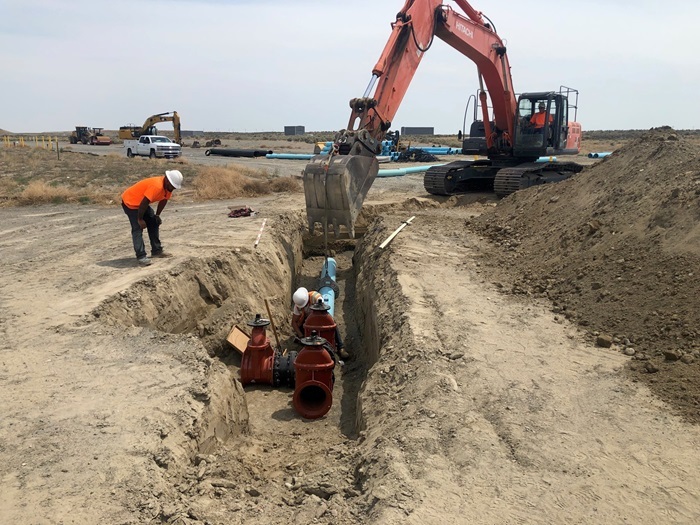 New risk-ranking criteria will help prioritize repairs to the Hanford Site’s waterline system.
RICHLAND, Wash. — Infrastructure teams at the Hanford Site will soon have a new waterline risk ranking system.
Hanford Field Office (HFO) contractor Hanford Mission Integration Solutions (HMIS) held a workshop to improve how risk is assessed in the site’s waterline systems.
The effort supports the U.S. Department of Energy's mission to enhance U.S. infrastructure and ensure public safety while providing good value for taxpayers.
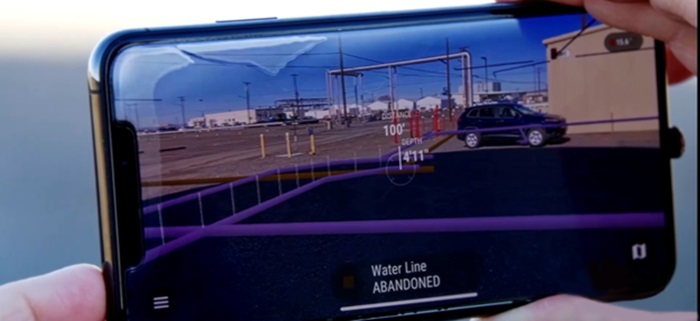 Innovative technologies based on geospatial data help engineers identify waterlines and their condition.
"The teamwork and fresh ideas shown by HMIS are key to reaching our goals for Hanford cleanup and U.S. infrastructure," said Vanessa Turner, HFO acting assistant manager for Mission Support. "This project boosts our operational standards and highlights our commitment to safety and efficient use of resources."
The workshop gathered key people to create a new system for ranking risks. The team used industry standards, and geospatial and historical data to consider how likely a failure is and what the impact would be. The improved approach will help teams manage the waterlines better, making them safer and more efficient.
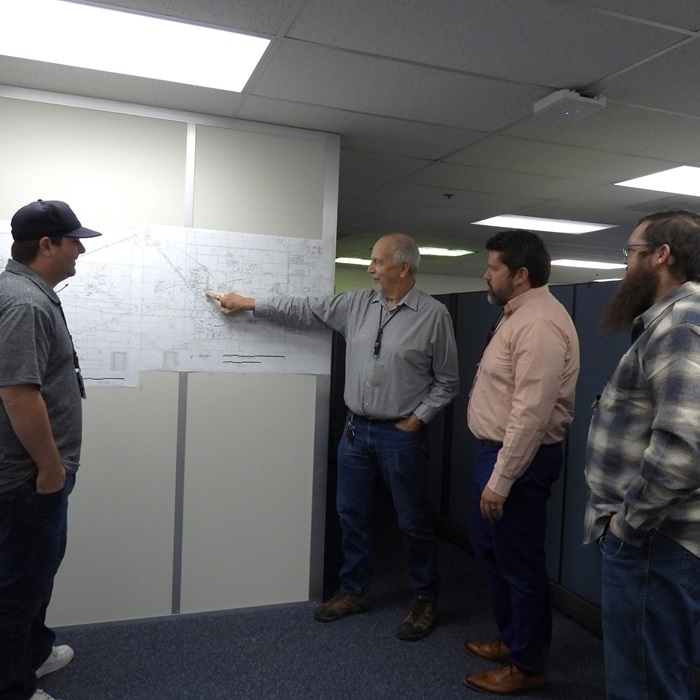 The workshop team reviewed current systems and risk criteria to develop an improved system.
"The great teamwork and progress during this workshop show our focus on new ideas and efficiency," said Brent Stenson, HMIS Water & Sewer Utilities director.
The workshop’s success shows how Hanford is turning challenges into opportunities for improvement. The new risk ranking system, which will be tested and improved, highlights the site’s emphasis on continuous improvement. By focusing on safety and efficiency, Hanford continues to drive innovation and maximize taxpayer value, helping to achieve the broader goals of U.S. energy security and infrastructure resilience.
|