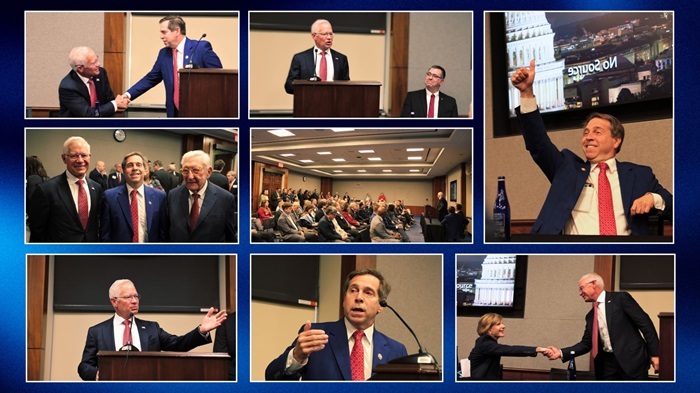
WASHINGTON, D.C. — U.S. Department of Energy Office of Environmental Management (EM) Assistant Secretary Tim Walsh recently joined U.S. Reps. Chuck Fleischmann and Susie Lee for the first U.S. House Nuclear Cleanup Caucus event of the year, where they highlighted how EM and its federal, state, local and industry partners are helping shape the American nuclear renaissance through remediation, restoration, redevelopment and the integration of artificial intelligence (AI). Walsh is pictured at top-center speaking, Fleischmann is shown at top right and Lee is pictured at bottom-right shaking hands with Walsh.
During the event, Walsh noted that the mission of EM begins with the contractors conducting the ongoing work at the cleanup sites, leading to economic development and vitality. He also discussed the near- and long-term plans across EM sites to transform liabilities into assets and streamline efficiency to allow the nuclear renaissance to be affordable and available.
Participants also focused on the cleanup program’s bold approach to implementing the use of AI across EM sites to help accomplish the goals of the Trump administration.
The well-attended event was hosted by the Energy Facility Contractors Group, Energy Technology and Environmental Business Association and Nuclear Energy Institute.
-Contributors: Jordan Anderson, Carly Howard
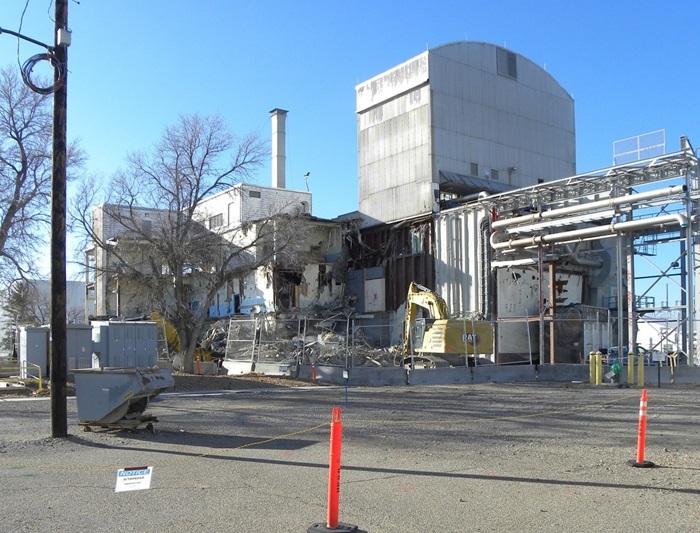 Idaho Cleanup Project crews demolish the Aircraft Carrier 1st Generation Westinghouse Annex administrative office areas, attached to the prototype building. The crane house, the tall arched portion of the building, is also visible at top right in the photo.
IDAHO FALLS, Idaho — The Idaho Cleanup Project (ICP) is progressing with deactivation and demolition (D&D) of two historic Naval Nuclear Propulsion Program prototypes, continuing an effective partnership between the U.S. Department of Energy Office of Environmental Management (EM) and the Office of Naval Reactors (NR) to reduce the environmental footprint at the Idaho National Laboratory (INL) Site.
“Our project crews work very efficiently and that has allowed us to work an accelerated timeline at all three prototypes,” said Shawna Burtenshaw, operations director for deactivation and demolition projects for ICP cleanup contractor Idaho Environmental Coalition (IEC).
Crews are currently focusing on the demolition of several areas around the Aircraft Carrier 1st Generation Westinghouse (A1W) prototype, including the facility’s generator building, administrative office areas and other buildings. Above-grade demolition in these areas is nearly complete, and removal of large, heavy mechanical components is underway, with an anticipated completion later this year.
This year, crews will also finish deactivating the A1W crane house, a mobile facility previously used for refueling and maintenance of the prototype.
Burtenshaw noted that early work at the A1W prototype at the Naval Reactors Facility began in 2023, thanks to progress on the Submarine 1st Generation Westinghouse (S1W) prototype, which crews finished demolishing late last year.
Teams have also started characterization and deactivation activities at the Submarine 5th Generation General Electric (S5G) prototype. IEC’s efficient D&D approach has allowed teardown of the defueled A1W and S5G prototypes to progress ahead of NR’s initial projections.
“Characterization and deactivation are crucial phases of any demolition project and focus on ensuring safety of the workers, the public and the environment,” said Burtenshaw. “These efforts are in progress and include the identification and removal of hazardous material like asbestos or polychlorinated biphenyls, and the isolation of electrical and mechanical components.”
The S5G prototype sits below-grade in a basin, and crews are characterizing, packaging and removing basin items for disposal.
EM and IEC assumed responsibility for D&D of the three legacy Navy prototypes starting in 2022. Work will continue at A1W and S5G through fiscal year 2031.
Beginning nuclear operations in 1958 and 1965, respectively, the A1W and S5G prototypes played a vital role in advancing naval nuclear research and training tens of thousands of Navy and civilian students.
-Contributor: Carter Harrison
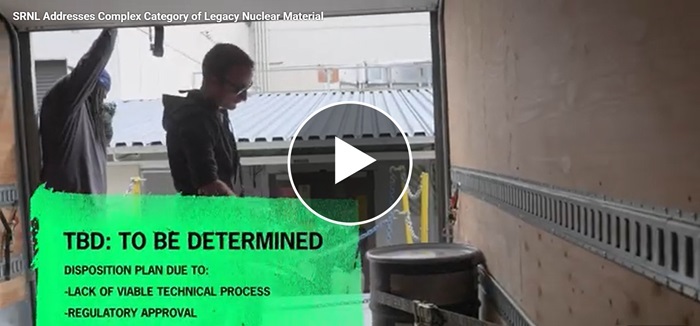
Sole EM-sponsored national lab addresses disposition challenges of ‘to be determined’ legacy nuclear materials
AIKEN, S.C. — The U.S. Department of Energy (DOE) keeps a detailed inventory of legacy nuclear materials housed across its complex, including disposition pathways for the materials. The National Nuclear Security Administration's Nuclear Materials Integration Division has chartered Savannah River National Laboratory (SRNL) to identify and begin developing a solution to challenges associated with the materials categorized as having a “to be determined” disposition path, such as unique fuel debris. SRNL is the sole national laboratory sponsored by DOE’s Office of Environmental Management.
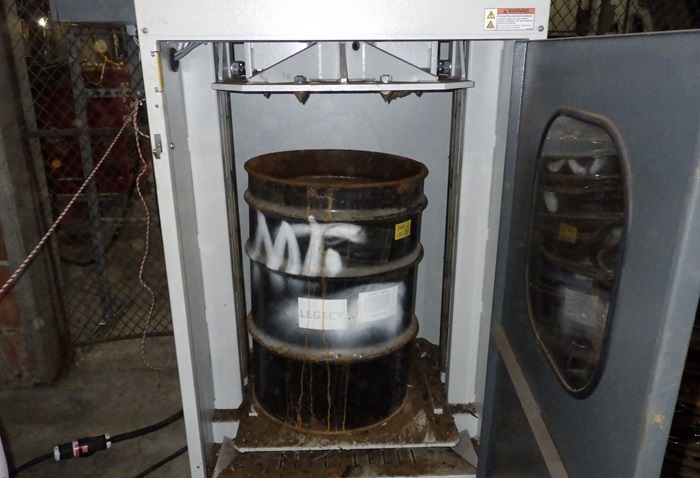 Hundreds of old drums in Alpha-4 are not compliant for shipping and must be crushed and packaged for shipment and disposal. Using a crusher, a three-person Oak Ridge Office of Environmental Management crew can now process 35 to 40 drums per hour, compared to 10 to 12 drums using previous manual cutting methods.
Quest for innovation, efficiency led Oak Ridge to crusher that performs work safer, faster
OAK RIDGE, Tenn. — The Oak Ridge Office of Environmental Management (OREM) and cleanup contractor United Cleanup Oak Ridge (UCOR) are “crushing it” at the legacy Alpha-4 building as an innovative approach to squashing old drums is accelerating waste disposal, avoiding $300,000 in costs and eliminating tasks with higher safety risks.
This innovation builds on earlier cost savings at Alpha-4 resulting from the declassification of materials for more efficient disposal. Combined, these efforts have pushed the project at the Y-12 National Security Complex nearly two years ahead of schedule with $16.3 million in cost savings.
“Alpha-4 is one of the most complex facilities in our cleanup portfolio,” said Alpha-4 Federal Project Director Morgan Carden. “Despite the challenges inherent with a project of this scale and magnitude, our team is advancing work forward and finding ways to save costs and accelerate the schedule.”
Spanning 561,000 square feet over 13 acres of land, Alpha-4 was constructed in the 1940s as part of the Manhattan Project for uranium separation and later supported lithium operations during the Cold War before being shut down in the 1960s.
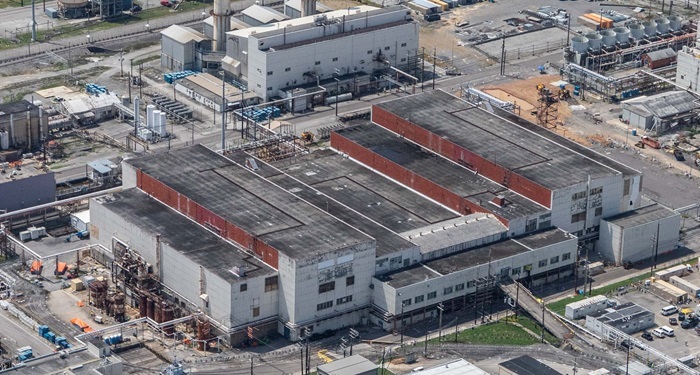 Alpha-4 was a former uranium separation and lithium processing facility that operated during the Manhattan Project and Cold War. The Oak Ridge Office of Environmental Management is tasked with deactivating and demolishing the 561,000-square-foot facility covering 13 acres of land at the Y-12 National Security Complex.
OREM and UCOR are addressing the contents of the sprawling building as they prepare it for future demolition. An early step involves sorting and segregating legacy containers inside the facility, and teams identified an alternative to the traditional approach for downsizing empty waste drums that aren’t compliant for shipment for disposal.
Historically, crews used saws and shears to cut drums manually to reduce the size of them for disposal. This labor-intensive process created sharp metal edges, elevated noise levels, increased personal protective equipment (PPE) requirements and introduced additional injury risk.
However, a new drum crusher compacts these drums into uniform round “pucks.” This innovation creates efficiencies and avoids costs by allowing workers to reduce the size of the drums much faster and place more drums in each waste container for shipment. This approach also significantly reduces risks and removes the need for the previous PPE requirements.
With this new equipment, a three-person crew can now process 35 to 40 drums per hour, compared to 10 to 12 drums using previous manual cutting methods. To date, workers have crushed 261 of the 354 legacy drums at Alpha-4.
This is the first Oak Ridge project to use the equipment, but now there are plans to apply it to other large deactivation and demolition projects on the horizon at Y-12 that involve large quantities of similar drums and waste containers.
“Thoughtful planning for waste disposal helps eliminate hazards early, protecting workers and support staff while maximizing the value of taxpayer dollars,” said Jonathan McKamey, UCOR’s Alpha-4 superintendent. “We are constantly evaluating and reevaluating our approaches to ensure we implement the safest and most cost-effective methods possible for cleanup.”
UCOR continues steady progress throughout the facility to begin preparing for deactivation. In late 2025, crews achieved “cold and dark” status, which involves isolating all the electrical systems to safely conduct future work inside the building.
-Contributor: Ryan Getsi
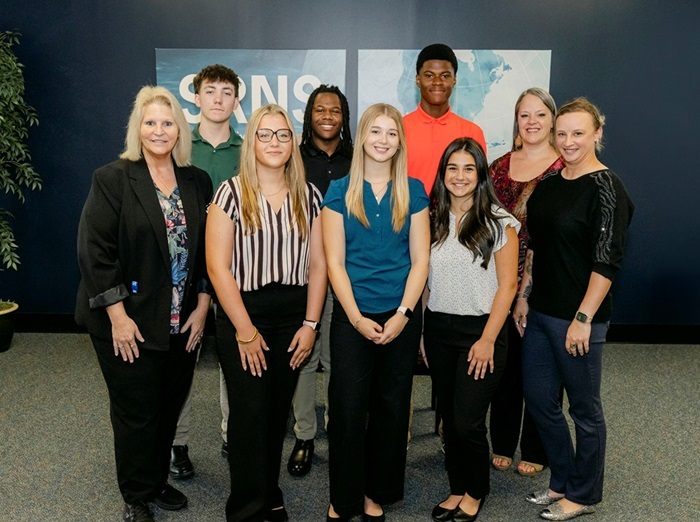 Six youth apprentices join the Savannah River Site (SRS). Front row, from left: BooBoo Roberts, SRS Apprenticeship School program manager; youth apprentices McKayla Smith, Lillian Garner, and Maya Deskevich; and Kaci Prouty, project controls administrative assistant. Back row, from left: youth apprentices Cohen Harrison, Steven Cook and Carson Williams; and Abigail Bowman, former Savannah River Nuclear Solutions college partner, curriculum, and pipeline development lead.
AIKEN, S.C. — Six youth apprentices are making a meaningful impact this year as part of the Savannah River Site’s (SRS) Youth Apprenticeship Program.
The program, integral to the SRS Apprenticeship School and its 29 registered apprenticeships, welcomes high school students from Aiken, Columbia and Richmond counties.
Since its expansion sitewide in 2020, the Apprenticeship School has graduated nearly 850 apprentices, with 91% successfully securing full-time positions at the site.
“To modernize the nation’s nuclear deterrent, we need a strong and diverse base of national expertise and educational opportunities in specialized technical areas that contribute to this mission,” said Sean Alford, senior vice president and chief administrative officer for Savannah River Nuclear Solutions (SRNS), the site’s managing and operations contractor. “Our program is designed to support STEM disciplines that are critical to the Nuclear Security Enterprise and the Department of Energy, such as nuclear operations and other technical areas.”
The Youth Apprenticeship Program fosters a resilient workforce to meet the site’s evolving needs, said Dorian Newton, SRNS site training director.
“Through various partnerships, the program provides hands-on training, job-specific education and professional development across three models: key-skilled technician, professional/degree-based and youth apprenticeships,” Newton said.
The 24-month program is tailored for high school juniors and seniors. Participants earn their diplomas while acquiring practical experience at SRS. As limited-service employees, youth apprentices earn wages and can also receive work-based learning credits.
In 2025, the program introduced two new roles: junior project controls engineer and junior business analyst, increasing the total number of youth apprenticeship options to five.
“These apprentices are eager to learn, quick to adapt and excelling in their new roles," said Kaci Prouty, SRNS project controls administrative assistant. "By beginning their careers while still in high school, they are setting a high standard for future program participants.”
McKayla Smith, a business analyst youth apprentice and Midland Valley High School senior, said her family has a long history of working at SRS, spanning four generations.
“I applied for the apprenticeship program to further my knowledge in business and accounting,” Smith said. “In my current role in Payroll Accounting, I am learning all of the different aspects of this department and how they work individually and together."
Halfway through their senior year, many youth apprentices are preparing to pursue relevant fields of study in college, with the goal of returning to SRS as adult apprentices or taking on full-time positions.
"My computer repair class, mock interviews and resume writing exercises prepared me for this opportunity," said Carson Williams, information technology youth apprentice and North Augusta High School senior. "My daily work involves computer repair and cybersecurity, and I am currently pursuing my CompTIA Cloud+ certification. I hope to work in cybersecurity or software engineering, and this experience is a crucial step toward achieving that."
Oscar Rushton, Aiken County Public School District work-based learning coordinator, said the SRS Apprenticeship School is a perfect example of positive outcomes that occur when education and industry work shoulder to shoulder: lives change, families gain stability and the community grows stronger.
“We are investing in clear, decisive opportunities to enable students to step into meaningful roles, while local businesses benefit from hiring homegrown talent,” Rushton said. “This is how you build a reliable workforce.”
The SRS Apprenticeship School benefits from a strong network of external and internal stakeholders that provide resources, expertise and funding support. Click here for more information.
-Contributor: Mackenzie McNabb
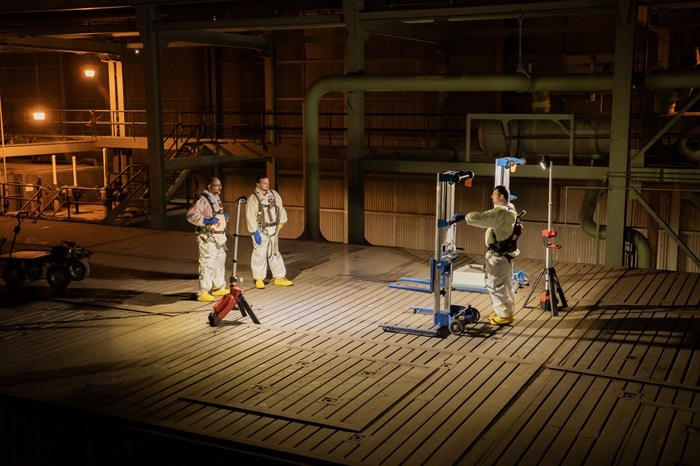 Technicians position instruments for the Rapid In Situ Screening for Converters and Compressors atop the housing of process gas equipment to measure components in place at the Paducah Site’s C-337 Process Building.
PADUCAH, Ky. — Cleanup at the Paducah Site is advancing thanks to new technology to efficiently scan equipment for uranium deposits as crews deactivate a second former uranium enrichment process building at the site to prepare it for eventual demolition.
Developed at the Paducah Site, the new component measurement method is designed to improve safety, reduce costs and significantly accelerate project schedules as U.S. Department of Energy Office of Environmental Management (EM) crews work to turn liabilities into assets for the American people. This initiative also demonstrates how EM incorporates innovation and efficiency into cleanup, focusing on priorities and reining in costs without sacrificing safety or effectiveness.
In the C-337 Process Building, nondestructive assay (NDA) experts are deploying the new technology, Rapid In Situ Screening for Converters and Compressors (RISCC), to scan process gas equipment in place, leading to significant efficiencies in preparing buildings for future demolition. NDA is a process of scanning without modifying or changing the condition of equipment being scanned.
“The C-337 Process Building is a complex facility, and its components pose new challenges as crews begin removing equipment from the former uranium enrichment process building,” Portsmouth Paducah Project Office (PPPO) Interim Acting Deputy Manager and Paducah Site Lead April Ladd said. “RISCC gives us a way to receive effective, defensible measurements without dismantling equipment, a major step forward for safety and efficiency.”
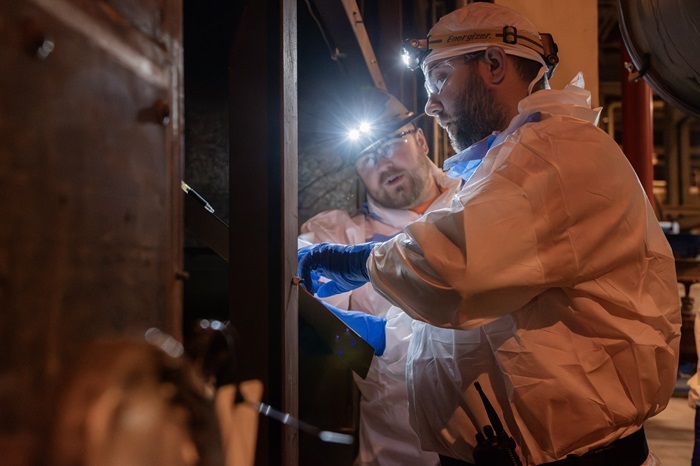 Johnathan Vaughan, right, and Chris Toon inventory process gas equipment to be scanned prior to removal in the Paducah C-337 Process Building.
NDA crews must measure equipment to determine if uranium deposits are present and whether any special handling is required. Historically, multiple NDA measurements were required for each component, a labor-intensive process. RISCC allows workers to obtain the necessary data in a safer, more efficient manner, reducing risk to workers, project costs and schedule durations.
The RISCC method is being deployed to scan nearly 1,000 components in C-337, leveraging lessons learned from the other methods developed at the Paducah Site. Implementing the RISCC approach before process gas equipment is processed for disassembly allows analysts to screen equipment against established criteria and potentially remove the special handling and spacing requirements that slow removal and transportation.
Previously, there was no way to scan components in place without modifying or removing other systems and structures in C-337. Crews partially disassembled the equipment, or moved it before taking measurements, adding time, cost and increased risk of exposure to hazardous conditions for personnel.
“By applying RISCC ahead of disassembly, we’re reducing the projected schedule for the C-337 Process Building significantly,” Ladd said. “It’s a novel methodology developed at the Paducah Site and will only become more accurate as we collect additional scans.”
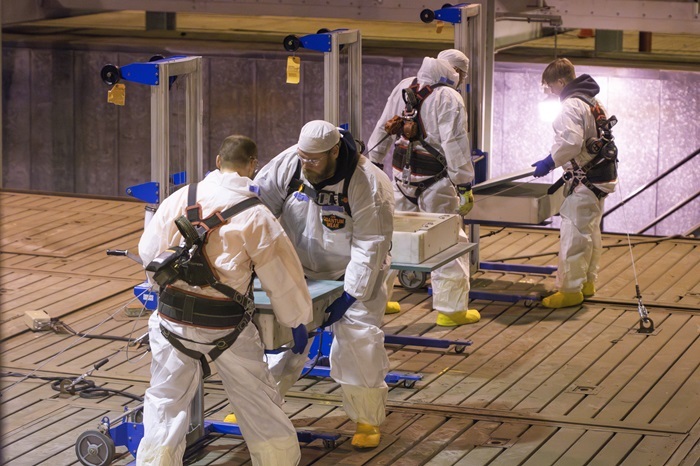 Nondestructive assay technicians set up detectors used for scanning methods to support Rapid In Situ Screening for Converters and Compressors at the Paducah Site’s C-337 Process Building.
Using existing equipment, RISCC takes advantage of spallation and atmospheric data collected during scanning from other NDA methods, ensuring valid measurements throughout the process to provide data that reduce operational costs with an expected acceleration of deactivation activities. Spallation is the process where small particles break away from an atom.
“The RISCC method significantly reduces the time required for each measurement,” Four Rivers Nuclear Partnership Program (FRNP) Manager Myrna Redfield said. “By gathering high quality data up front, we decrease the need to duplicate measurement efforts as components move through the removal process, saving a tremendous amount of time.”
FRNP is the Paducah Site deactivation and remediation contractor.
Removal of process gas equipment from C-337 is essential to prepare the facility for future demolition. PPPO conducts cleanup activities at the Paducah Site in accordance with the Comprehensive Environmental Response, Compensation, and Liability Act.
-Contributor: Dylan Nichols
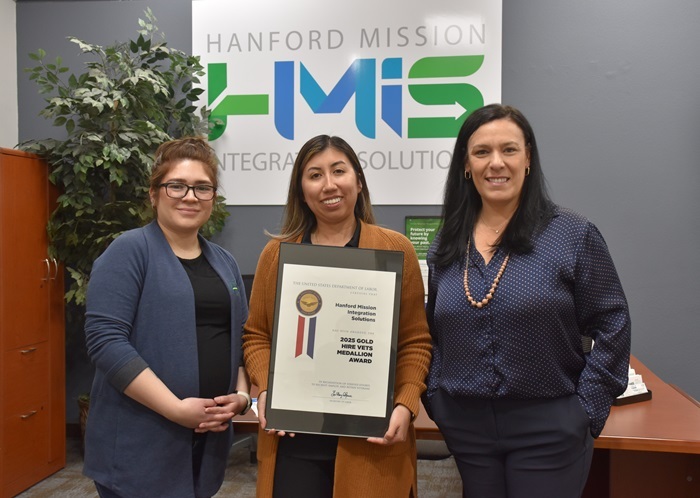
RICHLAND, Wash. — A Hanford Site contractor recently received the U.S. Department of Labor award for exemplary efforts in recruiting, employing and retaining the nation’s veterans — the Honoring Investments in Recruiting and Employing American Military Veterans (HIRE Vets) Gold Medallion Award.
Through their Veterans Advocacy for Learning, Opportunities and Resources (VALOR) program, Hanford Field Office contractor Hanford Mission Integration Solutions (HMIS) earned this honor for the mentorship, leadership development and other resources they provide to veteran employees at HMIS and veterans throughout the community.
“We’re proud to support those who have served, whether they’re just starting their civilian careers or continuing to grow with us,” said Maria Marler, U.S. Army veteran and HMIS human resources specialist, pictured above with HMIS Equal Employment Opportunity officer Sarah Vines, left, and HMIS vice president of Workforce Solutions Julie Lindstrom, right.
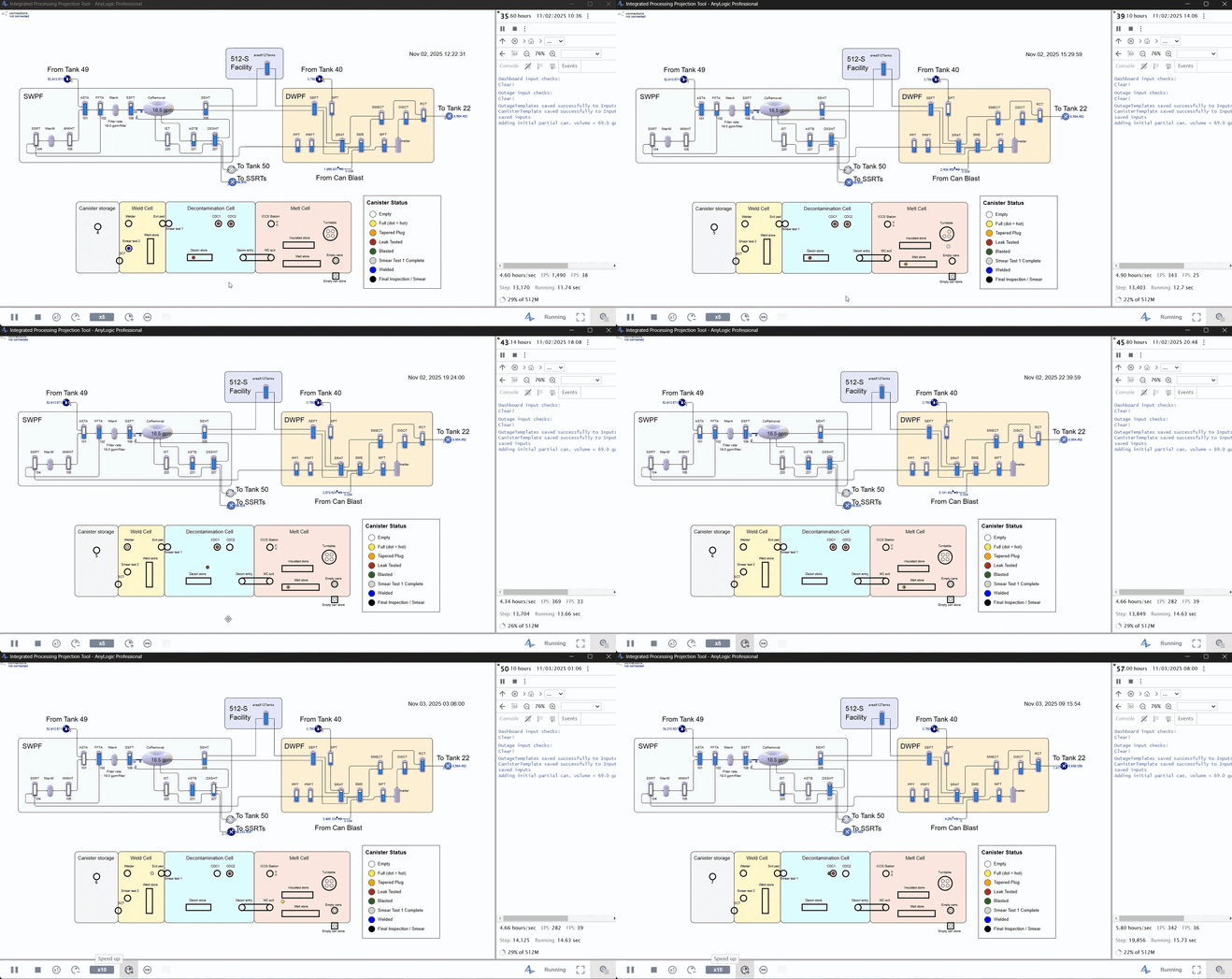 The Integrated Processing Projection Tool automates the ability for Savannah River Mission Completion managers to graphically see how short-term production changes can affect other processes and facilities. The tool is seen as a new way to help move the Savannah River Site Liquid Waste Program to completion.
AIKEN, S.C. — The U.S. Department of Energy (DOE) Office of Environmental Management and its liquid waste contractor at Savannah River Site (SRS) have implemented an agile, innovative toolset that expands near-term planning capabilities enabling optimized facility integration that improves the overall schedule for treating radioactive waste.
Savannah River Mission Completion (SRMC) is responsible for treating and disposing of the millions of gallons of waste remaining in underground tanks at SRS, as well as closing the tanks. One of the capabilities SRMC uses in mission planning is computer modeling tools developed by DBD Inc., an SRMC subcontractor.
The first model identifies process or facility improvements most likely to accelerate the SRS liquid waste mission. Computer models create digital representations, or simulations, of real-world processes. The outputs from the computer models are used to create tables, charts and schedules published in the SRS Liquid Waste System Plan and inform annual budget requests for cleanup activities.
The original model continues to be used for long-term system planning four years or more into the future. A new model, known as the Integrated Processing Projection Tool (IPPT), simulates the effects of processing changes down to a much shorter period and produces a graphical depiction of integrated facility processing, automating a process previously performed manually by knowledgeable employees. The IPPT focuses on the daily operation of facilities, helping to develop coordinated processing strategies for the short term.
 Savannah River Mission Completion’s Integrated Processing Projection Tool provides a significant improvement to system planning. The tool is used to estimate how long a Defense Waste Processing Facility outage can last without impacting salt waste production or mission completion goals. This software automation delivers the graphic in seconds and gives users a greater sense of an unexpected outage’s impact.
DOE-Savannah River acting Assistant Manager for Waste Disposition Tony Robinson expects the new short-term forecasting model to improve facilities planning for more optimized results.
“This update to the modeling software is an example of how we are leveraging the power of innovative technologies to further accelerate our cleanup efforts to address legacy waste,” Robinson said.
The IPPT delivers quick, clear and organized output for routine scenarios, an analysis of outages in one or more facilities, and provides for “what-if” scenarios that could occur, according to SRMC Senior Vice President for Optimization and Integration Steve Howell.
“This new capability helps SRMC obtain the best results possible and execute even more effectively,” Howell said. “We can now see all our short-term options and scenarios more quickly and clearly. This tool provides SRMC management with the information needed to make swift and strategic processing decisions in the near term.”
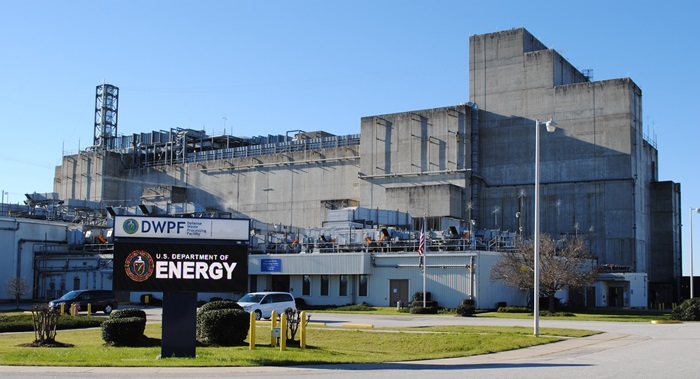
When emergent outages occur, a short turnaround of the modeling graphic can help managers align priorities, while considering other pending maintenance activities. For example, when specific data is input, the system model can estimate how long a Defense Waste Processing Facility outage can last without impacting salt waste production or mission completion goals. This software automation delivers the graphic in seconds and gives users a greater sense of an unexpected outage’s impact.
−Contributor: Jim Beasley
|