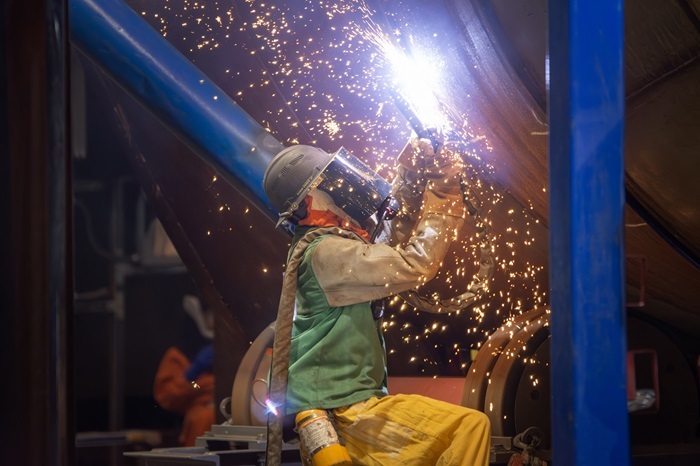
 A crew member safely segments a converter in the C-333 Process Building at the Paducah Site. Workers recently segmented the 497th and final converter from the facility, allowing crews to now turn their attention to the segmentation of converters from the C-337 Process Building.
Pursuit of innovation, efficiency helped crews accomplish goal as EM focuses on priorities, curbs costs without sacrificing safety or effectiveness
PADUCAH, Ky. — Since work began to prepare the first former uranium enrichment process building for eventual demolition at the Paducah Site, one number loomed large: 497. That’s the total number of large process components, called converters, the team needed to remove from the C-333 Process Building.
U.S. Department of Energy Office of Environmental Management (EM) crews recently reached their goal of clearing all 497 of them from the facility.
“Every step of this work was planned and executed with worker safety at the forefront,” EM Portsmouth Paducah Project Office Interim Acting Deputy Manager and Paducah Site Lead April Ladd said. “The technological advancements and disciplined approach the teams brought to this effort not only helped safely achieve this milestone but positioned us for continued success as deactivation activities transition to the C-337 Process Building.”
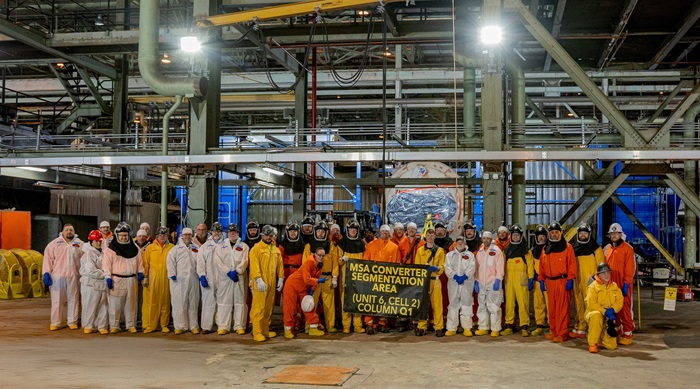 Workers gather in the C-333 Process Building with a banner that says, “MSA Converter Segmentation Area.” Crews recently completed the safe segmentation of all 497 converters from the facility. MSA stands for Material-Sizing Area.
Team members removed, precisely cut and downsized the converters through a process called segmentation. With converters weighing upward of 70,000 pounds, some of their contents were reclaimed, compacted and stored onsite for possible reuse.
Use of new tools, procedures and knowledge-sharing from their sister site, Portsmouth, allowed Paducah team members to dramatically increase productivity while process improvements shortened time for segmentation from roughly 14 days per converter during startup operations to as many as two converters daily. Meanwhile, compaction crews kept pace to prepare and store the contents of the converters onsite, maintaining rigorous safety standards that made the project a success.
Innovation and enhanced methods from custom dust-collection systems to advanced handling equipment for compacting the contents of the converters were essential to optimizing performance and safeguarding personnel during the segmentation process.
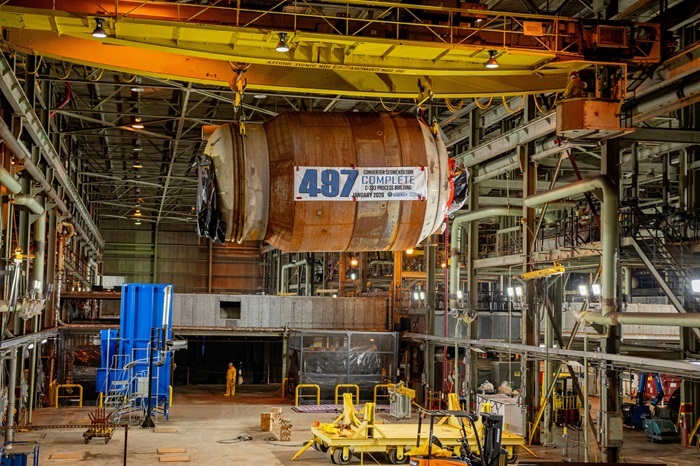 Crews hoist the final converter for segmentation in the C-333 Process Building. A banner on the equipment reads “497,” the total number of converters they segmented to prepare the facility for future demolition.
Crews will apply lessons learned from deactivating C-333 to future process buildings, supporting EM’s long term vision for holistic cleanup at the Paducah Site. This holistic approach focuses on end use fueled by community interest in site reuse for economic development while targeting land that has the highest potential for reuse.
“By embracing innovative technologies, engaging in continuous improvement from our workforce, and incorporating feedback from field operations and partner sites, our team set a strong foundation for the next phase of deactivation,” Four Rivers Nuclear Partnership (FRNP) Program Manager Myrna Redfield said. “Everyone involved showed an exceptional commitment to safety and excellence to complete this milestone for the Paducah Site.”
FRNP is the deactivation and remediation contractor at the Paducah Site.
The Paducah Site conducts cleanup in accordance with the Comprehensive Environmental Response, Compensation, and Liability Act.
-Contributor: Dylan Nichols
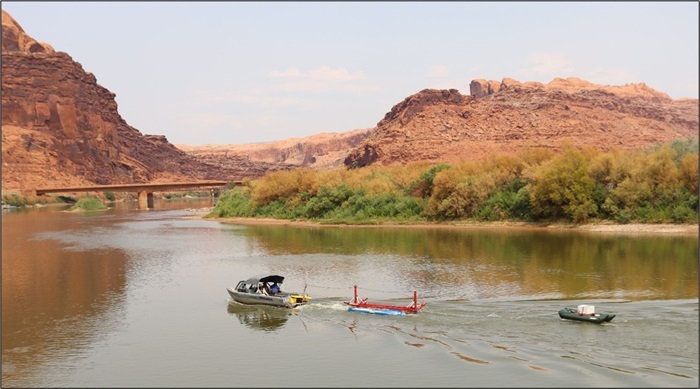 Pacific Northwest National Laboratory uses boat-towed electromagnetic equipment to conduct a geophysical survey in the Colorado River near the Moab Uranium Mill Tailings Remedial Action Project’s Moab site, which is adjacent to the river.
New field investigations are improving understanding of groundwater contaminant behavior and strengthening the scientific basis for future remediation decisions, the Moab Uranium Mill Tailings Remedial Action Project noted during a recent presentation at the Pacific Northwest National Laboratory (PNNL) RemPlex Seminar series.
To help the Moab Project identify data gaps in a study on corrective measures and inform development of a groundwater compliance action plan, the Network of National Laboratories for Environmental Management and Stewardship partnered with the Moab Project. The collaboration led to field investigations to refine the site’s conceptual model and fill in data gaps.
With new data, improved models and strengthened cross-laboratory collaboration, the Moab Project is well positioned to finalize its groundwater compliance action plan and move closer to site closure.
“It has been fascinating to see all the data come together to support the Moab Project’s final groundwater remedy, and we are grateful for the ongoing support from our national lab partners,” said Moab Project Environmental Manager Elizabeth Moran, who presented at the seminar.
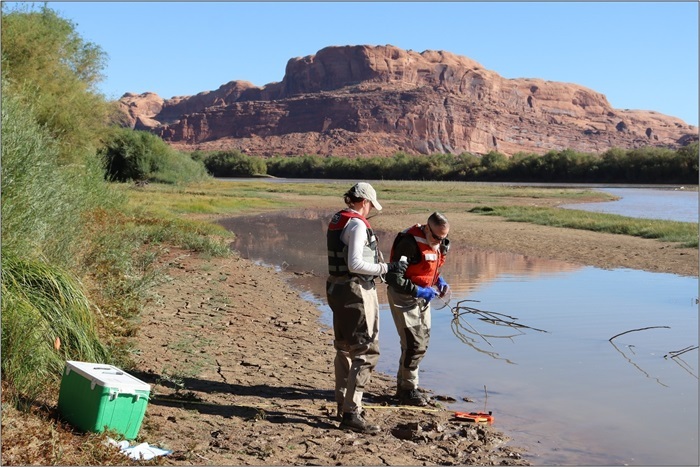 Pacific Northwest National Laboratory researchers conduct riverbed characterization analysis on the banks of the Colorado River, adjacent to the Moab Uranium Mill Tailings Remedial Action Project’s Moab site in southeastern Utah.
The seminar highlighted results from a diverse suite of studies conducted over a three year period by national laboratories, universities and technical partners, including PNNL, Savannah River National Laboratory (SRNL), Lawrence Berkley National Laboratory, Florida International University and the companies Geosyntec and Vista Clara. SRNL is the sole national laboratory sponsored by the U.S. Department of Energy Office of Environmental Management, which oversees the Moab Project.
Those studies provide clearer insight into subsurface conditions, plume dynamics and groundwater-river interactions — all critical factors for selecting and optimizing long term remedies.
The Regulatory Center of Excellence at SRNL continues to support the Moab Project in its development of a successful remediation strategy. The Moab Project is also considering using the SRNL-led Advanced Long-Term Environmental Monitoring System as a modern framework for long term monitoring.
-Contributor: Barbara Michel
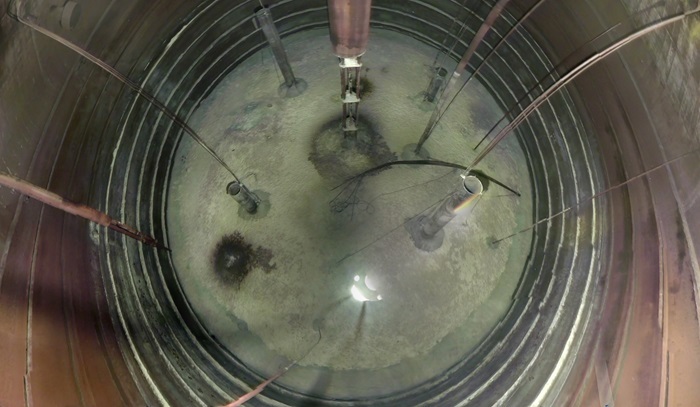 Radioactive and chemical waste inside Tank A-106 at the Hanford Site before workers started pumping it out to a double-shell tank for safe storage.
RICHLAND, Wash. — Crews recently began retrieving radioactive waste from the 24th single-shell tank at the Hanford Site, two years after using an innovative system to cut into the tank dome for the installation of new equipment.
Tank A-106 is a million-gallon tank that contains about 80,000 gallons of solid waste, which now is being transferred to a newer, double-shell tank for continued safe storage. It’s one of two tanks currently undergoing retrieval operations by the Hanford Field Office and its tank operations contractor, Hanford Tank Waste Operations & Closure (H2C).
“Safely cleaning up legacy waste at Hanford is not just a technical challenge — it’s a responsibility that honors our commitment to protecting our workforce, our communities and the environment,” said Katie Wong, program manager with the Hanford Field Office Tank Farms Programs Division. “Every step forward reinforces our dedication to a safer future for generations to come.”
 |
|
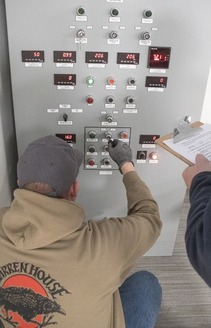
Hanford Tank Waste Operations & Closure workers recently conducted leak tests on Tank A-106’s piping systems and equipment in preparation for starting retrieval operations. |
In late 2023, workers drilled an opening through the thick concrete top of Tank A-106 and installed a pipe, called a riser, to provide access for waste retrieval equipment. This task had only been done three times in the previous 15 years at Hanford.
Hanford is home to 177 underground storage tanks built in groups called tank farms. Workers built A-106 and five other million-gallon tanks in the A Tank Farm in the 1950s to store waste from plutonium processing during the Cold War era.
A Tank Farm is the third farm to undergo retrieval at the site. Retrieval field operations on the farm’s first tank and Hanford’s 22nd single-shell tank, A-101, were completed last September.
“The retrieval team persevered through several challenges this past year, making it better as the year progressed,” said Dave Saueressig, H2C’s retrievals manager. “Other H2C organizations stepped up and supported retrievals in creating more double-shell tank space, allowing A-101 to finish by the end of fiscal year 2025 and A-102 to resume operations.”
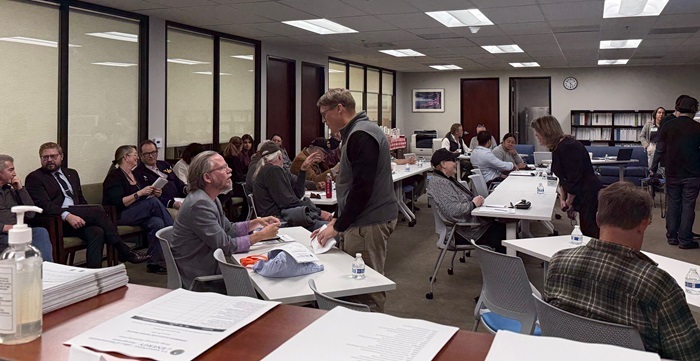 Josh Mengers, the U.S. Department of Energy Office of Environmental Management federal project director for Santa Susana Field Laboratory, interacts with attendees at the Energy Technology Engineering Center team’s first session in its new Community Outreach, Neighbor Notifications, Engagement, Collaboration and Training (CONNECT) series.
SIMI VALLEY, Calif. — In-person engagement and direct conversations with those invested in cleanup at the Santa Susana Field Laboratory (SSFL) were core concepts of the new series launched last month by the U.S. Department of Energy’s (DOE) Energy Technology Engineering Center (ETEC) team.
Nearly 40 people recently attended the first session in the Community Outreach, Neighbor Notifications, Engagement, Collaboration, and Training (CONNECT) series to hear updates on cleanup activities at SSFL.
SSFL is a 2,850-acre former rocket engine and nuclear research facility comprised of four operational areas. DOE’s Office of Environmental Management (EM) is charged with remediation in Area IV, where ETEC previously operated.
“The CONNECT series is our commitment to action, partnership and open communication,” said Josh Mengers, EM’s federal project director for ETEC. “The purpose of this series is simple — to strengthen relationships with the people and organizations who care about the site’s cleanup, and to increase the way we provide direct, timely information about the cleanup.”
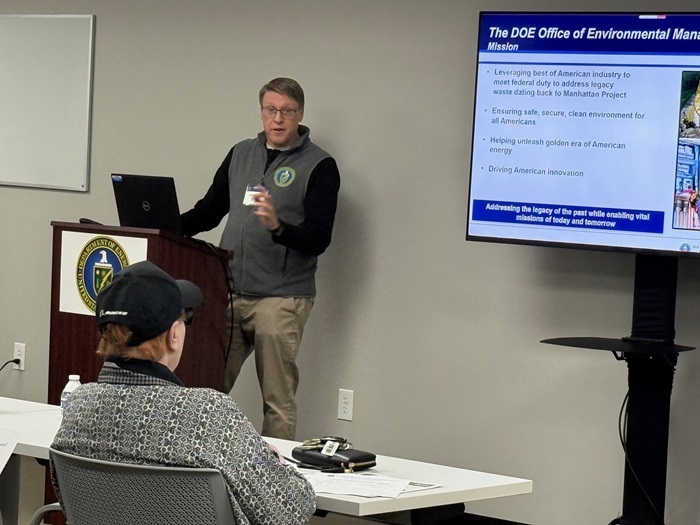 Josh Mengers, the U.S. Department of Energy Office of Environmental Management federal project director for Santa Susana Field Laboratory, presents a site overview during the Energy Technology Engineering Center team’s first session in its new Community Outreach, Neighbor Notifications, Engagement, Collaboration and Training (CONNECT) series.
Attendees at the January CONNECT session included representatives from state and local elected officials’ offices, school and park districts, neighborhood councils, conservancy groups, a Native American tribe and longtime cleanup advocates.
Mengers and Luke Hill, a project manager with EM contractor North Wind, gave the same presentation twice during the nearly four-hour CONNECT session, which was designed as an informal meeting to allow people to attend the portion that best fit their schedule.
The inaugural meeting provided a forum for key project updates, including plans for continuing building demolition and an update on groundwater remediation progress.
The group then engaged in Q&A with staff about groundwater, building demolition, technical data and potential topics for future events. Attendees were also encouraged to submit feedback about the session and share ideas for future events. The feedback will be used in upcoming events.
The ETEC team will host periodic CONNECT sessions, each focused on a specific topic, to provide the public with information and opportunities to engage with staff.
“My hope is that getting to know each other better will help us work more productively as partners towards a cleanup at SSFL that’s safe, scientifically sound and protective of this unique site,” Mengers said.
The Jan. 28 presentation will be shared on the CONNECT Series page, along with upcoming session dates or topics. To suggest future topics or provide feedback, fill out the CONNECT Feedback Form.
-Contributor: Melissa Simon
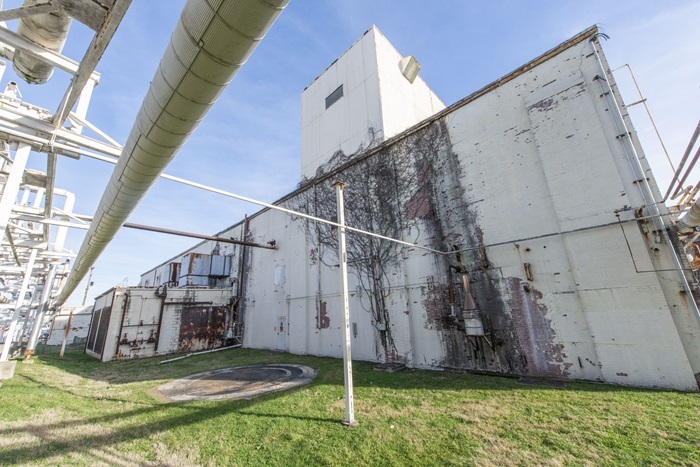 Oak Ridge crews have prepared the Old Steam Plant for demolition this summer. The facility dates to 1943 and has supported multiple missions over that span.
OAK RIDGE, Tenn. — The Oak Ridge Office of Environmental Management (OREM) and cleanup contractor United Cleanup Oak Ridge (UCOR) continue to make steady cleanup progress at the Y-12 National Security Complex.
The latest advancement involves taking the final steps to ready the Old Steam Plant for demolition — another in a string of projects to remove outdated and deteriorating infrastructure to clear space to support important national security missions.
The Old Steam Plant, also known as Building 9401-1, is a single-story, 13,454-square-foot facility constructed in 1943. Over the decades, it supported multiple missions, including uranium enrichment support activities, fuels testing and maintenance and storage operations.
Crews have successfully removed materials from the facility, the final preparation needed to begin its teardown. That is slated to start this summer.
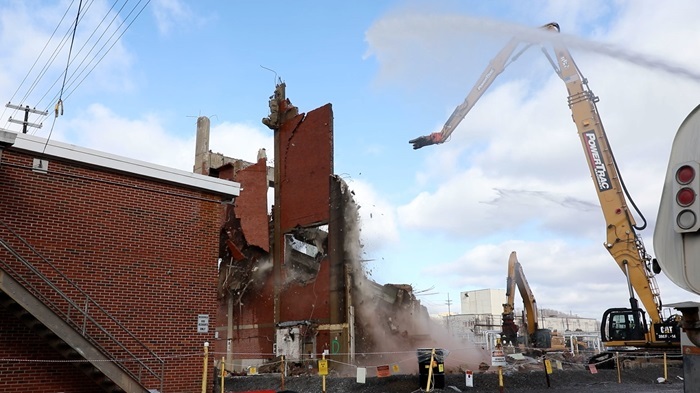 Crews take down the final columns of Alpha-2, marking the first former uranium enrichment facility officially on the ground at the Y-12 National Security Complex. Completing this project months early allows Oak Ridge Office of Environmental Management and UCOR to shift up the schedule for tearing down the Old Steam Plant.
“Being able to start this project a year ahead of schedule showcases the talent and commitment of our teams leading the transformation at Y-12,” said Joanna Hardin, portfolio federal project director for Y-12.
Hardin continued, “Completing Alpha-2’s demolition early has resulted in a trickle-down effect allowing us to deliver more risk reduction, clear the way for more modernization, and demonstrate responsible stewardship of taxpayer dollars by avoiding costs associated with maintaining and overseeing this facility for a longer period.”
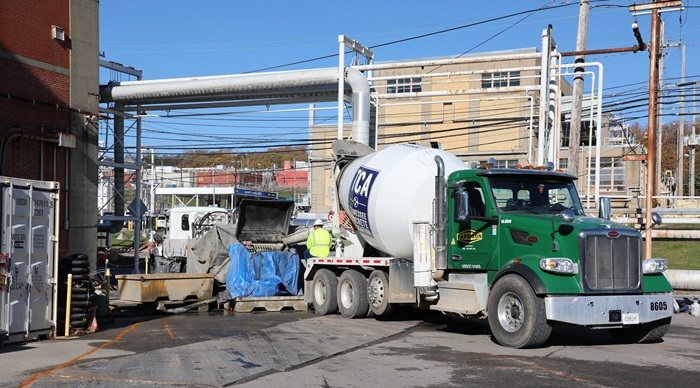 Crews pour a cement-like material into the basement of Beta-1 to enable large equipment to safely travel on the facility’s foundation during demolition.
The Old Steam Plant is the latest project in a broader sequence of deactivation and demolition reducing Y-12’s legacy footprint.
Since major cleanup began at Y-12 in 2020, OREM and UCOR have completed demolition of Alpha-2, the former Criticality Experiment Laboratory and the former Biology Complex, which collectively total more than 650,000 square feet. Together these removals have cleared more than 20 acres for Y-12 to reuse.
Now crews are busy preparing for the next wave of Y-12 demolitions — some of the biggest facilities yet to be torn down, altering Y-12’s landscape on an even larger scale. The first project in that sequence is Beta-1, a 210,000-square-foot former Manhattan Project uranium enrichment facility.
Beta-1 is scheduled to be demolition-ready by the end of the year.
-Contributor: Ryan Getsi
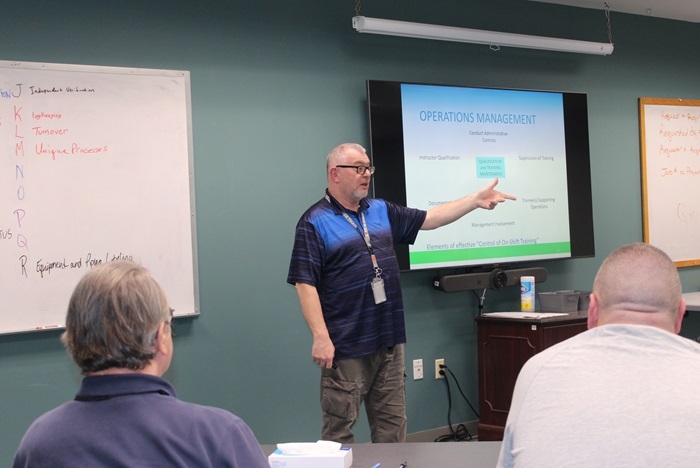 A cross section of employees at the West Valley Demonstration Project participate in a conduct of operations class to further improve the implementation and understanding of the program and its importance for safety and operational excellence.
WEST VALLEY, N.Y. — All hands were on deck recently for a unique sitewide training focused on conduct of operations, which establishes the core standards and operating philosophy that drive excellence across the West Valley Demonstration Project and broader U.S. Department of Energy (DOE) Office of Environmental Management (EM) complex.
The message from the training was clear: every employee contributes directly to operational integrity and mission success.
A conduct of operations program consists of formal documentation, practices and actions implementing disciplined and structured operations that support mission success and promote worker, public and environmental protection, according to DOE.
The training for the West Valley team reinforced the critical role conduct of operations plays in ensuring safe, compliant and high quality cleanup work. While often associated with nuclear operations, conduct of operations principles extend across maintenance, engineering, environmental services, quality control, procurement, accounting and all other disciplines at the site.
The training also demonstrates how EM leverages the best of American industry to run the largest environmental cleanup program in the world, safely meeting DOE’s legal cleanup responsibilities to ensure American communities are safe and prosperous.
“When faced with the cleanup work we perform, following our training is key,” said Jason Casper, president and program manager for EM cleanup contractor West Valley Cleanup Alliance (WVCA). “This is what directs and guides us to a better outcome without sacrificing safety, compliance or quality. Conduct of operations training reinforces this concept of leading with safety while sustaining operational excellence.”
Developed in-house, the training draws on decades of site experience, global incidents and benchmarking from other DOE locations. WVCA Conduct of Operations Program Specialist Barry Lester designed the program to strengthen awareness, improve implementation and deepen employees’ understanding of how their daily actions support the broader mission.
“This class is about creating awareness of how this program applies to each employee and how they can contribute to its success,” Lester explained. “We’ve hired many new employees over the past few years, and it was the right moment to reinforce the workforce’s understanding and application of conduct of operations. In doing so, we continue our efforts as a learning organization — one that is committed to growing, improving and achieving excellence in safe and compliant operations.”
A key takeaway for Lester: Newer employees shared real world personal experiences and examples of events where various aspects of conduct of operations failed. That’s when you know they understand how conduct of operations can affect us all, whether at work or at home, he noted.
The training incorporates hands-on exercises and group discussions to reinforce key concepts and encourage practical application. A final exam helps measure knowledge retention and identify opportunities for continuous improvement.
To maintain a high level of readiness and ensure new employees receive consistent instruction, conduct of operations training will be offered every two months at West Valley. Refresher sessions will also remain available for employees seeking to strengthen their understanding and performance.
-Contributor: Joseph Pillittere
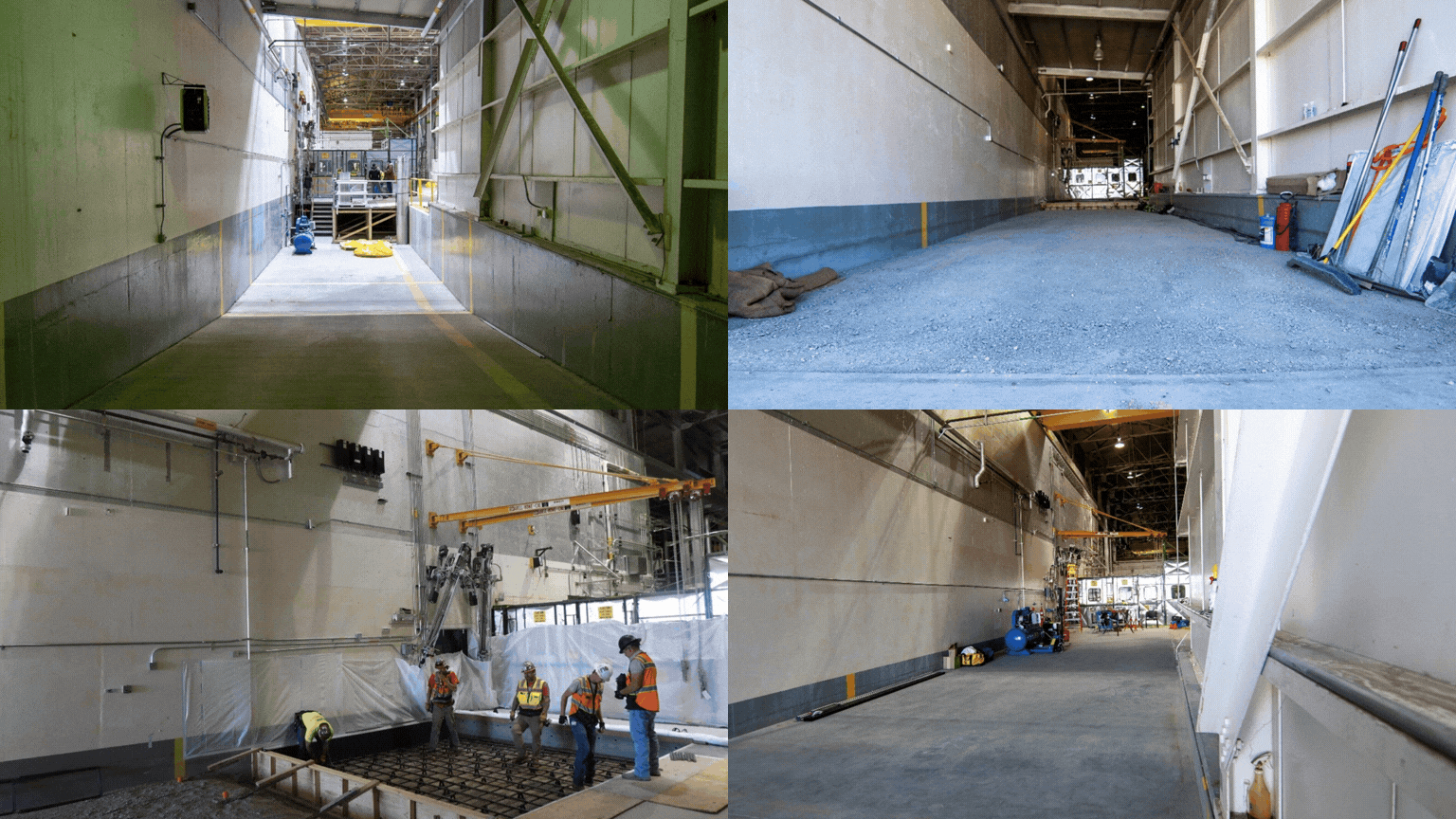 This sequence of photos shows the progression of converting a sloped truck bay into a level concrete staging area at the Idaho National Laboratory Site’s primary onsite used nuclear fuel dry storage facility. U.S. Department of Energy Office of Environmental Management crews filled and compacted the sloped truck bay to prepare for the concrete. Next, they placed forms and rebar for the fuel cask staging pad. The last photo shows the sloped truck bay modification completed.
IDAHO FALLS, Idaho — The Idaho Cleanup Project (ICP) recently completed another important modification to a Cold War-era storage facility to get used nuclear fuel (UNF) “road ready” for future shipment and permanent disposal out of state.
Crews converted a sloped truck bay into a level concrete staging area at the ICP’s CPP-603 building, the Idaho National Laboratory Site’s primary onsite UNF dry storage facility. This project is one of many to improve critical safety features, help crews meet U.S. Department of Energy commitments and prepare the legacy facility to support future work.
ICP’s primary UNF mission prepares packages for future shipment and disposal out of Idaho.
Modifications to CPP-603, such as crane upgrades, increasing size capacity of the transfer car that moves fuel in and out of storage, and leveling the sloped truck bay not only enhance the current management of fuel stored there but also ensures the work will continue safely.
“This project is an important step forward,” said Kerry Oltmanns, a senior manager with ICP cleanup contractor Idaho Environmental Coalition. “Leveling the truck ramp is one of many CPP-603 enhancements that will allow our crews to continue the safe execution of their existing work scope, and it places us in a unique position to carry out the long term used fuel mission in Idaho.”
-Contributor: Carter Harrison
|