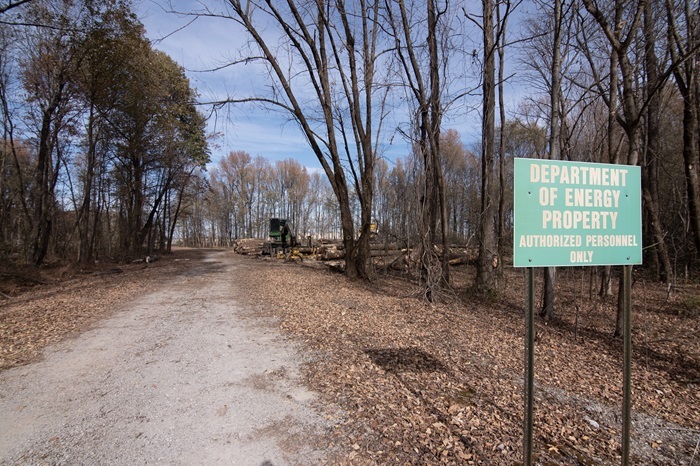
 A road at the Paducah Site leads to an area where trees are gathered after being cut down. General Matter is leasing 100 acres of land at the site, and is clearing space to prepare for construction of a uranium enrichment facility.
At center of new industry is General Matter, a company critical to rebuilding America’s nuclear fuel production base
PADUCAH, Ky. — U.S. Department of Energy (DOE) Office of Environmental Management (EM) crews have begun clearing trees at the Paducah Site to prepare for new tenant General Matter to eventually build a uranium enrichment plant on about 100 acres of leased land.
“This skyline change is a visible reminder new industry is coming,” Portsmouth Paducah Project Office (PPPO) Interim Acting Deputy Manager and Paducah Site Lead April Ladd said. “Paducah is leaning into the new nuclear renaissance, working with commercial companies supporting national security and providing competitive jobs for the current and future Paducah workforce.”
Well before DOE announced a lease agreement with General Matter last August for a new private-sector uranium enrichment facility, EM’s critical environmental planning was underway, including a cultural evaluation to ensure no archeological items needed to be preserved.
Paducah Site officials also worked with General Matter on a National Environmental Policy Act (NEPA) review to assess potential environmental impacts of the project and ensure environmental considerations are consistent with the proposed use.
“Because this is DOE property, it’s important all requirements are met to move forward with leasing a portion of the land,” Enterprise Technical Assistance Services (ETAS) Paducah Project Manager Kelly Layne said. “The NEPA review is an administrative checklist to verify it’s appropriate to move forward.”
ETAS is the PPPO technical support services contractor.
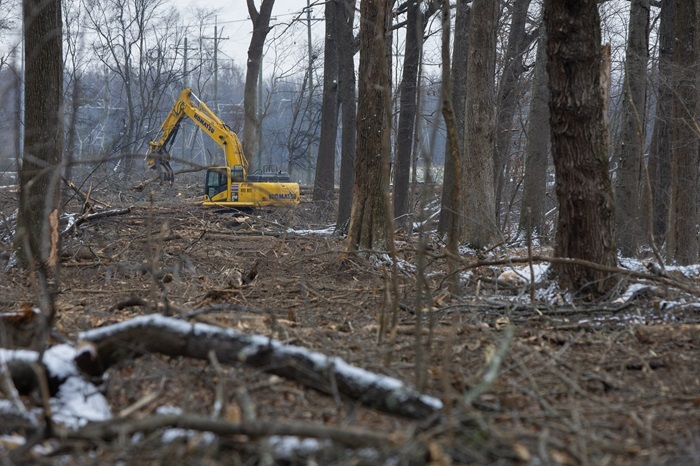 An equipment operator moves recently cut trees at the Paducah Site. Tree clearing is altering the skyline, making way for new industry.
For its part, General Matter performed an ecological survey last fall to evaluate wildlife and biological fauna. The company engaged with regulatory bodies to confirm endangered species would not be impacted by preparations for construction.
General Matter representatives are also now part of a shared site initiative. They participate in meetings and are at the table to discuss their plans.
“It’s all about good communication between General Matter and the site contractors,” said Layne.
After the trees are cut down, they will be removed from the site for size reduction and reuse. Crews will soon begin extracting tree root systems, allowing for a smoother surface. General Matter will also perform geotechnical sampling to validate the soil has the right compaction specifications before building. Further studies will take place this year.
Global Laser Enrichment, a company building a laser uranium enrichment facility on land adjacent to the Paducah Site, is also clearing trees ahead of constructing its facility, adding to the changing skyline near the site.
General Matter plans to launch uranium enrichment operations by the end of the decade upon receiving a license from the U.S. Nuclear Regulatory Commission. Global Laser Enrichment recently announced that the commission completed an acceptance review of its license application for the slated Paducah facility and intends to re-enrich a portion of the depleted uranium tails inventory at the Paducah Site by 2030.
-Contributor: Sarah Marko
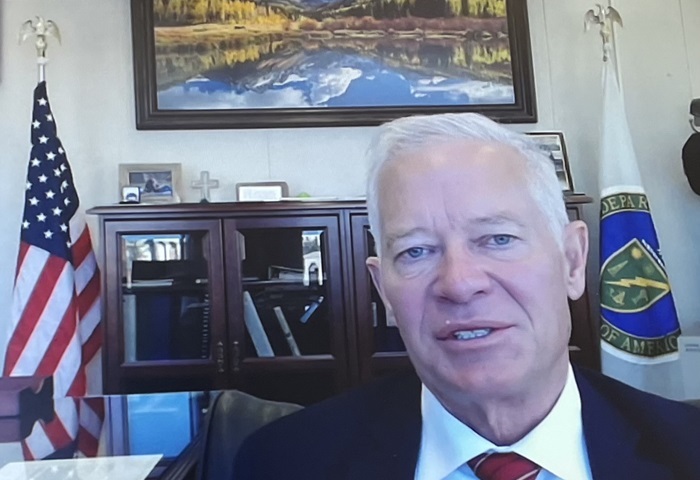 U.S. Department of Energy Office of Environmental Management Assistant Secretary Tim Walsh speaks with more than 90 officials from local, state and tribal governments during a recent virtual meeting.
More than 90 officials from local, state and tribal governments recently took part in a virtual meeting where U.S. Department of Energy (DOE) Office of Environmental Management (EM) Assistant Secretary Tim Walsh addressed five national intergovernmental groups with representatives located near cleanup sites who provide community perspectives to EM leadership.
Walsh said he looks forward to working with the community groups as EM builds bridges across government, communities and industry to expedite remediation and redevelopment opportunities. He asked attendees to envision the broader EM mission to help enable American energy, innovation and security, and advance infrastructure critical to winning the artificial intelligence race.
“In my experience, the best outcomes come when working closely with stakeholders,” Walsh told the participants.
The community representatives expressed interest in the burgeoning nuclear renaissance. Chuck Hope, an Oak Ridge City Council member and Energy Communities Alliance chair, remarked about his community’s enthusiasm for the new chapter of remediation, revitalization and redevelopment. He added that he supports the remediate-to-reuse approach.
The intergovernmental groups communicated their shared priorities: transparency, the need for ongoing dialogue, and regular interactions and coordination among DOE offices.
Walsh told the attendees he will visit EM sites and meet with community leaders.
The National Governors Association hosted the meeting, which included representatives from the Energy Communities Alliance, Environmental Council of States, National Association of Attorneys General and State and Tribal Government Working Group. The groups are set to meet for their annual in-person meeting in June.
-Contributor: Jill Conrad
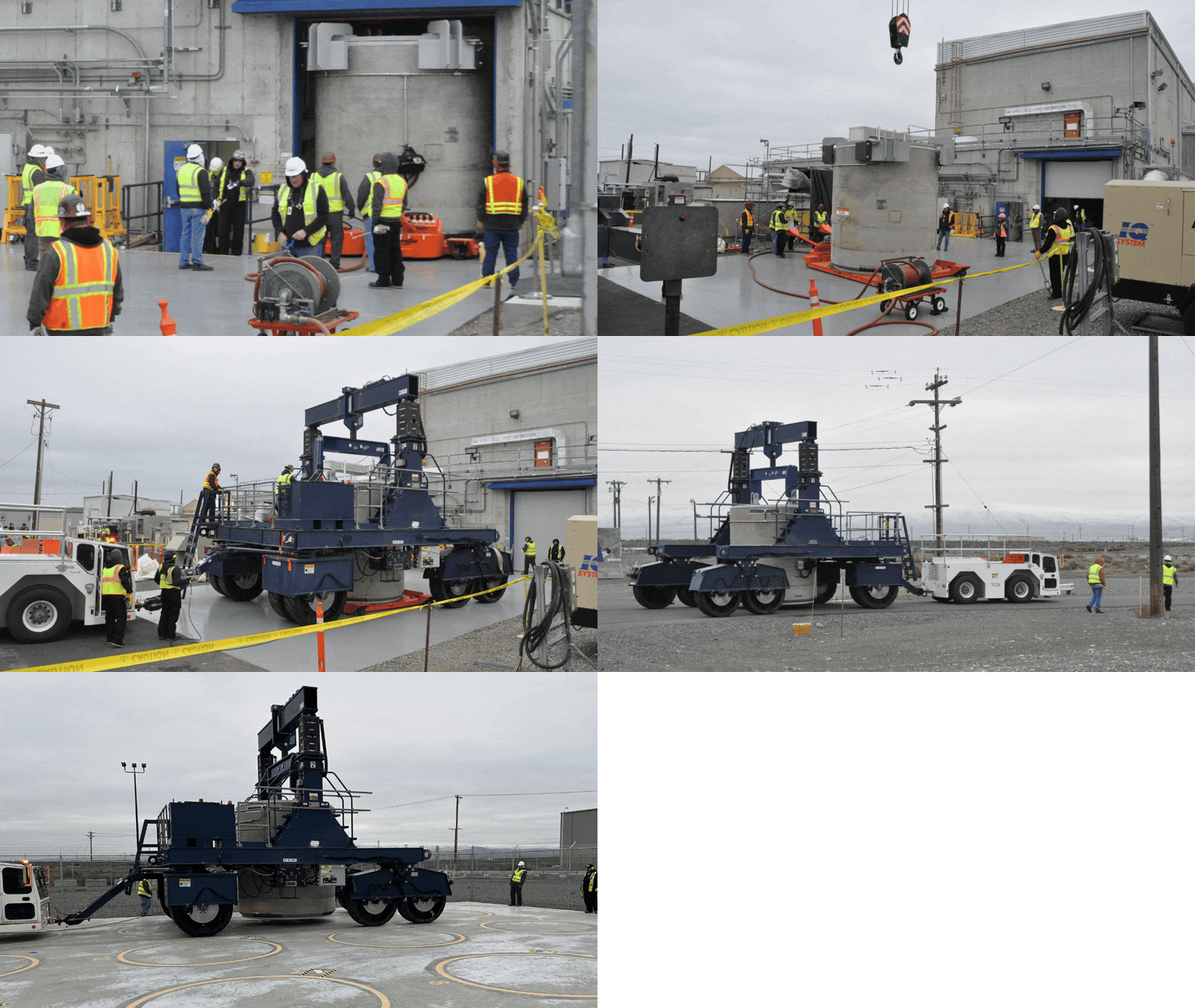 Hanford Capsules on the Move: The first engineered concrete cask filled with radioactive capsules — weighing about 160,000 pounds — is moved out of the Hanford Site’s Waste Encapsulation and Storage Facility and on to the truck port pad, where it is loaded on a transporter for the quarter-mile journey to the Capsule Storage Area. There, it is placed for safe, long term interim storage until a final disposition pathway is determined.
RICHLAND, Wash. — In a significant achievement years in the making, workers with U.S. Department of Energy Office of Environmental Management contractor Central Plateau Cleanup Company (CPCCo) recently moved the first of 18 concrete casks loaded with radioactive cesium and strontium capsules out of the Waste Encapsulation and Storage Facility (WESF) to a nearby dry storage pad at the Hanford Site.
The nearly 2,000 stainless steel double-walled capsules have been stored under 13 feet of water in WESF to protect workers from radiation exposure. The cesium and strontium were removed from Hanford’s underground waste storage tanks in the 1970s to reduce the temperature in the tanks. Collectively, the 1,335 cesium capsules and 601 strontium capsules hold about one-third of the radioactivity on the Hanford Site.
“The safe transfer of these capsules to dry storage is truly a historic accomplishment in Hanford’s cleanup mission,” said Gary Pyles, Hanford Field Office federal project director. “Moving the capsules out of WESF eliminates a significant risk on the site and will allow for the eventual deactivation of the aging facility.”
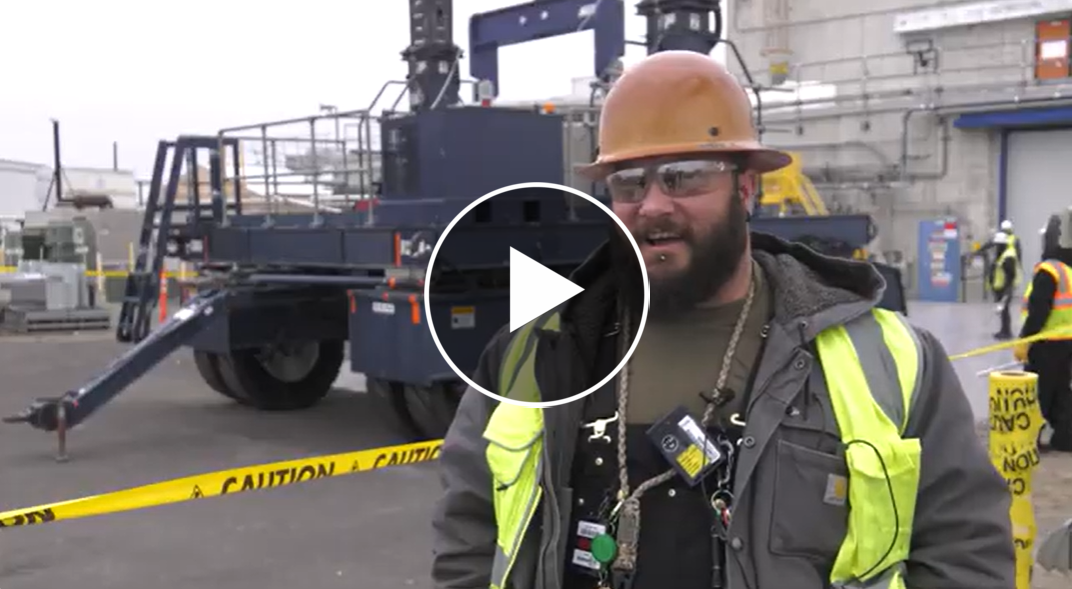 EMTV: Watch as Hanford Site crews safely transfer the first concrete cask of radioactive capsules to dry storage. Moving the 1,936 capsules from the aging Waste Encapsulation and Storage Facility reduces a significant risk on the site.
Each concrete cask can hold up to 132 capsules and weighs about 160,000 pounds fully loaded. The remote transfer of the capsules from underwater storage to the engineered cask storage system and then to the dry storage pad will continue for the next several years, with completion expected by late summer 2029.
“Moving the first cask to dry storage has been a long time coming, and I couldn’t be more proud of our team,” said CPCCo President Bob Wilkinson. “We look forward to continuing to safely advance this high-priority risk-reduction project throughout the next few years.”
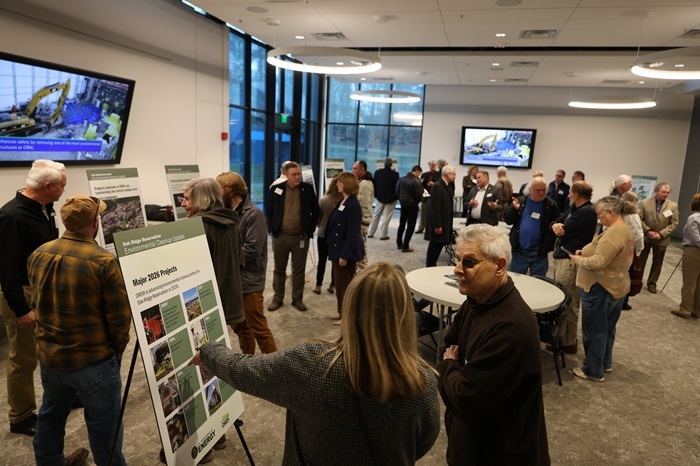 The Oak Ridge Office of Environmental Management hosts outreach events to help educate the public about the work underway and provide a venue for people to ask questions to the projects managers leading cleanup at the site.
OAK RIDGE, Tenn. — The Oak Ridge Office of Environmental Management (OREM) held an open-house public information session on Jan. 29 to keep the community updated on the priorities and latest cleanup happening across the U.S. Department of Energy (DOE) Oak Ridge Reservation.
The session at the Oak Ridge Conference Center included poster stations that highlighted recent achievements, projects on the horizon and goals for 2026. Federal and contractor project managers were also on hand to speak with participants.
The progress on display at the event demonstrates how the DOE Office of Environmental Management is removing risks, supporting DOE modernization efforts to advance important national missions and providing land for Oak Ridge to serve as a hub for nuclear energy technology and innovation.
“The support and involvement we receive from the Oak Ridge community has been a driving factor behind our success,” said OREM Public Affairs Specialist Ben Williams. “Events like this help ensure residents, local officials and partners are equipped with the latest information and have opportunities to ask questions and provide input directly to the project managers who are leading the work.”
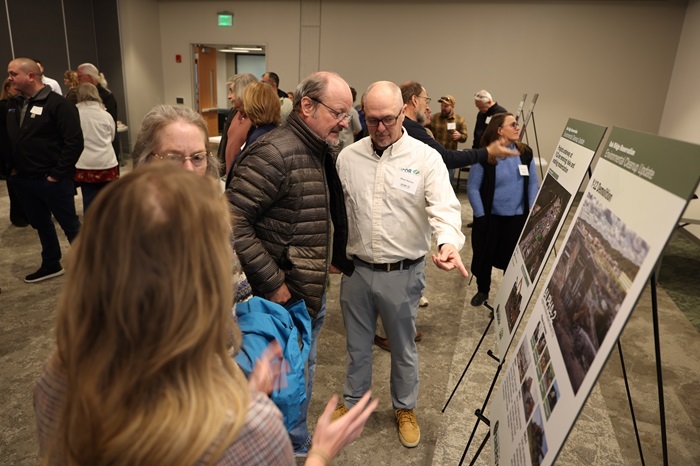 United Cleanup Oak Ridge Project Manager Brian Hutson discusses cleanup efforts underway at the Y-12 National Security Complex, including the Alpha-4 project, where he helped avoid $16 million in costs to taxpayers and accelerated the deactivation schedule by 1.5 years.
The Oak Ridge National Laboratory (ORNL) poster station included maps showing the real time status of deactivation and demolition efforts, and employees shared plans for removing the final hot cell at the former Radioisotope Development Laboratory, which is one of the most contaminated structures at the site. They also highlighted how they’re starting the teardown of 11 former isotope labs and production facilities.
Team members also discussed how OREM is steadily removing inventories of nuclear and radiological waste from ORNL that have been in storage for decades, including the nation’s inventory of uranium-233, legacy transuranic waste and reactive metals.
The Y-12 National Security Complex station showcased the completion of OREM’s largest demolition yet at the site. Crews finished tearing down Alpha-2 only days before the event. Posters also walked attendees through the deactivation process and provided details about the next big takedowns including Alpha-4, Beta-1 and Beta-4. All are former Manhattan Project uranium enrichment facilities.
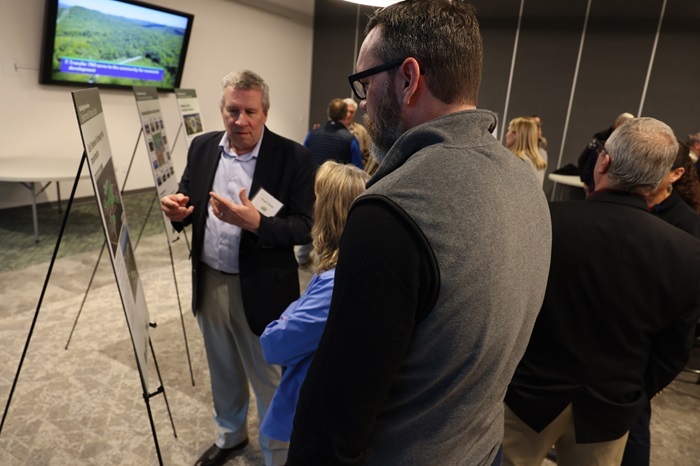 Oak Ridge Office of Environmental Management Regulatory Affairs Specialist Roger Petrie answers questions about the cleanup and transformation at the East Tennessee Technology Park.
Stations focusing on the East Tennessee Technology Park (ETTP) revealed how cleanup is creating new economic opportunities for the region. Land OREM has transferred from government ownership is now home to nuclear businesses that have announced capital investments of $10 billion, and they expect to generate 2,500 private sector jobs.
OREM employees also shared how the organization has fulfilled its major historic preservation commitments at ETTP with the recent opening of the William J. Wilcox, Jr. K-25 Interpretive Center. The facility’s elevated view provides a look at K-25’s 44-acre footprint.
Other stations highlighted OREM’s joint success with regulators confirming half of federal acreage in Oak Ridge was not impacted by historic operations. That designation simplifies future land transfers and supports beneficial reuse on those parcels.
Employees also provided updates about the Environmental Management Disposal Facility project, which provides crucial waste disposal capacity needed to finish ORNL and Y-12 cleanup. This year, teams will finish gathering groundwater-level samples to inform the facility’s design, and they are scheduled to begin constructing support facilities.
-Contributor: Ryan Getsi
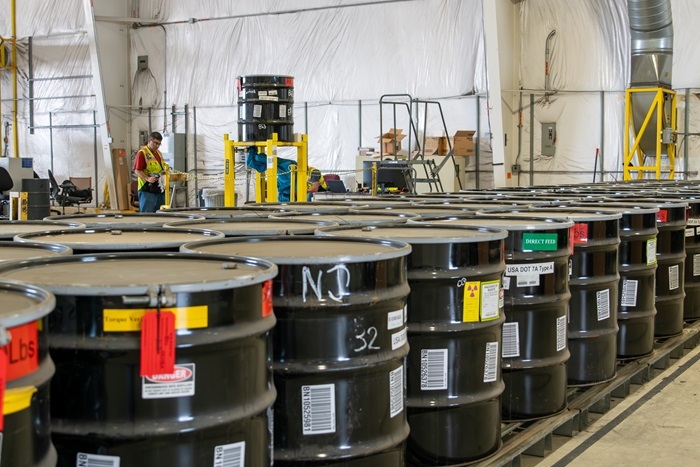 Transuranic waste drums await ultrasonic testing at the Advanced Mixed Waste Treatment Project at the Idaho Cleanup Project. All drums at the facility have now been scanned and cleared for safe shipment to the Waste Isolation Pilot Plant.
Use of robotic technology highlights EM's drive for innovation and efficiency, focusing on priorities and reining in costs without sacrificing safety or effectiveness
IDAHO FALLS, Idaho — Idaho Cleanup Project workers capitalized on innovative robotic technology to complete surveys of approximately 4,400 legacy transuranic waste drums, ensuring they meet safety requirements for shipment to the Waste Isolation Pilot Plant (WIPP) in New Mexico for permanent disposal.
Cleanup contractor Idaho Environmental Coalition (IEC) used robotic ultrasonic technology at the Advanced Mixed Waste Treatment Project (AMWTP) to scan 100-gallon transuranic waste drums that had been stored onsite and exposed to harsh weather conditions for an extended period, with the goal of confirming their integrity for shipment.
The process confirmed that 86% of the drums met U.S. Department of Transportation (DOT) thickness requirements — comparable to the width of automotive sheet metal. Only 14% of them required overpacking with an additional container for added protection.
“Completing this effort gives IEC greater confidence that our product drums are structurally sound and meet DOT requirements,” IEC Production Planning Manager Mark Henderson said.
The scanning effort, initiated in response to two 2022 incidents in which older drums developed leaks during transit, marks a key step in meeting DOT standards for shipment to WIPP. Henderson noted the process offered lessons for potential future campaigns, suggesting that the use of a drum rotator for future scans could improve efficiency when handling large quantities of waste. The equipment includes a robotic arm with an affixed scanner and high-tech software.
Drum rotation equipment could allow drums to be securely held and rotated during scanning, increasing the efficiency of scanning time and ensuring a higher level of precision in identifying any structural concerns.
With all drums now scanned, shipments to WIPP are expected to occur over the next several years. Over time, the effort is projected to save taxpayers approximately $20 million by reducing the need to overpack the drums, while maintaining the highest safety standards.
“I’m really proud of this team at AMWTP for how quickly they worked through this important project,” said IEC President and Program Manager Dan Coyne. “Thanks to their efforts, we are able to continue meeting our cleanup commitments by shipping waste out of Idaho.”
Watch this video about the robotic ultrasonic drum inspection demonstration at the Idaho National Laboratory Site.
-Contributor: Ryan Christensen
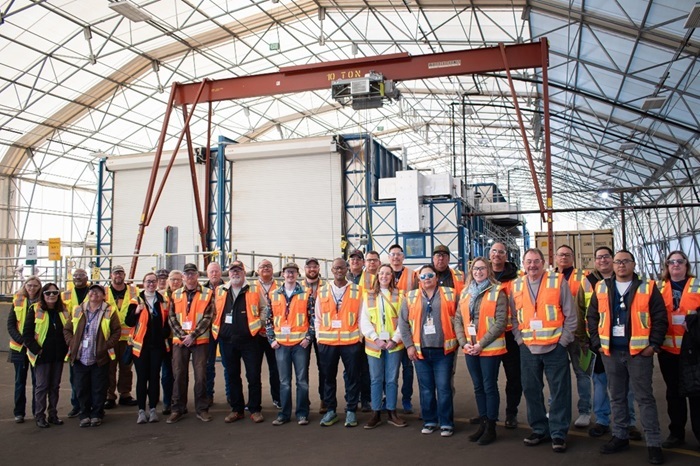 Tribal Radioactive Materials Transportation Committee members, U.S. Department of Energy headquarters staff and representatives from other federal agencies tour Technical Area 54, Area G at Los Alamos National Laboratory in conjunction with the committee’s midyear meeting.
LOS ALAMOS, N.M. — Tribal Radioactive Materials Transportation Committee members recently visited Los Alamos National Laboratory (LANL) to learn more about the U.S. Department of Energy (DOE) Environmental Management Los Alamos Field Office (EM-LA) legacy cleanup mission.
EM-LA is dedicated to the cleanup of legacy contamination and waste resulting from nuclear weapons production and research during the Manhattan Project and Cold War era at LANL.
EM-LA and its contractor, Newport News Nuclear BWXT-Los Alamos LLC (N3B), conducted the tour as part of the committee’s midyear meeting in Santa Fe, New Mexico. Tribal governments across the U.S., DOE headquarters staff and representatives from other federal agencies convened to discuss programs and activities relating to the transport and storage of radioactive waste and materials.
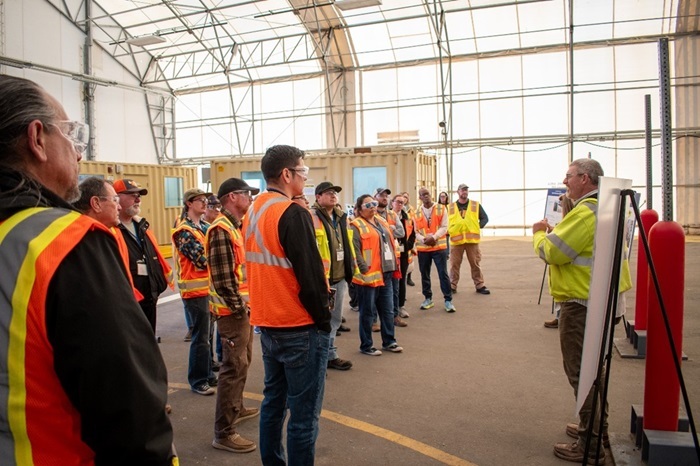 Inside Dome 375 at Technical Area 54, Area G, Brian Clayman, contact-handled transuranic waste program manager for Newport News Nuclear BWXT-Los Alamos LLC, provides an overview of current legacy waste operation activities. Clayman responds to questions from Tribal Radioactive Materials Transportation Committee members regarding the different classifications of waste, waste transportation routes and safety measures implemented for workers.
The tour highlighted legacy waste operations at Technical Area 54, Area G — the facility dedicated to storing, characterizing and remediating LANL’s legacy transuranic, and mixed and low-level waste before it is shipped offsite for permanent disposal. The visitors learned about the process to safely prepare waste for shipment, including the close coordination with DOE’s Central Characterization Program to certify transuranic waste according to the Waste Isolation Pilot Plant’s waste acceptance criteria.
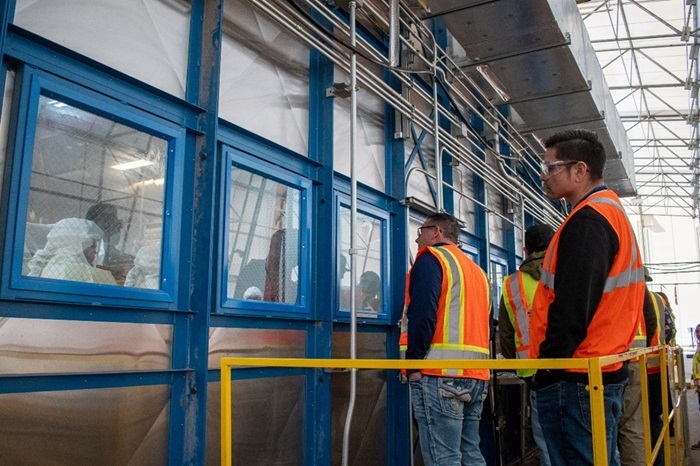 During a tour of legacy waste operations at Technical Area 54, Area G, Tribal Radioactive Materials Transportation Committee members observe characterization of standard waste boxes containing size-reduced corrugated metal pipes with cemented transuranic waste. Several stages of characterization are safely conducted using protective gear, specialized equipment and continuous air monitoring to abate risk to workers, the public and the environment. Once certified as safe and compliant to ship, the boxes will be permanently disposed of at the Waste Isolation Pilot Plant.
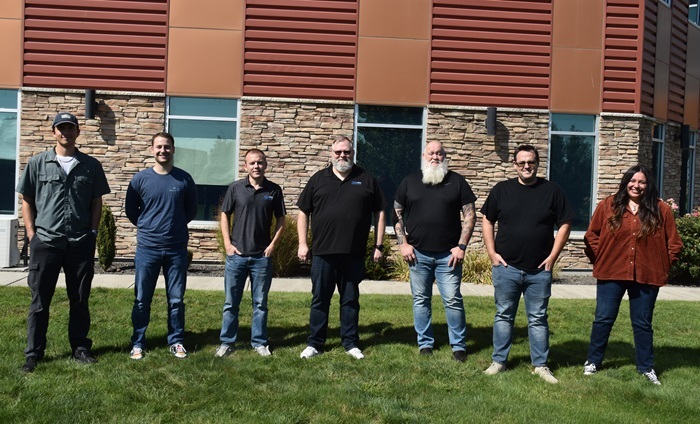 Meet the Hanford Site’s Digital Forensics and Incident Response Team with contractor Hanford Mission Integration Solutions. From left: Zoran Djuric, Thomas Collette, John Shaw, Joe Garry, Daniel Johann, Corey Hopper and Ashlee Gonzales.
RICHLAND, Wash. — When it comes to cybersecurity and protecting the Hanford Site’s vital information, simply monitoring the network and waiting for an alarm to sound is not enough. Skilled analysts at the Hanford Field Office (HFO) are actively combing through the site’s expansive computer networks to uncover hidden risks.
Hanford’s Digital Forensics and Incident Response (DFIR) team is taking a bold, proactive approach with its new Threat Hunting program, deliberately searching for trouble across more than 10,000 connected devices. In many ways, it’s like searching for breadcrumbs in a forest.
“The Hanford Site utilizes a comprehensive strategy to protect its sensitive and proprietary information and maintain a strong cybersecurity posture,” said Paul Boehning, HFO director of information management and chief information officer. “The DFIR team is a key part of that strategy, identifying small clues before they turn into bigger issues.”
Analysts say attackers often hide by using tools that are already part of the network. By carefully planning hunts, collecting system logs, analyzing anomalies, and validating findings against threat intelligence, the team can confirm there are no active threats on the network and strengthen defenses against future attempts.
The DFIR team, managed by contractor Hanford Mission Integration Solutions (HMIS), says hunts for threats can last hours or weeks depending on the complexity, and no two are alike.
“No network can be completely secure,” said Joe Garry, Security Operations and Engineering manager with HMIS. “But the more difficult we make it for attackers, the more likely they’ll give up and look elsewhere.”
The program started in 2023 and now includes six DFIR specialists. While the team has not found an active threat in 50 hunts, they have created more than a dozen new defenses that keep Hanford’s critical systems secure.
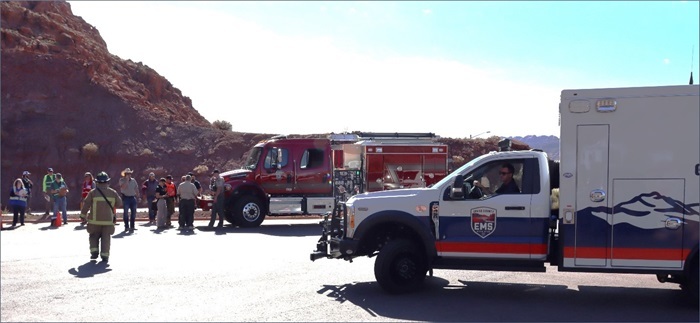 Emergency responders join Moab Uranium Mill Tailings Remedial Action Project staff at a multi-agency emergency response exercise in Moab, Utah.
MOAB, Utah ― The Moab Uranium Mill Tailings Remedial Action Project joined forces with public safety agencies to conduct a successful multi-agency emergency response exercise designed to evaluate coordination, communication and readiness in the face of a simulated disaster.
“This exercise demonstrated the value of a coordinated, multi-agency response and the effectiveness of an offsite unified command center,” said Tim Mason, Environmental, Safety, Health & Quality manager for the Moab Project’s remedial action contractor. “It was gratifying to see each organization perform so well, and the strong participation from local, county and state agencies made the exercise a success.”
The emergency scenario centered on a simulated gas leak at the Moab Project’s Moab site, with a third-party delivery truck running over a natural gas pipeline valve, creating a significant leak without ignition. The incident required an immediate order to stop work, and a simulated site evacuation.
The U.S. Department of Energy Office of Environmental Management (EM) oversees cleanup at the Moab site, located along the Colorado River. Since 2009, EM crews have been transporting uranium mill tailings by rail from the Moab site to the Crescent Junction site, where an engineered disposal cell is being constructed.
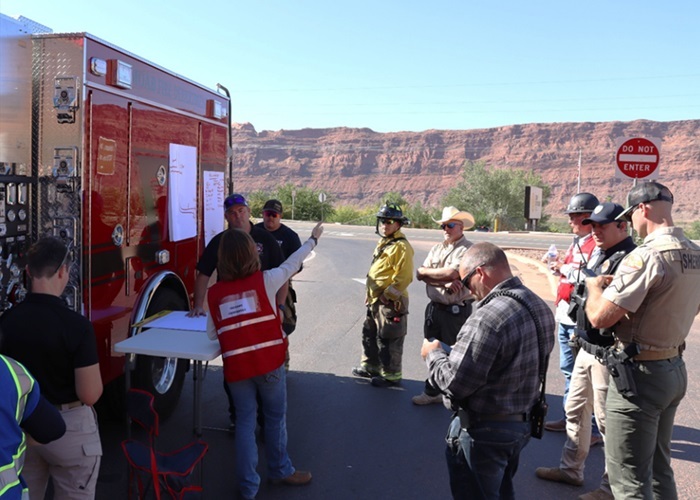 Moab Uranium Mill Tailings Remedial Action Project staff discuss evacuation logistics with local emergency responders.
While the leak during the emergency scenario was contained within the exercise parameters, officials emphasized that a real event of this nature could expand rapidly and affect the surrounding community, which includes the city of Moab three miles south, and the main entrance to Arches National Park two miles north. In addition, the Moab area sits in a valley with canyon walls of sandstone cliffs, so gases from a gas line leak would potentially sit in the valley, raising the possibility of an ignition in the air.
Multiple public safety agencies participated, and the gas company whose pipeline was fictionally damaged in the exercise provided expertise and support. They worked under tight timeframes to coordinate evacuation, secure the site, manage public safety, and ensure effective communication across jurisdictions.
The exercise tested emergency communication systems and incident command protocols under pressure. Responders demonstrated strong capabilities in rapid deployment, medical triage and resource sharing. The drill also highlighted areas for improvement, including traffic management and long term shelter operations, informing future training efforts.
-Contributor: Barbara Michel
|