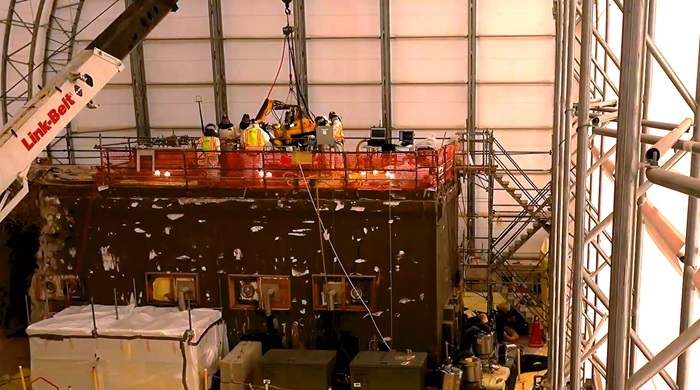
 Oak Ridge crews move the remote equipment into place at the remining hot cell of the former Radioisotope Development Laboratory. They will use it to systematically remove irradiated components from one of the most contaminated structures at Oak Ridge National Laboratory to prepare it for near term demolition.
Reuse of robots hands taxpayers savings while keeping employees safer
OAK RIDGE, Tenn. — The seamless transfer of four robotic demolition machines from the Portsmouth Site in Ohio to Oak Ridge in Tennessee illustrates how equipment sharing among cleanup sites within the U.S. Department of Energy Office of Environmental Management (EM) continues to enhance worker safety, save taxpayer dollars and reduce equipment inventory.
“This is a fine example of reutilizing equipment to minimize cost and maximize government resources,” Acting Portsmouth Site Lead Jud Lilly said.
Sharing resources between sites shows how EM maximizes opportunities to deliver more for American taxpayers. These initiatives drive efficiency, allowing the cleanup program to focus on priorities and reining in costs without sacrificing safety or effectiveness.
Such collaborations are nothing new. Last year, equipment used to load waste containers at the Savannah River Site in South Carolina found a new home at the Idaho Cleanup Project, which had also received equipment used to handle hazardous materials remotely from the West Valley Demonstration Project in New York a year earlier.
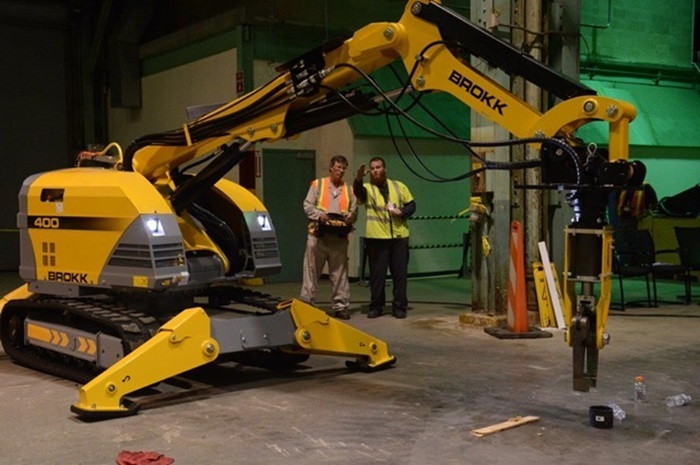 In this 2017 photo, Acting Portsmouth Site Lead Jud Lilly, left, learns how to maneuver the robotic arm of a robotic demolition machine. At right is Jessie Love, a trainer from Swedish company Brokk, which manufactured the equipment.
While saving more than $1.7 million by avoiding the need to purchase new equipment, the remotely operated machines transferred to Oak Ridge are reducing risks by increasing the distance between work crews and potential hazards. They’re particularly effective in areas with limited space and high levels of contamination, which are common challenges when demolishing aging Manhattan Project and Cold War facilities.
At Oak Ridge National Laboratory (ORNL), the units are integral to the deactivation and removal of the remaining hot cell of the former Radioisotope Development Laboratory, one of the most contaminated structures at the site.
Looking ahead, these machines will assist with deactivating other highly contaminated former isotope research and production labs at ORNL and facilities with mercury vapors at the Y-12 National Security Complex.
Portsmouth acquired the robots for deactivation and other efforts in the X-333 Process Building. Employees operated the machines with a remote control, improving safety by putting more distance between the workers and items being downsized.
The equipment was no longer necessary following completion of the X-333 deactivation. Crews are now demolishing the massive building after achieving an EM priority late last year to launch demolition of the second of Portsmouth’s three former uranium process buildings.
With the help of EM’s Consolidated Business Center, Oak Ridge learned of the excess equipment at Portsmouth, and the units and their accessories were shipped to the site in October.
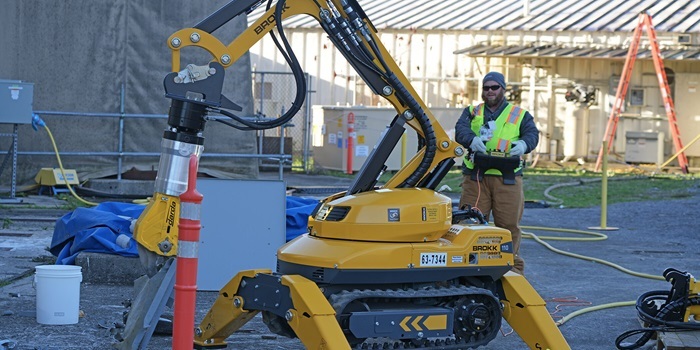 Oak Ridge crews practice using the remote equipment during mock-ups prior to use in cleanup areas.
“We all tag-teamed through the process,” said Rachel Costilow, government property manager at Portsmouth Site cleanup contractor Southern Ohio Cleanup Company. “This is by far one of the largest transfers of equipment that we have done at the Portsmouth Site.”
Tee Duncan, asset manager with Oak Ridge cleanup contractor United Cleanup Oak Ridge (UCOR), called the equipment transfer a major accomplishment and a demonstration of the efforts the personal property management team made to reutilize federally owned equipment.
“This success story not only shows UCOR’s commitment to assist projects in meeting their mission goals but also underscores the entire organization’s dedication as mindful stewards of taxpayers’ dollars,” Duncan said.
-Contributors: Mike Butler, Michelle Teeters
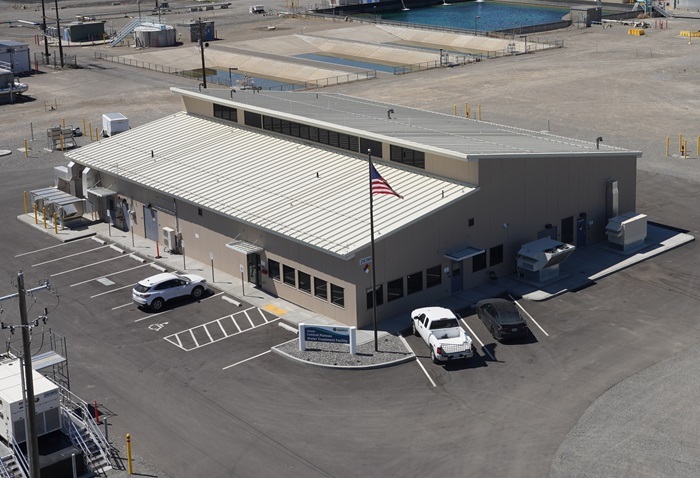 The Central Plateau Water Treatment Facility will treat 3.5 million gallons of water a day to support the Waste Treatment and Immobilization Plant and other cleanup operations on the Hanford Site.
Facility supplying millions of gallons of water daily
RICHLAND, Wash. — As part of ongoing efforts to modernize infrastructure on the Hanford Site, the U.S. Department of Energy Office of Environmental Management (EM) announced the Central Plateau Water Treatment Facility has passed all operational acceptance testing and now provides water to Hanford’s water system.
Automating much of the water treatment process, the new facility provides all potable water to the cleanup hub of the site, the Central Plateau, while also supporting tank waste treatment operations. The Central Plateau contains Hanford’s former processing facilities, current site operations and the Waste Treatment and Immobilization Plant.
“With the Direct-Feed Low-Activity Waste program now treating tank waste and immobilizing it in glass, we are embarking on a period of 24/7 cleanup operations that will continue for several decades,” EM Hanford Field Office Manager Ray Geimer said. “This facility will play a critical role in providing services to the Hanford Site. It’s one of many projects now in place that are going to set the conditions for future work at the site.”
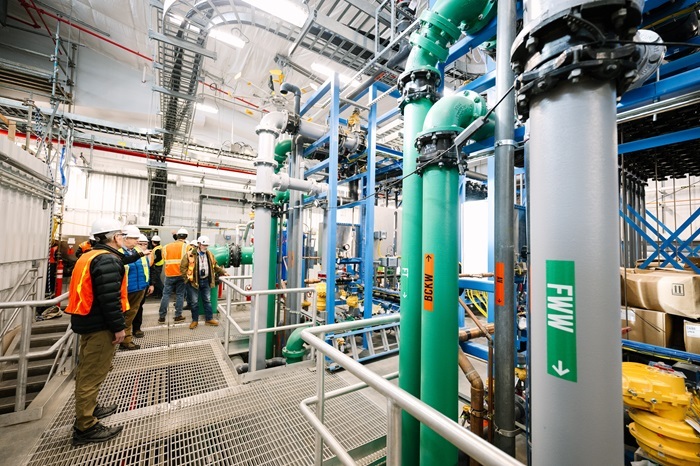 The new water treatment facility will use an innovative microfiltration method to deliver high quality water to cleanup operations and will replace the Hanford Site’s original water treatment plant built in the 1940s.
The effort to successfully treat and vitrify Hanford tank waste for safe disposal will increase the demand for a reliable water supply at facilities and for fire suppression capabilities. The new water facility will increase current daily capabilities from 2.1 million gallons of clean water up to 3.5 million gallons, with the ability to expand to 5 million gallons.
Contractor Hanford Mission Integration Solutions (HMIS) awarded the construction contract for the 10,000-square-foot facility to Richland’s Fowler General Construction Inc. HMIS will manage the facility, which will use an innovative microfiltration method to deliver high quality water to cleanup operations.
“We take great pride in our role in the Hanford mission to enable all cleanup progress, including long term tank waste treatment and risk reduction,” said Amy Basche, HMIS president. “This facility will support Hanford in the next phase of operations and support the cleanup mission for the next several decades.”
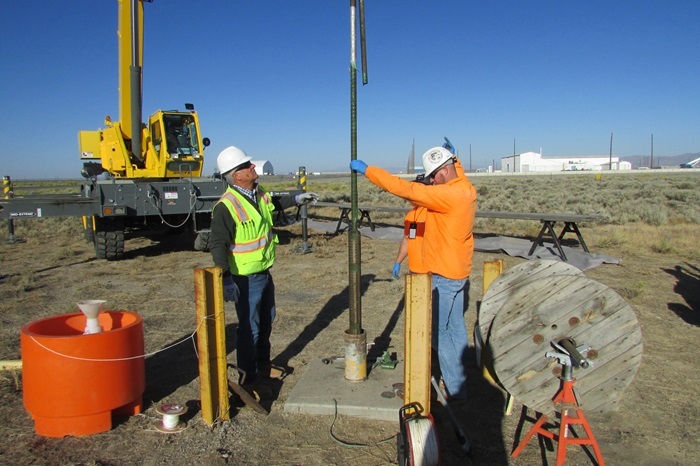 Dan Smith, left, Groundwater Sampling lead for cleanup contractor Idaho Environmental Coalition (IEC) at the Idaho Cleanup Project, and Hayden Lambert, IEC Waste Operations equipment operator, are shown replacing a pump in a groundwater monitoring well at the Idaho National Laboratory Site.
IDAHO FALLS, Idaho — Idaho Cleanup Project (ICP) efforts have improved the water quality of the Snake River Plain Aquifer for over 35 years.
The U.S. Department of Energy Office of Environmental Management and its contractors have been diligent about groundwater monitoring, helping ensure the aquifer’s continued protection.
Dan Smith is the Environmental Services – Groundwater Sampling lead with contractor Idaho Environmental Coalition (IEC). He has worked in ICP environmental programs for 35 years and has seen the cleanup progress firsthand.
Smith routinely travels much of the 890-square-mile Idaho National Laboratory (INL) Site while performing his work scope. Environmental Services teams conduct groundwater sampling, water level measurement, well maintenance and other activities. Crews took about 72,500 groundwater samples from April 1991 through October. IEC currently monitors 228 wells across the INL Site.
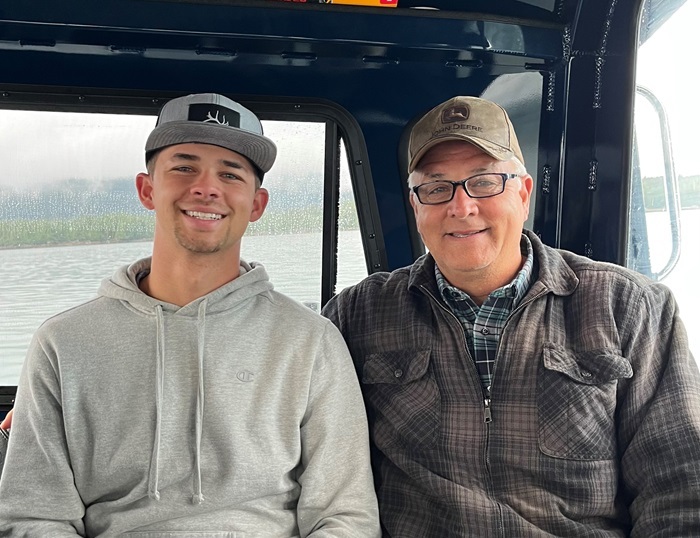 Dan Smith, right, Groundwater Sampling lead for cleanup contractor Idaho Environmental Coalition at the Idaho Cleanup Project, and Kolter Smith, his son, enjoy the outdoors together.
Smith shared insight from his time in ICP environmental programs in a Q&A with EM Update:
How have you seen cleanup work progress over your time on the ICP?
For most waste area groups, remedial actions have been completed, and the only ongoing sampling activity is monitoring. As monitoring continues, wells and specific chemical constituents, such as metals, organic solvents, radionuclides, etc. are often removed from the monitoring plan as contaminant trends decline. For instance, if previous contaminants of concern are well below the maximum contaminant levels or are no longer detected, sampling frequencies are reduced.
What are some of your favorite things about the area you live in and your job?
This western United States area we live in offers us so many outdoor opportunities and adventures, be it hunting, camping, boating, hiking, floating rivers, and of course fishing. My wife and I are very fortunate to have two boys to share these experiences with. As for my job, I get to see all the seasonal changes the INL has to offer. When we receive enough snow, the Big Lost River flows on the site; when spring and early summer is wet enough, flowers bloom across the site. All year long this INL desert has a menagerie of wildlife living on it.
What is the best advice you have been given about working in your field?
Enjoy what you do. Life is way too short not to enjoy your work.
Is there anything else you’d like to share?
It doesn’t matter where I have been or what facility we are in. There are a tremendous number of outstanding people I have been very privileged to work with. I would like to say to all my co-workers in environmental services and site-wide, a very sincere “Thank you.”
-Contributor: Leamarie Mitchell
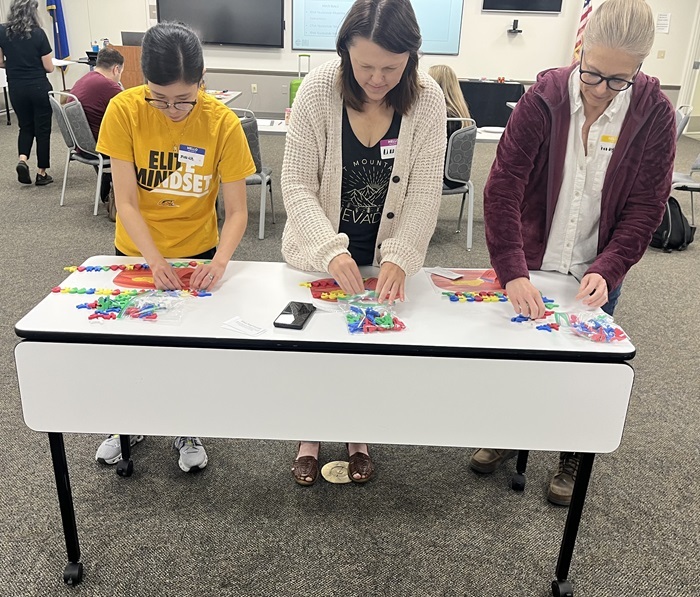 Educators participate in a hands-on activity involving genetic information during an educator professional development training. Photo by Carmina Chavez
LAS VEGAS — Nevada’s scientific research institute is advancing STEM education opportunities to increase students’ interest in careers at the Nevada National Security Sites (NNSS) through grants from the U.S. Department of Energy (DOE) Office of Environmental Management (EM).
The NNSS is managed by the National Nuclear Security Administration (NNSA) and plays a pivotal role in ensuring the nation’s security. The EM Nevada Program has a presence at the NNSS through its work on environmental restoration, groundwater monitoring and waste disposal at the facility where historic nuclear testing took place from 1951 to 1992.
The three-year collaboration led by the Desert Research Institute (DRI), in partnership with the Atomic Museum in Las Vegas, is funded through the Community Capacity Building Grant Program.
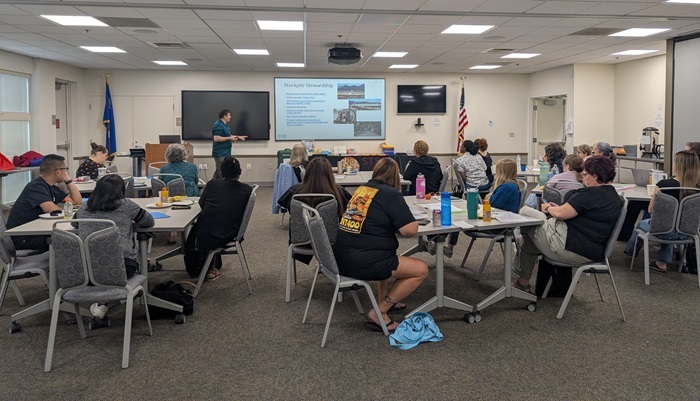 Educators listen to a presentation on careers during an educator professional development training held at the Desert Research Institute in Las Vegas. Photo by Monica Gehrig
The goal of DRI’s project is to prepare the next generation of students in Nevada with educational opportunities leading to careers in energy, waste management and environmental remediation — skills in significant demand at the NNSS.
DRI is achieving this goal by developing science, technology, engineering and math curriculum units for sixth to 12th graders, student field trips, and educator professional development trainings with tours of the NNSS.
“Through this project, we want to allow students to engage with meaningful, real world scientific research, history, and career connections aligned with the NNSS,” said Monica Gehrig, DRI’s STEM Education Training and Outreach administrator and project director.
During the student field trips, students participate in a hands-on science laboratory with DRI scientists, learning about fundamentals of radiation science through interactive experiments, and take a guided tour of the Atomic Museum.
“By connecting real world science to Nevada’s history, we’re helping students see themselves as part of the story, fostering curiosity, confidence and a deeper understanding of the phenomena that shape their world,” said Emily McDonald-Williams, director of the DRI STEM Education Program.
 |
|
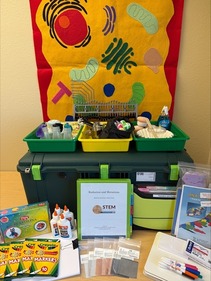
STEM curriculum unit lesson plan documents and materials available for Nevada educators to use in their classrooms. Photo by Liz Guillen |
The STEM curriculum units, educator professional development trainings, and student field trips are offered free of charge. This includes waived admission costs to the Atomic Museum, transportation reimbursement to attending schools and shipping of STEM curriculum units to and from any school in Nevada.
Email STEMeducation@dri.edu to learn more.
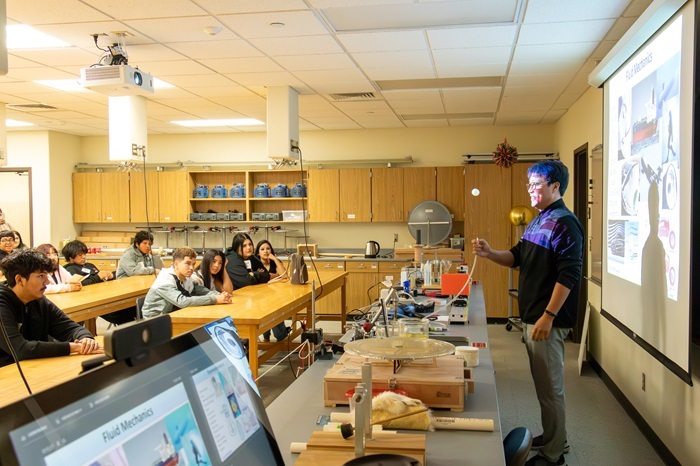 An instructor-led demonstration of physics concepts was among the offerings during the day of hands-on learning and interactive sessions at Columbia Basin College.
RICHLAND, Wash. — Nine Hanford Site team members recently partnered with the Washington State STEM Like Me Foundation to inspire local students to explore careers in science, technology, engineering, and mathematics (STEM).
The event took place at Columbia Basin College (CBC) in Pasco, Washington, where students from Kiona-Benton City High School participated in a day of hands-on learning and interactive sessions. Team members joined the students as they rotated through classrooms featuring a variety of engaging STEM-focused activities, including artificial intelligence, chemistry, and general science experiments.
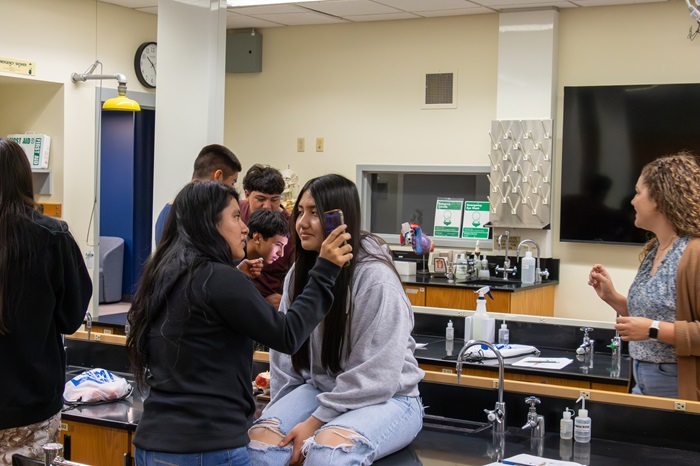 During breakout sessions, high school students participated in interactive STEM activities.
Each session was led by CBC instructors who showcased real world applications of STEM concepts designed to spark curiosity and highlight the wide range of opportunities available in technical and scientific fields. The Hanford team worked directly with the students, answering questions, sharing insights from their own careers and encouraging them to imagine themselves as future innovators and problem-solvers.
The partnership with STEM Like Me supports Hanford’s ongoing commitment to community engagement and workforce development. By connecting professionals with local youth, these programs build awareness of STEM career possibilities and help cultivate the next generation of innovators who will shape the future.
|