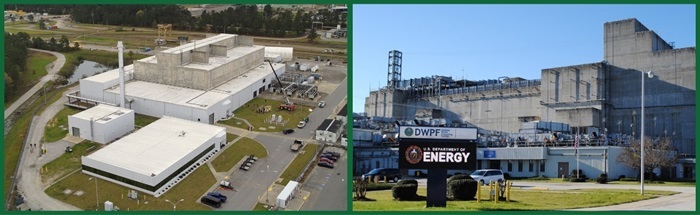
 A view of the Salt Waste Processing Facility, left, and Defense Waste Processing Facility at the Savannah River Site.
Savannah River Site Achieves Major Milestone in Radioactive Waste Processing
AIKEN, S.C. — The U.S. Department of Energy (DOE) Office of Environmental Management (EM) announced the successful completion of major optimizations across the Savannah River Site’s (SRS) liquid waste treatment system, dramatically accelerating the processing rate of radioactive tank waste and supporting America’s energy and national security goals.
Recent facility optimizations at both the Salt Waste Processing Facility (SWPF) and Defense Waste Processing Facility (DWPF) — the two cornerstone facilities in the liquid waste system onsite — are enabling unprecedented throughput of the over 30 million gallons of Cold War era radioactive waste stored in underground tanks.
“These facility improvements represent a turning point in our cleanup mission at Savannah River Site,” said Edwin Deshong, Savannah River Operations Office manager. “By doubling our processing capacity and enhancing operational flexibility, we’re not only accelerating the safe treatment of legacy waste, but we’re also delivering significant cost savings to taxpayers.”
At SWPF, the installation of three innovative extended cross flow filters doubled the available surface area, increasing the processing rate and improving operational reliability. Since restarting the new filters, SWPF continues to set new processing records, including the recent 30-day record in November of over 600,000 gallons. With only one of the new filters online, SWPF can process at a rate of 18.5 gallons per minute — a rate that provides the throughput to meet mission needs.
Complementing these improvements, the DWPF has implemented critical enhancements, including a new crane simulator to train the next generation of operators on safe and efficient movement.
Additionally, liquid waste contractor Savannah River Mission Completion (SRMC) repurposed two 5,000-gallon holding tanks to serve as lag storage between SWPF and DWPF, providing needed space to hold strip effluent transferred from SWPF before processing at DWPF. This cost-effective approach allows the two facilities to operate more independently, enabling SWPF to continue processing even when DWPF is down for maintenance.
Both facilities also benefited from the completion of comprehensive distributed control system upgrades, which included a complete overhaul of the software and hardware used to monitor instrumentation and control equipment for transfers and facility operations.
The radioactive liquid waste stored at SRS was generated as byproducts from the processing of nuclear materials for national defense, research, medical programs and NASA space missions during and after the Cold War. These combined improvements enable the site to process legacy tank waste at unprecedented rates, accelerating the overall cleanup mission timeline. The enhanced throughput at SWPF, coupled with the increased operational flexibility between the two facilities, means more waste can be safely treated and immobilized faster than ever before, reducing long term risks and costs to taxpayers.
|