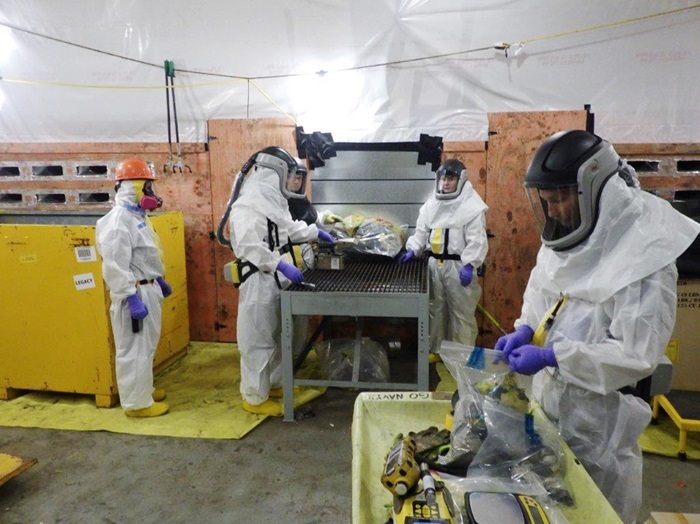
 Oak Ridge workers sort through legacy items inside the Alpha-4 building to prepare for the facility’s deactivation at the Y-12 National Security Complex.
OAK RIDGE, Tenn. — Insight and a questioning attitude from a project manager has led the Oak Ridge Office of Environmental Management (OREM) to accelerate one of the largest demolitions on the horizon at the Y-12 National Security Complex and help avoid millions of dollars in costs to taxpayers.
Brian Hutson with OREM contractor United Cleanup Oak Ridge (UCOR) believed the team could find efficiencies in a necessary step to get the Alpha-4 building demolition-ready: clearing all classified equipment and systems from the facility. Initial estimates identified nearly 3,000 items requiring special removal, which would take 4.5 years and cost $66 million.
Hutson worked closely with OREM, the Y-12 Field Office, and classification personnel to develop an approach that reduces the number of items requiring classified disposal from 3,000 to less than 300. The change shortens the schedule by 1.5 years and saves $16 million.
“Being in the right place at the right time and knowing the right people was the catalyst for bringing a different perspective to the table,” Hutson said. “It was time to re-evaluate efficiencies to reduce the process time, ease the labor burden, reduce the number of classified items for removal, make the work environment safer, and deliver a cost-avoidance outcome saving millions in budget and taxpayer dollars.”
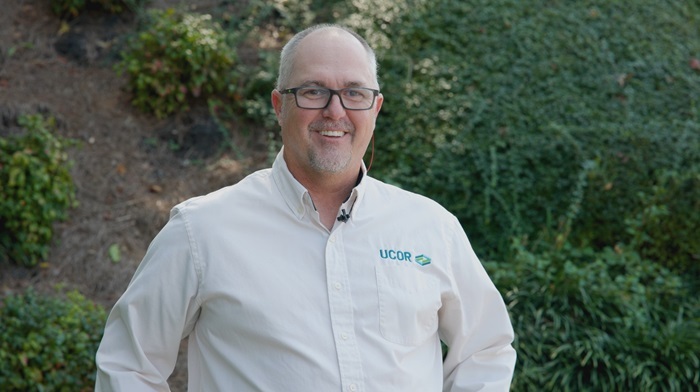 Input and leadership from United Cleanup Oak Ridge Project Manager Brian Hutson helped avoid $16 million in costs to taxpayers and accelerates the deactivation schedule for the Alpha-4 building project by 1.5 years.
Workers are in the early stages of deactivating Alpha-4, which spans 561,000 square feet and covers a 13-acre area. The facility was used for uranium separation in the 1940s, and it later supported lithium separation before it was shut down permanently in the 1960s.
There is hope OREM and UCOR can apply the revised approach to classified disposal to benefit other major upcoming cleanup projects at Y-12.
In the meantime, the savings from the Alpha-4 project are funding additional cleanup tasks and enabling more progress.
“Our projects at Y-12 are incredibly complex due to the size, condition and contents of the facilities we’re taking down,” said Morgan Carden, OREM’s Y-12 federal project manager. “Brian is an excellent example of what’s possible through a willingness to ask questions, challenge previous approaches and bring the right people together who are all committed to achieving the best result.”
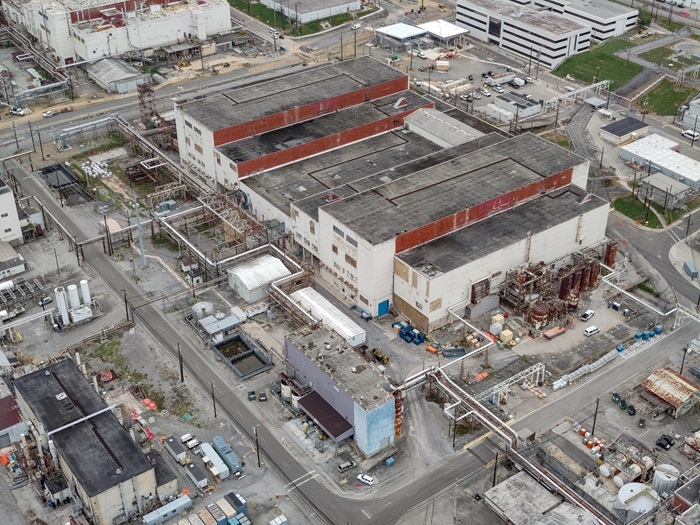 An aerial view of the Alpha-4 facility covering a 13-acre area at the Y-12 National Security Complex.
The work currently happening inside Alpha-4 to prepare the building for teardown follows extensive efforts on its exterior in recent years.
OREM and UCOR cleaned out the old Column Exchange (COLEX) equipment on the east and west sides of the structure, and removed all of the equipment from the west side.
Crews recovered 4.19 tons of mercury before demolishing the West COLEX. By deactivating the East COLEX and performing cleanup work in Alpha-4, teams retrieved another 2.3 tons, bringing the total amount of mercury recovered to 6.49 tons.
-Contributor: Carol Hendrycks
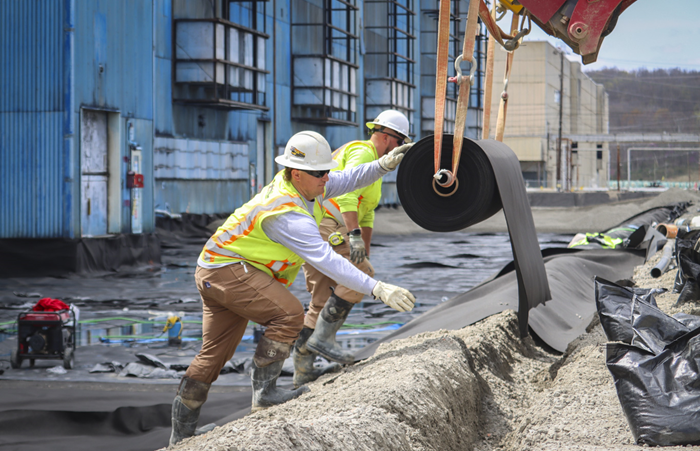 Laborers Tyler Roach, left, and Taylor Brown assist with the installation of liner to construct a water detention berm around the Portsmouth Site X-333 Process Building.
Portsmouth Site priority reflects DOE core value of safe work performance
PIKETON, Ohio — With crews in the early stages of demolishing X-333, the second of the Portsmouth Site’s three former uranium process buildings, U.S. Department of Energy (DOE) Office of Environmental Management (EM) leaders at the site are emphasizing the number one priority: safety of the workforce and community.
From incorporating lessons learned from previous work to ensuring dust suppression, water collection systems and project-specific air monitors are working as designed, all measures complement each other to complete the project safely.
“When we began the process of demolishing the first process building on the site, we had numerous discussions with other sites and incorporated lessons learned into the demolition plan to ensure we were using the gold standard in safety practices,” Portsmouth Site Lead Jeremy Davis said. “This was the starting point. From there, everything we did built on a solid plan to ensure safety was at the top of the list.”
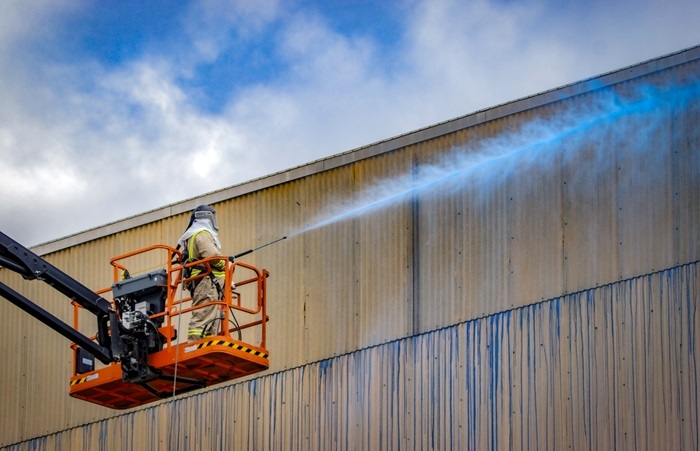 Demolition Specialist Jeff Howard sprays a blue fixative on the Portsmouth Site X-333 Process Building to maintain dust control on the transite panels during removal.
EM is in lockstep with a core DOE value of safe work performance, fostering a safety conscious work environment where employees understand their roles and responsibilities for safety and health, and learn from experience.
At Portsmouth, the first process building to be demolished was the 62-foot tall, 29-acre X-326 Process Building in 2022. Extensive safety practices and environmental monitoring conducted before and during that demolition resulted in zero recordable injuries for project workers and zero exceedances in air monitoring.
On Sept. 25, structural demolition began on the largest of the three process buildings, the X-333 Process Building.
Before demolition could begin, crews worked inside the building to complete deactivation of the 33-acre facility, which has two stories and 66 acres of floor space under roof. Deactivation includes characterizing the building and equipment from a radiological standpoint; disconnecting process equipment; preparing waste for onsite or offsite disposal; removing asbestos and other hazardous waste; and isolating and disconnecting utilities.
Crews also implemented safety measures, including installing fencing; removing above-grade structures and pads around the building; installing a perimeter liner, berm and water collection and treatment system; installing air monitors around the building; and applying fixative to maintain dust suppression.
“Before the first bolt was cut to begin demolition, we put several measures in place to protect not only our workers, but also our community,” Federal Project Director Christy Brown said. “We all live here, our families are here, so safety is personal to us.”
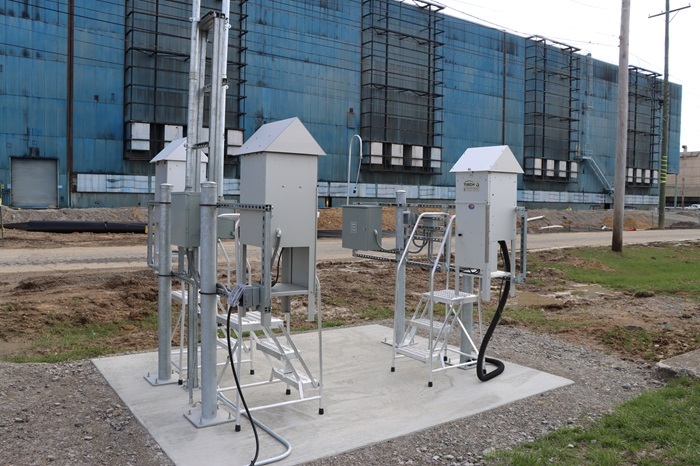 Air monitors are strategically placed around the X-333 Process Building demolition project to provide real-time data to alert project leadership if any issues arise. The final application of blue fixative to maintain dust control on the transite panels is visible in the background.
The liner around the building catches the water used to spray the building during demolition, which is then run through a treatment-and-filtration system and tested. Air monitors provide real-time data on the project to alert project leadership if any issues arise. The air monitors, placed strategically around the project, are in addition to permanent air monitoring stations around the site. The permanent air monitoring stations located both on the Portsmouth Site and in the surrounding area are positioned next to co-located monitors operated by the Ohio Environmental Protection Agency and the Department of Health.
“From Perimeter Road, you can see that we have sprayed the building a bluish color,” Brown said. “That is a special fixative. It is used to keep particles from the building drifting into the air.”
Using the fixative, along with spraying the building with water, prevented air emissions during the demolition of the first process building and the team is confident that the approach will also be effective for demolition of X-333.
“Our workers also are very vigilant in watching for anything that might even look like it is unsafe,” Southern Ohio Cleanup Company (SOCCo) Portsmouth Site Project Director Greg Wilkett said. “If something is seen that could be a potential hazard, work is stopped, and the concern is addressed. That is just the culture we have here onsite.”
SOCCo is the Portsmouth Site cleanup contractor performing demolition of X-333 and the upcoming X-330 Process Building. The Portsmouth Paducah Project Office conducts cleanup activities at the Portsmouth Site in accordance with a consent decree with the state of Ohio and director’s final findings and orders with the Ohio Environmental Protection Agency.
-Contributor: Shawn Jordan
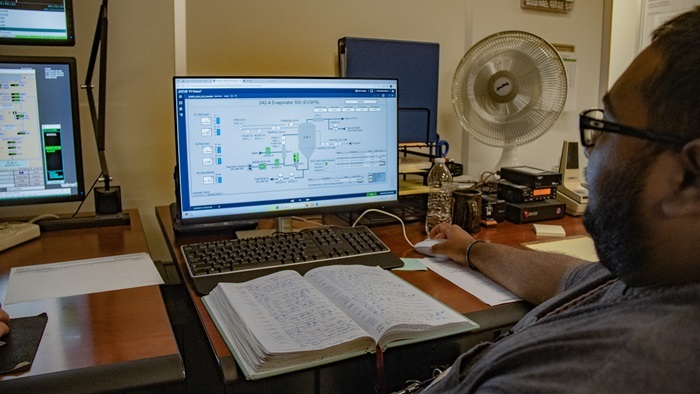 Issac Coronado, a nuclear chemical operator, monitors a waste-volume reduction campaign from the control room of the Hanford Site’s 242-A Evaporator.
RICHLAND, Wash. — Workers at the Hanford Site have made room for more than 1 million gallons of waste storage, supporting cleanup efforts to transfer waste from older underground tanks to newer, double-shell tanks.
The U.S. Department of Energy Office of Environmental Management (EM) completed five waste-reduction campaigns at the 242-A Evaporator during a six-month period. Together, the campaigns condensed the site’s waste by more than 1.1 million gallons, creating space needed to continue safe waste transfers.
“The evaporator is one of our most effective tools for managing tank space, giving us the capacity to safely transfer and keep cleanup moving forward,” said Will Ruane, 242-A program manager at Hanford Field Office. “Each campaign helps us safely manage liquid waste while preparing for long term treatment though vitrification.”
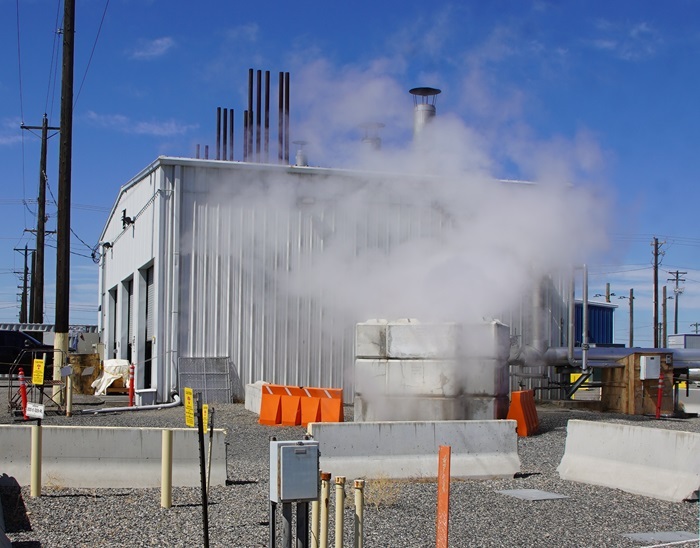 Steam rises near the 242-A Evaporator during system testing, ahead of a waste-volume reduction campaign this summer. The nonradioactive steam is from the facility’s normal operations.
The evaporator works by boiling radioactive and chemical waste at low pressure using steam heat to remove water. The remaining concentrated waste — known as slurry — is transferred back to a storage tank for future treatment. The evaporated water is filtered and sent to Hanford’s Effluent Treatment Facility for additional processing and disposal.
The facility, operated by EM contractor Hanford Tank Waste Operations & Closure (H2C), restarted in March following a series of upgrades and repairs.
“Reducing more than 1 million gallons of tank waste in a calendar year is a tremendous accomplishment,” said Brandon McFerran, H2C’s Production Operations manager. “It shows that all of the preparation, training and equipment modifications helped set the team up for the successful execution of five campaigns.”
Since beginning operations nearly 50 years ago, the 242-A Evaporator has helped remove more than 82 million gallons of liquid from Hanford’s waste tanks.
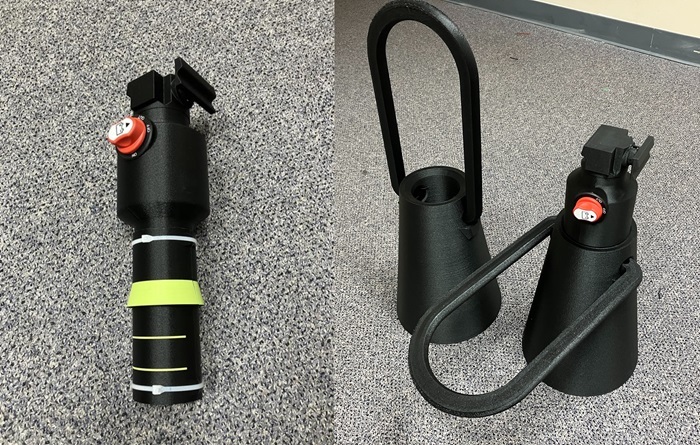 Savannah River Mission Completion developed a 3D-printed tool, left, that retrieves samples from radioactive waste tanks using centrifugal force. It’s an innovation that saves months from the sampling timeline by eliminating the need for the waste tank to dry before sampling can begin. Also pictured are 3D-printed crawler transport baskets used for the centrifugal sampler.
AIKEN, S.C. — Engineers with the contractor cleaning up the radioactive tank waste at the Savannah River Site (SRS) have developed a 3D-printed tool that can eliminate months from the tank waste sampling timeline.
Savannah River Mission Completion (SRMC), the SRS liquid waste contractor for the U.S. Department of Energy (DOE) Office of Environmental Management (EM), is responsible for treating and disposing of the millions of gallons of waste remaining in underground tanks at the site, as well as closing the tanks.
Before an emptied waste tank can be filled with grout — deeming it operationally closed — SRMC cleans the tank and collects samples of residual material left in the tank. Sampling helps confirm that the cleaning process has been effective and that the tank no longer contains significant residues of high-level radioactive waste.
Traditionally, residual waste inside the tank had to dry through evaporation before a remote crawler could be inserted into the tank to obtain the samples — a waiting period that could take six months or more before sampling could move forward.
However, a new sampling tool eliminates the need for evaporation by way of a centrifuge. SRMC engineers designed, refined and developed a centrifugal sampling tool using parts manufactured with a 3D printer, resulting in a cost-effective and efficient solution. The centrifugal sampler allows sampling to occur much sooner, thus achieving operational closure sooner, which reduces risk to the environment sooner.
The new tool recently proved successful in Tank 9 and will notably reduce the sampling schedule by eliminating the need for the waste tank to be dry before sample collection.
The sampling tool is lowered into the waste tank through an access port, called a riser, along with a transport basket, which was also 3D printed. A remote crawler picks up the transport basket with the sampling tool inside, drives it to the sample location, then picks up the sampling tool and activates it.
“This team thought outside the box and gave us an innovative way to make a significant leap forward in the tank closure process,” SRMC President and Program Manager Thomas Burns Jr. said.
Tony Robinson, DOE-Savannah River acting assistant manager for waste disposition,
said the new tool is yet another way SRS is building momentum toward tank closure and reducing the risk of legacy waste.
“This new sampling tool and the preliminary cease waste removal (PCWR) milestones will significantly advance the SRS liquid waste program safely and efficiently,” said Robinson.
PCWR is a regulatory milestone for old-style tanks that designates agreement between EM, the U.S. Environmental Protection Agency and the South Carolina Department of Environmental Services that, based on preliminary information, there is reasonable assurance that performance objectives for tank closure will be met.
PCWR approval means that work can begin on the sampling and analysis phase of the tank closure process. SRMC recently completed PCWR for seven old-style tanks years ahead of the SRS Federal Facility Agreement schedule.
-Contributor: Colleen Hart
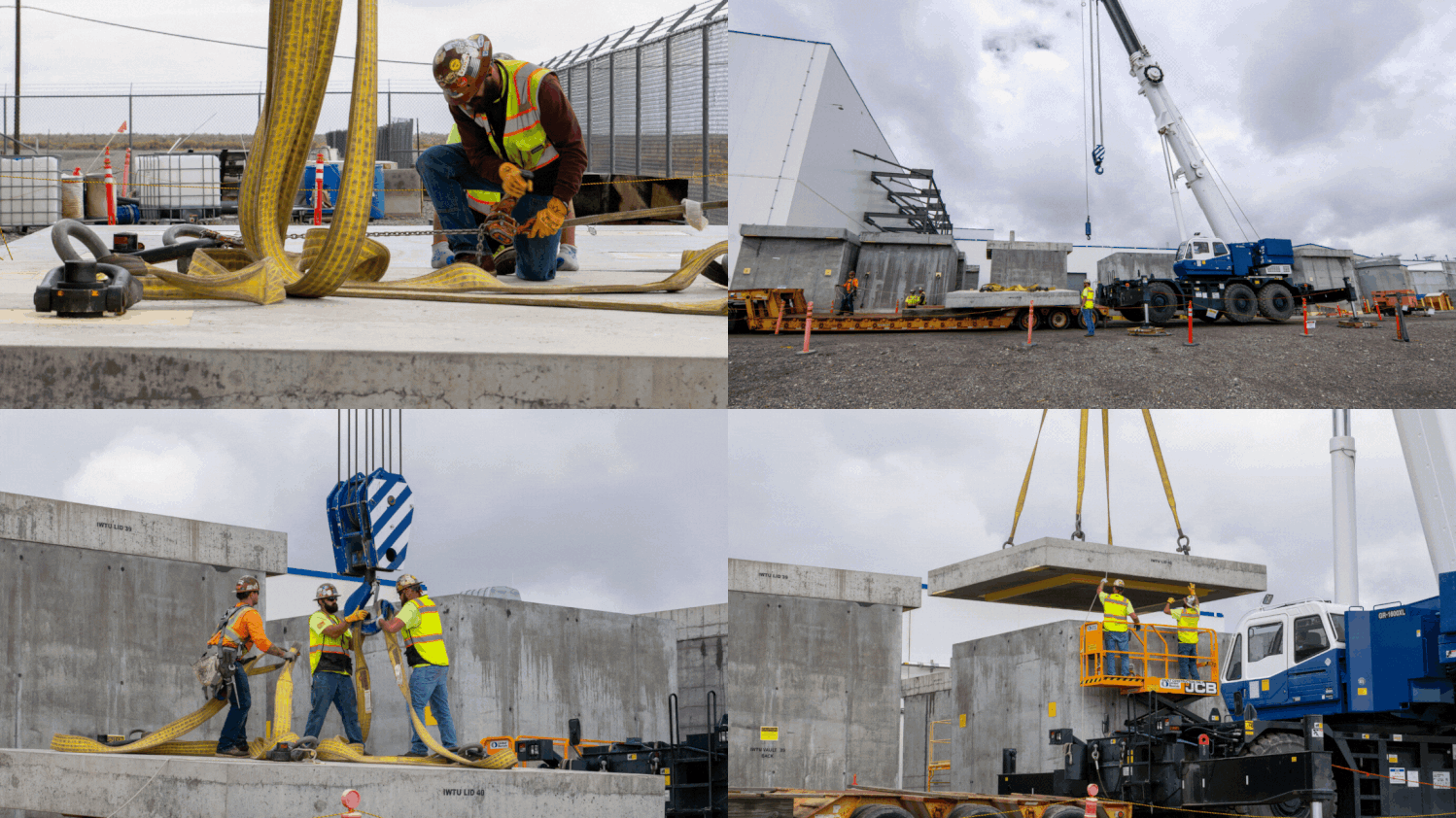
IDAHO FALLS, Idaho — Crews have finished constructing 13 storage vaults for the Idaho Cleanup Project’s Integrated Waste Treatment Unit (IWTU) as they continue to make strides toward fulfilling an important commitment to the state of Idaho to convert a radioactive liquid waste into a safer, more stable granular solid.
Construction of the large concrete vaults is essential to the facility as they store the stainless steel canisters that contain the converted waste.
The U.S. Department of Energy Office of Environmental Management crews finished building the 13 vaults by pouring concrete walls over a heavy base and placing lids over the vaults until they are ready for use. Vault bases and lids are formed offsite, but due to the vaults’ immense size and weight — each weighing approximately 325,000 pounds when empty — final assembly must be performed onsite.
During operations, an air pallet, similar to the function of an air hockey table, helps guide these colossal structures from the IWTU’s vault loading area to temporary storage in the product storage building.
To date, the IWTU has successfully filled 21 vaults, each holding 16 canisters, and treated one-third of the liquid waste stored onsite. An estimated 85 vaults will be filled by the end of IWTU operations. This ongoing project represents a major advancement in the safe management and storage of radioactive materials in Idaho.
-Contributor: Carter Harrison
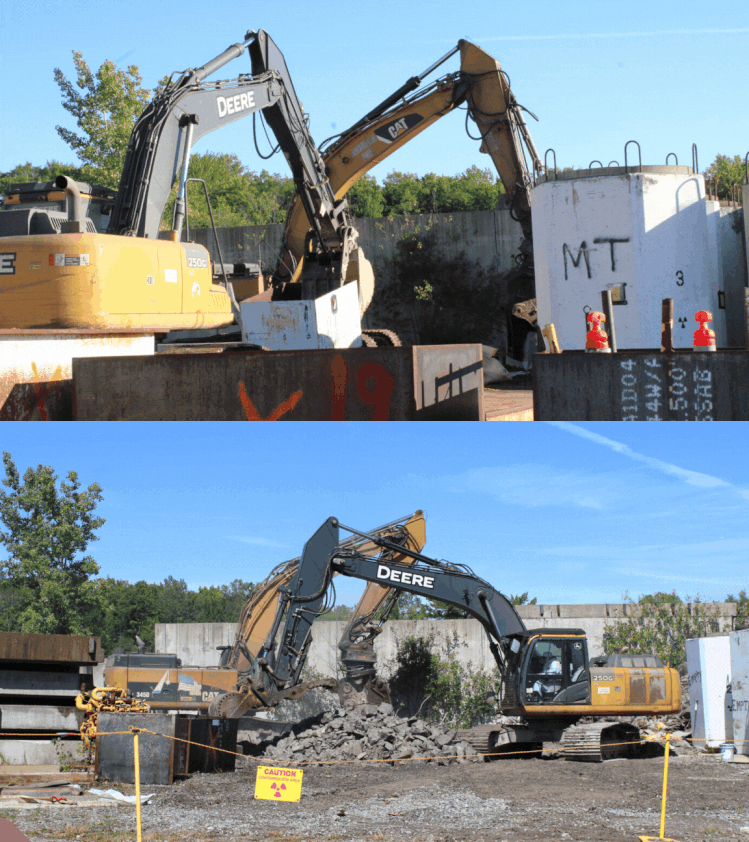 Workers use demolition equipment to reduce the size of degraded liners, or waste boxes, and vitrification vault lids at the West Valley Demonstration Project earlier this this year. They loaded the resulting debris in waste containers and shipped them to an offsite disposal facility. Among the items demolished and disposed of were SUREPAKs, or subsurface recoverable packaging systems, which were invented by a group of engineers at the site in the 1980s.
WEST VALLEY, N.Y. — As West Valley Demonstration Project workers prepared a miscellany of legacy items for disposal this year, they dug up memories of a patented invention for the safe disposal of radioactive waste created by a group of engineers working on the site’s cleanup in the 1980s.
The invention was a subsurface recoverable packaging system, or SUREPAK. It was unique in that it could be inspected, had its own liquid collection and monitoring system and was configured to eliminate gaps between waste containers for improved storage. The system also provided shielding for personnel involved with waste storage and disposal.
The engineers who created the SUREPAKs were with Westinghouse’s Waste Technology Services Division. West Valley Nuclear Services, a Westinghouse subsidiary, began operations as the management-and-operations contractor for the site’s cleanup in 1982.
Dan Meess was chief engineer with the Westinghouse group. He has been a longtime employee of the West Valley cleanup and currently supports the project part time.
"I was proud to help develop and implement the SUREPAK storage and disposal modules that were more environmentally friendly and reduced personnel dose," Meess said.
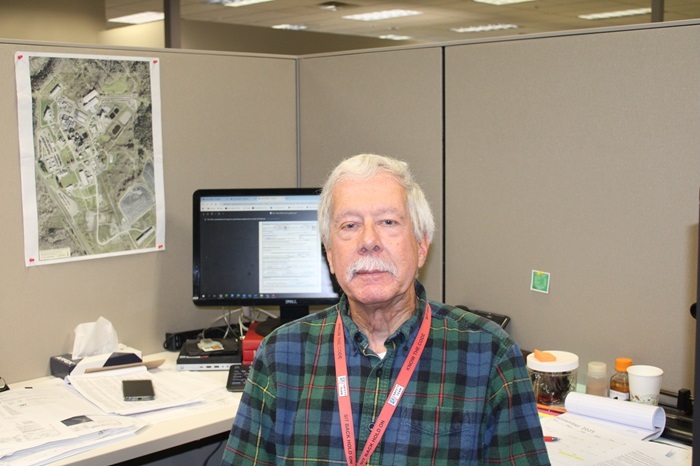 Dan Meess, a longtime team member of the West Valley Demonstration Project cleanup, was among a group of engineers who created a patented invention for the safe disposal of radioactive waste at the site in the 1980s.
In addition to three SUREPAKs, the present-day cleanup team demolished 28 degraded liners, or waste boxes, and 17 vitrification vault lid sections this year. They loaded the debris into 22 waste containers weighing nearly 1.2 million pounds — equivalent to more than 440 small cars — for shipment to an offsite disposal facility.
The vitrification vaults had stored contaminated equipment removed from the Vitrification Facility during its deactivation. In 2018, U.S. Department of Energy Office of Environmental Management workers demolished the 50-foot-tall, 10,000-square-foot facility once used to solidify thousands of gallons of radioactive waste.
Stephen Bousquet, assistant director for West Valley’s Office of Project Management, said the demolition and disposal of the SUREPAKs and other items this year continues the mission to reduce legacy waste and risks at the site.
“The U.S. Department of Energy Office of Environmental Management will continue advancing safe and compliant progress at the site for the surrounding communities,” he added.
Daniel Way, Decontamination and Decommissioning manager for cleanup contractor West Valley Cleanup Alliance, said his team planned and executed the demolition and disposal work safely, compliantly and efficiently.
“This crew used lessons learned to enhance safety, improve efficiency and reduce exposure to job-related hazards,” Way said. “They put their collective knowledge into practice.”
Bousquet noted that West Valley’s present-day team carries on the spirit of innovation seen in the early days of the site’s cleanup.
“The West Valley team continues to be innovative in the cleanup mission while maintaining safety, reducing costs and addressing the legacy of the past,” he said.
-Contributor: Joseph Pillittere
AIKEN, S.C. — Last year, the U.S. Department of Energy (DOE) Office of Environmental Management filled 52 canisters with nearly 215,000 pounds of glass-waste mixture at the Savannah River Site (SRS) and removed 11,872 pounds of volatile organic compounds from groundwater at the site.
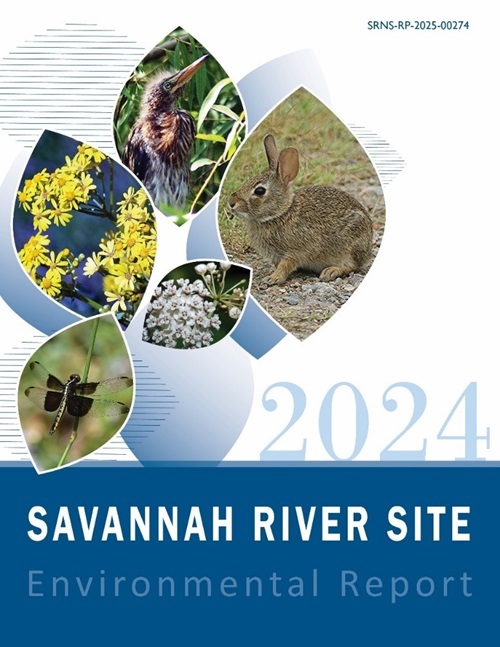
Those are among the highlights of the Annual Site Environmental Report (ASER), published to provide the public and stakeholders with comprehensive information on the site’s environmental conditions for the previous calendar year.
The ASER is key to DOE’s commitment to openness and public understanding of operations. Each year SRS and other DOE sites are responsible for creating the report in compliance with DOE reporting requirements.
In 2024, SRS continued to operate safely and accomplish its missions, all while upholding a strong record of environmental excellence. As in past years, the site adhered to federal and state regulations aimed at protecting both the public and SRS employees.
“A chief purpose of the ASER is to document the radiological and nonradiological condition of the site environment, the effluents and emissions released from DOE operations and noteworthy trends regarding these releases and environmental conditions,” said Eric Doman, Environmental Monitoring Program manager with Savannah River Nuclear Solutions (SRNS), the site’s management and operations contractor. “The report also summarizes SRS environmental data; compliance with relevant DOE, federal and state regulations; and updates on its remediation and surveillance monitoring programs.”
 |
|
The 2024 Savannah River Site (SRS) Annual Site Environmental Report provides the public with information about the site’s extensive environmental monitoring and compliance program, including verified data from samples taken at SRS and in the surrounding communities. |
SRS has been tracking environmental conditions since the site was established in the early 1950s and has released an ASER annually since 1959. Over the last 75 years, the comprehensive SRS Environmental Monitoring Program has shown the following:
- The annual radiological dose from SRS operations is less than one millirem. For context, the annual average dose per person in the U.S. from all natural and human-made sources is about 620 millirems.
- SRS protects, monitors, remediates and conserves groundwater at SRS.
- The site employs innovative, cost-effective technologies to reduce the site’s environmental footprint.
The SRNS Environmental Compliance and Area Completion Projects team collects more than 10,000 monitoring and surveillance samples annually from air, water, soil, sediment, food products, freshwater fish, seafood, wildlife, plants and trees. These samples, collected onsite and from neighboring cities, towns and counties in Georgia and South Carolina, are analyzed by the Environmental Bioassay Laboratory at SRS, or at an offsite accredited laboratory. Reports are then compiled and reported by the Environmental Monitoring group.
The annual report is a yearlong focus for the Environmental Monitoring team and serves as DOE’s primary document to educate the public on environmental programs, missions, accomplishments and community outreach efforts at the site. The SRS ASER has been referenced for many years as a model across the DOE complex.
Click here to view the 2024 ASER.
-Contributor: Fallan Flatow
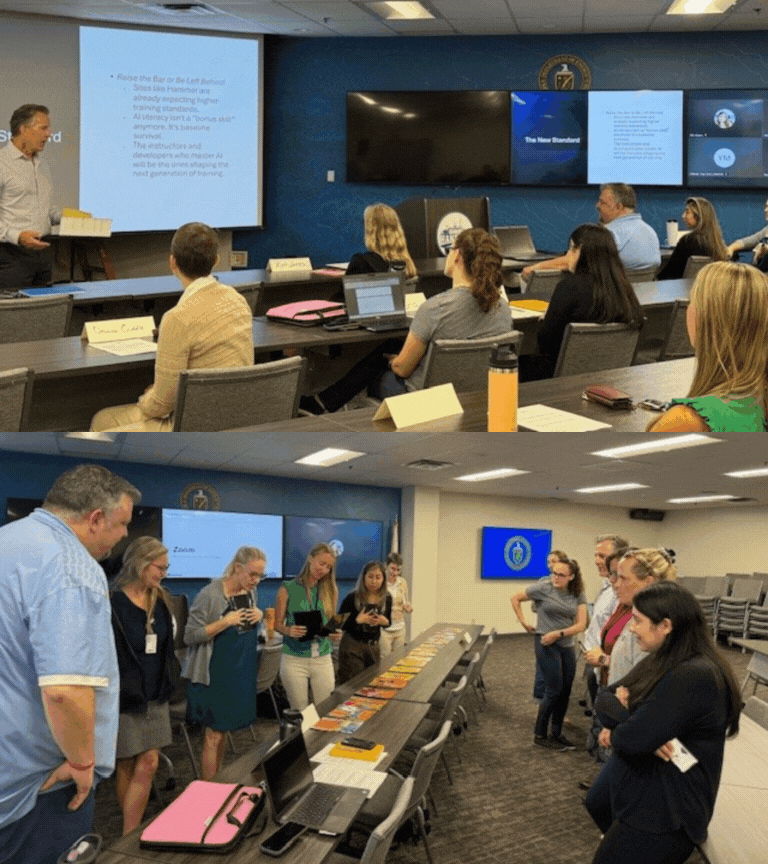
RICHLAND, Wash. — A collaborative initiative among training professionals at the Hanford Site is building stronger partnerships and improving the way training is developed and delivered in support of the U.S. Department of Energy’s mission of safe and efficient cleanup.
The Hanford Training Working Group meets quarterly to share ideas on topics such as adult learning theories, teaching methods, technology integration, learner motivation, and data collection and analysis. Representation from the Hanford Field Office and contractors Central Plateau Cleanup Company, Hanford Tank Waste Operations & Closure, Hanford Mission Integration Solutions and Navarro-ATL, as well as Pacific Northwest National Laboratory take part in the discussions.
The group promotes a culture of continuous improvement and shared growth, while giving members opportunities to refine their skills. Recent meetings featured a tabletop exercise and use of the Hanford Artificial Intelligence Liaison to develop new training materials.
-Contributor: Shyanne Palmus
|