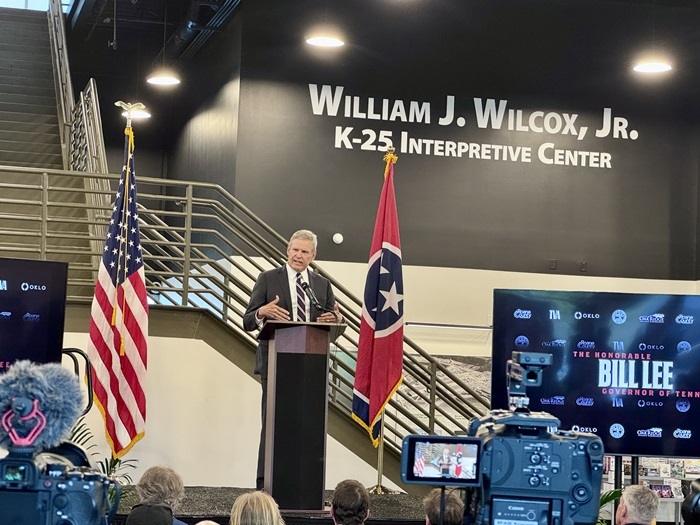
 Tennessee Gov. Bill Lee announces Oklo Inc.’s $1.68 billion investment will bring a projected 800 jobs to the region, during an event at the William J. Wilcox Jr. K-25 Interpretive Center.
OAK RIDGE, Tenn. — Oklo Inc. recently announced plans to build the first privately funded commercial nuclear fuel recycling facility at Oak Ridge’s East Tennessee Technology Park, the first phase of a $1.68 billion advanced fuel center expected to create more than 800 jobs and provide fuel for the nuclear energy company’s Aurora powerhouses and other advanced reactor designs.
Oklo officials shared the news in Oak Ridge alongside congressional leaders and local, state and federal officials. They highlighted the latest major economic development opportunity for the region resulting from the Oak Ridge Office of Environmental Management (OREM) and contractor UCOR’s work to transform a shuttered government-owned uranium enrichment complex into a privately owned industrial park that has become a hub for nuclear energy development.
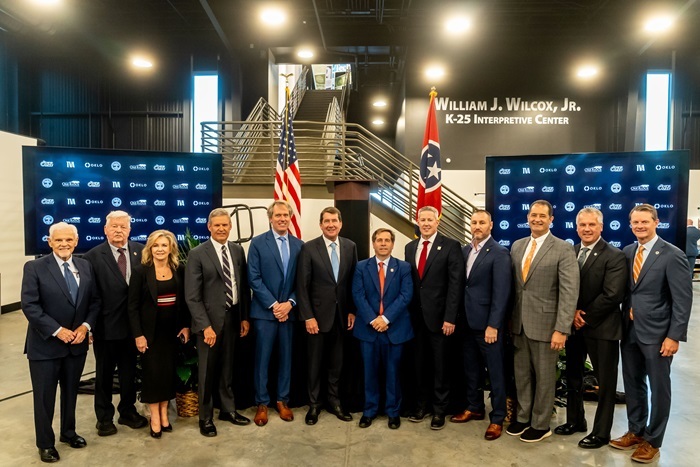 Officials celebrate Oklo Inc.’s planned advanced nuclear fuel center in Oak Ridge. From left: State Sen. Ken Yager, Lt. Gov. Randy McNally, U.S. Sen. Marsha Blackburn, Gov. Bill Lee, Oklo CEO Jacob DeWitte, U.S. Sen. Bill Hagerty, U.S. Rep. Chuck Fleischmann, Roane County Executive Wade Creswell, U.S. Nuclear Regulatory Commission Commissioner Bradley Crowell, Tennessee Valley Authority President Don Moul, State Rep. Rick Scarbrough, and Tennessee Economic and Community Development Commissioner Stuart McWhorter.
The Tennessee facility is expected to begin producing metal fuel for Aurora powerhouses by the early 2030s, following regulatory review and approvals.
“Fuel is the most important factor in bringing advanced nuclear energy to market,” said Oklo CEO Jacob DeWitte. “Tennessee is showing the nation that recycling can be done to support new nuclear development.”
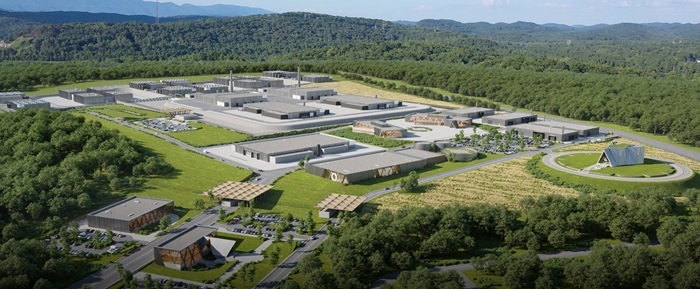 A rendering of Oklo Inc.’s advanced fuel center planned for the East Tennessee Technology Park. The company plans to build on approximately 250 acres of land at the site.
According to Oklo, the 94,000 metric tons of used nuclear fuel stored at power plant sites around the country contain considerable reserves of recyclable fuel. Oklo is focused on unlocking that material, equivalent to about 1.3 trillion barrels of oil.
“The impact of the U.S. Department of Energy Office of Environmental Management’s cleanup mission is on full display with another company announcing major investments and creating new jobs using acreage we cleaned and transferred to the community,” said OREM Manager Erik Olds. “It’s very rewarding to see our vision for the site being realized.”
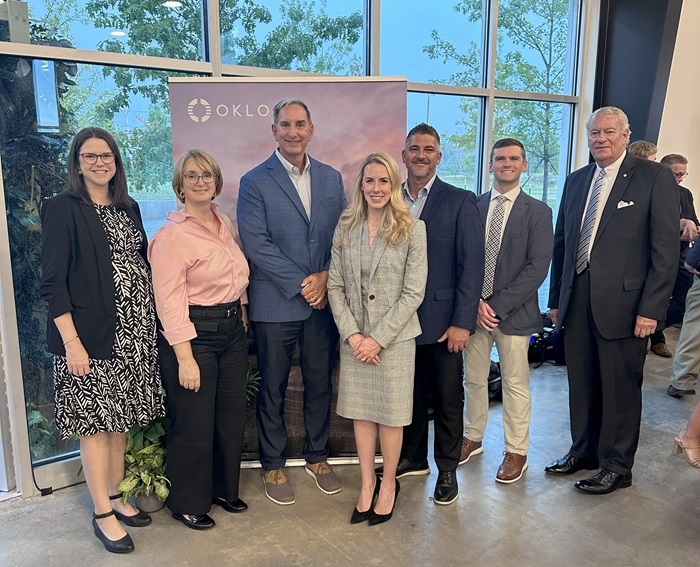 Oak Ridge Office of Environmental Management (OREM) and UCOR teams worked closely with state economic development officials and the Oak Ridge Corridor Development Corp. to provide information and materials on available properties at the East Tennessee Technology Park. Pictured from left are Ashley Saunders, UCOR; Erin Sutton, OREM; Kevin Ironside, UCOR; Meryl Harris and Derrick Collins, Tennessee Valley Authority; Braden Stover, Tennessee Department of Economic and Community Development; and Mike Magill, Oak Ridge Corridor Development Corp.
Oklo joins more than 25 businesses that are located on land OREM transferred to the community or have announced plans to build there. Together, they are making a projected capital investment of $8 billion and expect to generate 2,500 private sector jobs.
The company plans to build on approximately 250 acres of land at East Tennessee Technology Park. To date, OREM has transferred 1,832 acres for economic reuse. Another 667-acre parcel is slated for transfer by the end of the year.
“Oklo’s recognition of our strong business climate, reliable infrastructure and skilled workforce prove that Tennessee is ready to continue growing into the top state for nuclear energy,” said Tennessee Gov. Bill Lee. “We’re proud to partner with Oklo to continue pushing our state toward the future, increasing America’s energy independence and creating greater opportunity for all Tennesseans.”
-Contributor: Chris Caldwell
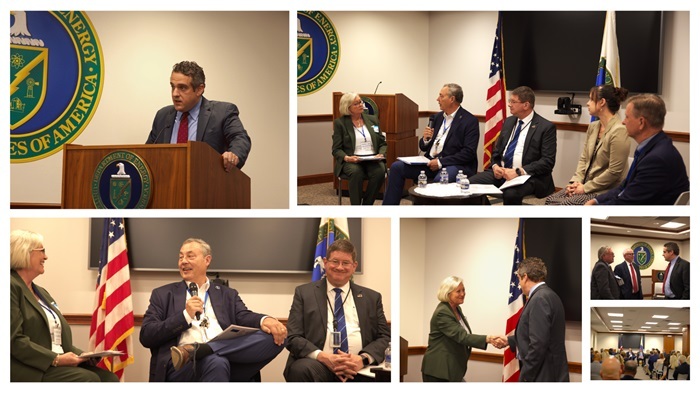 U.S. Department of Energy (DOE) officials and Paducah, Kentucky, community members take part in a meeting of the annual Paducah Chamber of Commerce Fly-In earlier this month. At top left, Deputy Secretary of Energy James P. Danly addresses the audience. At top right, from left, Paducah Chamber of Commerce President and CEO Sandra Wilson speaks with DOE Office of Environmental Management (EM) acting Assistant Secretary Joel Bradburne and EM leadership team members Greg Sosson, Kristen Ellis and Steve Trischman.
WASHINGTON, D.C. — Deputy Secretary of Energy James P. Danly recently joined more than 80 community leaders from Paducah, Kentucky, at a meeting where he highlighted U.S. Department of Energy (DOE) efforts to ensure reliable, affordable energy abundance and noted that the Department relies on the American people to help with these objectives, with Paducah being a prime example.
“The enthusiasm that Paducah has for the jobs that can be created, the economic well-being and enthusiasm to embrace the new wave of the Department’s energy abundance is much appreciated and more importantly much relied upon,” Danly said. “My message is thank you, and I hope we can continue to chart this course of cooperation going forward.”
Attendees of the annual Paducah Chamber of Commerce Fly-In also discussed federal priorities at the DOE Office of Environmental Management (EM) Paducah Site and continued collaboration with acting EM Assistant Secretary Joel Bradburne and other members of the EM leadership team, including Greg Sosson, Kristen Ellis and Steve Trischman. Participants emphasized that Paducah is well-positioned to unleash a nuclear renaissance made possible by the vision of the chamber, local leaders and business executives.
The Paducah Site's recent agreements and partnerships to provide land and a portion of a legacy coproduct from the former uranium enrichment process to commercial partners is turning liabilities into assets, accelerating production of domestic energy supplies.
“We love being part of the legacy, but that is our history. That's who we are,” said Sandra Wilson, president and CEO of the chamber. “But we're so excited to be a part of the future of the Department of Energy with all of the projects that are going on.”
At the close of the meeting, Bradburne added, “Paducah is ready,” drawing applause from attendees.
“Thank you, folks, for being my inspiration,” he said. “Thank you, folks, for the partnership that you offered.”
-Contributors: Jordan Anderson, David Sheeley
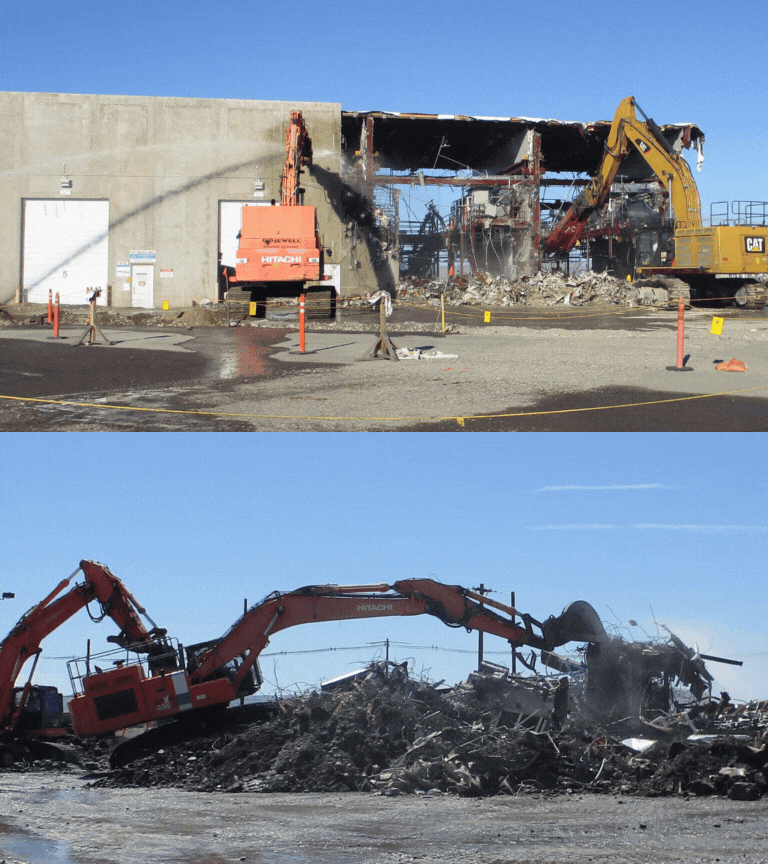 Heavy equipment operated by contractor Central Plateau Cleanup Company demolishes the 142K Cold Vacuum Drying Facility near the Columbia River. The facility was once used to prepare spent nuclear fuel for removal from the former K East and K West Reactor basins.
RICHLAND, Wash. — Workers at the Hanford Site have removed a facility once used to prepare spent nuclear fuel for storage, marking continued progress in the U.S. Department of Energy Office of Environmental Management’s risk-reduction work near the Columbia River.
“Every structure we take down is one less risk along the Columbia River,” said Heather Dale, assistant manager for river and plateau with the Hanford Field Office. “Removing this facility is a visible step forward in worker and environmental safety.”
The 16,000-square-foot building, called the 142K Cold Vacuum Drying Facility, played a key role in removing spent nuclear fuel, mostly from N Reactor. That fuel had been stored for decades in the K East and K West Reactor basins near the river until it could be stabilized for long term storage.
Crews from contractor Central Plateau Cleanup Company (CPCCo) tore down the 142K facility and a nearby 650-square-foot metal structure that supplied emergency power, then hauled the debris to Hanford’s regulated disposal facility.
The 142K facility is one of several key structures removed this year by CPCCo, including:
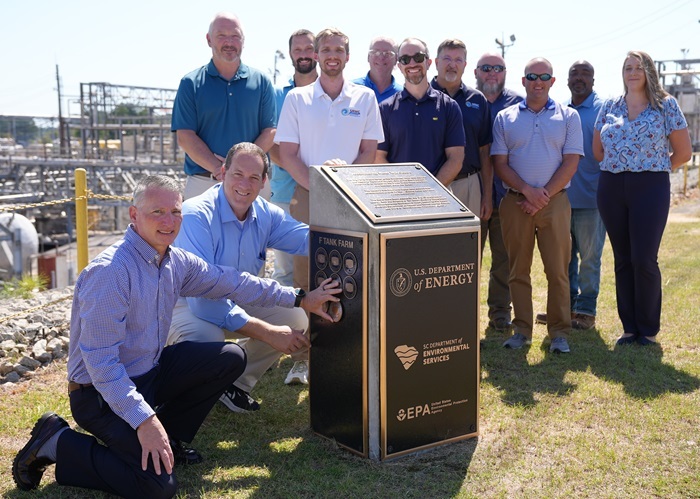 Tony Robinson, DOE-Savannah River acting assistant manager for waste disposition, left, commemorates the completion of preliminary cease waste removal (PCWR) for Tank 3. Pictured at right of Robinson is Tom Burns, Savannah River Mission Completion (SRMC) president and program manager. Personnel from the Tank 3 project team are gathered in the background. The U.S. Department of Energy Office of Environmental Management and SRMC achieved Tank 3 PCWR 27 months ahead of schedule.
It’s the site’s seventh old-style tank to reach this regulatory approval since 2024
AIKEN, S.C. — The U.S. Department of Energy (DOE) Office of Environmental Management (EM) has reached another significant milestone with concurrence from regulators that radioactive waste has successfully been removed from another tank at the Savannah River Site (SRS).
Tank 3 makes the seventh old-style tank to reach preliminary cease waste removal (PCWR) regulatory approval, years ahead of the SRS Federal Facility Agreement (FFA) schedule.
Tony Robinson, DOE-Savannah River acting assistant manager for waste disposition, said each PCWR milestone completed is another step toward remediating the legacy radioactive waste at SRS.
"Achieving the waste tank closure mission is critically important to both environmental stewardship and community safety," Robinson said. “This mission underscores our commitment to responsible waste management, safeguarding public health and reinforcing trust with all our stakeholders.”
PCWR is a regulatory milestone for old-style tanks that designates agreement between EM and its federal and state environmental regulators — the U.S. Environmental Protection Agency and South Carolina Department of Environmental Services — that, based on preliminary information, there is reasonable assurance that performance objectives for tank closure will be met.
Savannah River Mission Completion (SRMC) is EM’s liquid waste contractor responsible for achieving PCWR through safely treating and disposing of the millions of gallons of waste remaining in the underground tanks at SRS, located between two tank farms. Tank 3 is the third old-style tank in F Tank Farm to complete PCWR by SRMC. The tanks will ultimately be filled with grout to be permanently sealed and operationally closed.
SRMC has completed PCWR on Tank 3, Tank 4, Tank 8, Tank 9, Tank 10, Tank 11, and Tank 15 — all seven to 27 months ahead of the agreed-upon deadlines outlined in the FFA. The agreement establishes a procedural framework, including liquid waste-tank milestone agreements, such as the schedule for waste removal and operational tank closures, and other site cleanup priorities.
Achieving seven PCWRs shows that SRMC is a team committed to advancing the mission by getting waste safely out of the aging tanks, according to Mike Borders, SRMC executive vice president and chief operations officer.
“The waste removal and tank closure efforts related to completing seven PCWRs in the first three years of the SRMC contract has been nothing short of excellence,” Borders said. “Real risks and real hazards are being reduced in our area, and everyone involved — SRMC, DOE and the regulators — have a high sense of ownership that we are accomplishing this as a team.”
This regulatory concurrence also means that work can begin on the sampling and analysis phase for these tanks as part of the tank closure process. This next phase will verify these conclusions, based on laboratory analysis of any remaining material, and final residual volume determination, prior to stabilization and final isolation of the waste tank.
-Contributor: Colleen Hart
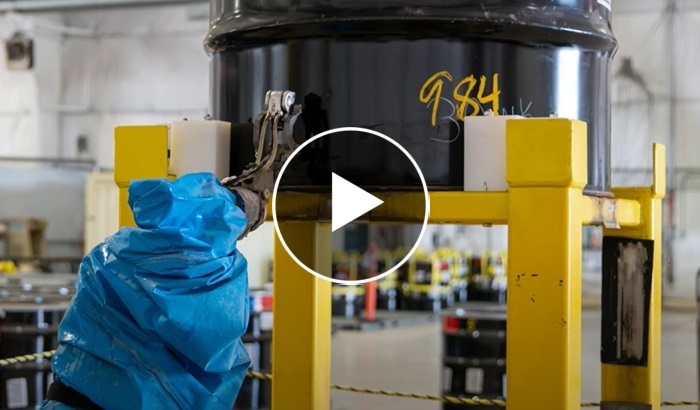 EMTV: This photo montage shows the process each legacy transuranic waste drum goes through for ultrasonic testing within a storage building at the Advanced Mixed Waste Treatment Project at the Idaho National Laboratory Site. Ultrasonic testing provides validation that the drums meet the minimum U.S. Department of Transportation thickness requirement for shipment to the Waste Isolation Pilot Plant for permanent disposal.
Use of ultrasonic technology could lead to potential taxpayer savings of $20 million
IDAHO FALLS, Idaho — An innovative robotic technology has confirmed the integrity of most legacy transuranic waste drums at the Idaho National Laboratory (INL) Site screened so far, enabling their safe and compliant shipment to the Waste Isolation Pilot Plant (WIPP) for disposal and saving taxpayers a potential $20 million.
Since testing and implementation of the ultrasonic testing began in March, team members with Idaho Cleanup Project contractor Idaho Environmental Coalition (IEC) have scanned more than 2,000 drums of lower-contaminated contact-handled transuranic waste. Only 14% of them don’t meet minimum thickness requirements or have other anomalies, and must be placed in overpack containers prior to their shipment to WIPP.
Personnel are encouraged by these results midway through the ultrasonic testing campaign.
“We’re very pleased that we’ve surpassed the expectations of previous estimates,” said Mark Henderson, Production Planning manager for IEC. “Based on past testing of a small number of drums, it was estimated that as many as 40% of the legacy waste drums would fail inspection.”
The technology was deployed to ensure about 4,400 100-gallon drums — in storage for four or more years — meet U.S. Department of Transportation minimum thickness requirements — comparable to the width of automotive sheet metal.
If the drums meet those requirements, they can be loaded directly into shipping casks without overpacking. An overpack is a container designed to provide additional protection.
Based on results so far, Henderson estimates there is a potential $20 million savings over the cost of overpacking all 4,400 legacy waste drums.
During testing, a robotic arm with an affixed ultrasonic testing probe and high tech software scans each waste drum, providing real time data. The equipment scans more than 95% of the impact area of the drum bottom followed by the lower one-third of the drum. Just as gel is used for conventional ultrasonic testing scans, water is used to displace the air during ultrasonic testing, providing a more effective scan.
“The ultrasonic testing system is very robust,” said Henderson. “As long as we’ve kept up on preventative maintenance, it has been mechanically and electronically flawless.”
The need for this technology stems from two 2022 incidents where supercompacted waste packaged in 100-gallon drums developed pinholes and leaked while in transit to the underground waste repository in New Mexico. Both shipments were returned to the Advanced Mixed Waste Treatment Project at the INL Site for the removal of their contents and decontamination of the shipping casks.
Engineering studies indicated that drums more than five years old have the potential to develop pinholes and breach during their transport. As a conservative measure, IEC halted shipments of waste drums older than four years old, resulting in thousands of drums remaining in storage.
This work is being performed under the Resource Conservation and Recovery Act and in support of the 1995 Idaho Settlement Agreement, which requires stored legacy transuranic waste be shipped out of Idaho.
-Contributor: Erik Simpson
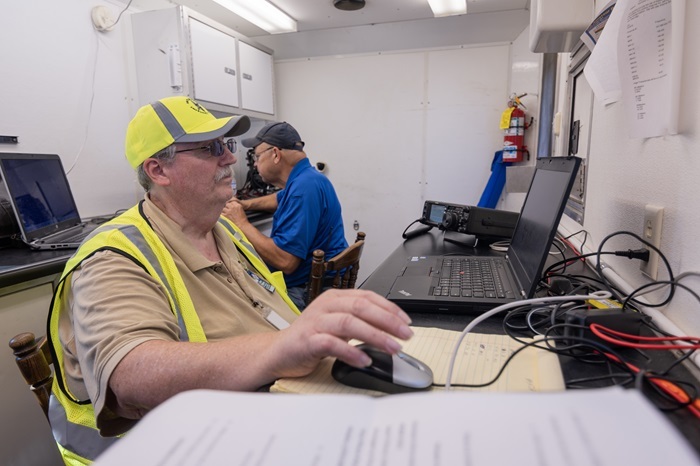 Amateur Radio Emergency Service operators conduct a first-of-its-kind drill at the Paducah Site designed to test alternative communication in the event of an emergency.
PADUCAH, Ky. — The U.S. Department of Energy (DOE) Office of Environmental Management (EM) Paducah Site has incorporated amateur radio into a drill for its emergency management program — a first in the nuclear cleanup complex that demonstrates the site’s ability to maintain backup communications in the event of widespread equipment failure or telecommunications service loss during an emergency.
In the drill, local Amateur Radio Emergency Service team members mobilized at the Paducah Site Emergency Operations Center where they established a portable transmission station. Instead of relying on traditional internet connection, they relayed drill messages as emails over radio waves to the DOE headquarters location in Washington, D.C., and the Portsmouth Paducah Project Office in Lexington, Kentucky.
The unique drill highlights how EM draws from innovation to ensure safety excellence while working to meet DOE’s legal cleanup responsibilities
“This drill highlights our commitment to preparedness and innovation when dealing with emergencies,” Paducah Site Lead April Ladd said. “By incorporating amateur radio, we’ve added another layer of resiliency that can keep vital communication lines open, even when traditional methods are down.”
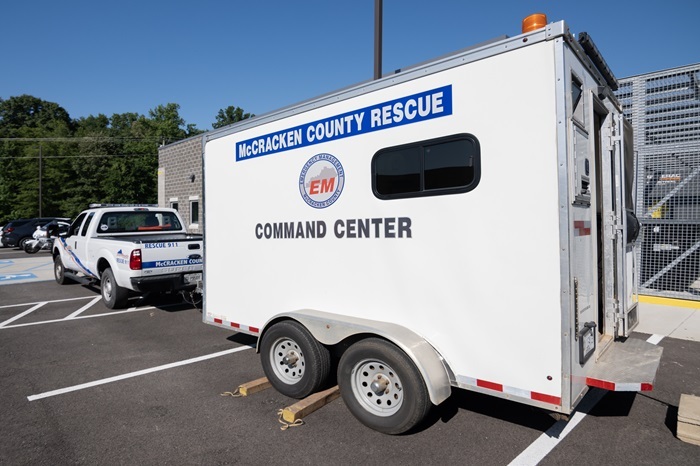 A mobile transmission station is mobilized at the Paducah Site Emergency Operations Center during a drill to provide ham radio communication.
Historically, operators of amateur radio — commonly known as ham radio — have provided critical support during emergencies, including recent natural disasters affecting western Kentucky communities. Their participation in the Paducah Site drill underscores the important role community partners play in supporting DOE’s mission, such as mutual aid agreements with local law enforcement and outside first responder agencies.
Four Rivers Nuclear Partnership (FRNP), the Paducah Site deactivation and remediation contractor, coordinated the innovative exercise. FRNP is tasked with conducting cleanup in accordance with the Comprehensive Environmental Response, Compensation, and Liability Act.
“Strong partnerships between DOE, contractors and the community are at the heart of the emergency management program at the Paducah Site,” FRNP Program Manager Myrna Redfield said. “Exercises like this not only enhance our preparedness but also strengthen ties with local responders who share our commitment to protecting people and the environment.”
The drill shows amateur radio can bridge communication gaps when cell phones, landlines or internet service are unavailable, giving first responders a powerful tool to ensure critical connections continue during a crisis.
While the Paducah Site maintains several communications systems, the addition of amateur radio provides a proven, low-cost and reliable alternative when conventional infrastructure is unavailable, site officials say.
-Contributor: Dylan Nichols
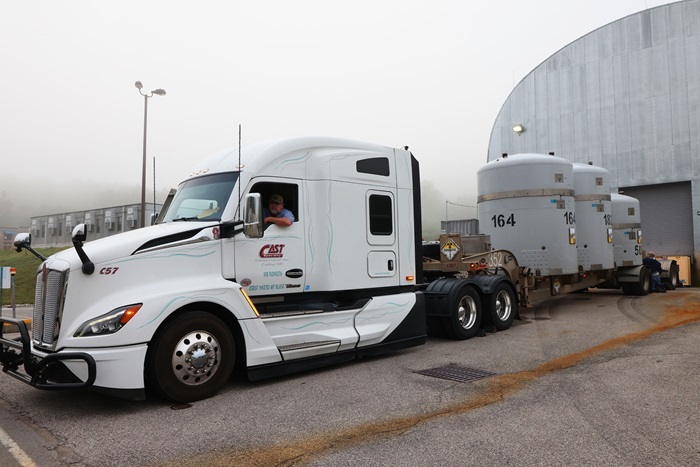 Oak Ridge’s eighth and final shipment of transuranic waste for fiscal year 2025 left the site earlier this month, destined for the Waste Isolation Pilot Plant in New Mexico for permanent emplacement.
OAK RIDGE, Tenn. — The Oak Ridge Office of Environmental Management (OREM) has met its goal to complete eight shipments of transuranic waste to the Waste Isolation Pilot Plant (WIPP) in New Mexico for permanent disposal this fiscal year ending Sept. 30, further reducing its inventory of the material.
Transuranic waste consists of manufactured radioactive elements heavier than uranium on the periodic table. In Oak Ridge, this waste was generated from decades of research at Oak Ridge National Laboratory (ORNL).
Employees at Oak Ridge’s Transuranic Waste Processing Center (TWPC) treat and package the waste destined for WIPP. This fiscal year’s shipments removed 232 drums from storage as OREM and contractor UCOR steadily work to eliminate the entire inventory of legacy transuranic waste from the site.
To date, crews have processed 98% of the lower-contaminated contact-handled transuranic waste at Oak Ridge and shipped 94% of it for disposal. They have also processed approximately 98% of the higher-contaminated remote-handled waste and shipped 80% of it. Click here for an explanation of contact- and remote-handled transuranic waste.
 Workers at the Transuranic Waste Processing Center load drums of processed transuranic waste for shipment and permanent emplacement at the Waste Isolation Pilot Plant in New Mexico.
Patrick Rapp, UCOR’s TWPC area program manager, said this year’s shipments were timed to coincide with the completion of a WIPP maintenance outage that ended in March.
The shipments were orchestrated in collaboration with the Central Characterization Project (CCP), which has specialists deployed at TWPC whose expertise ensures all WIPP-bound shipments meet stringent safety protocols and regulatory compliance standards.
“It is imperative that we work together in planning waste processing and waste characterization,” said Evan Desjardins, CCP ORNL project manager. “The ultimate goal is to have transuranic waste shipped out of Tennessee, and TWPC and CCP work closely together to accomplish that.”
-Contributor: Mike Butler
|