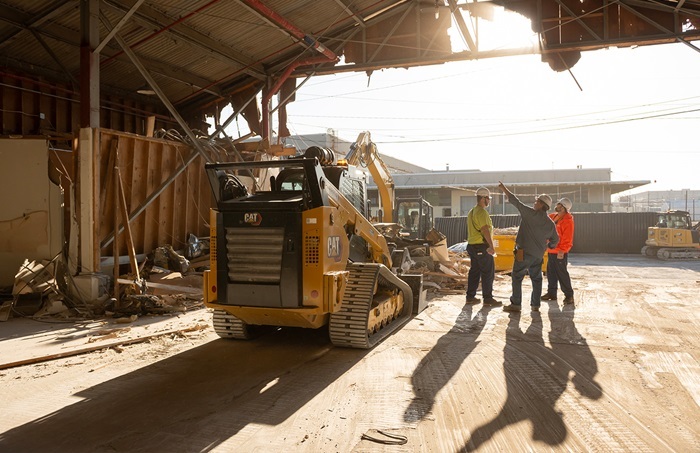
 Crews at the Paducah Site pause to discuss how to best proceed with demolition of one of the 33 inactive facilities demolished earlier this year. The safe demolition of unused facilities has been ongoing at the Paducah Site in recent years as the cleanup mission progresses to prepare the site for reindustrialization.
WASHINGTON, D.C. — U.S. Department of Energy (DOE) Office of Environmental Management (EM) crews recently reached a historic milestone of over 40 million safe hours at the Savannah River Site (SRS) and received an award from the National Safety Council at the Paducah Site, highlighting safety excellence and a core value of DOE culture: safe performance of work.
As the United States enters the golden era of American energy dominance, DOE will pursue multiple interrelated objectives, including promoting energy abundance, leading world-class innovation, strengthening and modernizing its weapons stockpile, and fulfilling Cold War legacy cleanup commitments. To succeed, DOE strives for a culture of transparency, performance and common sense.
With a commitment to protecting the public, its workers and the environment, DOE embraces Integrated Safety Management (ISM) as the overarching framework for safely accomplishing mission activities. ISM is a common-sense, enduring framework for identifying and controlling hazards, following applicable safety standards, delivering results and continuously improving.
EM is in lockstep with the broader DOE core value of safe performance of work, fostering a safety conscious work environment where employees understand their roles and responsibilities for safety and health, and learn from experience.
"We are committed to a strong and resilient safety culture," said Greg Sosson, EM associate principal deputy assistant secretary for field operations. "Our environmental cleanup program is working to safely meet DOE’s cleanup responsibilities to ensure American communities are safe and prosperous."
 The U.S. Department of Energy Office of Environmental Management’s liquid waste construction workforce at the Savannah River Site has clocked over 40 million safe hours since 1998.
As DOE faces a wide array of hazards in carrying out its mission, including nuclear, radiological, chemical, biological and industrial hazards, its goal is safety excellence. That means zero accidents and zero workplace injuries.
Since the summer of 1998, the liquid waste construction workforce at the Savannah River Site in Aiken, South Carolina, has been setting the standard for workplace safety, and has clocked over 40 million safe hours, which means the total number of hours worked without an employee sustaining an occupational injury that prevents the employee from returning to work the following day.
“This decades-long record demonstrates our longstanding commitment to prioritizing the safety of our workers and performing the critical work of the liquid waste mission efficiently at every step of operations,” said Edwin Deshong, EM Savannah River Operations Office manager.
The National Safety Council awarded Paducah Site deactivation and remediation contractor Four Rivers Nuclear Partnership its Million Work Hours Award on the heels of the contractor exceeding 4 million safe work hours without a lost workday accident at the legacy nuclear site in Kentucky.
“This award recognizes the dedication of the entire Paducah workforce to protecting each other, our community and the environment while carrying out DOE’s cleanup mission,” acting EM Assistant Secretary Joel Bradburne said.
-Contributor: David Sheeley
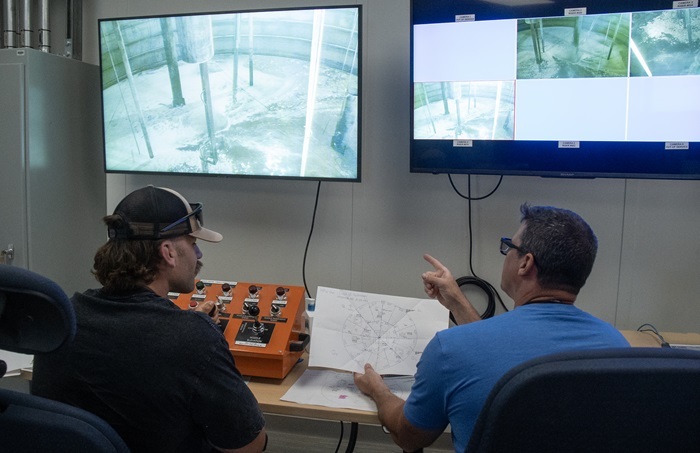 Waste retrievals team members with Hanford Tank Waste Operations & Closure use in-tank cameras and equipment to remove waste safely from inside a control room.
RICHLAND, Wash. — The Hanford Field Office is tackling the legacy of the past, cleaning up decades-old radioactive waste stored in large underground tanks.
Workers at the U.S. Department of Energy Office of Environmental Management site recently transferred more than 430,000 gallons of radioactive and chemical waste from Single-Shell Tank A-101 to a newer double-shell tank for continued safe storage. Crews from site contractor Hanford Tank Waste Operations & Closure (H2C) started working on it in summer 2024, using remote-controlled equipment and pressurized water to break up waste.
“This work addresses some of the most challenging and hazardous waste at Hanford,” said Katie Wong, program manager with the Hanford Field Office Tank Farms Programs Division. “Every tank we retrieve waste from not only reduces potential exposure but also shows our commitment to protecting people and the environment.”
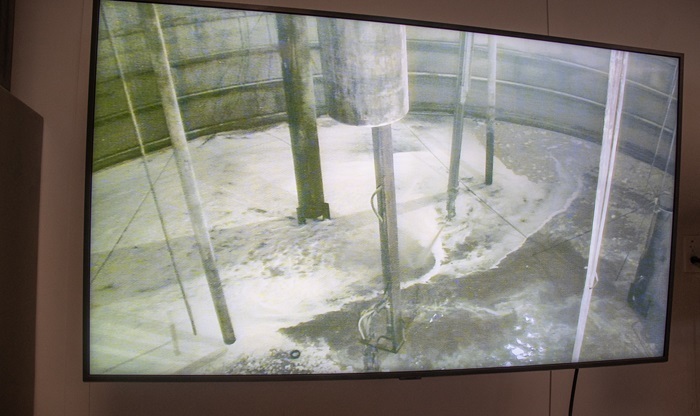 A photo from inside Tank A-101 during retrieval activities earlier this summer shows radiological and chemical waste before being transferred out.
Hanford produced plutonium for U.S. nuclear weapons from 1944 to 1989. Today, the focus is on cleanup. This waste will eventually be sent to the nearby Waste Treatment and Immobilization Plant to be vitrified into glass for safe disposal.
This is the 22nd single-shell tank to undergo waste retrieval. Workers will pivot to Tank A-102 this fall, continuing the important work of cleaning up Hanford’s legacy waste.
“We are committed to making sure these operations are conducted safely and effectively, reflecting our dedication to protecting the environment and the community,” said Dave Saueressig, H2C’s retrievals manager.
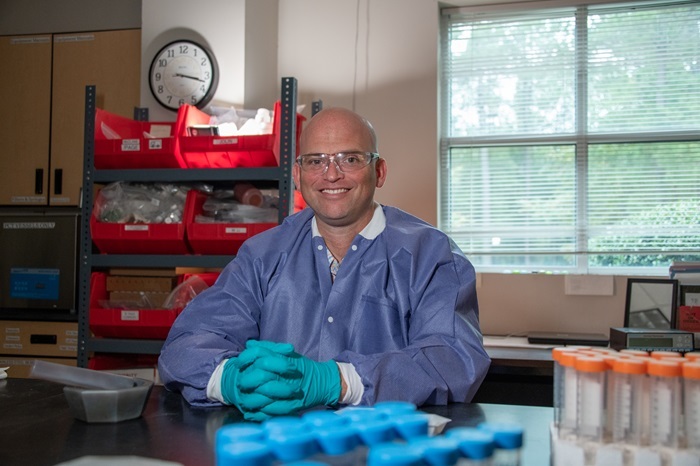 Savannah River National Laboratory researcher Cory Trivelpiece and his team, in partnership with Silica-X Inc., developed a technology known as advanced engineered cellular magmatics that led the laboratory to be named an R&D 100 Awards winner.
SRNL team to advance award-winning technology at EM’s new Advanced Manufacturing Collaborative
AIKEN, S.C. — The Savannah River National Laboratory (SRNL) has won a prestigious R&D 100 Award this year for its breakthrough technology that converts landfill-bound materials into high-value products that could help accelerate the U.S. Department of Energy (DOE) Office of Environmental Management (EM) cleanup mission.
Earning an R&D 100 Award showcases the national significance of SRNL’s EM-funded research and its contribution to innovation in environmental stewardship.
The awards are sponsored by “R&D World Magazine” and recognize the world’s 100 most innovative technologies each year. They are often referred to as the “Oscars of Innovation.”
The SRNL technology in the spotlight, known as advanced engineered cellular magmatics (AECM), was developed by SRNL researcher Cory Trivelpiece and his team in partnership with Silica-X Inc.
“I’m incredibly proud of our SRNL team for earning this R&D 100 Award in partnership with Silica-X,” SRNL Director Johney Green said. “This recognition highlights the power of innovation, collaboration and turning bold ideas into real-world impacts.”
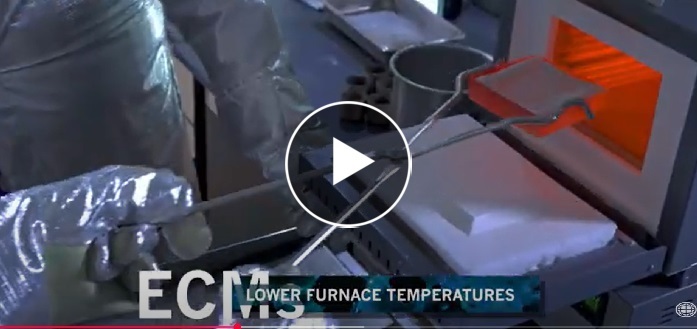 EMTV: Watch this video showcasing the advanced engineered cellular magmatics technology.
The winning team members include Trivelpiece and William Ramsey with SRNL and Gert Nielsen and Robert Hust with Silica-X.
“It’s an honor for me and this team to get recognition from the awards committee,” Trivelpiece said. “To be selected for the award along with other national labs and some of the largest R&D companies in the world is truly humbling and amazing.”
The award recognition in the mechanical/materials category highlights the innovative AECMs project, which involves reusing materials, such as recycled glass or other feedstocks, in creative ways to develop products with applications in waste remediation, construction and more.
Trivelpiece’s team recently developed AECMs that react like a cementitious material with low-activity radioactive waste streams. If implemented, this would enable a containerized waste form that requires no mixing equipment and minimal onsite operations.
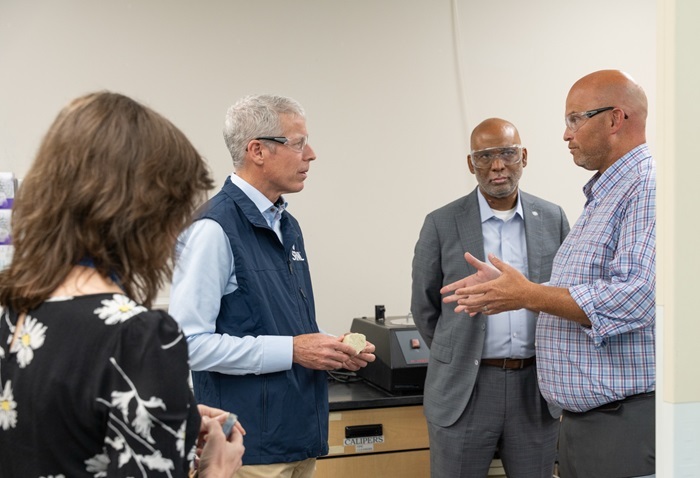 From left, Energy Secretary Chris Wright and Savannah River National Laboratory (SRNL) Director Johney Green listen while SRNL researcher Cory Trivelpiece discusses advanced engineered cellular magmatics during a demonstration of the technology.
Trivelpiece’s team is moving its laboratory into the Advanced Manufacturing Collaborative (AMC) Facility to continue advancing the technology. EM constructed the facility for SRNL on the University of South Carolina Aiken campus.
Joined by local, state and congressional leaders, Energy Secretary Chris Wright and other DOE officials opened the doors to the AMC facility last month, launching a new chapter for American innovation in South Carolina.
“This is an example why the recently completed AMC Facility is so critical to SRNL’s future. And we can’t wait to see what the laboratory will do next,” said Greg Sosson, EM associate principal deputy assistant secretary for field operations.
Ming Zhu, EM’s senior advisor for laboratory policy, said SRNL has been expanding its research portfolio through public-private partnership to position the laboratory for an enduring mission as EM works towards the completion of nuclear legacy cleanup.
“SRNL’s partnership with Silica-X Inc. enables real-time tech-to-market analysis of laboratory-scale results and the ability to translate these results to industrial-scale solutions,” Trivelpiece said.
Learn more about engineered cellular magmatics here.
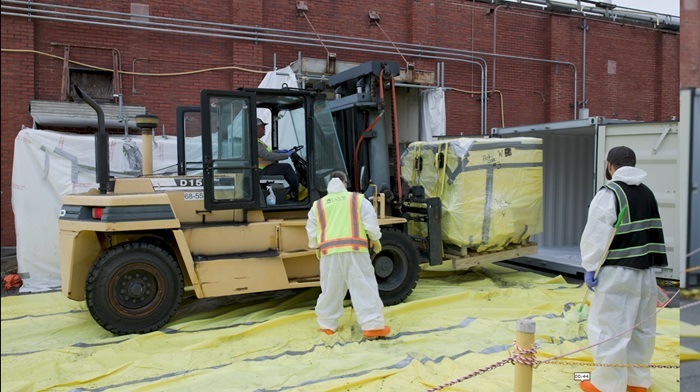 Workers remove a packaged hot cell from Building 3038 at Oak Ridge National Laboratory. To date, they’ve removed three hot cells, with the remaining two to be withdrawn in coming weeks.
EM cleanup to transform national lab, support research and innovation missions
OAK RIDGE, Tenn. — The Oak Ridge Office of Environmental Management (OREM) and contractor UCOR are advancing projects that will transform Oak Ridge National Laboratory (ORNL) and make space available to support important research and innovation missions.
U.S. Department of Energy Office of Environmental Management (EM) cleanup crews are preparing multiple facilities for demolition in ORNL’s central campus area. They include the former Isotope Development Lab, known as Building 3038, and a collection of 11 highly contaminated former radioisotope processing facilities referred to as Isotope Row.
“The efforts underway now by our employees are laying the foundation for EM to achieve some of its most significant cleanup successes in Oak Ridge over the next year,” said Steve Clemons, ORNL portfolio federal project director.
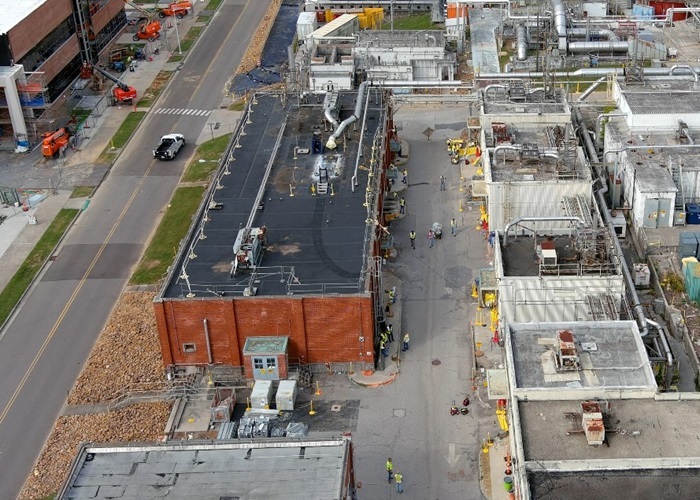 An aerial view of Building 3038, at left, and Isotope Row, at right. Work underway is reducing risks and supporting efforts to remove highly contaminated facilities located in the central campus of Oak Ridge National Laboratory.
Workers have safely separated all five hot cells inside Building 3038. They’ve removed three of them, and will take out the final two in coming weeks. Clearing away the hot cells is one of the most crucial deactivation tasks to reduce risks inside the structure and prepare the building for demolition. Hot cells are heavily shielded, concrete rooms used to safely contain and manipulate highly radioactive materials.
“This facility posed several challenges that required deliberate and precise approaches to workforce safety,” said UCOR Project Manager William Lloyd. “Building 3038 is deemed one of the most high-risk facilities on the ORNL central campus due to its past and current condition and contents.”
Constructed in 1949, Building 3038 contained equipment used to process, convert and ship radioactive isotopes. For decades, researchers in the facility studied transuranic elements, fabricated targets and sources and produced medical isotopes.
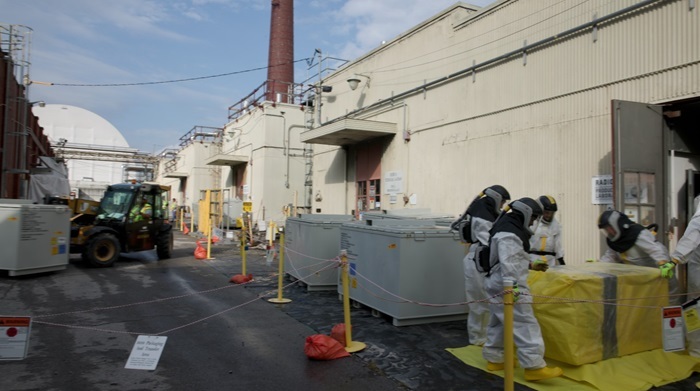 Cleanup crews are performing deactivation tasks inside Isotope Row facilities to prepare them for demolition next year.
Work is also ongoing in Isotope Row to enable near term demolition. These facilities were constructed in the 1950s and 1960s to process radioisotopes. Cleanup crews are completing tasks to remove these highly contaminated structures from the heart of ORNL.
“The adjoining buildings presented a unique set of challenges with extremely hazardous risks requiring highly skilled crews to perform their deactivation duties,” Chad York, UCOR ORNL cleanup area project manager, said.
Most buildings in Isotope Row are in various stages of decontamination activities, pipe and duct removal and radiological surveys. Those activities include removing highly irradiated sources, ventilation system ducts and hot cells.
Demolition is scheduled to begin on the Isotope Row facilities in 2026. Removing these structures eliminates hazards, provides space to support larger demolition projects and opens land for future research missions.
-Contributor: Carol Hendrycks
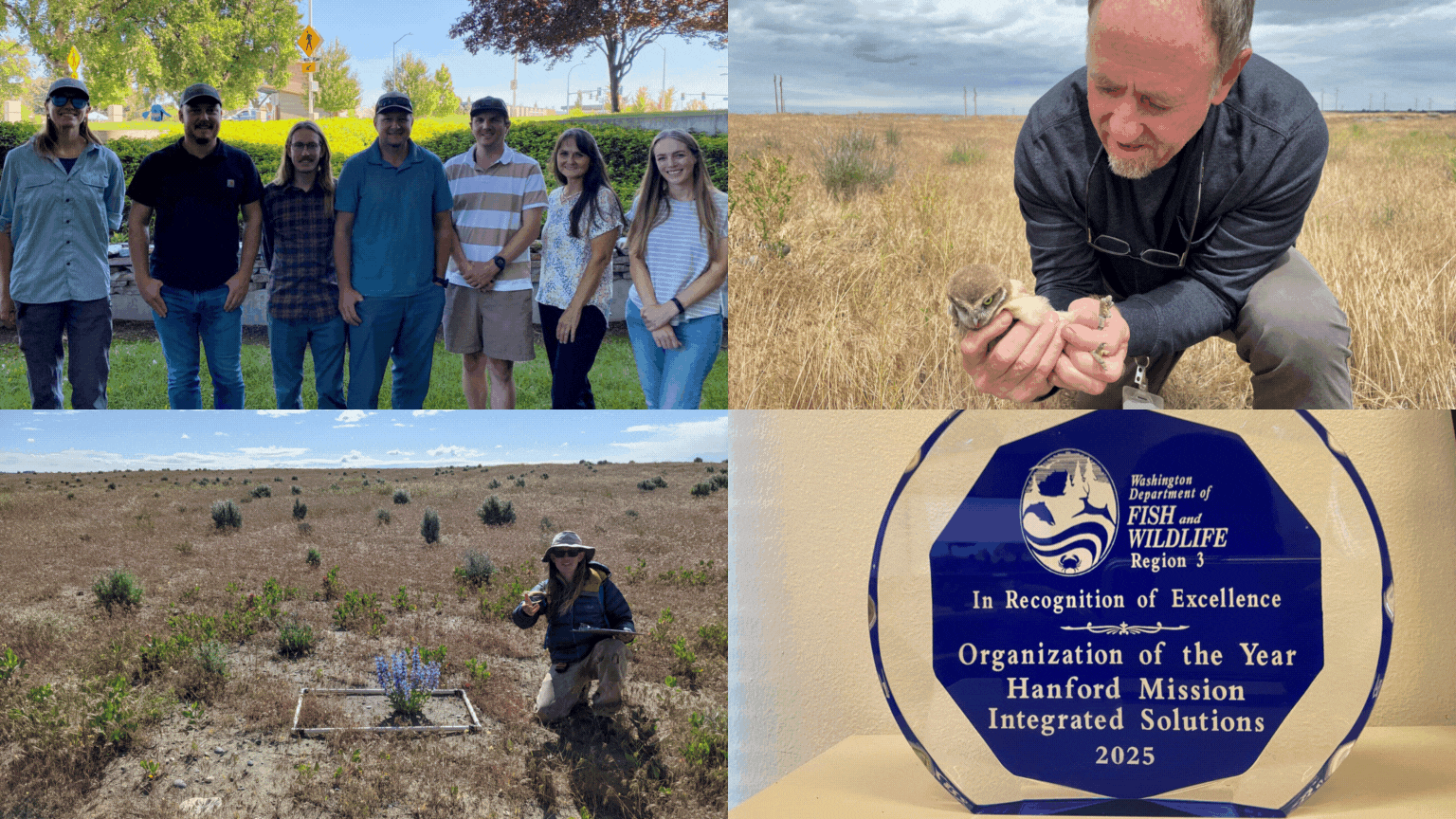 This series of photos shows Hanford Mission Integration Solutions (HMIS) Ecological Monitoring Compliance Team members and the award they received from the Washington Department of Fish and Wildlife. Pictured in the first photo, from left: Mia Johnson, subcontractor Environmental Assessment Services (EAS); Dave Shaw, HMIS; Nolan Exe, HMIS; Cole Lindsey, HMIS; Matt Paulson, EAS; April Johnson, HMIS; and Becky Elias, EAS. Not pictured: Kevin Cranna, HMIS; and John Nugent, subcontractor FRAME.
RICHLAND, Wash. — Hanford’s Ecological Monitoring & Compliance team earned the Organization of the Year award from the Washington Department of Fish and Wildlife (WDFW) for protecting plants, animals and habitats on the Hanford Site.
Hanford Field Office contractor Hanford Mission Integration Solutions manages the team. They monitor how these natural resources change over time to ensure they remain healthy for future generations. They follow the Hanford Site Biological Resource Management Plan that identifies which species need more attention, especially those that are vulnerable or declining and could become endangered without active intervention. The team often works with WDFW and other groups to gather information and develop innovative ideas to help preserve and restore native species.
Jason Fidorra, WDFW wildlife biologist, nominated the Hanford team, highlighting numerous examples of their work. “From deploying trail cameras to systematically monitor jackrabbits to conducting flights to determine seasonal elk abundance, this group has routinely collected accurate and valuable species information. Their efforts have contributed to maintaining wildlife populations on this unique landscape.”
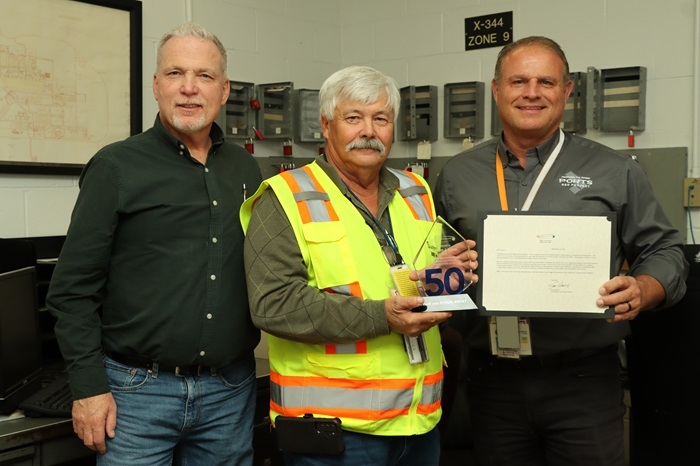 Fluor-BWXT Portsmouth (FBP) employee Robert “JR” Lyon, center, recently completed 50 years of service at the Portsmouth Site. Nuclear Operations Director Tim Poe, left, and FBP Project Director Greg Wilkett present Lyon with a 50th Anniversary Service Award.
PIKETON, Ohio — Career longevity has come into focus recently at the Portsmouth Site, where 17 of the more than 2,000 contractor workers there have marked over 50 years of service, with one employee at 56 years.
While the 17 employees have worked for a variety of contractors during their time at the U.S. Department of Energy Office of Environmental Management site, they are currently with Fluor-BWXT Portsmouth (FBP), the decontamination and demolition contractor; North Wind Dynamics (NWD), the infrastructure support services contractor; and Mid-America Conversion Services (MCS), which manages the depleted uranium hexafluoride conversion facility at the legacy nuclear site.
“The level of dedication and hard work that takes place at the site every day is truly remarkable,” Portsmouth Site Lead Jeremy Davis said. “To work at the same location for 50 years shows how much these individuals love what they do.”
 |
|
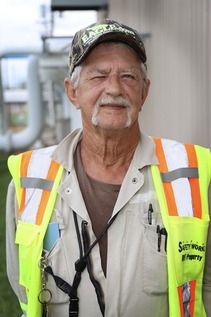
Jack Galloway with Fluor-BWXT Portsmouth recently completed 50 years of service at the Portsmouth Site. Galloway was originally hired as a janitor and is now a utility distribution operator. |
Jack Galloway, an FBP utility distribution operator, is one of the most recent to cross the 50-year threshold. He said he couldn’t imagine working anywhere else.
“It’s challenging, hard work, but I enjoy the people I work with,” said Galloway.
Another half-century employee is FBP’s Robert “JR” Lyon. He has been a nuclear facility manager since 2013. Lyon has worked rotating shifts in several facilities at the site for nearly four decades.
“This job has been very good to me to raise a family in southern Ohio,” Lyon said. “Now my son works here in business services. It is an honor to show him where I’ve worked and introduce him to my work family.”
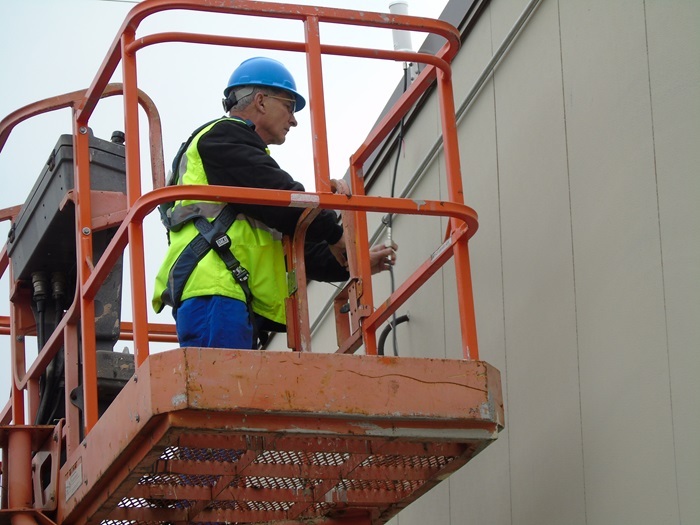 From instrument apprentice to instrument and electrical mechanic with North Wind Dynamics, Mike Bower marks 50 years of service at the Portsmouth Site.
Instrument and Electrical Mechanic Mike Bower with NWD is also a member of the 50-plus-years-career club.
“One of my most memorable moments was when the plant went into cold standby in 2001. I was working on the cell floor of X-330 Process Building when the cascade was shut down,” Bower said. “The silence was deafening.”
At MCS, a couple employees have reached the 50-year mark. One of them is Operator Technician Bill Bowen.
“I was blessed to have the opportunity to start my career on the reservation 50 years ago, and I have never looked back,” he said.
 |
|
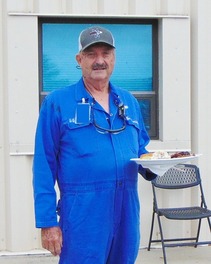
Mid-America Conversion Services Instrument Maintenance Technician Paul Dutcher recently celebrated 50 years at the Portsmouth Site. |
Employees who have worked more than 50 years at the Portsmouth Site include:
- Jerry Rider, FBP – 56 years
- Albert Stone, FBP – 55 years
- John Albright, FBP – 52 years
- Haden Davis, FBP – 52 years
- Johnny Duke, NWD – 52 years
- Earl Elliott, NWD – 52 years
- John Knauff, NWD – 52 years
- Bruce Royal, FBP – 52 years
- Thomas Simon, FBP – 52 years
- Robert “JR” Lyon, FBP – 51 years
- Larry Thomas, NWD – 51 years
- Bob Beaumont, NWD – 50 years
- Bill Bowen, MCS – 50 years
- Mike Bower, NWD – 50 years
- Paul Dutcher, MCS – 50 years
- Jack Galloway, FBP – 50 years
- Thomas Samples, NWD – 50 years
-Contributors: Kearney Canter, Shawn Jordan, Rachel Stroth, Michelle Teeters
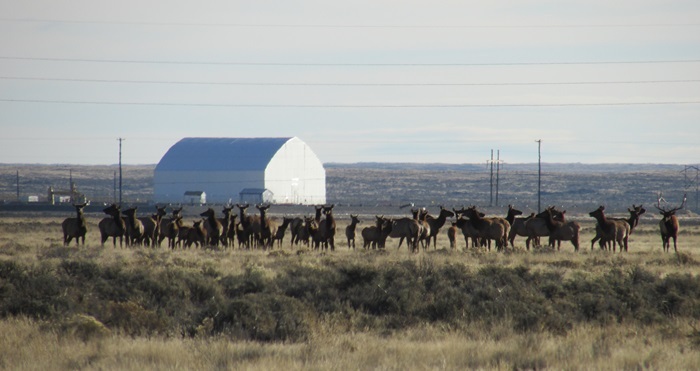 An elk herd congregates near an Idaho National Laboratory Site (INL) facility. Both elk and pronghorn antelope have used the INL Site as a sanctuary during the day while feeding on nearby private agricultural fields at night.
IDAHO FALLS, Idaho — The U.S. Department of Energy Office of Environmental Management (EM) has worked with the state of Idaho and U.S. Environmental Protection Agency on an agreement that strikes a balance between public safety and wildlife management on the 890-square-mile Idaho National Laboratory (INL) Site.
The two federal entities and state have agreed to expand an existing hunting boundary at the INL Site following a request from the Idaho Department of Fish and Game to address concerns that elk and pronghorn antelope have been grazing on private fields adjacent to the INL Site. The agreed-upon hunting expansion includes public access to an additional 79.8 square miles of the INL Site.
“This was a good example of several entities coming together to address an ongoing problem,” said Chris Vilord, Environmental Restoration Technical Support manager for EM contractor Idaho Environmental Coalition. “We have a unique situation where these animals use the site as a sanctuary during the day while feeding in adjacent fields at night. This hunting boundary expansion is designed to upset that trend, using the long-established management tool of public hunting integrated within the environmental regulatory framework to ensure protectiveness of the hunters accessing the INL Site.”
Although the hunting boundary expansion area has never been known to contain any unexploded ordnance from the site’s past mission as the Naval Proving Grounds, those selected for these depredation hunts are required to complete an online unexploded ordnance awareness training course developed by the U.S. Department of Defense and to report any suspicious items. Click here for more information about the training course.
In advance of expanding the hunting boundary, EM’s Idaho Cleanup Project briefed the nearby Shoshone-Bannock Tribes and received input from the tribal council. EM regularly meets with the council and engages in government-to-government consultation on large-scale cleanup projects or issues that affect the historical lands of the tribes.
-Contributor: Erik Simpson
|