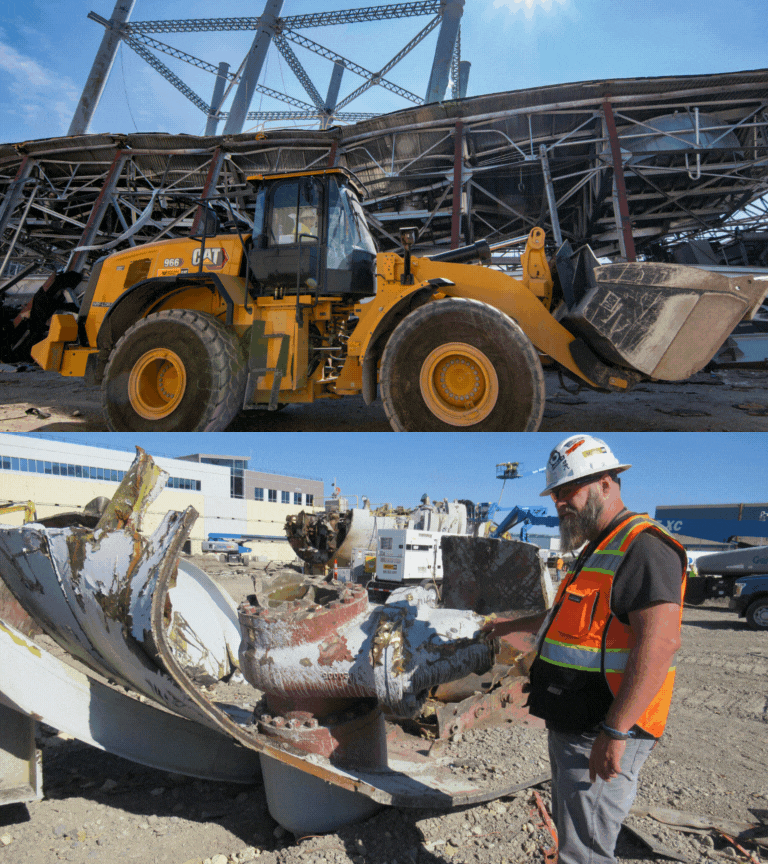
 Idaho Cleanup Project crews are gaining ground on environmental goals and saving taxpayer dollars, having recycled more than 2,100 tons of non-contaminated metal debris generated by demolition activities at the Naval Reactors Facility since 2022.
D&D work helps move EM’s environmental cleanup forward, supports Naval Reactors
IDAHO FALLS, Idaho —The Idaho Cleanup Project (ICP) is advancing its environmental goals and saving taxpayers nearly $2 million as it demolishes three legacy Naval Nuclear Propulsion Program prototypes at the Naval Reactors Facility (NRF).
Project crews have recycled more than 2,100 tons of non-contaminated metal debris since 2022, when the U.S. Department of Energy Office of Environmental Management (EM) and ICP contractor Idaho Environmental Coalition (IEC) began deactivation and demolition (D&D) activities at NRF. To compare, a giant sequoia, the world's most massive tree species, can weigh 2,100 tons or more.
As a result, more than 3,100 cubic yards of material have been diverted from landfill disposal and the project has offset approximately 3,700 tons of carbon dioxide emissions.
These recycling efforts highlight EM’s partnerships with American industry to execute the world’s largest environmental cleanup mission in a manner that saves money and enables the beneficial reuse of materials.
When metal or other debris cannot be recycled at ICP, crews follow strict environmental regulations and send the material to a disposal facility, ensuring protection of the workforce, public and underlying Snake River Plain Aquifer.
In addition to these environmental successes, the project has saved over $1.9 million in costs and supported small businesses in the region by recycling D&D debris.
Located on the Idaho National Laboratory Site, NRF is home to three defueled historic land-based Naval Nuclear Propulsion Program prototypes: the Submarine 1st Generation Westinghouse (S1W), Aircraft Carrier 1st Generation Westinghouse (A1W) and Submarine 5th Generation General Electric (S5G). Each facilitated critical training for naval personnel and testing that helped develop the U.S. Navy’s nuclear-powered fleet.
ICP and IEC are set to complete final D&D of S1W this fall and anticipate completing D&D of A1W and S5G over the next six years.
Mike Swartz, IEC senior project director for D&D and capital projects, recognizes the importance of balancing EM’s priorities to successfully complete the project while responsibly reducing environmental legacy.
“I’m proud of our team and their commitment to complete this work safely, responsibly and efficiently,” said Swartz. “Idahoans and the Idaho Cleanup Project will benefit as we maintain this commitment and continue applying the valuable lessons we’ve learned through demolition of the A1W and S5G prototypes.”
-Contributor: Carter Harrison
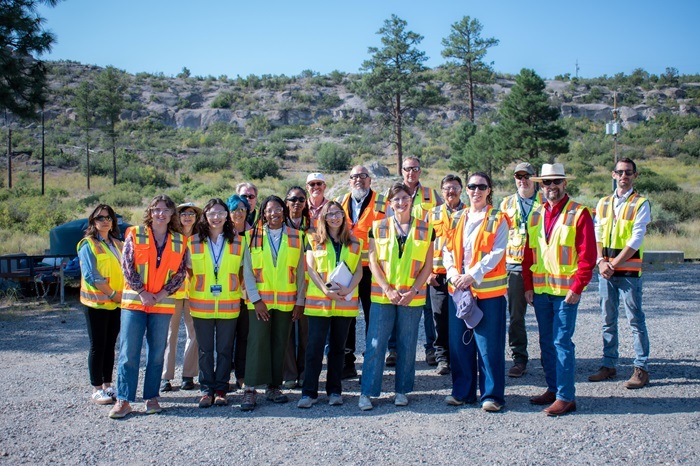 Staff from the U.S. Senate Energy and Natural Resources Committee and New Mexico staffers with Sen. Martin Heinrich’s office toured Mortandad Canyon to view interim measures to prevent migration of a hexavalent chromium plume from the Los Alamos National Laboratory boundary and to treat contaminated groundwater. The group also learned about how well drilling plays a critical part in further defining the plume.
LOS ALAMOS, N.M. — With Congress playing a vital role in the U.S. Department of Energy’s (DOE) environmental cleanup efforts, congressional Senate committee staff members recently visited Los Alamos National Laboratory (LANL) to see and learn more about the legacy cleanup mission.
The visit included staff members from the U.S. Senate Energy and Natural Resources Committee, of which Sen. Martin Heinrich of New Mexico serves as ranking member. The committee has DOE oversight responsibilities. The committee staff was joined by New Mexico field office representatives for Heinrich.
The visitors learned about the major aspects of the LANL legacy cleanup mission: protecting water quality, cleaning up contaminated soil and safely disposing of remaining radioactive waste from nuclear weapons development and research during the Manhattan Project and Cold War era.
“We appreciate the strong support of Congress for the DOE Office of Environmental Management (EM) and our work here at LANL,” said Jessica Kunkle, manager, EM Los Alamos Field Office (EM-LA). “It was important to show the committee staffers and local Senator Heinrich staff what we do to safely, efficiently, effectively and transparently advance our legacy cleanup mission.”
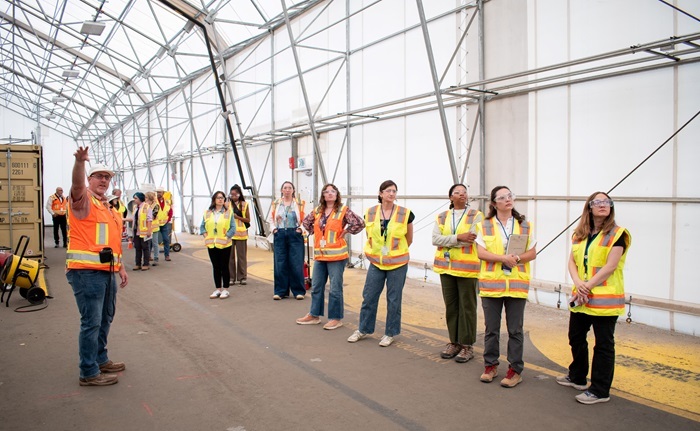 Inside Dome 375 at Technical Area 54, Area G, Brian Clayman, Contact-Handled Transuranic Program manager for Newport News Nuclear BWXT-Los Alamos LLC, provides an overview of current legacy waste operation activities. The tour stop focused on legacy waste characterization and certification, along with operations to remove items from transuranic waste drums that do not meet the Waste Isolation Pilot Plant’s waste acceptance criteria.
EM-LA and Newport News Nuclear BWXT-Los Alamos LLC (N3B), the legacy cleanup contractor at LANL, took the staffers to Mortandad Canyon to view efforts to control and address a hexavalent chromium groundwater plume. EM-LA and N3B are operating an interim extraction, treatment and injection system to prevent migration of the plume beyond the LANL boundary and remove the contaminant.
The staffers also toured Technical Area 54, Area G to see how legacy transuranic waste is prepared for disposition at EM’s Waste Isolation Pilot Plant near Carlsbad, New Mexico. A stop at Technical Area 21 enabled the group to better understand challenging future remediation projects at the location that housed former LANL plutonium processing facilities.
“It’s important for all those with a stake in the legacy cleanup here at LANL to learn more about the challenges we’re tackling, how we’re making progress in cleanup and, most importantly, how we are focused on doing our work safely,” N3B President and General Manager Brad Smith said. “We’re grateful for the staffers’ time and effort to come out to LANL, and we appreciate the opportunity to show our continued success for DOE and the residents of northern New Mexico.”
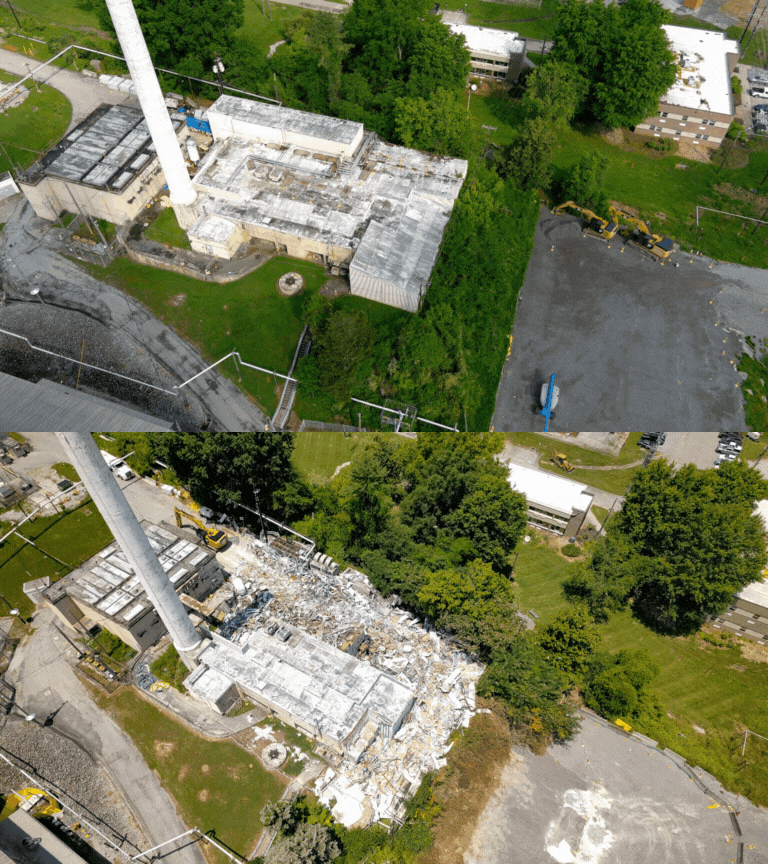 Aerial views show the Graphite Reactor support facilities prior to demolition and with demolition underway. They include Building 3003, right, Building 3002, left, and the Building 3018 stack, center. These structures are located on a small footprint in a heavily congested area atop of a hill at Oak Ridge National Laboratory.
OAK RIDGE, Tenn. — The Oak Ridge Office of Environmental Management (OREM) and contractor UCOR have completed demolition of another aging, contaminated structure at Oak Ridge National Laboratory (ORNL), the latest in a line of projects steadily removing risks and transforming the heart of the site to enable future modernization.
Demolition of Building 3003 began in June and workers finished removing debris from the project in recent weeks.
Removal of the facility cleared 10,000 square feet of space essential to support future teardowns of neighboring facilities. Heavy equipment operators now have room necessary to demolish the adjacent Building 3002 and Building 3018, a 200-foot-tall stack.
“While finishing up deactivation and making our way to demolition start, challenges would arise, but all were faced with teamwork and problem-solving mindsets,” said UCOR ORNL Area Cleanup Project Manager Zachary Dew. “The skill of our craft and strength of our partnerships provided us with a clear path to success. I’m thankful to all involved for their part in making this project a success.”
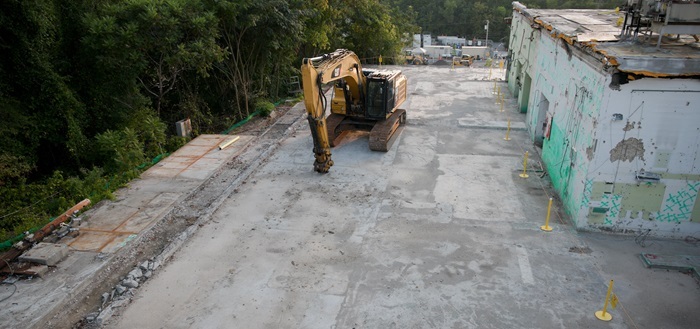 Crews completed final debris removal from the Building 3003 footprint in August. This project cleared 10,000 square feet of space essential to support demolition of two remaining Graphite Reactor support facilities.
Located on a small footprint in a heavily congested area on a hilltop, Building 3003 presented many challenges during demolition.
To overcome spatial constraints, OREM and UCOR developed a plan to use the nearby footprint of the former Low Intensity Test Reactor. Workers built a ramp connecting the two areas and used the footprint to reduce the size of debris and load 80 shipments of that waste for disposal without further congesting the active demolition site.
Built in 1943, Building 3003 contained a fan house and provided ventilation for the Graphite Reactor. The fan house drew air from the reactor through underground ducts and released it through the stack.
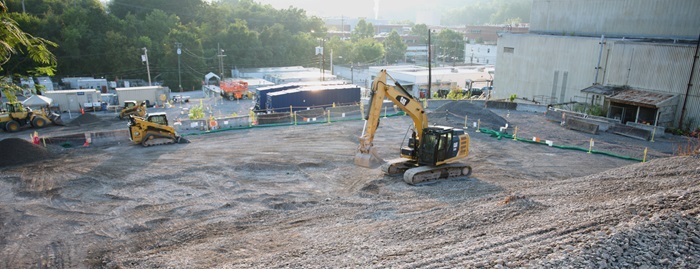 Workers built a ramp connecting the Building 3003 demolition site to the nearby footprint of the former Low Intensity Test Reactor. Linking the two sites helped overcome spatial constraints so crews could reduce the size of debris and load shipments of that waste for disposal without further congesting the active demolition site.
Constructed in only nine months, the Graphite Reactor achieved criticality in 1943, and it was the world’s first continuously operating nuclear reactor. Its initial mission involved showing plutonium could be extracted from irradiated uranium. After the Manhattan Project, it supported nuclear energy and medical research missions.
The Graphite Reactor was shut down in 1963, and it was designated a national historic landmark in 1965. Today, the facility is part of the Manhattan Project National Historical Park. Taking down Building 3003 has removed risks near the historic facility, opened land for reuse and enhanced access for park visitors.
Planning and preparation are ongoing for the demolition of the two remaining Graphite Reactor support facilities. Teardown of Building 3002 and Building 3018 will occur in coming years.
-Contributor: Carol Hendrycks
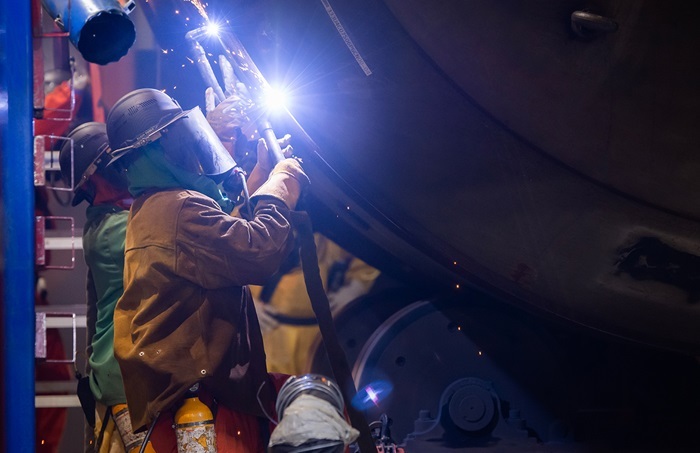 Workers segment a converter in support of continued deactivation activities at the Paducah C-333 Process Building. The National Safety Council’s Million Work Hours Award presented to the Paducah Site deactivation and remediation contractor, Four Rivers Nuclear Partnership, demonstrates the achievement of completing such complex work while keeping safety at the forefront.
PADUCAH, Ky. — The National Safety Council has awarded the deactivation and remediation contractor at the Paducah Site its Million Work Hours Award, reflecting the safe completion of some of the most complex and challenging work at the site.
U.S. Department of Energy (DOE) Office of Environmental Management contractor Four Rivers Nuclear Partnership (FRNP) received the honor on the heels of exceeding 4 million safe work hours without a lost workday accident.
“This award recognizes the dedication of the entire Paducah workforce to protecting each other, our community and the environment while carrying out DOE’s cleanup mission,” Portsmouth Paducah Project Office (PPPO) Manager Joel Bradburne said.
The award also shines a light on EM's efforts to draw from the best of American industry to run the largest environmental cleanup program in the world, safely meeting DOE’s legal cleanup responsibilities to ensure American communities are safe and prosperous.
What's more, FRNP is among four contractors with PPPO that reached safety milestones earlier this year, collectively achieving nearly 18 million safe work hours. The accomplishment demonstrates their commitment to a strong safety culture while making substantial progress in cleanup at the Paducah, Kentucky, and Portsmouth, Ohio, legacy nuclear sites.
At the Paducah Site, FRNP team members advanced a range of projects while maintaining the highest standards of worker safety. They shipped more than 5 million pounds of refrigerant for incineration, removed hundreds of pieces of process gas equipment from former uranium enrichment facilities and demolished more than 33 facilities, including the site’s tallest structure, the C-611-R High Pressure Fire Water Tower.
Crews also achieved progress toward the reindustrialization of the site, transferring more than 765,000 pounds of recyclable materials to the community’s reuse organization and supporting land reuse efforts that prepare the site for future economic growth.
“These achievements are a result of prioritizing safety at every step of the mission,” Bradburne said.
The Million Work Hours Award is presented to organizations completing at least 1 million consecutive work hours without a lost-time injury. The council is a nonprofit safety advocate, focusing on eliminating the leading causes of preventable injuries and deaths.
FRNP’s recognition highlights the essential role safety plays in advancing DOE’s cleanup mission, conducted in accordance with the Comprehensive Environmental Response, Compensation, and Liability Act, while protecting the workforce and the surrounding community.
“Our employees take pride in knowing safety is not just a requirement, but a core value, ensuring everybody goes home safe each day,” FRNP Paducah Site Program Manager Myrna Redfield said. “Surpassing 4 million safe hours is a remarkable accomplishment that underscores our team’s vigilance and care in everything they do.”
-Contributor: Dylan Nichols
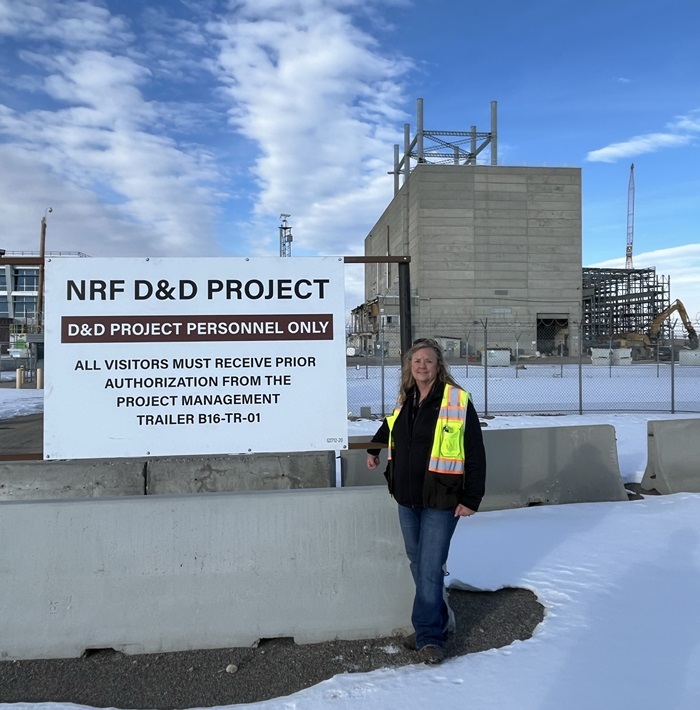 Shawna Burtenshaw, senior project manager of Decommissioning and Demolition (D&D) Projects for cleanup contractor Idaho Environmental Coalition at the Idaho Cleanup Project, stands in front of the Submarine 1st Generation Westinghouse naval reactor prototype plant. Crews are set to finish demolition of the plant this year.
IDAHO FALLS, Idaho — Shawna Burtenshaw leads a team gearing up to finish the demolition of a submarine reactor prototype plant this year, a project that will reduce the legacy footprint of the Naval Reactors Facility and advance environmental cleanup at the Idaho National Laboratory (INL) Site.
Burtenshaw is the senior project manager of Decommissioning and Demolition (D&D) Projects for Idaho Cleanup Project contractor Idaho Environmental Coalition.
The Submarine 1st Generation Westinghouse (S1W) naval reactor prototype plant once served as a training ground for about 14,000 U.S. Navy submariners and plant operators. Earlier this year, crews successfully removed, transported and disposed of the prototype’s reactor vessel, one of the last heavy components from the S1W, in an onsite landfill at the INL Site.
Burtenshaw grew up on a ranch in Idaho before she started working at the INL Site over 40 years ago. She began her career as a document control clerk at the Idaho Chemical Processing Plant (CPP), now known as the Idaho Nuclear Technology and Engineering Center. The key project at that time was to construct CPP-666, which is a storage facility that supported the U.S. Department of Energy spent nuclear fuel mission. This project piqued her interest in construction and with the support of her supervisors, Burtenshaw was able to develop skills that helped her advance to the career she has today.
From construction, Burtenshaw moved into scheduling, cost estimation, radiation protection, emergency management, nuclear operations and demolition. Notably, she has worked for nine contractors at eight different facilities on the INL Site. She has served in several management roles throughout the years.
Burtenshaw shared insights from her variety of experiences in a Q&A with EM Update:
What is the best advice you have been given about working in your field?
Expect the unexpected and look ahead.
What are some of your favorite things about your job?
It’s always something different every day. It presents challenges and opportunities so that any given day you may be celebrating success, resolving issues, or managing and recovering from an event.
What challenges do you face in your field?
The work always comes to an end; construction and D&D are always working yourself out of a job.
What has the most difficult day in your career taught you?
Difficult situations arise in any job. I think it’s important to be sensitive while remaining professional and resilient.
How have you overcome hurdles in your career?
I have worked hard, took on a lot of new challenges and have had good management that helped and supported me along the way. With each contractor, career and facility change, you need to be able to adjust and learn from everyone. No matter what the situation, there are always lessons to be learned.
What advice would you give someone considering a career in your field?
Come to work early, work hard, have integrity and earn respect. You would need to like field work, which is cold and dirty, but it is also fun and rewarding. Most of all, surround yourself with good people because your team makes your success.
What advice would you give a woman working in construction, still early in her career?
Learn all you can from everyone you work with, good and bad. Earn your coworkers’ respect, do not demand it. Try anything you think you have an interest in. The important thing to remember is don’t be afraid of change. You cannot grow if you don’t accept change and recognize an opportunity. Keep learning and growing.
-Contributor: Leamarie Mitchell
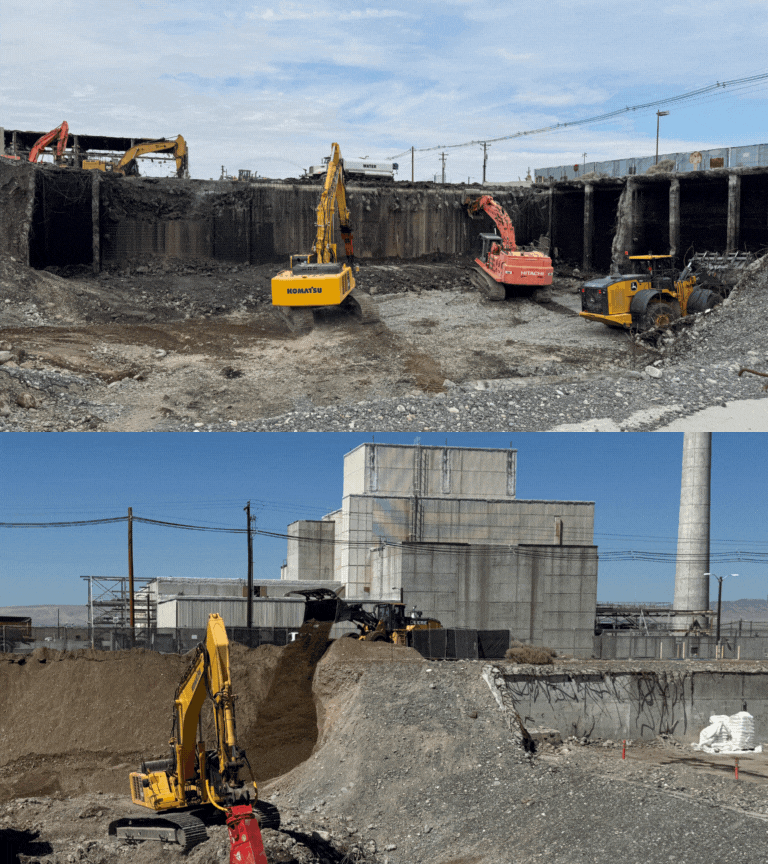 Heavy equipment operators with Hanford Site contractor Central Plateau Cleanup Company demolish a 1950s-era fuel oil bunker that supported operations at the K West Reactor.
RICHLAND, Wash. — Heavy equipment operators have dealt a final blow to an underground fuel oil bunker built 70 years ago at the Hanford Site. The demolition clears away the remaining structure and supports the U.S. Department of Energy Office of Environmental Management’s risk-reduction activities near the Columbia River.
The more than 12,000-square-foot building once stored fuel for the K West Reactor. The fuel tanks were emptied decades ago, and most of the structure was demolished in 2022, but two 23-foot-tall concrete walls remained until this year. Crews from contractor Central Plateau Cleanup Company recently tore down the remaining walls and roof supports.
The rubble was hauled to Hanford’s regulated disposal facility, and nearly 300 truckloads of clean soil were used to backfill the dig site, leaving the area in a safe configuration.
ARLINGTON, Va. — The National Cleanup Workshop is two weeks away, and there’s still time to register for it.
Join speakers and panelists to hear about the next phase of accomplishments by the U.S. Department of Energy Office of Environmental Management (EM), and how these achievements advance a new era of American energy, support national security and enable U.S. innovation and jobs.
EM leaders will detail progress to drive down risks and build new opportunities for communities and the nation. EM empowers the American people by strengthening partnerships and ensuring they have a voice in cleanup and in the future of their communities.
Workshop participants will highlight EM’s work to enable efficiency and drive innovation at Oak Ridge; successes at the Savannah River National Laboratory, Waste Isolation Pilot Plant and West Valley Demonstration Project; and a new vision for the Portsmouth, Ohio, and Paducah, Kentucky, sites. They also will focus on tackling EM waste challenges, and new energy and artificial intelligence infrastructure projects at DOE sites.
Billed as the premier annual gathering to discuss progress in EM’s environmental cleanup of former government weapons sites and nuclear research facilities, the workshop brings together senior DOE executives and other federal partners, officials from DOE sites, industry leaders, local elected officials, state officials, and other stakeholders. It’s hosted by the Energy Communities Alliance, in cooperation with the Energy Facility Contractors Group and EM.
Click here for more information on the workshop.
|