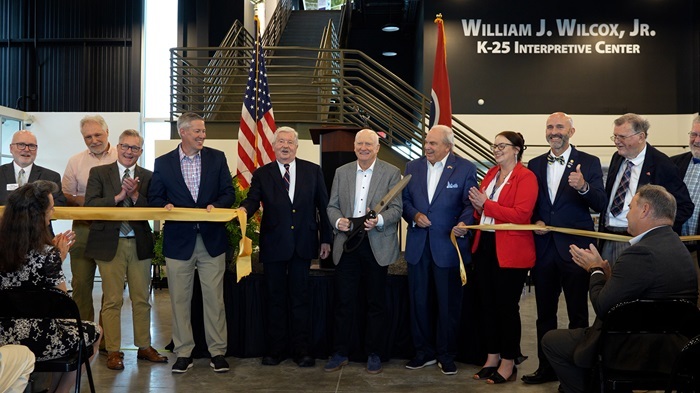
 From left, American Museum of Science and Energy (AMSE) Foundation Executive Director Alan Lowe, UCOR President and CEO Ken Rueter, Oak Ridge Office of Environmental Management Manager Erik Olds, Roane County Executive Wade Creswell, Tennessee Lt. Gov. Randy McNally, William H. Wilcox, son of William J. Wilcox, Oak Ridge City Mayor Warren Gooch, AMSE Development Director Jennifer Lee, AMSE Board President Jim Dodson, former Y-12 Plant Manager Gordon Fee, and Oak Ridge Historian Ray Smith cut the ribbon to open the new K-25 Interpretive Center.
OAK RIDGE, Tenn. — Visitors to the former Oak Ridge Gaseous Diffusion Plant can view the entire footprint of what was once the world’s largest building from a new vantage point now that an interpretive center overlooking the site of the mile-long K-25 Building has opened.
K-25 was one of five large gaseous diffusion uranium enrichment facilities at the Oak Ridge location, now called East Tennessee Technology Park (ETTP). Constructed in 1943, it produced enriched uranium used in the weaponry that helped end World War II.
Local elected officials and other dignitaries recently gathered to celebrate the opening of the viewing facility, called the William J. Wilcox Jr. K-25 Interpretive Center.
The center is named after Oak Ridge’s first official historian, an original resident of the city when it came into existence in the 1940s. The late Wilcox ultimately became the technical director for all research and development programs for the plant, and he used his extensive knowledge from his 43 years of service to educate future generations about what was accomplished at the site.
Attendees included Tennessee Lt. Gov. Randy McNally, Roane County Executive Wade Creswell, Oak Ridge City Mayor Warren Gooch, Oak Ridge City Councilman Jim Dodson, American Museum of Science and Energy Foundation Executive Director Alan Lowe, UCOR President and CEO Ken Rueter, and Oak Ridge Office of Environmental Management (OREM) Manager Erik Olds.
“Our employees are proud to be part of the accomplished history of this site, and their efforts have played a pivotal role in making today possible,” said Olds. “Our cleanup has paved the way for the public to be able to enter and experience a site that was once off limits, and it has created an exciting next chapter involving new businesses, new jobs, and new visitors through our land transfers, historic preservation, and conservation.”
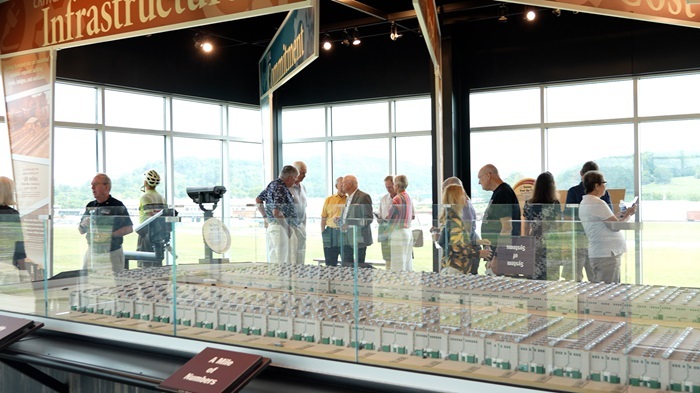 A scaled model of the K-25 Building is located on the top floor of the K-25 Interpretive Center. It provides additional insight into the size of the former structure as visitors view the building’s massive 44-acre footprint.
OREM and cleanup contractor UCOR completed demolition of the K-25 Building in 2013, leaving behind a massive 44-acre footprint that was impossible to fully view from ground level. With the interpretive center’s elevated view, the entire footprint is visible. The facility also features displays and exhibits, including a scaled model of the building, detailing K-25’s extraordinary contributions through the years.
Construction of the center fulfills an agreement OREM signed in 2012 to commemorate the history of the former Oak Ridge Gaseous Diffusion Plant. That commitment also included construction of the K-25 History Center next to the interpretive center, as well as preservation of the historic Alexander Inn.
Crews completed construction of the interpretive center through a partnership among OREM, the U.S. Army Corps of Engineers and contractor Geiger Brothers. UCOR and subcontractor Smee + Busby Architects designed the facility.
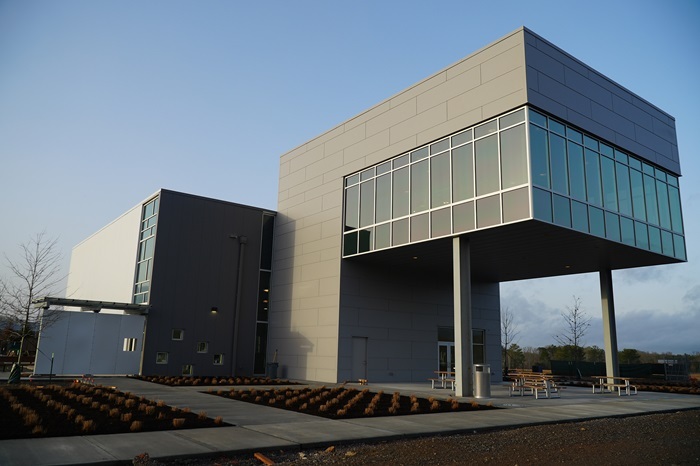 The U.S. Army Corps of Engineers and its construction contractor, Geiger Brothers, completed construction on the K-25 Interpretive Center. The facility helps visitors understand the size and scope of the former Manhattan Project and Cold War-era uranium enrichment complex.
“This center is an important piece commemorating the historical significance of the K-25 Building, and its construction completes one of the final tasks to achieve our vision for the site,” said Mark McIntosh, ETTP portfolio federal project director. “We’ve finished major field work to clean the site, and our efforts have also made it possible for future generations to learn about what was accomplished here.”
The interpretive center is the latest installation on a site that has seen major transformation during the past three decades. OREM and UCOR have completed demolition and soil remediation at the site, marking the first-ever cleanup of a gaseous diffusion complex.
As OREM completed cleanup, it simultaneously made land available for new businesses. To date, 1,800 acres of former government land have been transferred to the community for economic development. That land is attracting companies investing billions of dollars, creating new jobs and advancing energy technologies to meet the nation’s future power needs.
-Contributor: Wayne McKinney
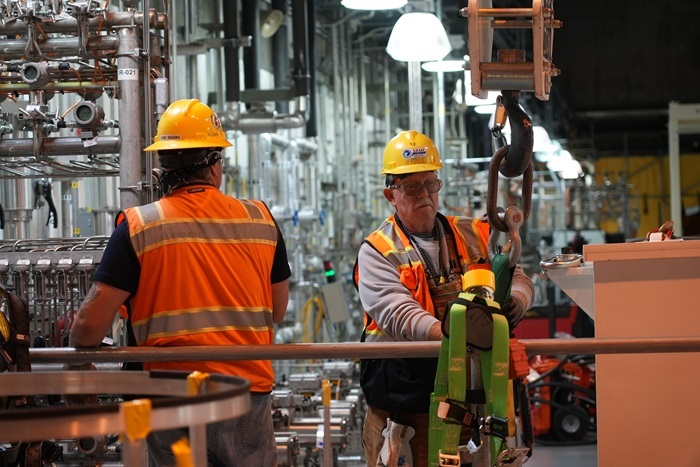 The construction workforce for the Savannah River Site liquid waste contractor recently achieved a record milestone of 40 million hours worked without an employee sustaining an occupational injury that prevents the employee from returning to work the following day. Pictured are Savannah River Mission Completion rigging personnel at the Salt Waste Processing Facility.
AIKEN, S.C. — Since the summer of 1998, the liquid waste construction workforce at the Savannah River Site (SRS) has been setting the standard for workplace safety, leading to a new milestone of over 40 million safe hours.
The U.S. Department of Energy (DOE) Office of Environmental Management’s (EM) construction team at SRS has clocked over 40 million “safe hours,” which means the total number of hours worked without an employee sustaining an occupational injury that prevents the employee from returning to work the following day.
There have been three liquid waste contractors spanning the duration of this safe-workday streak. It began under Washington Savannah River Company, continued through Savannah River Remediation, and is now with Savannah River Mission Completion (SRMC), EM’s current SRS liquid waste contractor.
Prioritizing worker safety at every step of operations is imperative, according to Tony Robinson, DOE-Savannah River acting assistant manager for waste disposition.
“This achievement by the Savannah River Mission Completion construction workforce demonstrates their commitment to maintaining the highest standards of safety while completing mission-critical work,” Robinson said.
In the last three years alone, SRMC’s construction team has completed modifications to remove waste from multiple high-level waste tanks, construction of several mega Saltstone Disposal Units and significant infrastructure work to improve system reliability and worker safety.
SRMC’s legacy of a safety-first culture is built into the foundation of the site’s history, according to Thomas Burns Jr., SRMC president and program manager.
“Names of companies completing this important work may have changed over the years, but the value placed on safety has not,” Burns said. “Achieving 40 million safe hours is a testament to our construction team’s intentional effort in keeping themselves and their co-workers safe. We will continue to foster this foundation of safety.”
-Contributor: Katie Cannon
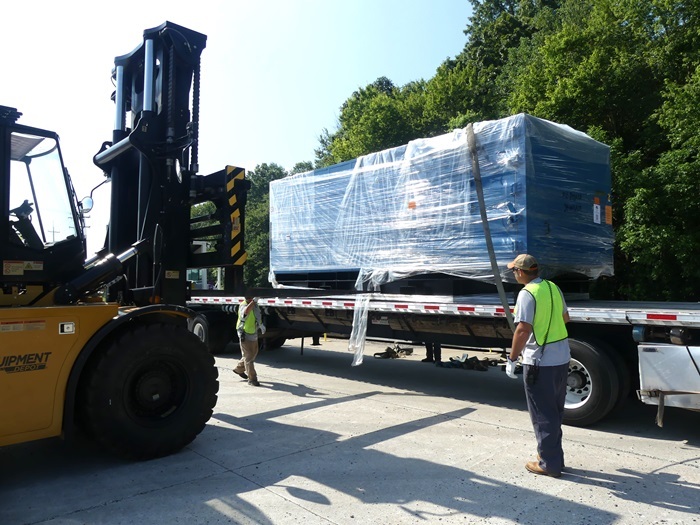 Technicians at the Paducah Depleted Uranium Hexafluoride Conversion Project facility prepare to install a newly fabricated cold box, part of a major system upgrade designed to eliminate vacuum pump failures and boost processing efficiency up to 15%.
LEXINGTON, Ky. — The Portsmouth Paducah Project Office (PPPO) is modernizing its depleted uranium hexafluoride (DUF6) conversion facilities by installing a new system designed to significantly enhance safety, improve efficiency and reduce operational pauses.
“This upgrade is a great example of how smart engineering can solve persistent challenges,” PPPO DUF6 Program Manager Zak Lafontaine said. “By replacing aging vacuum pumps with a more reliable and efficient system, we’re not only improving safety and performance, but we’re also reducing operational pauses and maintenance. It’s a practical, forward-looking solution that further reinforces the long term success of the DUF6 mission.”
Earlier this summer, PPPO met a U.S. Department of Energy (DOE) Office of Environmental Management priority for 2025 after successfully converting more than 1,000 cylinders of DUF6 into a safer, more stable oxide form.
The DUF6 material, a coproduct of decades of uranium enrichment for defense and commercial energy purposes, poses long term storage and environmental challenges in its original form. Through conversion to uranium oxide, the DUF6 team is helping mitigate those risks and advance DOE’s cleanup mission.
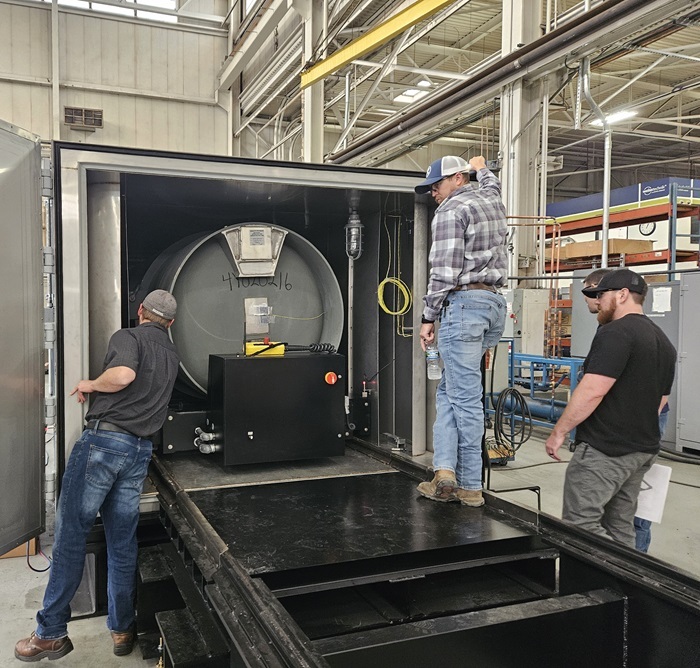 A cold box is shown being assembled at a facility in Cincinnati, Ohio. Once installed at the U.S. Department of Energy Office of Environmental Management’s Depleted Uranium Hexafluoride Conversion Project facilities, these units will enable gas-phase uranium hexafluoride transfers and reduce cylinder processing time by two to three hours.
Currently, the DUF6 conversion process relies on small vacuum pumps to remove residual uranium hexafluoride (UF6) from heated cylinders during the final stages of processing. These pumps have been prone to failure, resulting in repairs and operational pauses. The new system will eliminate the need for these pumps by performing this transfer process more reliably and efficiently using cold box chambers to freeze the residual UF6 in receiving UF6 cylinders under vacuum.
These improvements will deliver higher UF6 processing rates than is achievable in conventional designs. A key benefit of this upgrade includes increased throughput, as the new system is expected to reduce processing time by approximately two to three hours per cylinder — representing a 10 to 15% increase in throughput.
The new system also provides a means of transferring the entire volume of UF6 contents between cylinders in the gas phase, a capability not previously available at the DUF6 project. The addition of a cold box improves the conversion process by making it more efficient and reliable. It helps cool and recycle process gases, which saves energy, reduces emissions, and supports safe and sustainable operations at the plant. The number one priority is safety, and all upgrades completed at the facilities undergo a rigorous safety analysis to ensure they meet the highest standards of operational safety and regulatory compliance.
“This upgrade represents a major step forward in our commitment to safe, efficient and cost-effective management of legacy nuclear materials,” Mid-America Conversion Services (MCS) Program Manager Dutch Conrad said. “We’re proud to support this mission with innovative engineering solutions and a focus on continuous improvement.”
MCS is the contractor charged with managing the DUF6 facilities at EM’s Portsmouth and Paducah legacy nuclear sites.
The cold box installation is scheduled for completion by the end of this year at the Paducah facility, with Portsmouth following in the fall next year.
The DUF6 project draws from innovative methods and technologies to manage and convert DUF6 into usable materials, ensuring compliance with all safety and environmental regulations. PPPO conducts operations of the DUF6 conversion plants as required by Public Law 107-206.
-Contributor: Kearney Canter
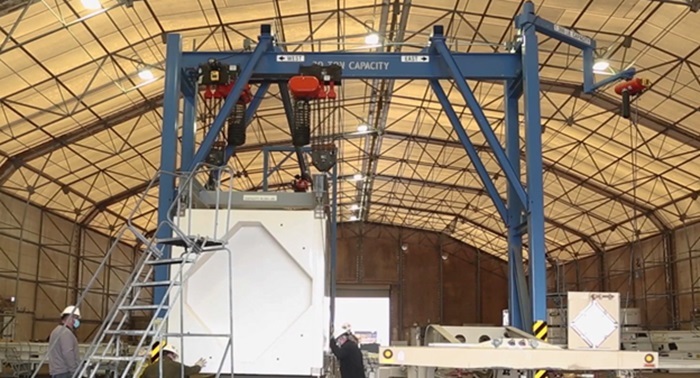 The Savannah River Site recently sent specialized loading equipment for TRUPACT-IIIs to the Idaho Cleanup Project for reuse.
AIKEN, S.C. — In spring of 2022, employees with a U.S. Department of Energy Office of Environmental Management (EM) team saw the final shipment of a specific type of container holding transuranic waste leave the Savannah River Site in a TRUPACT-III shipping package en route to the Waste Isolation Pilot Plant (WIPP) for permanent emplacement.
Now, the equipment used to load those containers, called Standard Large Box 2, into TRUPACT-III shipping packages is finding a new home at EM’s Idaho Cleanup Project (ICP) at the Idaho National Laboratory Site. TRUPACT stands for Transuranic Package Transporter.
This collaboration enabling beneficial reuse of equipment from one cleanup site to another shows how EM drives efficiency, focusing on priorities and reining in costs without sacrificing safety or effectiveness.
“This is a win-win for EM sites,” said Kerri Crawford, Solid Waste Programs manager with EM contractor Savannah River Nuclear Solutions (SRNS). “This transfer of equipment highlights how EM works to share resources and collaborate as an integrated organization. We are always looking for ways to be the best stewards we can with the resources we have.”
Crawford noted that most DOE sites use TRUPACT-IIs to ship their transuranic waste to WIPP.
“Until this point, SRS was the only site utilizing TRUPACT-IIIs, which are bigger than TRUPACT-IIs and allow for a larger transuranic waste container to be shipped,” she said.
EM and SRNS have made progress in transuranic waste shipments to WIPP and no longer need to use the bigger casks, Crawford said.
“So we offered the special loading equipment to other DOE sites for their use,” she said.
TRUPACT-IIIs weigh approximately 50,000 pounds and are used to ship radioactive boxes. In order to load and transfer the containers to a truck for shipment, specialized loading equipment needed to be created, both for lifting the boxes and to maintain shielding for the workers. The equipment SRS transferred to ICP included hoists, support beams, lifting fixtures and a control board.
“SRS completed a total of 239 shipments using this equipment since initial startup in 2011,” said Crawford.
ICP will benefit from the addition of the SRS equipment.
“As the largest volume shipper of transuranic waste to WIPP, this equipment, once it is placed into service, will give us an additional capability to remove waste from Idaho,” said Mark Henderson, Production Planning manager for Idaho Environmental Coalition, ICP’s cleanup contractor.
Transuranic waste typically consists of protective clothing, tools, rags, equipment and miscellaneous items contaminated with small amounts of plutonium and other heavy elements.
WIPP is the only geological repository in the country that safely and permanently disposes of the nation's defense-related transuranic waste. EM established the National TRU Program to oversee the process of preparing transuranic waste from DOE waste generator sites to meet WIPP requirements and provides guidance and requirements for receiving the waste at WIPP.
This process involves the characterization and packaging of the waste at the generator sites, followed by the transportation of the waste to the WIPP facility, which is 26 miles southeast of Carlsbad, New Mexico.
-Contributor: Lindsey MonBarren
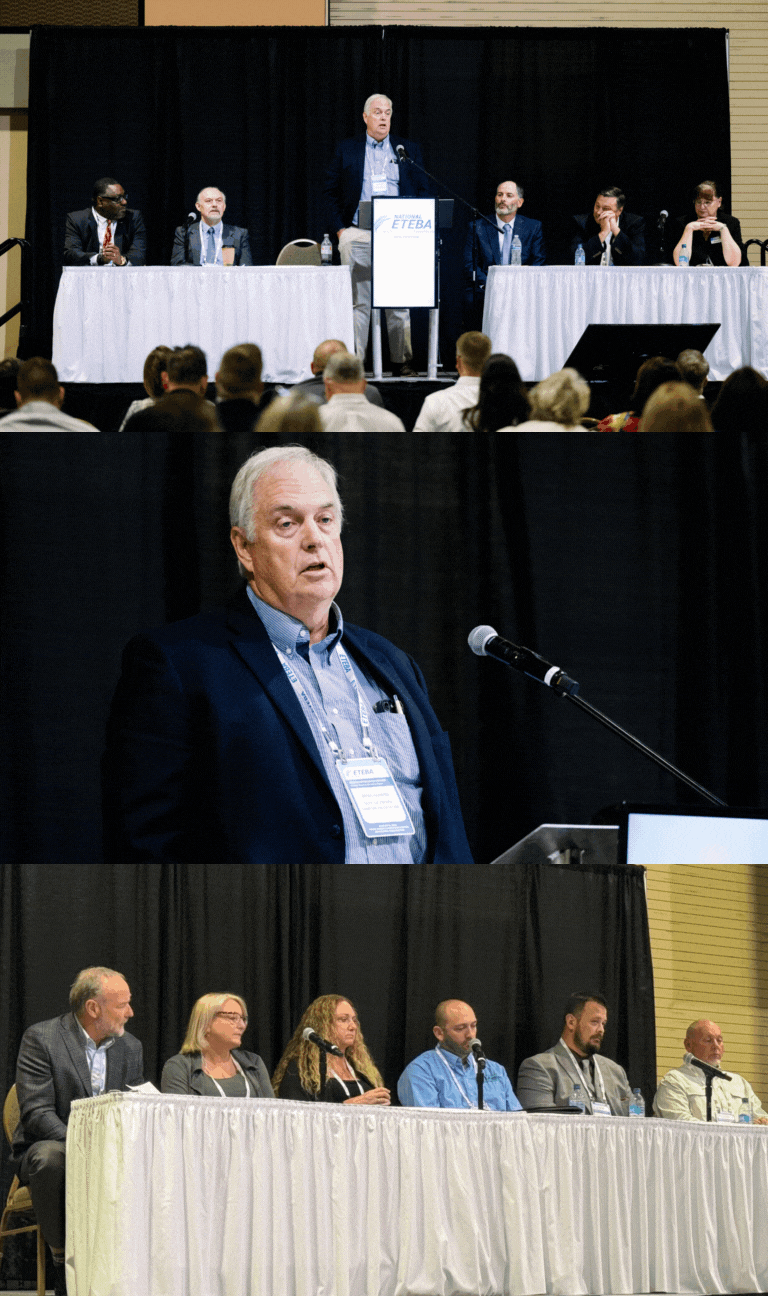
RICHLAND, Wash. — The Hanford Field Office and its prime contractors recently participated in a day-long forum highlighting the Hanford Site cleanup mission and federal business opportunities in the region.
More than 200 people attended the Hanford Business Opportunities Exchange hosted by the Energy Technology and Environmental Business Association (ETEBA). Hanford Field Office acting Manager Brian Harkins, pictured speaking in the above photo slideshow, provided an overview of the site’s cleanup mission during a panel discussion on Hanford Site priorities, while contractor leaders spoke about their contract scope, high profile activities, collaborative work and community impact.
ETEBA has hosted similar events near U.S. Department of Energy sites in New Mexico, South Carolina and Tennessee, but this was the first time the group showcased the Hanford Site exclusively.
-Contributor: Jill Harvill
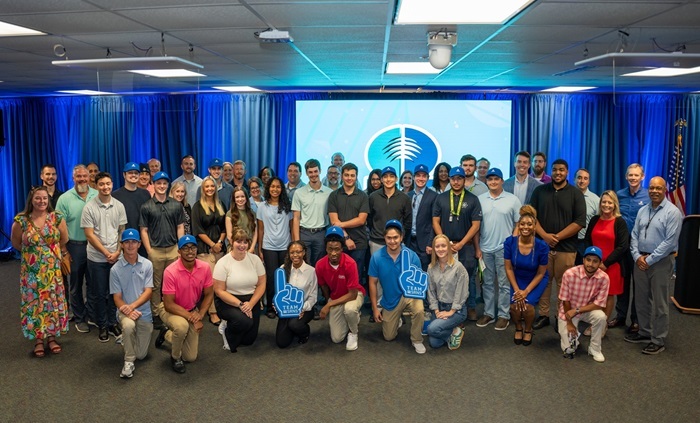 Students in the Savannah River Nuclear Solutions Internship Program signed full-time job offers during the contractor’s recent Signing Day event.
AIKEN, S.C. — Nearly 40 summer interns at the Savannah River Site (SRS) received job offers during an annual Signing Day event, helping shape the U.S. Department of Energy Office of Environmental Management (EM) workforce of the future that will continue progress addressing the legacy of the past.
Concluding the 12-week program, 38 interns signed on to full-time opportunities, and 25 others converted to apprenticeships with EM contractor Savannah River Nuclear Solutions (SRNS). They are part of the more than 2,000 new employees SRNS plans to hire in the next five years to support growing EM and National Nuclear Security Administration missions.
 |
|
Read a recent EM Update feature about intern Olivia Ruszczyk, a senior mechanical engineering student at New Mexico State University. She spent this summer inspecting steam systems in the Savannah River Site H Canyon, the only operating, production-scale, radiologically shielded chemical separations facility in the United States. |
The SRNS Internship Program provides opportunities for students from two-year technical colleges and four-year universities, up to the doctoral level, to gain hands-on learning experiences related to their fields of study. This year, SRNS selected 173 interns from nearly 4,500 applications.
“You’ve seen firsthand how SRNS’ missions are essential to our nation's safety and strength,” said Jim Dawkins, SRNS executive vice president and chief operations officer. “As you sign your offer today, remember that you’re now part of something bigger than yourself. Ask questions, show up early, and do what needs to be done to support the mission.”
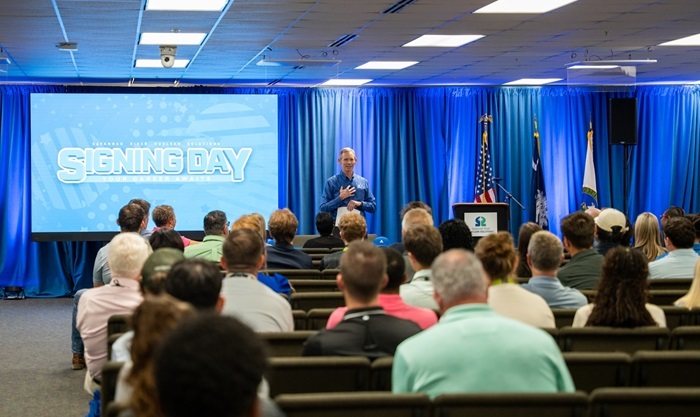 Jim Dawkins, Savannah River Nuclear Solutions executive vice president and chief operations officer, shares opening remarks during the Signing Day event.
Sean Alford, SRNS senior vice president and chief administrative officer, told the interns, “There’s a lot to be done at the Savannah River Site and we need great young minds like you to accomplish it."
He highlighted the work of Mia Thompson, a senior studying computer science at Augusta University in Georgia.
“One of my key responsibilities was to gather data from various departments and transform it into understandable formats and dashboards,” said Thompson, who developed a predictive analysis algorithm to combat attrition. “By collecting historical data on employees’ demographics when they left the company, we’re able to calibrate the model to understand factors that might influence this decision."
She added that she looks forward to graduating in December and returning to the site for her new role.
Bryan Ortner, senior vice president, SRNS Workforce Services and Talent Management, noted over 100 interns have signed job offers with SRNS in the past three years.
“From a hiring standpoint, we are closing major gaps and positively impacting our future workforce," he said.
Andrew Guerry from the University of South Carolina spent his summer with SRNS Contract Administration. He offered advice to future interns.
“Fully immerse yourself in the experience. Go to everything, contribute to your team and build connections with everyone. It sounds simple, but it’s not,” Guerry said. “It’s easy to say you don’t want to go to an event because you’re tired. Stay active and engaged and this unique experience will be the best one yet.”
-Contributor: Mackenzie McNabb
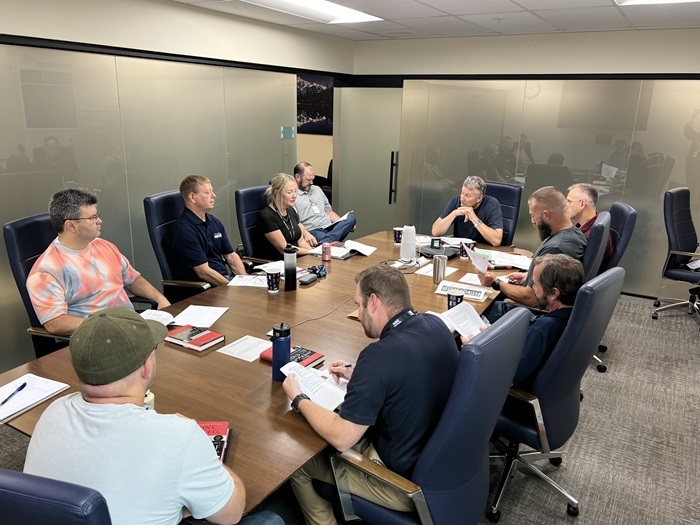 A group of Hanford Tank Waste Operations & Closure middle managers and supervisors meet during off-work hours with company chief operating officer Phil Breidenbach, top center, to discuss leadership skills, set professional goals and share feedback on professional challenges.
RICHLAND, Wash. – A new mentoring initiative at the Hanford Site is paving the way for future leaders to strengthen communication, build teamwork and prepare the workforce to carry out the U. S. Department of Energy Office of Environmental Management Hanford Field Office’s (HFO) long term cleanup mission.
HFO contractor Hanford Tank Waste Operations & Closure (H2C) launched the program, called Mentoring Circles, this summer. The monthly listening sessions, held outside of work hours, are based on reading assignments from a popular leadership book and focus on applying lessons to work at Hanford.
“We’re in the business of eliminating environmental hazards, but we’re a company of humans, and we need to focus on developing the people who are doing this important work,” said Phil Breidenbach, H2C chief operating officer. “Building leadership capacity now ensures that we can safely and efficiently complete the Hanford cleanup mission in the future.”
 |
|
Hanford Field Office Contracting Officer Nadine Johnson shares with fellow Mentoring Circle members the ways she discovered she can improve her communication skills. |
Senior H2C leaders guide the small group discussion to help middle managers and supervisors build their skills, along with three HFO employees who joined the program. Participants say learning from senior leaders and peers is having a positive impact on the way they lead.
“I considered myself a good communicator, but I’m identifying ways I can improve by being more intentional with my time to prepare for meetings and presentations,” said Nadine Johnson, HFO contracting officer.
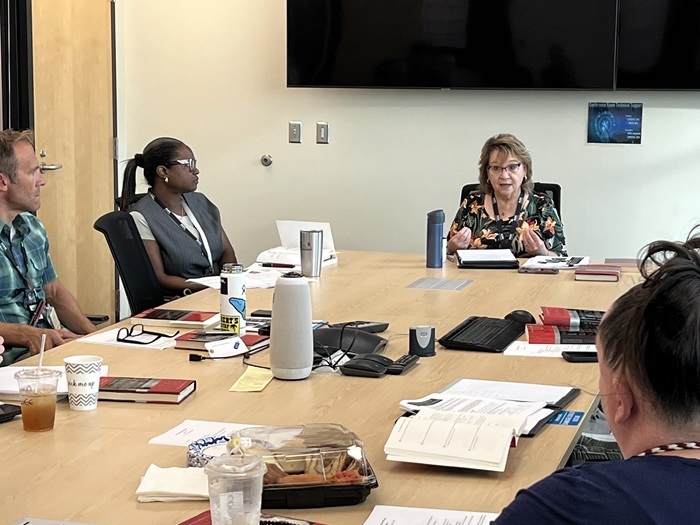 Laurie Hollick, Hanford Tank Waste Operations & Closure chief of staff, meets monthly with a group of middle managers and supervisors as part of the Mentoring Circles pilot program for the prime contractor at the Hanford Site.
“H2C’s Mentoring Circle is different than other mentorship programs I’ve been involved in,” said Mel Miller, H2C Core Procedures project manager. “The dynamic of the group is amazing, and it provides professional growth benefits for anyone, not just those who want to be a manager.”
The pilot program will run for one year, with additional Mentoring Circles expected to follow.
|