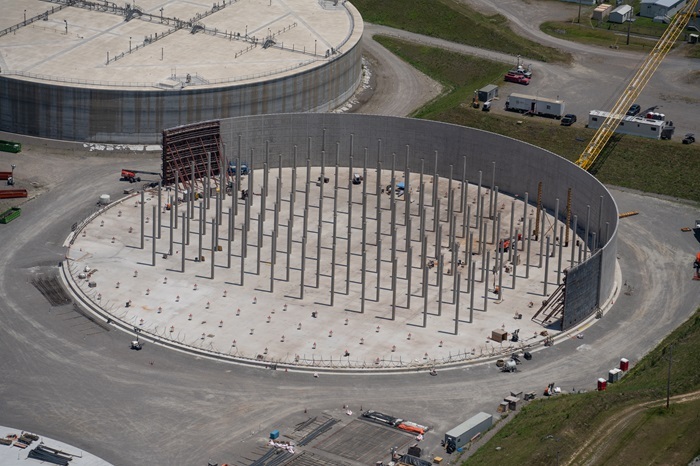
 A view of the Savannah River Site's Saltstone Disposal Unit 11 under construction this past July, with 10 of 25 wall sections, 117 of 208 columns and 14 of 14 floor sections complete. The U.S. Department of Energy awarded the Saltstone Disposal Unit 10, 11 and 12 Project Team the Project Controls Excellence Award, new to the Project Management Awards Program this year.
EM celebrates the "very best" in project management across its complex endeavors, honoring professionals critical to cleanup success
WASHINGTON, D.C. — The U.S. Department of Energy (DOE) has recognized its environmental cleanup program for superior performance and exemplary service in project management, with three awards going to the Savannah River Site (SRS) liquid waste mission and a fourth to a Portsmouth Site demolition project — the most honors the cleanup program has received in one year from the annual awards program.
“This year, we are particularly proud to highlight the exceptional performance of DOE's Office of Environmental Management (EM). Importantly, the two most prestigious awards — Federal Project Director of the Year and Project Management Excellence Award — were both a testament to their remarkable contributions,” EM Principal Deputy Assistant Secretary Roger Jarrell said in a recent ceremony. “You’ve exceeded expectations and set new benchmarks. Your complex work is vital to EM, the Department and to the nation. Congratulations and thank you.”
These achievements in project management drive EM efforts to address the legacy of the past and transform liabilities into opportunities while contributing to a golden era of American energy dominance, strong national security and DOE efforts to lead the world in innovation.
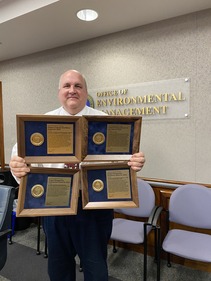
U.S. Department of Energy Office of Environmental Management (EM) Office of Project Management Director Rodney Lehman displays the four Project Management Awards that went to EM team members at the Savannah River and Portsmouth sites this year. Each year, the Department recognizes projects that have demonstrated excellence in the project management discipline. |
|
 |
 |
|
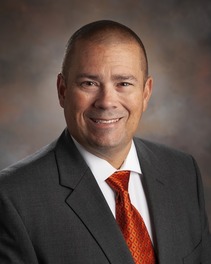
The U.S. Department of Energy's Federal Project Director of the Year Award went to Charles Comeau at the Savannah River Site. |
Federal Project Director of the Year Award
For the second year in a row, EM captured the Federal Project Director of the Year Award. Charles Comeau at SRS was the recipient, exemplifying superior project management and achieving outstanding results.
“I am very humbled to receive this award,” Comeau said. “While this is an individual award, I appreciate that I would not be receiving the award if not for the hard work and dedication of my federal and contractor team.”
Comeau led the Saltstone Disposal Unit 8 and 9 project to completion seven months ahead of schedule and over $60 million under budget, and provided critical leadership to the Saltstone Disposal Units 10, 11 and 12. The mega-size units are integral to EM's ability to safely dispose of legacy liquid waste at SRS. He also supported underground ventilation system and utility shaft projects at the Waste Isolation Pilot Plant, showcasing exceptional leadership and commitment to EM’s mission.
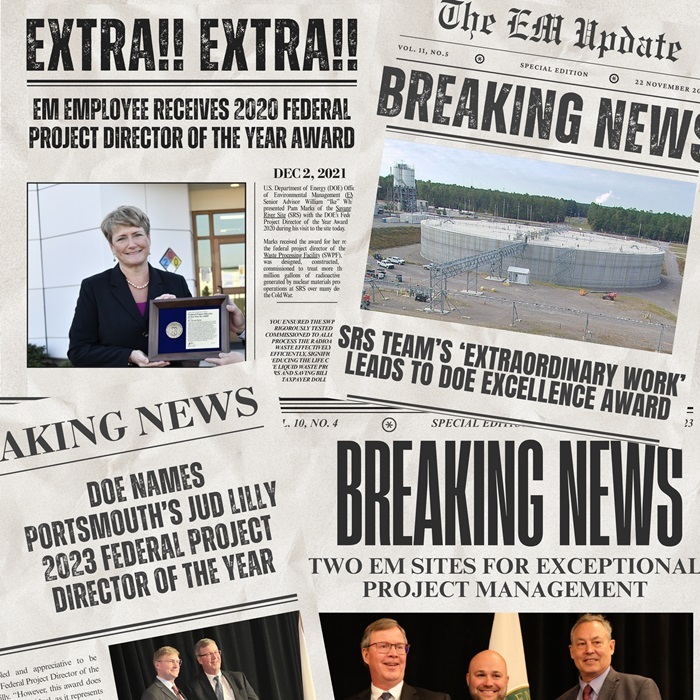 EM Retrospect: A look back at some of the U.S. Department of Energy Office of Environmental Management's past Project Management Awards.
Project Controls Excellence Award
New to the awards program is the Project Controls Excellence Award, celebrating a team's excellence in integrated project management.
The award went to the Saltstone Disposal Unit 10, 11 and 12 Project Team at SRS. The team managing the $496 million projects demonstrates superior project controls, rigorous data integrity and continuous improvement in practices, according to DOE.
EM and its liquid waste contractor at SRS, Savannah River Mission Completion, excelled in their use of project controls to manage and report credible, reliable monthly project information to drive leadership decisions.
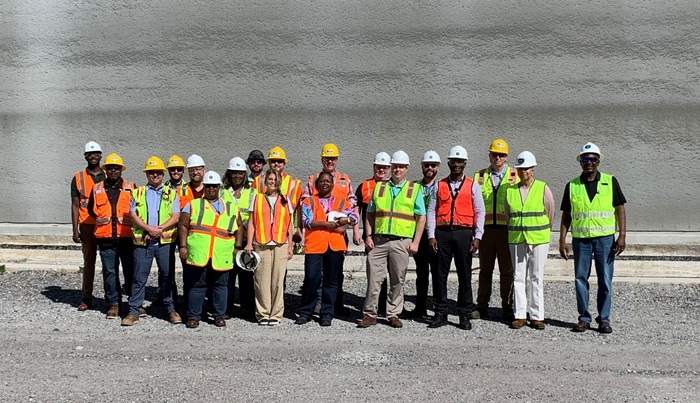 U.S. Department of Energy-Savannah River and Savannah River Mission Completion team members gather in front of Saltstone Disposal Unit 10, the fifth mega-size unit built at Savannah River Site.
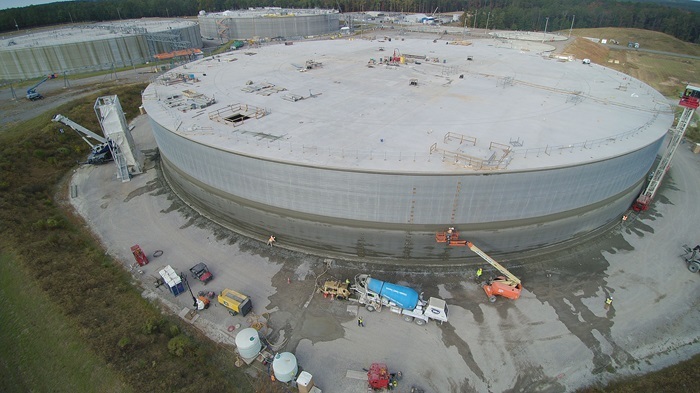 Workers operate a stress cable wrapping machine on Saltstone Disposal Unit 9 in October 2022. The facility is wrapped with seven layers of cable totaling 341 miles.
Project Management Achievement Award
Recognizing a team for significant results in completing a project within cost and schedule, the Project Management Achievement Award went to the Saltstone Disposal Unit 8 and 9 Project Team at SRS.
“This $280 million project was delivered an impressive $60 million under budget and seven months ahead of schedule, successfully commissioning two mega-volume disposal units,” said Rodney Lehman, director of EM’s Office of Project Management, who led the ceremony.
The Saltstone Disposal Unit projects provide landfill capacity for low-activity treated waste grout, supporting SRS site closure goals. Each unit can store up to 32 million gallons of the low-level radioactive grout waste generated by nuclear materials production operations at SRS over many decades of the Cold War.
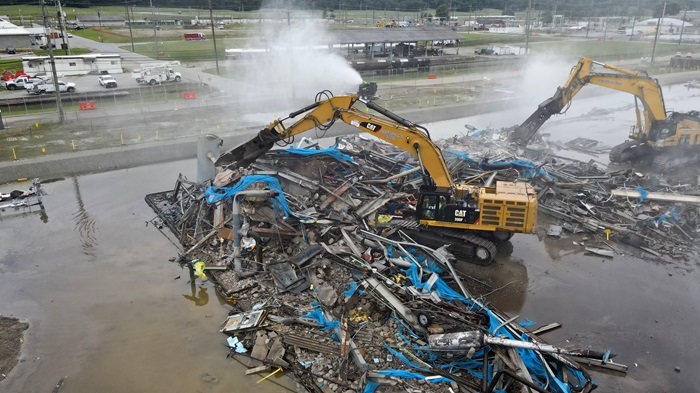 Portsmouth Site crews work to complete structural demolition of the X-326 Process Building in 2022. Water used for dust suppression is captured in a detention berm during demolition and downsizing of debris.
Project Management Excellence Award
DOE bestowed its Project Management Excellence Award on the X-326 Process Building Demolition Project at the Portsmouth Site for achieving extraordinary results on a vital EM project.
“This $160 million environmental cleanup project completed an impressive $28.5 million under budget and 16 months ahead of schedule, setting a high benchmark for project execution,” Lehman said.
Before closing the ceremony, he thanked the EM winners for their hard work and dedication, and said the cleanup program looks forward to their continued success.
"To all our awardees today, thank you for your contributions. They’re invaluable," Lehman said. "Your commitment to excellence, innovation and effective project management drives our agency forward, ensuring the successful delivery of critical initiatives."
-Contributor: David Sheeley
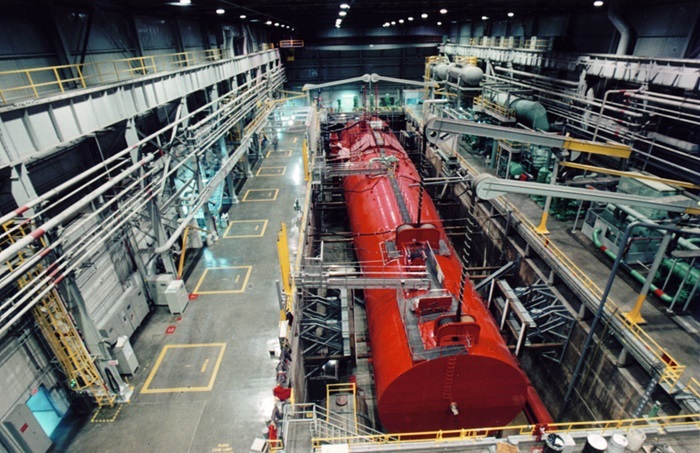 Federal and state agencies have agreed to the final end state for the Submarine 5th Generation General Electric Prototype Facility, which is to remove the prototype, including the defueled reactor vessel and associated equipment.
IDAHO FALLS, Idaho — The Idaho Cleanup Project (ICP) is moving forward with plans to demolish a third defueled naval reactor prototype vessel at the Idaho National Laboratory (INL) Site’s Naval Reactors Facility (NRF).
The U.S. Department of Energy Office of Environmental Management (EM), Office of Naval Reactors Idaho Branch Office, U.S. Environmental Protection Agency and Idaho Department of Environmental Quality have signed an action memorandum to outline the end-state plan for decommissioning and demolishing (D&D) the Submarine 5th Generation General Electric (S5G) Prototype Facility.
Together, those four parties considered four alternatives, including no action, continued monitoring, targeted removal of radiological or other hazardous substances, and complete removal of the S5G prototype.
After considering public comments, and input from the Shoshone-Bannock Tribes and the ICP Citizens Advisory Board, EM opted for complete prototype removal, which includes removal of the defueled reactor vessel and associated equipment. The other parties concurred with the decision.
ICP and contractor Idaho Environmental Coalition (IEC) are currently managing the D&D of two other legacy naval reactor prototype vessels at NRF: the Submarine 1st Generation Westinghouse (S1W) and the Aircraft Carrier 1st Generation Westinghouse (A1W).
Nick Balsmeier, acting ICP manager, recognizes the importance of this project and the workforce tasked with completing it.
“The Idaho Cleanup Project is able to begin work at the S5G because of our contractor and the highly skilled and experienced workforce they employ,” said Balsmeier. “I am thrilled by progress already made to date and look forward to seeing that progress continue.”
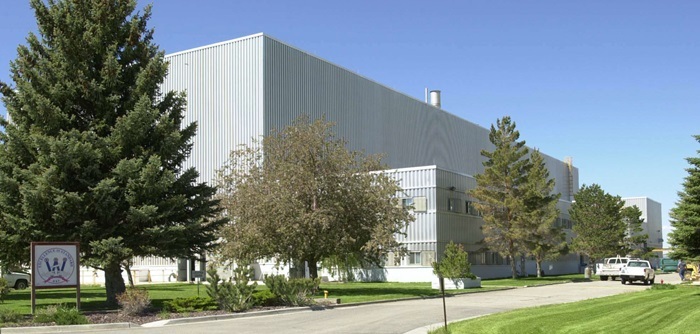 The Submarine 5th Generation General Electric is located at the Naval Reactors Facility on the Idaho National Laboratory Site. It operated for 30 years between 1965 and 1995 as a critical training and research facility for the Naval Nuclear Propulsion Program.
Unlike plans at the S1W and A1W D&D projects, which call for complete demolition of the prototypes and their associated buildings, the final end state of the S5G will allow for continued use of the prototype building. As outlined by the chosen alternative, crews will remove hazardous materials and the S5G prototype before backfilling and closing the basin, wherein the S5G is located. This approach enables use of the building to support future work.
“We are excited by this development,” said Dan Coyne, IEC president and program manager. “I am confident in our workforce and their ability to safely demolish these legacy prototype vessels at the Naval Reactors Facility.”
The S5G operated for nearly 30 years from 1965 to 1995. It was used by the Naval Nuclear Propulsion Program for U.S. Navy personnel training and research and development. The S5G is defueled and remains in an inactive state. Nearly 40,000 Navy personnel trained at the three NRF propulsion prototypes to be nuclear operators between 1953 and 1995.
D&D of the S5G will be conducted in accordance with Comprehensive Environmental Response, Compensation, and Liability Act requirements. Successful removal of the prototype is expected to eliminate the cost of long term maintenance and remove the risk that leaving the defueled prototype in place might present to the workforce, public and the environment.
-Contributor: Carter Harrison
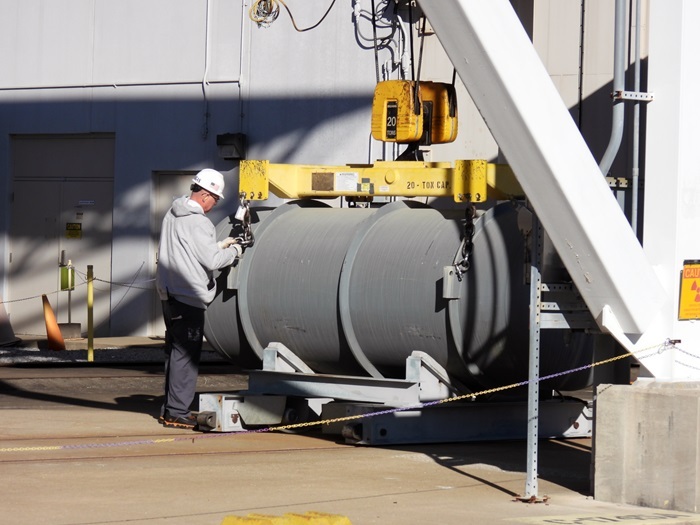 Technicians at the Paducah Depleted Uranium Hexafluoride Conversion Facility monitor operations as the 1,000th cylinder of depleted uranium hexafluoride is safely processed into a stable oxide form, marking a major 2025 priority for the U.S. Department of Energy Office of Environmental Management.
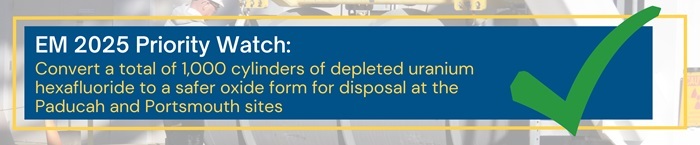
LEXINGTON, Ky. — The Portsmouth Paducah Project Office recently met a U.S. Department of Energy (DOE) Office of Environmental Management priority for 2025 after successfully converting more than 1,000 cylinders of depleted uranium hexafluoride (DUF6) into a safer, more stable oxide form.
The DUF6 team reached the milestone through coordinated operations at the Paducah, Kentucky, and Portsmouth, Ohio, legacy nuclear sites, which are central to the nation’s uranium enrichment history.
 The DUF6 material, a coproduct of decades of uranium enrichment for defense and commercial energy purposes, poses long term storage and environmental challenges in its original form. Through conversion to uranium oxide, the DUF6 team is helping mitigate those risks and advance DOE’s cleanup mission.
“Reaching this milestone demonstrates the team’s excellence in efficient operation of the DUF6 plants,” DUF6 Program Manager Zak Lafontaine said. “The team's consistent operation of the facilities, coupled with a stellar safety record, are essential to our continued success.”
The conversion process involves chemically transforming DUF6 into uranium oxide powder, which is significantly less reactive and safer to manage for reuse or disposal. The oxide is then packaged in robust containers and shipped to a licensed disposal facility.
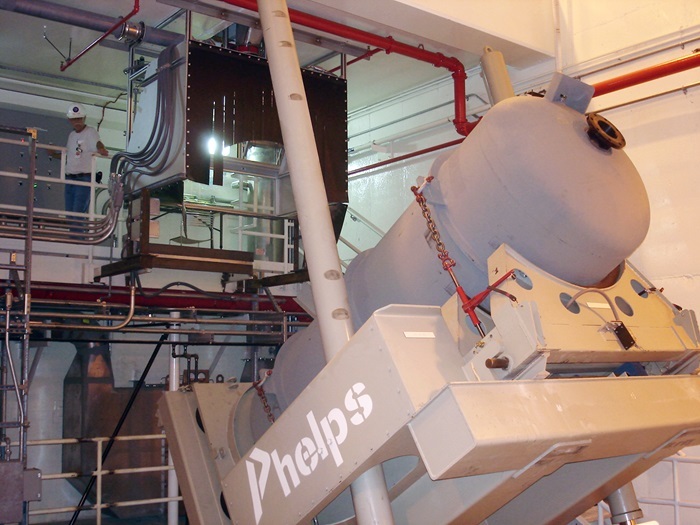 At the Paducah Depleted Uranium Hexafluoride (DUF6) Conversion Facility, a cylinder is positioned to collect uranium oxide powder from the storage hopper. This process is part of converting DUF6 into a more stable uranium oxide for safe long term storage and management.
“This is more than just a number. It’s a reflection of our team’s dedication to safety, precision and environmental responsibility,” Mid-America Conversion Services (MCS) Project Manager Dutch Conrad said. “Every cylinder we convert brings us one step closer to a safer future for the communities around Paducah and Portsmouth, and for the nation as a whole.”
MCS is the contractor for the DUF6 project.
The DUF6 project draws from innovative methods and technologies to manage and convert DUF6 into usable materials, ensuring compliance with all safety and environmental regulations. The Portsmouth Paducah Project Office conducts operations of the DUF6 conversion plants as required by Public Law 107-206.
-Contributor: Kearney Canter
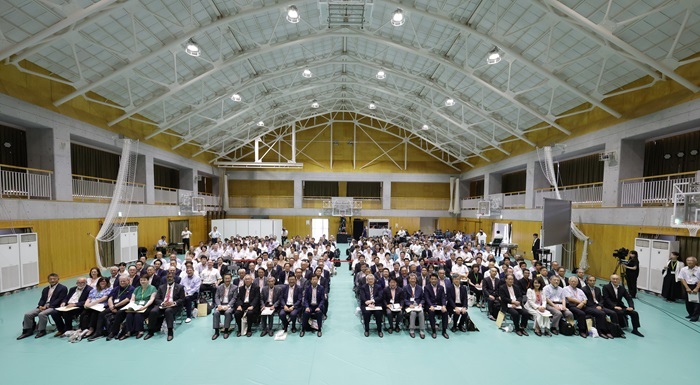 The 9th International Forum on the Decommissioning of the Fukushima Daiichi Nuclear Power Station attendees, community members and members of the media.
JAPAN — A member of the U.S Department of Energy Office of Environmental Management (EM) leadership team recently attended the 9th International Forum on the Decommissioning of the Fukushima Daiichi Nuclear Power Station hosted by Japan’s Nuclear Damage Compensation and Decommissioning Facilitation Corporation.
The two-day event fosters global collaboration, allowing experts from around the world to share insights on nuclear cleanup while learning about progress of the Fukushima Daiichi cleanup.
“This event brings together such a tremendous wealth of knowledge, expertise and experience from nuclear leaders across the globe,” said Greg Sosson, EM associate principal deputy assistant secretary for field operations. “The Office of Environmental Management values the ongoing collaboration between the U.S. and Japan to solve challenges and share progress in cleanup missions.”
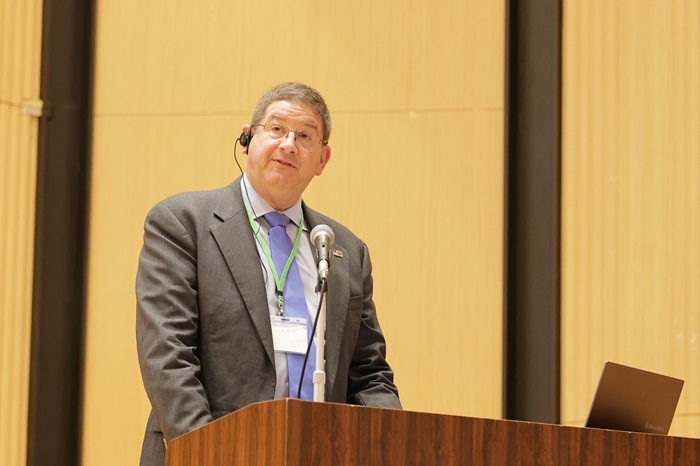 Greg Sosson, U.S. Department of Energy Office of Environmental Management (EM) associate principal deputy assistant secretary for field operations, provides remarks at the 9th International Forum on the Decommissioning of the Fukushima Daiichi Nuclear Power Station. He highlighted the challenges EM has overcome over the years to achieve mission success and the value of continued collaboration with the U.S.
The first day of the forum took place in Katsurao Village. Sosson participated in a panel discussion with leaders from Japan, the local community, countries around the world and industry. The panelists shared information and focused discussion on decommissioning efforts at Fukushima Daiichi and ongoing efforts and impacts on the health and economy of the local community.
Katsurao was one of the villages evacuated during the Fukushima Daiichi nuclear accident. To date, only about 35% of the Katsurao population has returned to their homes in the village.
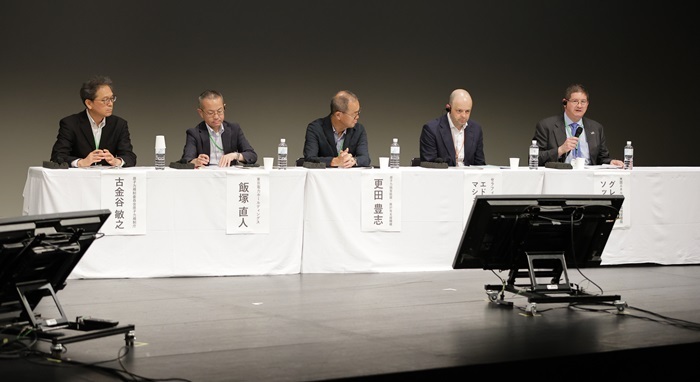 Greg Sosson, at far right, U.S. Department of Energy Office of Environmental Management associate principal deputy assistant secretary for field operations, participates in a panel at the 9th International Forum on the Decommissioning of the Fukushima Daiichi Nuclear Power Station. The panel focused on methodology and nuclear and radiological safety during fuel debris retrieval at Fukushima Daiichi.
On the forum’s second day, in Iwaki, technical experts discussed ongoing progress, current status and future challenges of nuclear sites, as well as regulatory and project management challenges for the Fukushima Daiichi decommissioning effort.
In addition to providing remarks at the forum, Sosson took part in a panel discussion focused on methodology and nuclear and radiological safety during fuel debris retrieval activities at Fukushima Daiichi. He spoke about the importance of ongoing stakeholder engagement and collaboration, and the need to make timely risk-informed decisions to address the significant challenges ahead to continue progress in large-scale fuel debris removal.
Sosson also discussed the challenges EM has overcome over the years to achieve mission success and the value of continued collaboration with the U.S.
-Contributor: John Howard
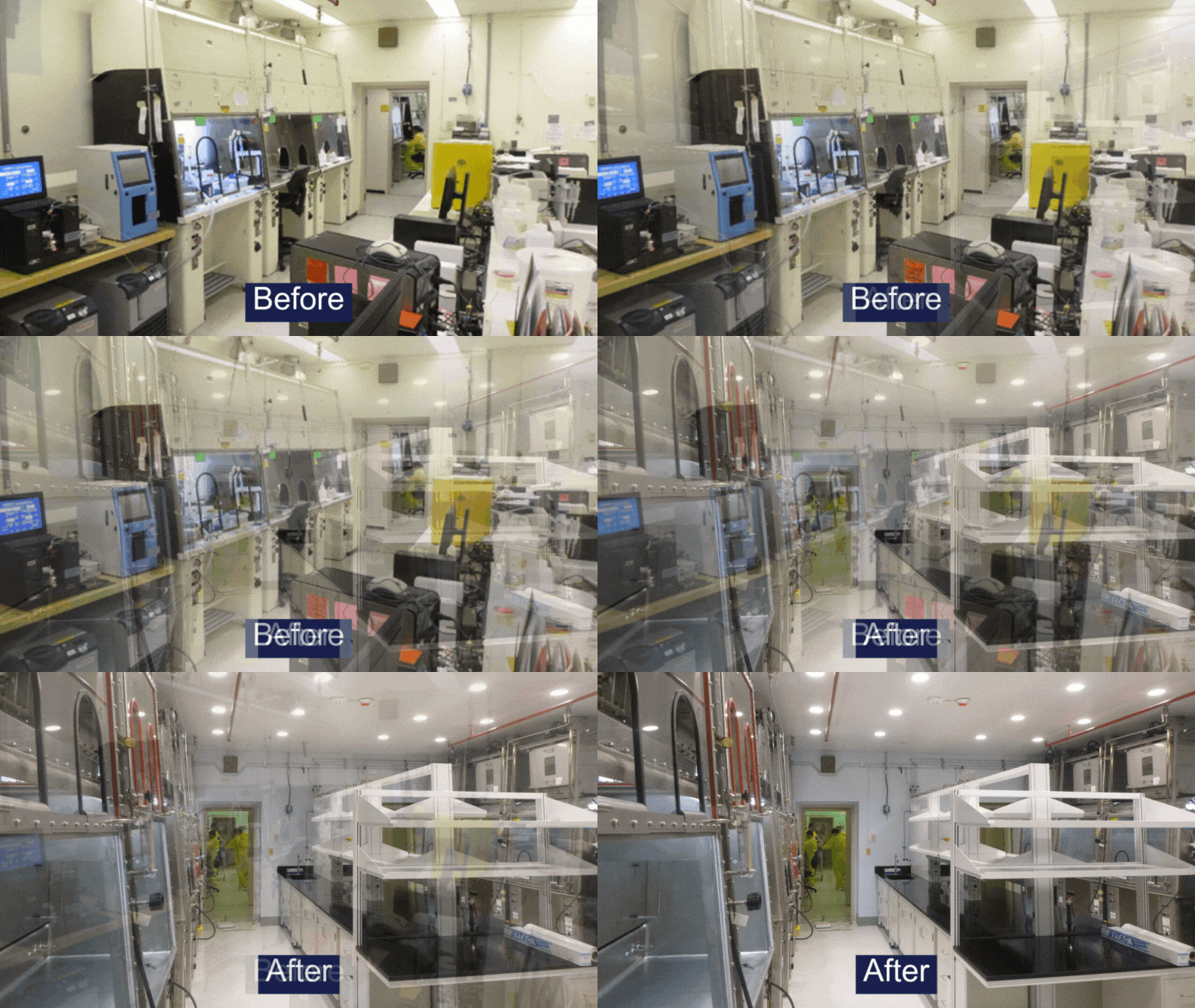 The 222-S Laboratory at the Hanford Site operated with equipment and infrastructure dating back to the 1950s, before recent upgrades necessary for modern cleanup needs. Renovations transformed the laboratory into a state-of-the-art facility with updated instruments, improved ventilation and lighting, and work areas designed to analyze waste.
Updates to meet modern demands, support a sustainable future
RICHLAND, Wash. — The U.S. Department of Energy Office of Environmental Management (EM) Hanford Field Office (HFO) is modernizing the 222-S Laboratory at the Hanford Site to enhance its capability, capacity and reliability for future cleanup work.
The 70,000-square-foot facility, operated by HFO contractor Navarro-ATL, provides essential analytical services. Lab workers analyze a variety of samples, including air, liquid, soil, tank sludge, and biological materials, to aid safe cleanup decisions.
Built in 1951, Hanford’s lab required updates to meet modern demands. The multiyear modernization program includes upgrading lab equipment, improving infrastructure and renovating workspaces to improve efficiency and safety.
“The 222-S Laboratory is one of the few facilities in the nation capable of highly radioactive tank waste analysis,” said Jeff Cheadle, 222-S program manager with HFO. “These upgrades allow us to deliver valuable chemical and radiological data that support innovation and long term cleanup.”
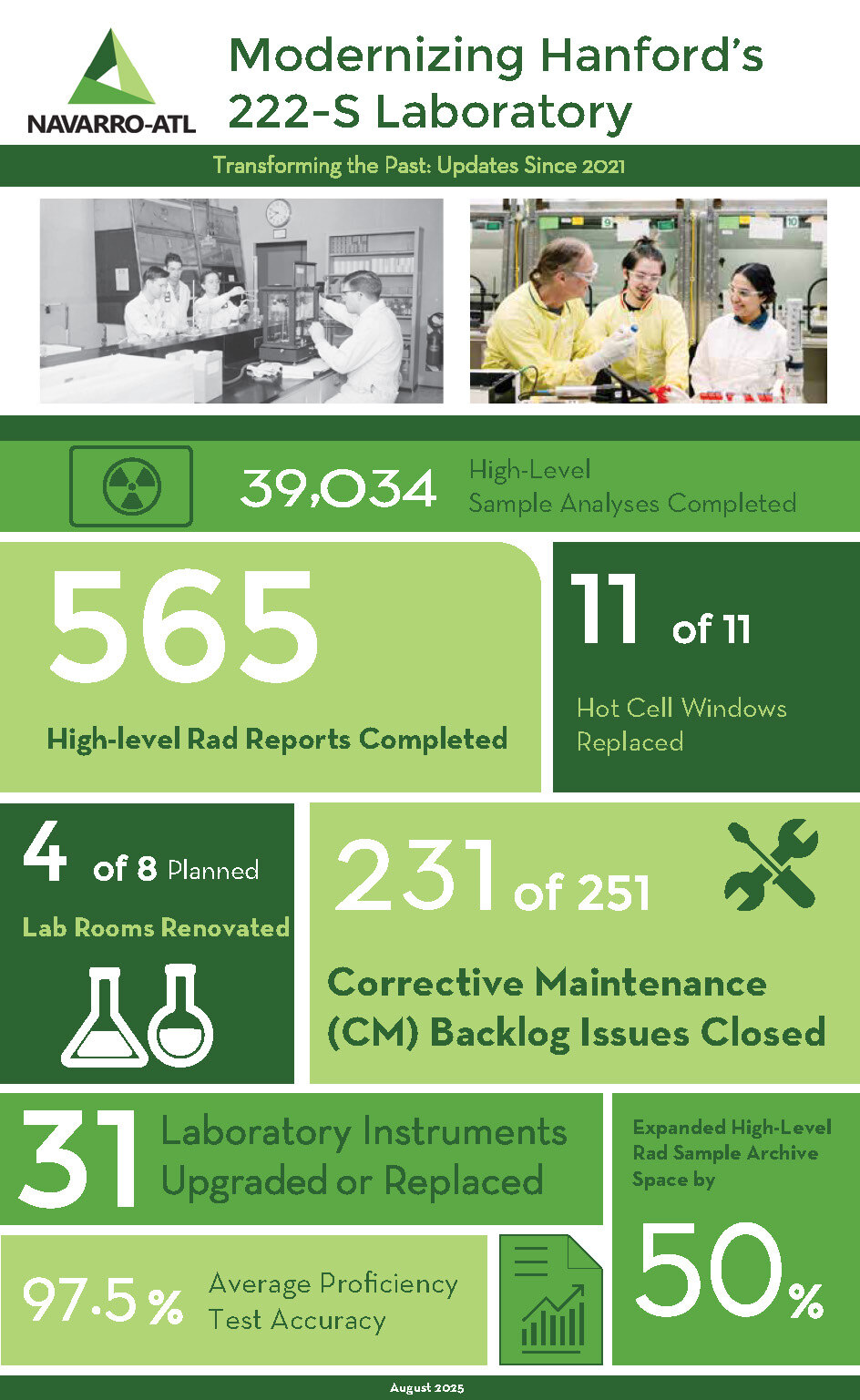 222-S Laboratory by the Numbers: This snapshot highlights key upgrades and maintenance completed to modernize the facility.
Recent improvements include renovating four workspaces from top to bottom, replacing equipment and instruments, installing new electrical and ventilation systems, and adding specialized lighting for high-precision work. Crews also replaced aging hot cell windows, which are thick shielded glass workers use to safely examine radioactive samples. The new windows are expected to last approximately 20 years.
“Replacing hot cell windows and related equipment has significantly improved safety and ergonomics for workers," said Ray Geimer, general manager of Navarro-ATL. “Future improvements will further enhance our ability to deliver highly radioactive analyses efficiently, timely and safely.”
Last year, the facility completed about 8,000 analytical measurements. That number is expected to grow as the lab supports the startup of Hanford’s Waste Treatment and Immobilization Plant, where liquid waste will be immobilized in glass for safe storage. To prepare, lab chemists introduced the Stir Bar method, which is safer, more efficient, and cuts analysis time from days to hours, resulting in cost savings.
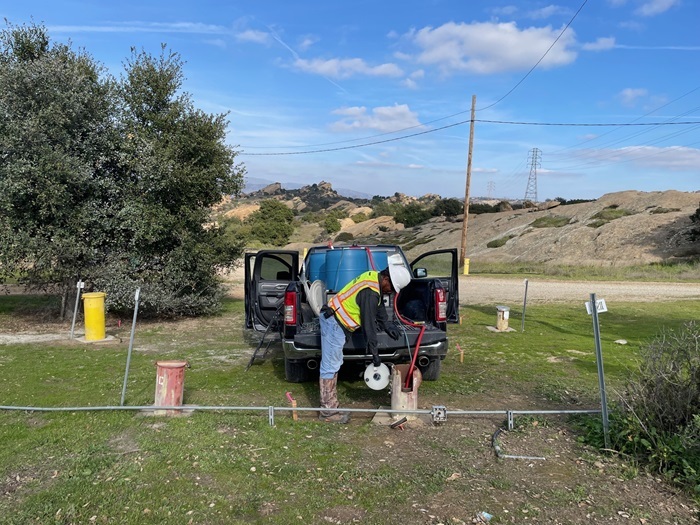 A U.S. Department of Energy Office of Environmental Management contractor measures water levels at one of the wells onsite at the Energy Technology Engineering Center. Photo by Pamela Hartman
SIMI VALLEY, Calif. — Approval for an innovative groundwater pilot study, completion of ongoing soil sampling and submission of demolition work plans to state regulators are all part of the recent progress toward cleanup at the U.S. Department of Energy’s (DOE) Energy Technology Engineering Center (ETEC) at the Santa Susana Field Laboratory (SSFL).
SSFL is a 2,850-acre former rocket engine and nuclear research facility comprised of four operational areas. DOE’s Office of Environmental Management (EM) is charged with remediation in Area IV, where ETEC previously operated.
In July, the California State Water Resources Control Board approved a permit for a pilot study at ETEC’s Hazardous Materials Storage Area.
The in-situ, or in-place, study is an innovative remediation approach that uses biological and chemical reduction to treat contaminated groundwater, said Josh Mengers, EM’s federal project director for ETEC.
The pilot will be a small-scale study that involves injecting biological and chemical amendments into separate wells to create a reductive environment and stimulate natural degradation of the contaminants present. EM will then monitor the progress over time.
“We’re conducting this pilot on a small scale because we want to understand the sphere of influence these amendments will have on the contaminants,” Mengers said, adding that using two types of amendments will hopefully create a more robust treatment with two degradation mechanisms happening.
“We’re not proposing that this is going to be the solution, but we’re testing it out to see how well it works,” he said.
The pilot study is just one groundwater interim measure EM has been conducting at ETEC.
Pumping groundwater manually has taken place at the Former Sodium Disposal Facility since 2017, and in May 2024, an automated pump system became operational. To date, more than 67,000 gallons of contaminated groundwater have been removed both manually and automatically.
 |
|
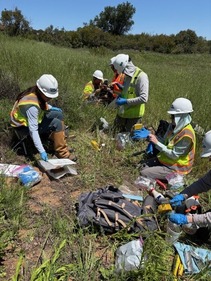
U.S. Department of Energy Office of Environmental Management geologists perform characterization for total petroleum hydrocarbons soil samples taken at China Flats in 2024. Photo by Pamela Hartman |
In addition to continued interim groundwater measures, crews have completed several soil sampling events at ETEC.
Over the past year, EM conducted several soil sampling events to collect data on laboratory method reporting limits (MRL) and backfill sources, and to fill gaps in background data.
The MRL study aimed to understand the contaminant concentrations an instrument can reliably detect and report. Backfill sampling tests potential sources for material to replace any soil that may be removed during cleanup, ensuring EM can complete remediation without causing environmental harm.
EM also sampled additional background data to fill data gaps for specific groups of chemicals, including total petroleum hydrocarbons (TPH). These studies are essential for achieving a feasible cleanup that is safe for the community.
“Sampling is the only way to understand the type of contamination we’re dealing with, how much there is and where it is,” said Pamela Hartman, EM’s deputy federal project director for ETEC. “Without sampling, we don’t have the information we need to clean up the site.”
Crews collected over 5,800 samples for the initial characterization of DOE’s portion of SSFL, Hartman said. During the last year, samples were taken at 30 locations for the TPH study and at six locations for the MRL study.
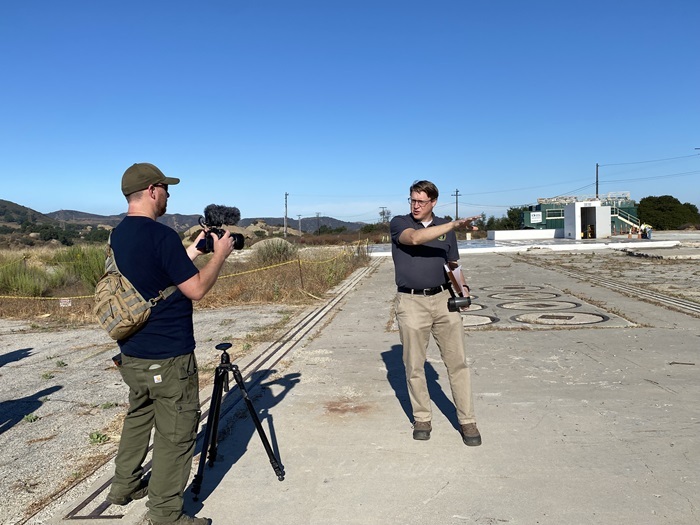 Andrew Walker, left, interviews U.S. Department of Energy Office of Environmental Management Federal Project Director Josh Mengers about the System for Nuclear Auxiliary Power program at Santa Susana Field Laboratory on July 28. Photo by Karen Edson
Another recent achievement was ETEC’s submission of work plans for the Building 4024 basement demolition to the California Department of Toxic Substances Control for review and approval, setting the stage for the next accomplishment as EM works with state regulators to gain their approval and continue progress at SSFL.
The basement is the last remnant of the rich legacy of research and development of nuclear reactors as part of the System for Nuclear Auxiliary Power program. It was this legacy that brought social media influencer Andrew Walker to ETEC for the second time since October 2024 to film footage for his social media channel.
-Contributor: Melissa Simon
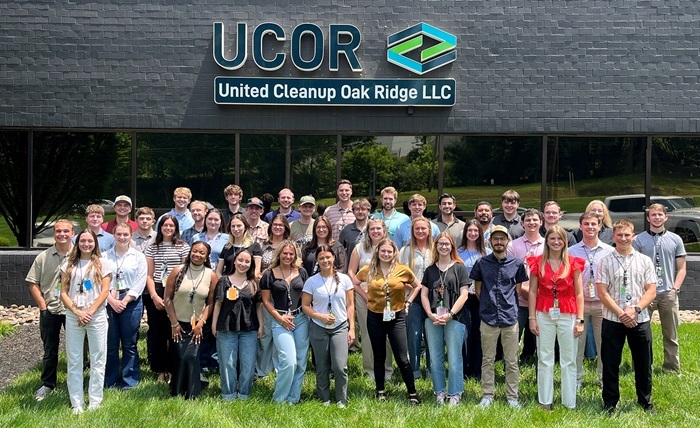 UCOR’s summer intern program has grown significantly over the past three years. This year, 41 students from 10 different schools took part — an increase of more than 40% since 2022.
OAK RIDGE, Tenn. — A new generation of workers have gotten career experience and mentorship from Oak Ridge Office of Environmental Management (OREM) contractor UCOR this summer.
More than 40 students from 10 schools completed summer internships in 2025, learning numerous aspects of the company’s project and business operations.
Supporting OREM’s mission involves clearing away Manhattan Project and Cold War-era infrastructure and legacies, creating more economic opportunities for the community and providing land to support important research and national security missions for the U.S. Department of Energy.
To accomplish this challenging and complex work, UCOR looks to its intern program to help develop the next generation into its workforce. The program continues to grow, increasing the number of participants by more than 40% since 2022.
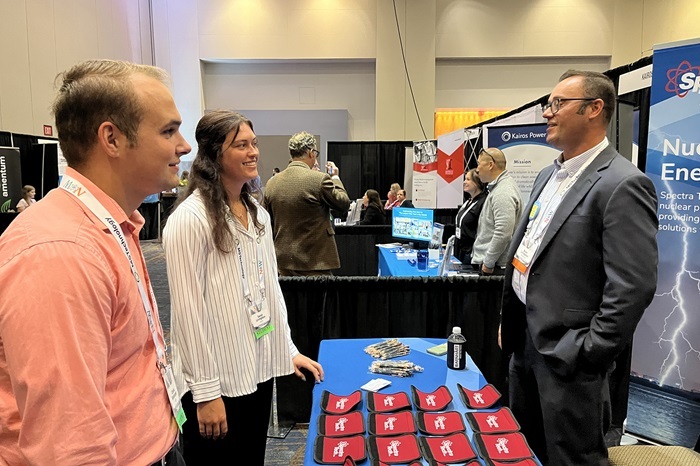 Interns Charles Shamburger and Sarah Livingston, at left, took part in the East Tennessee Economic Council's Nuclear Opportunities Workshop.
Professions that students can pursue have grown, too. This year, UCOR offered opportunities in engineering, data analytics, nuclear safety and criticality, environmental services and characterization, waste programs, business and financial management, and public affairs.
Data analytics has become one of the fastest growing areas. UCOR began offering data analytic internships in 2024, with two individuals supporting the effort. This year, four interns took part.
“Studying data helps find patterns and insights that can help guide better decisions,” said Ryan Lee, data analytics intern. “I chose the data analytics internship at UCOR because I wanted to apply what I’ve learned in school to real world projects. Now, my interest in data has only grown.”
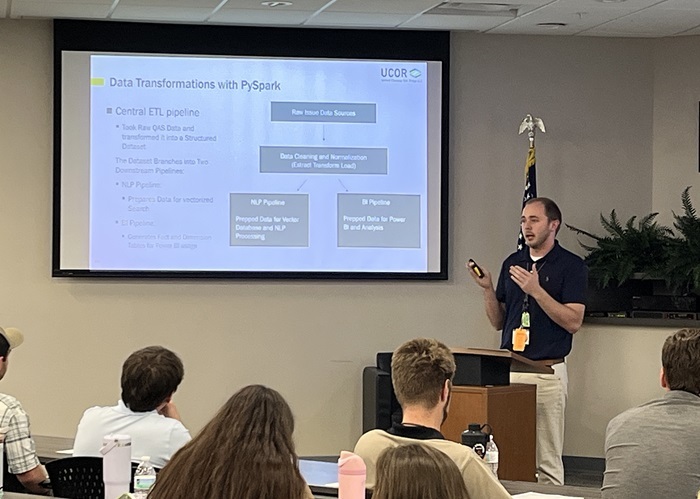 Ryan Lee discusses what he learned as a UCOR data analytics intern. All interns give presentations recapping their work experiences from the summer months.
Another area of expertise offered through the internship program is environmental stewardship and characterization. While major field work is complete at the East Tennessee Technology Park, much remains at Oak Ridge National Laboratory and Y-12 National Security Complex. That work will require significant demand for employees in those fields.
“Not only did I get to see how environmental cleanup operates on such a large scale, but I also got to experience the different types of expertise and backgrounds that go into environmental cleanup at UCOR,” said Dillen Priest, an environmental services project control intern. “It was eye-opening, and for that reason, I hope to continue my work in such a rewarding field.”
Waste management is another profession that has expanded. This year, a former UCOR intern who has since joined the waste management group full time mentored three interns. They primarily learned about Resource Conservation and Recovery Act regulations to dispose of waste properly.
“As an intern in previous summers, it was a great experience to teach other upcoming waste management experts from the other side of the table,” said Danner Keeton, waste technical specialist at UCOR. “I remember first learning about our complicated job and being overwhelmed at the responsibility, but now being able to teach a new class of interns is a great opportunity.”
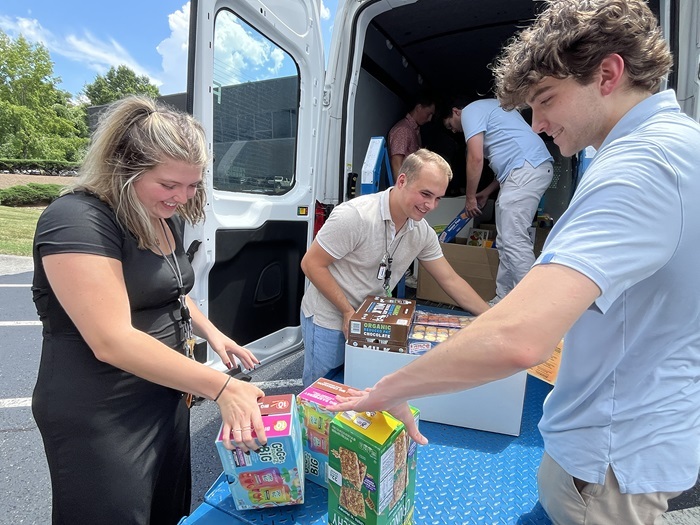 UCOR’s summer interns hosted a food collection event, called “Pack the Van,” gathering over 6,000 food items for the Second Harvest Food Bank in East Tennessee’s Food for Kids Program.
The interns made a big impact in the Oak Ridge community, too. They hosted a food collection event, called “Pack the Van,” gathering over 6,000 food items for the Second Harvest Food Bank in East Tennessee’s Food for Kids Program.
Since the start of UCOR’s contract in 2022, 36 students in the summer internship program have joined the workforce full time, including three from the 2025 class. Approximately half of the 2025 class will continue applying the skills they learned in the classroom by supporting UCOR part time throughout the upcoming academic year.
-Contributor: Ryan Getsi
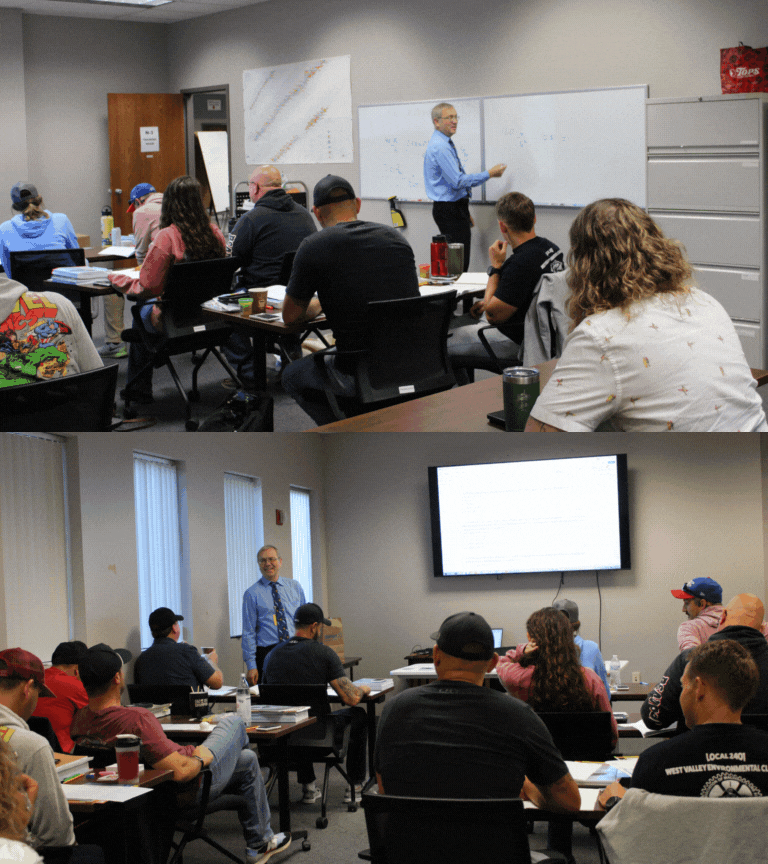 Radiation control technicians at the West Valley Demonstration Project participate in a 40-hour class to prepare for a credentialling exam by the National Registry of Radiation Protection Technologists. Passing the exam shows their commitment to safe practices and adherence to industry standards.
WEST VALLEY, N.Y. — Eleven radiological control technicians at the West Valley Demonstration Project have undergone a 40-hour training to prepare for a credentialing exam that validates competency and provides credibility in their field of work.
Passing the National Registry of Radiation Protection Technologists exam leads to registered radiation technologist status, demonstrating a commitment to safe practices and adherence to industry standards, potentially leading to career advancement and more job opportunities.
“This is an investment in our employees,” said Jason Casper, president of West Valley Cleanup Alliance, the site’s U.S. Department of Energy Office of Environmental Management cleanup contractor. “To be prepared in this field, one must take advantage of beneficial training opportunities like this. This will give them the knowledge and the tools that reflect the highest standards of professional ethics and conduct while working in the field to protect our workers, the public and the environment.”
A radiological control technician monitors and controls radiation levels to ensure safety in environments where radioactive materials or radiation-generating equipment are used. The technicians play a crucial role in preventing radiation exposure to personnel, the public and the environment.
“This class is about pursuing professionalism and excellence in radiation protection,” said Thomas E. Johnson, instructor for the registry. “I have always enjoyed teaching, but more importantly, it’s about seeing my students learn, grow and succeed in their careers.”
The registry was established in 1976 through the sponsorship of the Health Physics Society and the American Board of Health Physics.
Four hours are allowed for completion of the exam, which consists of 150 multiple-choice questions from 24 categories, such as mathematics, physics and sources of radiation. Passing the exam also provides the equivalent of 30 college credit hours.
-Contributor: Joseph Pillittere
|