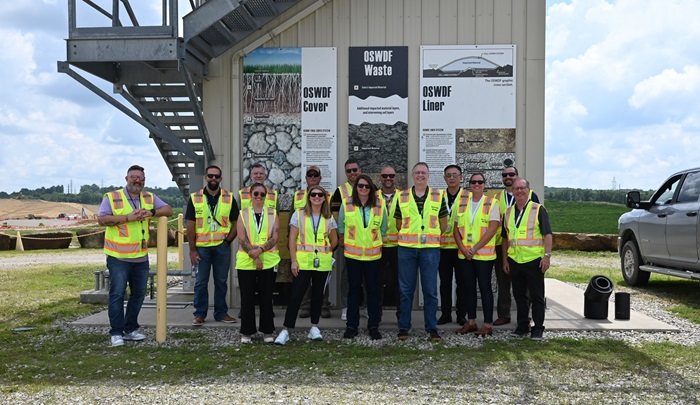
 Ohio Nuclear Development Authority members pose for a photo at the Portsmouth Site On-Site Waste Disposal Facility during a recent tour.
PIKETON, Ohio — Leaders from the Portsmouth Site recently met with representatives from the Ohio Nuclear Development Authority (ONDA) during their first visit to the Portsmouth Site.
The visit underscored the Portsmouth Site’s growing role in the nation’s energy renaissance and its prime location for reindustrialization in conjunction with the local community’s vision.
ONDA is a governor-appointed board Ohio lawmakers established in 2023 to boost research and development of advanced nuclear reactors, commercial isotope production, and nuclear waste reduction and storage technology.
The board seeks to foster innovative partnerships in the state — including Ohio’s public institutions of higher education, private companies, federal laboratories and nonprofit organizations — to accomplish those goals.
ONDA has a unique interest in the Portsmouth Site and has engaged the community to prepare resources for a future workforce.
“Visiting the Portsmouth Gaseous Diffusion Plant, I was struck by the scale and progress of the cleanup efforts. What was once an enormous industrial complex tied to the uranium enrichment has been transformed and ready for future industrial reuse,” said Lei Raymond Cao, ONDA board member and professor at The Ohio State University. “It's a powerful example of how long term vision and sustained investment can turn legacy nuclear sites into opportunities for regional revitalization.”
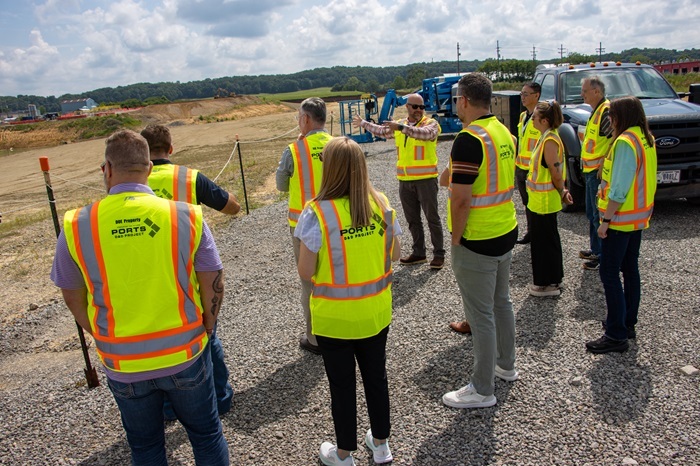 Portsmouth Site Lead Jeremy Davis, center, conducts a tour of the Portsmouth Site for members of the Ohio Nuclear Development Authority. The group discussed the legacy of the Portsmouth Site and the role the site will play in America’s energy future.
Portsmouth Site Nuclear Criticality Safety Engineer Alicia (Ali) Walls was raised in Pike County and is one of the original ONDA members appointed in August 2024.
“The Portsmouth Site has always been important to the local community as both a source of jobs but also a point of pride with its role in the Cold War,” Walls said. “Now, we are looking forward to creating a new nuclear industry in Ohio that will support the area in the future.”
As cleanup accelerates and progress continues toward transferring the fourth parcel of land at the Portsmouth Site for reuse, stakeholders like ONDA are partnering with the U.S. Department of Energy Office of Environmental Management (EM) and the community to ensure Piketon, Ohio, is part of the future of energy.
“We have known from the start of our cleanup activities that reindustrialization of the site is an important goal for the community,” Portsmouth Site Lead Jeremy Davis said. “ONDA and other parties interested in the future of the site will play an important role as we continue to assist the community in realizing their vision.”
In addition to the strategic partnerships with ONDA, EM supports reindustrialization studies with local organizations to generate a roadmap that identifies pathways for commercial development and fosters workforce growth for the site and the region.
The Portsmouth Paducah Project Office conducts cleanup activities at the Portsmouth Site in accordance with a consent decree with the state of Ohio and director’s final findings and orders with the Ohio Environmental Protection Agency.
-Contributor: Melissa Green
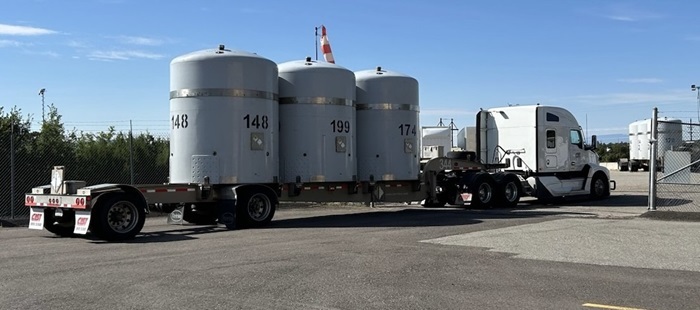 The 200th transuranic shipment from Technical Area 54, Area G, at Los Alamos National Laboratory heads to the Waste Isolation Pilot Plant for permanent emplacement.
LOS ALAMOS, N.M. — The U.S. Department of Energy Environmental Management Los Alamos Field Office (EM-LA) legacy cleanup contractor at the Los Alamos National Laboratory (LANL) completed its 200th shipment of transuranic waste to the Waste Isolation Pilot Plant (WIPP) for safe disposal earlier this month.
The 200th shipment consisted of three standard waste boxes containing segments of corrugated metal pipes (CMPs) formerly buried at Area G in LANL’s Technical Area 54. The CMPs contained cemented radioactive liquid waste from a former LANL radioactive liquid waste treatment facility that operated during the Cold War era. In 2024, Newport News Nuclear BWXT-Los Alamos LLC (N3B) completed work to retrieve and size-reduce the set of 158 CMPs, and began shipping them to WIPP earlier this summer.
“Reducing the inventory of transuranic waste here at LANL is one of the most visible aspects of our entire legacy cleanup mission and an important priority for the pueblos and stakeholders of northern New Mexico,” EM-LA Manager Jessica Kunkle said. “I want to congratulate all those at N3B who played a role in reaching this milestone. We still have more work ahead of us, and our focus remains on safely reducing the remaining inventory of legacy waste.”
EM-LA and N3B manage transuranic waste produced during LANL’s legacy nuclear weapons research and production operations. That waste consists of materials such as protective clothing, tools, equipment, soil and debris contaminated with elements heavier than uranium, including plutonium or americium.
Since beginning shipments in October 2018, N3B has sent more than 665 cubic meters of transuranic waste — or about 3,194 55-gallon drums — from Technical Area 54 to WIPP.
“Our 200th transuranic waste shipment represents tangible progress in one of the core areas of our work at LANL,” N3B President and General Manager Brad Smith said. “I’m proud of all those at N3B who played a role in getting us to this point. There’s more to be done, and the N3B workforce’s ongoing emphasis on safety and operational excellence will continue to be critical as we work to address the remaining legacy waste at LANL.”
-Contributor: Michael Nartker
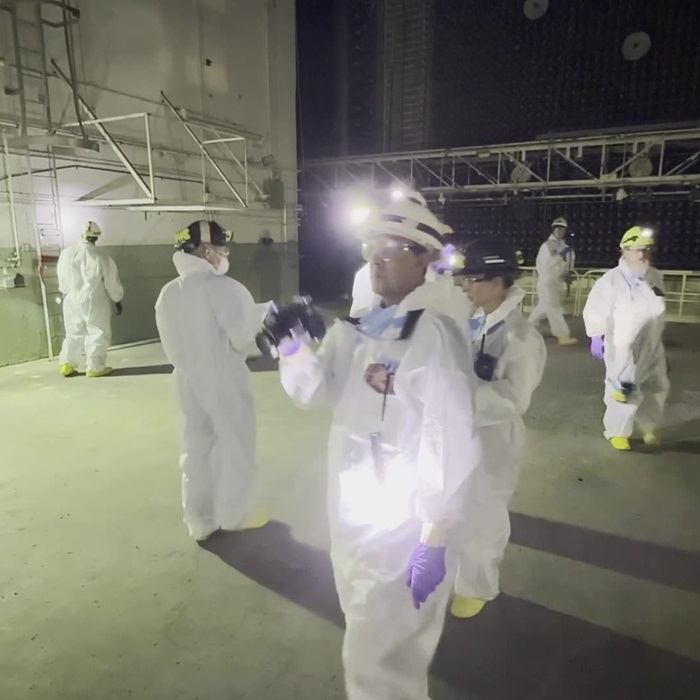 Members of the Engineering and Long-Term Stewardship teams at Hanford Mission Integration Solutions inspect the interior of the F Reactor enclosure for structural changes since the last inspection.
RICHLAND, Wash. — Workers at the U.S. Department of Energy Office of Environmental Management (EM) Hanford Field Office (HFO) used new imaging technology to inspect the Hanford Site’s decommissioned nuclear reactors, revealing a detailed look inside the sealed enclosures.
Putting this new technology to use at Hanford is part of EM's commitment to innovation and efficiency, focusing on priorities and reining in costs without sacrificing safety or effectiveness — all to deliver more to the American taxpayer.
 |
|
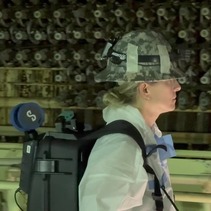
Long-Term Stewardship Project Manager Deanna Breckon uses a lidar backpack to map the interior of the F Reactor enclosure. |
Crews from HFO contractor Hanford Mission Integration Solutions (HMIS) recently completed routine 10-year internal inspections of the safe storage enclosures for six cocooned reactors, as part of its Long-Term Stewardship Program.
"These inspections are critical to ensuring the cocooned reactors continue to function as designed," said Tashina Jasso, acting director with the HFO’s Site Stewardship Division. “The inspections are part of our commitment to reducing risk and preserving infrastructure for long term management and safe disposal.”
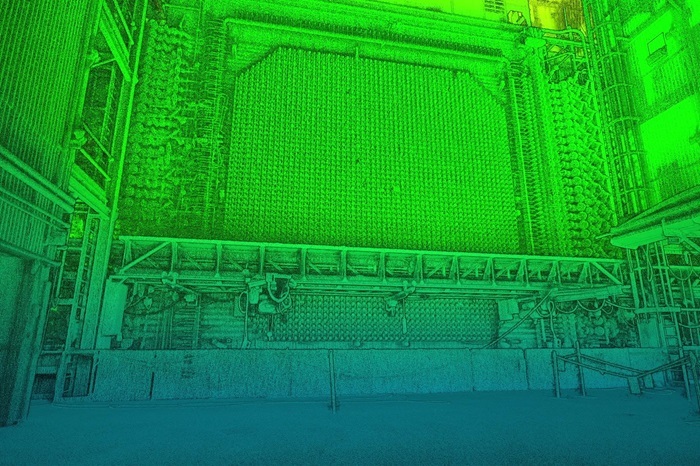 Lidar technology creates detailed imaging by scanning the interior structure of cocooned reactors at the Hanford Site, supporting future monitoring and safety planning.
These inspections required meticulous planning and collaboration among engineers and safety specialists. Unlike the yearly checks that focus on the exterior of the enclosures using drones, these explored the interior of the structures.
A key feature was the use of lidar technology, which created 3D models of the storage enclosures. This advanced tool provided a detailed picture of conditions and helped identify potential issues.
"Lidar technology has been a game-changer in how we assess these structures," said Deanna Breckon, project manager with HMIS Long-Term Stewardship. "It allows us to see things we couldn't before and ensures we are taking the right steps to maintain safety."
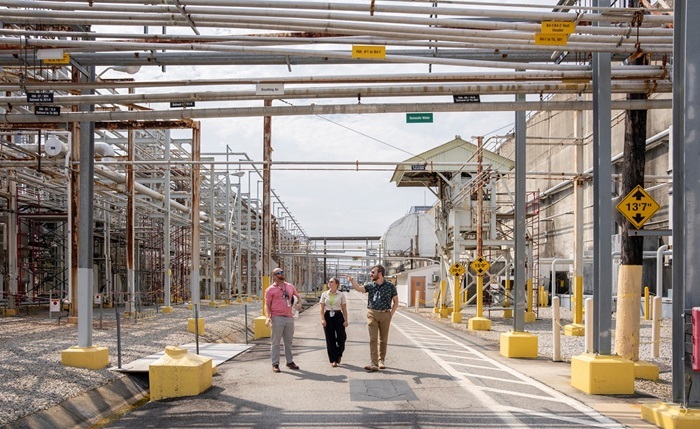 From left, Griffin Bethle, Savannah River Nuclear Solutions (SRNS) mechanical engineer lead; Olivia Ruszczyk, former SRNS process support intern; and Cody Fee, SRNS Environmental Management Operations senior program planner, walk through H Area at the Savannah River Site.
AIKEN, S.C. — Olivia Ruszczyk, a senior mechanical engineering student at New Mexico State University, has spent this summer inspecting steam systems in the Savannah River Site (SRS) H Canyon, the only operating, production-scale, radiologically shielded chemical separations facility in the United States.
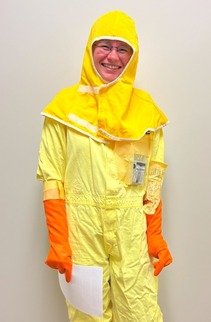
She completed required radiological training prior to the invaluable field experience, and each inspection required donning personal protective equipment.
Pending graduation from the university, Ruszczyk is set to return to SRS as an employee with U.S. Department of Energy Office of Environmental Management contractor Savannah River Nuclear Solutions (SRNS) — one of 38 interns who secured full-time positions there. Twenty-five additional interns will transition into apprenticeship roles. SRNS officials announced the offers at its recent Internship Signing Day.
“This is just one example of the vast experiences available when interning at the site’s unique facilities,” said Cody Fee, SRNS Environmental Management Operations senior program planner. “Olivia brings valuable mechanical engineering and computer-assisted design perspectives to the team, and those insights have provided complementary benefits to our group this summer.”
 |
|
Olivia Ruszczyk suits up in protective clothing while gaining hands-on experience with nuclear processing in H Canyon. |
The 12-week internship program, which began in 2009 to build a pipeline of future leaders in national defense, environmental stewardship, and nuclear nonproliferation, enables participants to join a legacy of service, innovation and national security at SRS, which marks its 75th year in 2025.
SRNS launched this year’s program in June, drawing students from 18 U.S. states and Canada.
“She has a natural questioning attitude, and her drive maximized her exposure to various aspects of SRS operations and missions,” Fee said of Ruszczyk. “We are grateful to have her on our team.”
For Ruszczyk, every day of the internship was different. Her tasks included creating 3D models, automating spreadsheets, shadowing, training and completing hands-on assignments.
"When I applied for this position, I thought, ‘What a cool opportunity to expand my skillset,’” said Ruszczyk. “I was excited for the chance to work at a nuclear facility and learn more about processing fuel after its useful lifecycle. I knew I wanted to pursue a career in a nuclear or nuclear-adjacent field post-graduation but did not know much about nuclear energy or research beyond a material's fissionable life.”
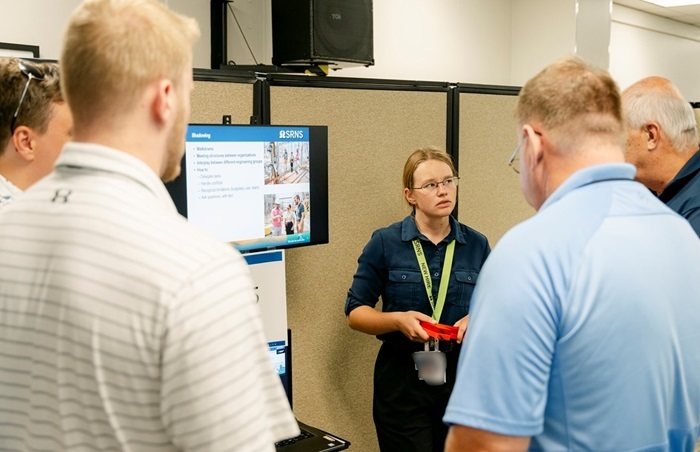 Olivia Ruszczyk shares her experiences during the recent Savannah River Nuclear Solutions Internship Showcase and Farewell event.
Ruszczyk found the radiological training to be her favorite experience this summer.
“The class helped me better understand the units of measurement for radioactivity, absorption, and dose — which previously seemed like very abstract, almost magical units. The class also allowed me to do something I had imagined myself doing in high school — entering contaminated and radioactive areas. I've gained some great connections and troubleshooting skills from this internship that I know will help me in the future.”
Ruszczyk and other interns are the operators, radiation protection inspectors, engineers and other team members of the future, said Janice Lawson, senior vice president of SRNS Environmental Management Operations.
“Their experience will be invaluable to ensuring H Canyon can support national security and environmental cleanup missions well into the future,” Lawson added.
-Contributor: Mackenzie McNabb
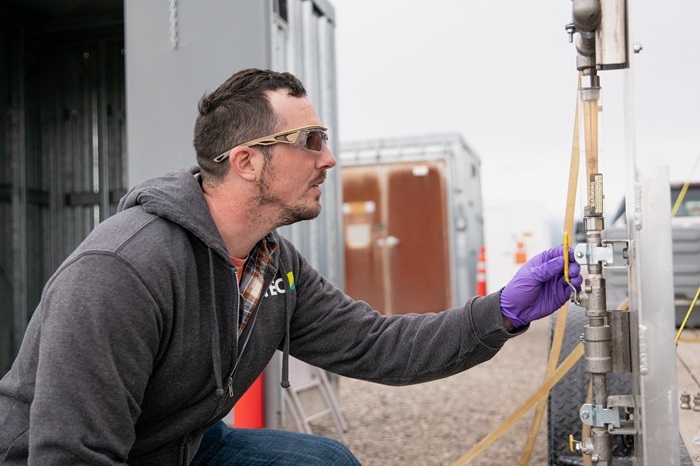 Idaho Cleanup Project crews, including Technical and Groundwater Lead Eric Traub, pictured, are supporting a groundwater remediation project to reduce contaminant concentrations and protect the Snake River Plain Aquifer.
IDAHO FALLS, Idaho — A groundwater treatment well installed by Idaho Cleanup Project (ICP) crews four years ago to contribute to an important remediation project is preserving the quality of the underlying Snake River Plain Aquifer.
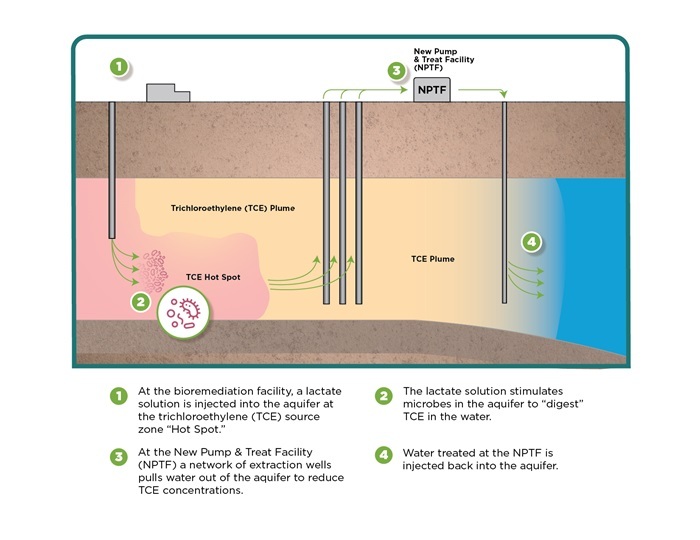
The well was installed to support two existing groundwater treatment wells at Test Area North (TAN), located on the Idaho National Laboratory (INL) Site, and is positioned to treat a specific source area of a contamination plume located directly below the facility.
The ICP groundwater remediation project is part of the mission of the U.S. Department of Energy Office of Environmental Management — the largest environmental cleanup program in the world — to address the environmental legacy of past nuclear weapons programs and nuclear energy research.
The TAN wells facilitate groundwater treatment by injecting an organic sodium lactate and fatty acid solution into the aquifer, which stimulates naturally occurring microorganisms to break down and reduce the concentration of contaminants in the water.
Before 2021, the source area in question was not responding to treatments through the two existing wells. The third injection well is helping provide treatment to a larger area, ensuring that the treatment solution reaches portions of the source area not previously reached by prior injections.
The area of focus has high concentrations of trichloroethylene (TCE), which was historically used as an industrial solvent at TAN. Constructed in the 1950s, TAN hosted the Aircraft Nuclear Propulsion program. After 1961, the facility was used for additional nuclear reactor research.
 Technical and Groundwater Lead Eric Traub with ICP contractor Idaho Environmental Coalition was encouraged by results of the treatment with the addition of the third injection well. He also recognized that the impact to the groundwater won’t be immediate.
“While it will take some time to determine if the injected solution at this well is reaching the entirety of the source area, we have seen a decrease in TCE concentrations in the downgradient of the injection area.”
Due to complex subsurface geology, complete reduction of the plume will occur over time, but ICP crews regularly monitor groundwater to ensure the treatment is effective in decreasing contaminant concentrations and that the plume is not expanding.
Groundwater on the INL Site is frequently monitored and does not leave INL Site boundaries above drinking water standards or create a risk to the public.
Since 2002, EM has also deployed the use of an above-ground treatment unit called the New Pump and Treat Facility. This facility uses a network of extraction wells to move water from the aquifer to the facility, where a technology known as an air stripper removes contaminants by evaporation. Treated water that meets regulatory standards is then reinjected into the aquifer.
The plume originated from common waste disposal practices of the past, like injecting hazardous wastewater directly into the underlying aquifer, and is the subject of a 1990 Comprehensive Environmental Response Compensation and Liability Act cleanup record of decision regulated by the U.S. Environmental Protection Agency and state of Idaho. The actions outlined in the record of decision address the plume and will improve the quality of the aquifer.
-Contributor: Carter Harrison
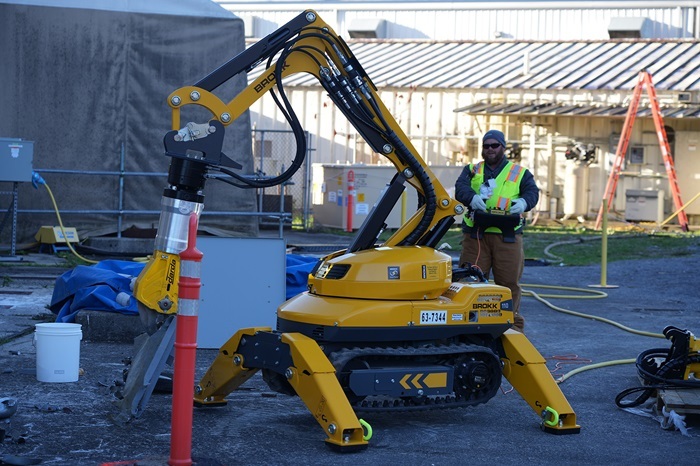 A worker demonstrates a robotic device that will support deactivation and demolition efforts on the last remaining hot cell structure of the former Radioisotope Development Laboratory at Oak Ridge National Laboratory.
OAK RIDGE, Tenn. — Oak Ridge Office of Environmental Management contractor UCOR is testing new remote equipment that will help workers avoid some of the most challenging, contaminated environments during upcoming deactivation and demolition (D&D) projects at Oak Ridge National Laboratory (ORNL).
Over the past year, employees have tested the remote demolition unit, performing initial demonstrations at the Experimental Gas-Cooled Reactor. The device allows workers to significantly increase their distance from potential hazards, reduce exposure and make the work safer.
“The great thing about remote demo equipment is the focus on safety for the team by keeping them out the hazard area,” said Scott Ward, UCOR cleanup and D&D engineering manager. “This style of deactivation and demolition is critical for the future of cleanup in Oak Ridge.”
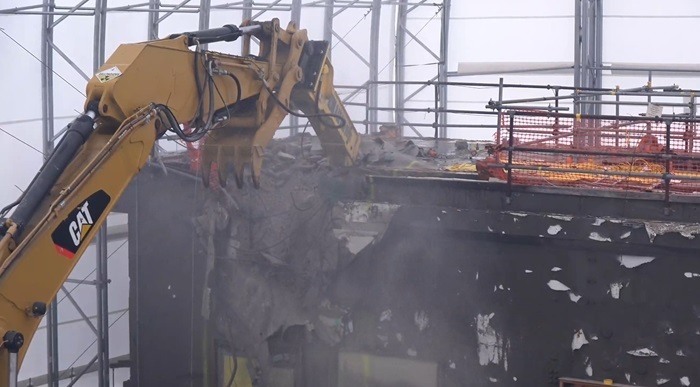 The final remaining hot cell of the former Radioisotope Development Laboratory is divided into subcells A and B. Crews achieved a U.S. Department of Energy Office of Environmental Management priority by beginning demolition of subcell B earlier this year. Next, workers will use this remotely operated equipment to assist with deactivating subcell A.
Workers have already conducted mock-ups with the robotic system to prepare to support upcoming deactivation and removal activities at the former Radioisotope Development Laboratory. Those activities are scheduled to begin later this year to help remove the final portion of the Manhattan Project-era building.
Crews demolished the facility’s outer structure and five of the six hot cells in the former laboratory, known as Building 3026, in previous years.
The cells were heavily shielded concrete rooms that provided researchers protection from radioactive material as they conducted research. The laboratory was built in 1945 to support isotope separation and packaging and was later used to examine irradiated reactor fuel experiments and components.
The final hot cell is divided into subcells A and B. Crews achieved a U.S. Department of Energy Office of Environmental Management priority by beginning demolition of subcell B earlier this year. Next, workers will use this remotely operated equipment to assist with deactivating subcell A due to the high radioactivity there. Demolition is scheduled for completion next year.
Remote deactivation is essential because the last remaining hot cell is one of the most contaminated structures at ORNL.
Workers will use the robotic system to reduce the size of contaminated items in the cell, load them into containers and ready the debris for final packaging and disposal. The team will also use the remote equipment to remove a contaminated stainless steel liner in the hot cell prior to demolition.
There are also other opportunities on the horizon to use remote equipment to aid the deactivation of other highly contaminated facilities at ORNL, including the former Fission Production Development Lab, known as Building 3517.
-Contributor: Carol Hendrycks
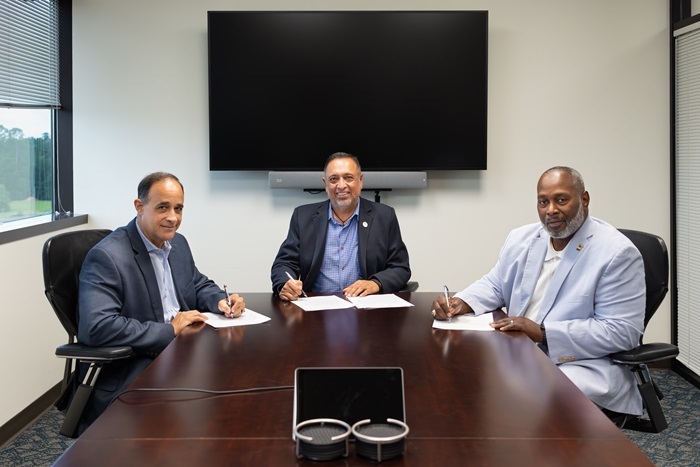 Officials gather for a ceremonial memorandum of understanding signing. From left: Rich Zaharek, Savannah River Nuclear Solutions (SRNS) senior vice president, chief engineer and nuclear safety officer; Leonel Lagos, Florida International University associate professor and director of research, Applied Research Center; and Sean Alford, SRNS senior vice president and chief administrative officer.
AIKEN, S.C. — A Savannah River Site (SRS) contractor and university research center have signed an agreement seeking to expand workforce opportunities for students and support the U.S. Department of Energy’s (DOE) nuclear cleanup program and other critical missions.
It’s the latest effort by Savannah River Nuclear Solutions (SRNS) to continue advancing innovation and strengthen research partnerships that deliver solutions for DOE’s Office of Environmental Management (EM).
The collaboration was formalized with the signing of a memorandum of understanding between SRNS and the Florida International University (FIU) Applied Research Center (ARC). They have a shared goal of increasing the number of SRNS internships as well as the number of interns transitioning into full-service positions at SRNS. The pact also looks to advance DOE’s collaborative research in environmental remediation and nuclear operations, and strengthen technical capabilities.
“One of our primary goals is to build strong talent pipelines,” said Bryan Ortner, senior vice president, SRNS Workforce Services and Talent Management. “Partners like this allow us to solve complex technical problems that support both the National Nuclear Security Administration and DOE’s Environmental Management missions. By investing in students today, we’re building the workforce of tomorrow.”
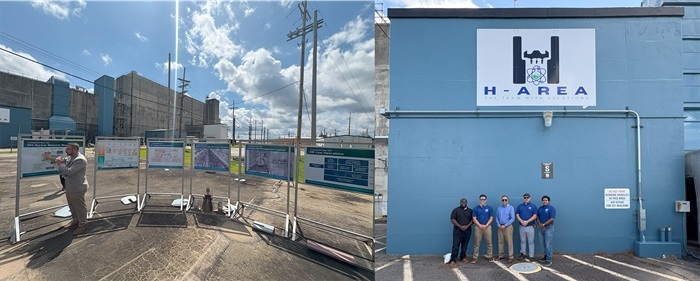 James Therrell, at left, Savannah River Nuclear Solutions mission planning manager for Environmental Management Operations, educates Florida International University representatives, at right, on the H Canyon process at Savannah River Site.
During a visit to SRS, FIU representatives toured key SRS facilities, including H Canyon, the only operating, production-scale, radiologically shielded chemical separations facility in the United States. H Canyon was originally built to recover uranium and neptunium from fuel tubes used in nuclear reactors for weapons production. Its mission shifted after the Cold War to focus on nonproliferation and environmental cleanup.
“We want to create a clear pipeline for FIU to join SRNS — not just in engineering, but in multiple disciplines,” said Leonel Lagos, FIU associate professor and director of research at ARC. “We’re working with SRNS to identify research topics and develop technologies that can directly support site operations. For example, robotics systems designed by FIU staff and students could one day inspect and repair facilities such as H Canyon.”
ARC’s work is performed under the DOE-FIU Cooperative Agreement, which focuses on environmental remediation and workforce development. In 2007, EM and FIU created the Science & Technology Workforce Development Initiative. The aim of this workforce development program is to develop future talent by fostering collaboration between academic, government and DOE contractor organizations. This partnership trains and mentors the next generation of scientists and engineers while helping develop innovative technologies that address DOE’s environmental cleanup challenges.
“This partnership allows SRNS to tap into a proven source of talent,” added Sean Alford, SRNS senior vice president and chief administrative officer. “FIU students are well trained, and with our growing missions, we want to give them the best opportunities to contribute. Beyond engineering, we see potential for students to support supply chain, construction management and other critical areas. Together, SRNS and FIU are committed to advancing applied research and technology development to support DOE’s critical missions while developing a highly skilled future workforce.”
|