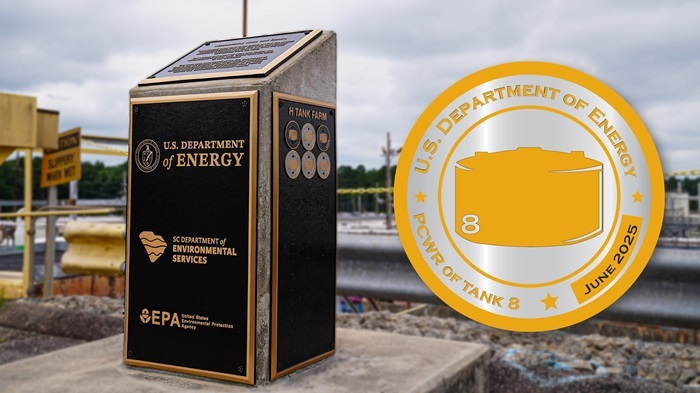
 The U.S. Department of Energy Office of Environmental Management and liquid waste contractor Savannah River Mission Completion completed preliminary cease waste removal for Tank 8 at the Savannah River Site ahead of schedule.
AIKEN, S.C. — The U.S. Department of Energy (DOE) Office of Environmental Management (EM) has reached another milestone with concurrence from regulators that the Savannah River Site (SRS) has successfully removed waste from another highly radioactive waste tank.
Tank 8 makes the sixth tank to reach preliminary cease waste removal (PCWR) regulatory approval in 13 months. EM achieved this latest PCWR regulatory approval over a year ahead of schedule.
Savannah River Mission Completion (SRMC) is EM’s liquid waste contractor responsible for achieving PCWR through safely treating and disposing of the millions of gallons of waste remaining in the underground tanks at SRS. The tanks will ultimately be filled with grout to be permanently sealed and operationally closed.
PCWR is a regulatory milestone for old-style tanks that designates agreement between EM, the U.S. Environmental Protection Agency (EPA), and the South Carolina Department of Environmental Services that, based on preliminary information, there is reasonable assurance that performance objectives for tank closure will be met.
Also, the concurrence means that work can begin on the sampling and analysis phase of the tank closure process. This next phase will verify these conclusions, based on laboratory analysis of any remaining material and final residual volume determination, prior to final isolation and stabilization of the waste tank.
In a letter to DOE-Savannah River, Jana Dawson, EPA remedial project manager, said EPA looks forward to continued progress in high-level waste tank closure.
“EPA is excited about the progress DOE has achieved in accelerating the removal of high-level liquid waste by exceeding the number of tanks reaching PCWR committed to in the 2022 High Level Waste Tank Agreement and Federal Facility Agreement, to date,” Dawson said.
Tony Robinson, EM acting assistant manager for waste disposition at SRS, said the Tank 8 PCWR achievement, less than a month after the milestone for Tanks 11 and 15, is testament of EM and SRMC’s collaboration to safely and efficiently advance legacy waste cleanup.
"Keeping our people and environment safe will always be the number one commitment of EM,” Robinson said, “And it’s a win for everyone when the work is completed effectively and efficiently while keeping that commitment.”
Thomas Burns Jr., SRMC president and program manager, said achieving a record number of PCWR milestones shows that SRMC executes with excellence.
“Savannah River Mission Completion has shown time and time again that we have the right people with the right skills to not just move the high-level waste cleanup mission for EM, but to accelerate it,” Burns said. “SRMC continues to be an international model for the work we do and how to conduct it safely.”
SRMC has also completed PCWR on Tank 4, Tank 9, Tank 10, Tank 11, and Tank 15 — all seven to 19 months ahead of the agreed-upon deadlines.
PCWR is outlined in the SRS Federal Facility Agreement, which establishes a procedural framework, including liquid waste tank milestone agreements, such as the schedule for waste removal and operational tank closures, and other site cleanup priorities.
-Contributor: Colleen Hart
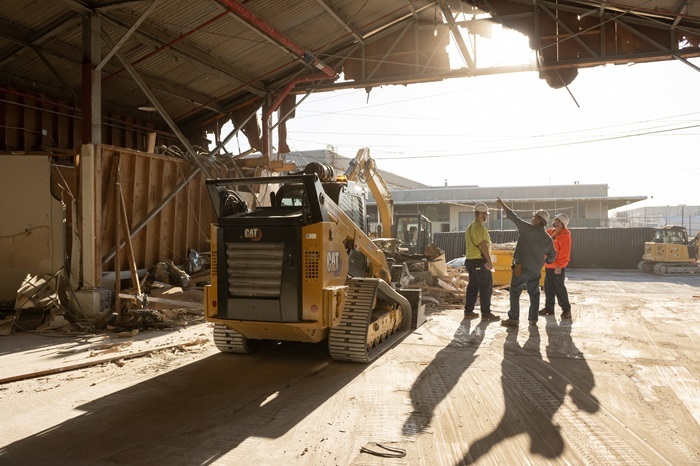 Demolition crews clear a former storage location-turned-office building to reduce the surveillance and maintenance of unused facilities at the Paducah Site.
PADUCAH, Ky. — Crews have safely demolished six unused facilities at the Paducah Site ahead of schedule and under budget in the current fiscal year ending Sept. 30, reducing the cleanup footprint by more than 19,000 square feet and supporting future reuse of land and economic development.
The U.S. Department of Energy Office of Environmental Management team at Paducah has torn down more than 180 structures to date since cleanup began — a footprint of 560,000 square feet.
This deliberate, strategic work is enabling the safe cleanup and future demolition of the site’s former uranium enrichment facilities. As the Paducah Site looks ahead, each step of cleanup strengthens the foundation for future land transfer and reindustrialization, creating new opportunities for the community.
“This work represents more than demolition,” Portsmouth Paducah Project Office Manager Joel Bradburne said. “It’s a crucial part of our commitment to the community to prepare the site for safe, productive reuse. Every facility removed brings us closer to that vision.”
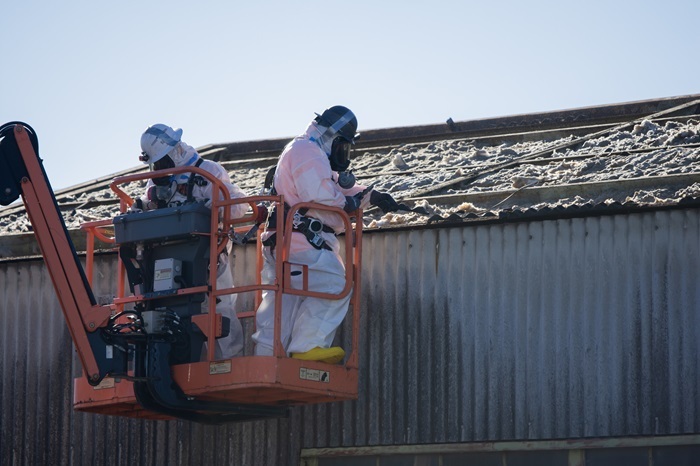 Crews prepare a legacy building for demolition. It’s one of six facilities demolished at the Paducah Site in fiscal year 2025.
The crews responsible for demolition collaborated with engineering and waste management personnel to adapt their approach and find creative solutions, highlighting the value of teamwork and flexibility on a dynamic cleanup site.
Thorough predemolition assessments resulted in more than $1 million in cost savings for packaging and disposition of the more than 50,000 cubic feet of debris that resulted from demolition of the six facilities in fiscal year 2025. Waste engineers employed a surgical-like approach to identifying and surveying debris to ensure it met requirements for disposition, reducing costs by using the site’s sanitary landfill and segregating regulated waste.
“This year’s success is a result of innovative thinking, collaboration and a shared focus on the future,” Four Rivers Nuclear Partnership (FRNP) Program Manager Myrna Redfield said. “Our team continues to make progress supporting long term site transformation.”
FRNP is the deactivation and remediation contractor at the Paducah Site. Demolition of unused facilities is part of EM’s ongoing environmental cleanup at the site, conducted in accordance with the Comprehensive Environmental Response, Compensation, and Liability Act.
-Contributor: Dylan Nichols
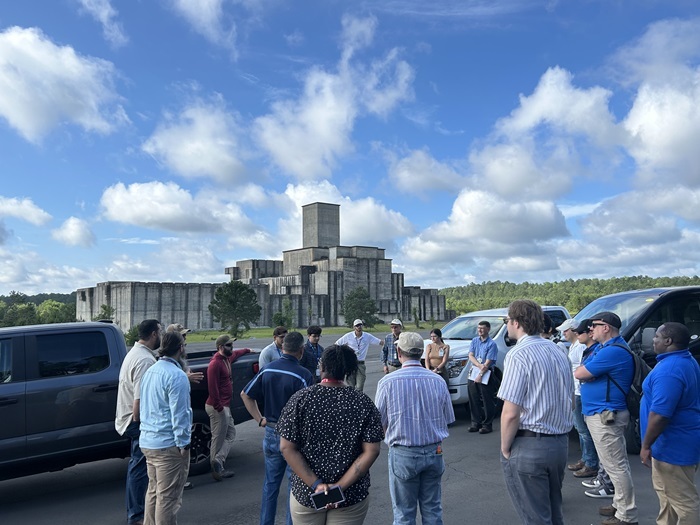 U.S. Department of Energy Office of Environmental Management and Savannah River Nuclear Solutions personnel visit the R Reactor Seepage Basin at the Savannah River Site as part of post-remediation maintenance. The reactor, shown in the background, was decommissioned in 2011.
AIKEN, S.C. — The U.S. Department of Energy Office of Environmental Management (EM) has completed 85% of its Federal Facility Agreement milestones and Resource Conservation and Recovery Act commitments for the current fiscal year at the Savannah River Site (SRS) on or ahead of schedule.
EM contractor Savannah River Nuclear Solutions (SRNS) continues work on the remaining milestones and commitments for fiscal year 2025, which ends Sept. 30.
“The team has demonstrated exceptional dedication and efficiency in achieving 57 of its 67 critical milestones and regulatory commitments so far this fiscal year,” SRNS Area Completion Projects Manager Kelsey Holcomb said. “Their success reflects not only strong project management, but also a deep commitment to environmental stewardship and regulatory excellence.”
The Federal Facility Agreement directs the comprehensive remediation of SRS, while the federal Resource Conservation and Recovery Act provides a framework for managing waste.
Since 1993, EM crews have successfully achieved over 4,230 cleanup milestones and commitments at SRS — all on or ahead of schedule.
The EM crews are decommissioning excess facilities and remediating soil and water at SRS to help protect the environment for future generations. To date, they have decommissioned over 317 buildings covering more than 2.5 million square feet of land, significantly reducing the site's cleanup footprint while cutting expensive surveillance and maintenance costs. Additionally, they have closed 415 of the site's 515 waste units.
SRNS Environmental Compliance and Area Completion Projects Director Chris Bergren said he’s incredibly proud of the team for its dedication and disciplined performance.
“Their ability to consistently deliver ahead of schedule reflects the critical role they play in meeting our regulatory obligations and driving our mission forward,” Bergren said. “The work they do is foundational — not just to the success of our organization but to our broader commitment to national security and environmental protection.”
-Contributor: Fallan Flatow
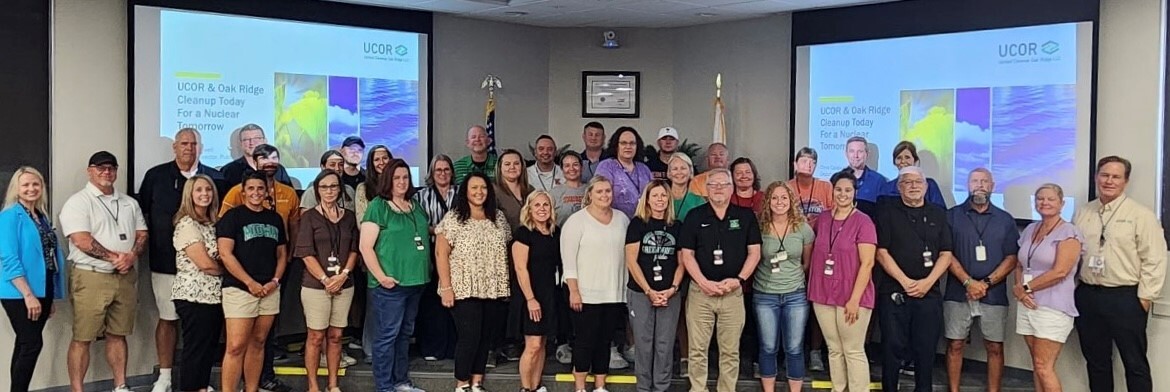 Teachers, administrators and staff from Roane County High, Midway High and Midway Middle schools visit Oak Ridge Office of Environmental Management contractor UCOR for briefings and tours of cleanup.
OAK RIDGE, Tenn. — Public school teachers, administrators and staff in the region recently learned more about the diverse array of careers for students in the years ahead related to the Oak Ridge Office of Environmental Management’s (OREM) mission — and a growing list of jobs possible due to cleanup success.
Attendees explored how OREM’s mission is ensuring local communities are safe, clean, and prosperous by removing hazards; enabling modernization at U.S. Department of Energy (DOE) research and national security sites; and creating new economic opportunities that attract new industry to Oak Ridge. Cleanup achievements and economic opportunities are connected: Oak Ridge's successful cleanup of the East Tennessee Technology Park has led to the siting of the nation’s first nuclear innovation hub.
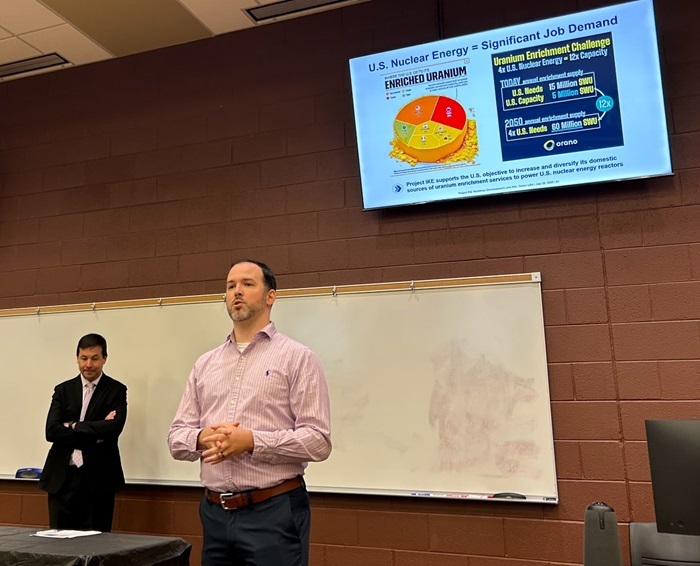 From left, Orano USA Operations and Commissioning Manager Loris Kim and Roane State Community College Oak Ridge Campus Director Andy Spellman talk about training the future workforce for Orano USA’s uranium enrichment facility that will diversify domestic sources of uranium enrichment for nuclear energy. The Oak Ridge Office of Environmental Management is enabling the transfer of land for the announced location for the company’s multibillion dollar facility.
OREM contractor UCOR was a featured industry partner at The Roane Alliance’s first-ever “Nuclear Careers Day.” Roane County is one of two counties that contains portions of DOE’s 30,000-acre Oak Ridge Reservation, where OREM’s cleanup takes place.
Nearly 300 public school teachers, career counselors and school administrators from 11 middle and high schools attended the professional development event, spending a full day touring DOE’s sites and learning from employees and partners before students return to class this fall.
The event was created with support from Roane Alliance, the county’s unified economic development voice that promotes economic development, job creation and workforce development partnerships.
“Talking with our education partners, we found that teachers wanted to learn more about the current opportunities at Oak Ridge, and also the future jobs with new commercial nuclear investments, like Orano USA, and the facilities now under construction,” Roane Alliance Education & Workforce Development Director Jennifer Brown said.
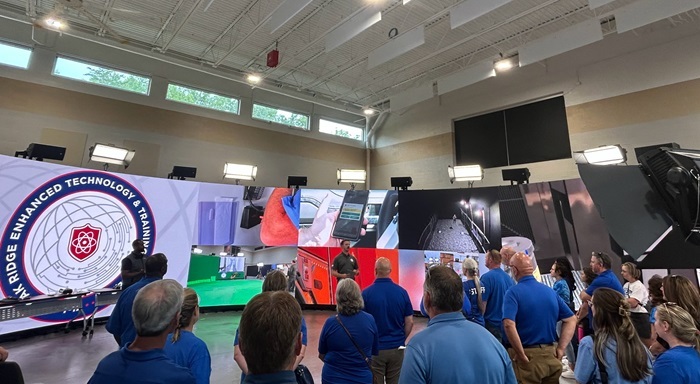 The Roane Alliance and Roane Public Schools’ Career & Technical Education staff assembled a packed agenda for school staff groups to visit. Participants are pictured here touring the Oak Ridge Enhanced Technology and Training Center.
Roane Alliance and Roane Public Schools’ Career & Technical Education staff assembled a packed agenda for school staff groups to visit UCOR; Oak Ridge National Laboratory; Y-12 National Security Complex; Tennessee Valley Authority’s Clinch River site; and Roane State Community College, where they heard from college and business leaders about future workforce needs and development programs.
Roane County Secondary Supervisor of Schools Lance Duff was one of the drivers for the Nuclear Careers Day. He noted how the event provided staff with information to share with students to help them realize broader opportunities and paths available to them.
“We know there will be significant hiring in the Oak Ridge Corridor over the next five years due to retirements and new facilities being built, so our teachers and counselors can be the most influential voices for students and parents to encourage them to pursue these great career options,” said Duff. “We know there will continue to be needs for scientists and engineers, but we walked away learning about the skilled craft labor, operators, construction jobs and support positions needed today and in the future. Several teachers told me, ‘I had no idea about all of these job opportunities.’”
-Contributor: Chris Caldwell
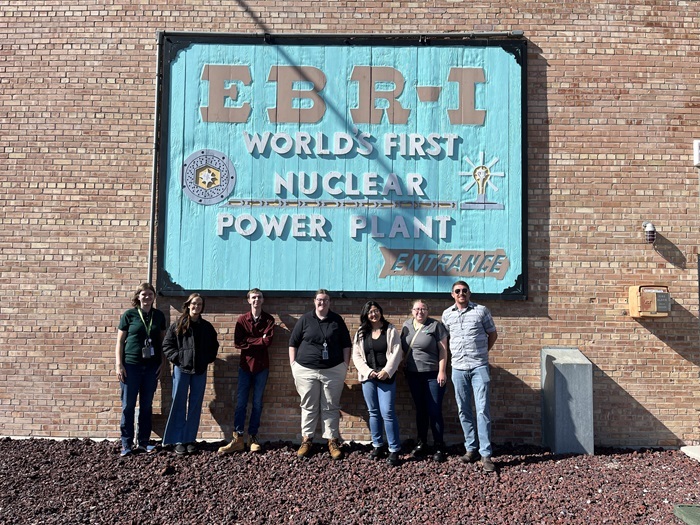 Idaho Cleanup Project staff and interns visit the Experimental Breeder Reactor-1, a national historic landmark at the Idaho National Laboratory Site. Pictured from left are Eliza Haderlie, Grace Savage, Isaac Ryner, Brenleigh Killpack, Selena Torres, Leamarie Mitchell and Ryan Christensen. Not pictured: Duncan Ferguson.
IDAHO FALLS, Idaho — An internship at the Idaho Cleanup Project (ICP) means hands-on work, interfacing with industry experts, deadlines and real-world experience to put on a resume.
This summer, five interns joined U.S. Department of Energy Office of Environmental Management (EM) ICP contractor Idaho Environmental Coalition (IEC), supporting a variety of organizations from engineering and essential missions to information technology and safety and health.
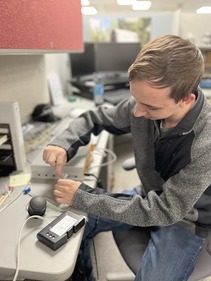
For EM’s Calcine Disposition Project, Isaac Ryner focused on integrating a physical control system into real-time machine movement. He supported project engineers by mapping control inputs, changing the format of the data communicated between control systems and programming that data into movement.
 |
|
Idaho Cleanup Project intern Isaac Ryner works to integrate a physical control system with a robotic system, allowing employees to control the robot in real time more intuitively than the current interface. |
Remote technology will be crucial to safely retrieving calcine, a granular waste stored onsite, for eventual removal from the state of Idaho, and Ryner contributed to the development of this technology.
Another priority project for IEC is the creation of periodic task orders for the continuation of ICP work. This summer, Grace Savage assisted IEC’s estimating and essential missions teams with this project. This work involved frequent communication with senior management, in-depth analysis of proposal data, development of detailed cost estimates, and ongoing modification and adjustment of those estimates across all accounts.
“Throughout this process, I’ve gained meaningful insight into the complexities of the industry and developed a deeper appreciation for the level of detail and effort required in each task,” said Savage. “As a finance major at Utah State University, this hands-on experience has significantly enriched my understanding of real-world applications and will enhance my learning in the classroom.”
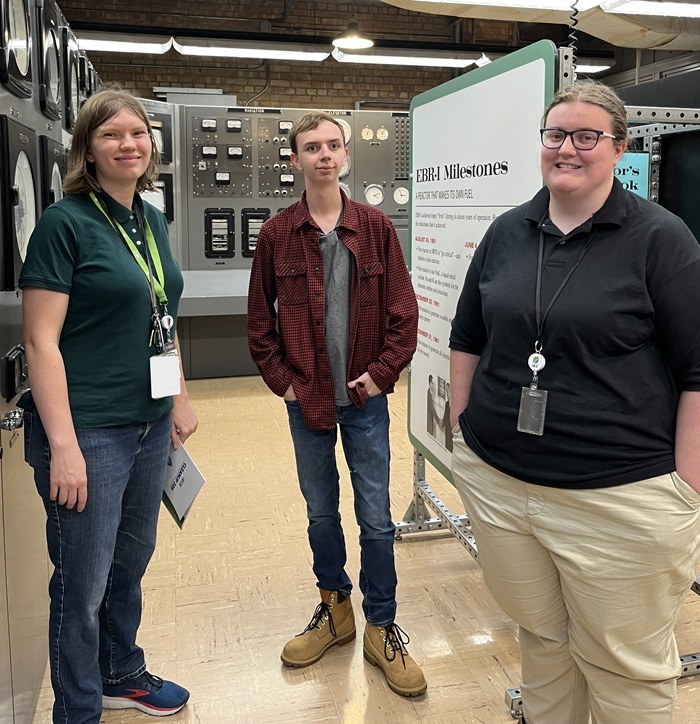 Idaho Cleanup Project interns Eliza Haderlie, Isaac Ryner and Brenleigh Killpack learn about the Experimental Breeder Reactor-1, a national historic landmark at the Idaho National Laboratory Site.
Interns Brenleigh Killpack and Eliza Haderlie worked on a software inventory portfolio, which is important to the ICP mission because it contains information vital to IEC’s Data Governance Program.
Their efforts improved the portfolio, making it more user friendly and enhancing its data identification process. As a result, the Data Governance Program will be more efficient in identifying key stakeholders as they strive to gain a better understanding of ICP data.
Idaho Cleanup Project intern Duncan Ferguson is shown wearing personal protective equipment for use when scanning for asbestos prior to deactivation and demolition work at the Naval Reactors Facility. |
|
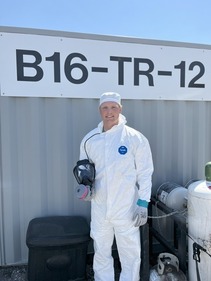 |
A primary goal of the IEC internship program is to provide the next-generation workforce with experience and insight into the industry. Duncan Ferguson experienced this firsthand as he conducted asbestos sampling at the deactivation and demolition (D&D) site for three legacy Naval Propulsion Program prototypes at the Naval Reactors Facility at the Idaho National Laboratory Site. This is an important step to safely complete D&D of the prototypes.
“As someone passionate about protecting health and well-being, this internship has been an impactful experience. It has reinforced my belief that preventing harm by controlling hazardous substances and maintaining healthy environments is just as important as treating illness,” said Ferguson. “While I’ve always been grateful for healthcare professionals, this experience has expanded my view of public service to include those who work behind the scenes in health protection and environmental cleanup.”
-Contributor: Leamarie Mitchell
|