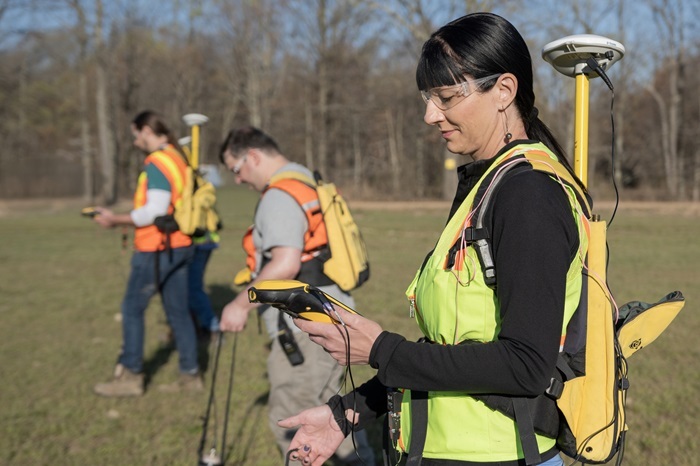
 The Oak Ridge Institute for Science and Education performs an independent verification for the environmental baseline survey on a 188-acre parcel of land at the Paducah Site slated for transfer to the community for future reuse and economic development. The institute has been providing independent verification for the U.S. Department of Energy, U.S. Nuclear Regulatory Commission and others for more than 40 years.
PADUCAH, Ky. — Officials are a step closer to the first land transfer at the Paducah Site for future reuse and economic development after completing a comprehensive survey of the 188-acre parcel that identifies environmental impacts through review of records of past operations and inspections, historical photographs, and interviews with former and current employees.
The environmental baseline survey is required under the Comprehensive Environmental Response, Compensation, and Liability Act. The U.S. Environmental Protection Agency and the Commonwealth of Kentucky approved the document, per a regulatory agreement for the U.S. Department of Energy (DOE) Office of Environmental Management (EM) site.
Completing this key step for the parcel, located on the southeastern portion of the site, advances the community’s vision for reindustrialization through the land-transfer process.
“New opportunities are on the horizon for Paducah as we work side by side with the community and their vision for reindustrialization, planting the seeds for economic growth in the region,” Portsmouth Paducah Project Office Manager Joel Bradburne said. “Receiving approval on the environmental baseline survey is a significant step in the transfer process and continues to demonstrate commitment from DOE and the regulatory parties to take action to complete safe and successful cleanup at the Paducah Site.”
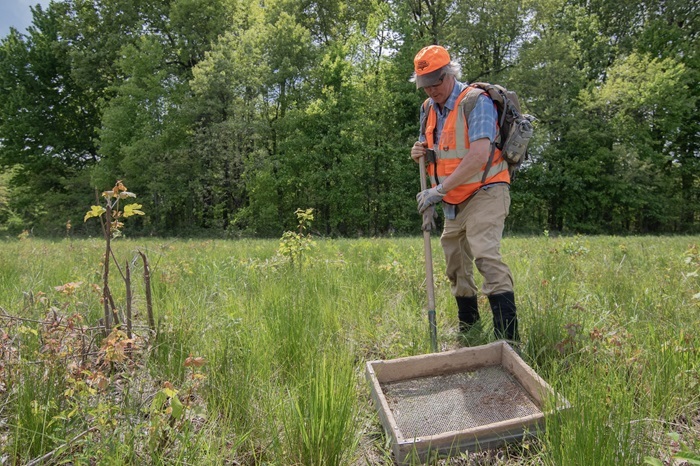 A cultural survey is conducted to identify and document any cultural, historical or archaeological resources that may exist on or near a 188-acre parcel of land at the Paducah Site slated for transfer to the community for future reuse and economic development. This work was done as part of a broader, comprehensive survey of the parcel.
The survey report says EM met the requirements for the transfer, and affirms the transfer is protective of human health and the environment. The survey incorporated thorough records reviews, visual inspections, interviews and sampling data, ensuring a full and accurate assessment of environmental conditions.
“Fulfilling the community’s request for land for reuse is integral to the site’s overall cleanup strategy moving forward, helping to drive new industry and investment,” Four Rivers Nuclear Partnership (FRNP) Program Manager Myrna Redfield said. “The completion of the environmental baseline survey ensures steady progress toward that goal, allowing the site to move into the next phase of the land-transfer process.”
FRNP is the deactivation and remediation contractor at the Paducah Site.
-Contributor: Dylan Nichols
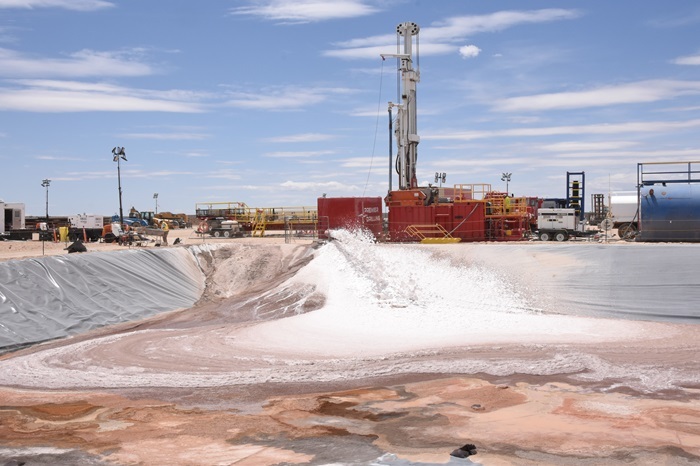 An Environmental Management Nevada Program drilling well, ER-20-13-1, is pictured as bits of rock, soil and fluids are discharged into a lined sump on the remote Pahute Mesa at the Nevada National Security Site.
LAS VEGAS — The Environmental Management (EM) Nevada Program has commenced well drilling in a remote stretch of the Nevada National Security Site (NNSS), furthering a decades-long mission to document the nature and extent of groundwater contamination caused by historic nuclear testing at the NNSS.
Crews started drilling the first well, ER-20-13-1, in May on the Pahute Mesa region of the NNSS. They reached a final depth of 2,570 feet below ground surface before moving on to a second well, ER-20-13-2. Drillers will then deepen an already existing third well, ER-20-1, so groundwater from the three wells on the Pahute Mesa can be analyzed for contamination and compared with computer modelings.
“The drilling supports future closure of the final groundwater corrective action unit at the NNSS,” said EM Nevada Program Manager Rob Boehlecke. “To do so, we need hard data. The goal is to demonstrate the reliability of our groundwater contaminant transport model results and provide confidence that the model results can support decisions leading to closure.”
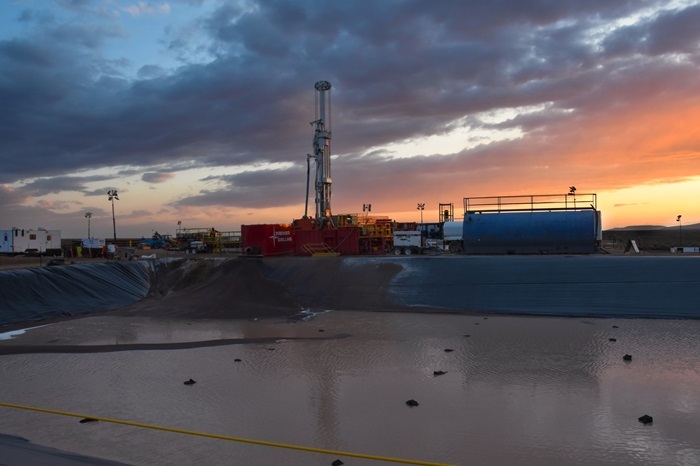 An Environmental Management Nevada Program drilling well, ER-20-13-1, is pictured on the remote Pahute Mesa at the Nevada National Security Site.
The government carried out 928 nuclear tests at the NNSS from 1951 to 1992. Nearly 90% of those tests were detonated underground. The U.S. Department of Energy Office of Environmental Management in 1989 was assigned the job of documenting the extent of the contamination of groundwater stemming from the tests, discerning where the contaminated water is headed and the rate of flow.
In 2016, Frenchman Flat was the first groundwater corrective action unit at the NNSS that EM closed. The Yucca Flat groundwater region was brought to closure in 2020. The same year, the Rainier Mesa and Shoshone Mountain groundwater corrective action unit reached closure three years ahead of schedule to the result of $5 million in federal savings.
In 2023, after extensive scientific analysis, the EM Nevada Program reached what is known as the model evaluation stage for the final groundwater corrective action unit of Pahute Mesa.
The current drilling campaign has required extensive planning carried out by EM Nevada Environmental Program Services contractor Navarro Research and Engineering. Navarro Field Operations Manager Brian Haight said protecting workers has been the top priority for the team since day one.
“There has been a lot of effort focused on both safety and using the newest technology,” Haight said.
 |
|
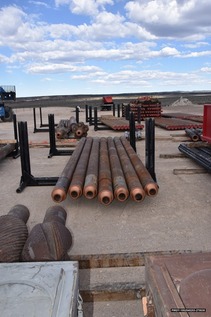
Some of the casing and materials for an Environmental Management Nevada Program drilling well, ER-20-13-1, are pictured. |
Haight said to further safety, Navarro worked with subcontractor Premier Drilling on the use of a top drive drilling rig system, which reduces the need for manual labor on the rig. This minimizes the potential for accidents or injury.
“I no longer have to have a worker required to be up in the tower, which is a very dangerous position,” Haight said.
Safety measures are also in place for workers to avoid heat stress. From noise reduction to pressure points, the engineering of the project has prioritized safety.
“It is built so people don’t have to put their hands on everything, and that eliminates a lot of your typical pinch points and the things where most accidents occur,” Haight said.
If there is any confusion or questions during work, the team pauses to go over everything, Haight said.
He added: “We are extremely happy with the progress made. We are confident that the wells will produce quality data to support closure at Pahute Mesa.”
Through closure activities, the EM Nevada Program is confident that contaminated groundwater will not impact public water supplies.
-Contributor: Glenn Puit
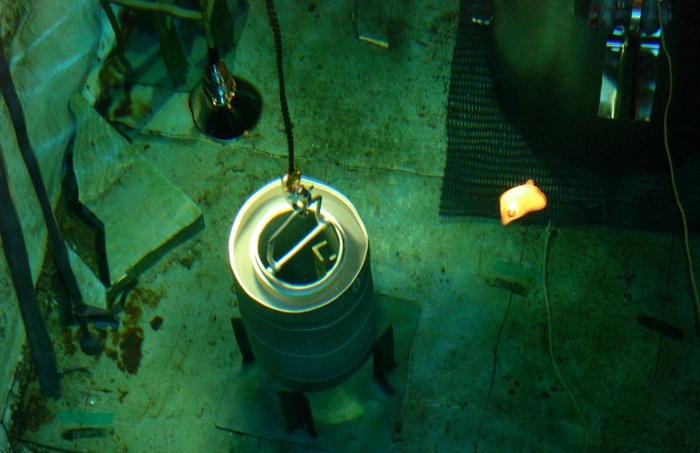 A High Flux Isotope Reactor core is lifted in an underwater storage basin at Savannah River Site. The fuel elements, an inner and an outer element, together form a reactor “core.”
AIKEN, S.C. — Workers at the Savannah River Site (SRS) have demonstrated their resourcefulness and unique capabilities by implementing a newly created carrier to transport spent nuclear fuel, reducing the time needed to process the material for permanent disposal in coming years.
Engineers and operators of an underwater basin at SRS where the fuel is stored recently redesigned carriers used to transport and store a special type of the material. The carriers now have a different material alloy, or aluminum, which more easily dissolves, reducing the time needed for fuel disposition in the site’s H Canyon chemical separations facility.
Spent nuclear fuel from the High Flux Isotope Reactor (HFIR) at Oak Ridge National Laboratory in Tennessee is sent to SRS to be processed for eventual disposal. HFIR is the highest flux reactor-based source of neutrons for research in the U.S. using highly enriched uranium.
Under an approach called Accelerated Basin De-inventory, SRS will dissolve the fuel at H Canyon and send it through the site’s liquid waste program to be vitrified and safely stored onsite until a federal repository is identified. This approach will accelerate the disposition of spent nuclear fuel at SRS by more than 20 years and result in savings of more than $4 billion.
As part of that process, the fuel is placed in casks using the specially designed carriers and sent by rail to H Canyon for processing.
 |
|
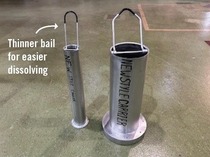
The new-style High Flux Isotope Reactor spent nuclear fuel carriers have a slightly thinner bail made of a more easily dissolvable alloy than the previous bail. |
HFIR fuel is shaped differently than other types of spent nuclear fuel. The HFIR fuel has the form of a cylindrical core rather than a long tube, or bundle, according to Spent Fuel Project Operations Manager Tristan Downey with U.S. Department of Energy Office of Environmental Management contractor Savannah River Nuclear Solutions (SRNS).
“To use our existing rigging and cranes to remove it from the basin water, the cores are placed on special carriers. The core basically acts as the ring while the carrier is the base that goes through the middle,” Downey said. “The carrier has a bail on top that allows us to pick up the whole unit, transport it underwater to the cask and transfer it to the waiting train cars while maintaining the proper shielding for operators.”
Once the fuel is transferred to H Canyon, operators pick up the fuel from the train car using remote cranes and transfer it to a dissolver for dissolution. Dissolution involves lowering the fuel into a nitric acid solution, which produces a liquid. To ensure all material is dissolved completely, operators use a specialized probe to “feel” for remaining solids.
Operators found that the fuel wasn’t dissolving completely, requiring additional time for the process. Through inspections, they determined this issue was due to the carrier bail — not the fuel itself.
“When the canyon told us what they were experiencing, our engineering team got to work to look at how the carrier was made and find a way to reduce dissolution time,” said Downey. “The end result was changing aluminum alloy used on the part of the carrier that was taking the longest to dissolve to a slightly thinner, more readily dissolvable alloy.”
The team worked with an outside vendor to redesign and construct replacement carriers. The carriers are scheduled for replacement prior to next planned transfer of HFIR fuel to H Canyon.
“Our employees are adept at partnering to find process improvements and solutions to ensure their work is done as safely and efficiently as possible,” said Nick Miller, deputy vice president for SRNS Environmental Operations. “This change allows SRS to better achieve processing goals and supports sustained operations of the HFIR research reactor at Oak Ridge, allowing them to complete crucial nuclear research.”
-Contributor: Lindsey MonBarren
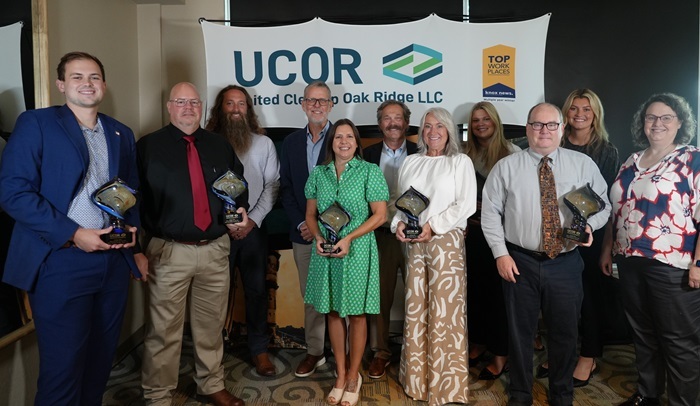 Recipients of UCOR’s small business awards this year include representatives from Aleut Demolition Services, Capitol Museum Services, Oliver Springs Portable Toilets, RSI Entech, Street Legal Industries and Turnkey Technical Services.
OAK RIDGE, Tenn. — Oak Ridge Office of Environmental Management (OREM) contractor UCOR recently recognized six small businesses at an annual awards program for their critical support to the U.S. Department of Energy (DOE) Office of Environmental Management cleanup mission.
“This event is a great way to recognize the exceptional work of small businesses and showcase tangible examples of how they are helping advance our mission,” said Erik Olds, OREM manager. “We also want to commend UCOR for their strong and continued commitment to small business partnerships.”
That commitment is evident in the numbers. UCOR has awarded $770 million, or 85%, of its subcontract work to small businesses in the past three years, far exceeding DOE’s goal to award 45% of that work to small businesses. UCOR began its current contract with OREM in 2022.
Each award recipient contributed to cleanup projects by providing outstanding customer service and exceptional responsiveness, according to the small business awards program.
One of the most notable examples is RSI Entech LLC (RSI). The Oak Ridge-based company specializes in environmental cleanup and beneficial site reuse, and has been instrumental in the cleanup and transformation of the East Tennessee Technology Park (ETTP).
RSI expedited sampling activities to ensure soil remediation at ETTP was completed on schedule. The company also provided crucial support that helped OREM receive approval for the first two groundwater-related records of decision for the site. RSI also contributed to innovative water management practices at the Environmental Management Waste Management Facility (EMWMF), an important onsite disposal facility enabling cleanup in Oak Ridge.
“RSI’s mission can be summed up in our purpose, which is to leave things better than we found them,” said Allison Getsi, RSI president. “We get the opportunity to do that as a partner with UCOR every day.”
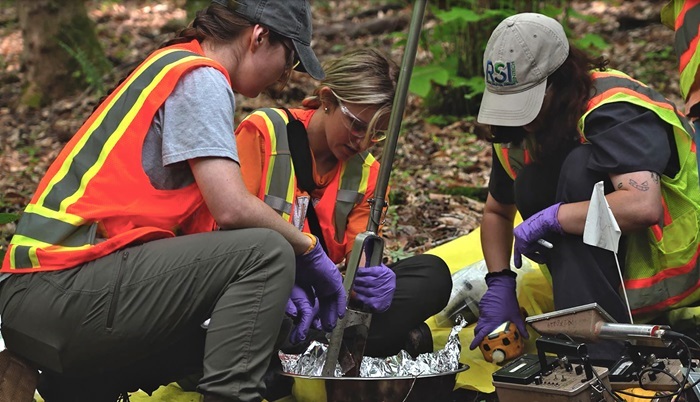 RSI Entech LLC employees gather soil samples to support characterization for cleanup projects across Oak Ridge. This is often the first step in fieldwork that helps provide insight to cleanup crews and ensures safe and effective cleanup.
The awards ceremony featured keynote speaker Charlie Smith, director of DOE’s Office of Small and Disadvantaged Business Utilization, and UCOR President and CEO Ken Rueter, who gave remarks and presented the awards.
Rueter told attendees what they do makes a difference.
“Each and every one of you exemplify our culture of excellence as demonstrated by your performance,” Rueter said. “Thank you for your commitment to excellence, safety and this project. Your partnership is integral to cleanup success.”
Partnerships with other subcontractors supported OREM and UCOR’s cleanup operations at Oak Ridge National Laboratory and the Y-12 National Security Complex.
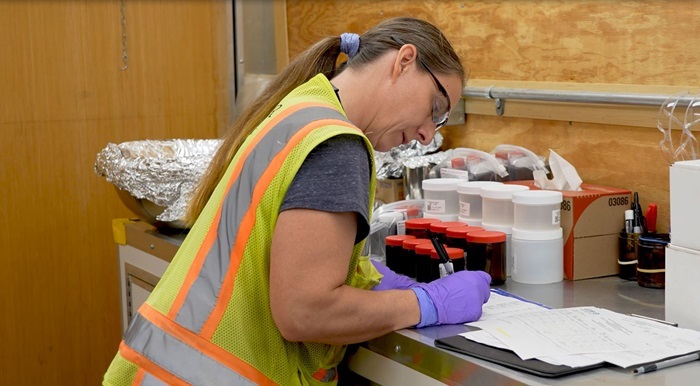 An RSI Entech LLC employee logs data from soil samples gathered in the field.
In addition to RSI, UCOR’s awards for top performance and the small businesses that received them this year are:
-
Aleut Demolition Services LLC: Based in Oak Ridge, Aleut contributed greatly to the success of an Alpha-2 building utility reroute project at Y-12. The company’s efforts to respond to challenges avoided months of delays and millions of dollars in costs for the project.
-
Capitol Museum Services (CMS): Based in Manassas, Virginia, CMS fabricated and installed displays at the newly constructed K-25 Interpretive Center. The facility overlooks the footprint of the former K-25 gaseous diffusion building and will help highlight the site’s history to visitors when it opens this August.
-
Oliver Springs Portable Toilets LLC (OSP): Based in Oliver Springs, Tennessee, OSP provided swift and timely service after a severe weather incident over a weekend. UCOR needed emergency service on a broken sewage pump. OSP’s response helped minimize damages and prevent the release of sewage water.
-
Street Legal Industries Inc. (Street Legal): Based in Oak Ridge, Street Legal provided services for the infrastructure of trailers at EMWMF. Despite challenges with trailer pad construction and delivery, the company worked 12-hour days to complete the trailer pad on schedule, preventing project delays.
-
Turnkey Technical Services LLC (Turnkey): Oak Ridge-based Turnkey’s quick turnout and availability provided UCOR with more than 30 trucks and drivers to haul clean soil for the construction of the Environmental Management Disposal Facility. This service allowed UCOR to meet the critical schedule for completion of early site preparation for this new waste disposal facility.
-Contributor: Ryan Getsi
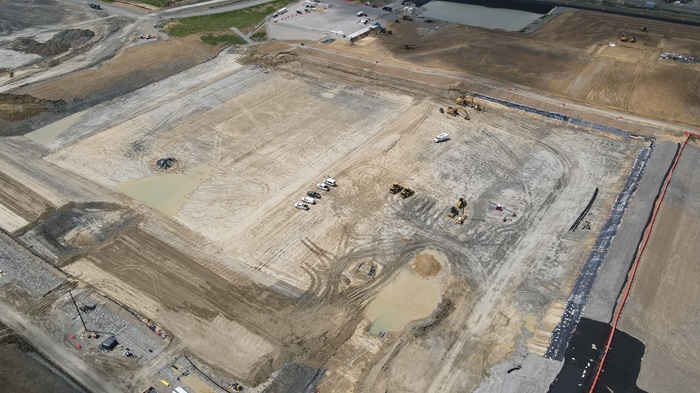 An aerial view looking southwest at the two cells being constructed at the On-Site Waste Disposal Facility at the Portsmouth Site.
PIKETON, Ohio — Cleanup crews have placed the final layer of a special soil forming the ideal foundation for two new cells being constructed at the On-Site Waste Disposal Facility (OSWDF) at the Portsmouth Site.
These new waste disposal cells will accept debris from the X-333 Process Building, the second of three former uranium enrichment process buildings currently being demolished at the site. This work expedites environmental cleanup of the site and provides more land for future reuse.
Known as select fill, the backfill soil has been screened to eliminate stone or particles larger than 3 inches in size to meet specific permeability and density requirements.
U.S. Department of Energy Office of Environmental Management (EM) Portsmouth Site Federal Project Director Jud Lilly noted the many tasks involved in placing this compacted soil in the two cells being built at the OSWDF, which currently has four active cells.
“Completing the select fill placement for these two additional cells involved safely excavating, screening, hauling, placing, compacting, testing and surveying screened soil,” Lilly said. “The workers kept at it through the tough winter conditions. They did a great job, and now we are all glad to have safely reached this point.”
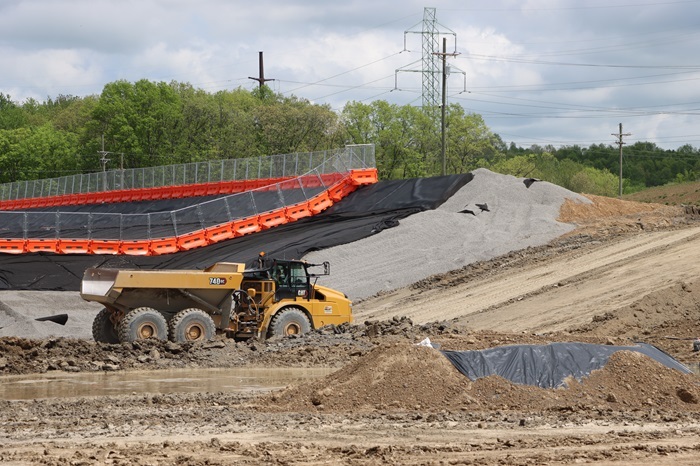 A dump truck departs one of two new cells being constructed via a ramp at the On-Site Waste Disposal Facility at the Portsmouth Site.
Crews hauled and placed the soil using heavy equipment such as screeners, radial stackers, soil stabilizers, compactors, bulldozers, excavators, motor graders, water trucks and 40-ton articulated dump trucks.
The select fill can be up to 13 feet thick in some areas. Each layer of the cell is surveyed to ensure the slope of the surface is consistent with the OSWDF engineering design.
“We have a grid of control points along the top and toe of the slopes for each cell, as well as across all the floors of each cell that have to be approved by engineering,” said Mason Thomas, land surveyor for Fluor-BWXT Portsmouth, EM's prime contractor for decontamination and decommissioning activities at the site. “Then we locate and double check the points in the field.”
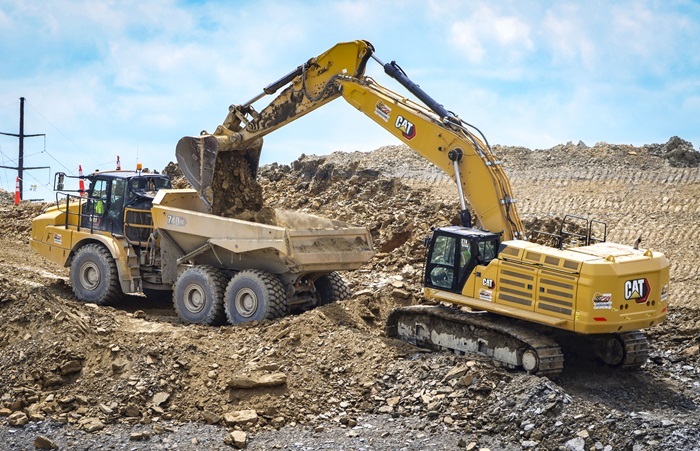 An excavator operator fills a dump truck near one of two cells being built at the On-Site Waste Disposal Facility at the Portsmouth Site.
Reaching the select-fill milestone for the two disposal cells being constructed allows workers to execute the next step in cell construction, placing and compacting about 67,000 cubic yards of clay, forming the clay layer of each new cell’s multilayer liner system. To compare, a cubic yard of material is enough to fill the bed of a standard pickup truck.
Workers will place the clay layer in 8-inch loose layers, then compact it to 6 inches. They will repeat that process six times until a 3-foot-thick clay layer is constructed.
The new cells are expected to be ready to accept waste from the X-333 demolition in the spring next year.
The Portsmouth Paducah Project Office conducts cleanup activities at the Portsmouth Site in accordance with a consent decree with the state of Ohio and director’s final findings and orders with the Ohio Environmental Protection Agency.
-Contributor: Michelle Teeters
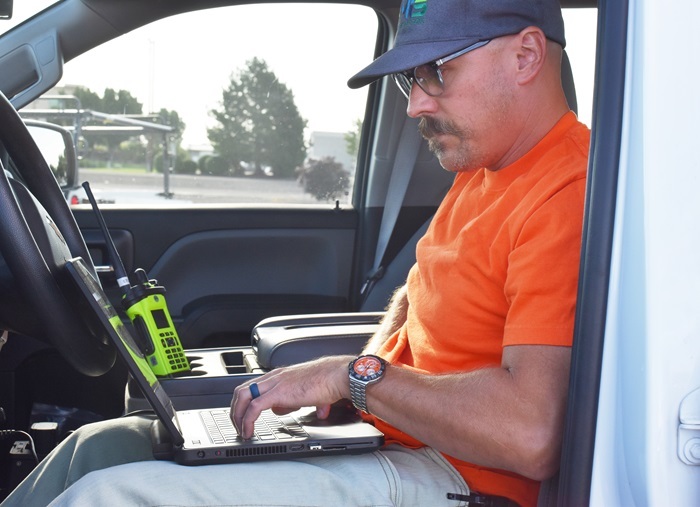 Quinn Bragg, a radio maintenance technician with Hanford Mission Integration Solutions, programs handheld and vehicle radios on the Hanford Site’s updated emergency communication system for first responders.
RICHLAND, Wash. — First responders at the Hanford Site have a new radio system that makes it easier to communicate and improves site safety during emergencies.
Hanford Field Office contractor Hanford Mission Integration Solutions (HMIS) launched the upgraded system this summer. The modern simulcast system enhances coverage — especially inside buildings — and supports clearer and more efficient communication across the 580-square-mile site. It also works with radio systems other first responders use in the region, maximizing coordination during mutual aid efforts.
“The ability to respond quickly and effectively during emergencies is essential to our mission,” said Tim Haddick, Hanford Field Office director of security and emergency services. “By modernizing our equipment and infrastructure, our teams are better equipped to protect people, property, and the environment, both onsite and by mutual aid to our community.”
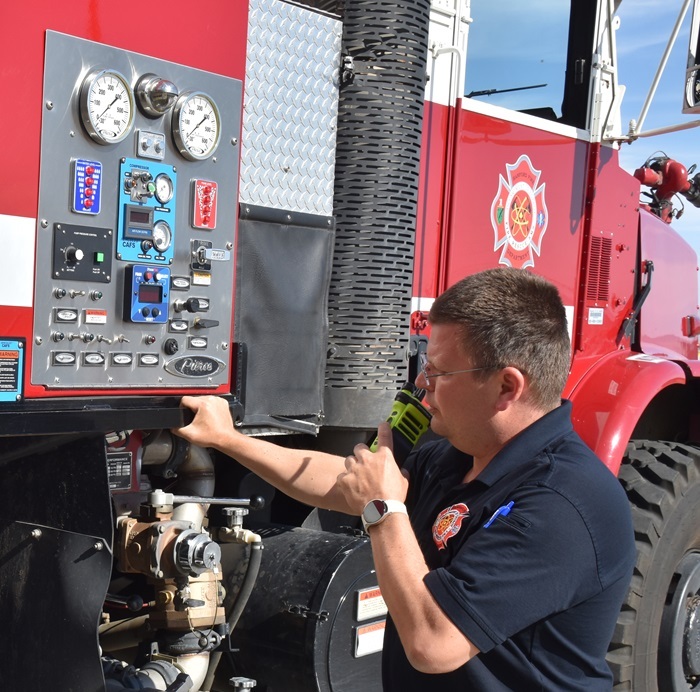 With a new emergency radio system in place, Hanford Site firefighter Robbert Sadesky takes a call on a handheld radio while performing a daily vehicle check.
The new radio system also automates encryption, making communications secure without manual steps or extra gear. Another key feature is the system’s ability to handle multiple conversations at the same time, without needing extra channels.
Switching to the new system was complex and involved careful planning and coordination among the Safeguards, Security and Emergency Response, Information Management Services and Engineering and Projects teams at HMIS. The system’s manufacturer, Motorola, was also involved in the process.
“Integrating the new technology with existing infrastructure posed some challenges,” said Todd Eckman, HMIS vice president of Information Management Services. “Our teams did a great job working together to overcome those hurdles to get the system up and running.”
-Contributor: Dustin Arbogast
|