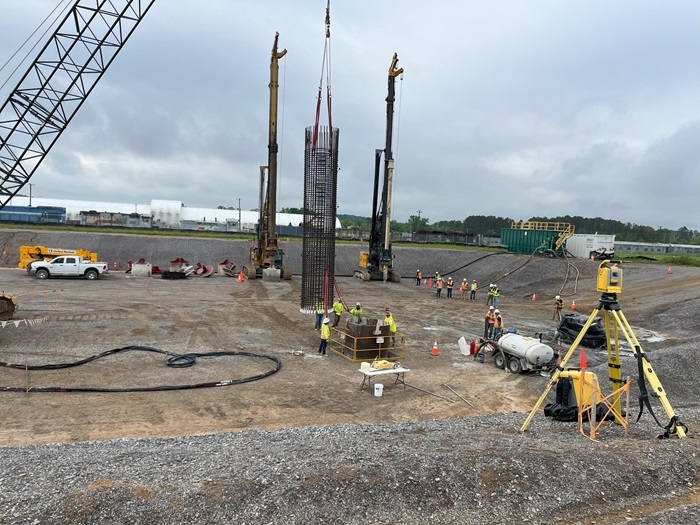
 Construction is progressing on Kairos Power’s low-power demonstration reactor at the East Tennessee Technology Park at Oak Ridge. Early work involved deep digs requiring removal of subsurface infrastructure. Workers are seen digging and installing piers for the facility’s foundation.
OAK RIDGE, Tenn. — In a unique collaboration, the Oak Ridge Office of Environmental Management (OREM) and contactor UCOR recently assisted one of the largest companies locating at the East Tennessee Technology Park (ETTP), helping keep a key energy project on track.
OREM completed a two-decade cleanup effort at ETTP last year that removed 500 buildings and excavated more than 50,000 dump truck loads of soil. This work cleared away old, contaminated infrastructure and environmental risks, providing the community with large amounts of reusable land to attract new economic opportunities.
One such opportunity came when Kairos Power announced a $100 million investment on the former U.S. Department of Energy-owned land at ETTP in 2021. The company purchased a 185-acre parcel that previously housed the massive K-31 and K-33 uranium enrichment buildings demolished as part of the cleanup. While OREM removed the buildings and slabs, some subsurface electrical infrastructure was left in place.
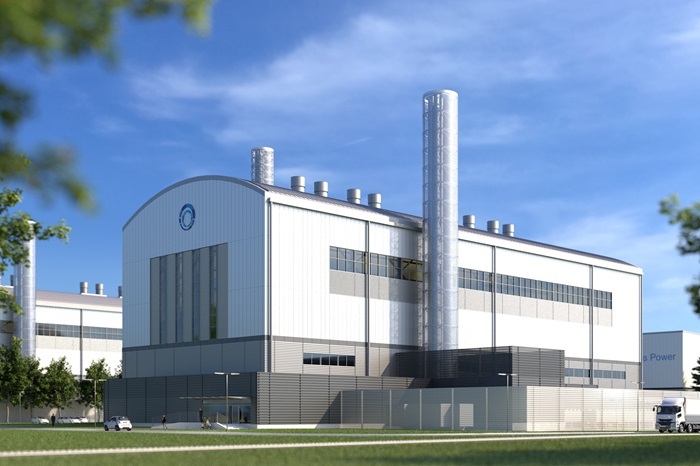 A rendering of Kairos Power’s Hermes Low-Power Demonstration Reactor when construction is complete. Coordination among Kairos Power, the Oak Ridge Office of Environmental Management and contractor UCOR helped avoid impacts to the construction timeline for this project.
Constructing a sturdy foundation for the company’s Hermes Low-Power Demonstration Reactor involved deep digs requiring the removal of that subsurface infrastructure, including large amounts of lead and copper wire.
“When we started excavation, we coordinated with the Department of Energy, and they let us know there were some underground duct banks,” said Marty Bryan, Tennessee Site Integration director for Kairos Power. “We coordinated closely with them throughout the whole process, and they were very good at supporting us and working with us on the characterization of this material.”
Through coordination and support from OREM and UCOR, Kairos Power was able to confirm the excavated materials were safe for normal disposal, while a significant portion could be recycled to generate major savings. With this confirmation, Kairos Power was able to recycle 18 super sacks containing more than 70,000 pounds of lead and copper.
Through this partnership, the company was able to maintain the timetable for the Hermes project, which is helping to commercialize advanced reactor technology to support the nation’s energy future. This ongoing effort avoids costly disposal pathways, generates revenue, and provides lessons learned and best practices for future digs across the site as industrial development continues.
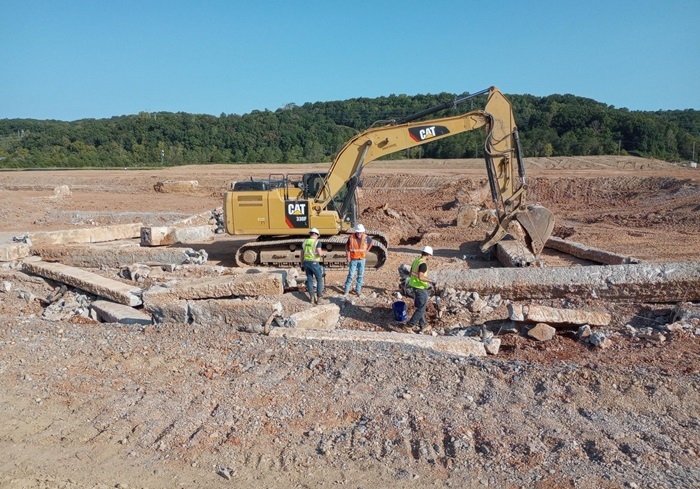 Construction crews at the East Tennessee Technology Park at Oak Ridge excavate old underground electrical duct banks that once supported the K-33 uranium enrichment facility.
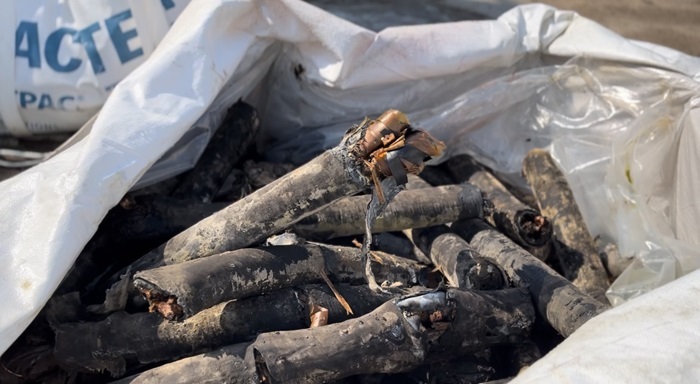 Excavated old electrical infrastructure beneath the site of the former K-31 and K-33 uranium enrichment facilities at the East Tennessee Technology Park contained large amounts of lead and copper.
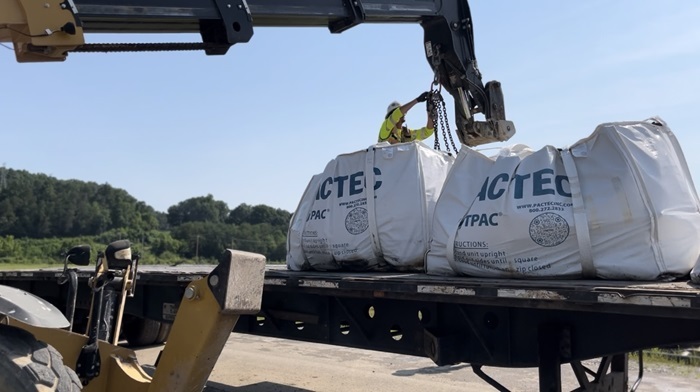 Workers supporting construction of Kairos Power’s low-power demonstration reactor at the East Tennessee Technology Park load sacks of lead and copper from excavations for recycling, which will generate savings for the company.
To date, OREM has transferred more than 1,800 acres at ETTP for economic development. That land has attracted more than 25 businesses that have announced nearly a billion dollars in capital investments, and more transfers and developments are expected in the years ahead.
ETTP is formerly known as the K-25 Site or Oak Ridge Gaseous Diffusion Plant, which operated from the mid-1940s until 1985. The plant was originally used to enrich uranium as part of the Manhattan Project, but it continued operations after World War II to produce enriched uranium for defense missions and commercial power generation.
-Contributor: Ben Williams
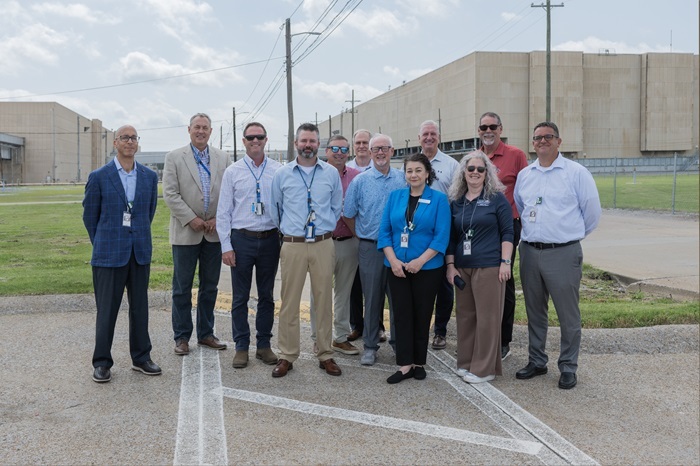 Kentucky Nuclear Energy Development Authority members pose for a photo with Portsmouth Paducah Project Office staff and community leaders during a recent Paducah Site tour.
PADUCAH, Ky. — Leaders from the Portsmouth Paducah Project Office (PPPO) met with representatives from the Kentucky Nuclear Energy Development Authority (KNEDA) during their first visit to the Paducah Site.
The visit underscored the U.S. Department of Energy Office of Environmental Management (EM) Paducah Site’s growing role in the nation’s energy renaissance and its prime location for reindustrialization in conjunction with the local community’s vision.
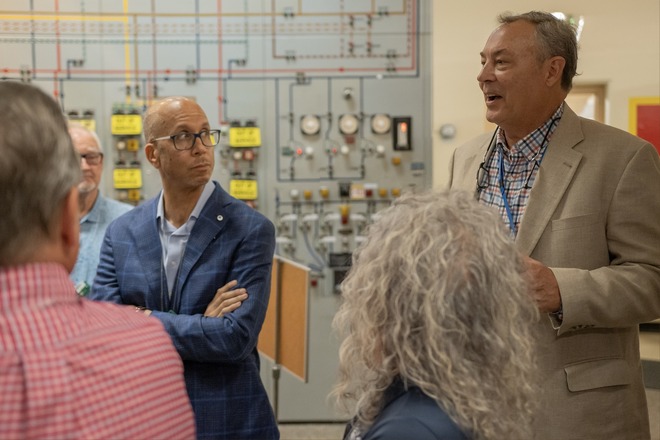 Portsmouth Paducah Project Office Manager Joel Bradburne, right, speaks during a Paducah Site tour with members of the Kentucky Nuclear Energy Development Authority, who visited the site to explore its potential role in the future of nuclear energy and reindustrialization.
KNEDA was established in 2024 with unanimous support by the Kentucky legislature to serve as the nonregulatory, trusted state agency on nuclear energy issues and development. The authority supports and enables the development of nuclear energy across Kentucky collaboratively to enhance the economy, support economic development opportunities and increase energy education. The organization has a unique interest in the Paducah Site and has engaged the community to prepare resources for a future workforce.
“We knew it was important to host the first in-person Kentucky Nuclear Energy Development Authority in Paducah, where nuclear in Kentucky got its start,” said KNEDA Chair Rodney Andrews, who also serves as the director of the University of Kentucky Center for Applied Energy Research. “We felt it was important for KNEDA members to start our visit with a tour of the Paducah Site, where we learned about its important role in our nation’s history, as well as the work currently done at the site for redevelopment and expanded economic opportunities.”
As cleanup accelerates and progress continues toward transferring the first parcel of land at the Paducah Site for reuse, stakeholders like KNEDA are partnering with EM and the community to ensure Paducah, Kentucky, is a part of the future of energy.
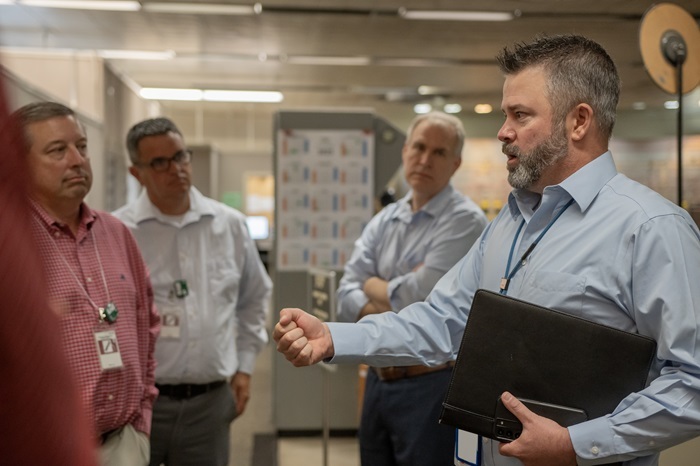 Federal Project Director William Wessel leads a tour with Kentucky Nuclear Energy Development Authority members at the Paducah Site.
“Working with our stakeholders, with the support of organizations like KNEDA, is essential to realizing the cleanup and reindustrialization goals for the Paducah Site,” PPPO Manager Joel Bradburne said. “KNEDA and other parties interested in the future of the site will play an important role as we continue to assist the community in realizing their vision.”
In addition to the strategic partnerships with KNEDA and others, EM supports reindustrialization studies with local organizations to generate a roadmap that identifies pathways for commercial development and fosters workforce growth for the site and region.
The Paducah Site continues to conduct cleanup activities in accordance with the Comprehensive Environmental Response, Compensation, and Liability Act for the safe cleanup and future demolition of the former uranium enrichment facilities.
-Contributor: Dylan Nichols
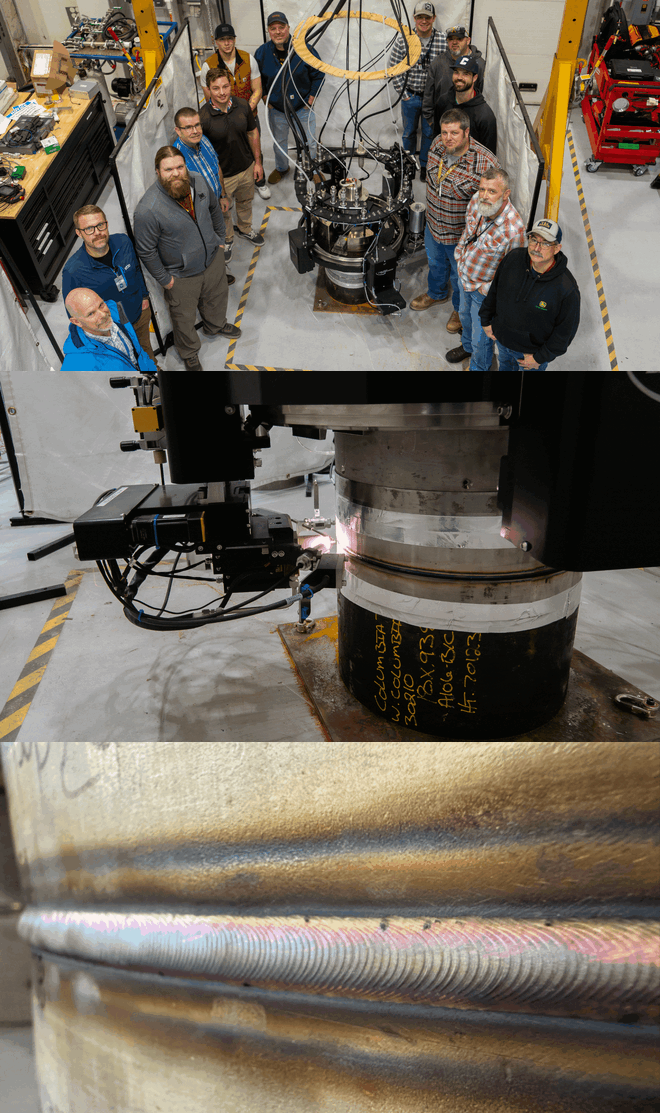 Scenes from a recent demonstration of the capabilities and readiness of a new closure welding system that seals U.S. Department of Energy standard canisters containing spent nuclear fuel.
IDAHO FALLS, Idaho — Teams from the U.S. Department of Energy (DOE) offices of Environmental Management (EM) and Nuclear Energy (NE) recently collaborated on a demonstration of new equipment to seal spent nuclear fuel into a safe, transportable “road ready” system for future shipment out of Idaho.
EM and contractor Idaho Environmental Coalition LLC, and NE and contractor Battelle Energy Alliance (BEA) showcased the capabilities and readiness of the closure welding system at the Idaho National Laboratory Site.
Designed by BEA, the system is part of the spent nuclear fuel Road Ready Demonstration Project. In the future, EM and IEC will load spent fuel currently in an onsite dry storage facility into canisters and use the closure welding system to seal the loaded canisters. This work ensures the long term safety of spent nuclear fuel currently stored in Idaho and helps meet a DOE commitment to remove the material from the state.
The welding system is unique in that it attaches to a canister and automatically performs the closure weld. It then uses ultrasonic testing technology to inspect the weld, ensuring the weld is code-compliant and the canister meets applicable closure requirements.
The Road Ready Demonstration Project is developing the designs, technology, processes and licensing framework necessary to load and seal one “road ready” system, which consists of loaded DOE standard canisters placed into multipurpose canisters stored in larger transportable casks.
The demonstration occurred as EM's Idaho Cleanup Project completed the first of many modifications to a legacy facility to get spent nuclear fuel “road ready.” EM and IEC installed an insert into a transfer car that moves large casks containing spent nuclear fuel through a storage area.
ICP crews also recently completed a significant achievement by transferring 40 spent nuclear fuel baskets into safer, long term storage vaults. They finished the final transfer — moving the spent fuel from older, first-generation vaults to new, second-generation vaults — several months ahead of schedule.
And in 2023, ICP crews finished transferring the remainder of spent nuclear fuel from a pool to safer, dry storage nine months ahead of an Idaho Settlement Agreement milestone. EM worked closely on that project with NE and the Office of Naval Reactors Idaho Branch Office.
-Contributor: Carter Harrison
ARLINGTON, Va. — Progress by the U.S. Department of Energy (DOE) Office of Environmental Management (EM) to drive down risks and build new opportunities for communities and the nation takes center stage at this year’s National Cleanup Workshop.
Much of EM’s planned work for this year reduces risk and connects to broader DOE objectives that bring benefits to communities and the nation. The cleanup program is transforming liabilities into opportunities to unleash American energy, support national security and enable U.S. innovation and jobs.
Speakers and panelists at the 11th annual National Cleanup Workshop, set for Sept. 24-25 in Arlington, Virginia, will detail EM’s next phase of accomplishments and how the cleanup program supports a new era of America energy. Participants will highlight EM’s work to enable efficiency and drive innovation at Oak Ridge; a new phase for the Hanford Site cleanup; and a new vision for the Portsmouth, Ohio, and Paducah, Kentucky, sites. They also will focus on tackling EM waste challenges, and new energy and artificial intelligence infrastructure projects at DOE sites.
EM Principal Deputy Assistant Secretary Roger Jarrell and other members of the cleanup program’s leadership team are among the speakers scheduled for the event.
A growing list of federal representatives, industry officials and state and local leaders will also speak at the workshop, billed as the premier annual gathering to discuss progress in EM’s environmental cleanup of former government weapons sites and nuclear research facilities.
The workshop brings together senior DOE executives and other federal partners, officials from DOE sites, industry leaders, local elected officials, state officials, and other stakeholders. It’s hosted by the Energy Communities Alliance, in cooperation with the Energy Facility Contractors Group and EM.
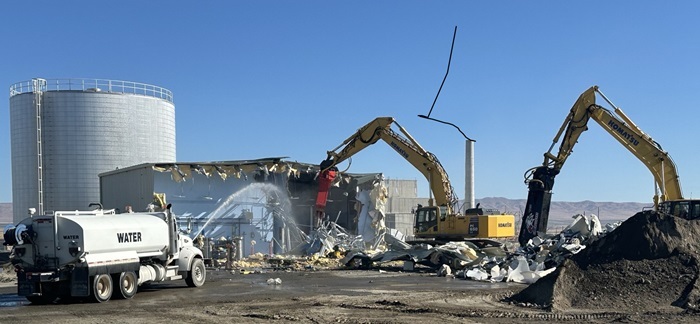 Heavy equipment tears into a former water treatment facility that supported cleanup in the Hanford Site’s K Reactors area near the Columbia River.
RICHLAND, Wash. — Hanford Site workers recently demolished a 6,000-square-foot water treatment facility near the Columbia River that once supported major risk-reduction work.
The facility provided water for fire protection and dust suppression during the "cocooning" of the K East Reactor and removal of radioactive sludge from the K West Reactor’s spent fuel basin. Other fire and dust suppression systems are in place to support future cleanup activities at the reactor site.
Before demolition began, crews from Hanford Field Office contractor Central Plateau Cleanup Company removed hazardous materials and disconnected the building’s electrical and mechanical systems. Workers also drained about 365,000 gallons of water from a nearby water tank before that was taken down, too.
The debris was safely delivered to Hanford’s regulated disposal facility.
Watch the demolition in time-lapse here.
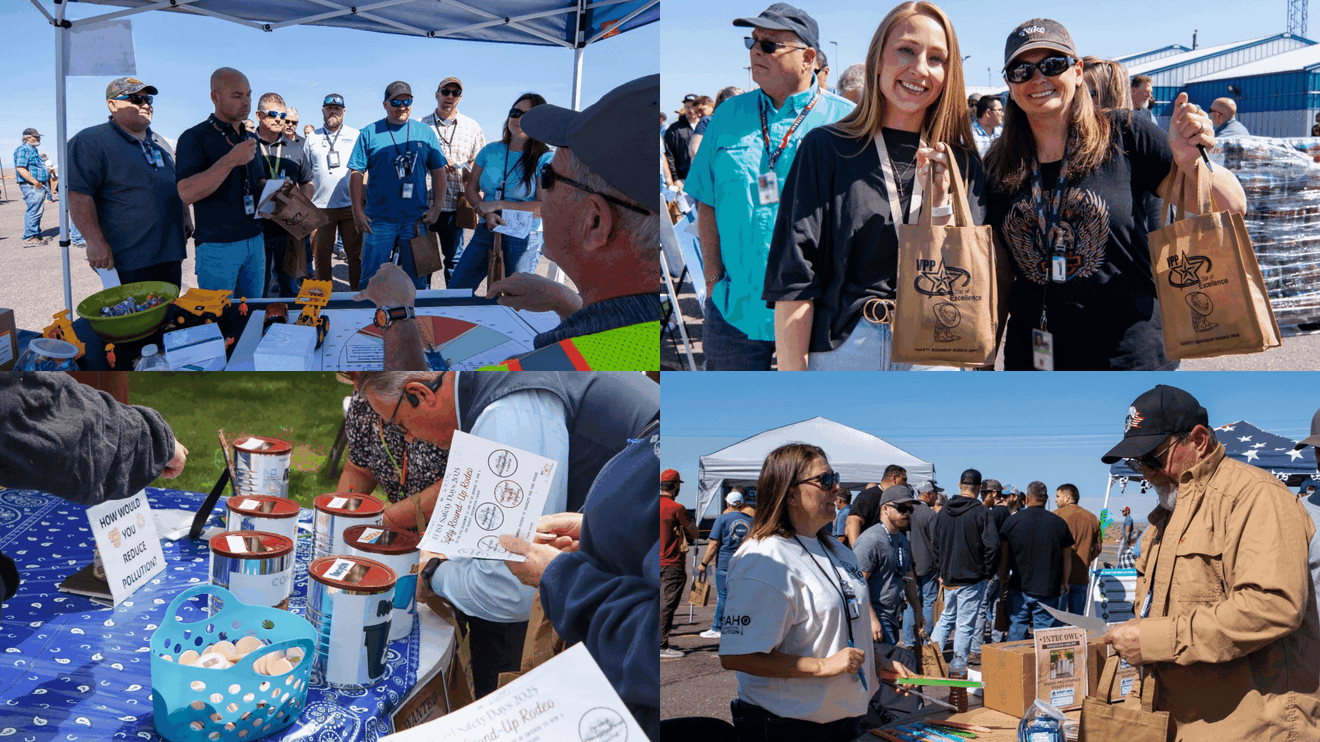
IDAHO FALLS, Idaho — Each year, Idaho Cleanup Project (ICP) team members host the Safety Days event, where they reinforce safety principles with the workforce.
This year, U.S. Department of Energy Office of Environmental Management cleanup contractor Idaho Environmental Coalition LLC organized events at four key cleanup projects at the Idaho National Laboratory Site. Employees participated in educational activities that highlight personal safety at work and at home.
This year’s Safety Days themes centered on health and wellness; cybersecurity; emergency response; science, technology, engineering, arts and math (STEAM) education and volunteerism; environmental stewardship; motor vehicle safety; and the importance of procedural compliance.
Saprena Lyons manages several ICP health and safety programs, including the Voluntary Protection Program, Integrated Safety Management System, and Safety Culture and Human Performance Improvement programs.
“It is vital that our employees engage in safety and understand the important role they play in their own personal safety,” Lyons said. “Safety Days is a great way for our workforce to learn more about topics that keep them safe on the job and at home.”
-Contributors: Leslie Dal Lago, Allie Hoskins
|