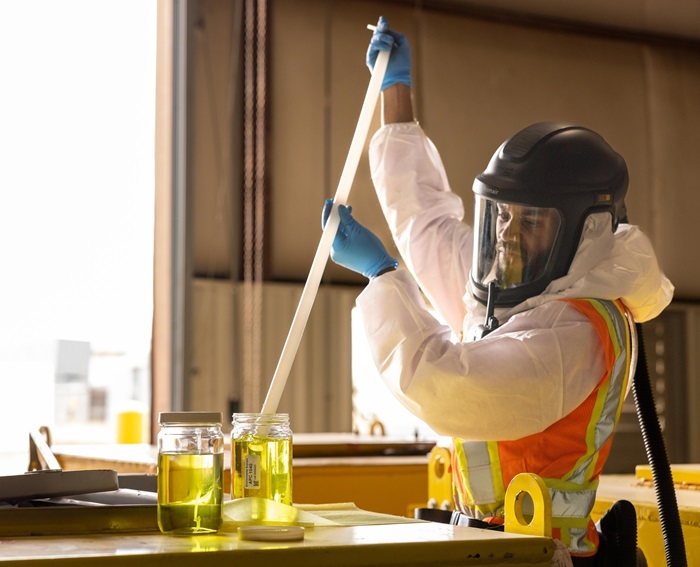
 A worker with EnergySolutions collects a sample to confirm the Hanford Site tank waste meets requirements before it is grouted.
RICHLAND, Wash. — Approximately 2,000 gallons of treated tank waste from the Hanford Site have been safely and successfully solidified in grout and permanently disposed of at licensed commercial facilities as part of the U.S. Department of Energy Office of Environmental Management’s Test Bed Initiative.
“This is an innovative effort to demonstrate options with the potential to accelerate the Hanford tank-waste mission in a safe, effective and efficient manner,” said Katie Wong, program manager with the Hanford Field Office Tank Farms Programs Division. “This major accomplishment reflects the strong collaboration with our tank-waste contractor and commercial disposal partners.”
Following in-tank treatment at Hanford to reduce radioactivity by more than 99%, contractor Hanford Tank Waste Operations & Closure (H2C) shipped it to Waste Control Specialists in Texas and EnergySolutions in Utah where it was grouted and disposed of in accordance with regulatory requirements.
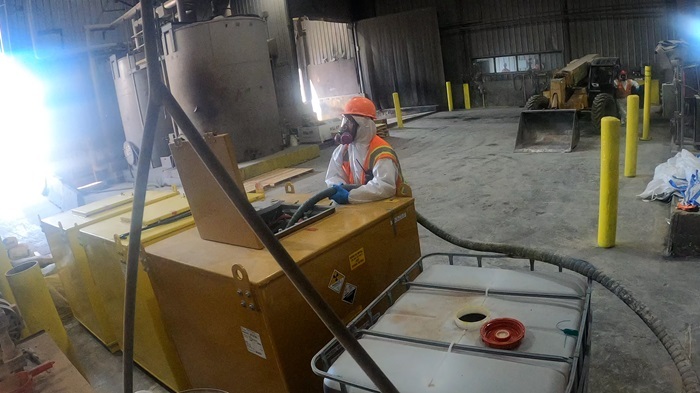 A worker prepares to transfer 1,000 gallons of Hanford Site liquid waste from one of three containers for grouting and disposal at EnergySolutions in Clive, Utah.
 |
|
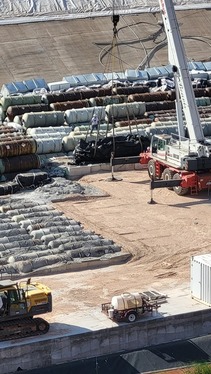
After grouting, the team from Waste Control Specialists prepared the treated Hanford Site tank waste for safe disposal in Texas. |
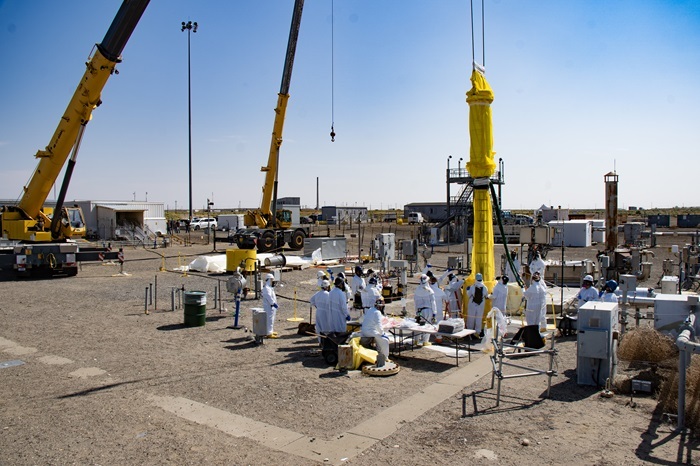 Crews with Hanford Waste Treatment Operations & Closure have removed equipment used to treat the tank waste that reduce radioactivity by more than 99%.
In addition, crews from H2C have removed the equipment from the tank used to treat the waste.
“Every step of this initiative was carried out with great leadership, teamwork and a shared commitment to safely advancing our cleanup mission,” Wong added.
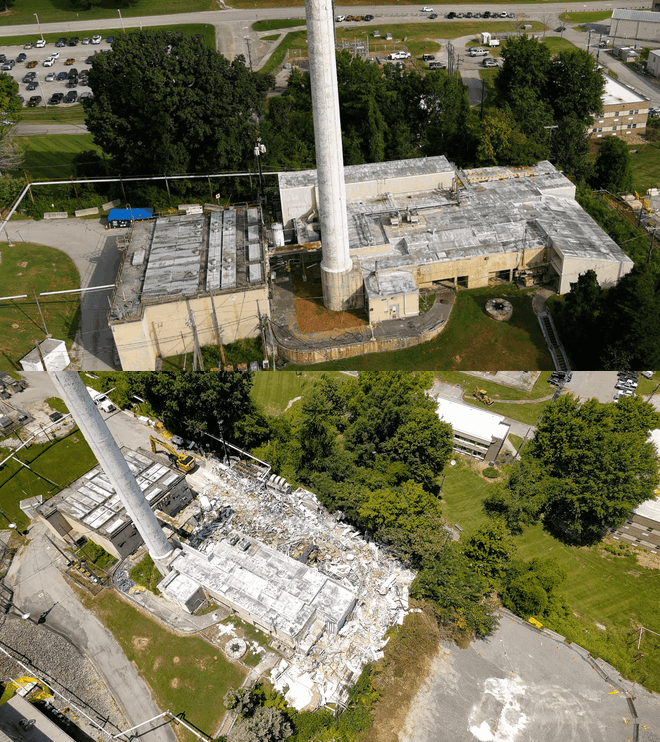 Aerial views show the Graphite Reactor support facilities prior to demolition and as demolition is underway. They include Building 3003, right, Building 3002, left, and the Building 3018 stack, center. These structures are located on a small footprint in a heavily congested area on top of a hill at Oak Ridge National Laboratory.
OAK RIDGE, Tenn. – For the first time ever, cleanup crews are conducting more than one demolition project simultaneously at Oak Ridge National Laboratory (ORNL).
While crews with the Oak Ridge Office of Environmental Management (OREM) and contractor UCOR begin demolishing Building 3003, another team is tearing down the former Radioisotope Development Lab, one of the most contaminated structures at the site.
Used during the Manhattan Project, Building 3003 is one of three support facilities for the former Graphite Reactor, the world’s oldest reactor. The structures are located on a small footprint in a heavily congested area on top of a hill. Removing Building 3003 provides space to support teardowns of the neighboring facilities.
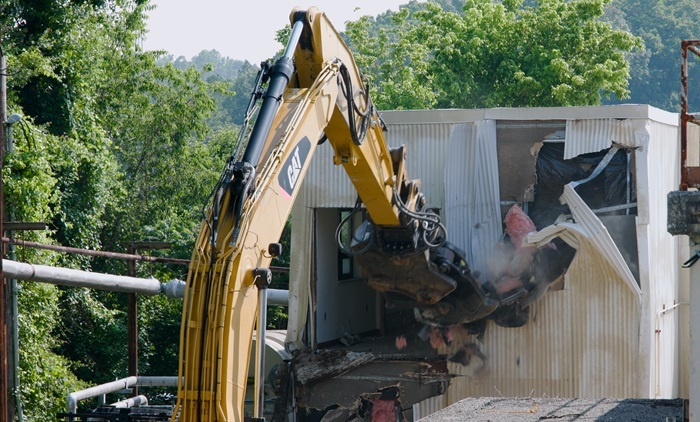 Demolition crews take the “first bites” of Building 3003 at Oak Ridge National Laboratory. Teardown on the outer portion of the facility is scheduled for completion this month with debris removal expected to be finished in early August.
This project is clearing 10,000 feet for workers and heavy equipment operators to demolish the adjacent Building 3002 and Building 3018, a 200-foot-tall stack.
“Reaching this milestone is important,” said Chad York, ORNL area project manager at OREM. “Our purpose at ORNL is to make the overall footprint cleaner, safer and prepared for future missions. This is our first demolition at the Graphite Reactor complex, and the additional real estate generated from this demo will ease some the spatial constraints for the demolitions that follow.”
Built in 1943, Building 3003 contained a fan house and provided ventilation for the Graphite Reactor. The fan house drew air from the reactor through underground ducts and released it through the stack.
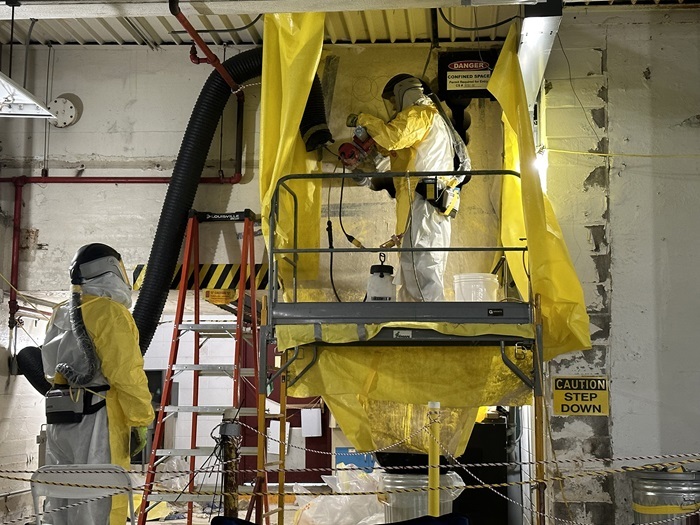 Workers perform deactivation activities inside Building 3003 at Oak Ridge National Laboratory before demolition begins.
To prepare for demolition, workers made multiple entries into the subgrade duct space to perform sampling, survey and spray fixative. They removed general debris and hazardous waste, and poured a concrete mixture into the exterior utility trench to ensure a flat working surface around the building.
“A lot of work went into getting us to this point,” said Mike Vestal, OREM project manager. “That success reveals a lot about this workforce and our effort to achieve our cleanup mission at ORNL."
Demolition on the outer portion of Building 3003 is scheduled for completion later this month with debris removal expected to be finished in early August. Teardown of Building 3002 and Building 3018 will occur in coming years.
The removal of these facilities clears away aging, contaminated structures, opens land for reuse and enhances accessibility to the Graphite Reactor, which is part of the Manhattan Project National Historical Park.
-Contributor: Carol Hendrycks
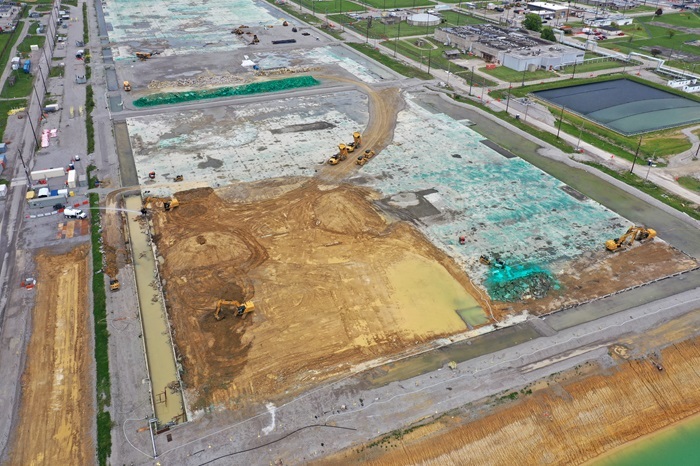 Crews excavate soil in the 5-Unit Area Plume at the Portsmouth Site. In this sixth of 13 phases of the project, they will excavate about 170,000 cubic yards of soil for use at the On-Site Waste Disposal Facility for the placement of debris from the X-333 Process Building currently being demolished at the site.
PIKETON, Ohio — Crews at the Portsmouth Site have kicked off another phase of excavating a legacy groundwater plume at the Portsmouth Site to provide a substantial source of impacted soil for use at the On-Site Waste Disposal Facility (OSWDF) for the disposal of debris from the X-333 Process Building demolition.
This is the sixth of 13 phases for the 5-Unit Plume Area Excavation Project, which will ultimately provide more contiguous land for future use of the site. In the sixth phase, crews are set to excavate approximately 170,000 cubic yards of impacted soil for use at the 5 million-cubic-yard OSWDF for the placement of debris from X-333, the second of three former uranium enrichment process buildings currently being demolished at the site.
All remaining phases of the excavation project are expected to provide about 350,000 cubic yards of soil for use as fill at the OSWDF, which equates to about 29,000 dump truck loads of soil.
“Landfill and plume excavation is a key part of our integrated project strategy at the site.” Portsmouth Site Lead Jeremy Davis said. “By carefully planning our excavation activities, we are prepared to safely and responsibly support the pace of building demolition and OSWDF operations.”
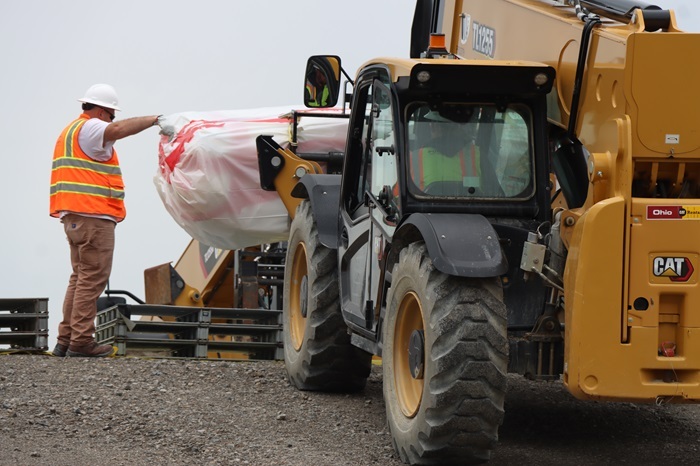 Workers unload a bundle of transite panels from the X-333 Process Building at a ramp at the On-Site Waste Disposal Facility. Soil from the 5-Unit Area Plume will be used as engineered fill to provide stability to materials like the transite panels being placed in the disposal facility.
Portsmouth Site officials have said that using soil from legacy groundwater plumes and old landfills onsite avoids the cost of buying clean fill for OSWDF, expedites environmental cleanup of the site and provides more land for future reuse.
The pace set for the excavation of soil from the groundwater plume is driven by multiple factors, including the need for soil at OSWDF, progress on the X-333 demolition and the amount of debris generated during the demolition. The demolition activities increase the need for impacted soil, which in turn advances environmental cleanup as crews use the soil from the plume at OSWDF.
“We are working to clean up an area that was once impacted by trichloroethylene, a chemical used to clean equipment, and in the process, produce enough engineered fill for use in the OSWDF,” Fluor-BWXT Portsmouth (FBP) Environmental Remediation and Environmental Protection Director Jyh-Dong Chiou said. “Initiating this phase of the project is integral to providing sufficient amounts of engineered fill to be used in the OSWDF to start placement of X-333 Process Building demolition debris.”
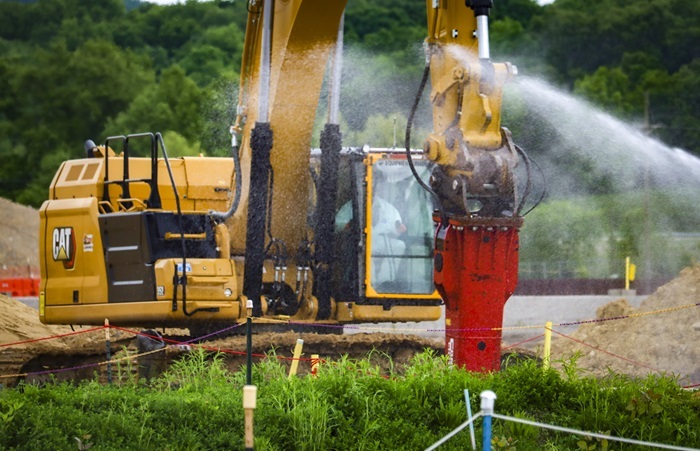 Operator Brent Groves uses heavy equipment to break through concrete of the former X-326 Process Building. Workers removed the southwestern portion of the foundation to reach the outer edge of the 5-Unit Area Plume to excavate soil for use at the On-Site Waste Disposal Facility. Water is sprayed onto the work area for dust suppression.
Crews with FBP, the deactivation and demolition contractor for the Portsmouth Site, initiated the sixth phase with the demolition and excavation of a portion of the concrete foundation from the X-326 Process Building, the first process building demolished at the Portsmouth Site. Workers removed the southwestern portion of the foundation to reach the plume's outer edge.
Overall, the plume is about 33 acres, resulting from a number of sources of groundwater contamination. All 13 phases of excavation of impacted soils from the plume are scheduled to be complete in 2027.
To date, workers have transported approximately 60,000 truckloads of soil and debris from the plume area to OSWDF, traveling nearly 20,000 miles to transport the dirt and debris.
The Portsmouth Paducah Project Office conducts cleanup activities at the Portsmouth Site in accordance with a consent decree with the state of Ohio and director’s final findings and orders with the Ohio Environmental Protection Agency.
-Contributor: Michelle Teeters
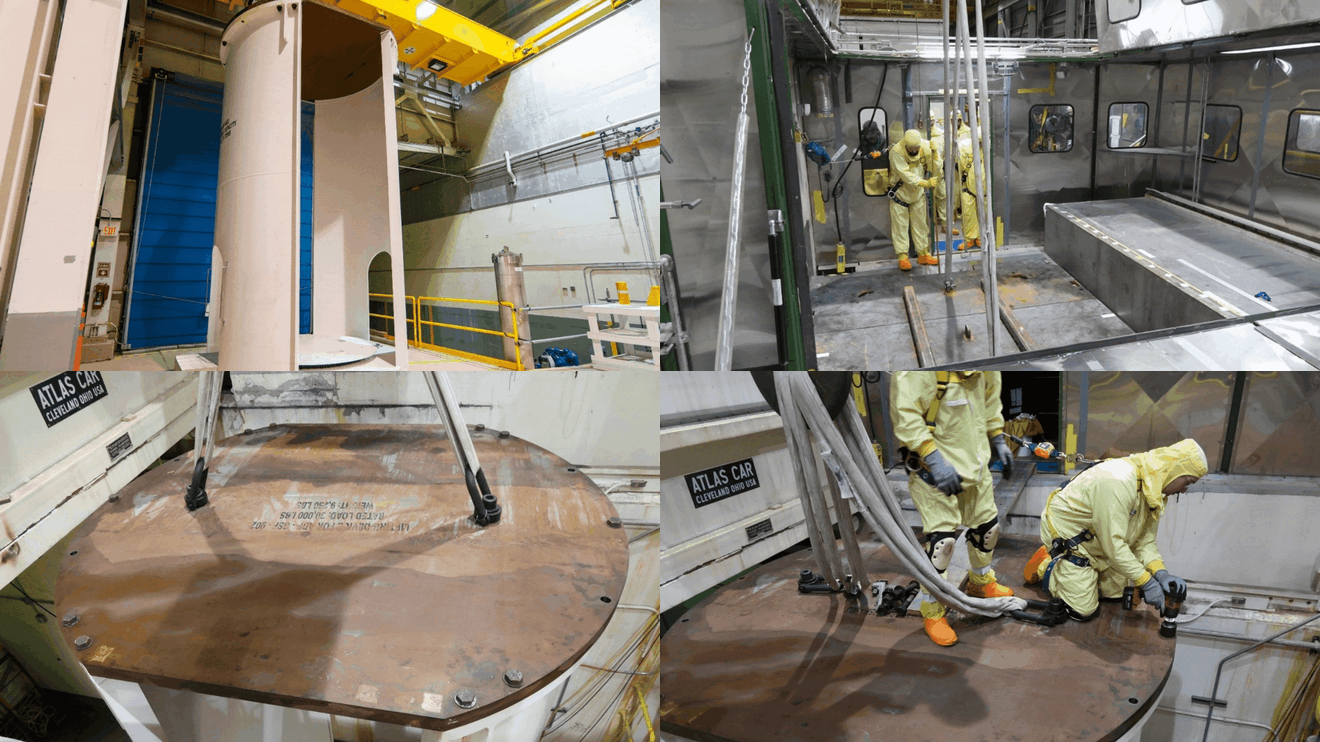 This series of photos offers a glimpse into the first of many modifications to get spent nuclear fuel “road ready” for future shipment out of Idaho. Crews installed a new insert into a transfer car that moves large casks containing spent nuclear fuel through a storage area.
IDAHO FALLS, Idaho — Crews with the Idaho Cleanup Project (ICP) successfully completed the first of many modifications to a legacy facility to get spent nuclear fuel “road ready” for future shipment out of state.
The U.S. Department of Energy (DOE) Office of Environmental Management (EM) and cleanup contractor Idaho Environmental Coalition LLC (IEC) installed a large cask insert into a transfer car at the Irradiated Fuel Storage Facility.
The insert, installed into a transfer car that moves large casks containing spent nuclear fuel through a storage area, will support the Road Ready Demonstration Project. In the project, workers will remove the spent fuel from storage and package it into transportable road ready systems for removal in accordance with an agreement between DOE and the state.
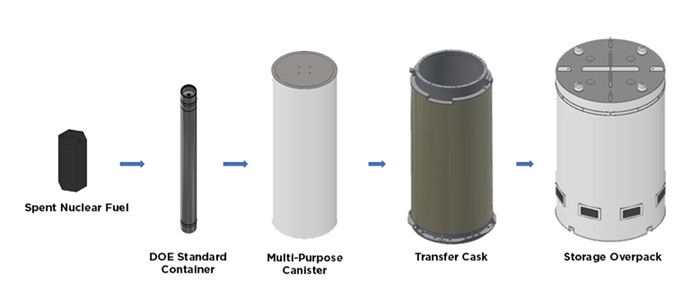 The Road Ready Demonstration Project will transfer spent nuclear fuel to a storage configuration safe for transport for permanent disposal.
The process of installing the insert spanned several months, beginning with modifications to the insert itself. Fabricators installed a turntable on the insert base to enable future maintenance and improve operations during large cask projects.
Crews followed strict radiological and safety protocols to remove the previous spent fuel transfer car insert and bolt the new one to the transfer car. That car moves casks through a below-grade pit to a location where spent nuclear fuel is handled remotely and prepared for storage.
The new insert will allow crews to handle large casks as heavy as 130 tons for packaging anticipated fuel types. The transfer car will continue to support an existing mission to place spent nuclear fuel from the Advanced Test Reactor at the Idaho National Laboratory Site into dry storage.
“I am incredibly proud of our spent nuclear fuel projects team for completing this phase of our road ready project,” IEC President and Program Manager Dan Coyne said. “We take our commitments to the state seriously and this group is bringing us one step closer to achieving our ultimate goal.”
ICP has begun the next phase of modifications, including changes to the facility’s truck bay. In coming months, the existing truck bay ramp will be backfilled and replaced with a level concrete floor for future equipment staging.
Planned modifications will improve the facility’s ability to support the Road Ready Demonstration Project and allow EM workers to safely advance DOE’s spent nuclear fuel mission.
-Contributor: Carter Harrison
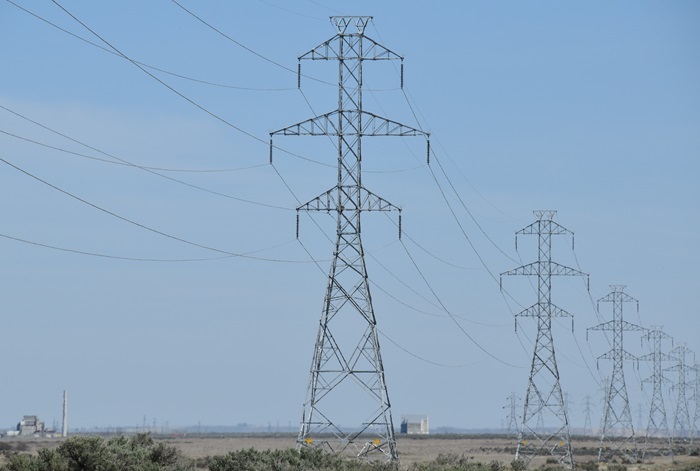 The Bonneville Power Administration’s new double-circuit, high-voltage transmission line runs along towers on the Hanford Site. The line provides reliable power to support Hanford’s cleanup operations and facilities, including the Waste Treatment and Immobilization Plant. Hanford’s historic B Reactor, part of the Manhattan Project National Historical Park, is in the background on the left.
RICHLAND, Wash. — Crews have finished installing a new high-voltage transmission line that improves the reliability of electrical service used to power waste treatment operations and other cleanup efforts at the Hanford Site.
The Bonneville Power Administration (BPA), in partnership with the U.S. Department of Energy Office of Environmental Management’s Hanford Field Office, recently energized an 18-mile, 230-kilovolt transmission line. It connects two substations, one near the center of Hanford operations and another just outside the site.
The new line replaces an 80-year-old system that contractor Hanford Mission Integration Solutions (HMIS) determined could no longer meet the site's long term cleanup needs.
A dual-circuit tower design is included in the new line. That improves reliability for key cleanup projects, including the Waste Treatment and Immobilization Plant. That facility is preparing to begin turning radioactive tank waste into glass for safe disposal, a major milestone in Hanford's effort to reduce risks and protect the environment.
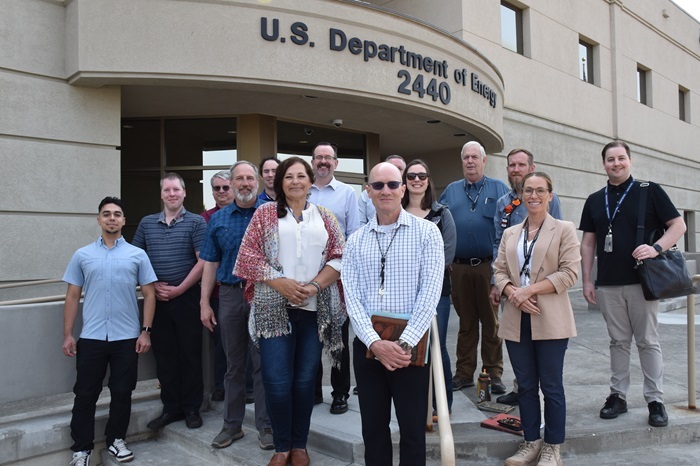 Staff from the Hanford Field Office and Bonneville Power Administration gather for a photo before touring the new 230-kilovolt transmission line on the Hanford Site. From left: Jose Alcocer, Bonneville Transmission Services student intern; Joe Braley, Bonneville customer service engineer; Fred Bryant, Bonneville regional manager; Jeff Cook, Bonneville vice president, Engineering & Technical Service; Dallas Filan, Bonneville customer service engineer; Tina Edwards, Bonneville project manager; Mike Miller, Bonneville senior vice president, Transmission Services; Jeff Sedgwick, Hanford Infrastructure & Services Division; Charles Sweeney, Bonneville Transmission Services account executive; Katie Sheckells, Bonneville Transmission Services manager; Brian Harkins, Hanford Field Office acting manager; Brian Stetter, Hanford Infrastructure & Services Division; Vanessa Turner, Hanford acting assistant manager for Mission Support; and Sean Madderom, Hanford Electrical Utilities program manager.
"This new transmission line will ensure the Waste Treatment Plant, and all our risk-reduction projects continue to have the reliable power they need to operate safely,” said Vanessa Turner, acting assistant manager for Mission Support. "It's a strong example of the One Hanford team in action and the many moving parts that must come together to accomplish our mission."
BPA constructed the towers and transmission line and will use the second circuit. HMIS supported the project and will operate the circuit that provides power to the Waste Treatment Plant and other key Hanford Site facilities.
“As the Hanford Site’s essential services provider, we make sure the infrastructure is ready to meet the demands of the work underway now, and decades into the future,” said Amy Basche, HMIS president. “This partnership with the Bonneville Power Administration helps ensure the Hanford cleanup mission continues to move forward.”
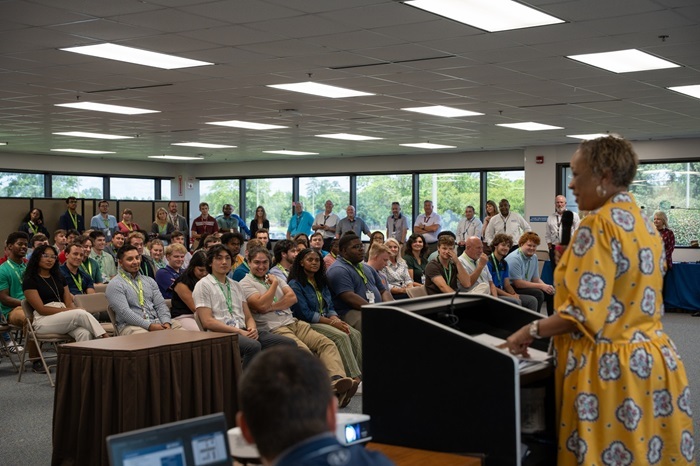 Savannah River Nuclear Solutions Talent Acquisition Manager Angela Martin welcomes nearly 175 interns to the Savannah River Site during a meet-and-greet with executive and senior leaders last month.
Twelve-week immersive program drew nearly 4,500 applicants
AIKEN, S.C. — More than 170 students from 53 colleges and technical institutions across 18 states and Canada are participating in a summer intern program conducted by a U.S. Department of Energy (DOE) Office of Environmental Management contractor at the Savannah River Site (SRS).
The Savannah River Nuclear Solutions (SRNS) Internship Program kicked off last month with an executive meet-and-greet, where interns connected with leadership and gained insight into the company’s strategic priorities, expectations and mission-driven work at SRS.
"This year alone, SRNS received nearly 4,500 applications, and each of you is among the 173 chosen to be part of this program,” Jeff Griffin, SRNS president and CEO, said in his opening remarks at the event. “The future workforce we need is represented by this diverse and talented group.”
Hannah Ho, a Site Software Engineering intern and a senior at the University of Georgia, returned this summer for a second internship after supporting SRNS Solid Waste Management two years ago.
“I’m thrilled to gain new experience in software automation testing — a whole new avenue for me,” she said. “My goal is to secure full-time work by the end of this internship and follow in my parents' footsteps at SRS.”
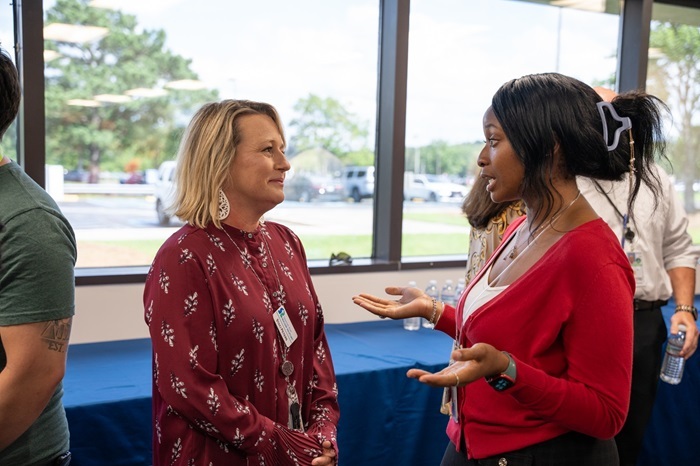 Staci Peters, senior vice president of Savannah River Nuclear Solutions Business Services, connects with engineering intern Tellajah Chalk during a meet-and-greet.
SRNS began the internship program in 2009 to build a pipeline of future leaders in national defense, environmental stewardship and nuclear nonproliferation. Over the next five years, SRNS plans to hire approximately 2,000 additional employees to meet the growing mission demands of DOE and the National Nuclear Security Administration.
Bryan Ortner, senior vice president, SRNS Workforce Services and Talent Management, said the internship program could create a lifelong career at the site.
“The program remains a critical tool for building tomorrow’s workforce,” Ortner said. “Students will apply innovative ideas to complex problems, expand existing university and college relationships and establish new ones.”
The program offers a 12-week immersive experience, allowing interns to explore potential careers, including engineering, computer science, physical sciences, business services, communications, site services, information technology and nuclear materials control.
Rachael Ogundare, a junior at the University of Georgia and an Information Technology Business Analytics intern, said she’s been exposed to various business aspects and has explored different programs, solidifying her interest in analytics while also diving into project management.
“Working on projects like process optimization and visualizations has given me valuable insights into the critical missions at SRS,” Ogundare said.
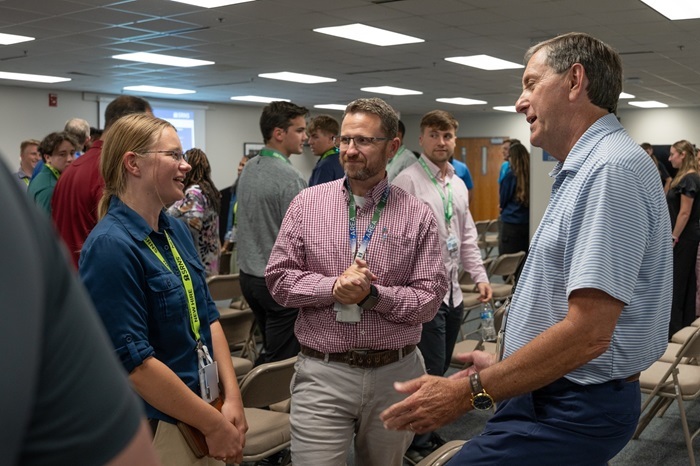 Mike Swain, Savannah River Nuclear Solutions senior vice president and nuclear operations officer, right, and James Therrell, mission planning manager for Environmental Management Operations, connect with intern Olivia Ruszczyk, a senior mechanical engineering student at New Mexico State University.
Following the SRNS internship program last year, 61 interns received full-service positions and 25 transitioned into apprenticeships, according to Felicia Hartzog, SRNS Internship Program coordinator.
"The talent and passion displayed by this cohort are truly inspiring and something to be proud of,” Hartzog added.
Griffin concluded the meet-and-greet by encouraging the interns to make the most of their time at SRNS.
"You’re not just here to fill a summer; it’s about building a bridge to full-time careers. Engage fully, learn relentlessly and contribute boldly,” Griffin said. “When this internship ends, we hope it’s just the beginning of your journey with us."
-Contributor: Mackenzie McNabb
|