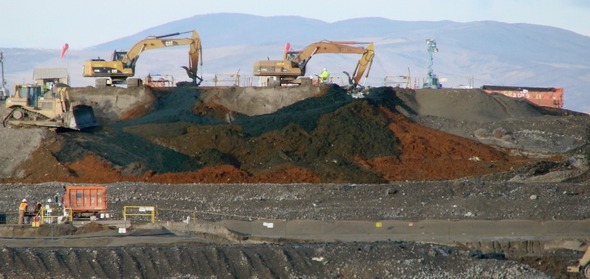
Hanford Expanding Environmental Landfill to Support Ongoing Risk-Reduction Cleanup
RICHLAND, Wash. – Workers are preparing to begin construction on a new disposal cell at the Environmental Restoration Disposal Facility (ERDF), an engineered landfill at the Department of Energy’s Hanford Site in southeastern Washington.
The construction of an 11th cell – called a “super cell” because it is twice the size of the facility’s original cells – will add about 2.8 million cubic yards of disposal capacity to support ongoing Hanford cleanup projects through calendar year 2040.
“ERDF has been a cornerstone of our waste disposal strategy for nearly 30 years, and expansion of the facility is critical to provide for uninterrupted, efficient and safe disposal in support of our ongoing cleanup mission for years to come,” said Brian Harkins, Acting Manager for the Hanford Field Office.
ERDF is located on the Central Plateau near the center of the 580-square-mile Hanford Site and is regulated by the U.S. Environmental Protection Agency. It accepts low-level radioactive and hazardous chemical waste generated from Hanford cleanup operations.
More than 19 million tons of waste have been disposed of at the 107-acre facility since it opened in 1996. The waste includes debris from the demolition of more than 800 facilities and solid material and soil from about 1,300 waste sites. The facility currently receives an average of 10,000 to 15,000 tons of waste per month.
“Our team remains committed to safe and efficient operations at ERDF, and our experienced crews are excited to get started on this important project to support continued risk reduction at Hanford,” said contractor CPCCo President and Project Manager Bob Wilkinson.
This is the fifth expansion of ERDF since the facility started operations. Designed to be expanded as needed, the facility was expanded in 1999, 2003, 2007 and 2011.
###
The Department of Energy (DOE) is engaged in one of the great public works of this century at the Hanford Site near Richland, Washington. Responsible for the federal government’s cleanup of the legacy of more than 40 years of producing plutonium through the 1980s, DOE is transforming the site back into a 24/7 operations mode to treat tank waste from the production era. The DOE Hanford Field Office is responsible for the safe and efficient retrieval, treatment and disposal of the 56 million gallons of chemical and radioactive waste stored in Hanford’s underground tanks. The mission includes building and commissioning the world’s largest radioactive waste treatment plant, which will immobilize the legacy tank waste through vitrification. The DOE Hanford Field Office is also responsible for all remaining Hanford cleanup and is currently focused on stabilizing and demolishing former plutonium production structures, excavating and disposing of contaminated soil and waste, treating contaminated groundwater, and configuring Hanford Site infrastructure for the future, with an emphasis on supporting the tank waste mission. Hanford Site work is conducted by a federal and contractor workforce of approximately 13,000 personnel. Visit www.hanford.govfor more information about the Hanford Site.