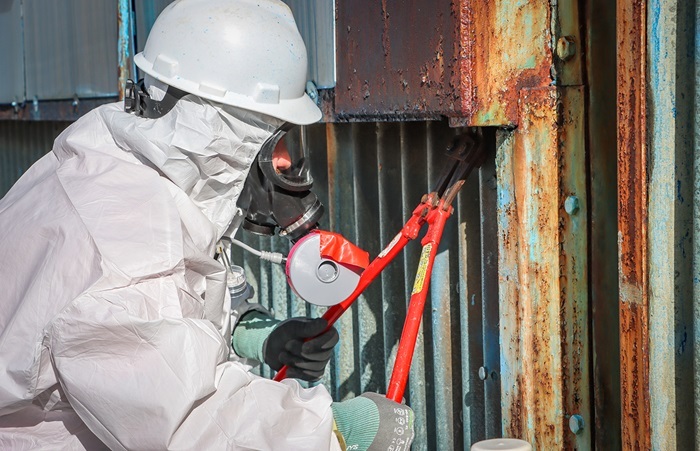
 Asbestos Worker Luke Fryman cuts the first bolt of the X-333 Process Building at the Portsmouth Site to kick off demolition activities.
PIKETON, Ohio — Cleanup crews recently removed the first transite panel from X-333 to prepare for the demolition of the second of three former uranium enrichment process buildings at the Portsmouth Site.
Teardown of all three process buildings — among the largest facilities in the DOE complex — helps enable new opportunities for the local community to continue advancing U.S. energy and security goals, contributing to the goal of ushering in a new golden era of American energy dominance. Crews finished demolishing X-326 in 2022, and X-330 will be the third process building to be knocked down.
Transite, the outer panels covering the building, is a known asbestos-containing material that must be cautiously removed to meet environmental regulatory requirements.
“Transite removal is the first step toward the demolition process,” Federal Project Director Christy Brown said. “The workers will work in teams using personnel lifts. They will remove, lower, and stack each panel, one at a time, so it is a big job.”
Crews are set to safely remove more than 16,000 transite panels from the X-333 Process Building over the next 17 months. Each panel measures 8 feet by 4 feet and weighs 90 to 140 pounds.
“This is the first phase of bringing down the largest of the two remaining process buildings onsite,” Federal Project Director Jud Lilly said. “A lot of work has been done prior to this to ensure this process is completed efficiently and safely.”
Crews worked inside the building to complete deactivation of the two-story, 33-acre X-333 prior to beginning removal of the transite panels.
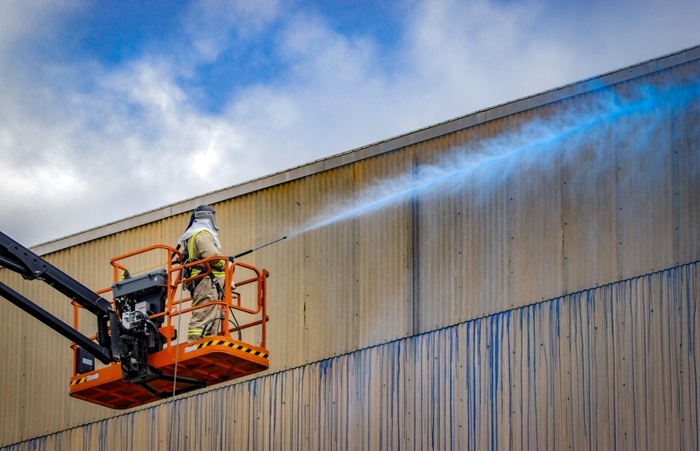 Demolition Specialist Jeff Howard sprays a blue fixative to the Portsmouth Site’s X-333 Process Building to maintain dust suppression on the transite panels.
Deactivation included characterizing the building and equipment from a radiological standpoint; disconnecting process equipment; segmenting, crushing and preparing waste for onsite or offsite disposal; removing asbestos and other hazardous waste; and isolating and disconnecting utilities, according to Lilly. Workers also installed fencing and removed above- and below-grade obstructions around the building.
Workers also completed several activities to ensure safety of the workforce, community and environment. For example, they installed a water detention system that includes a lined perimeter berm to capture water runoff from the X-333 demolition project area. The water will be sent to a treatment system designed to treat all contaminants of concern.
Air quality will also be maintained. Prior to demolition, crews will apply a fixative to the transite panels, inside and out, to reduce dust. They also will spray water on portions of the facility as they are demolished to suppress dust. Air monitors installed around the building will measure air quality to ensure the safety measures are effective.
 Laborers Tyler Roach, left, and Taylor Brown help install a liner to construct a water detention system berm around the Portsmouth Site’s X-333 Process Building to prepare for the facility’s demolition.
Teardown of X-333 is set to take several years due to the facility’s size. It is scheduled to be completed in 2030. The team will look for opportunities to accelerate the schedule without compromising safety.
The Portsmouth Paducah Project Office conducts cleanup activities at the Portsmouth Site in accordance with a consent decree with the state of Ohio and director’s final findings and orders with the Ohio Environmental Protection Agency.
-Contributor: Shawn Jordan
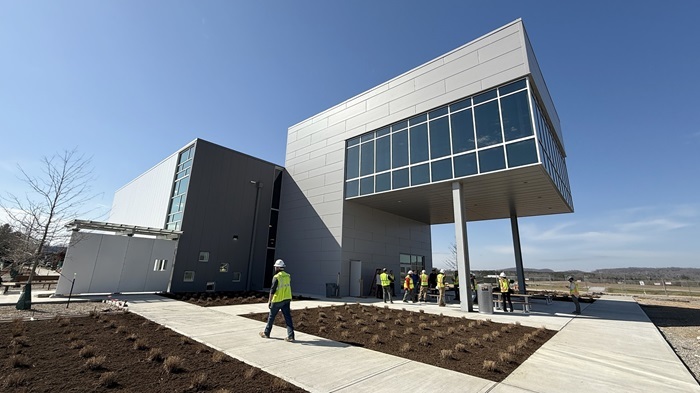 The U.S. Army Corps of Engineers and its construction contractor, Geiger Brothers, have completed construction on the K-25 Interpretive Center. The facility will help visitors understand the size and scope of the former Manhattan Project and Cold War-era uranium enrichment complex.
OAK RIDGE, Tenn. — Crews have completed construction of the K-25 Interpretive Center through a partnership among the Oak Ridge Office of Environmental Management (OREM), U.S. Army Corps of Engineers (USACE) and contractor Geiger Brothers.
When the facility opens this summer, it will provide a venue for visitors to visualize the size and scope of the former Manhattan Project and Cold War-era uranium enrichment complex.
The center features an elevated viewing platform with floor-to-ceiling, wraparound glass windows that provide a sweeping, panoramic view of one of World War II’s most historically significant sites.
The K-25 Building was constructed as part of the Manhattan Project and was tasked with enriching uranium for the first nuclear weapon, which helped end the war and positioned Oak Ridge as a world leader in innovation and discovery. The building spanned 44 acres and was the largest in the world at the time of its construction.
 Lt. Col. Robert Green, commander of the U.S. Army Corps of Engineers Nashville District, speaks about the significance of the K-25 Interpretive Center project. The agency built the K-25 Gaseous Diffusion Plant, and oversaw construction of the facility dedicated to preserving its history.
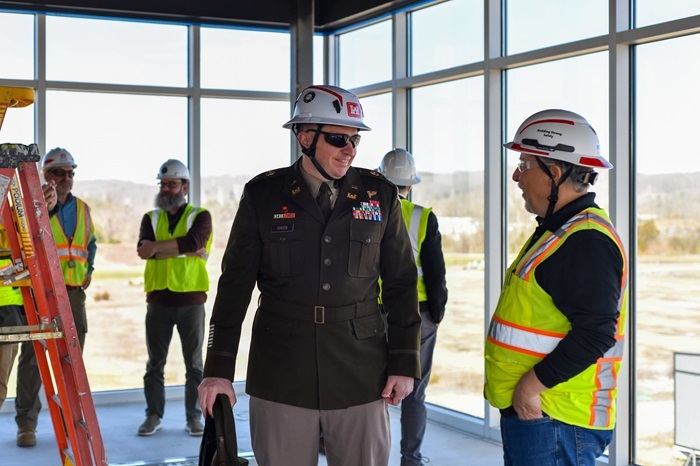 Lt. Col. Robert Green, commander of the U.S. Army Corps of Engineers Nashville District, tours the newly constructed K-25 Interpretive Center.
“It's impressive. Visiting this site gives you a sense of the vast footprint of what the facility once was. The historical significance of this place and the scale of the facilities really convey the importance of what used to be here," said Lt. Col. Robert Green, commander of the USACE’s Nashville District.
The project holds particular importance for the USACE because it brings the agency’s involvement there full circle — from building the K-25 Gaseous Diffusion Plant at the start of U.S. involvement in the war to managing construction of the new facility dedicated to preserving its significant history.
The center is one of the final components of a multiproject agreement OREM signed in 2012 as a remedy under the National Historic Preservation Act. The agreement recognizes the importance of commemorating the history of the former Oak Ridge Gaseous Diffusion Plant, where the K-25 Building was located. OREM completed the other elements of the agreement in previous years, including constructing the K-25 History Center and preserving the historic Alexander Inn.
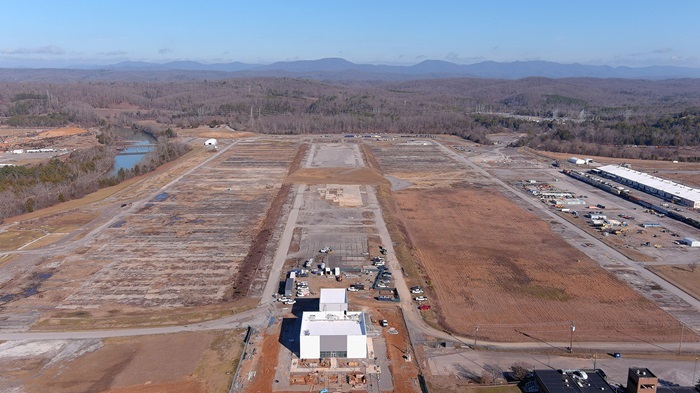 The K-25 Interpretive Center has an elevated viewing platform that provides a sweeping, panoramic view of the K-25 Building’s massive 44-acre footprint.
Uranium enrichment operations ceased at the site in 1985, and it was permanently shut down in 1987. Afterward, the U.S. Department of Energy (DOE) committed to a large-scale environmental cleanup effort to transform the site into a multiuse industrial park to support economic growth in the region. That effort involved tearing down five massive enrichment facilities, including K-25, and 500 other structures that supported operations at the site.
OREM and UCOR completed teardown of the K-25 Building in 2013 and all other demolition at the site in 2020. Additionally, soil remediation at the site wrapped up last year.
The transformed site, now called the East Tennessee Technology Park, already has numerous private businesses onsite, and is emerging as home to the long-awaited American nuclear renaissance, a key DOE priority.
Additionally, the K-25 Building footprint is part of the Manhattan Project National Historical Park, a unit of the National Park Service that also includes Los Alamos, New Mexico, and Hanford, Washington, sites.
“I hope the community appreciates and enjoys this project as much as I do,” Green added. “This is a special place for our country and the region, and I hope they come out and experience it.”
-Contributor: Wayne McKinney
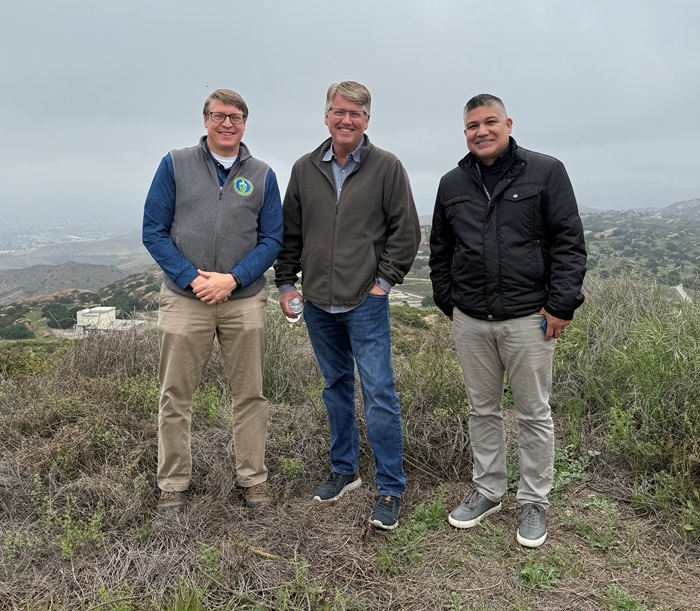 Pictured from left, Josh Mengers, federal project director for the Energy Technology Engineering Center; Eric Lundstrom, Rancho Simi Recreation and Park District director; and Joseph D. Ayala, Simi Valley City Council member.
SIMI VALLEY, Calif. — Local elected officials toured the U.S. Department of Energy’s (DOE) Energy Technology Engineering Center (ETEC) at Santa Susana Field Laboratory (SSFL) earlier this month.
Attendees for the May 6 site tour included Simi Valley City Councilmember Joseph D. Ayala, Simi Valley City Manager Samantha Argabrite and Rancho Simi Recreation and Park District Director Eric Lundstrom. DOE representatives were Josh Mengers, federal project director for ETEC; Pamela Hartman, federal deputy project director for ETEC; Melissa Simon, community outreach manager for ETEC; and DOE contractors Lucas Ray and Stewart Williford.
 |
|
U.S. Department of Energy contractor Stewart Williford, wearing a yellow vest, explains an air monitoring system during a May 6 site tour with local elected officials at the Santa Susana Field Laboratory. |
Josh Mengers, federal project director for the Energy Technology Engineering Center, provides an overview of the U.S. Department of Energy’s past operations at the Santa Susana Field Laboratory during a May 6 site tour with local elected officials. |
|
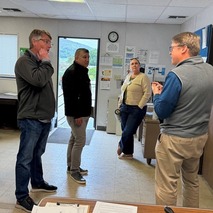 |
During the tour, Mengers gave an overview of SSFL, ETEC’s past operations, and cleanup at the site, including already completed remediation, current progress and next steps. Attendees visited milkvetch hill, the Sodium Reactor Experiment, Hazardous Materials Storage Area and Former Sodium Disposal Facility.
SSFL is a 2,850-acre former rocket engine and nuclear research facility comprised of four operational areas. DOE’s Office of Environmental Management is charged with remediation in Area IV, where ETEC previously operated.
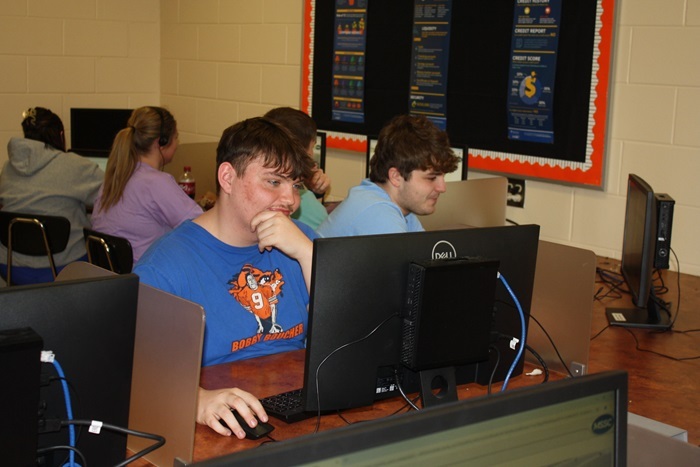 Students at Waverly High School review Manufacturing Skills Standard Council Program material on computers. The inaugural class includes current Waverly High School seniors and recent graduates who started college but have decided to pursue different career paths.
PIKE COUNTY, Ohio — A first-of-a-kind program is preparing young adults for careers while providing a pipeline of talent for local companies around the U.S. Department of Energy Office of Environmental Management Portsmouth Site.
This year, United Steelworkers (USW) Local 689, a labor union for Portsmouth Site team members, partnered with Waverly High School for a training program for high school seniors and recent graduates looking for new career paths.
Students who successfully complete the Manufacturing Skills Standard Council Program will earn a certification that qualifies them for many entry level manufacturing jobs.
North Wind Dynamics Service Worker and USW Worker-Trainer Jeff Pinson says the program is great for the future of the community as the Portsmouth Site continues to transform liabilities into opportunities for new jobs, innovation and strong economies. North Wind Dynamics is the site’s infrastructure support services contractor.
“Using these nationally validated standard skills programs, we can raise the skill set of these young adults in the area for the reindustrialization of the site,” said Pinson, referring to the former Portsmouth Gaseous Diffusion Plant in Piketon, Ohio.
 |
|
Jessie Vanderpool, far left, and Steven Amburgey, second from left, successfully completed the Manufacturing Skills Standard Council Program. Here, they speak with Fluor-BWXT Portsmouth human resources generalists Britani Wolfenbarker, second from right, and Gracie Morgensen, far right, at the Waverly High School Career Fair. Vanderpool and Amburgey discussed the hiring process at the Portsmouth Site and potential jobs opportunities with their new certification. |
Students at Waverly High School review Manufacturing Skills Standard Council Program material on computers. The students meet twice a week for 12 weeks after school. |
|
 |
The 12-week program covers safety, quality practice and measurement, manufacturing process and production, and maintenance awareness.
“This has been a wonderful opportunity for us to help some of our students prepare for the workforce,” Waverly High School Principal Sara Ramsey said. “We recognize that our students are a valuable resource to our community and are always looking for ways to help them gain access to a career path of their choice. That path isn't always college or trade school, so helping them gain knowledge that can be applied to our local workforce is a benefit to us all.”
The inaugural class of 15 students features a range of backgrounds and experiences, from those currently in high school to recent graduates who have started college but are looking for different career paths.
Jaylen Riffe, a senior at Waverly High School, is looking to enter the workforce after graduating this spring.
“This program has helped me discover career paths I would not have really known about if it wasn’t for this class,” said Riffe. “Now, I have access to different types of jobs and a certificate that will help improve my resume.”
Students who successfully complete the class will receive a Certified Production Tech and Skills Boss certification. These certifications are accepted in a wide variety of manufacturing jobs nationwide.
-Contributor: Cindi Remy
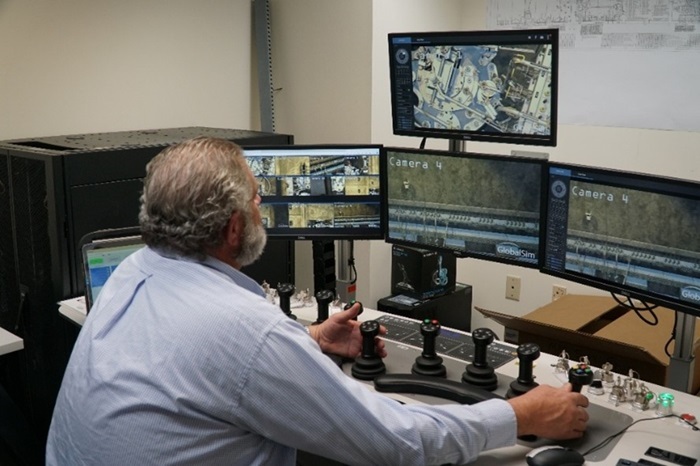 Savannah River Site liquid waste contractor Savannah River Mission Completion has deployed simulator technology to train crane operators for the Defense Waste Processing Facility. The new simulator provides a 3D representation of the facility’s canyon area. Simulator Instructor Marc Widener, pictured, said the simulator can adjust parameters within the program to fine-tune the new operators’ capabilities.
AIKEN, S.C. — A new simulator will help train operators on the safe and efficient movement of a crane at the Defense Waste Processing Facility (DWPF) at the Savannah River Site (SRS).
Since DWPF began its U.S. Department of Energy (DOE) Office of Environmental Management mission of dispositioning highly radioactive liquid waste in 1996, crane operators learned their skills through on-the-job training. However, the Main Processing Cell (MPC) crane, which they will use following simulator training, is extremely important to the overall work performed inside the DWPF canyon where processing occurs. The processing area of the facility is referred to as a canyon because it resembles a deep valley with steep, vertical walls.
The MPC crane carries several tools, including hoists designed for lifting items weighing from 1 ton to 117 tons. Eleven cameras mounted to the crane frame allow the operator to position the crane and its hoists wherever needed over the canyon. Another camera is used to get close-up views of anything in the canyon.
Manipulating a powerful crane by way of a video screen through the facility’s canyon full of equipment proved challenging for new hires. With the site’s aging workforce and the need to train a new generation of operators, finding a worthy training device became a necessity.
Liquid waste contractor Savannah River Mission Completion (SRMC) identified an appropriate simulator in 2022 that would be so realistic, trainees could be thoroughly trained on everyday duties as well as unusual events in a comparably short time. The simulator uses the same type of crane operator console coupled with a simulation model that uses high resolution imaging and physics-based video game technology. MPC Simulator Instructor Marc Widener believes this new video instructional tool will prove to be invaluable over time.
“We can create personalized scenarios for crane operators to help them hone their skills,” Widener said. “We can develop scenarios specifically designed to help them in problem areas they personally experience, instead of a blanketed approach to cover everyone. This simulator enables us to adjust parameters within the program to fine-tune movements and tune their capabilities.”
SRMC Chief Operations Officer Wyatt Clark believes the simulator will help prepare crane operators for major tasks that lie ahead.
“In the future, we have plans to replace the melter, which is a DWPF process vessel that heats a mixture of molten glass and concentrated high-activity radioactive waste at 2,100 degrees Fahrenheit,” Clark said. “This is no small task, and it is certain to present numerous challenges to operators who have never performed this work before. With this simulator, we believe we can train our operators to prepare to overcome many of these challenges.”
Tony Robinson, DOE-Savannah River acting assistant manager for waste disposition, said the simulator could help new operators better understand and manage the unexpected.
“The safety of the SRS workforce is dependent upon good training and the ability to perform our jobs well and efficiently,” Robinson said. “By employing new technologies like this simulator, it is likely that operators will be better prepared to recognize and respond to challenges they might face. This preparation helps our workforce perform better and with more confidence.”
-Contributor: Jim Beasley
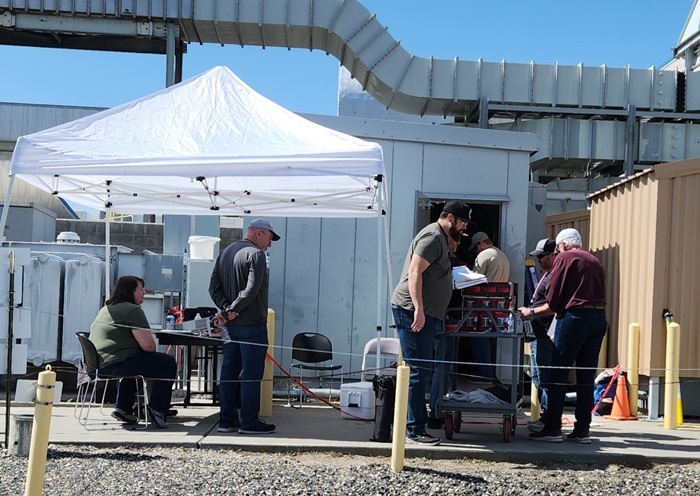 At the 222-S Laboratory, the Navarro-ATL team tests sensor readings on a programmable logic controller at the substation. This testing ensures the system can manage and restore the normal power distribution.
RICHLAND, Wash. — The 222-S Laboratory plays an important role in analyzing radioactive tank waste at the Hanford Site — so when crews needed to shut down the facility’s power for a full week to complete infrastructure upgrades, timing and precision were everything.
In April, Navarro-ATL's operations and maintenance team, in partnership with the lab's analytical operations group, successfully completed the planned outage that improved safety, reliability and performance at the more than 70-year-old facility. Navarro-ATL is the Hanford contractor that manages the lab.
"The maintenance team did an amazing job with this outage,” said Mark Hughey, chief operations officer at Navarro-ATL. "Their meticulous planning and commitment ensured that critical upgrades and improvements were implemented seamlessly. It also supports the safety and efficiency of our operations, paving the way for future advancements. I’m grateful to the team for their invaluable contributions to our continued success."
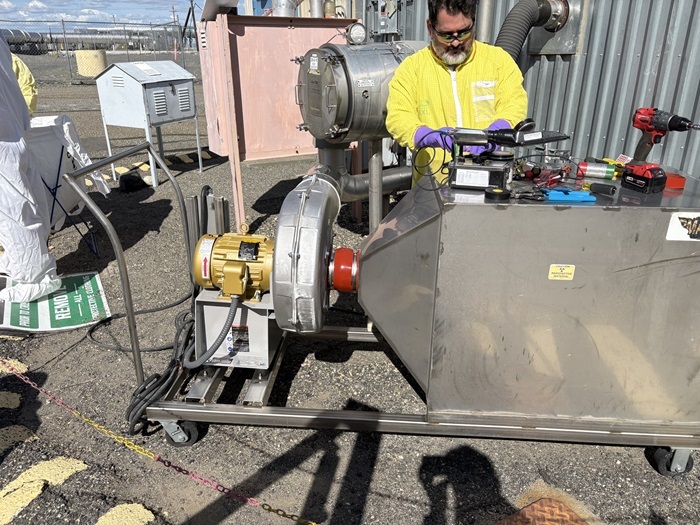 Lance Gimlin, a health physics technician with Navarro-ATL, replaces a portable radioactive air emissions unit at the 219-S facility during the planned outage.
Key improvements included restoring the programmable logic controller, which operates the tie breaker in the substation, enabling automatic power transfers. Additionally, crews installed two new air compressors, replacing outdated units, and conducted extensive inspections and cleaning of breakers and disconnects, ensuring dependable and uninterrupted power for future projects.
Another notable achievement was flushing out the lab’s industrial cooling system. Maintaining stable temperatures is vital for accurate sample analysis and proper instrument calibration, especially in warmer months.
“These improvements are important for safely and efficiently analyzing tank waste samples,” said Jeff Cheadle, 222-S program manager with the U.S. Department of Energy Office of Environmental Management’s Hanford Field Office. “The lab’s work directly supports ongoing efforts to advance the tank-waste treatment mission.”
Completing the outage required close coordination with other Hanford Site contractors, Hanford Mission and Integration Solutions, Hanford Tank Waste Operations & Closure and Central Plateau Cleanup Company. The collaboration kept sample shipments on schedule and helped shape future maintenance and operational strategies at the 222-S Laboratory.
-Contributor: Tracie Arnold
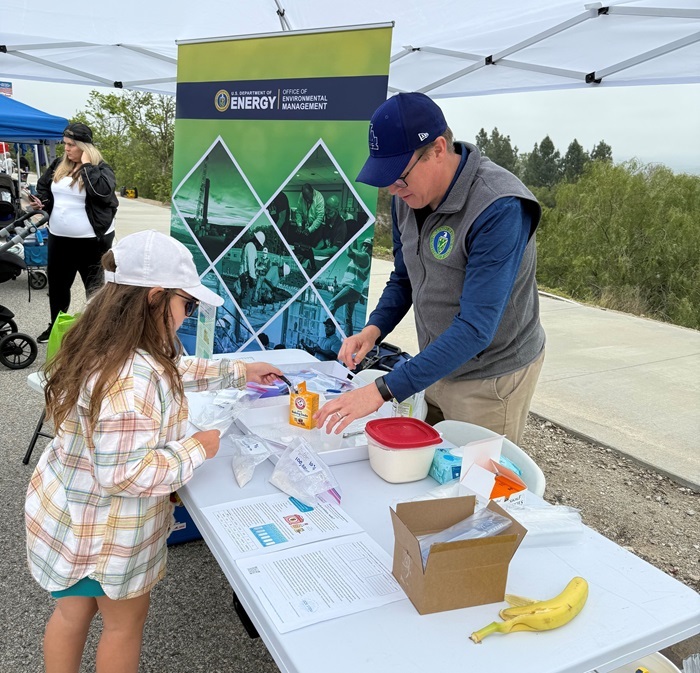 Josh Mengers, federal project director for the Energy Technology Engineering Center, teaches Noelle Saenz about soil backfill sampling and laboratory studies as part of a science activity at the Simi Valley Street Fair on May 3.
SIMI VALLEY, Calif. — Gloomy weather didn’t do much to dampen the spirits of the thousands of community members who attended the Simi Valley Street Fair earlier this month.
The U.S. Department of Energy (DOE) was among the 400 vendors that hosted a booth at the biannual event sponsored by the Simi Valley Chamber of Commerce. Attendees could see the wares of local artists and crafters, taste culinary delights, and learn about local businesses, community leaders, civic organizations, police and fire departments, and school districts.
Visitors at DOE’s booth not only had the opportunity to learn about the department’s work at the Santa Susana Field Laboratory (SSFL) but could also pick up a copy of the December 2024 CleanUpdate newsletter, snag some local California poppy seeds or register to receive email updates about the site.
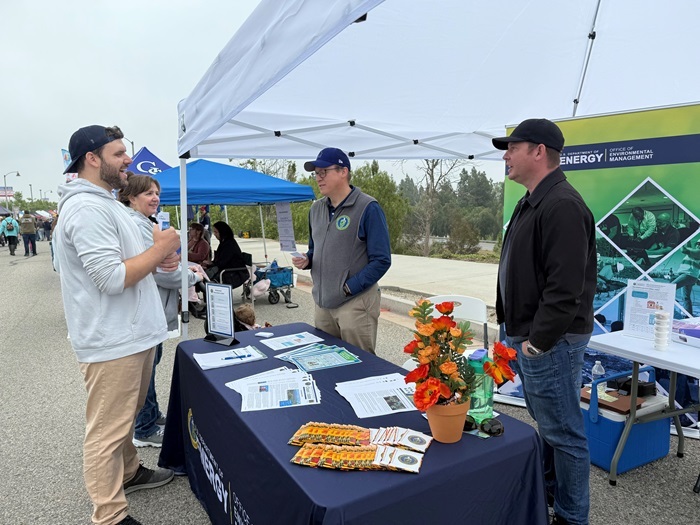 Community members ask about the U.S. Department of Energy’s work at Santa Susana Field Laboratory (SSFL) during the Simi Valley Street Fair on May 3. Also pictured are Lucas Ray, radiological control technician at SSFL, center, and Josh Mengers, federal project director for Energy Technology Engineering Center, right.
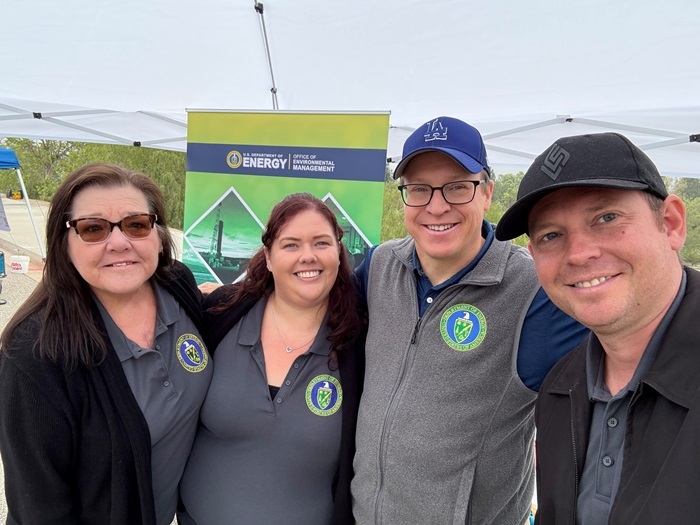 From left, Deb Kramer, executive assistant for the Energy Technology Engineering Center (ETEC); Melissa Simon, community outreach manager for ETEC; Josh Mengers, federal project director for ETEC; and Lucas Ray, radiological control technician at the Santa Susana Field Laboratory.
DOE team members also heard from some people who either worked at the 2,850-acre former rocket engine testing and nuclear research facility in Ventura County, California, or knew someone who did.
DOE’s Office of Environmental Management is charged with remediating Area IV at SSFL where the department formerly operated the Energy Technology Engineering Center.
Aside from questions about SSFL and DOE’s work at the site, visitors also had the chance to learn about soil backfill sampling and laboratory studies, where they got to see an example of detection limits using flour, baking soda and vinegar to see how different parts mixed together would react. The project was inspired by questions raised at the recent public scoping meetings for DOE’s supplemental environmental impact statement on cleanup at SSFL.
|