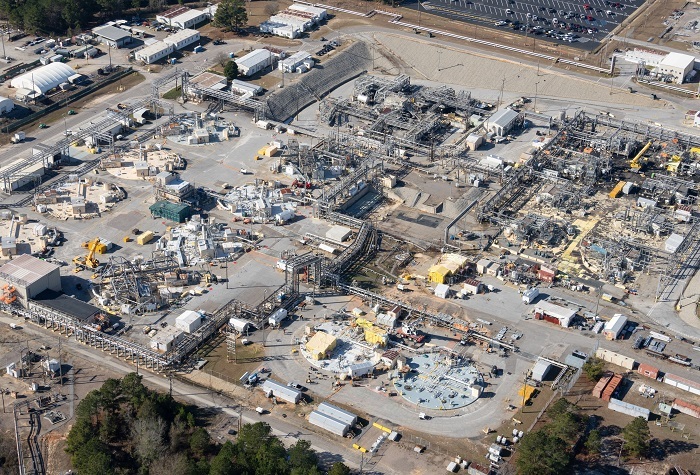
 The U.S. Department of Energy Office of Environmental Management achieved preliminary cease waste removal for Tank 4 in F Tank Farm, pictured, at the Savannah River Site a year ahead of schedule.
AIKEN, S.C. — The U.S. Department of Energy (DOE) Office of Environmental Management (EM) has achieved its third radioactive waste removal milestone in one calendar year at the Savannah River Site (SRS) — now marking three waste tanks staged ahead of schedule for next steps in the closure process.
EM received concurrence from the South Carolina Department of Environmental Services (SCDES) and U.S. Environmental Protection Agency (EPA) that SRS has successfully removed waste from Tank 4 and may now proceed to waste sampling and analysis of that tank.
Completing that phase of work on the waste tank, called preliminary cease waste removal (PCWR), is a regulatory milestone outlined in the SRS Federal Facility Agreement (FFA). The FFA establishes a procedural framework, including liquid waste tank milestone agreements, such as the schedule for waste removal and operational tank closures, and other site cleanup priorities.
Savannah River Mission Completion (SRMC) is EM’s liquid waste contractor responsible for safely treating and disposing of the millions of gallons of waste remaining in the underground tanks at SRS, as well as closing them.
Tank 4 is not the first PCWR completed by SRMC ahead of schedule. PCWR was achieved for Tank 10 in May, seven months ahead of its FFA deadline, and for Tank 9 in October, more than a year ahead of its deadline. Tank 4 PCWR was also completed a year ahead of the agreed-upon deadline.
PCWR is a regulatory milestone for old-style tanks that designates agreement between EM, SCDES, and EPA that, based on preliminary information, there is reasonable assurance that performance objectives for tank closure will be met. Also, the concurrence means that work can begin on the sampling and analysis phase of the tank closure process. This next phase will verify these conclusions, based on laboratory analysis of any remaining material and final residual volume determination, prior to stabilization and final isolation of the waste tank.
Jim Folk, DOE-Savannah River assistant manager for waste disposition, said significant waste retrieval and tank closure milestones at SRS, such as PCWR, demonstrate that EM is committed to completing the SRS liquid waste mission through tank waste cleanup.
“EM and our contractor, Savannah River Mission Completion, remain committed to working together to remove the highest risk from the tank waste at SRS,” Folk said. “Continuously completing preliminary cease waste removal milestones ahead of schedule shows the dedication this team has to be successful.”
James Harris, Waste Retrieval and Tank Closure director for SRMC, said PCWR is not an easy task, but the talented team at SRMC makes it happen.
“We perform numerous tasks within the SRS tank farms that are complicated, complex and critical,” Harris said. “The ability to achieve PCWR is a by-product of the highly integrated effort that involves everyone from our skilled craftspeople to operations, maintenance, integration, and radiological control crews; engineering teams; and project managers.”
Tank 4 is an underground storage tank placed into service in 1961. It is 75 feet in diameter and 24.5 feet tall, and has a capacity of 750,000 gallons.
-Contributor: Colleen Hart
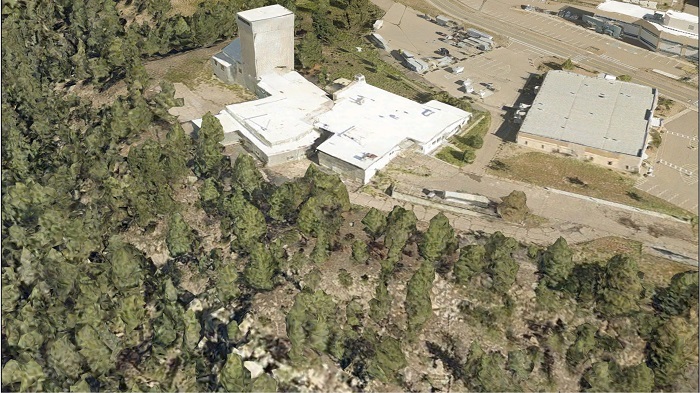 The Ion Beam Facility, center, at Technical Area 03, Los Alamos National Laboratory.
Ion Beam Facility housed two Van de Graaff accelerators, which at the time of construction were among the largest in the world
LOS ALAMOS, N.M. — The U.S. Department of Energy (DOE) Environmental Management Los Alamos Field Office (EM-LA) has commenced work to deactivate, decommission and remove the Ion Beam Facility at Los Alamos National Laboratory (LANL).
The project is part of the DOE Office of Environmental Management’s mission to address excess facilities resulting from nuclear weapons production and research during the Manhattan Project and Cold War era.
EM-LA’s deactivation, decommissioning and removal contractor, Aptim Federal Services (APTIM), is managing the project.
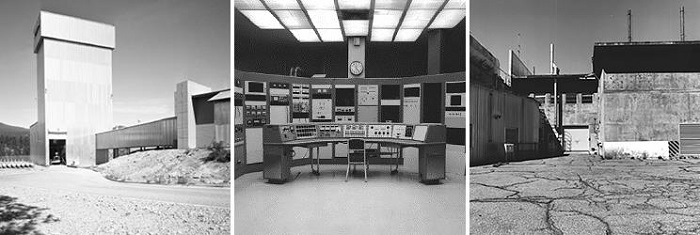 Historical photos of the Ion Beam Facility. Left: The tower housed the vertical accelerator, with the tunnel connecting it to office buildings on the right. Center: The control room for the vertical Van de Graaff accelerator. Right: The south side of the Ion Beam Facility.
Demolition of the facility's administrative wing is anticipated to begin this fall. The deactivation, decommissioning and removal project is expected to span over five years.
As part of the initial project work, APTIM has mobilized onsite and set up work trailers, displayed safety signage and constructed protective fencing. The work process includes removal of contaminants while prioritizing the protection of workers, the local community and the environment.
APTIM crews have begun performing interior facility sampling at the estimated 60,000-square-foot facility to assess for potential contamination. They also are conducting verification surveys to enable implementation of proper controls and safety measures during removal of materials. Air monitoring will confirm that all controls are properly functioning during the project.
APTIM is working closely with EM-LA, LANL management and operations contractor Triad National Security and the National Nuclear Security Administration Los Alamos Field Office on all areas of the project.
The Ion Beam Facility housed two Van de Graaff accelerators, which at the time of construction were among the largest in the world. The accelerators were some of LANL’s most significant scientific tools for conducting nuclear experiments. They played a major role in pure physics research and experiments that helped develop America's nuclear arsenal during the 1950s and 1960s.
Demolition of the facility's administrative wing is anticipated to begin this fall. The deactivation, decommissioning and removal project is expected to span over five years.
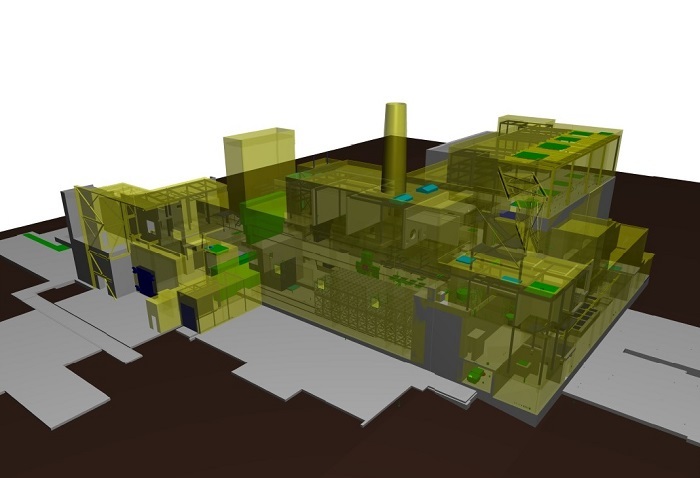 This 3D model shows areas of the Main Plant Process Building demolition project that have been completed in yellow. Workers at West Valley Demonstration Project have removed 52 of the building’s 56 cells since the start of the demolition in September 2022.
WEST VALLEY, N.Y. — West Valley Demonstration Project (WVDP) officials met with representatives from the Oak Ridge Office of Environmental Management (OREM) in Tennessee to share lessons learned from the ongoing demolition of the Main Plant Process Building.
The meeting focused on West Valley’s 3D model of the Main Plant — an indispensable tool for the U.S. Department of Energy Office of Environmental Management (EM) that shows everything from walls and support beams to equipment and piping.
Subject matter experts from West Valley and OREM met virtually to discuss the model and how it is used to help guide the West Valley workforce through a safe and compliant demolition. EM has completed 85% of the Main Plant deconstruction.
OREM is taking down excess contaminated facilities across the Oak Ridge Reservation, which eliminates risks and opens land for reuse to support research and national security missions. Teams are set to demolish the final hot cell at the former Radioisotope Development Laboratory at Oak Ridge National Laboratory (ORNL) this year. Workers will also advance efforts that are preparing more than a dozen facilities for future demolition. That list includes the Oak Ridge Research Reactor, Graphite Reactor support facilities and Isotope Row facilities at ORNL.
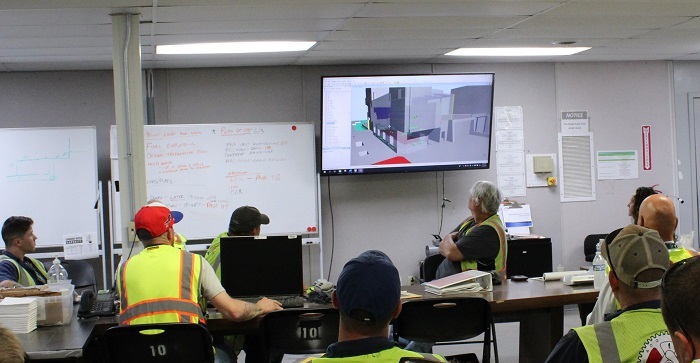 Workers at the West Valley Demonstration Project use the site’s 3D model at pre-job briefings each workday to prepare for demolition activities.
Created with the help of onsite engineers and an outside company prior to the start of the demolition, the 3D model was used to determine the rate and sequence crews would deconstruct the Main Plant. The project has been successful with no incidents, unplanned releases or injuries.
The model showed the locations of more than 120 items requiring special handling and packaging. It also pinpointed multiple locations of specialty piping with high radiation potential and asbestos-containing material, which is hazardous. Crews applied all required safety measures for that material to the Main Plant demolition. Engineers used the model to evaluate the plant’s walls, components, structural members and obstructions, allowing for an analysis of structural integrity and hazard points as the demolition sequence unfolded.
Evan Koelker, a Savannah River National Laboratory senior scientist, noticed an abstract submitted to this year’s Waste Management Symposia on West Valley’s 3D model and thought information about the technology would be useful for his colleagues at OREM. He contacted West Valley to help schedule a meeting to learn more about the 3D model.
“Being able to share experiences, expertise and lessons learned is an important element in being a learning organization,” said Koelker. “Obtaining information and lessons learned from a successful project is a formula for success, and ensuring that information is available for future teams and projects is a formula for progress.”
Neil Armknecht, facility disposition engineer with West Valley cleanup contractor CH2M HILL BWXT West Valley (CHBWV), said West Valley is happy to share its lessons learned in support of similar risk-reduction activities at Oak Ridge.
“The open exchange of information and collaboration among the sites benefits cleanup efforts across the DOE complex,” Armknecht said.
Daniel Hurst, a project engineer with OREM contractor UCOR, believes that sharing information is vital to success.
“When one site has figured out how to perform work safer and more efficient while maintaining environmental compliance, it needs to be shared across the complex for continuous improvement,” Hurst said. “For us at UCOR, we have a specific need to use what West Valley has done to better plan and execute some of our future characterization work. Finding better ways to perform cleanup activities now is important to help our current and future workforce and protect the public for generations to come.”
Gaining insight from lessons learned is not a one-time activity, said Jason Casper, CHBWV president.
“Our learning has not stopped. It continues everyday as we perform cleanup efforts to reduce legacy risks as we learn from other sites,” he said. “OREM and WVDP, along with other sites, will continue to share lessons learned and best practices for the benefit of our employees, the general public, the taxpayer and the environment.”
The above-grade portion of the Main Plant is one of the last major facilities remaining at West Valley. Its successful demolition will further reduce environmental risks and position the site for the next phase in cleanup. The demolition is expected to be completed this fiscal year, which ends Sept. 30.
-Contributor: Joseph Pillittere
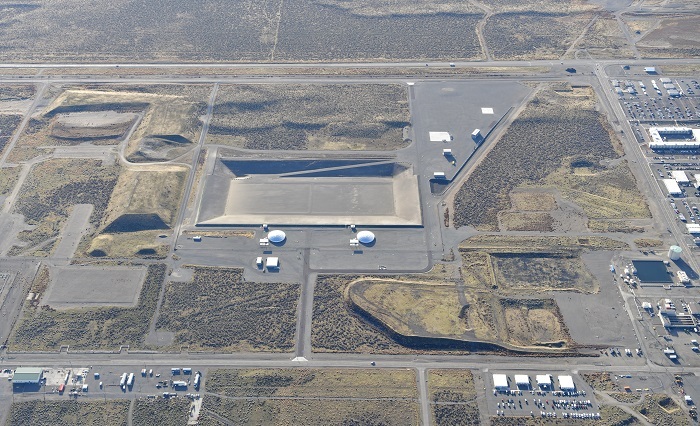 An aerial view of the Integrated Disposal Facility. The engineered landfill will allow for safe disposal of vitrified low-activity waste from the Hanford Site’s Waste Treatment and Immobilization Plant.
RICHLAND, Wash. — The construction work is done, the heavy equipment is onsite, the regulatory permits are in place, and the operating procedures are almost complete. It won’t be long before the Integrated Disposal Facility (IDF) is ready for its critical role in the mission to treat tank waste through the Direct-Feed Low-Activity Waste (DFLAW) Program at the Hanford Site.
The IDF is an engineered landfill that will allow for safe disposal of vitrified, or immobilized in glass, low-activity waste from Hanford’s Waste Treatment and Immobilization Plant (WTP) when it begins operations.
“Completing activities at IDF is another important step toward the startup of our DFLAW mission to begin treating tank waste, a top Hanford Site priority,” said Carmen Rodriguez, Hanford Field Office federal project engineer.
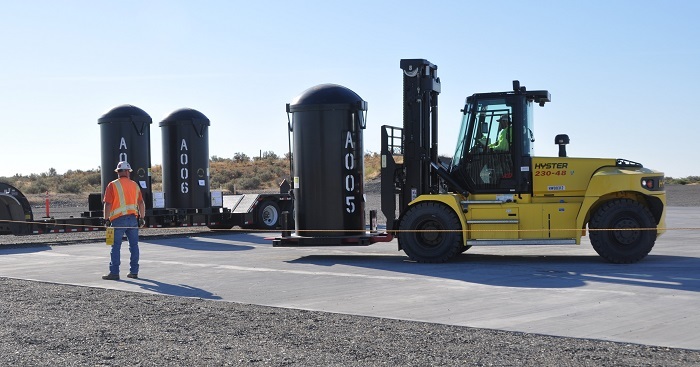 Workers with Hanford Site contractor Central Plateau Cleanup Company are conducting performance demonstrations to ensure the Integrated Disposal Facility is ready to dispose of vitrified, or immobilized in glass, low-activity waste from Hanford’s underground tanks later this year.
Located in Hanford’s Central Plateau, the IDF is approximately 1,500 feet wide, 765 feet long and 45 feet deep. It includes two disposal areas called cells, but it can be expanded as needed to six disposal cells.
To protect groundwater under IDF, the disposal cells are double lined and include a leachate collection system. Leachate is contaminated liquid generated from water percolating through waste. The system is engineered to collect water from rain, snowmelt and dust suppression. Two 400,000-gallon storage tanks at the facility hold the leachate until workers can send it to an onsite facility for treatment to remove contaminants.
Hanford Field Office contractor Central Plateau Cleanup Company (CPCCo) is currently conducting comprehensive testing at IDF to validate procedures and verify workers perform all disposal operations safely and proficiently. Final assessments are expected by the end of March.
“Thanks to the IDF team’s hard work and commitment to safety over the past several years, we look forward to completing final preparations at the facility to support the DFLAW Program, one of Hanford’s most meaningful and historic environmental cleanup projects,” said Paul Branson, CPCCo disposal facilities manager.
Workers should deliver the first containers of vitrified waste from WTP to IDF for disposal later this year.
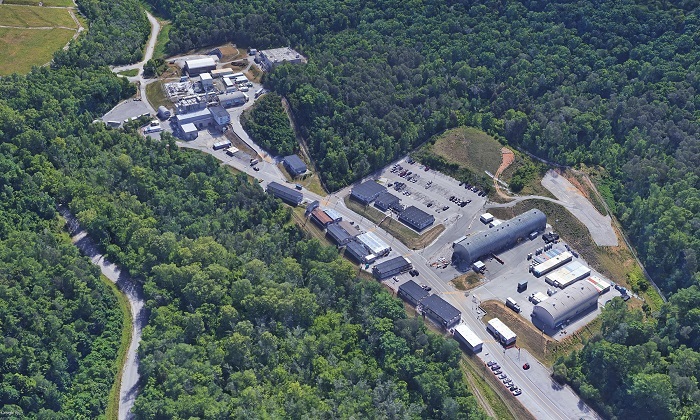 The Transuranic Waste Processing Center sits on 25 acres at the Oak Ridge Reservation and has 38,000 square feet of waste processing buildings and support facilities. Since 2008, employees have completed more than 7,200 waste shipments from the center to the Waste Isolation Pilot Plant in New Mexico.
OAK RIDGE, Tenn. — The Oak Ridge Office of Environmental Management (OREM) and contractor UCOR have successfully reestablished full production capacity at the Transuranic Waste Processing Center.
Recent repairs have teams at the facility working full speed again as they process and repackage waste for shipment and permanent disposal to the Waste Isolation Pilot Plant (WIPP) in New Mexico. Years of defense-related research conducted primarily at Oak Ridge National Laboratory in decades past generated Oak Ridge’s transuranic material.
A large, 900-pound waste-drum crusher at the center had broken. It plays a key role in waste processing operations, requiring teams to replace the equipment.
When drums arrive at the center for processing, employees empty them to access, process and repackage the waste for shipment and disposal. Once emptied, the drums are reduced in size and disposed of as well.
The mission of the crusher is to do exactly that: squash the empty drums. However, its outage presented multiple challenges.
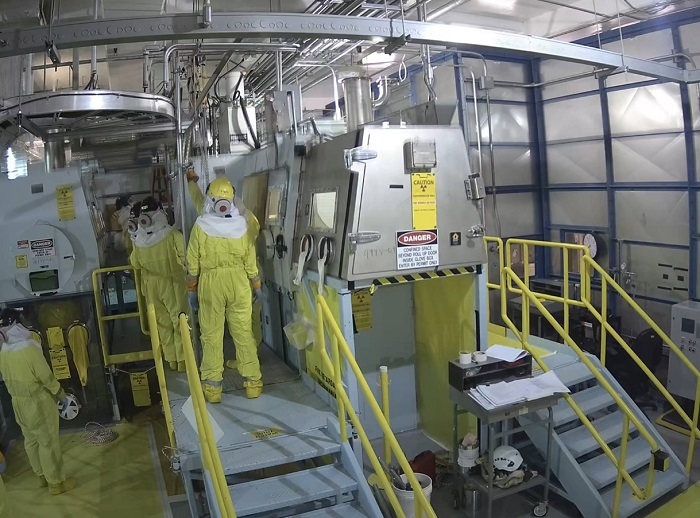 Transuranic Waste Processing Center workers safely replaced the facility’s 900-pound waste-drum crusher, restoring the center’s full waste processing capabilities for an ongoing cellulosic waste campaign.
With the crusher out of commission, workers wore protective suits and manually cut and reduced the size of the old drums. While this approach kept work moving forward, it also presented more risks, took more time and was more labor intensive. The equipment’s failure also impacted activities in the work area below the crusher.
“With the drum crusher’s location on top of the contact-handled waste glovebox in the facility’s main operating gallery, we couldn’t process waste in that glovebox, and we were also forced to reduce the size of those waste drums in an alternate process area,” UCOR Transuranic Waste Processing Center Area Project Manager Pat Rapp said.
Replacing the waste-drum crusher required entering a confined space. Safety, maintenance and waste operator teams planned and trained extensively before entering the room. The challenging work included conducting a critical lift, working from scaffolding and navigating tight clearance spaces on the replacement.
“We had a lot of great support to get this issue safely resolved and restore our full waste processing posture for our ongoing cellulosic waste campaign,” UCOR End State Delivery Director Clint Wolfley said.
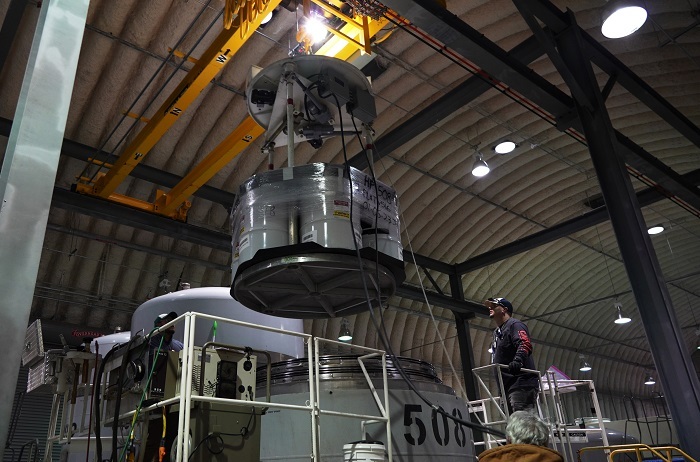 When waste drums arrive at the Transuranic Waste Processing Center for processing, employees empty them to access, process and repackage the waste for shipment and disposal. The employees pictured here are loading the processed and repackaged waste for shipment.
Workers are in the middle of a campaign to process 100 drums of waste containing cellulosic material. This material poses risks of combusting if left untreated; however, OREM and UCOR developed one of the first approved processes to treat this waste in the U.S. Department of Energy Office of Environmental Management complex.
That approval, which occurred last year, allows employees to advance work that is eliminating Oak Ridge's remaining inventory of transuranic waste stored onsite.
OREM and UCOR expect to complete processing the cellulosic waste this year.
To date, Oak Ridge has shipped 94% of its contact-handled waste and 78% of its remote-handled waste to WIPP for permanent emplacement in the underground repository.
-Contributor: Chris Caldwell
AIKEN, S.C. — U.S. Department of Energy Office of Environmental Management (EM) workers at the Savannah River Site (SRS) recently restored six portable tanks, helping preserve an essential site capability of transporting large quantities of radioactively contaminated or hazardous liquid solutions while creating a significant cost savings over acquiring new ones.
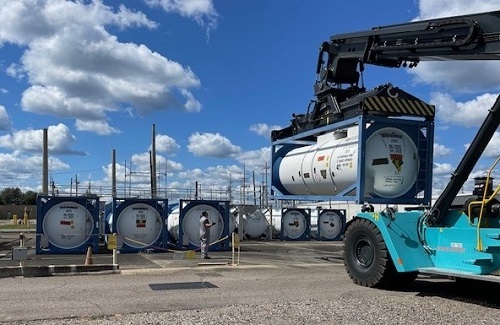
SRS obtained the tanks over two decades ago to support the disposal of plutonium-uranium extraction solvent used at the site’s two chemical separations facilities — F and H canyons, according to Cody Fee with the Environmental Management Operations Programs for Savannah River Nuclear Solutions, the site’s managing and operating contractor. Each tank has a more than 4,600-gallon capacity, and stands 8 feet tall, 8 feet wide and 20 feet long.
“Deactivating F Canyon resulted in the creation of excess, radioactively contaminated solutions that needed to be dispositioned,” Fee said. “The tanks were used to transport these solutions offsite for disposal.”
 |
|
The last of six portable tanks is delivered to a holding area at H Canyon for recertification. Restoring these tanks for use at the chemical separations facility is a significant cost savings over procuring new ones. |
EM finished deactivating F Canyon in 2010, and the facility is awaiting decommissioning. H Canyon continues to operate.
Following the F Canyon deactivation, SRS used the tanks in other areas of the site. They were later drained and left in the SRS Solid Waste Management Facility (SWMF). SRS planned to dispose of the tanks at that facility before employees came up with potential uses for them at H Canyon.
Because the tanks had been sitting empty for a number of years, employees performed inspections and examinations to ensure their structural integrity. The tanks passed these examinations, and they’re expected to be recertified this fiscal year, which ends Sept. 30.
“When we began investigating the cost of procuring new tanks to perform needed activities in H Canyon, we discovered that the reuse of these tanks was a significant cost and time savings,” Fee said. “Rather than waiting for new tanks to be custom built and delivered, we had tanks on hand that just needed to be transferred a few miles from SWMF to H Canyon and undergo recertification testing, which is required periodically regardless of the age of the tanks.”
Fee added that the tanks will be essential to carrying out future missions at SRS.
-Contributor: Lindsey MonBarren
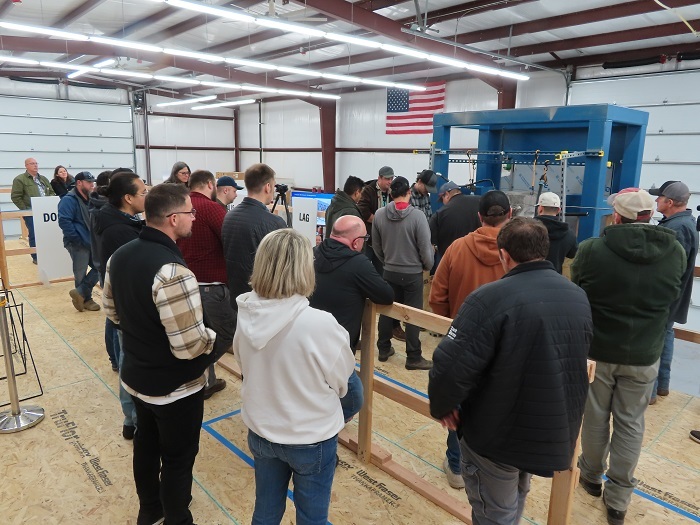 Craft workers with Hanford Field Office contractor Washington River Protection Solutions view the proposed waste pretreatment process unit full-scale mock-up.
RICHLAND, Wash. — The Hanford Field Office and tank operations contractor Washington River Protection Solutions (WRPS) are working with a local business to create a full-scale mock-up for the next phase of liquid radioactive waste pretreatment.
Over the last three years, the Tank-Side Cesium Removal (TSCR) System demonstration project has pretreated more than 830,000 gallons of Hanford’s underground tank waste to prepare for feeding it to the Waste Treatment and Immobilization Plant for vitrification, or immobilization in glass.
Lessons learned in building and operating TSCR are helping to design process units that will remove radioactive cesium and solids from waste in Hanford’s 200 East and West areas prior to treatment.
“We continue to make great progress toward starting to vitrify waste from Hanford’s large underground tanks,” said Janet Diediker, federal project director for Tank Waste Operations. “But we’ve known that TSCR was a near-term solution. We had planned for a higher-capacity pretreatment system to feed the vitrification facility.”
 |
|
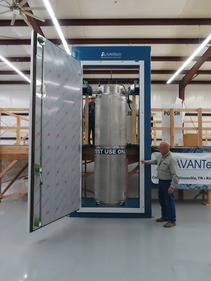
Project Manager Randy Havenor with Hanford Field Office contractor Washington River Protection Solutions demonstrates how new ion exchange column access doors will be wider and taller to make it easier to install and remove the columns. |
Blue tape on the mock-up floor marks where the wall of the Tank-Side Cesium Removal System process enclosure ends, illustrating the larger size of the new waste processing units. |
|
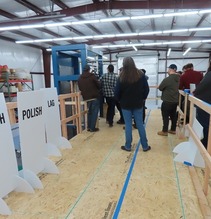 |
One of the first steps in designing these units is constructing a mock-up so workers can get a sense of the improvements. The company designing, fabricating and testing the process units, AVANTech, has built a mock-up of one of the units in its Richland, Washington, warehouse. Workers recently toured the facility to gain valuable insight into how the new layout, piping and hose configurations will improve efficiency and ergonomics.
“We had more than 200 lessons learned documented from TSCR,” said Laura Cree, WRPS project engineer, “and one was that it was a tight fit when trying to change out an ion exchange column, which removes the cesium from the waste. The new process unit configuration put a lot of the piping under the grating, and the floor is higher, so pipefitters have an easier time reaching the piping to disconnect or connect the columns.”
Pipefitter Ivan Howard, who has been working on TSCR since it started processing waste in January 2022, likes the improved design.
“The piping connections on this mock-up are a lot lower; they’re now about mid-chest level,” said Howard. “When you’re in there for hours disconnecting or connecting an ion exchange column, it can get difficult to keep your arms over your head. So having the connections at chest level is much more comfortable.”
The units will also be larger, measuring more than twice the width of the TSCR unit, and longer to accommodate an additional ion exchange column, increasing the system from three to four columns.
Throughout process unit design, workers will continue to use the mock-up to provide worksite analysis, feedback and improvement ideas to help the next generation of waste processing units be more efficient and worker friendly.
To see more on the mock-up, watch this video.
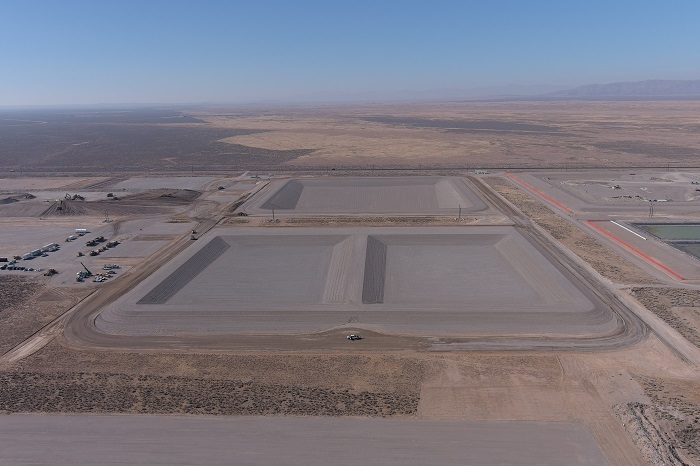 U.S. Department of Energy Office of Environmental Management crews completed excavation for a new disposal cell, background, and two evaporation ponds, foreground, as part of a major expansion project at the Idaho National Laboratory Site’s Idaho CERCLA Disposal Facility.
IDAHO FALLS, Idaho — Idaho Cleanup Project crews are preparing for the next stages of construction of a waste disposal facility expansion project following recent progress that includes completion of excavation for a new disposal cell and evaporation pond areas.
For 14 months, crews carefully excavated over 13 acres for the new cell. It will provide more than 500,000 cubic meters of disposal space, increasing the long term capacity of the Idaho CERCLA Disposal Facility (ICDF) threefold and extending its operational life by 25 years.
The additional disposal volume supports major footprint reduction projects at the Idaho National Laboratory (INL) Site, including the demolition of legacy reactor prototypes at the Naval Reactors Facility. When construction began on the new cell in 2023, the ICDF disposal volume was approaching 80% capacity, incapable of meeting future disposal needs.
Crews also excavated nearly 8 acres for two evaporation ponds, which will protect the environment and the Snake River Plain Aquifer by collecting stormwater that falls into the disposal cell and preventing this water, known as leachate, from percolating into the soil below.
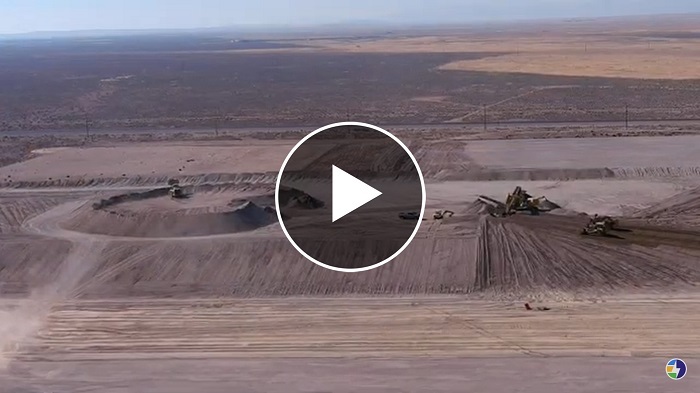 EMTV: Watch this video on the progress of construction of the Idaho CERCLA Disposal Facility at the Idaho National Laboratory Site. CERCLA stands for the Comprehensive Environmental Response, Compensation, and Liability Act, which is a law enacted by Congress in 1980.
The new disposal cell is designed like the existing landfill, with multiple liners, various water collection and detection systems, and lined evaporation ponds, all of which comply with state-of-the-art disposal facility requirements protective of the environment and human health.
In coming months, the U.S. Department of Energy Office of Environmental Management (EM) and contractor Idaho Environmental Coalition (IEC) will focus on construction of the cell and the neighboring evaporation ponds. This includes bringing the excavated areas to final grade and placing the liner systems in both the new cell and the evaporation pond areas.
During the winter months, which create challenges for the project, crews will continue screening operations, in which excavated soil and gravel are sifted, separated and staged. Some of the material will be used during construction of the new cell and evaporation ponds later this year, while the rest will be used to bury waste during disposal.
CERCLA stands for Comprehensive Environmental Response, Compensation, and Liability Act, a law enacted by Congress in 1980. As a result of the CERCLA regulatory process, the ICDF has stringent waste acceptance criteria. It only accepts waste generated from CERCLA and deactivation and decommissioning remediation efforts. It does not accept offsite waste.
EM and IEC are expected to complete construction of the new cell and evaporation ponds this year. The new cell is projected to begin accepting waste in 2027.
-Contributor: Carter Harrison
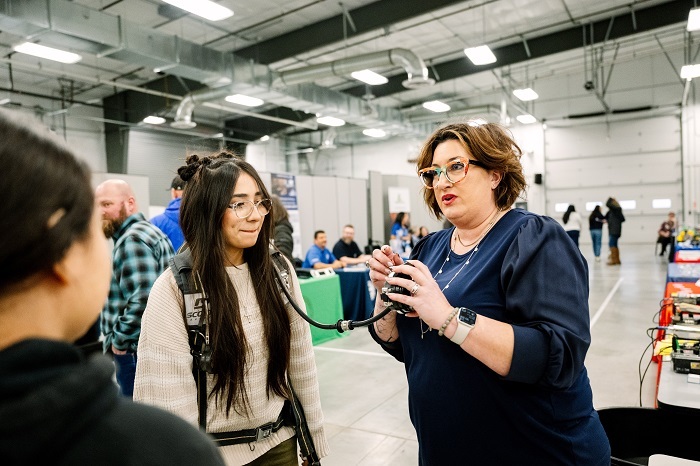 Carrie Jacobs, Beryllium and Asbestos Program manager with Hanford Mission Integration Solutions’ Training & Technology Program at the Volpentest HAMMER Federal Training Center, shows students how to use respiratory equipment during a recent Hanford STEM Day event. HAMMER stands for Hazardous Materials Management and Emergency Response.
RICHLAND, Wash. — About 40 students from local rural high schools visited the Hanford Site’s Volpentest HAMMER Federal Training Center to learn about the U.S. Department of Energy Office of Environmental Management (EM) mission and career opportunities in the fields of science, technology, engineering and math (STEM) at the site.
“These community events allow us to introduce students to the Hanford cleanup mission and showcase the critical work we do,” said Cerise Peck, public affairs specialist with the Hanford Field Office. “We are able to provide a firsthand look at future career paths.”
Hosted by Hanford Field Office contractor Hanford Mission Integration Solutions, the event highlighted EM's efforts to build pathways for students to pursue STEM careers while encouraging future workforce development aligned with the Hanford cleanup mission.
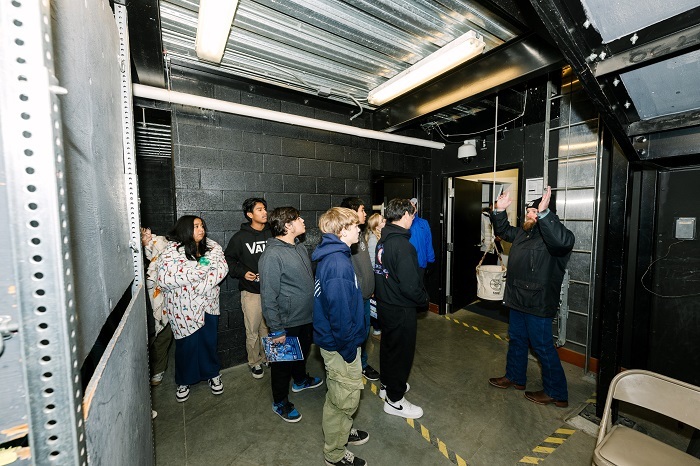 Ben Culver, Hanford Mission Integration Solutions’ Industrial Safety Training manager at the Volpentest HAMMER Federal Training Center, guides students through the facility’s Search & Rescue Building as part of a recent Hanford STEM Day event.
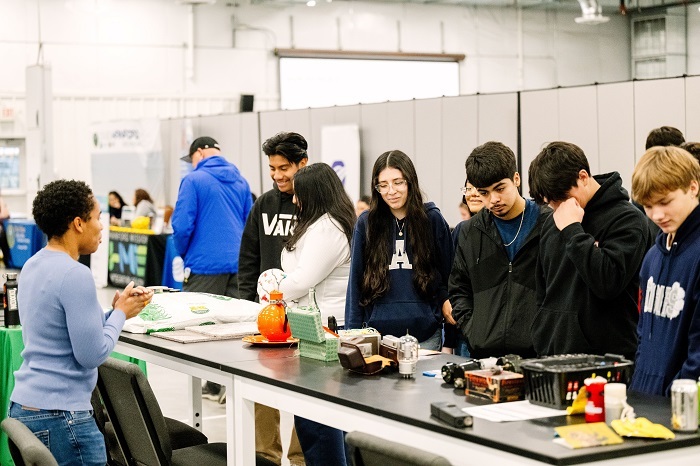 Brittany Robertson, a nuclear chemist for Pacific Northwest National Laboratory’s (PNNL) Nuclear Material Processing team, talks to students about technology used for PNNL careers during a recent One Hanford STEM Day Career & Resource Fair.
Students participated in hands-on demonstrations and presentations on jobs in fields such as search and rescue, health and safety, hoisting and rigging, fall protection and fire response.
Part of the STEM Day event was a career and resource fair that included representatives from local colleges, EM and Hanford contractors. It gave students the chance to learn about the variety of opportunities available at Hanford and the educational and technical programs some careers require.
“This is career-connected learning at its finest,” said Heather Tibbett, deputy director of the Washington State STEM Education Foundation. “These are experiential opportunities for students to really see the career opportunities available right here in their own backyards and that, no matter what their interests are, there are options for them at Hanford.”
-Contributor: Shyanne Palmus
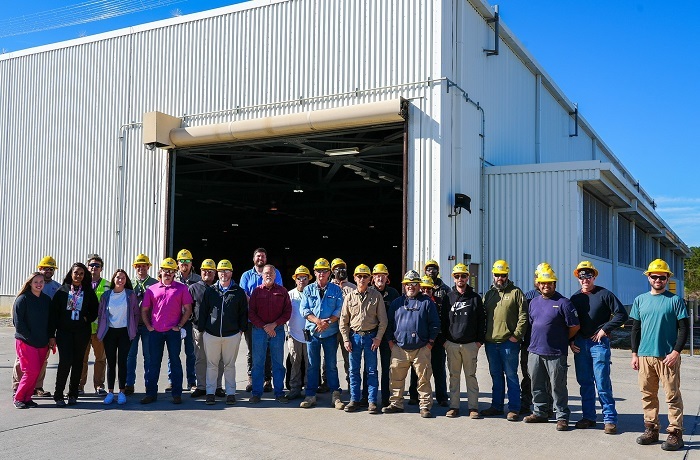 The canister double-stack team at Savannah River Mission Completion comprises members of the construction craft crew, engineers, radiological control inspectors, project managers and more. The team is modifying additional storage positions in a second glass waste storage building to accommodate two canisters stacked atop each other, a space-saving project that saves tens of millions of dollars.
AIKEN, S.C. — The U.S. Department of Energy Office of Environmental Management (EM) and its liquid waste contractor at the Savannah River Site (SRS) are now adding more capacity to store vitrified liquid waste, a significant federal cost-savings initiative at SRS.
Crews modified the first canister storage positions inside Glass Waste Storage Building (GWSB) 2 in December. Since then, they have fully modified 150 positions.
This milestone continues the undertaking to accommodate stacking two canisters of vitrified high-level waste from the Defense Waste Processing Facility (DWPF) one atop the other in GWSB 2. Double stacking began at GWSB 1 in 2016 and saves the federal government an estimated $100 million or more by avoiding construction of a third canister storage building. Modifying GWSB 2 saves the government another $100 million.
Savannah River Mission Completion (SRMC), the SRS liquid waste contractor, is completing this innovative project for EM to ensure there is enough onsite storage space for the projected 8,100 canisters to be produced at DWPF, according to the SRS Liquid Waste System Plan. SRMC completed modifications of all canister storage positions to accommodate double stacking in GWSB 1 in March. More than 2,400 canisters have been placed in double stacked locations in that building so far.
To achieve double-stack modifications, crews use a specially designed cutting tool to remotely remove an existing steel crossbar from each canister support in the below-grade vaults. The elevated crossbar is replaced with a plate that rests on the vault floor. This technique increases the height available to allow the 10-foot-tall canisters to be stacked one on top of the other. Crews have already cut more than 230 of the crossbars to prepare for the full modifications in GWSB 2.
Jim Folk, DOE-Savannah River assistant manager for waste disposition, said safely optimizing canister storage space at SRS is necessary to keep the liquid waste mission moving toward completion.
“The canisters from the Defense Waste Processing Facility are the final output from the sludge waste processing of the tank waste,” Folk said. “If we run out of space to safely store the canisters, the liquid waste processing system will stop. Thank you to the teams who are ensuring that doesn’t happen and for supporting the Department in our commitment to keep moving forward safely and efficiently.”
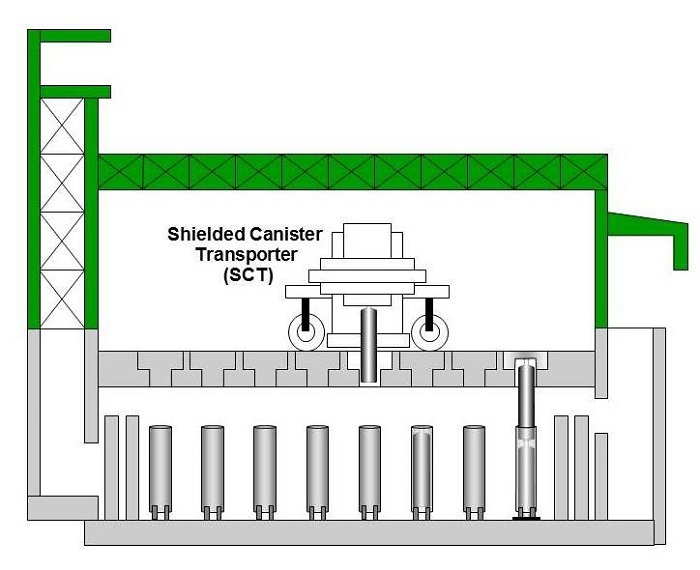 The canister double-stack project at the Savannah River Site modifies each canister storage position to provide enough room to add a second canister on top of the first. Double stacking canisters in both onsite storage buildings saves an estimated $200 million by deferring the expense of constructing another storage building.
At DWPF, the waste is mixed with a special glass and heated to more than 2,000 degrees Fahrenheit, turning the mixture into molten glass in a process called vitrification.
Current plans are to modify three of the four below-grade vaults in GWSB 2 for double stacking canisters. Once completed, this strategy will increase the total storage capacity to 8,619 canisters. The option of modifying the fourth vault would be available, if necessary, and would increase the total storage capacity of both buildings to 9,204 canisters.
The canisters are safely stored in below-grade concrete vaults in the glass waste storage buildings until a federal repository for high-level waste is established.
A specially designed vehicle, called the shielded canister transporter, is used to move the canisters from the DWPF vitrification building to the glass waste storage buildings. It is also used to move the canisters for the double-stacking process.
SRMC President and Program Manager Dave Olson said successful expansion of the canister double-stack project into GWSB 2 is an example of continuous improvement at work.
“What started as an innovative and challenging idea sprung from a small team of engineers has turned into one of the largest cost savings in our program for the Department of Energy,” Olson said. “Innovative ideas taken from inception to execution, with double stacking canisters as just one example, is a testament to the ingenuity of this team.”
The radioactive liquid waste that is vitrified inside the canisters was generated at SRS as by-products from processing nuclear materials for national defense, research, medical programs and NASA missions. The waste — totaling 33 million gallons — is stored at SRS in two groupings of underground waste tanks known as tank farms.
-Contributor: Colleen Hart
|