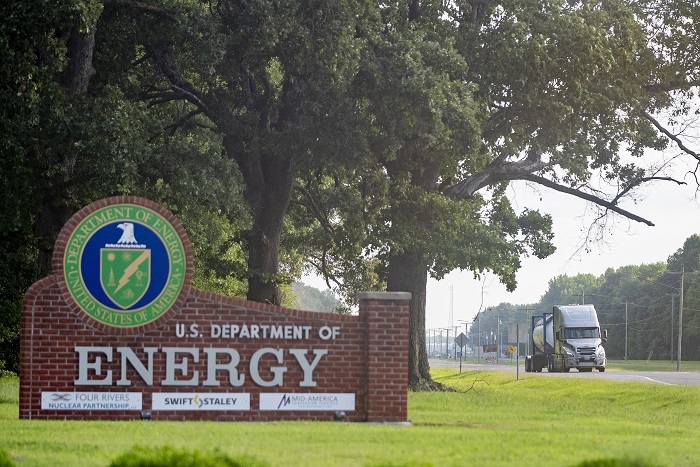
 The Paducah Site has shipped more than two-thirds of its 8.5 million-pound inventory of R-114 refrigerant for disposal, significantly reducing site hazards.
Paducah meets million-mark challenge for fourth consecutive year
PADUCAH, Ky. — The Paducah Site met a U.S. Department of Energy Office of Environmental Management (EM) 2024 priority by safely and successfully removing 1 million pounds of R-114 refrigerant — a legacy environmental hazard stored at the site — this year.
Since 2020, the site has shipped 5.9 million pounds of the refrigerant for disposal offsite out of its total inventory of 8.5 million pounds of R-114. Significant improvements, including upgrading shipment trailers and strategic partnerships with commercial incinerators, ensure the continued safe and compliant disposal of R-114 from the site.
“This is a significant accomplishment for the Paducah Site,” Portsmouth Paducah Project Office Manager Joel Bradburne said. “Reducing site hazards continues to be one of EM’s strategic objectives over the next several years. This is a giant step to reaching that goal.”
 R-114 is an ozone-depleting refrigerant that has been stored at the site for many years. The disposition of 1 million pounds of it is equivalent to reducing greenhouse gas emissions by taking about 4 million gas-powered vehicles off the roads for a year.
During uranium enrichment operations, Paducah produced large quantities of heat when uranium hexafluoride gas was compressed. The heat was removed by pumping R-114 into the system to control temperatures during the conversion process.
EM deactivation and remediation contractor Four Rivers Nuclear Partnership (FRNP) led the effort to remove the environmental hazard from the site. It was the fourth consecutive year FRNP met the EM priority to dispose of 1 million pounds of R-114 within a calendar year.
“Achieving these goals ahead of schedule is a testament to the ingenuity of our team and their proactive approach.” FRNP Program Manager Myrna Redfield said. “The team has worked diligently to ensure the continued safe and successful removal of this hazard from the site.”
-Contributors: Dylan Nichols, Chris Skates
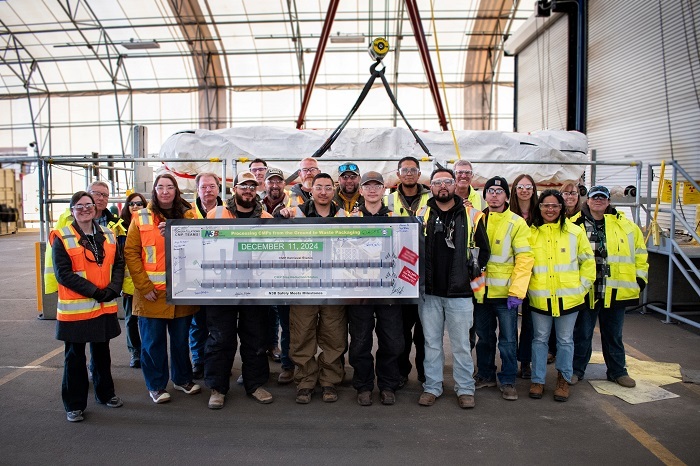 Environmental Management Los Alamos Field Office team members are pictured in front of the 158th and final corrugated metal pipe before it is segmented.
LOS ALAMOS, N.M. — Size-reduction activities have wrapped up for 158 corrugated metal pipes (CMPs) containing legacy cemented transuranic waste at Los Alamos National Laboratory (LANL).
Last week, LANL legacy cleanup contractor Newport News Nuclear BWXT-Los Alamos (N3B) finished reducing the size of 158 CMPs. Each CMP was cut into five sections, and then each section was loaded into a standard waste box for shipment to the U.S. Department of Energy (DOE) Office of Environmental Management (EM) Waste Isolation Pilot Plant for disposal. Shipments are expected to begin in late 2025. Each CMP measured approximately 20 feet long and weighed between 10,000 and 14,000 pounds.
“This project marks the first time N3B has successfully addressed buried waste on this scale at LANL,” N3B President and General Manager Brad Smith said. “I want to thank all those across N3B who played a role in our ability to safely carry out and complete this project. We’ll take the lessons we learned on the CMP project to further aid our efforts to address legacy radioactive and other wastes at LANL.”
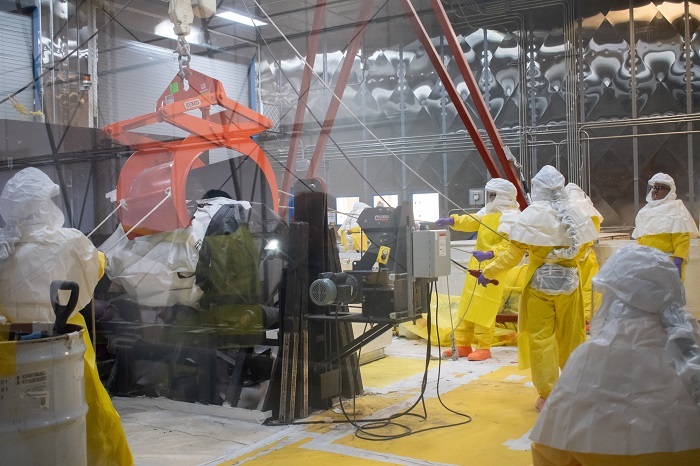 A corrugated metal pipe section is lifted with a gantry crane for placement into a standard waste box. Once loaded, the standard waste box is transferred to another room where it is decontaminated before it is moved outside of the PermaCon for interim storage, waste certification and shipment to the Waste Isolation Pilot Plant.
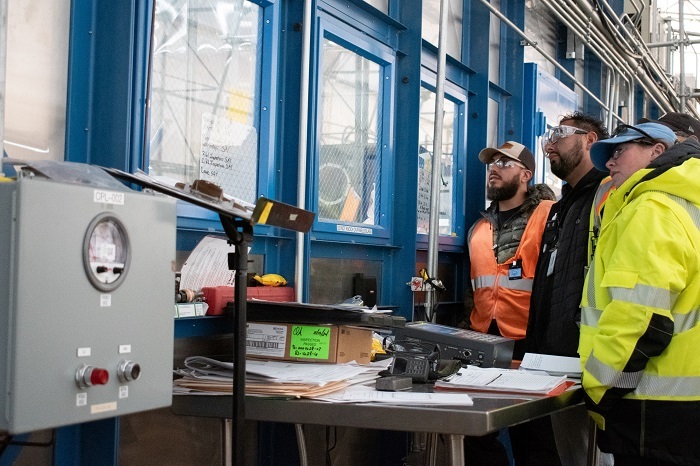 Team members watch the corrugated metal pipe segmentation process safely outside the PermaCon, protected from any contamination.
The CMPs contained cemented radioactive liquid waste that originated from a former LANL radioactive liquid waste treatment facility that operated during the Cold War era at Technical Area 21 (TA-21). They were buried at TA-54, Area G, in 1986 for future retrieval. Retrieval activities began in the fall of 2022 and were completed earlier this year.
Size-reduction activities commenced in the summer of 2023. Each CMP was brought into a facility called Dome 375. This facility was designed to prevent the release of contamination from the cutting into the environment. Inside a permanent containment unit nested within Dome 375, workers cut the CMPs into sections using a hydraulic shear that was equipped with its own exhaust ventilation to reduce dust creation and support worker safety. Significant safety planning and practice evolutions were performed before workers began size-reduction activities.
“I want to congratulate N3B on this accomplishment. CMPs are a key project for the EM Los Alamos Field Office (EM-LA) and are a DOE EM priority goal,” said Jessica Kunkle, EM-LA manager. “The safe and successful retrieval and size-reduction of the CMPs is a significant step forward for the LANL legacy cleanup mission and adds to the growing progress we continue to make in reducing legacy waste inventories.”
-Contributor: Michael Nartker
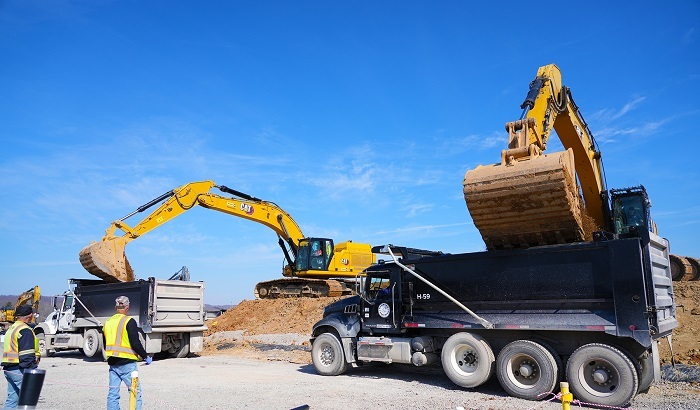 Crews excavated more than 50,000 dump truck loads of soil during remediation projects at East Tennessee Technology Park. Completion of that work in 2024 allows the Oak Ridge Office of Environmental Management to transfer the remaining federally owned parcels at the site to the community for beneficial reuse.
OAK RIDGE, Tenn. – The Oak Ridge Office of Environmental Management (OREM) and its contractors recorded another successful year by completing all of their U.S. Department of Energy (DOE) Office of Environmental Management (EM) priorities and reaching an ambitious milestone decades in the making.
Crews with contractor UCOR finished soil remediation at the East Tennessee Technology Park (ETTP) after workers excavated and disposed of nearly 50,000 dump truck loads of soil. Finishing this phase of cleanup marks the conclusion of nearly 20 years of major field work that transformed a former enrichment complex into a multi-use industrial park.
Completing soil remediation at ETTP eliminates risks and allows OREM to transfer the remaining federally owned parcels at the site to the community to help attract businesses and promote new economic development.
Regulators signed two records of decisions that provide the approval and guidance necessary to address groundwater at ETTP. These decisions, along with two others under development, will guide future remediation for OREM to complete the cleanup mission at ETTP.
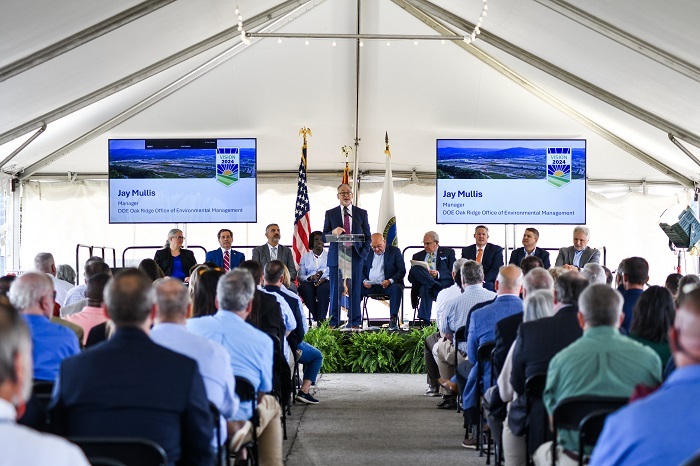 Oak Ridge Office of Environmental Management Manager Jay Mullis speaks at the Vision 2024 event, celebrating the completion of soil remediation and major fieldwork at East Tennessee Technology Park. He is joined on stage, from left, by U.S. Department of Energy Office of Environmental Management Senior Advisor Candice Trummell Robertson; U.S. Rep. Chuck Fleischmann of Tennessee; U.S. Environmental Protection Agency (EPA) Superfund Federal Sites National Program Manager Greg Gervais; EPA Region 4 Division Director Caroline Freeman; Tennessee Department of Environment and Conservation Commissioner David Salyers; Oak Ridge Mayor Warren Gooch; Roane County Executive Wade Creswell; Kairos Power Chief Technology Officer Ed Blandford; and UCOR President and CEO Ken Rueter.
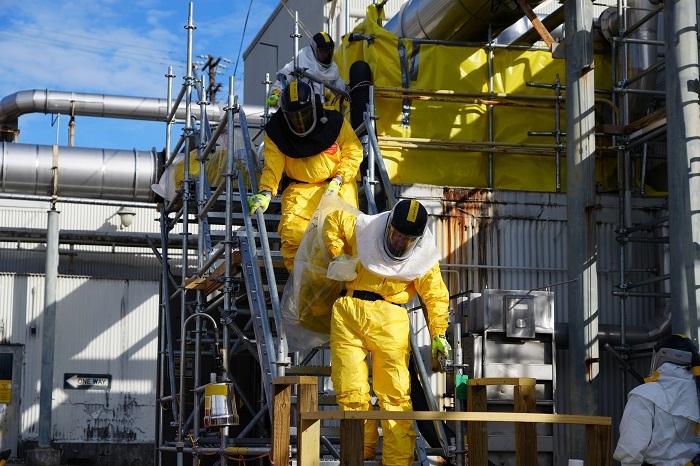 Deactivation activities are in full swing at Oak Ridge National Laboratory (ORNL). Crews are preparing 13 buildings for demolition and paving the way for more transformation in the heart of ORNL’s central campus.
At Oak Ridge National Laboratory (ORNL) this past year, teams were busy preparing more than a dozen excess contaminated facilities for demolition. Some of the biggest moments in 2024 involved shipping the Low Intensity Test Reactor vessel for disposal and removing and shipping the reactor vessel from the Oak Ridge Research Reactor for disposal.
OREM contractor Isotek significantly advanced processing and disposal of the inventory of uranium-233 stored at ORNL. Employees processed more than 90 canisters of high-dose material this year, exceeding the goal of 35.
As part of an innovative public-private partnership, employees with that project are also extracting medical isotopes from the uranium-233 material that are supporting next-generation cancer treatment research. The company receiving the isotopes announced it is now producing at a commercial scale to supply clinical trials across the globe.
Another public-private partnership enabled OREM to transfer one of the largest single sources of legacy radioactive material from storage at ORNL. That material — strontium-90 — will be recycled into a source of clean energy for new power systems employed by other federal agencies.
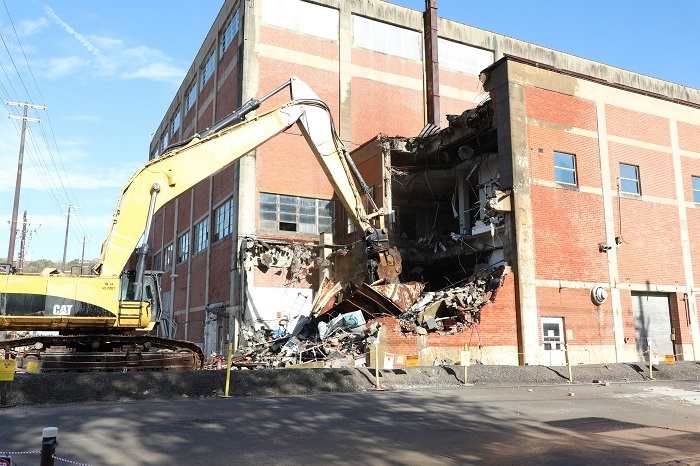 Demolition is now underway on the massive 325,000-square-foot Manhattan Project-era Alpha-2 building at the Y-12 National Security Complex. This marks the largest demolition yet at Y-12 and the first teardown of a former enrichment facility at the site.
At the Y-12 National Security Complex, OREM and UCOR began demolishing Alpha-2, marking the largest demolition to date at Y-12, and the first teardown of a former enrichment building at that site.
The massive 2.5-acre Manhattan Project-era structure stands three stories tall and measures 325,000 square feet. Alpha-2 is categorized as a high-risk excess contaminated facility, and its removal eliminates hazards and opens land for national security missions moving forward.
Employees also advanced work on the Environmental Management Disposal Facility (EMDF) project. When complete, this crucial piece of infrastructure will provide OREM the waste disposal capacity needed to complete cleanup at Y-12 and ORNL.
In 2024, team members completed EMDF’s early site preparation five months ahead of schedule and more than $12 million under budget. Crews also finished field work on the second phase of the project, known as the groundwater field demonstration.
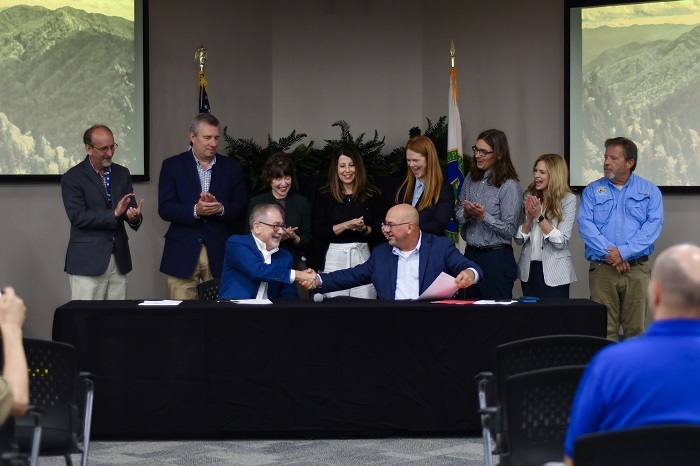 Tennessee Department of Environment and Conservation Commissioner David Salyers, right, and Oak Ridge Office of Environmental Management Manager Jay Mullis, left, sign a $42 million agreement to fund local natural resources and recreation projects.
OREM also signed a $42 million agreement with the state of Tennessee to address impacts from DOE’s historic operations on the Oak Ridge Reservation.
The funds from the agreement will support grants for a wide range of local projects that enhance the area’s natural resources and provide nature and recreational opportunities. Local residents and organizations can apply for the first round of these grants through Feb. 6.
-Contributor: Ben Williams
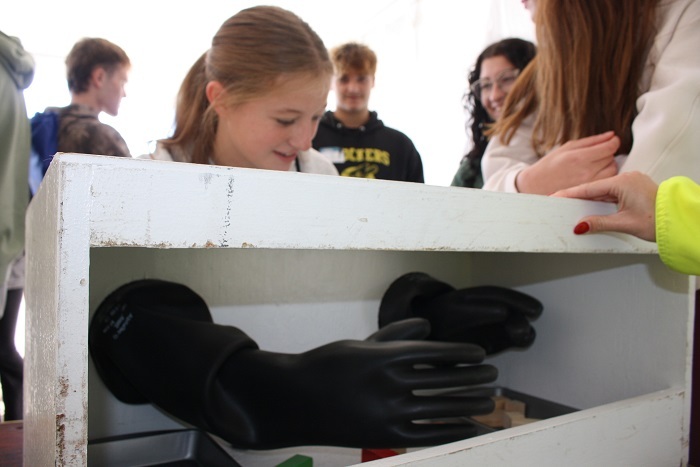 Waverly High School students participate in a glovebox challenge trying to be the first team to correctly separate different colored blocks to the correct trays. At the Science Alliance, many of the interactive stations involve competition.
PIKETON, Ohio — The Portsmouth Site is well known for encouraging scientific learning and exploring science, technology, engineering and math (STEM) opportunities with students of all ages in the community year-round.
“Our STEM related programs have grown tremendously in the past couple of years, and it is great to see so many employees from the U.S. Department of Energy (DOE) Office of Environmental Management and all site contractors taking part in providing our local students with new opportunities,” Portsmouth Site Lead Jeremy Davis said.
This fall, more than 1,400 students from 30 high schools in five nearby counties descended on the site for the annual Science Alliance. In its 13th year, Science Alliance is one of the largest hands-on science events in southern Ohio. Students enjoy science activities, meet with college and local industry representatives and learn about the site’s history and plans for future development.
“It is always inspiring to see the students come here and enjoy themselves and interact with all the presenters, whether it’s during a hands-on demonstration or learning about a career or educational path after high school,” said Davis. “The students seem to really appreciate the opportunities that go beyond the classroom.”
The majority of students participating in Science Alliance are juniors. Many of them are thinking about their plans for the future.
“I really enjoyed going to Science Alliance and learning about all the STEM opportunities in southern Ohio,” said Waverly High School Junior Quinn Shaffer. “This program gives students a chance to learn about things we might not get a chance to experience in class or any of our extracurricular programs at school.”
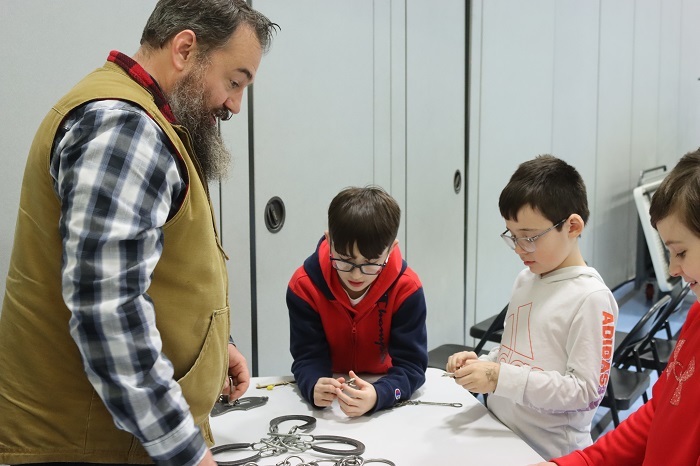 Mentors from the Portsmouth Site help students discover new ideas, practice critical thinking and explore different careers as part of the STEAM Ahead program used by all four public school districts in Pike County, Ohio.
In winter, the focus turns to third and fourth graders with the STEAM Ahead program. Now in its fifth year, the program is in all Pike County public schools with plans to expand to Scioto County next year. STEAM stands for science, technology, engineering, art and math.
Employees from the site create and demonstrate a wide variety of 15-minute activities that include physics lessons, building through engineering principles, water purification, chemistry, centrifuge technology, biology and even video editing.
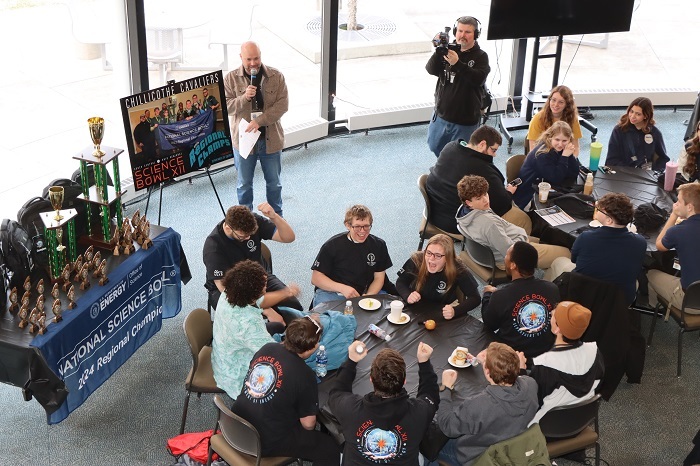 Portsmouth Site Lead Jeremy Davis welcomes students to the U.S. Department of Energy South Central Ohio Regional Science Bowl, where 32 teams compete for the title of regional champion and the chance to participate in the National Science Bowl in Washington, D.C.
By spring, competition takes center stage, as some of the brightest students in Pike, Ross, Scioto, and Jackson counties compete during the DOE South Central Ohio Regional Science Bowl. Each year, 32 teams compete for the title of regional champion and advance to the national competition in Washington, D.C.
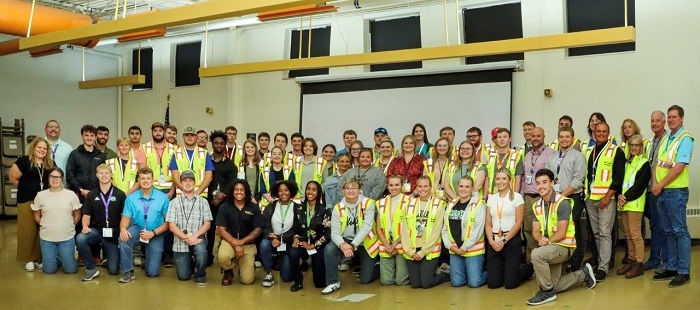 The Portsmouth Site hosted more than 50 interns this past summer on behalf of the U.S. Department of Energy Office of Environmental Management and site contractors. All interns participated in a “Lunch and Learn” where they learned more about the Portsmouth Site mission from Portsmouth Site Lead Jeremy Davis and networked with one another.
In summer, the spotlight moves to college students ready to prepare for their future. Students work hand in hand with Portsmouth Site experts in a wide range of fields to learn job skills they may not get in the classroom.
“Our internship program is one of the most sought-after in our community, not only because it’s a paid internship, but it’s the opportunity and experiences they are presented within the workplace setting that are directly instrumental in launching their professional career paths,” said Todd Cron, human resources acting director for Fluor-BWXT Portsmouth, the prime contractor for the Portsmouth Site’s decontamination and decommissioning project.
This year, more than 50 interns worked at the Portsmouth Site, with some accepting positions with the site after completing the program.
-Contributor: Cindi Remy
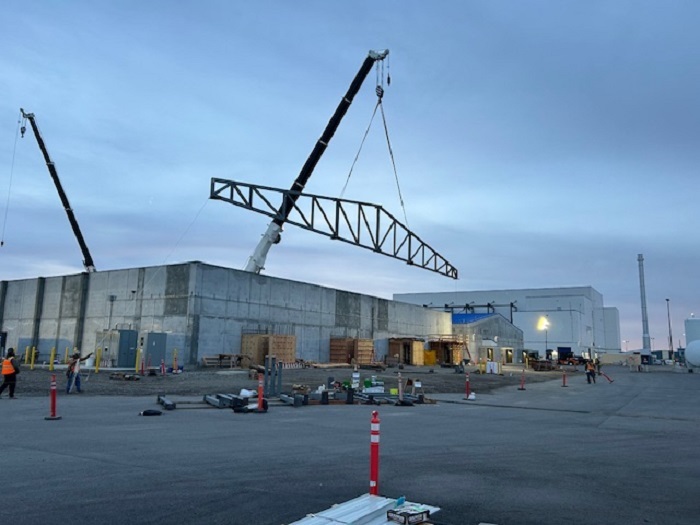 Crews move the first truss into position over the partially constructed storage building. Once completed, the building will store sodium-bearing waste processed by the Idaho National Laboratory Site’s Integrated Waste Treatment Unit.
IDAHO FALLS, Idaho – U.S. Department of Energy Office of Environmental Management (EM) crews at the Idaho Cleanup Project have benefited from collaboration, proper planning, and effective communication to advance toward completing a major construction project at the Integrated Waste Treatment Unit (IWTU).
Beginning in 2023, construction crews worked to build a second 20,000-square-foot concrete storage facility for liquid radioactive waste processed by IWTU, which surpassed an EM priority earlier this year.
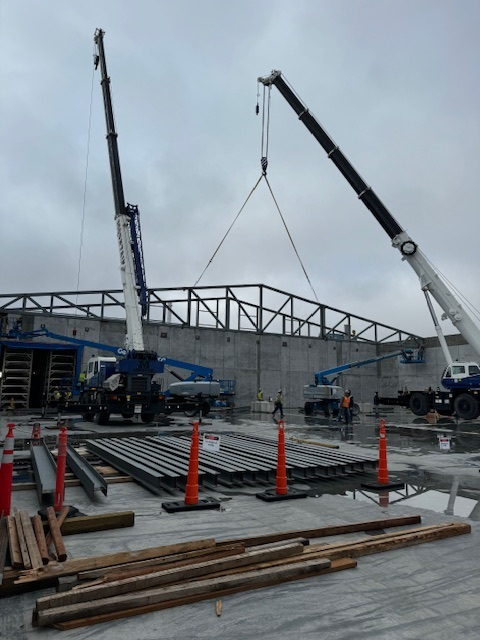
Recent efforts have focused on laying large steel trusses on the partially constructed facility. Trusses provide structure for roofs, span long distances and transfer the weight of heavy loads to engineered supports in a building.
About 30 workers placed seven large steel trusses in five days. Each of those trusses weigh nearly 25,000 pounds and span 130 feet in length.
Kory Edelmayer, senior construction manager at IWTU, recognized the difficulty of the task but credited the crew and their planning efforts as contributors to success. The project applied lessons learned from the commercial industry to ensure safe emplacement of the trusses.
“Our crews are highly skilled and very experienced,” said Edelmayer. “The buildup and planning, including assembling the trusses and numbering them in an efficient sequence, was critical to moving through this phase quickly.”
 |
|
Two cranes work in tandem to place trusses for a storage facility for processed liquid radioactive waste. A nearby U.S. Department of Energy Office of Environmental Management project at the Idaho National Laboratory Site shared a second crane with the Integrated Waste Treatment Unit construction crews to support completion of this project phase. |
While the crew’s planning efforts helped them complete the phase quicker than expected, Edelmayer recognized that collaboration from spent nuclear fuel crews at the neighboring Idaho Nuclear Technology and Engineering Center was invaluable.
“We were able to borrow a second crane, which helped us place and secure trusses,” said Edelmayer. “Without this second crane and the support from our colleagues, it may have taken twice as long to place and install the trusses and could have resulted in increased crane costs if the second, in-house crane was not available.”
Safety and effective communication are crucial to construction of the storage facility.
“This is one of the largest construction projects at the Idaho Cleanup Project over the last 20 years, second only to the IWTU construction, and I am amazed by the cooperation and teamwork of this crew,” Edelmayer said. “From our operators to our iron workers, everyone had a role to play and executed their job to the highest standard. Their commitment to safety and the mission allowed us to complete this phase of the project without incident.”
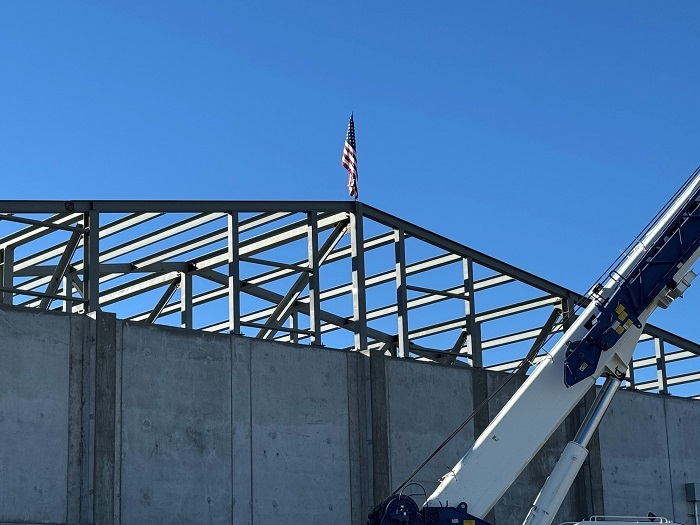 Workers decorate the highest piece of steel on the structure with an American flag, an ironworker’s tradition known as topping out.
Once construction is complete, the second storage facility will house vaults full of stainless steel canisters containing sodium-bearing waste processed through the IWTU.
In coming months, workers will complete electrical work, construct a hot shop and a breezeway connection to the existing product storage building, and install the roof.
Idaho Environmental Coalition, EM’s contractor at the INL Site, expects to complete construction of the storage building in 2025.
-Contributor: Carter Harrison
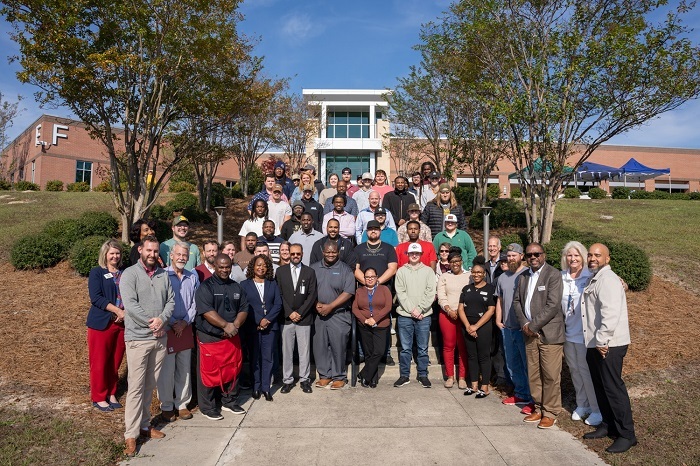 To mark National Apprenticeship Week, the Savannah River Site Apprenticeship Program recognized current apprentices and program partners at a luncheon at Aiken Technical College.
AIKEN, S.C. — The Savannah River Site (SRS) recently joined the nationwide celebration of the U.S. Department of Labor’s 10th annual National Apprenticeship Week, spotlighting the progress and diversity of the site’s apprenticeship program spanning 27 occupations.
More than 600 apprentices have enrolled in the SRS Apprenticeship Program since its inception, with nearly a quarter of them minorities, 11% veterans, 26% women and 12% young adults. Over 91% of enrolled apprentices have transitioned to careers at the site.
“Diversity and skill development are the cornerstones of our workforce strategy, critical for meeting our growing industry needs and national priorities,” said Dorian Newton, director, SRS Site Training. “National Apprenticeship Week allows us to reflect on and celebrate the transformative role that apprenticeships play in empowering individuals for lasting and fulfilling careers at SRS.”
 |
|
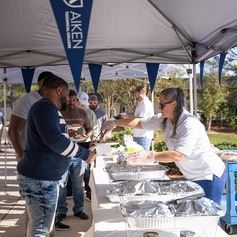
Savannah River Site Apprenticeship School’s Abigail Bowman, foreground, and Patrick Ott serve lunch to apprentices during the appreciation luncheon held at Aiken Technical College in celebration of National Apprenticeship Week. |
A recent event showcased the efforts and achievements of SRS apprentices while celebrating partnerships between Savannah River Nuclear Solutions (SRNS), Savannah River National Laboratory, Savannah River Mission Completion (SRMC), and Aiken, Augusta, and Denmark technical colleges. SRNS is the management and operations contractor at SRS and SRMC is the liquid waste contractor at the site.
"This team has provided you with the tools for success; now, it’s up to you to apply yourself in the classroom and the field," Sean Alford, SRNS executive vice president and chief administrative officer, said during the event. “It's more than a personal milestone; it's an initiative with national resonance, setting a precedent that could shape apprenticeship programs across the country.”
Lawrence Winburn with the Office of Apprenticeship at the Department of Labor said, "Since its inception in 1937, Registered Apprenticeship has opened doors, providing innovative pathways for those without the opportunity to attend college. This cohort, one of the largest I’ve seen, is setting the bar high and illuminating the possibilities that exist within our workforce.”
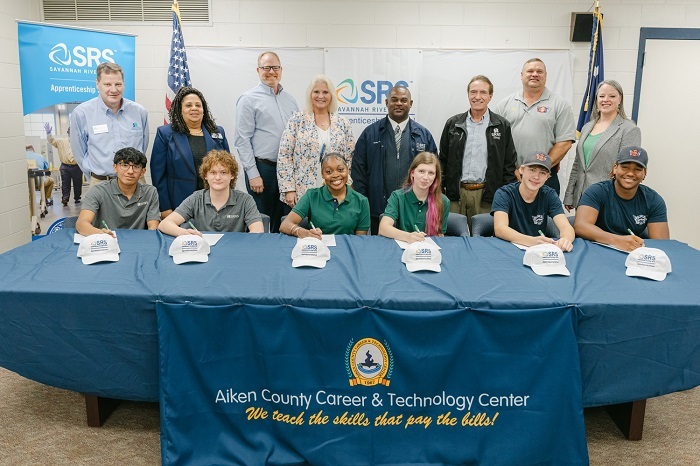 Savannah River Site (SRS) youth apprentices committed to career paths that offer paid, work-based learning credits during National Apprenticeship Week. The 24-month program enables rising high school juniors and seniors to complete on-the-job training within the Information Technology, Emergency Medical Services and Site Training divisions at SRS.
The weeklong celebration also included the SRS Youth Apprenticeship “Career Signing Day” event at the Aiken County Career and Technology Center, honoring high school youth apprentices committed to career paths that offer paid, work-based learning credit.
“This experience has been amazing,” said Alejandro Aguirre-Hernandez, SRNS Information Technology youth apprentice from North Augusta High School. “Being able to gain hands-on experience at SRS while earning my high school diploma gives me a unique advantage. I am so grateful for this opportunity.”
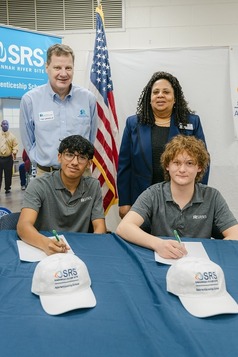
Savannah River Site Information Technology (IT) youth apprentices Alejandro Aguirre-Hernandez, left, and Jacob Lott are pictured during the “Career Signing Day” event. Also pictured: Savannah River Nuclear Solutions IT Manager Tim Arnold and IT Response Center Manager Jaqueline Starlings. |
|
 |
Citizens for Nuclear Technology Awareness recently hosted a breakfast focused on Workforce Opportunities in Regional Careers grant funds and the many partner organizations that support the region’s employee pipeline.
“Our apprenticeship programs are not just about filling jobs — they are about building long term careers for people from all walks of life,” SRNS Apprenticeship School’s Abigail Bowman said. “By investing in each apprentice, we’re investing in the future of SRS and our surrounding community.”
Click here to watch a video highlighting the SRS Apprenticeship Program.
-Contributor: Mackenzie McNabb
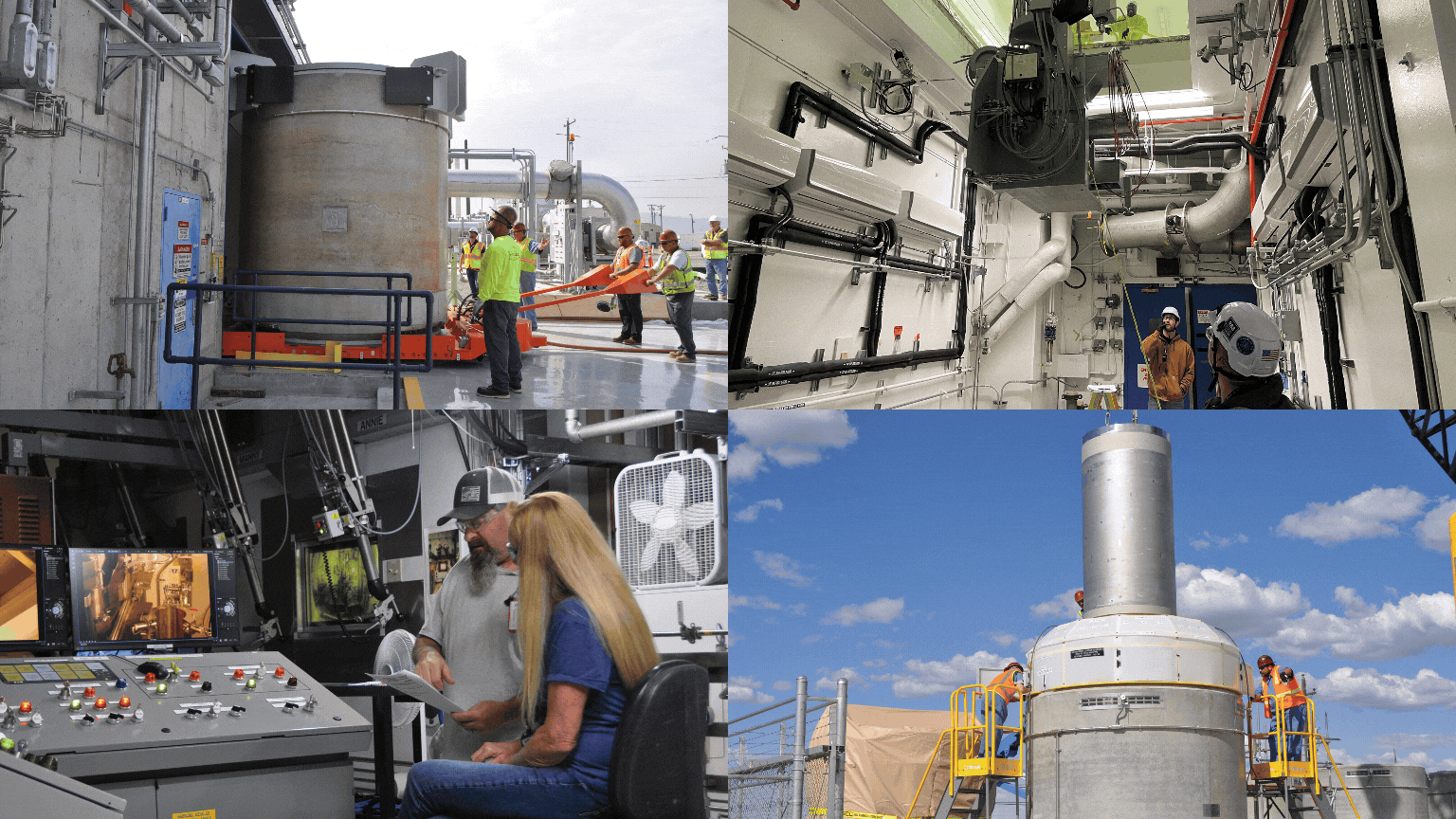 Crews with U.S. Department of Energy Office of Environmental Management contractor Central Plateau Cleanup Company are making steady progress on a project to transfer nearly 2,000 radioactive capsules from an underwater basin to safer dry storage at the Hanford Site.
RICHLAND, Wash. — Workers with U.S. Department of Energy Office of Environmental Management contractor Central Plateau Cleanup Company (CPCCo) recently completed comprehensive testing of new components at the Hanford Site’s Waste Encapsulation and Storage Facility (WESF).
The monthslong testing program aimed to ensure that engineers installed and operated the parts as designed, and that they worked as an integrated system to successfully transfer nearly 2,000 radioactive capsules from the facility’s underwater basin to a dry-storage area.
“Completing the process is a big step for this critical project,” said Gary Pyles, Hanford Field Office federal project director. “While we still need to conduct readiness reviews and assessments in the coming months, the project is on track to begin transferring capsules as soon as next fall.”
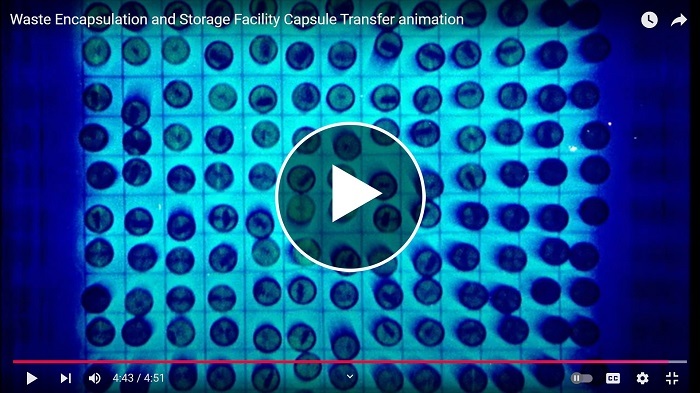 EMTV: Check out this animation to learn more about the capsule transfer process.
Last spring, crews assembled a cask storage system to hold the capsules when they are moved to the dry-storage area. About one-third of the Hanford Site's radioactivity is contained in the capsules.
“We’ve come a long way on this project in the past few years thanks to a hardworking team that routinely demonstrates innovative thinking, problem-solving skills and a commitment to safety,” said Neal Sullivan, CPCCo project manager. “We’re excited for and confident that we’ll continue to meet our challenges over the next year and deliver on a project that ranks high on the Hanford cleanup priority list.”
From 1974 to 1985, cesium and strontium recovered from Hanford’s waste storage tanks were placed in stainless steel capsules and stored under 13 feet of water in WESF. The water provides shielding from radiation and keeps the capsules from overheating. Moving the capsules to dry storage not only eliminates a longer-term risk of a radioactive release in the unlikely event of a loss of basin water but also enables the deactivation of the aging WESF facility, saving as much as $6 million in annual operating costs.
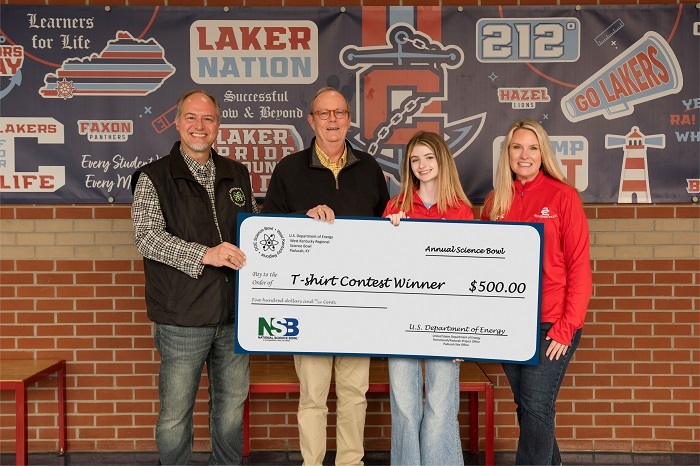 U.S. Department of Energy (DOE) Office of Environmental Management Strategic Planner Robert ‘Buz” Smith presents a check for $500 to Calloway County High School, the winner of this year’s DOE West Kentucky Regional Science Bowl T-Shirt Design Contest. From left: Steve Christmas, Four Rivers Nuclear Partnership community relations specialist; Smith; Kaylee Tharp, winning t-shirt contest designer and Calloway County High School senior; and Erica Gray, Calloway County High School Science Bowl coach.
PADUCAH, Ky. — Calloway County High School has been named the winner of the U.S. Department of Energy (DOE) West Kentucky Regional Science Bowl T-Shirt Design Contest.
The winning design, created by senior Kaylee Tharp, will be featured on the official t-shirts for the 2025 West Kentucky Regional Science Bowl competitions in February.
"The students at Calloway County High School demonstrated exceptional creativity and enthusiasm with their winning design,” DOE Office of Environmental Management Paducah Site Lead April Ladd said. “Kaylee’s design embodies the spirit of the Science Bowl, where math, science and engineering take center stage."
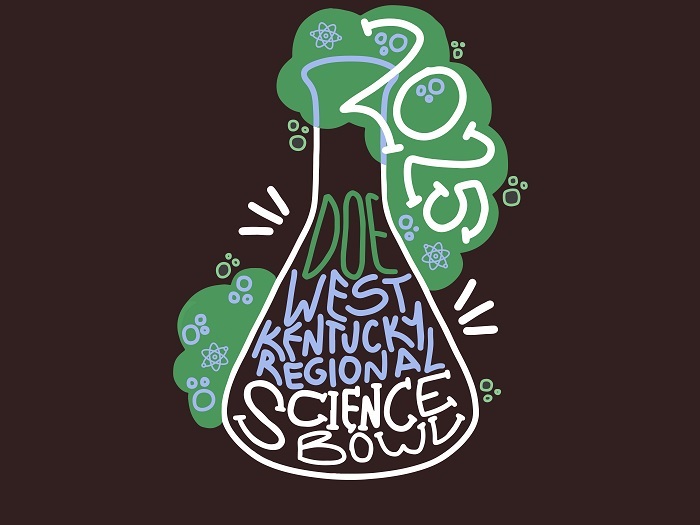 The winning design in the U.S. Department of Energy West Kentucky Regional Science Bowl T-Shirt Design Contest by Calloway County High School senior Kaylee Tharp.
The annual t-shirt design contest encourages young designers to focus on the concepts fundamental to the mission of the Science Bowl with designs highlighting the creativity and innovation the event seeks to inspire in students across the region.
"Kaylee has been on the Academic Team since elementary school and is an integral part of our team,” Calloway County High School Science Bowl Team Coach Erica Gray said. “Kaylee has always enjoyed creative arts, particularly the imaginative aspect of design."
The Science Bowl is a premier academic competition, challenging students in the fields of science, technology, engineering and mathematics.
“Calloway County High School’s success in the contest reflects their dedication to academic excellence and creative expression,” Ladd added.
-Contributors: J.T. Crawford, Dylan Nichols
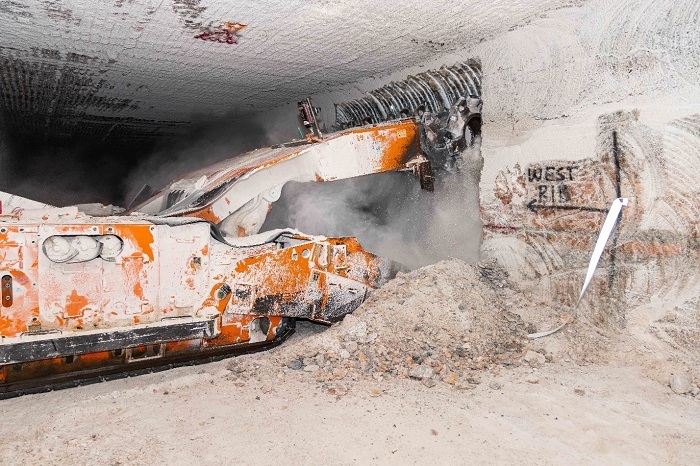 Approximately 2,150 feet underground at the Waste Isolation Pilot Plant in New Mexico, crews with Salado Isolation Mining Contractors deploy a mammoth-sized continuous miner machine to cut into salt rock, the beginning phase of what will become Panel 11, one of the underground waste repository’s next waste disposal panels.
The U.S. Department of Energy Office of Environmental Management (EM) recently awarded performance-based fee payments to 14 of its contractors at sites across the DOE complex, including Hanford, Savannah River, Paducah, Portsmouth, Waste Isolation Pilot Plant, Idaho, Nevada, Los Alamos, and Savannah River National Laboratory.
EM releases information relating to contractor fee payments — earned by completing work called for in the contracts — to further transparency in its cleanup program.
Following are the fee payments for the contractors over varying performance evaluation periods within fiscal year 2024:
- Washington River Protection Solutions, the Hanford Field Office (HFO) tank operations contractor, was awarded nearly $32.8 million, or 69% of the available fee of $47.5 million for fiscal year 2024.
- HFO 222-S Laboratory contractor Hanford Laboratory Management and Integration received nearly $4.5 million, or 95% of the available fee of almost $4.7 million for fiscal year 2024.
- Hanford Mission Integration Solutions, HFO mission support contractor, was awarded close to $22.2 million, or 94% of the available fee of nearly $23.6 million for fiscal year 2024.
-
Savannah River Site (SRS) management-and-operations (M&O) contractor Savannah River Nuclear Solutions received almost $33.5 million, or 95% of the available fee of nearly $35.1 million for fiscal year 2024.
- Savannah River Mission Completion, the liquid waste contractor at SRS, received $3.9 million, or nearly all of the available fee for varying periods within fiscal year 2024.
- Centerra-Savannah River Site, the protective force services contractor at SRS, was awarded over $7 million, or 96% of the available fee of more than $7.3 million for the period of July 15, 2023, to Sept. 30, 2024.
- At Savannah River National Laboratory, M&O contractor Battelle Savannah River Alliance earned more than $5.7 million, or 94% of the available fee of nearly $6.1 million for fiscal year 2024.
- Four Rivers Nuclear Partnership, the Paducah Site cleanup contractor, received close to $9.7 million, or 96% of the available fee of over $10.1 million for fiscal year 2024.
- Fluor-BWXT Portsmouth, the Portsmouth Site decontamination and decommissioning contractor, was awarded more than $16.4 million, or 96% of the available fee of $17 million for the period of April 1 to Sept. 30 this year.
- Mid-America Conversion Services earned nearly $3.5 million, or 94% of the available fee of approximately $3.7 million for the period of April 1 to Sept. 30 this year, for its operation and maintenance of the depleted uranium hexafluoride (DUF6) conversion facilities at the Portsmouth and Paducah sites.
- Salado Isolation Mining Contractors, the Waste Isolation Pilot Plant M&O contractor, received close to $15.7 million, or 93% of the available fee of about $16.8 million for fiscal year 2024.
- Idaho Environmental Coalition, EM’s cleanup contractor at the Idaho National Laboratory Site, received nearly $22.6 million, or 99% of the available fee of almost $22.8 million for fiscal year 2024.
- Navarro Research and Engineering, EM’s cleanup contractor for the Nevada National Security Sites, was awarded close to $1.2 million, or 91% of the available fee of almost $1.3 million for fiscal year 2024.
- Newport News Nuclear BWXT-Los Alamos, the EM Los Alamos Field Office legacy cleanup contractor at Los Alamos National Laboratory, earned almost $13.7 million, or 79% of the available fee of nearly $17.4 million during fiscal year 2024.
|