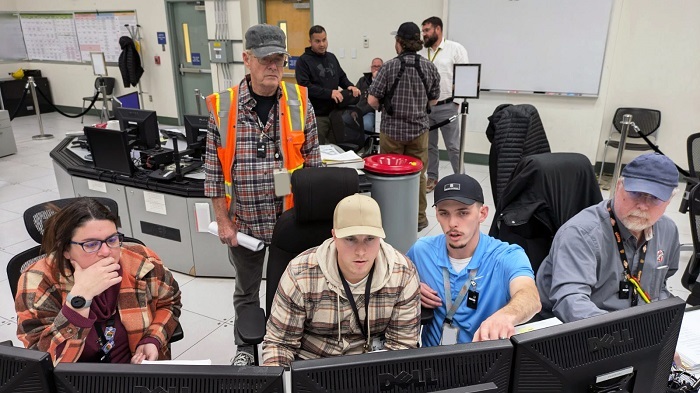
 Workers at the Hanford Site’s Waste Treatment and Immobilization Plant monitor automated safety systems during a simulated loss of power to the Low-Activity Waste Facility.
RICHLAND, Wash. — Crews at the Hanford Site Waste Treatment and Immobilization Plant’s (WTP) Low-Activity Waste Facility recently completed the final test of key safety systems, demonstrating that the facility’s emissions treatment system can remain functional, even during an emergency loss of power.
“This was the ultimate test to demonstrate that the emissions treatment system can respond to this worst-case scenario,” said Mat Irwin, Hanford’s acting assistant manager for the WTP Project. “The test was true to life, and the plant responded exactly as it would during full operations.”
WTP crews prepared for the test by adding a mixture of powdered glass-forming materials and simulated tank waste into both melters at the facility, creating conditions nearly identical to full operations. Workers then cut power to the facility and watched as the safety systems automatically activated the backup power and isolated the emissions system to prevent leakage.
“This test was exceptionally complex. It included running both melters with a cold cap for the first time ever, which is an achievement in its own right,” said Chris Musick, deputy project director for WTP. “It also spanned over a shift change for our operations team, adding another layer of complexity to the test. It demonstrated that our team, and the facility, are ready and able to respond to a loss of power.”
A cold cap is a floating mass of glass-formers and simulated, and eventually real, tank waste that forms shortly after the mixture is fed into a melter. The cold cap slowly melts into the glass pool, producing the gasses the emissions treatment system addresses.
The completion of this test demonstrates the reliability of the Low-Activity Waste Facility’s safety systems, and that the emissions treatment system is ready for the next stages of operation.
-Contributor: Tyler Oates
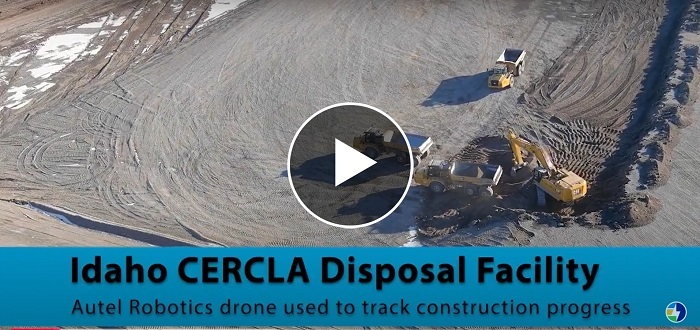
IDAHO FALLS, Idaho — The U.S. Department of Energy Office of Environmental Management at the Idaho National Laboratory Site is using a drone and other visual technologies to benefit cleanup, enhance communications with the public on technical subjects and more effectively document progress.
Idaho Cleanup Project (ICP) contractor Idaho Environmental Coalition (IEC) is relying on drones more frequently to capture and monitor progress of the construction of an onsite landfill cell, calculate the landfill’s excavation and disposal volumes, take aerial photographs and videos of operational activities and film building demolitions. These varied activities grew from ICP’s original purpose for the drones: to acquire photos to map land surfaces and contours, and calculate remaining landfill volumes.
Recently, IEC deployed light detection and ranging technology to more efficiently capture land surface and contour data. That technology uses lasers to measure the time it takes for light to be reflected from a surface.
In a world’s first in 2022, crews with ICP’s Calcine Disposition Project employed a drone to map the interior of a calcine bin set vault where 220 cubic meters of granulated high-level radioactive waste is stored. They relied on the light detection and ranging technology to compare bin set configuration with construction drawings.
IEC drone pilot Dan Mahnami works with project and safety professionals prior to a drone taking flight. He also conducts test runs to obtain the best height and angle to position a drone before it captures video footage.
Prior to the availability of drone technology, a fixed-wing aircraft pilot shot aerial photographs for ICP. That was costly and limiting because of flight elevation requirements, making it nearly impossible to obtain video. Mahnami can fly a drone closer to a subject matter than the aircraft to take high-definition photos and high-resolution video.
Employees with IEC’s Communications Department have also been using timelapse video to show progress preparing buildings for demolition as well as the teardowns themselves. Timelapse cameras are programmed to take one or more photos per day, and they can be used to create video. Also recently, they placed a video camera inside a bulldozer responsible for demolishing a building to give viewers a different perspective of demolition work.
The employees have also drawn from advanced graphic images to help write content about the cleanup. This helps communicate cleanup progress to the public, document work processes and provide lessons learned across the DOE complex.
“Using every communications tool available helps the public better understand the complexities of completing the cleanup mission and the progress being made,” said IEC Communications Director Jessica Vasseur. “These tools have improved our engagement with the public and ICP stakeholders through direct interactions and feedback received.”
-Contributor: Erik Simpson
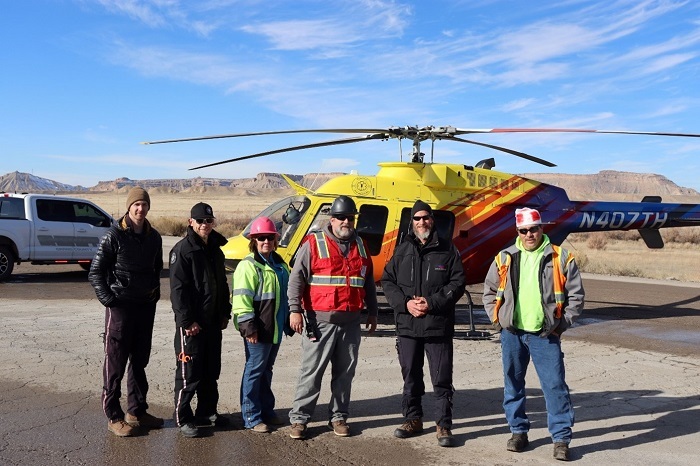 Moab Uranium Mill Tailings Remedial Action Project staff members from the Crescent Junction disposal site are pictured with a local pilot and paramedics who took part in a recent multi-agency response exercise.
CRESCENT JUNCTION, Utah ― The U.S. Department of Energy Office of Environmental Management’s (EM) Moab Uranium Mill Tailings Remedial Action (UMTRA) Project recently conducted a multi-agency emergency response exercise involving a thundersnow scenario at its Crescent Junction disposal cell site.
The exercise simulated a thundersnow event involving thunder, lightning and snow. Although rare, this weather phenomenon has occurred in Utah as recently as March.
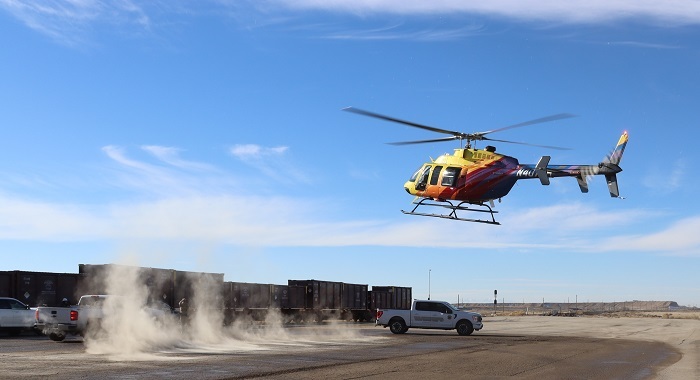 A helicopter lands at the Moab Uranium Mill Tailings Remedial Action Project’s Crescent Junction site as part of a recent emergency response exercise.
The onsite exercise evaluated the abilities of the Moab UMTRA Project and the emergency organization of the surrounding community to respond to the mock incident at the Crescent Junction site, which is in a remote location approximately 30 miles north of Moab, Utah. Response times for an onsite emergency are most likely to be longer than normal, therefore practice scenarios are crucial learning tools for the project.
The scenario involved a lightning strike resulting in a life-threatening injury and a fire engulfing a vehicle and fuel tank. Moab UMTRA Project personnel practiced emergency event procedures, a sitewide “stop work” protocol, fire management procedures, and medical response plans including patient assessment, stabilization, and transport.
“This emergency exercise was critical training, and it ensures that our workers know what actions to take in case of a real-world incident. It was fantastic that local first responders were able to partner with us,” Moab UMTRA Project Engineer Chris Pulskamp said. “We’ll use the lessons learned from this exercise to continually improve our readiness and to plan future exercises.”
-Contributor: Barbara Michel
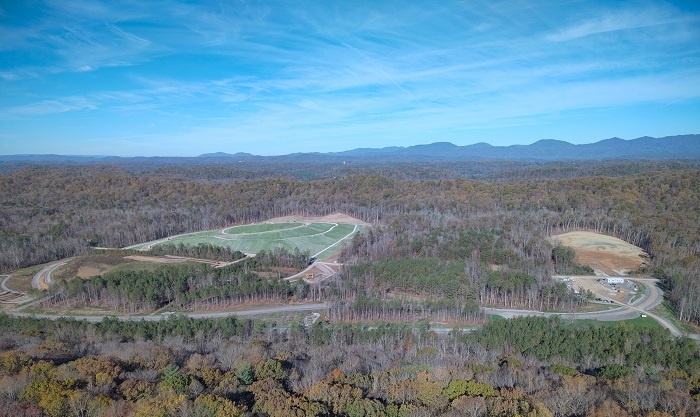 An aerial view of a geosynthetic cover system Oak Ridge crews installed for a groundwater field demonstration at the Environmental Management Disposal Facility site. Workers cleared and recontoured more than 30 acres of land as part of fieldwork that began in February.
OAK RIDGE, Tenn. — The Oak Ridge Office of Environmental Management (OREM) and contractor UCOR have finished fieldwork and begun monitoring groundwater elevations for a study at the Environmental Management Disposal Facility (EMDF) site.
This marks the second major phase for the EMDF project. This past summer, teams completed the first phase, early site preparation, five months ahead of schedule and $12.3 million under budget.
EMDF is a vital piece of infrastructure to provide the waste disposal capacity OREM needs to complete cleanup at the Y-12 National Security Complex and Oak Ridge National Laboratory. OREM’s current onsite waste disposal facility is more than 85% full.
“We’re extremely proud of UCOR and their subcontractor CTI and Associates, who’ve completed this important project on time despite being on a tight schedule,” EMDF Federal Project Director Dennis Mayton said. “We needed to complete fieldwork so we could begin gathering data when the wet season begins in December, and that’s exactly what they did.”
Fieldwork for the second phase of the EMDF project began in February. Workers cleared more than 30 acres of land and recontoured it. They also installed a geosynthetic cover system composed of three layers: the geomembrane, turf and sand infill.
The 1.3 million-square-foot geomembrane layer simulates the effect of lined disposal cells on groundwater elevations, creating an impermeable barrier over the site. The turf, much like grass, slows the flow of stormwater, providing improved stormwater controls. The final layer, sand infill, weighs down the turf and prevents damage from strong winds.
This work allows OREM and UCOR to gather information about how groundwater elevations change, providing valuable information for the landfill’s final design.
Gathering data during the wet seasons is important because that's when groundwater levels are highest. There is more rain, and plants without foliage absorb less water. In east Tennessee, the wet season typically runs from December through March.
“Completing the cover system was essential to the start of the groundwater field demonstration and continuing progress on this project,” UCOR EMDF Project Execution Manager Mary Magleby said. “The next two wet seasons of monitoring will support the EMDF design phase and move us closer to completion.”
UCOR and teaming partner RSI will monitor groundwater elevations over the course of the next two wet seasons through 2026. That data will be used to inform the final design and enable the final phase of the project, which includes EMDF’s construction.
EMDF is slated for completion in 2030.
-Contributor: Ella Stewart
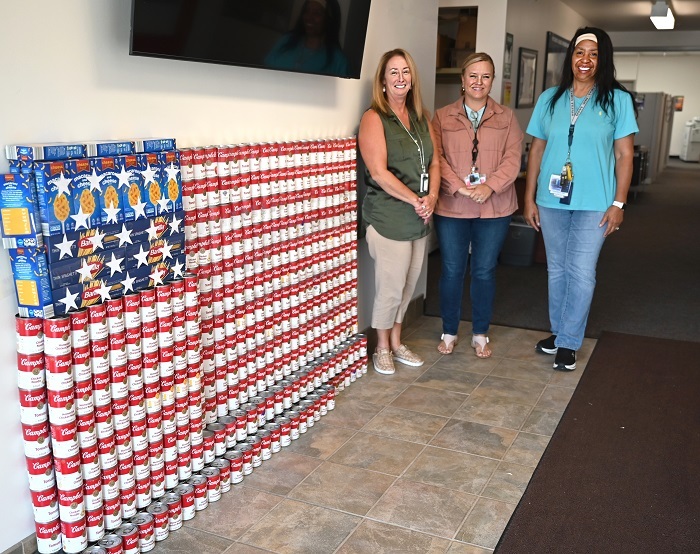 Personnel at the Portsmouth Site donated food to build an American flag in support of the Feds Feed Families campaign using 479 cans of soup and 49 boxes of pasta. From left: Depleted Uranium Hexafluoride Program Engineer Tracey Duncan, Federal Project Director Christy Brown and Infrastructure Project Manager Dee Powell.
LEXINGTON, Ky. — The U.S. Department of Energy (DOE) Office of Environmental Management (EM) Portsmouth Paducah Project Office (PPPO) recently hosted fundraisers and food drives to help stock local food pantries through Feds Feed Families, an annual campaign led by the U.S. Department of Agriculture.
“We strive to maintain strong, cooperative relationships with our communities, and Feds Feed Families is just one of the ways we can help,” PPPO Manager Joel Bradburne said. “I am grateful for all the support our workforce provided for the program this year.”
In Lexington, employees collected more than 5,000 pounds of food for food banks such as God’s Pantry Food Bank. They arranged soup cans and pasta boxes in the shape of an American flag as part of the effort.
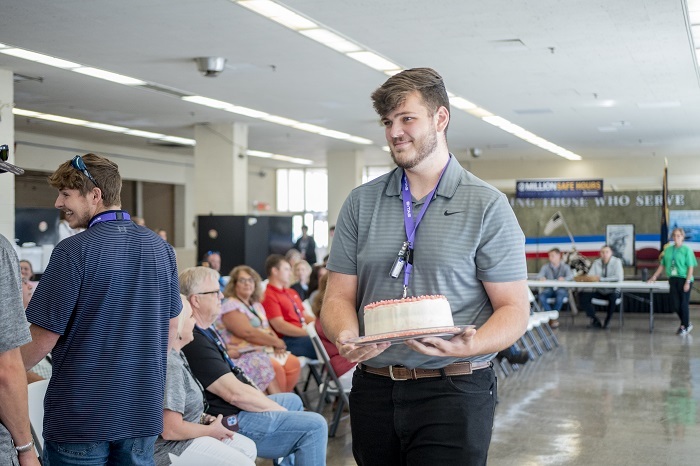 Network Engineer Intern Trenton Jones with the Paducah Site showcases a cake to audience members during the Four Rivers Nuclear Partnership Cake Auction to raise funds for Feds Feed Families.
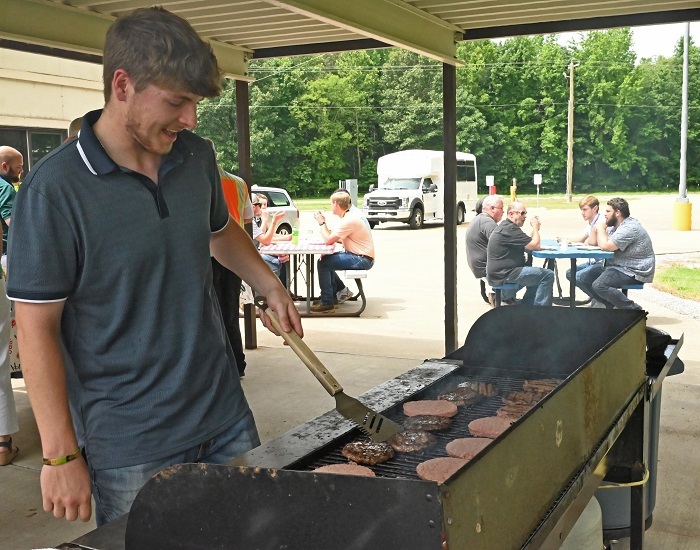 Environmental Health & Safety Intern Jaden Mott grills hamburgers at the Paducah Site as part of the “Picnic on the Patio” fundraiser for the Feds Feed Families campaign.
At the Paducah Site in Kentucky, interns with Enterprise Technical Assistance Services (ETAS), the PPPO technical support services contractor, participated in four separate fundraisers over two weeks to raise money and awareness for the campaign. They raised $4,261, surpassing their goal of $2,500.
“It was eye-opening to learn the significant impact these fundraisers have on our community,” ETAS Visual Communications Intern Tori Vukadinovich said. “I enjoyed being a part of the team we had organizing the fundraisers and contributing to such an important cause.”
EM and Paducah Site contractors participated in activities to gather food and funding for Feds Feed Families. Total donations exceeded $33,000, equivalent to more than 167,000 pounds of food. All proceeds generated at the Paducah Site went to 11 local nonprofits in Ballard, Graves, Marshall, and McCracken counties in Kentucky, and Massac County in Illinois.
 Project Support Employee Brianna Charles, left, and Contracts Administrator Shana Lawhorn with Fluor-BWXT Portsmouth sell tickets for the Feds Feed Families lottery pig raffle in front of the fundraiser lunch tent at the Portsmouth Site Health and Safety Fair.
 Food donations of soup and pasta, constructed in the shape of an American flag, stand in the Portsmouth Paducah Project Office in Lexington as part of a Feds Feed Families food drive.
At the Portsmouth Site in Ohio, EM employees worked with contractors on several fundraisers, including an ice cream social and lunches.
“We have focused on working together as a Portsmouth Site instead of as individual companies for Feds Feed Families,” Portsmouth Site Feds Feed Families Coordinator Dee Powell said. “It has generated better results in our efforts and increased camaraderie.”
Personnel provided nonperishable food items to help construct an American flag in the X-3000 Building entrance at the Portsmouth Site. They created the flag with 479 cans of soup and 49 boxes of pasta.
Team members held a cookout at the annual Health and Safety Fair for all Portsmouth Site employees. They raised more than $2,500 to support Veterans Care Network, which provides resources to veterans and their families in need in Pike, Ross, Jackson and Scioto counties.
EM personnel also collaborated with site contractors to create a piggy bank stuffed with gift cards, cash and other items. They sold tickets at locations throughout the Portsmouth Site, with the winner drawn at the Health and Safety Fair.
-Contributors: Zachary Boyarski, Melissa Green
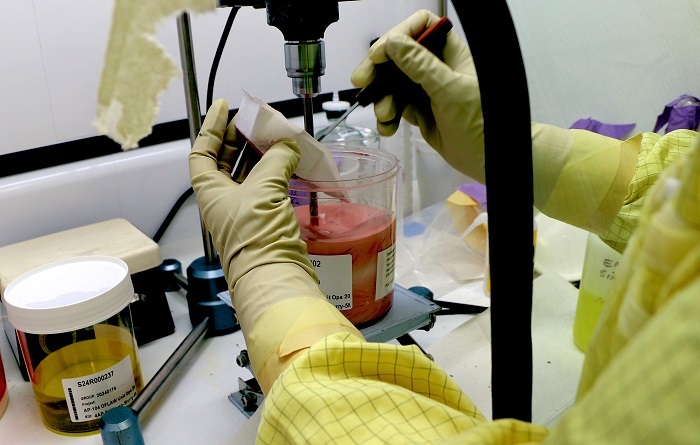 Navarro-ATL scientists prepare a slurry of treated tank waste and glass-forming compounds that were used to create a laboratory-scale test of vitrified tank waste.
RICHLAND, Wash. — Hanford Site contractors are busy preparing for a second Direct-Feed Low-Activity Waste (DFLAW) Program campaign after the site’s 222-S Laboratory evaluated waste feed for the first DFLAW campaign, ensuring the waste is suitable to be treated for vitrification.
The laboratory, operated by Navarro-ATL, plays a key role in Hanford’s DFLAW Program, which will vitrify, or immobilize in glass, and dispose of low-activity waste from Hanford’s underground waste storage tanks.
"Hanford engineers have determined that DFLAW waste samples will need to be evaluated by the lab in less than 90 days to keep operations running,” said Jeff Cheadle, Hanford Field Office 222-S Lab Program manager. “The 222-S Laboratory completed its most recent evaluation in 75 days, demonstrating it is ready to meet the necessary pace of this critical waste treatment mission."
 |
|
A crucible that mimics the plant melter, with contents often referred to as melter feed, is pictured inside a furnace at 2,100 degrees Fahrenheit at the 222-S Laboratory at the Hanford Site. |
Cooled vitrified tank waste created at Hanford’s 222-S Laboratory will be tested to verify the quality of the glass formula and ensure it is suitable for vitrification. |
|
 |
Hanford tank operations contractor Washington River Protection Solutions collected samples from waste Tank AP-104 and delivered them to the lab for evaluation. Each waste tank has enough chemical differences to require a separate waste evaluation and glass formula. In the case of Tank AP-104, the tank operations contractor determined that formula and provided it to lab staff to make a laboratory-scale test of the glass formula.
In early November, Navarro-ATL scientists prepared a glass slurry by mixing glass-forming compounds with treated waste from Tank AP-104.
“The slurry was dried, turned into a powder and placed in a furnace set at 2,100 degrees Fahrenheit,” said Rob Schroeder, laboratory director at Navarro-ATL. “The high temperature melted the mixture, closely mimicking the vitrification process that will take place at Hanford’s Waste Treatment and Immobilization Plant.”
The team allowed the melted product to cool and solidify. Navarro-ATL scientists will test the cooled glass in the 222-S Laboratory to verify the quality of the glass formula and ensure it is suitable for vitrification.
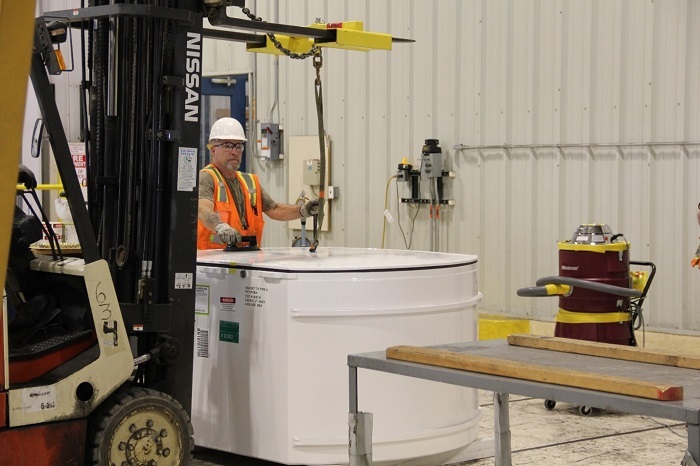 At the Idaho Cleanup Project's Advanced Mixed Waste Treatment Project, standard waste boxes containing compacted waste drums are inspected prior to shipment to the Waste Isolation Pilot Plant.
IDAHO FALLS, Idaho — The Idaho Cleanup Project (ICP) has improved transuranic waste operations to address waste inventory challenges, ensure shipments remain compliant with safety standards and meet commitments to the state of Idaho.
In recent years, aging waste containers in storage have become more commonplace at the Advanced Mixed Waste Treatment Project (AMWTP) at the Idaho National Laboratory Site. An analysis of the drum inventory identified signs of corrosion and degradation on drums more than 5 years old.
Dan Coyne, president and program manager of ICP contractor Idaho Environmental Coalition (IEC), recognizes the challenge this has presented to the IEC mission at AMWTP, where transuranic waste is characterized, repackaged, stored and shipped.
“Our product drums are safely stored, but many are showing signs of degradation,” Coyne said. “Without effective solutions, aging waste containers will continue to pose challenges to our mission at AMWTP.”
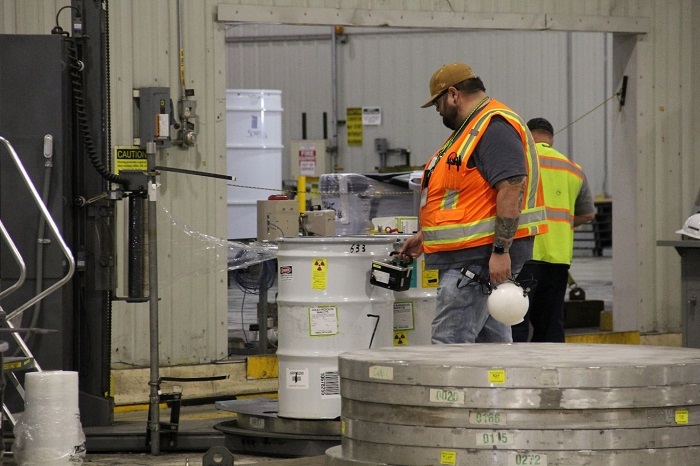 Idaho Cleanup Project crews inspect transuranic waste drums to ensure they comply with shipping requirements.
Coordinating with partners at the Waste Isolation Pilot Plant (WIPP), IEC led an effort to address these challenges by improving drum designs, acquiring important shipping commodities and applying new technologies.
Corrosion is often prevalent along seams and at the bottom of the drums, so IEC crews now use drums coated with a corrosion inhibitor as a remedy. The coating improves drum integrity by protecting the inside of the drum and its contents from corrosion. A 1-inch-thick fiberboard is also placed in the inside bottom of the drum to protect against impact and abrasion from the drum “pucks” stored inside. The workhorse of AMWTP — the supercompactor — crushes the 55-gallon drums, converting them into 5-inch-thick pucks.
Additionally, IEC loads aged and corroded drums into standard waste boxes for transport and permanent emplacement at WIPP. Although the boxes have offered a safe, effective solution to continue shipping the waste, they are costly and in short supply.
To help address that shortage, IEC will begin evaluating a robotic ultrasonic testing scanner for use to confirm the integrity of aging drums. These tests inspect the thickness of the metal drums to ensure they meet the minimum specifications of radioactive materials containers approved by the U.S. Department of Transportation and other transuranic waste shipping requirements.
“I am proud of our problem-solving workforce for finding innovative WIPP-approved solutions to Idaho’s challenging waste streams,” Coyne said. “Because of their efforts, and our supportive partners at WIPP, we are better equipped to complete our mission.”
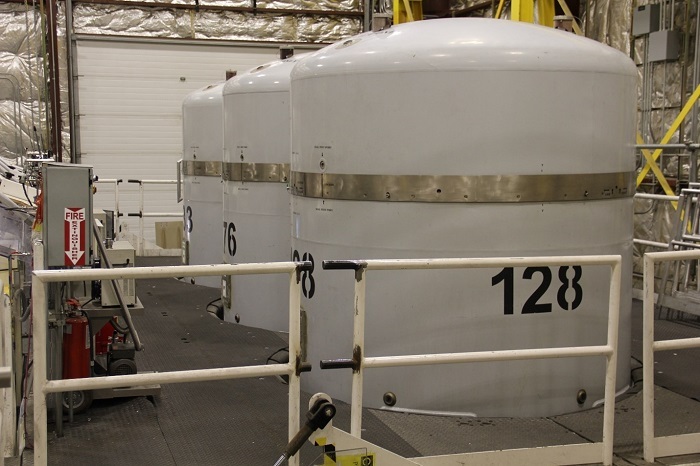 TRUPACT shipping containers allow for the safe transportation of transuranic waste from the Idaho National Laboratory Site to the Waste Isolation Pilot Plant for permanent emplacement.
Transuranic waste is a byproduct of the nation’s nuclear defense program, and generally consists of tools, rags, protective clothing, sludge, soil, and other materials contaminated with radioactive elements that have atomic numbers greater than uranium.
IEC is tasked with shipping the remaining transuranic waste at AMWTP for permanent emplacement at WIPP. Crews average eight to 12 shipments to WIPP each week. In fiscal year 2024, which ended Sept. 30, IEC made 365 shipments to WIPP, the highest single-year total at ICP in over a decade. IEC’s shipments represent more than 70% of all waste received at the New Mexico underground waste repository since 2022, and over 50% of all waste shipments to WIPP since it began operations in 1999.
-Contributor: Carter Harrison
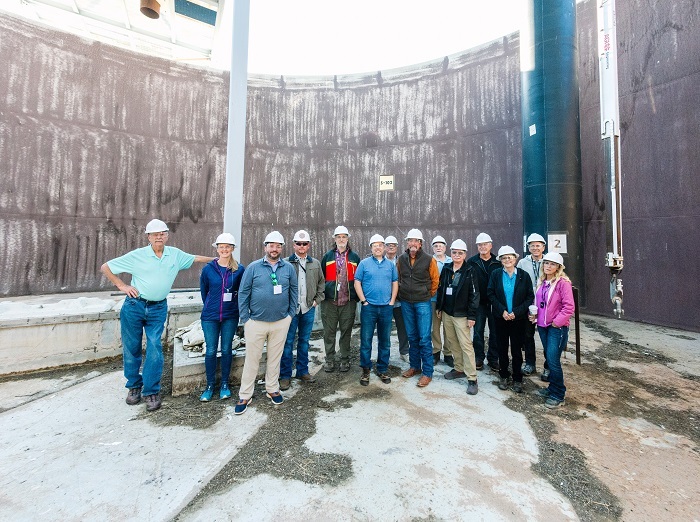
RICHLAND, Wash. — New and returning members of the Hanford Advisory Board (HAB) recently toured several Hanford Site facilities, including a full-size mock-up of a single-shell waste-storage tank at the site’s Cold Test Facility. The full-day tour also included stops at the Waste Treatment and Immobilization Plant, Environmental Restoration Disposal Facility and Integrated Disposal Facility. The U.S. Department of Energy Office of Environmental Management Site-Specific Advisory Board, which is made up of eight local boards including the HAB, celebrated its 30th anniversary earlier this year. HAB members provide consensus-based, policy-level recommendations on Hanford’s cleanup mission to the Tri-Party Agreement agencies — the Department of Energy, U.S. Environmental Protection Agency and Washington State Department of Ecology.
-Contributor: MaryAnne Wuennecke
|