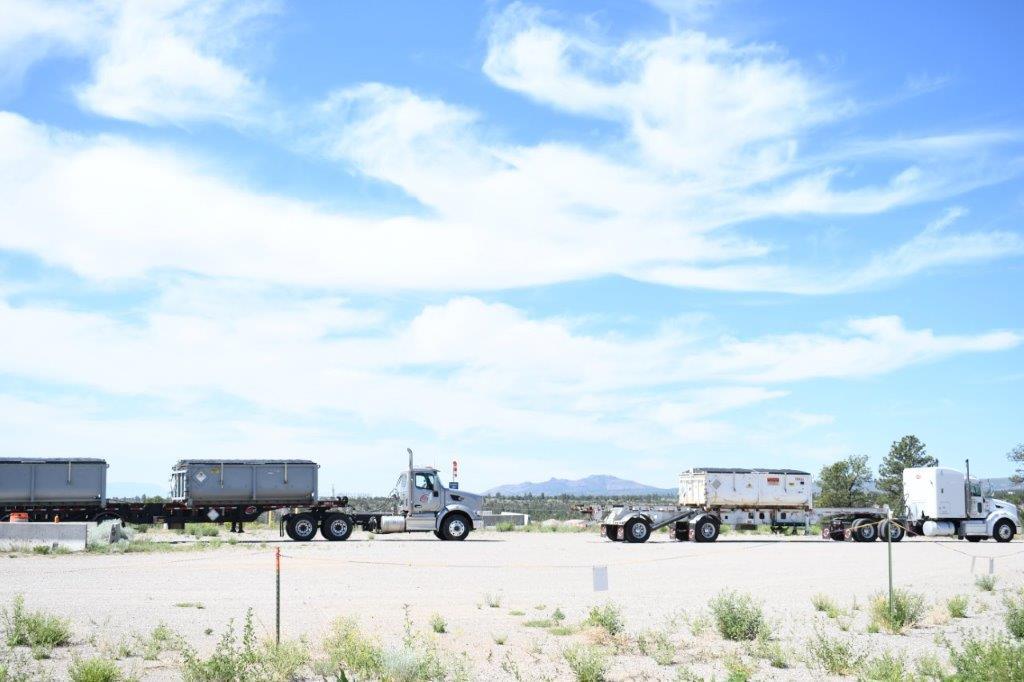
 The last shipment of soil and debris from the completed cleanup at the Middle DP Road Site leaves for an off-site, licensed disposal facility.
LOS ALAMOS, N.M. — The EM Los Alamos Field Office (EM-LA) has achieved another year of fulfilling its legacy cleanup commitments with the New Mexico Environment Department (NMED) at Los Alamos National Laboratory (LANL).
For the recently ended fiscal year 2024, EM-LA and legacy cleanup contractor, Newport News Nuclear BWXT-Los Alamos, LLC (N3B), completed all 15 of the agreed FY24 Appendix B Milestones under the 2016 Compliance Order on Consent (Consent Order) between DOE and NMED. Since 2016, EM-LA has successfully completed 128 of 129 milestones under the Consent Order.
“I’m proud of our continued success in meeting our regulatory commitments with the state of New Mexico,” EM-LA Manager Jessica Kunkle said. “By fulfilling our commitments, we are demonstrating to the State, and the residents of northern New Mexico, our dedication to safely, effectively, efficiently and transparently progressing the LANL legacy cleanup mission.”
The Consent Order is an enforceable agreement for the cleanup of legacy waste at LANL. It contains requirements for investigation and cleanup, which are part of the corrective action process. The Consent Order establishes a structure for accomplishing cleanup work on a priority basis through campaigns.
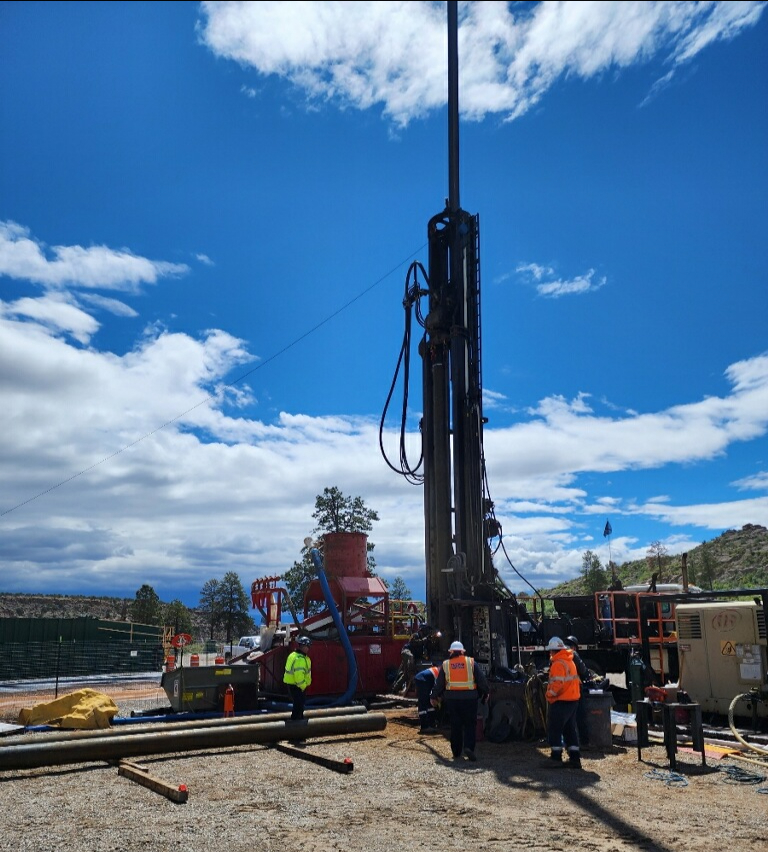 Installation of R-76 groundwater monitoring well for the hexavalent chromium plume completes a regulatory milestone for fiscal year 2024 with the New Mexico Environment Department.
Waste Disposition Progress, Middle DP Road Site Wrap-Up Among FY24 Accomplishments
In addition to completing all FY24 Appendix B Milestones, EM-LA and N3B had several other accomplishments over the last fiscal year that advanced the LANL legacy cleanup mission. These accomplishments occurred while N3B continued to focus on safely executing the mission.
Approximately 71 cubic meters of transuranic (TRU) waste were sent to the Waste Isolation Pilot Plant (WIPP) for disposal, and more than 1,350 cubic meters of low-level and mixed low-level waste were shipped off-site for disposal. In total, EM-LA and N3B have completed the disposal of more than 80 percent of the legacy above-ground low-level and mixed low-level waste at LANL.
N3B retrieved all 158 corrugated metal pipes of cemented TRU waste from above Pit 9 at Technical Area 54 and made steady progress in size-reduction activities to prepare this waste for shipment to WIPP. EM-LA and N3B also completed a demonstration of the Universal Drum Assay and Segregation System (UDASS), which is designed to more accurately analyze the contents of radioactive waste containers. If successful, there is potential value for UDASS across the EM complex.
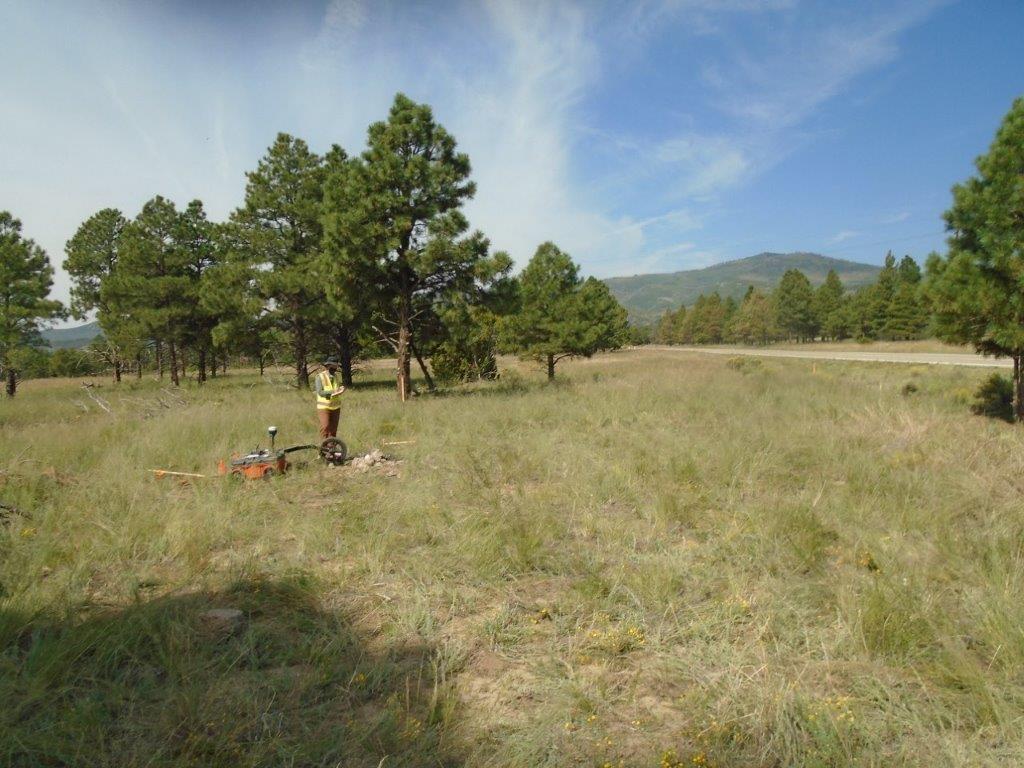 Workers perform a geophysical survey as part of investigation and soil remediation activities at Twomile Canyon Aggregate Area.
Additionally, significant progress was made in addressing soil contamination at LANL. For the first time, N3B simultaneously performed work in five Aggregate Areas—watersheds or canyons that contain contaminated soil and debris from legacy operations at LANL. Of those five Aggregate Areas, N3B completed field work, including soil remediation, and submitted an Investigation Report to NMED in one Aggregate Area (Twomile Canyon). Field work was completed in two other Aggregate Areas.
EM-LA and N3B obtained NMED approval of the successful cleanup of the Middle DP Road Site, confirming completion of the project. In addition, N3B conducted over 4,500 surface water inspections and collected over 1,800 surface water samples to help inform cleanup decision-making.
“I want to thank every N3B team member for their contributions to our cleanup successes during FY24,” N3B President and General Manager Brad Smith said. “In partnership with EM-LA, we continued to advance our goals of protecting water quality, cleaning up land and disposing of waste. I’m especially proud of the strong safety performance of the N3B workforce in making progress, and the spirit of operational excellence we have established across the LANL legacy cleanup mission.”
-Contributor: Mike Nartker
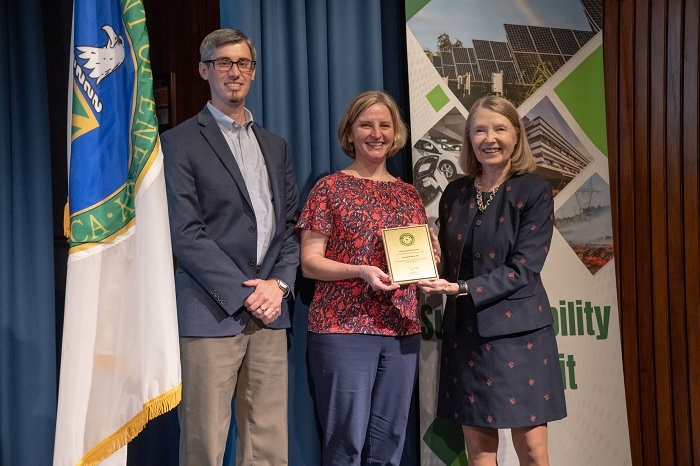 Savannah River Nuclear Solutions Program Manager Daniel White and Sustainability Strategic Planner Jennifer Weedon accept the 2024 Department of Energy (DOE) Sustainability Award for Outstanding Climate Resilience during the Sustainability Performance Office’s Sustainability Summit in Washington, D.C. The award was presented by Ingrid Kolb, DOE’s chief sustainability officer and director of the Office of Management. Photo by Charles Watkins
AIKEN, S.C. — An effort to improve the lifespan and resiliency of a communication tower against extreme weather events at the Savannah River Site (SRS) has garnered the U.S. Department of Energy (DOE) Sustainability Award for Outstanding Climate Resilience Project.
DOE’s Sustainability Performance Office recognized the site’s Communication Tower 623-40G Structural Analysis and Upgrade Project for its commitment to ensuring DOE is a federal leader in sustainability during a ceremony at its second annual Sustainability Summit.
“SRS consistently identifies projects to proactively improve site infrastructure, increase reliability and avoid risk of failure,” said Brian Stephens, director, DOE-Savannah River Infrastructure and Operations Division. “With the release of the fiscal year 2022 Vulnerability Assessment and Resilience Plan, SRS took a closer look at infrastructure risks attributed to extreme weather events — including the communication tower.”
Last year, DOE bestowed three Sustainability Awards and an honorable mention to a trio of DOE Office of Environmental Management sites for achievements in innovative water management practices, strategic partnerships to strengthen the workforce, high performance sustainable building construction and water conservation.
Erected in 1998, the 600-foot tower at SRS supports approximately 2,000 radios for SRS Emergency Services and remote workers. It was constructed to withstand 80 mph winds but offered limited support for ice accumulation.
“It wasn’t easy moving this resilience project forward. It took time to secure the necessary funding required to perform the integrity testing for the guyed wire system and foundation anchors,” said Brent Cole, strategic integration manager for Site Services at Savannah River Nuclear Solutions (SRNS), the site’s management and operations contractor. “Although the tower was not actively failing, we highlighted the potential negative impacts on SRS and the surrounding community if the tower stopped functioning properly.”
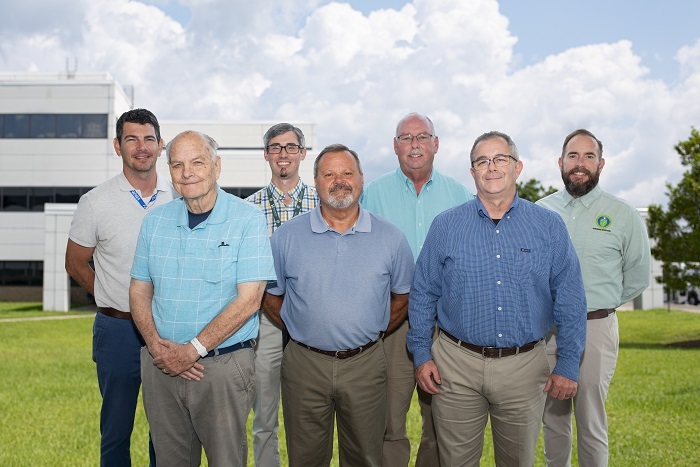 The Savannah River Site’s Communication Tower 623-40G Structural Analysis and Upgrade Project team, back row, Brian Stephens, Daniel White, Judson Davis and Dustin Thomas; front row, Earl Morrison, Marty Taylor and Brent Cole.
Traditionally, crews inspected the tower every three years. But in the upgrade project, a structural engineer conducted a more in-depth inspection and structural life-cycle analysis. Using guided ultrasonic wave testing — a cutting-edge, nondestructive evaluation method — the engineer noted the tower had mild corrosion ranging from 8 to 12%.
Following the inspection, the SRNS structural analysis recommended additional internal bracing to reinforce the structure’s legs and foundation. Now, the tower can withstand 102 mph wind speeds and 131 mph wind gusts, and remain functional under the weight of 1 inch of ice.
“Ensuring our first responders and security forces have a resilient and reliable communications infrastructure is of upmost importance in the event of a crisis or natural disaster. These upgrades will measurably improve the probability it will function when needed,” said Judson Davis, SRNS facility maintenance manager for the Spent Fuels Project.
The upgrades will extend the tower’s life by an additional 10 years and result in a cost savings of more than $5 million over the next decade. In addition, the structural improvements provide the capability for 1,000 radios to be added to the network in the next two years.
The structure will continue to support SRS during critical weather events and serves as a successful resilience planning example that can be applied to future towers across the site and the DOE complex. The tower project was also recommended as a case study for the Federal Climate Resilience Best Practices Guide.
-Contributor: Mackenzie McNabb
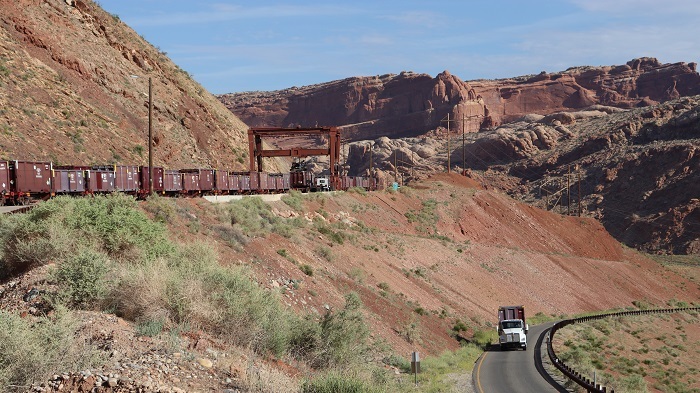 At the Moab Site, haul trucks carry sealed steel containers of uranium mill tailings up to the hillside rail bench where they are loaded on train cars and transported 30 miles north to the disposal cell at the Crescent Junction site.
Achievement marks removal of a cumulative 15 million tons of mill tailings, completes EM 2024 priority
MOAB, Utah ― The Moab Uranium Mill Tailings Remedial Action (UMTRA) Project has achieved another 1-million-ton cleanup milestone, checking off a priority of the U.S. Department of Energy Office of Environmental Management (EM) for the year.
As of mid-October, the Moab UMTRA Project has removed and shipped a cumulative 15 million tons of uranium mill tailings from the Moab Site to a nearby disposal facility.
“Each year our team meets EM’s priority through innovation, attention to detail and hard work. Removing the mill tailings from the Moab Site protects the beautiful Colorado River and the Moab community, and allows EM to advance its cleanup and closure mission at Moab,” said Moab Federal Project Cleanup Director Matthew Udovitsch. “It’s exciting to see years of community and project partnership get the site so close to completion and ready for its next evolution.”
 About 1 million tons of the contaminated soil and debris remain to be disposed of in an engineered disposal cell in Crescent Junction, 30 miles north of the Moab Site. The material resulted from legacy uranium milling operations.
EM is partnering with the community to determine an end state for the site and plan for its future use.
-Contributor: Barbara Michel
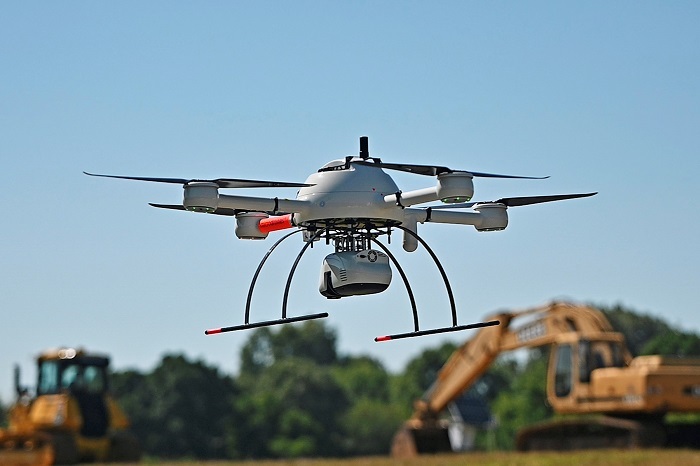 A drone takes flight at the Paducah Site landfill to complete required surveys. The drone uses a scanner to generate millions of data points for a fast and accurate survey.
PADUCAH, Ky. — Engineers at the U.S. Department of Energy Office of Environmental Management (EM) Paducah Site are making strides in implementing new technology by using drones to survey the site’s sanitary landfill.
Previously, the site’s surveyors spent days walking over the 300,000-square-foot constructed landfill to gather the required elevation and GPS data, generating hundreds of data points in the process.
 EMTV: Watch a drone in action in the sky above the Paducah Site. These flying robots are becoming more prevalent in daily life around the world. This rings true at the Paducah Site, where crews are using the new technology to survey over 300,000 square feet of constructed landfill in as little as 15 minutes, all while enabling workers to minimize risks.
Surveys completed by drones can be performed in as little as 15 minutes, cover more ground and produce millions of data points resulting in more detailed and accurate information using Light Detection and Ranging technology — a method for calculating ground distances that uses lasers to measure the time it takes for light to be reflected from a surface.
“Not only has the use of drones for surveys provided more accurate data, but the cost savings in collecting, analyzing and reporting of data has resulted in a significant return on EM’s investment in this technology,” Paducah Site Lead April Ladd said.
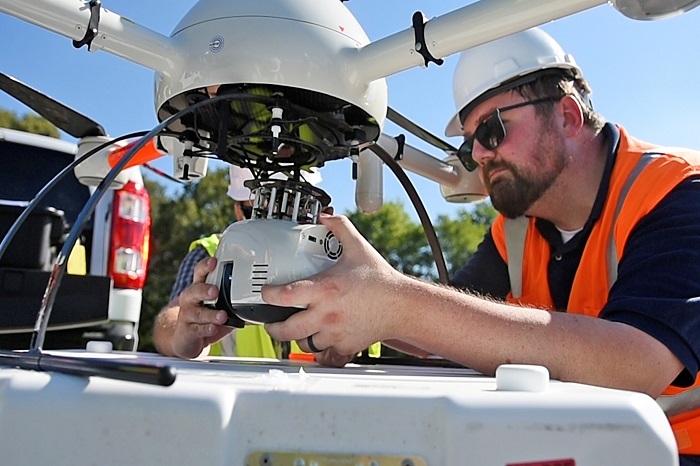 Paducah Site Engineer Daniel Hatton affixes a scanner to a drone to perform surveys at the site’s landfill.
Most importantly, this new technology enables workers to complete the surveys while reducing the risk and avoiding hazards intrinsic with traditional survey methods. Slips, trips, and falls; insect stings and bites; and environmental factors cannot be overlooked, making the use of the drone instrumental in minimizing the risk to employees.
“The technology used for surveying the landfill is impressive, but the effect it has on safety is its greatest strength,” said Myrna Redfield, program manager for Four Rivers Nuclear Partnership, the site's deactivation and remediation contractor. “The team completing these surveys take great care to ensure safe and controlled operations using the drone, which is a safer alternative to traditional walk-downs.”
-Contributor: Dylan Nichols
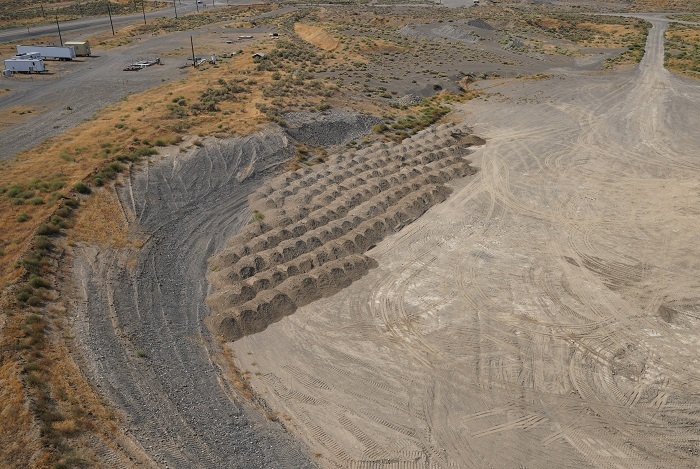 An aerial view of mounds of gravel and sand currently stored inside a borrow pit on the Hanford Site. The material will be used for construction and remediation projects around the site.
RICHLAND, Wash. — Stretching across 580 square miles in southeastern Washington, the U.S. Department of Energy Office of Environmental Management’s Hanford Site is home to natural resources like gravel rock and sand — essential materials for the site's ongoing construction and remediation efforts.
The Land Management team with Hanford Mission Integration Solutions (HMIS) manages these resources. There are six onsite borrow pits that store gravel, sand, topsoil and other rock that have been “recycled” from onsite projects.
“Remediation is a key part of the Hanford mission, and our teams are doing a great job of managing the limited resources we have available here at Hanford,” shared Tashina Jasso, with EM’s Site Stewardship Division at Hanford. “By repurposing these materials, we’re able to better support new and ongoing projects.”
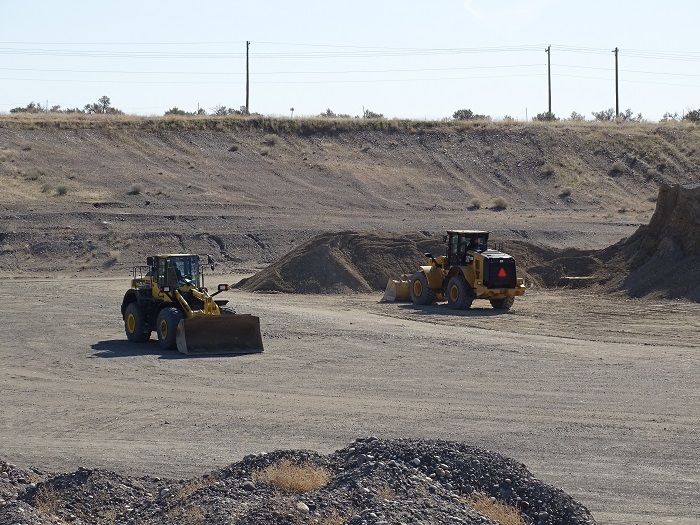 Crews with Hanford Site contractor Hanford Mission Integration Solutions use front-end loaders inside one of Hanford’s borrow pits to load material for an onsite construction project.
The Land Management team uses the Hanford Stewardship Information System to catalog the type of resources available and where they are located within the pits. They review and approve requests from contractors to extract materials when needed.
In addition to the electronic database, the team collaborates with other groups and employs advanced technology to manage resources. For the past few years, they've been using drones to gather data on the pits.
“The HMIS Unmanned Aircraft Systems team is helping us measure the volume of the pits,” said Aaron Lambert, a project manager with the Land Management team. “We’re using a drone and mapping tools to estimate the sizes of the pits and how much material remains in each.”
This summer alone, more than 10,000 cubic yards — equal to about 100 swimming pools — of clean material were added to the borrow pits. The new supply came from recent construction projects at Hanford’s Effluent Treatment Facility and Central Plateau Water Treatment Facility.
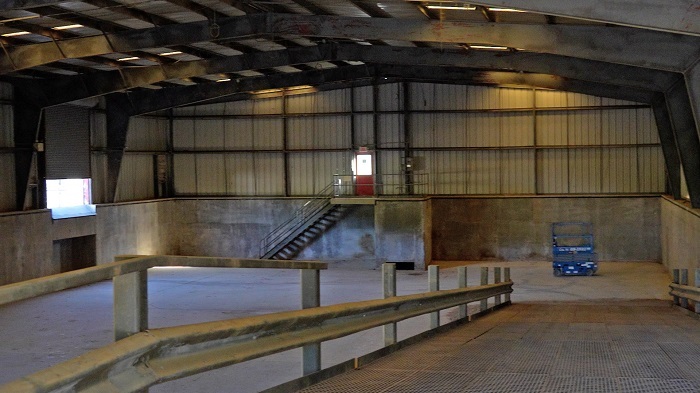 A view of the interior of the facility undergoing upgrades to become the Technology Demonstration Facility at Oak Ridge. Workers are set to remove the steel ramp, shown at bottom right, to provide a more open floor plan.
OAK RIDGE, Tenn. — The Oak Ridge Office of Environmental Management (OREM) and its contractors are seeking new and innovative methods to tackle the challenges involved with addressing aging, contaminated structures that date back to the Manhattan Project and Cold War.
A project underway will provide the space necessary to test promising technologies aimed at advancing complex cleanup projects in Oak Ridge. OREM and contractor UCOR are creating an onsite testbed facility called the Technology Demonstration Facility.
“The goal of this facility is to provide space to collaborate with other agencies and companies and ultimately help us develop solutions more rapidly,” said Elizabeth Phillips, OREM’s lead for technology development.
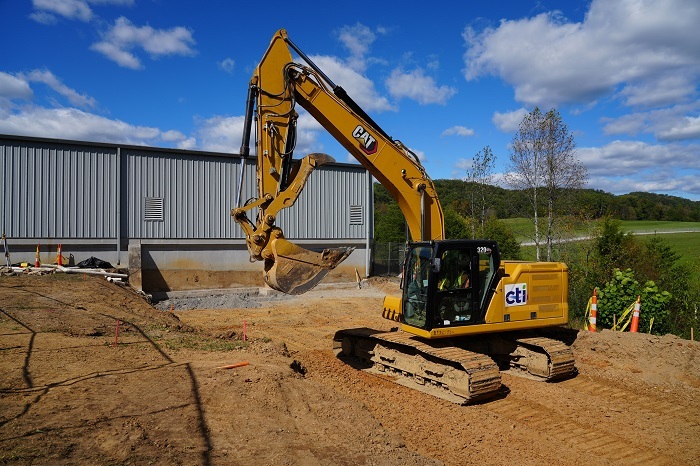 Crews are clearing the way to install a large overhead door in the new Technology Demonstration Facility that will provide easier access for future testbed operations.
Crews have begun repurposing the facility previously used for storage. Measuring more than 12,000 square feet, the building boasts plenty of room for a wide range of experiments and demonstrations required for technology development.
During renovation for the new Technology Demonstration Facility, workers are installing a large overhead door and an entryway to provide easy access to the facility. Crews are also upgrading the electrical service, adding a fire suppression system, enhancing lighting in the demonstration area and installing a remote office trailer.
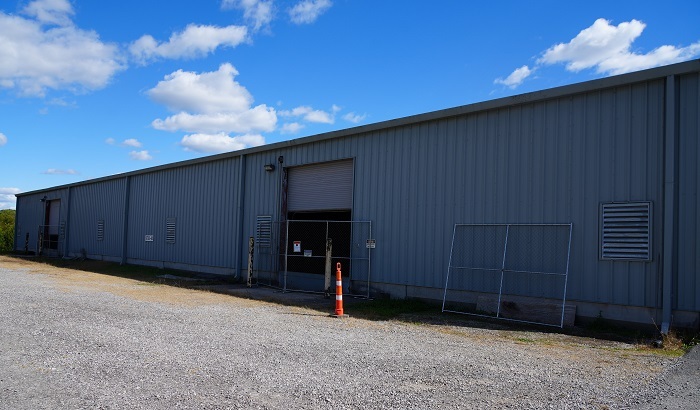 Measuring more than 12,000 square feet, the future Technology Demonstration Facility boasts plenty of space for a wide range of demonstrations and experiments to test new technologies.
“The location just outside the security footprint provides easier access for academic investigators and the U.S. Department of Energy’s laboratories and contractors to test solutions and mature their products and research,” said UCOR Technology Development Program Manager Boaz Buechley.
Construction of the facility is scheduled to be complete next spring, and operations are expected to begin next summer.
-Contributor: Susanne Dupes
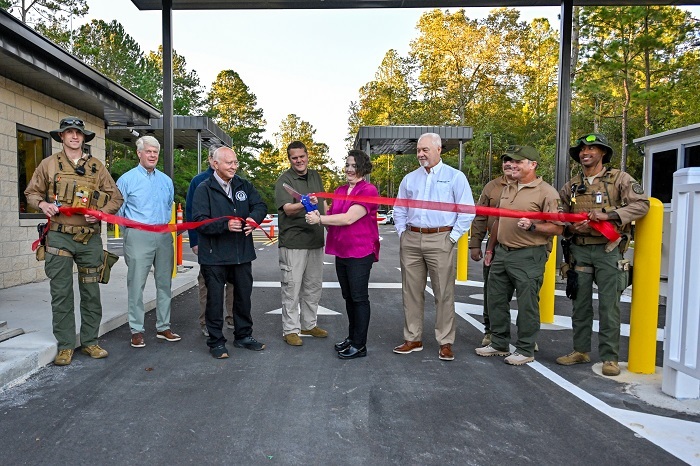 Chuck Filbin, Centerra-SRS project engineer administrator, and Clarissa (Crissy) Kuhl, U.S. Department of Energy-Savannah River (DOE-SR) Office of Programs and Project Management federal project director, cut a ribbon to open a new guardhouse at the Savannah River Site. Pictured from left are Noah Boyd, security police officer; Mike Budney, DOE-SR manager; Greg Briatico, Savannah River Nuclear Solutions Site Security Maintenance Section manager; Filbin; Kuhl; Mark Bolton, Centerra-SRS general manager; Capt. Ray Melton, Perimeter Protection Department, Centerra-SRS; Maj. Charles Shoup, Perimeter Protection Department, Centerra-SRS; and David Willis Jr., security police officer.
AIKEN, S.C. — The Savannah River Site (SRS) recently completed construction of a much-needed renovation of a key access control gate at the 310-square-mile nuclear facility.
Dedicated to maintaining the highest possible safety and security standards, SRS is a key U.S. Department of Energy (DOE) and National Nuclear Security Administration industrial complex responsible for national security and nonproliferation missions, disposition of nuclear materials, waste management, and environmental cleanup and stewardship.
Barricade 9, a vehicle access gate located near the site’s main badge office, closed in December 2022 for construction of a new guardhouse and covered canopy. The new facility formally opened with a ribbon-cutting ceremony earlier this month. It was accessible to site traffic afterward.
“The barricades and the security police officers who staff them are the first line of defense for the safety and security of SRS,” said Ron Bartholomew, director of the DOE-Savannah River Office of Safeguards, Security and Emergency Services. “The renovations will improve traffic safety for the thousands of employees and vendors who enter and exit the site each day and keep the officers safe as well.”
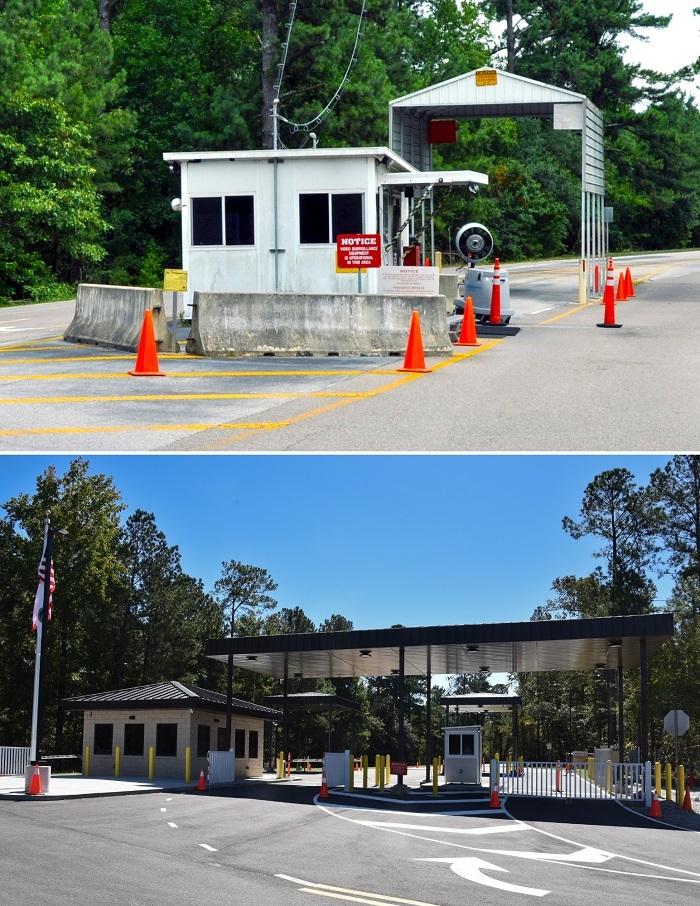 A new barricade facility is a significant upgrade over the old guardhouse, at top, which had been in operation for over 25 years at the Savannah River Site. The new barricade, immediately above, is over four times larger than the previous guardhouse and has double the traffic lanes for incoming and exiting vehicles at this access point to the nuclear facility.
The site’s perimeter barricades are staffed and operated by Centerra-SRS, the site’s protective force services contractor since 1983. Security police officers at barricades restrict site entry to properly badged and authorized individuals, conduct inspections of vehicles to deter the introduction of prohibited items onto the site and check for government property upon exit.
The old guardhouse was built over 25 years ago, and vehicle traffic was limited to single-lane entry and exit traffic patterns. As a result, traffic delays were common during peak hours. The new facility allows for two-lane traffic going in and out of the site, which should minimize delays while enhancing safety and improving efficiency of the access control and vehicle inspection process.
The new guardhouse is a bullet resistant enclosure that is over four times larger than the old facility and provides protection against severe weather, including tornadoes and hurricane force winds. The guardhouse also includes an interior restroom with a dedicated septic system, eliminating the need to refill a tank and drain a septic tank weekly.
“We began planning in 2019 to replace the old guardhouse,” said Chuck Filbin, Centerra-SRS
project engineer administrator. “The Corps of Engineers (COE) was awarded a contract to create a design package for replacement and we worked with our DOE oversight and the COE on multiple concepts and designs.”
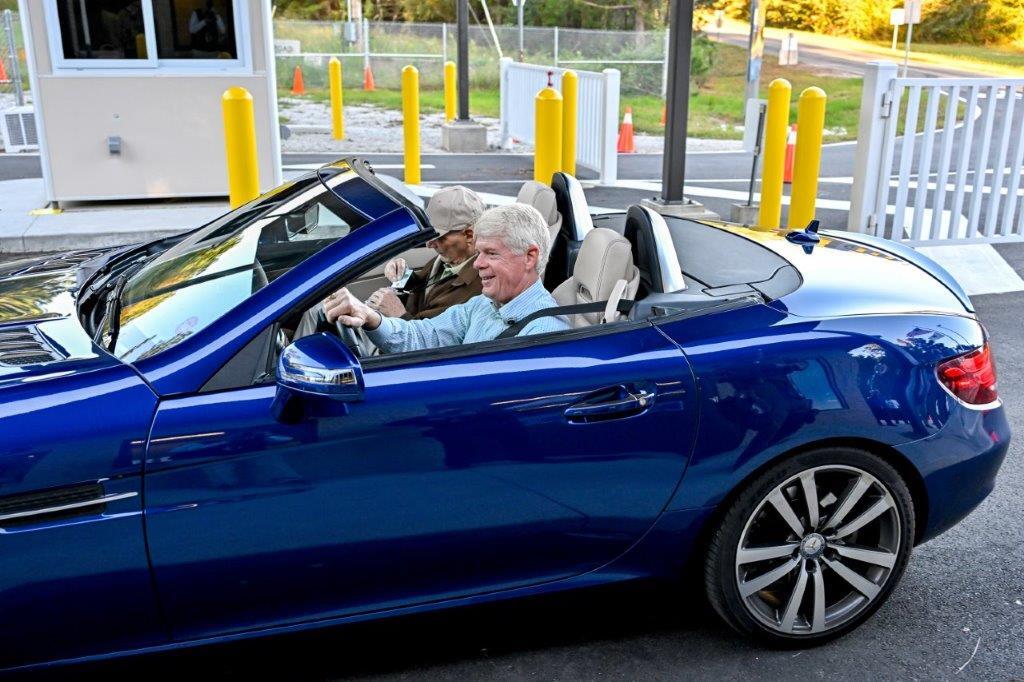 Mike Budney, U.S. Department of Energy-Savannah River (DOE-SR) manager, and Ron Bartholomew, DOE-SR director of Safeguards, Security and Emergency Services, take the first drive through the new barricade at the Savannah River Site.
Safety and compliance with environmental management system requirements were at the forefront throughout the design and construction phases of the project, which required close coordination between Centerra, DOE, COE and construction contractors.
“The final phases of the project were recently completed with installation and inspection of lighting, fiber-optic cables, security cameras, and commissioning of the generator, well, and HVAC unit,” said Filbin.
After closure of the old Barricade 9 in 2022, an alternate gate was opened for use during the construction project, and that temporary gate has now been closed.
“The reopening of the gate is good news for SRS employees who use that road for access to work locations and visits to the badge office,” Bartholomew said. “It also represents a significant facility improvement that will minimize delays while further enhancing safety and security.”
-Contributor: Rob Davis
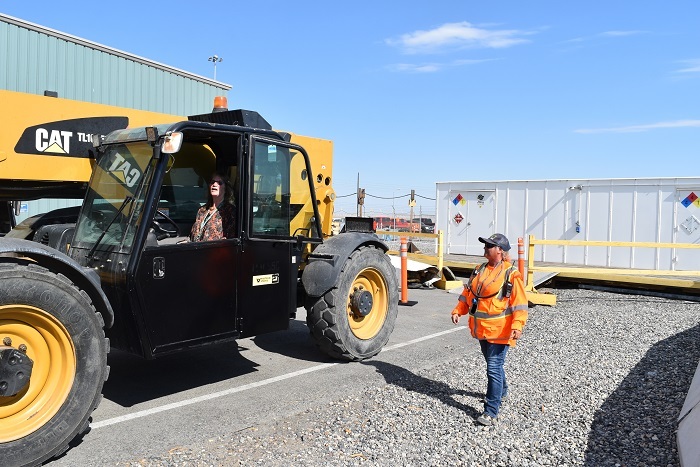 A Hanford Waste Treatment and Immobilization Plant heavy equipment operator, right, demonstrates the large blind spots of a telehandler to Jamei Perez, left, administrative supervisor for the plant.
RICHLAND, Wash. — Large vehicles and heavy machinery took center stage at the Hanford Site Waste Treatment and Immobilization Plant’s (WTP) second annual Heavy Equipment Expo. The event gives workers hands-on experience with the large vehicles used at the plant while promoting awareness of the hazards they can pose.
As Hanford continues its mission to treat and immobilize millions of gallons of chemical and radioactive waste, workforce safety remains a top priority, and events like these highlight that ongoing commitment.
Expo attendees climbed inside bulldozers, excavators and telehandlers to experience firsthand the blind spots and other challenges operators face. Operators answered questions and shared valuable insights about the unique hazards associated with operating each machine.
“Every worker needs to understand the safety risks associated with large machines,” said Mat Irwin, acting assistant manager for the WTP Project. “Hands-on experiences offer workers perspectives that classroom or computer-based training can’t.”
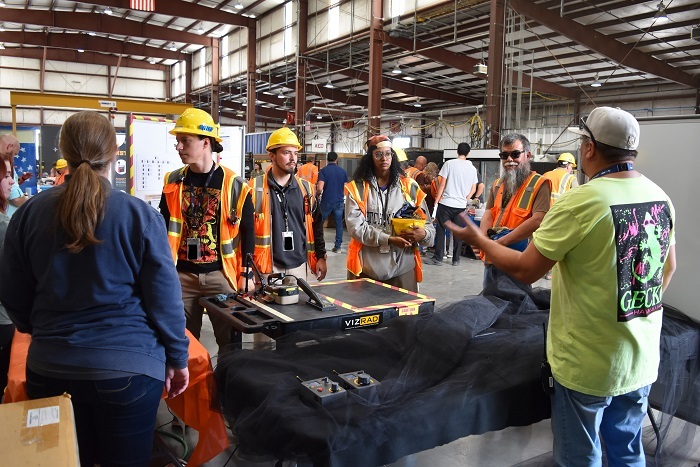 Some of the Hanford Site’s Waste Treatment and Immobilization Plant construction staff speak to members of the plant’s Radiological Control department at the annual safety expo before trying out radiological detection equipment used for training.
This year WTP staff members combined the Heavy Equipment Expo with their annual safety expo, which brings together different safety teams and departments from across the plant. Each team set up a booth with safety-themed activities and provided information about their roles in plant operations.
“Seeing our staff excited to learn about safety shows how valuable these events are for building a strong safety culture,” said Brian Hartman, project director for WTP and senior vice president for Bechtel National Inc., the WTP contractor. “Our team members walked away with a lot of important information, and creative activities make the lessons more memorable.”
-Contributor: Tyler Oates
|