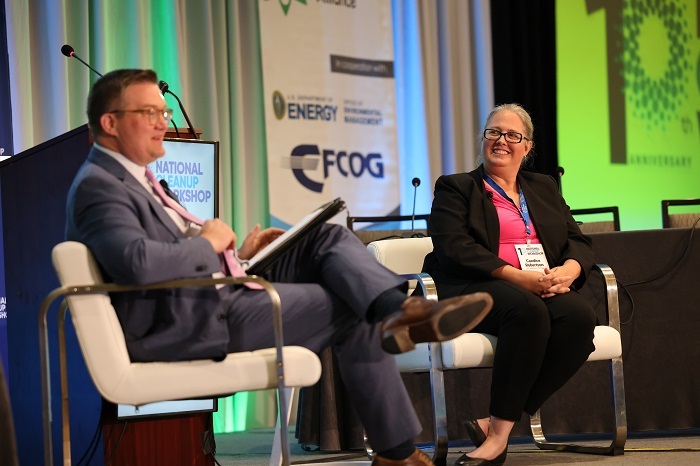
 Martin Schneider, president of Longenecker & Associates, speaks with U.S. Department of Energy Office of Environmental Management Senior Advisor Candice Robertson during “A Career Conversation with EM’s Cleanup Chief,” part of the 2024 National Cleanup Workshop’s Early Career Professional Session.
ARLINGTON, Va. — The 2024 National Cleanup Workshop kicked off its 10th year with an event dedicated to early career professionals, offering them insights into how to grow and succeed in the U.S. Department of Energy (DOE) cleanup program.
The pre-conference workshop began with remarks from Kristen Ellis, DOE Office of Environmental Management (EM) associate principal deputy assistant secretary for regulatory and policy affairs, and Martin Schneider, president of Longenecker & Associates.
They reminded participants that qualification for the session is not determined by age, but by years of involvement in the EM program. The session was geared to people involved in the cleanup program for less than five years.
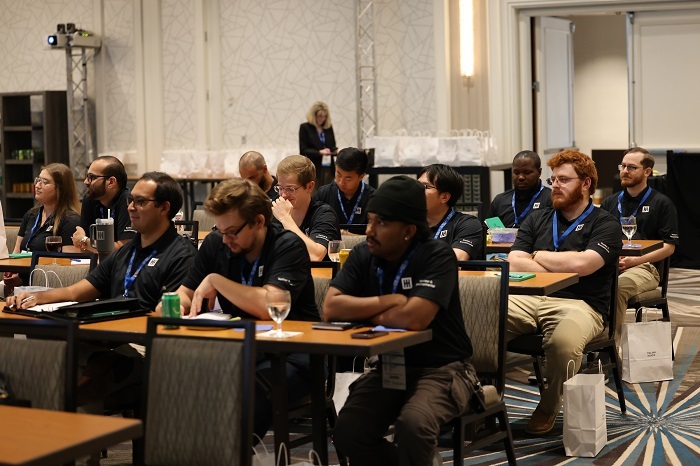 Audience members at the Early Career Professional Session.
In a conversation with attendees, EM Senior Advisor Candice Robertson reflected on her professional journey, sharing lessons, stories and advice.
Robertson discussed her career path leading to her current position as head of EM, from dreaming of becoming a dolphin trainer to serving as a Nye County commissioner in Nevada at age 23, and the diverse staff and leadership roles she has held at DOE, including EM.
“I learned so much in each of those positions,” Robertson said, “but especially the ones that were outside my comfort zone.” She didn’t work to a particular career plan, she said, but instead found success by working hard on the job at hand, being strategic in solving problems, and being willing to go where DOE leadership needed her most. “That allowed me to gain broad experience and build a network across DOE that continues to be important to me today.”
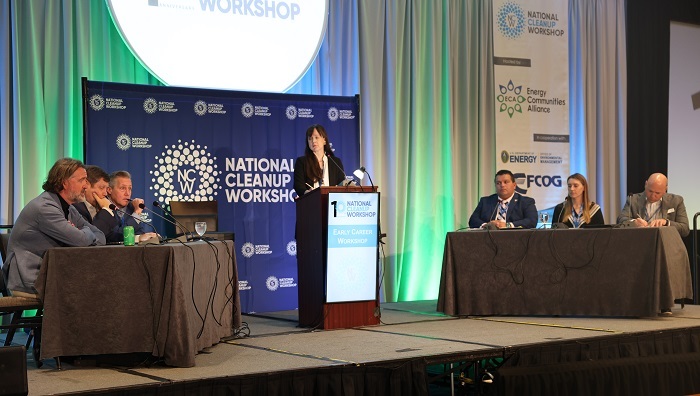 A panel discussion focused on supplementary career experiences was held as part of the Early Career Professional Session. From left: Colin Jones, deputy general manager, North American Nuclear; James Blankenhorn, senior vice president and lead of environment and security, Amentum; Erik Olds, deputy manager, Oak Ridge Office of Environmental Management; moderator Kristen Ellis, U.S. Department of Energy (DOE) Office of Environmental Management associate principal deputy assistant secretary for regulatory and policy affairs; JJ Chavez, council member, City of Carlsbad, New Mexico; Allison Finelli, chief of staff, DOE Office of Legacy Management; and Joe Aylor, director of Critical Projects, UCOR.
In a panel that encouraged the audience to focus on supplementary career experiences they can bring back to their work in the EM cleanup, six panelists highlighted different roles they’ve held that strengthened their careers. They include a congressional fellowship, business development rotation and chief of staff position. The panelists also cited running for local public office, moving between headquarters and field assignments, and serving in the Army Reserve and National Guard.
Joe Aylor, director of Critical Projects for Oak Ridge Office of Environmental Management (OREM) contractor UCOR, reflected on his former experience as a business development director at Amentum. He said working in a different field helps give you a broader, deeper understanding of the overall mission for the agency where you work.
Erik Olds, OREM deputy manager, discussed how he moved between headquarters and field assignments. The former EM communications director said that switching positions in his career has opened a lot of doors for him, echoing the advice Robertson gave earlier in the event.
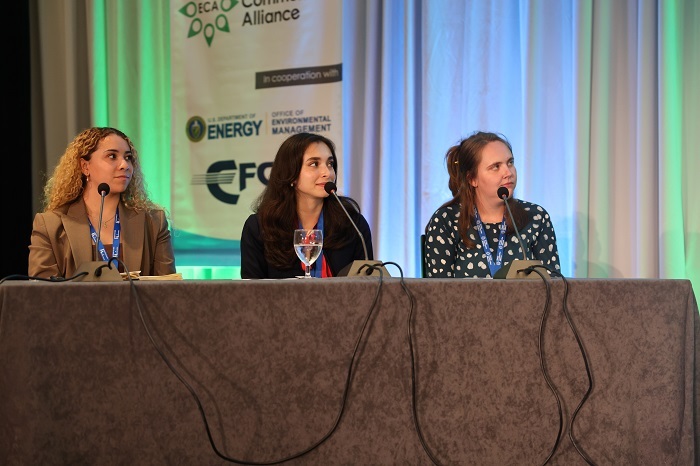 From left, panelists Faith Sanchez, Samina Mondal and Camryn Mikesell are pictured during a roundtable discussion titled, “Early Career Perspectives.”
Participants also heard from other early career professionals, including Ellen Howe, project engineer, Longenecker & Associates; Natalie Lackey, capture manager, Fluor Corporation; Mireya Martinez, project controls specialist, Waste Treatment Plant; Camryn Mikesell, nuclear engineer, HII; Samina Mondal, program analyst, EM; and Faith Sanchez, program director, Energy Communities Alliance.
Panelist Samina Mondal, an EM program analyst, reflected on her experience with the EM Pathways Program, which led to her current role in EM’s Office of Workforce Management. The program also provided training and mentorship, and eased Mondal’s transition to the workforce.
-Contributors: Carly Howard, Matt Roberts
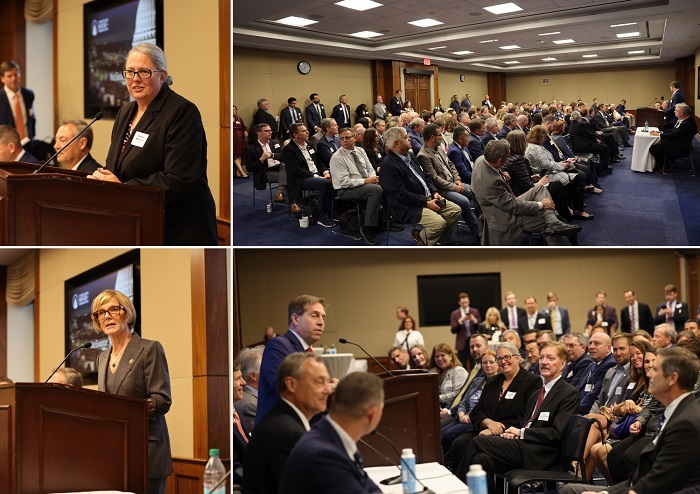
WASHINGTON, D.C. — U.S. Department of Energy (DOE) Office of Environmental Management (EM) leaders participated in a U.S. House Nuclear Cleanup Caucus event titled, “EM's Trade Workforce: Getting the Job Done,” on Sept. 18. U.S. Reps. Chuck Fleischmann and Susie Lee and EM Senior Advisor Candice Robertson welcomed attendees to the caucus, which featured a panel of experts who discussed how to support EM’s trade workers and ensure their safety while carrying out cleanup work across the country. Panelists included Martin Helms, executive director, Helmets to Hardhats; Joel Bradburne, manager, EM Portsmouth Paducah Project Office; Ken Rueter, president and CEO, UCOR; and Ty Blackford, president and program manager, Idaho Environmental Coalition. It was the third caucus event held this year and was hosted by the Energy Facility Contractors Group, Energy Technology and Environmental Business Association and Nuclear Energy Institute. Pictured top left, Robertson introduces the panel; bottom left, Lee shares remarks on the future workforce; and Fleischmann discusses the importance of skilled labor in the workforce at bottom right.
-Contributors: Carly Howard, Matt Roberts
 Editor's Note
This special wrap-up section of the weekly EM Update focuses on the National Cleanup Workshop, held Sept. 16-18 in Arlington, Virginia. The annual event, which celebrated its 10th anniversary in 2024, drew 780 in-person and 39 virtual attendees this year. Hosted by Energy Communities Alliance with the cooperation of the U.S. Department of Energy Office of Environmental Management (EM) and the Energy Facility Contractors Group, it's the premier annual gathering to discuss progress in environmental cleanup of former government weapons sites and nuclear research facilities.
 |
|
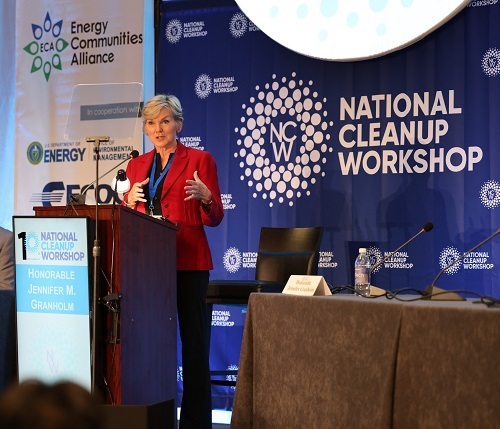
Click this box to read EM Update coverage of the National Cleanup Workshop addresses by Energy Secretary Jennifer Granholm and EM Senior Advisor Candice Robertson, who spoke of the importance of public service and partnerships in EM's cleanup:
|
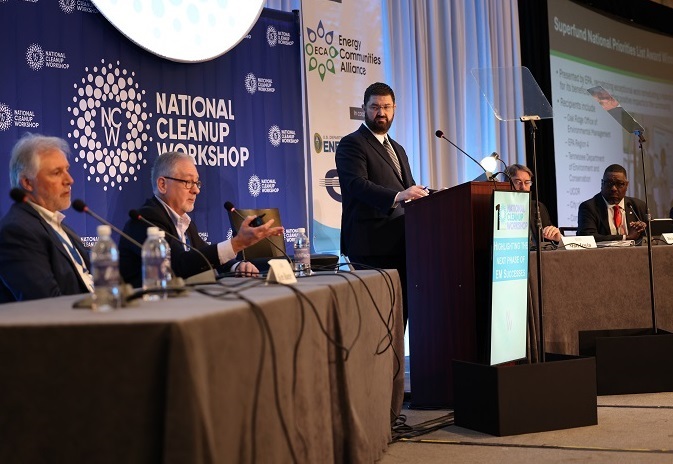 The National Cleanup Workshop panel titled, "Highlighting the Next Phase of EM Successes" included, from left, Ken Rueter, president and CEO, UCOR; Jay Mullis, manager, Oak Ridge Office of Environmental Management (EM); moderator Jeff Avery, U.S. Department of Energy Office of Environmental Management principal deputy assistant secretary; Matt Irwin, acting assistant manager, Waste Treatment and Immobilization Plant (WTP) Project, EM Office of River Protection; and Brian Hartman, WTP project director, Bechtel National Inc. Additional panelists not pictured included Jessica Kunkle, manager, EM Los Alamos Field Office, and Brad Smith, president and general manager, Newport News Nuclear BWXT. Photo by Matt Roberts
What’s Next? Cleanup Sites Lay Out Plans for Future Success
A National Cleanup Workshop panel focused on the next phase of successes in the U.S. Department of Energy cleanup program shared exciting updates. Moderated by Jeff Avery, DOE Office of Environmental Management (EM) principal deputy assistant secretary, the panel of EM and contractor leadership from Oak Ridge, Tennessee, Hanford, Washington, and Los Alamos, New Mexico, delivered presentations on what’s next at their cleanup sites.
Jay Mullis, Oak Ridge Office of Environmental Management manager, and Ken Rueter, UCOR president and CEO, discussed the recent completion of Vision 2024, the culmination of 20 years of cleanup at the East Tennessee Technology Park, and how those accomplishments represent what is possible in the realm of reindustrialization and beneficial reuse for local communities. They pointed to strong partnerships and high performing teams as key drivers behind successes in this area and noted the same will be true for executing plans for new partnerships with the community and industry surrounding the site.
Matt Irwin, acting assistant manager for Hanford’s Waste Treatment and Immobilization Plant (WTP) Project, and Brian Hartman, WTP project director, detailed the work that has gotten the plant to where it is today. Irwin noted it takes all parts of the site working in close partnership to achieve success in such a complicated mission. Hartman shared a video that walked the audience through the process for getting the plant’s two melters up to operational temperature and outlined some next steps as the site begins to shift to vitrification of liquid tank waste.
Jessica Kunkle, manager of the Environmental Management Los Alamos Field Office, and Brad Smith, president and general manager for legacy cleanup contractor Newport News Nuclear BWXT, highlighted a new technology aimed at improving the accuracy of waste classification processes. The Universal Drum Assay and Segregation System was developed in the United Kingdom and is now being tested at Los Alamos National Laboratory with exciting potential applications at other sites across the complex.
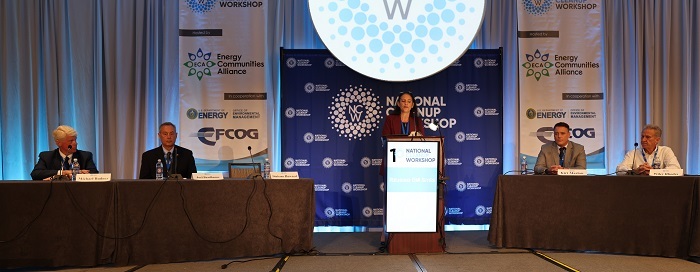 Members of the panel titled, "Reusing EM Sites to Support Clean Energy and Economic Opportunities," are pictured from left: Mike Budney, manager, Savannah River Operations Office; Joel Bradburne, manager, Portsmouth Paducah Project Office; Diahann Howard, executive director, Port of Benton; Kirt Marlow, executive director, Idaho Advanced Energy Consortium, and senior vice president, Boston Government Services; and Wiley Rhodes, CEO of Newpoint Gas LLC. Photo by Matt Roberts
Transparency, Public Engagement Central to Economic Development, Panelists Say
Transparency and the importance of community participation were the top themes during the economic development discussion with industry and U.S. Department of Energy Office of Environmental Management (EM) leaders at the 2024 National Cleanup Workshop.
Taking place shortly after Energy Secretary Jennifer Granholm’s keynote address, the panel explored how the private sector can reuse EM sites to support clean energy initiatives and generate economic growth — two priorities Granholm highlighted in her remarks.
Throughout the hourlong conversation, panelists emphasized the need for community-driven ideas and processes to ensure a successful outcome for all parties involved.
“Having a shared community vision for reusing EM sites and surrounding land is critical,” said Diahann Howard, executive director for the Port of Benton and administrator for the VERTical innovation cluster. “The Northwest Clean Energy Park is our community’s collective vision.”
Howard cited the Northwest Clean Energy Park as a positive example of how the local community and businesses can transform a former DOE site into an advanced clean energy manufacturing and industrial hub.
The park, which sits on Port of Benton property within the city of Richland and on Energy Northwest land, was formerly part of DOE’s Hanford Site. The park is now home to leading research, technology and manufacturing industries with a global impact.
Nearly 200 individuals and 60 companies came together to champion the park. To date, there are about $4.5 billion in projects with more than a thousand jobs under contract or pending at the Northwest Clean Energy Park.
To replicate the success of projects like the Northwest Clean Energy Park in other areas, panelists agreed that open dialogue between communities, DOE and industry is crucial.
Joel Bradburne, manager of EM’s Portsmouth Paducah Project Office, spoke about the possibilities for DOE site reuse.
“A lot of this stuff is site centric and that’s why the communities are so focused,” he said. “When it comes to energy alternatives, it’s not one size fits all.”
Several panelists commended EM for its commitment to community engagement.
“The bottom line is that EM has been very open and honest and transparent and tried very hard to make sure that at any of these sites, that people understand what is happening, and if they don’t, that there is a pathway to get there,” said Kirt Marlow, executive director, Idaho Advanced Energy Consortium, and senior vice president, Boston Government Services.
Wiley Rhodes, CEO of Newpoint Gas LLC, echoed Marlow’s sentiment: “From my standpoint, I have been extremely impressed with what the Department of Energy and the whole team have done.”
-Contributor: Melissa Sullivan
 Workshop Taps EM, Industry Experts for Insight on Reuse of DOE Materials
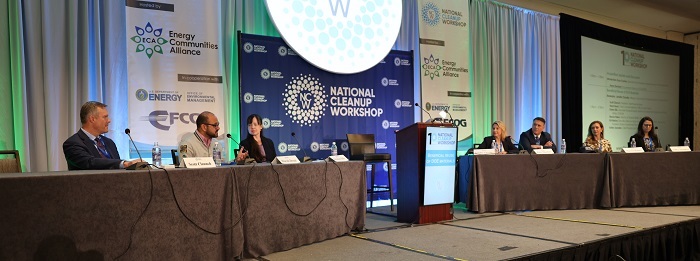
WASHINGTON, D.C. — Kristen Ellis, U.S. Department of Energy (DOE) Office of Environmental Management (EM) associate principal deputy assistant secretary for regulatory and policy affairs, joined five industry experts for a panel discussion of the potential for the beneficial reuse of DOE materials. Jennifer Chandler, a member of the Village Council for Piketon, Ohio, near EM’s Portsmouth Site, served as moderator, guiding the panelists through discussions on how EM, its contractors and local communities can work together to help local communities near EM sites achieve maximum economic benefits. Pictured from left: Scott Claunch, president of TerraPower Isotopes; Harsh Desai, chief commercialization officer for Zeno Power; Ellis; Chandler; Kirt Marlow, executive director of the Idaho Advanced Energy Consortium and senior vice president of Boston Government Services; Marcie Haber, director of Federal Affairs for Oklo; and Ashley Saunders, chief program and sustainability officer for UCOR. Photo by Matt Roberts
-Contributor: Keir-Kevin Curry
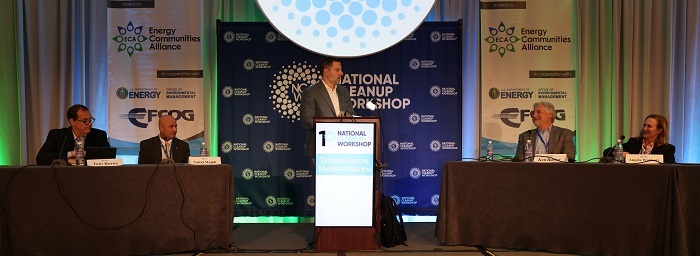 From left: Tom Burns, chief engineer, Savannah River Mission Completion; Vahid Majidi, director, Savannah River National Laboratory; moderator Mark G. Arnone, manager, Energy Innovation and Defense, Amazon Web Services; Ken Rueter, president and CEO, UCOR; and Angela Watmore, deputy assistant secretary for acquisition and project management, U.S. Department of Energy Office of Environmental Management. Photo by Matt Roberts
Panelists Consider How AI, Other Technologies Can Move Cleanup Mission Forward
Artificial Intelligence (AI) has been a dominant topic in recent years with platforms like Meta AI, Apple Intelligence and Google AI gaining attention for their advancements in virtual assistants.
The rise of ChatGPT, a large language model developed by OpenAI, further propelled the AI boom by demonstrating its capability to understand and generate human-like text. ChatGPT can produce content, answer questions and engage in conversations with a high degree of fluency. Beyond text, newer AI technologies now enable users to create images and videos with minimal input, expanding AI’s creative applications.
In a Sept. 18 session at the National Cleanup Workshop, experts from the U.S. Department of Energy Office of Environmental Management (EM), Savannah River National Laboratory (SRNL), Savannah River Mission Completion, UCOR, and Amazon Web Services gathered to discuss how AI, machine learning and data analytics can revolutionize the environmental cleanup mission.
The central theme of their discussion? Data.
“We work in an industry that’s extremely data-rich, and we’re figuring out how to use machine learning, data analytics and AI in practical ways to make that data work for us,” said Vahid Majidi, director of SRNL. “What is most important for us is to improve worker safety and secondly improving productivity.”
While generative AI tools like ChatGPT can deliver quality content such as code or music, the complex and vast datasets produced by EM’s operations offer a broader, largely untapped potential for AI applications.
“Part of this journey is understanding how to implement these technologies,” said Ken Rueter, president and CEO of UCOR. “People will remain the decision-makers, but AI can expand our range of options and improve decision-making processes. It all starts with data.”
The panelists expressed optimism about AI and machine learning’s potential to enhance the EM mission, but they acknowledged that it’s too early to fully harness these technologies.
“We have so much data, but I don’t know that we always know what that data means,” said Angela Watmore, deputy assistant secretary for acquisition and project management for EM. “We have to get to a place where we can crunch that data and create new information that we can use to make better, more informed decisions.”
-Contributor: Lee Tucker
 Panelists Note Importance of Collaboration as Hanford Prepares for 24/7 Operations
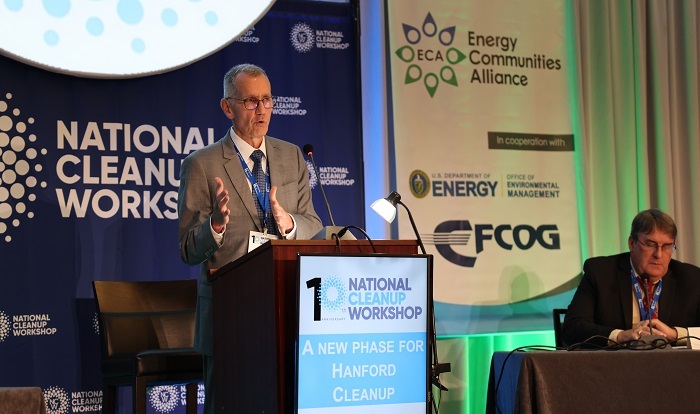
Brian Vance, manager of the Office of River Protection and Richland Operations Office, moderated a panel titled, “A New Phase for Hanford Cleanup,” at the National Cleanup Workshop on Sept. 18. The panel highlighted the complex integration taking place among six cleanup contractors at Hanford while they focus on achieving safe cleanup on their respective projects. The One Hanford leadership team, which includes U.S. Department of Energy Office of Environmental Management and contractor leaders, explained how their work on tank waste treatment, risk reduction and base operations continues to benefit from their close working relationships and their adoption of a sitewide governance model. The leaders explained current efforts in preparing to treat low-activity waste and plans for the future of high-level tank waste, as Hanford prepares in earnest for the site to be in a 24/7 operations posture. Vance is pictured with Mat Irwin, acting assistant manager for the Waste Treatment and Immobilization Plant, at right. Photo by Matt Roberts
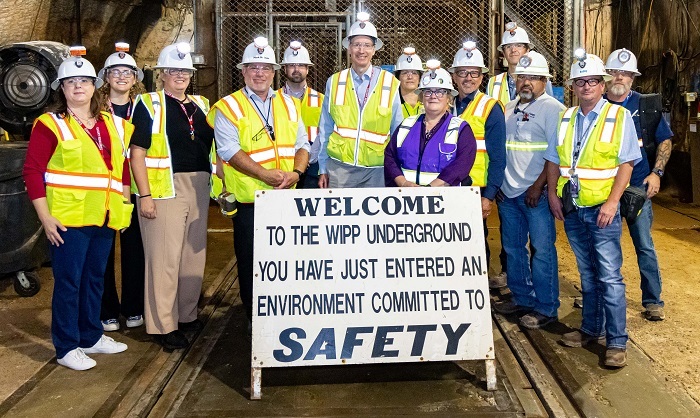
CARLSBAD, N.M. — In a recent visit to the Waste Isolation Pilot Plant (WIPP), U.S. Department of Energy (DOE) Deputy Energy Secretary David Turk and DOE Office of Environmental Management Senior Advisor Candice Robertson took a tour that went 2,000 feet into Earth where transuranic waste is being emplaced in mined salt beds. The visit also included a surface tour of the new Safety Significant Confinement Ventilation System project set to come online in 2026. That system will increase airflow to the underground up to 540,000 cubic feet per minute, enhancing worker safety. Turk is picture at center in the foreground, second from right, and Robertson is pictured in the foreground, fourth from right. Carlsbad Field Office (CBFO) Manager Mark Bollinger is at right of Robertson and CBFO Deputy Manager Betsy Forinash is at right of Turk. They are surrounded by employees of DOE headquarters, CBFO and WIPP management and operations contractor Salado Isolation Mining Contractors.
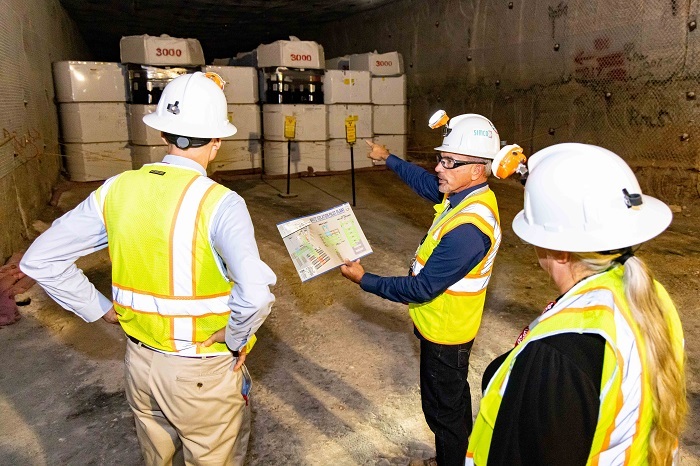 Salado Isolation Mining Contractors President Ken Harrawood, at center, shares updates with U.S. Department of Energy (DOE) Deputy Energy Secretary David Turk and DOE Office of Environmental Management Senior Advisor Candice Robertson at the front of Room 5, where recently received waste has been emplaced in the underground at the Waste Isolation Pilot Plant.
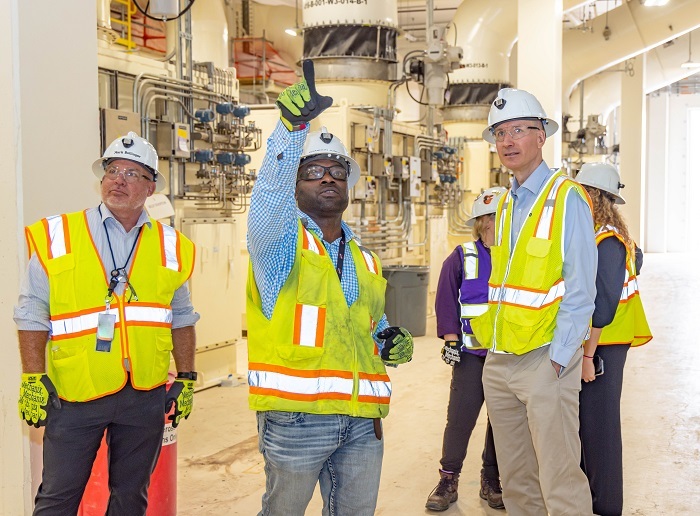 From left, Carlsbad Field Office Manager Mark Bollinger, Salado Isolation Mining Company employee Brandon Jones and U.S. Department of Energy Deputy Energy Secretary David Turk are pictured during a surface tour of the Safety Significant Confinement Ventilation System at the Waste Isolation Pilot Plant.
-Contributor: Valerie Gohlke
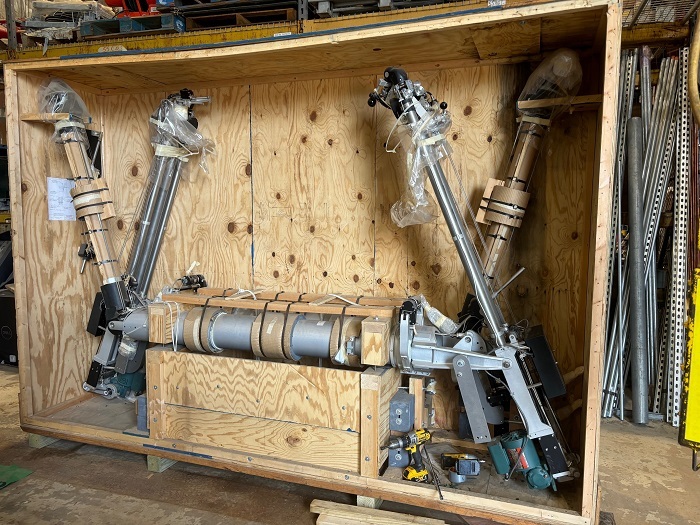
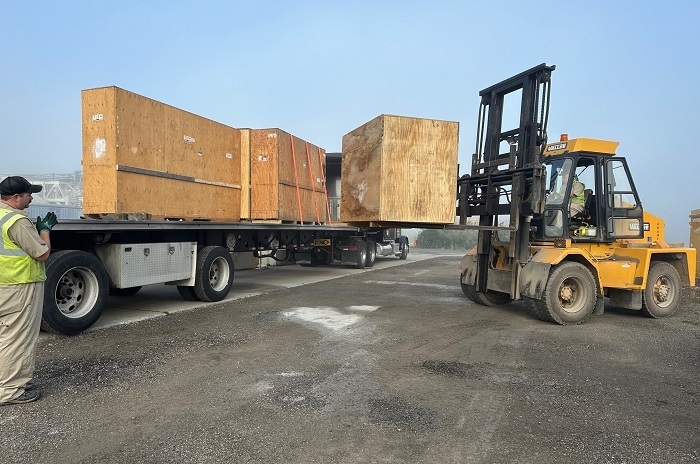 Crews shipped two telemanipulators packaged in a wooden crate along with other parts from the West Valley Demonstration Project to the Idaho National Laboratory Site. The specialized equipment is used to safely handle hazardous materials remotely for processing and packaging.
WEST VALLEY, N.Y. – Two U.S. Department of Energy Office of Environmental Management (EM) cleanup sites are expected to save taxpayers an estimated $1 million by sharing highly specialized equipment.
The West Valley Demonstration Project in New York transferred the equipment to the Idaho National Laboratory (INL) Site. The equipment is used to handle hazardous materials remotely, ensuring safety as crews process and package the materials.
“Repurposing highly specialized equipment like this helps save money for taxpayers and the government,” West Valley Project Management Office Assistant Director Stephen Bousquet said. “It also saves cost on schedule because the equipment is already built and available for immediate use.”
 A truck is loaded with specialized equipment for safely handling hazardous materials. The equipment will be repurposed for use at the Idaho National Laboratory Site. This initiative will save taxpayers approximately $1 million.
EM’s INL Site cleanup contractor, Idaho Environmental Coalition (IEC), will receive major components and spare parts from West Valley for several robotic manipulator arms used alongside telemanipulators to process waste. Telemanipulators allow an operator to control a hand-like mechanism from outside a working cell — similar to claw crane machine arcade games.
That equipment is among a large inventory of parts used to maintain and replace remote-handling equipment no longer needed at West Valley after crews there decommissioned the Main Plant Processing Building and Vitrification Facility. The site had used the remote-handling equipment to process and reduce the size of radioactive materials and package them remotely. The site continues to perform this work using a different model.
Royce Tyler, an IEC Waste Management system engineer, said it was remarkable to find the robotic manipulator parts and telemanipulators in the DOE complex through DOE’s excess property program.
“Idaho has an ongoing need for both parts in its cleanup mission and will certainly put these resources to good use at the Idaho Cleanup Project,” Tyler said.
Jason Casper, president of West Valley cleanup contractor CH2M HILL BWXT West Valley, said sharing equipment between sites is a formula for success.
“West Valley and other EM sites will continue to assist each other in reducing risks in a safe, cost-effective and environmentally compliant manner,” Casper said.
Several years ago, West Valley transferred a 12.5-ton tow tractor, 47-ton vertical cask transporter and robotically operated welder to other sites and received three used heavy-duty excavators.
-Contributor: Joseph Pillittere
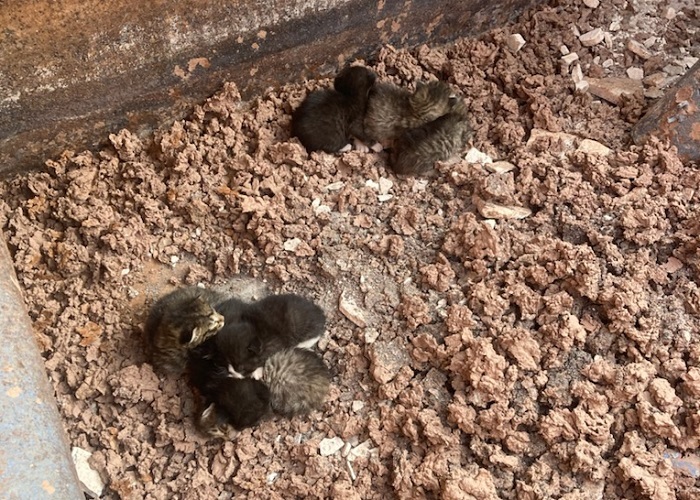 Seven kittens were discovered inside a mud mixer that was brought to the Idaho CERCLA Disposal Facility expansion project at the Idaho Natonal Laboratory Site.
IDAHO FALLS, Idaho — A U.S. Department of Energy Office of Environmental Management (EM) cleanup crew member recently experienced a surprise while on the jobsite at the Idaho National Laboratory (INL) Site.
An employee with subcontractor Western Construction was checking the perimeter of the Idaho CERCLA Disposal Facility (ICDF) cell expansion project when he heard meowing and informed his supervisor, Rick Johns. CERCLA stands for the Comprehensive Environmental Response, Compensation and Liability Act.
Upon further inspection, they found a litter of seven kittens inside a well drilling truck that had been brought to the construction site two days earlier.
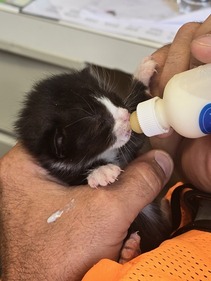
The kittens were without their mother, and appeared to be seven to 10 days old, as their eyes were not fully opened.
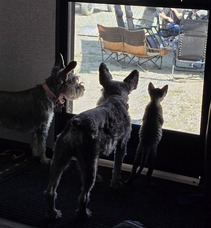
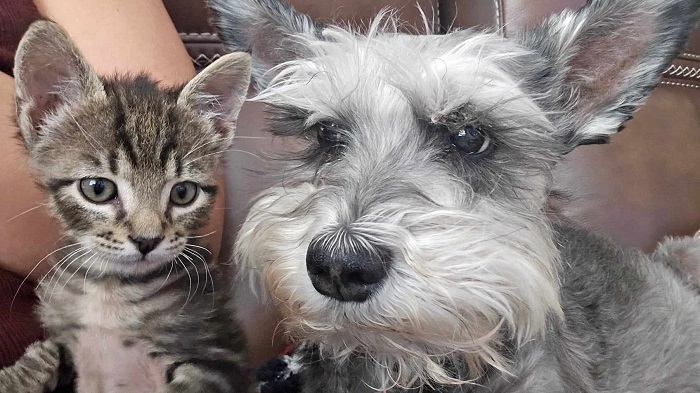 Idaho Environmental Coalition manager Eric King added one of seven kittens found at the Idaho National Laboratory Site to his family, which includes two dogs. The family’s new addition, Chupi, is pictured here with Max.
The Western Construction employees informed Eric King, an ICDF construction manager for EM contractor Idaho Environmental Coalition (IEC), who in turn consulted IEC’s Environmental Management Program. Program employees told King that the kittens could either be taken to a local animal shelter or a home.
In the interim, with the approval of the EM program, Western Construction employees gave the kittens milk, as they hadn’t been fed for at least two days.
Johns, with the support of his wife, Cheri, and daughter, Liera, decided to take the kittens home. His family members took turns feeding the kittens every four hours, even at 2 a.m.
 |
|
Inside a construction trailer, a worker feeds milk to one of seven kittens found at the Idaho National Laboratory Site. |
Idaho Environmental Coalition manager Eric King welcomed a kitten named Chupi to his family after Chupi and six other young cats were found at the Idaho National Laboratory Site. Chupi is pictured here with Max and Millie of the King family. |
|
 |
By late August, just 40 days after being found at the INL Site, all the kittens had been adopted.
“Seeing those helpless little guys, I couldn’t help but feel compassion,” said King. “One is now part of our family.”
According to King, his new male kitten, Chupi — short for Chupacabra — gets along great with the couple’s two dogs, Max and Millie.
-Contributor: Erik Simpson
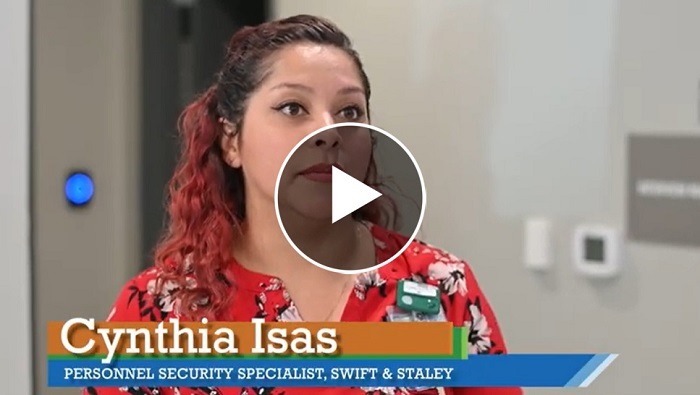 EMTV: Watch the Paducah Site's video marking Hispanic Heritage Month, which runs from Sept. 15 to Oct. 15.
PADUCAH, Ky. — The U.S. Department of Energy Office of Environmental Management Paducah Site is marking Hispanic Heritage Month with a special celebration, underscoring the importance of diversity and inclusion in the workplace. This year, the site produced a video shining a light on the rich cultural contributions and career achievements of its Hispanic employees.
Hispanic Heritage Month, which runs from Sept. 15 to Oct. 15, provides a valuable opportunity to honor the history, culture and contributions of Hispanic Americans. At Paducah, the celebration goes beyond mere recognition: It is a testament to the site’s commitment to foster an inclusive work environment where every employee's background and experiences are valued.
“Diversity is more than just a goal; it's the cornerstone of innovation and success in our work,” Paducah Site Lead April Ladd said. “By celebrating Hispanic Heritage Month, we not only recognize the valuable contributions of our Hispanic colleagues, but also strengthen our commitment to an inclusive environment where every voice is heard and valued.”
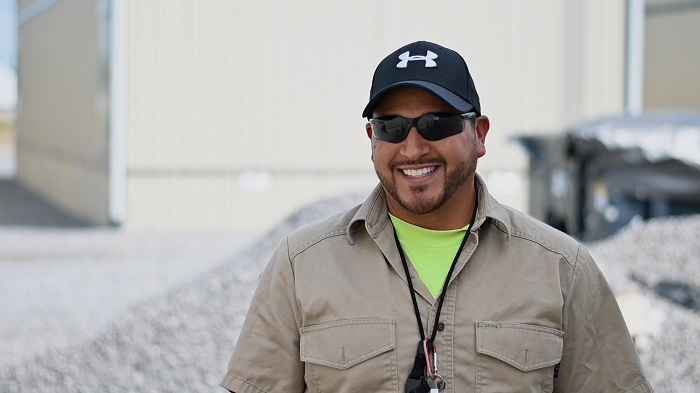 Freddy Montoya, a Paducah Site team member, shares how he celebrates Hispanic Heritage Month in a recent video produced by the site.
The newly released video features a series of personal stories from Hispanic employees, highlighting how they celebrate their Hispanic heritage and the impact those values have on their professional careers. These stories offer a glimpse into how diverse perspectives enhance problem-solving, drive innovation and contribute to a dynamic work culture.
The site's celebration of Hispanic Heritage Month recognizes a diverse workforce that brings a wealth of perspectives, crucial for addressing complex challenges and driving progress.
Cynthia Isas, personnel security specialist with Paducah Site infrastructure support services contractor Swift and Staley Inc., participated in the video.
“Everybody comes from different walks of life. They are going to grow up with different ideas. They are going to see and have different life experiences,” Isas said. “How they choose to use that to advance themselves and people around them and the team as a whole, is what makes a difference.”
-Contributors: J.T. Crawford, Dylan Nichols
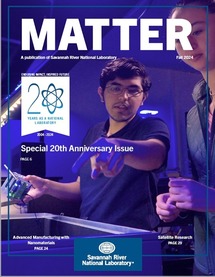
AIKEN, S.C. — The U.S. Department of Energy Office of Environmental Management's Savannah River National Laboratory (SRNL) recently released a special issue of its publication, "Matter," marking the 20th anniversary of SRNL's designation as a national laboratory.
Nearly every story in the issue highlights the global impact of SRNL’s work, including space nonproliferation, the Center for Hierarchical Waste Forms, grid security, the laboratory's mobile facilities and the deployment of Advanced Long-Term Environmental Monitoring Systems beyond the Savannah River Site (SRS).
The laboratory's research and development and applied science achievements continue to have impacts across the DOE complex, nation and world. SRNL is an EM laboratory and its support to the complex’s most challenging cleanup and monitoring problems remains steadfast.
Click here to view the publication.
|
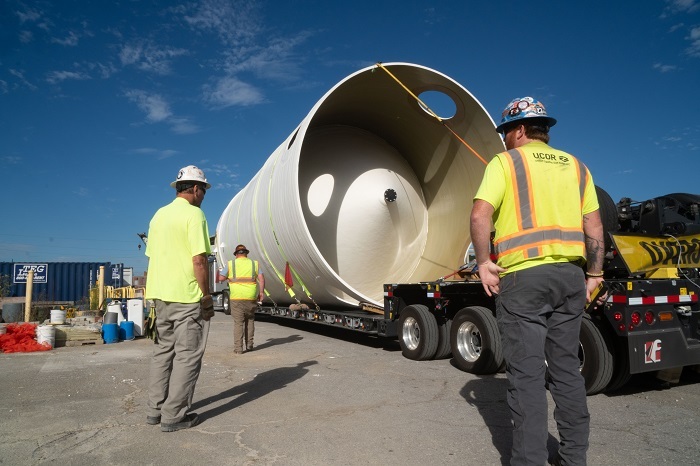 Workers prepare to remove from a specialized transportation trailer the first of three sludge-settling tanks for Oak Ridge’s Mercury Treatment Facility.
OAK RIDGE, Tenn. — The Oak Ridge Office of Environmental Management (OREM) and contractor UCOR took another step forward in the construction of the Mercury Treatment Facility at the Y-12 National Security Complex.
Workers finished installing the first of three large sludge-settling tanks, each of which will be 38 feet tall and 15 feet wide, and have a capacity of 36,000 gallons. With many of the recent tasks for the construction project happening below ground, this latest aboveground completion provides a visible sign of ongoing progress on the critical infrastructure.
“This facility is a linchpin for major cleanup on the horizon at Y-12,” said Steve Clemons, OREM project manager. “We understand the importance of this project, and we’re continuing our steady approach to get the facility up and operational.”
The facility is essential infrastructure that allows OREM to fulfill its regulatory commitments to reduce mercury levels in the East Fork Poplar Creek and begin large-scale cleanup at Y-12. When operational, it will limit and control potential mercury releases as crews demolish massive Manhattan Project and Cold War-era buildings and address the soil beneath them.
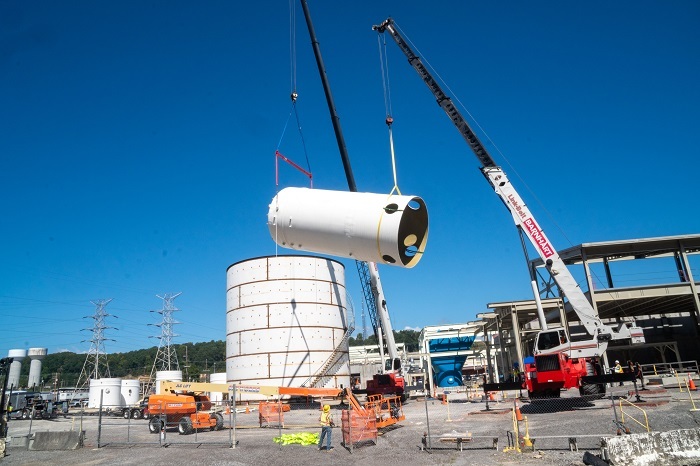 Crews install the first of three tanks at the Mercury Treatment Facility’s treatment plant at the Y-12 National Security Complex. Each of the 36,000-gallon tanks is 38 feet tall and 15 feet wide.
The project encompasses two components at two locations: a headworks facility and a treatment plant, both connected by a half-mile-long transfer pipeline.
The headworks facility will capture creek flow on the west end of Y-12, store excess stormwater collected during large rainfalls, remove grit, and pump water via the pipeline to the treatment plant on the east side of Y-12.
The tanks crews are installing are part of the treatment plant that removes and concentrates grit, dirt and other solids to be extracted from the water. That treated water will then flow into the creek.
“The installation of the sludge tanks is an important milestone,” Richard Bonner, UCOR project director said. “As we continue to progress the construction, the installation of these tanks can serve as a reminder of the desired end result of our cleanup mission.”
In coming weeks, crews will install the remaining two tanks. Due to their size, a transportation company is using a specialized trailer to transport each tank from the manufacturer in Arkansas to the project site in Oak Ridge.
Once completed, the facility will process up to 3,000 gallons of water per minute and collect stormwater in a 2-million-gallon storage tank.
-Contributor: Ella Stewart
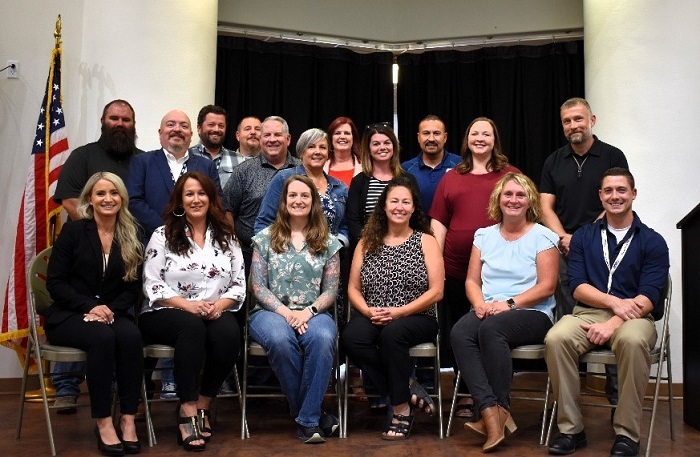 Hanford Mission Integrations Solutions recently graduated 17 employees from a nine-month leadership development program. Back row, from left: Daniel Anderson, Adam Palomarez, John-Paul LeCompte, Dustin Brewington, Matt Finkle, Dulcie Allen, MaryAnne Wuennecke, Echo Dahl, Jose Manjares, Tess Misipeka and Kyle Haff. Front row, from left: Elizabeth Allard, Jessica Shaw, Heather Healy, Kelly McDaniel, Tara Briggs and John Snider.
RICHLAND, Wash. — A Hanford Site contractor is investing in employee growth with a program to develop leadership and communication skills, create mentorship opportunities and encourage leadership interactions.
U.S. Department of Energy Office of Environmental Management contractor Hanford Mission Integration Solutions started its Supporting Talent and Engaging Professionals for Success Program last fall. The first class completed the nine-month program this summer.
“This project allows participants to combine expertise acquired in their fields with skills learned in the classroom, and apply them to real-time challenges,” said Julie Lindstrom, HMIS vice president of Workforce Solutions. “Successful leaders need to turn learning objectives into practical work products, and we’re excited to see their proposals and witness this growth opportunity in action.”
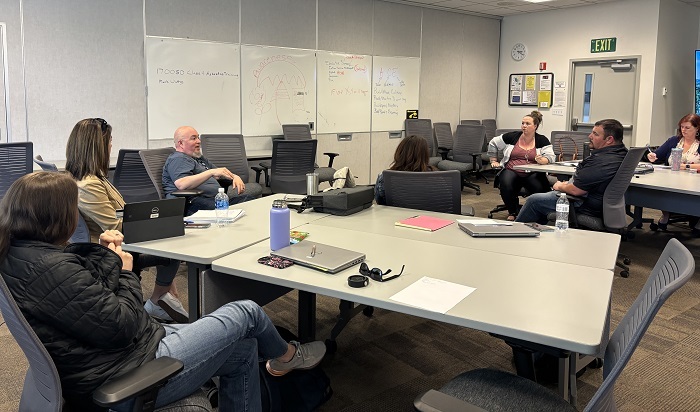 Participants with the Hanford Mission Integration Solutions leadership development program present their ideas to the contractor’s executive leadership team.
During the recent program, contractor employees took part in six learning forums to improve their business knowledge and better understand business processes. They also completed three training sessions to enhance communication skills.
The class worked on a group project and presented its recommendations to the contractor’s executive leadership team near the end of the program. Several recommendations from the 2024 class were immediately implemented.
“Investing in employee development is crucial for retaining talent, driving mission success, helping to reduce risks and fostering strong partnerships,” said Sierra Ochs, Hanford’s Workforce Management Program manager.
Leadership programs at Hanford foster a culture of continuous learning, support and new ideas to help accomplish the cleanup mission.
-Contributor: Jill Harvill
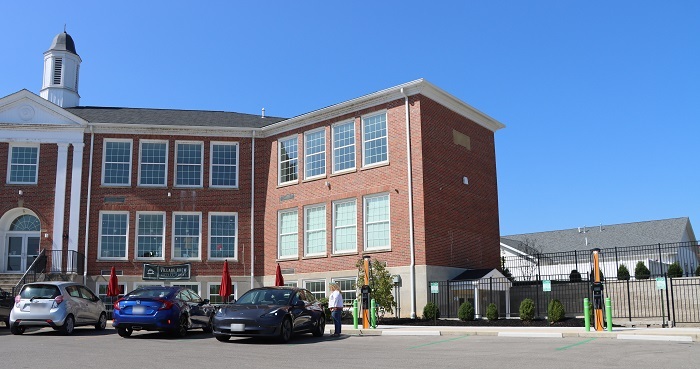 Two publicly available charging stations installed near the Portsmouth Site make it possible to charge four electric vehicles at the same time.
PIKETON, Ohio —The U.S. Department of Energy (DOE) Office of Environmental Management’s Portsmouth Paducah Project Office recently installed Pike County’s first publicly available electric vehicle charging stations using DOE grant funding received as part of the Green Fleet Award.
“As a 2023 Green Fleet Award site recipient, the Portsmouth Site is pleased to continue the effort to achieve zero emissions,” Portsmouth Site Lead Jeremy Davis said. “The installation of the first publicly available charging stations marks a key moment in the evolution of transportation, highlighting the potential of electric vehicles and setting the stage for the electric revolution that continues to unfold.”
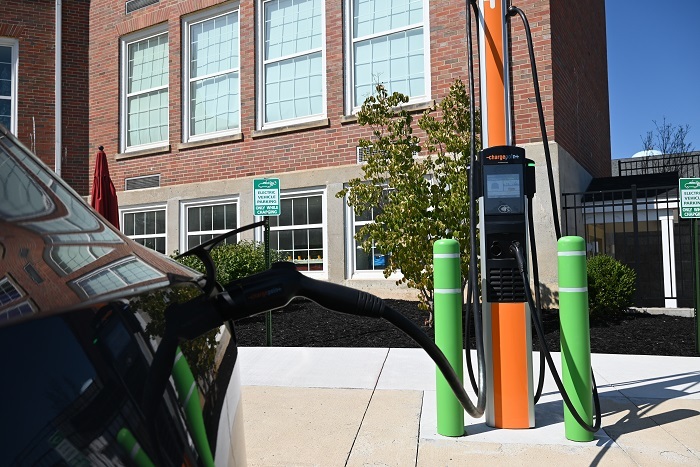 An electric vehicle uses a new charging station at The Square at Piketon. The first publicly available electric vehicle charging station in Pike County, Ohio, is available at this renovated schoolhouse that also houses the Portsmouth Site's Joint Information Center.
Installed in the heart of Piketon by infrastructure support services contractor North Wind Dynamics, the stations are a pivotal step toward the adoption of electric vehicles, reflecting a growing interest in sustainable transportation options. The stations are designed to provide a reliable, accessible location to charge four electric vehicles concurrently.
“The location of a former school that had been renovated to create The Square at Piketon links the past of the community to the future,” said Damon Detillion, North Wind Dynamic’s project manager, referring to a multiuse development in the village. “This project emphasizes the importance of infrastructure in the adoption of new technologies and puts Piketon on the charging station map.”
 |
|
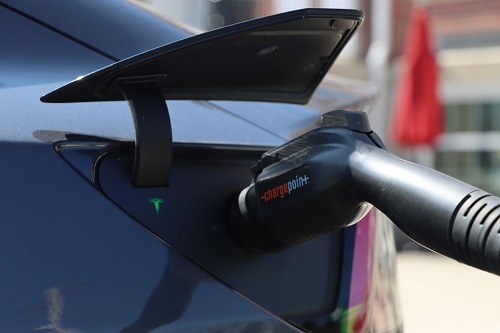
Adaptors, purchased by vehicle owners, make it possible to charge all types of electric vehicles. |
The location also houses the Portsmouth Site’s Joint Information Center to support media communications in the unlikely event of an emergency.
-Contributor: Rachel Stroth
|