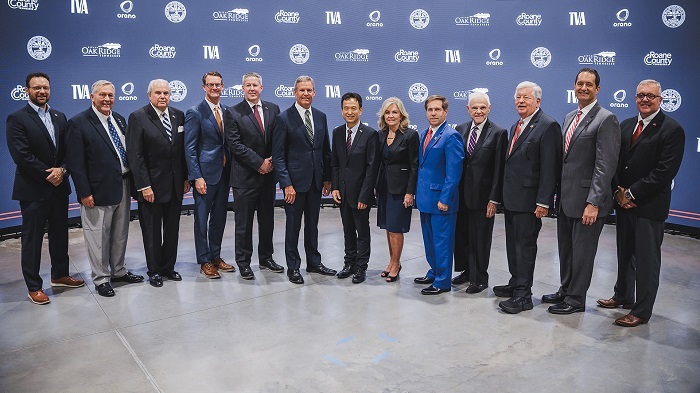
 From left: State Reps. Jason Zachary and John Ragan, Oak Ridge Mayor Warren Gooch, Tennessee Department of Economic and Community Development Commissioner Stuart McWhorter, Roane County Executive Wade Creswell, Tennessee Gov. Bill Lee, Orano USA President and CEO Jean-Luc Palayer, U.S. Sen. Marsha Blackburn, U.S. Rep. Chuck Fleischmann, State Sen. Ken Yager, Tennessee Lt. Gov. Randy McNally, Tennessee Valley Authority Chief Operating Officer Don Moul, and State Rep. Monty Fritts gather for the announcement of Oak Ridge as the site for Orano USA’s new multibillion dollar uranium enrichment facility — the largest investment in Tennessee history.
OAK RIDGE, Tenn. — In a landmark decision announced last week, Orano USA has selected Oak Ridge for the site of a new multibillion dollar uranium enrichment facility, representing the single largest investment in Tennessee’s history.
Gov. Bill Lee announced the news during a press conference at the Oak Ridge Enhanced Technology and Training Center. He was joined by city, state and federal officials who praised the project’s scale and significance.
The new facility, spanning 750,000 square feet, will become one of the largest uranium enrichment plants in North America, solidifying Oak Ridge as a hub for nuclear technology and innovation.
The ambitious endeavor, known as Project IKE, will be located on a 920-acre site on the Roane County side of Oak Ridge. The U.S. Department of Energy (DOE) land will be transferred to Orano USA.
The project will lead to the creation of more than 300 jobs, offering a substantial boost to the local economy. Lee emphasized the importance of these jobs.
“Whenever you bring into a community hundreds of jobs, particularly if they’re highly skilled and high paying, it elevates the entire workforce in the region. That’s part of the reason this is so important,” Lee said. “Hundreds of Tennesseans will have access to better employment opportunity for their families. This makes life better for the people in the community.”
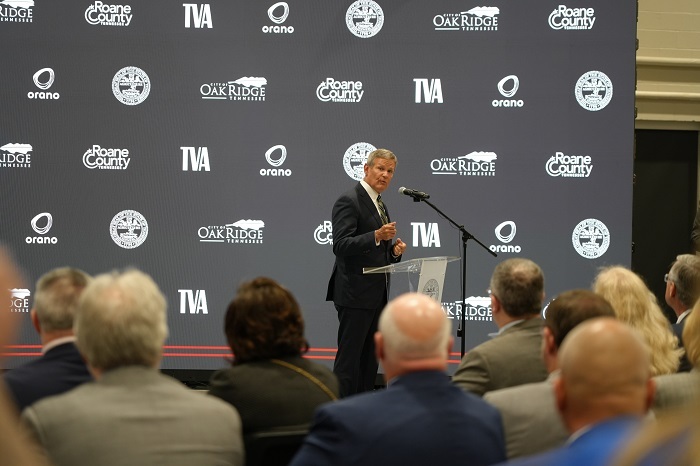 Tennessee Gov. Bill Lee addresses the audience and discusses the importance of the jobs created by this project.
Orano is a leading player in the nuclear industry. The French-owned company specializes in uranium mining, conversion, enrichment, used nuclear fuel management and recycling, decommissioning, site cleanup, and nuclear medicine.
Project IKE will be the second major project in Tennessee to benefit from the state’s Nuclear Energy Fund, an initiative that helps nuclear-related businesses establish or expand operations in the Volunteer State. The fund also supports Tennessee’s universities and research institutions in furthering their nuclear education programs.
Jean-Luc Palayer, CEO and president of Orano USA, noted the significance of the company’s partnership with DOE.
“We are very proud of partnering with the U.S. Department of Energy to clean up and convert one of their sites, set aside originally for the Manhattan Project, and repurpose it into one of the largest and state-of-the-art uranium enrichment facilities in the country,” said Palayer.
Project IKE continues the growing momentum of private companies locating on land transferred by DOE and spurring new economic development. To date, more than 1,700 acres have been transferred to the community that now house other nuclear companies, including Triso-X, Kairos Power and Ultra Safe Nuclear Corporation.
Education and workforce development will play a critical role supporting the success of Project IKE. Institutions such as the University of Tennessee, Tennessee Tech University, Roane State Community College and Tennessee College of Applied Technology will be key partners in developing the highly skilled workforce needed for the facility.
“This city is nothing without capable people, and this region and this state have a remarkable education program implemented by the state and the counties,” said Palayer. “With this program, you provide education and training for skilled workers, technicians, engineers, staff and many other jobs that will be needed.”
Lee also highlighted the broader implications of this investment for the nation’s energy landscape.
“There is a need like never before for energy independence in this country for reliable, safe, cost-effective energy,” Lee said. “There is no conversation about the future of America's energy industry that doesn't include nuclear, and nowadays there are not many nuclear conversations that don't include Tennessee.”
Orano USA will begin the licensing process with the U.S. Nuclear Regulatory Commission and anticipates the facility could begin production in the early 2030s, according to Palayer.
-Contributor: Allison Smith
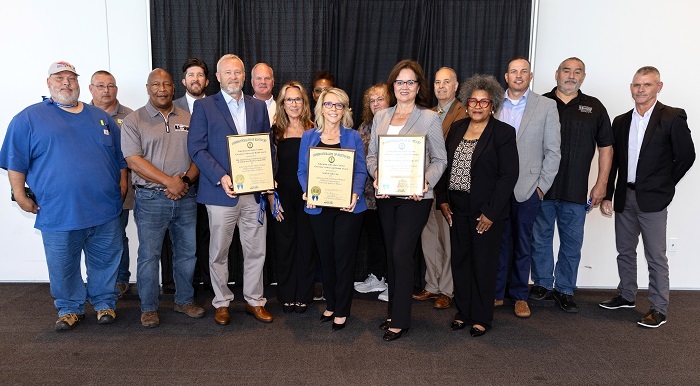 Leadership, employees and United Steel Workers representatives with three U.S. Department of Energy Office of Environmental Management Paducah Site contractors — Four Rivers Nuclear Partnership, Swift & Staley and Mid-America Conversion Services — are pictured after receiving the 2024 Kentucky Labor Cabinet Governor's Safety and Health Award.
PADUCAH, Ky. — In a significant recognition of excellence coming from the top level of state government, U.S. Department of Energy Office of Environmental Management (EM) Paducah Site contractors Four Rivers Nuclear Partnership, Swift & Staley and Mid-America Conversion Services have been honored with the 2024 Kentucky Labor Cabinet Governor's Safety and Health Award for their exceptional performance and commitment to creating a safe work environment.
The award spotlights organizations that have demonstrated exemplary safety practices and a commitment to protecting their workers. By achieving this honor, the three EM contractors set a high standard for safety in their industry, highlighting the importance of vigilance and continuous improvement in workplace health and safety.
“The Governor's Safety and Health Award is a testament to the outstanding safety culture cultivated by the Department of Energy,” EM Portsmouth/Paducah Project Office Manager Joel Bradburne said. “Their achievements in maintaining a safe work environment demonstrates the unwavering commitment to the health and safety of our site workforce.”
The three Paducah contractors were honored for achieving a significant safety milestone: surpassing 3 million safe work hours collectively without a lost workday in 2023. This accomplishment underscores the dedication to a safe work culture at Paducah and recognizes the workforce for its commitment to safety.
“The dedication shown by the workforce at the site in achieving such a high safety record reflects their proactive approach to workplace safety,” EM Paducah Site Lead April Ladd said. “Their efforts not only protect their employees but also contribute to the overall success of the DOE mission at the site.”
The award, presented annually, was given to 42 companies in Kentucky for exceptional performance in safety, underscoring the importance of prioritizing the well-being of employees throughout the commonwealth.
-Contributors: Kearney Canter, Dylan Nichols, Amanda Scott
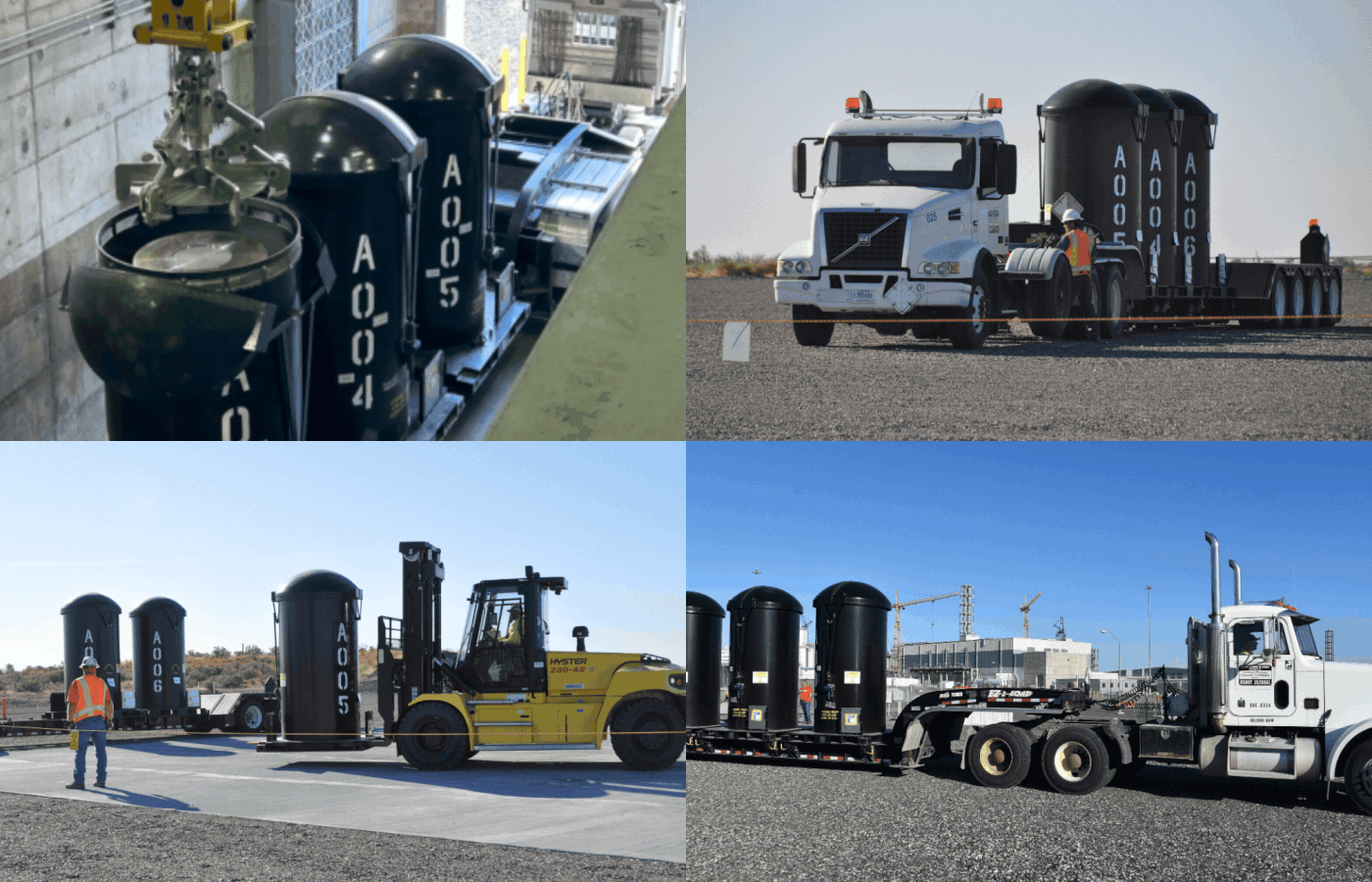 Workers recently transferred three containers of non-radioactive test glass from the Hanford Site’s Waste Treatment and Immobilization Plant to the nearby Integrated Disposal Facility.
RICHLAND, Wash. — On the heels of the Summer Olympics, two Hanford Site contractors have finished a first-time relay of test glass while preparing for a giant leap forward in the cleanup mission.
Working under the Direct-Feed Low-Activity Waste Program, the whole site is preparing to start 24/7 operations to treat radioactive waste from large underground tanks by immobilizing it in glass for safe disposal.
Workers with Bechtel National Inc. started the relay when they loaded large containers of non-radioactive test glass on a specially designed trailer at the Low-Activity Waste Facility in the Waste Treatment and Immobilization Plant (WTP). They drove it to a nearby staging area. Central Plateau Cleanup Company took the baton and drove the containers to the site’s Integrated Disposal Facility.
Mat Irwin, the U.S. Department of Energy Office of Environmental Management’s acting assistant manager for the WTP Project, noted the training runs using test glass are important qualifiers for the One Hanford team.
“Moving the containers allowed the contractors to practice the transfer process and provided the disposal facility with containers for additional training,” Irwin said. “The relays move at the deliberate and methodical pace required in our work to protect people and the environment.”
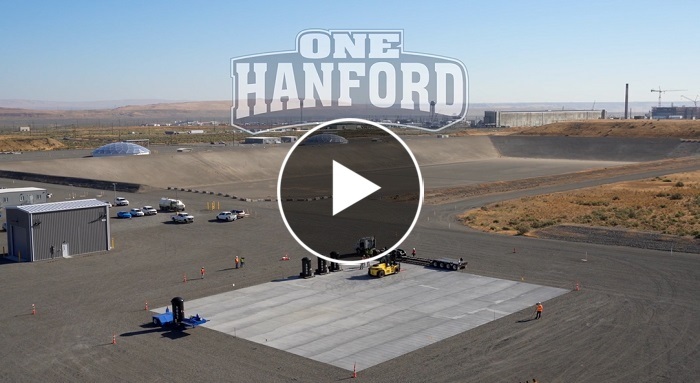 EMTV: Check out an "instant replay” of the Hanford Site's first-time relay of non-radioactive test glass.
The test glass in the containers was poured from one of the 300-ton melters in the treatment plant’s Low-Activity Waste Facility that will vitrify tank waste.
Vitrification is mixing liquid radioactive waste with glass-forming materials and heating them to 2,100 degrees in a melter. The melting incorporates the waste in the glass. The molten glass is poured into containers and allowed to solidify and cool.
After using containers of test glass for training at the disposal facility, Hanford will send them to a hazardous waste landfill in Oregon for disposal.
When operations begin vitrifying low-activity tank waste, contractors will relay more than 200,000 containers of waste immobilized in glass from the treatment plant to safe disposal in Hanford’s Integrated Disposal Facility.
Learn more about Hanford waste treatment and disposal at the Hanford Virtual Tour.
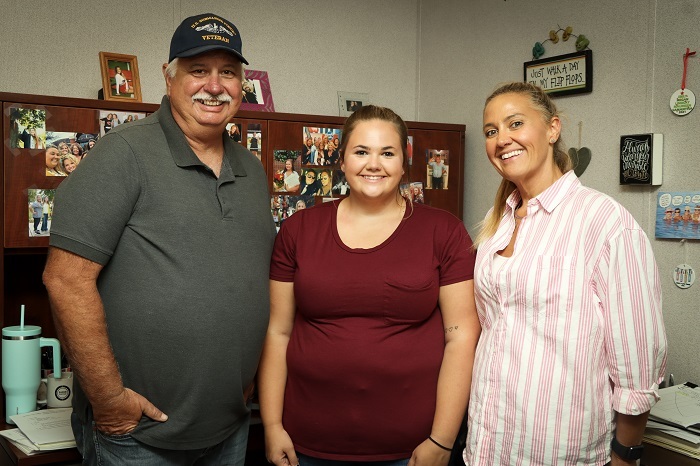 From left, Greg and Drea Tannehill and Megan Parker pose for a photograph at the Portsmouth Site. While Drea Tannehill is a third-generation employee of her family onsite, she is also a second-generation intern. Her mother, Megan Parker, started her career at Portsmouth with an internship.
PIKE COUNTY, Ohio — The U.S. Department of Energy Office of Environmental Management Portsmouth Site’s nearly 50 summer interns have a lot to share with their families about what they learned this year, but Drea Tannehill and Britton Kritzwiser can skip the history. That’s because they both are the third generation in their families to work at the site.
“You will find many family members on the Portsmouth Site, but to have three generations is unique,” said Portsmouth Site Lead Jeremy Davis. “College students seeking employment here and being interested in future development shows the importance of the site to our community.”
Greg Tannehill, Drea Tannehill’s grandfather, is a radiation protection section manager and has worked at the site for more than 30 years. Her mother, Megan Parker, is a waste characterization and disposition manager and has worked at Portsmouth for nearly two decades.
“It was great working with Drea,” said Parker. “For years she has not really understood what my career was or what we actually do onsite. Although she doesn’t work in my department, it has been impressive to see the work she has done this summer.”
Drea Tannehill enjoyed the opportunity to explore the potential of her college major with hands-on learning while getting a better understanding of her family members’ careers.
“As an integrated mathematics major, I love being able to work with numbers and math in a real-world job,” she said. “It was fun to apply the lessons I am learning in college outside of the classroom. One of the things I have realized is that there are many jobs here that include math and numbers.”
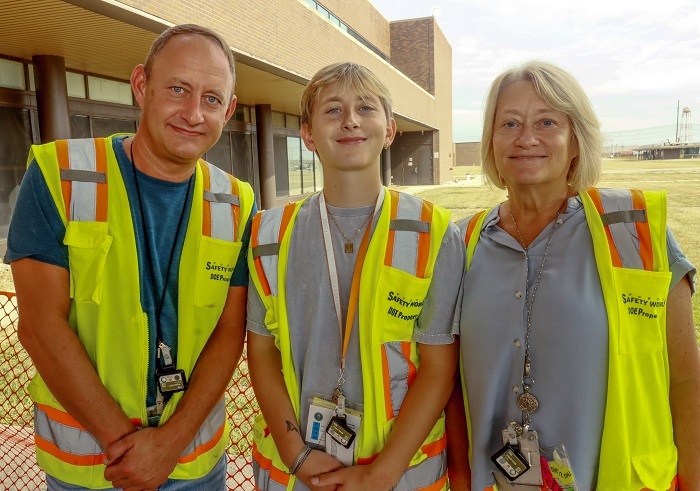 From left, Adam and Britton Kritzwiser and Anita Sheridan pose for a photograph at the Portsmouth Site. This was Britton Kritzwiser’s first year interning at Portsmouth, but not his first involvement with the site. He was a member of his high school’s team that competed in the U.S. Department of Energy South Central Ohio Regional Science Bowl and was also awarded Portsmouth cleanup contractor Fluor-BWXT Portsmouth’s S.T.E.A.M. Scholarship.
Being the third generation onsite does have its advantages. Like Drea Tannehill, Kritzwiser has grown up hearing about the site.
“It’s very fulfilling to take all the information that I have accrued over the years, and put the pieces together,” said Kritzwiser. “Along with this, having two family members employed here always gave me a unique appreciation of what the plant has given to our community.”
His father, Adam Kritzwiser, has worked as a technical writer at the site for nearly a decade and his grandmother, Anita Sheridan, a controller in finance and accounting, has worked onsite 16 years.
“Working with my son and grandson makes me appreciate them in a different way,” said Sheridan. “We carpool most days and can have work conversations we all understand. Also, it makes my day a little brighter when they stop by to say hi, pass in the hallway or stop by looking for snacks.”
“It has been a great experience,” said Adam Kritzwiser. “He has shown maturity and an enthusiasm to work. He reminds me often to wear my safety vest and grab my badge even if I already have them on and has taken our safety culture to new heights at home.”
-Contributor: Cindi Remy
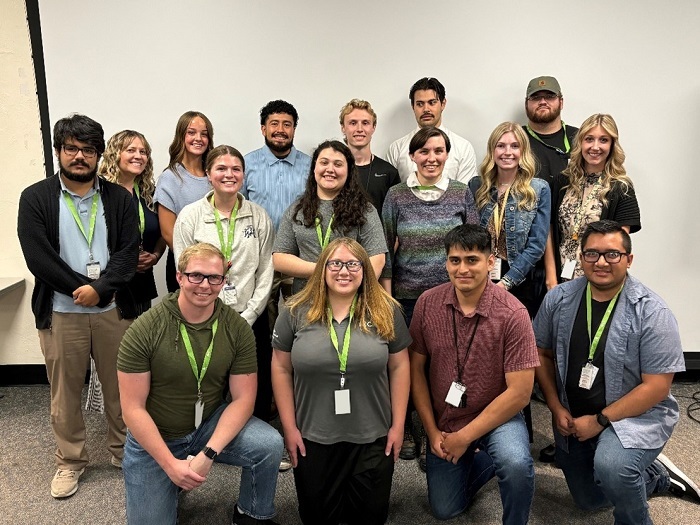 Participants in the Idaho Environmental Coalition’s Summer Intern Program present to senior directors and managers before the end of their internships. Pictured from left, back row, Hannah Fuquay, Grace Savage, Gerardo Garcia, William “Cade” Adamson, Joshua Deere, and Kolton Holt; middle row, Rafael Velasquez Vanegas, Carlie Prinster, Kylie Eaton, Eliza Jo Nims-Langlois, Jordyn Southwick, Braxton Green; and front row, Nathan Weber, Leamarie Mitchell, Cesar Reyes, and Jonathan Murillo.
IDAHO FALLS, Idaho — A group of 16 summer interns from colleges and universities throughout the United States this year joined the U.S. Department of Energy Office of Environmental Management (EM) contractor at the Idaho National Laboratory (INL) Site, supporting communications, accounting, engineering, waste management and other organizations.
The Idaho Environmental Coalition (IEC) intern program is mutually beneficial to students and the company. It gives students firsthand experience working in a variety of jobs, learning what it’s like to work in the nuclear cleanup industry. It also gives IEC supervisors and managers a chance to see if the students are a good fit for future employment needs in their departments.
Rafael Velasquez Vanegas interned with engineers working on IEC’s project to retrieve a radioactive waste known as calcine for his second summer with the company. Last summer, he proposed installing a cellular booster to increase efficiency within the former Fuel Reprocessing Restoration Facility, which was constructed in the late 1980s to reprocess spent nuclear fuel and recover unused uranium. Without a booster, service in the building is almost nonexistent, making it difficult to troubleshoot issues happening in the facility. The project liked Velasquez’s suggestion and, this summer, he helped implement the plan.
“It feels good to have worked on a project that, last year, felt a bit like busy work, but then flowered into a project with real implications. My research and proposal are being reviewed by engineers and funds are being allocated for the project,” said Velasquez. “This more traditional engineering role has helped me really improve in planning and detail. I have a much better appreciation for the minutiae that goes into any large project.”
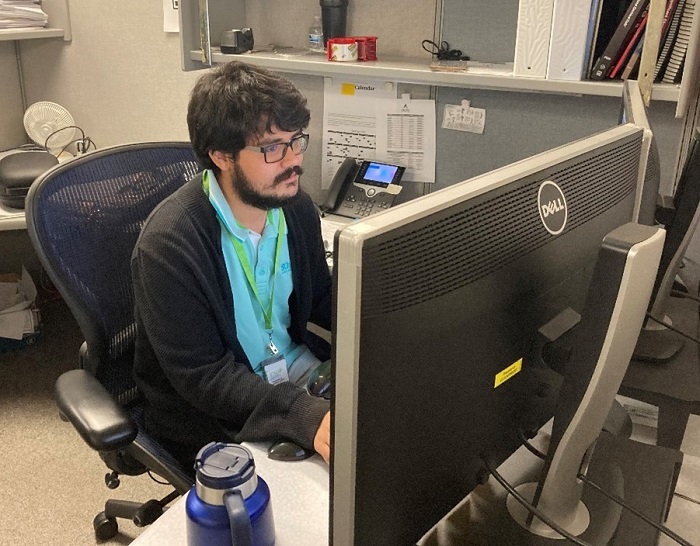 Rafael Velasquez Vanegas supported the Idaho Cleanup Program’s Calcine Project as an intern for the second summer in a row. This year, he helped oversee the implementation of an idea he had in 2023.
The intern program gives IEC supervisors and managers a chance to train the rising generations. This is crucially important for the Idaho Cleanup Project because, like many EM sites across the country, a large percentage of cleanup employees are or will be retiring in the near future. A benefit for EM sites is the chance to educate the next generation of workers on the mission needs, as well as to tap into their skillsets derived from college or university curriculums.
IEC is selective choosing interns in hopes these students become employees after completing their undergraduate or graduate degrees. Not only do departments look at resumes, letters of recommendation, cover letters and grades during interviews, but they also try to determine if the students’ skills match with the departments’ needs.
“We don’t just look for academic and industry knowledge, we also look for skills that can’t be measured on paper,” said Kimberly Davis, IEC cybersecurity specialist. “We look for such qualities as being a self-starter, a team player, a good communicator and what kind of work ethic they have.”
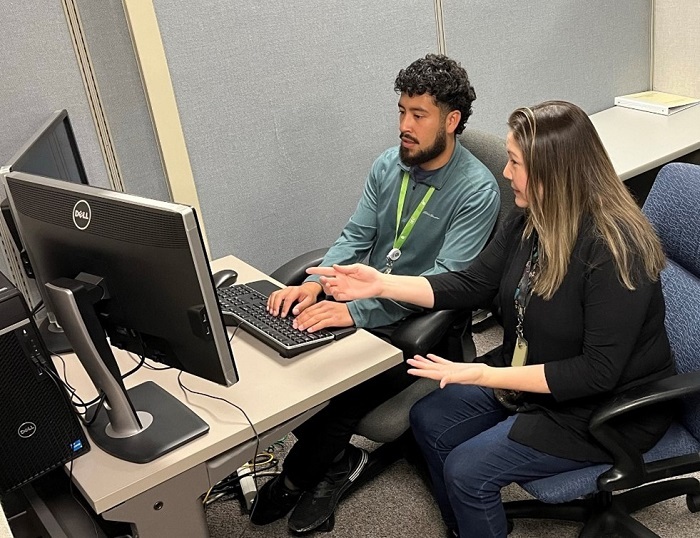 Kimberly Davis, Idaho Environmental Coalition cybersecurity specialist, mentors cybersecurity intern Gerardo Garcia.
Before the students left IEC this summer, they gave a presentation to managers and other interns on their job duties and what they learned during their internship.
“The project that taught or stretched me the most this summer was noise sampling of the work groups at INTEC,” said Carlie Prinster, an Industrial Hygiene intern, referring to the Idaho Nuclear Technology and Engineering Center. “This project entailed placing dosimeters on employees for a full day and then recording and interpreting that data. It taught me how to take good notes and helped me to improve my professional communication skills.”
Positive experiences with IEC encouraged the students to apply for future internships, and many expressed a desire to work for EM following graduation. Hannah Fuquay, who interned with IEC Training and Development, remarked on her experience this summer.
“I learned that everyone plays a part in keeping the momentum going and that everyone’s roles are important. I don’t know exactly where I will end up or what will happen career-wise after I finish my degree. However, IEC has set a pretty high standard as an employer, which makes it hard to want to go anywhere else.”
-Contributor: Leamarie Mitchell
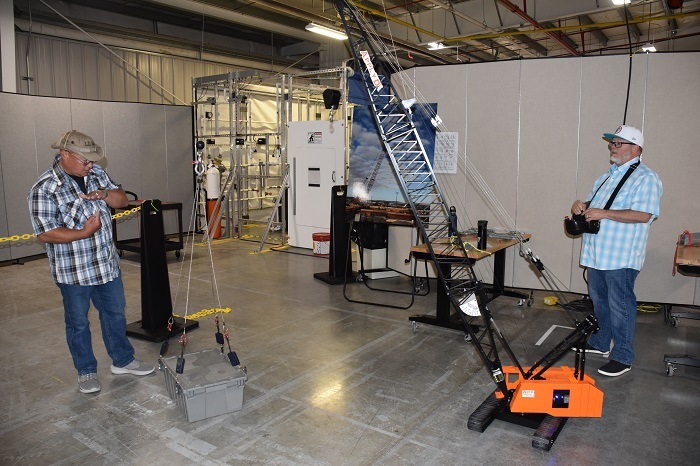 Course instructors Jon Bills, left, and Dave Hickman demonstrate hoisting and rigging techniques using a scaled-down, remote-controlled crane at the Hanford Site’s Volpentest Hazardous Materials Management and Emergency Response Federal Training Center.
RICHLAND, Wash. — Thanks to a new training tool, workers at the Hanford Site are getting hands-on experience operating cranes, just on a smaller scale.
The Volpentest Hazardous Materials Management and Emergency Response (HAMMER) Federal Training Center recently added a 1/14th scale, remote-controlled crane to its Hoisting and Rigging Training Program. Hoisting and Rigging teaches workers how to safely handle all components of a crane “under a hook.”
The course instructors operate the cranes while students alternate through four roles listed in Hanford’s sitewide hoisting and rigging manual — designated lead, rigger, signal person and tag-line holder — as the course progresses.
“Safety and risk reduction are paramount to our Hanford cleanup mission,” said Angela Stoddard, Hanford program manager. “HAMMER provides realistic training and emphasizes continuous improvement, which helps ensure our workforce continues to have the knowledge and skills to complete work safely.”
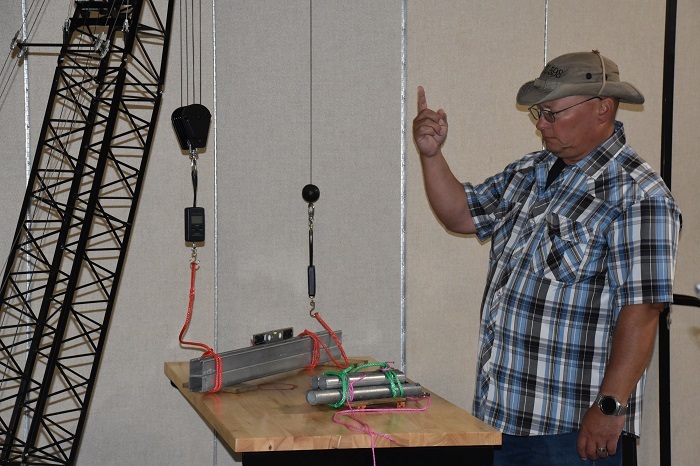 Course instructor Jon Bills demonstrates hand signals used during a lift.
Historically, instructors trained workers on safe rigging practices through lectures. This hands-on training allows workers to practice in a controlled setting, leading directly to transferable skills in the field.
“We can simulate the same situations they will encounter in the field,” said Scott Cannon, HAMMER’s activity manager for Hoisting and Rigging. “Using this crane reinforces students’ training by enabling them to practice on a smaller scale, with real rigging techniques.”
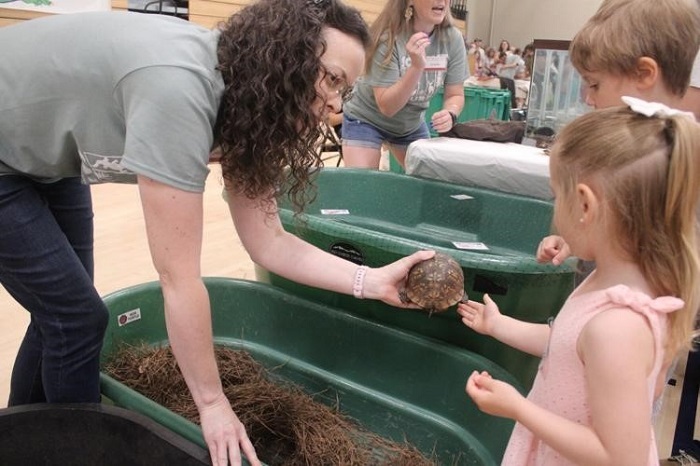 University of Georgia Savannah River Ecology Laboratory volunteer Kacee Poppy lets Adeline McDonald touch an eastern box turtle.
Annual Science Saturday event brings together more than 1,700 citizens through lab’s research
AIKEN, S.C. — The University of Georgia’s Savannah River Ecology Laboratory recently hosted its annual community engagement event, where more than 1,700 area residents engaged with research conducted by the laboratory’s researchers, staff and graduate students on the Savannah River Site (SRS).
Residents were eager to explore a wide range of the laboratory’s research, which covered radiation safety, biogeochemistry, ecosystems, wildlife and more. Highlights of the event included safely touching a rattlesnake and an alligator, observing over 40 species of vertebrates, invertebrates, and plants native to the area, and engaging with experts to ask questions about their research. The lively interactions sparked insightful discussions.
“We were pleased to again offer Science Saturday to the members of our local communities to present them the opportunity to engage with the faculty, staff and students and learn about the many interesting and impactful research activities we conduct at the laboratory,” said Olin “Gene” Rhodes, the laboratory’s director and a professor at the Odum School of Ecology. “We hope that highlighting the fantastic work that our employees and students conduct benefits our local communities, our nation and the world.”
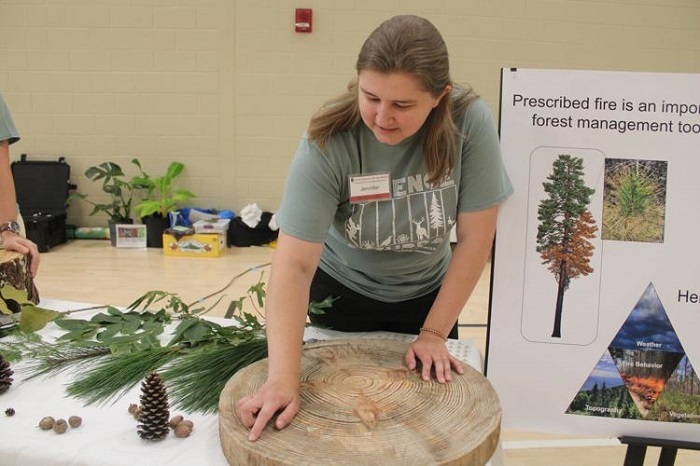 A volunteer talks about the importance of tree rings during Science Saturday.
Science Saturday is one of several free programs offered at the laboratory, continuing a longstanding tradition of community involvement and investing in future generations. Hands-on community opportunities allow students and residents to connect with the overall mission of SRS to protect the environment.
Laboratory staff can communicate with the public through the myriad of programs offered throughout the year. Some of the programs provided by the Outreach and Education team include the perennially popular Ecologist for a Day and EcoTalks programs.
Ecologist for a Day immerses students in guided field experiences where they explore the living and nonliving components of local ecosystems, inspiring them to consider careers in science, technology, engineering, and math (STEM).
EcoTalks bring nature into classrooms and afterschool programs, providing enriching educational experiences for students. These programs are important assets and boons to the community, shaping the next generation of future scientists and informing citizens about the important conservation work being completed on the SRS.
-Contributors: Katrina M. Ford, Bianca Moore
|