ARLINGTON, Va. — The U.S. Department of Energy (DOE) Office of Environmental Management (EM) will hold the 2nd Early-Career Professionals Session during the annual National Cleanup Workshop (NCW) with a goal of training and retaining its newest workforce members.
The workshop is being held Sept. 16-18 at the Crystal Gateway Marriott in Arlington. The NCW brings together senior DOE executives, officials from DOE sites, industry executives, and other key stakeholders to discuss EM’s progress in the cleanup of the environmental legacy of the nation’s Manhattan Project and Cold War era nuclear weapons program.
The Early-Career Professionals Session will take place on Monday, Sept. 16, from 12 p.m. to 4:30 p.m. and is aimed at helping attendees learn more about EM and how to grow and succeed in the DOE cleanup program.
This will be the 10th consecutive year that EM hosts the NCW in cooperation with Energy Communities Alliance and Energy Facility Contractors Group. Workshop organizers are offering a reduced registration for early-career professionals who have not previously attended the workshop and have only been involved in the EM program for less than five years. This rate includes admission to the NCW.
Last year, over 100 people attended the first-ever session to hear from leaders in EM and how they achieved their goals within the DOE cleanup program.
This year’s session attendees can expect to hear from EM Senior Advisor Candice Robertson and participate in roundtable discussions and networking opportunities, all focused on helping them grow professionally.
“Retaining the newest members of our workforce is a key component in executing our future mission. This event will help participants learn more about our fascinating mission and gain tools to build their professional network,” said Kristen Ellis, EM associate principal deputy assistant secretary for regulatory and policy affairs.
This year, U.S. Energy Secretary Jennifer Granholm is set to provide the keynote address for the conference and Robertson is set to give opening remarks, highlighting EM progress and current priorities.
-Contributor: Ryan Vanecek
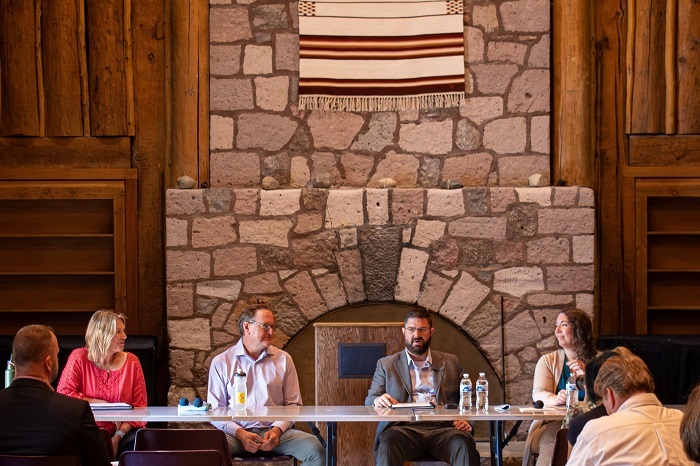 On Panel 2, “Future of Tech and Opportunities in Northern New Mexico,” U.S. Department of Energy Office of Environmental Management Principal Deputy Assistant Secretary Jeff Avery, second from right, moderates a discussion on the interconnectedness of community, environment and innovative technology. Pictured from left at the table: National Nuclear Security Administration Los Alamos Field Office Business, Security, and Mission Deputy Manager Stephanie Stringer, Los Alamos National Laboratory Entrepreneurship for Mission Innovation Program Director Duncan McBranch, Avery and Environmental Management Los Alamos Field Office Manager Jessica Kunkle.
LOS ALAMOS, N.M. — The U.S. Department of Energy (DOE) and its contractors are working hard to foster science, technology, engineering and math (STEM) focused jobs in Northern New Mexico, DOE Office of Environmental Management (EM) and industry representatives said here recently.
DOE and industry representatives participated in a series of panels on STEM-related issues at this year’s Los Alamos ScienceFest. EM Principal Deputy Assistant Secretary Jeff Avery underscored the significant role of STEM in EM’s mission that drives continuous improvement and efficient remediation strategies essential for addressing legacy waste in Los Alamos and across the nation.
“STEM is fundamental to our work in the environmental cleanup program and crosses all of our mission areas,” Avery said. "Our partnerships with communities to foster STEM programs, and our efforts to develop and sustain a cadre of STEM professionals, are vital to the future of our mission.”
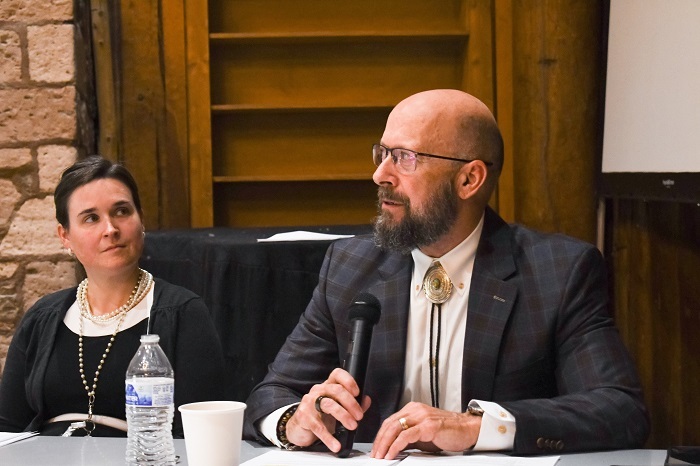 On Panel 1, “Growing STEM in Northern New Mexico Communities,” Newport News Nuclear BWXT Los Alamos President and General Manager Brad Smith, right, talks on his personal experiences that led him into the field of science, technology, engineering and math and emphasizes the importance that one does not need to start in a STEM position to end up in one. Environmental Management Los Alamos Field Office Deputy Manager Ellie Gilbertson, left, shared her perspective on teaching STEM prior to her career with DOE.
Brad Smith, president and general manager of Newport News Nuclear BWXT Los Alamos (N3B), the legacy cleanup contractor at Los Alamos National Laboratory (LANL), discussed the variety of workforce development programs N3B has established. These include scholarships for students at Northern New Mexico College and the University of New Mexico-Los Alamos (UNM-Los Alamos), apprenticeship programs at Northern New Mexico College and “bootcamps” for nuclear waste operators and radiation control technicians in partnership with UNM-Los Alamos. An advantage of the apprenticeship and bootcamp programs is both provide an opportunity for full-time employment with N3B.
Working at a cleanup site like Los Alamos isn’t just about a paycheck, according to Smith.
“The LANL legacy cleanup mission creates opportunities to do impactful work for our environment that is meaningful today and for generations to come. We provide jobs with competitive pay and benefits, skills training and growth opportunities. That means you can help protect this region while having a good paying job. That’s a win-win,” he said.
This year’s ScienceFest also included panels titled, "Future of Tech and Opportunities in Northern New Mexico," and "STEM in Schools." These panels involved industry, community, and pueblo leaders, the DOE Environmental Management Los Alamos Field Office (EM-LA), the National Nuclear Security Administration (NNSA) Los Alamos Field Office, LANL, Los Alamos County, and Pueblo de San Ildefonso, emphasizing the critical role of STEM education and opportunities in Northern New Mexico.
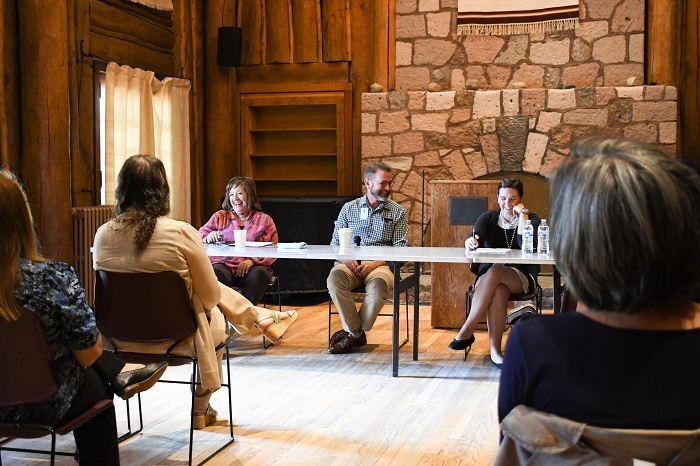 On Panel 3, “STEM in Schools,” University of New Mexico-Taos HIVE Executive Director Rose Reza, left, Los Alamos Public Schools Assistant Superintendent Carter Payne, center, and Environmental Management Los Alamos Field Office Deputy Manager Ellie Gilbertson discuss the importance of providing opportunities for students both in and out of school for science, technology, engineering and math.
During the “Future of Tech and Opportunities in Northern New Mexico” panel, EM-LA Manager Jessica Kunkle highlighted a new technology being used in legacy cleanup efforts at LANL. The technology was conceptualized at one of Savannah River National Laboratory’s partner universities, Georgia Institute of Technology.
"EM-LA has been working with LANL and NNSA contractor Triad on a new radiological inspection technology called Integrated Ground-based Autonomous Agent for Radiological Tracking for field testing at active sites at LANL. While working autonomously or by remote control, the robot detects radiological contamination using a location system and sophisticated sensors," said Kunkle.
The ScienceFest panels not only provided valuable insights into the future of technology and education in Northern New Mexico but also underscored the collaborative efforts essential for advancing STEM initiatives within the region.
In closing, Avery shared advice for consideration.
"If you are considering a STEM career, don’t be intimidated by the subject matter. You don't have to be an A-plus student, taking AP classes or be in the national honor society,” he said. “There are many different pathways and timelines to a successful STEM career. All you need is a little passion, knowledge and hard work to be successful."
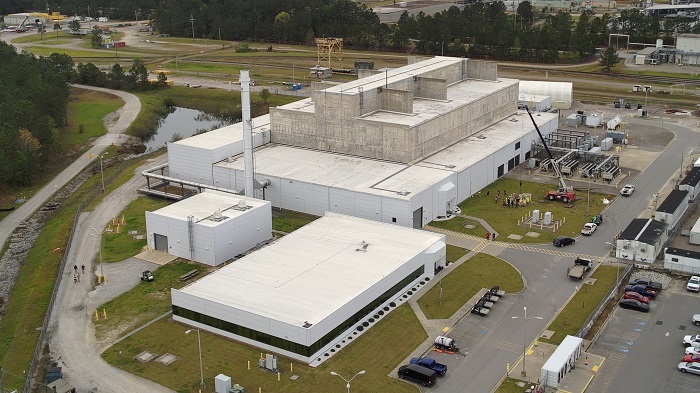 An aerial view of the Salt Waste Processing Facility at the Savannah River Site.
AIKEN, S.C. — A team of federal contractor and national laboratory engineers and scientists from the U.S. Department of Energy (DOE) Office of Environmental Management (EM) has been nationally distinguished as “Heroes of Chemistry” for making the world better through their effort, ingenuity, creativity and perseverance.
The American Chemical Society (ACS) recognized a team of seven individuals, representing Savannah River Mission Completion (SRMC), Savannah River National Laboratory (SRNL), Argonne National Laboratory (ANL), Oak Ridge National Laboratory (ORNL), and DOE, for the integrated effort in developing and deploying a first-of-a-kind separations chemistry that is remediating millions of gallons of radioactive waste through EM’s Salt Waste Processing Facility (SWPF) at the Savannah River Site (SRS). SRMC is EM’s liquid waste contractor at SRS.
The winning team includes SRMC Vice President and Chief Engineer Tom Burns, SRMC Nuclear Safety Officer and Engineering Integration Director Cliff Conner, former SRNL Actinide and Separations Sciences Director Samuel Fink, former SRNL Senior Advisory Scientist David Hobbs, SRMC Technical Advisor Manager Ryan Lentsch, the late ANL Engineer Ralph Leonard, ORNL Corporate Fellow Bruce Moyer, and former DOE-Savannah River Salt Processing Senior Program Manager Patricia Suggs.
The ACS Heroes of Chemistry award recognizes the role of industrial chemical scientists and their companies in developing successful commercialized products embedded with chemistry for the benefit of humankind.
From first-of-its-kind flowsheet development to selection and deployment of a novel chemical process, the winning team members contributed both leadership and technical expertise leading to the long-term success and innovative science behind the SWPF project.
“The successful process reflects what is certainly one of the most successful teaming efforts between national laboratories and industrial contractors, enabling the Department of Energy to complete the safe disposal of wastes that date from the 1950s through the present-day operations. So many researchers and engineers from such a variety of partners contributed to the success,” said Fink.
Approximately 33 million gallons of radioactive waste remains at SRS as a by-product of Cold War-era weapons production, space exploration and scientific experimentation. It is stored in two tank farms.
Because of the ingenuity of these award recipients, SWPF is successfully operating as the key facility treating the remaining tank waste at SRS.
SWPF separates and concentrates the highly radioactive portion of the tank waste — mostly cesium, strontium and actinides — from the less radioactive salt solution. After the separation process is completed, the concentrated, high radioactive waste is sent to the nearby Defense Waste Processing Facility to be immobilized in glass and stored in stainless steel canisters onsite until a federal repository is established.
This winning team has few peers in developing novel nuclear chemical processes at a test-tube scale and then implementing those processes successfully at full scale in a nuclear facility, according to Burns.
“It is an incredible honor to be presented the Heroes of Chemistry award from the American Chemical Society,” Burns said. “The award winners have given decades of dedication to the discovery, development and deployment of the Salt Waste Processing Facility separations chemistry, a process that is benefitting the health, environment and safety of humanity.”
SRNL played a vital role in the development and deployment of the technology from the inception of the combined technologies. In addition to coordinating research with the partner national laboratories and universities, SRNL led development of the technologies for removing strontium and the actinides as well as maturing the engineering scale filtration steps.
Hobbs acknowledged the efforts of his colleagues at SRNL as well as the many collaborators at universities, national laboratories and industrial partners that contributed mightily to the successful development of the strontium and actinide separation process.
The lynchpin to the success was the groundbreaking solvent extract chemistry developed at ORNL.
With support from DOE’s Basic Energy Sciences and EM programs, ORNL’s Moyer led the chemical development of the cesium extraction process starting from fundamental principles in solvent extraction. In 2008, the matured process began to operate at pilot scale at SRS to remove cesium from millions of gallons of legacy nuclear waste. It won the Secretary of Energy’s Award in 2013.
“I’m honored to be among the American Chemical Society awardees who have made a major contribution to mitigating nuclear waste,” said Moyer. “The awesome teamwork underlying this success from science to implementation shows DOE at its best."
-Contributors: Colleen Hart, Dawn Levy, Scott Shaw
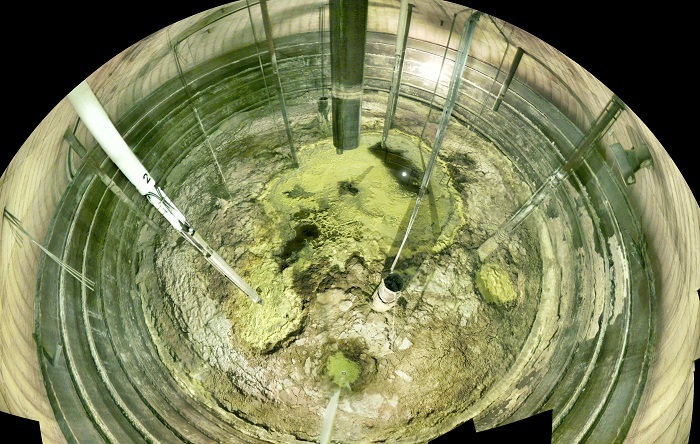 A June 2024 photo shows solid waste inside single-shell Tank A-101 in the Hanford Site’s A Tank Farm.
RICHLAND, Wash. — The Hanford Site continues to reduce environmental risk as crews start retrieval operations of radioactive and chemical waste from a third set of underground storage tanks.
U.S. Department of Energy Office of Environmental Management (EM) contractor Washington River Protection Solutions (WRPS) will retrieve and transfer more than 325,000 gallons of waste from single-shell Tank A-101 in Hanford’s A Tank Farm. Workers will send the waste to a newer, double-shell tank for continued safe storage.
The start of retrieval activities in the tank farm comes one month after workers emptied the site’s 21st single-shell tank. Waste removed from the 21 tanks totals approximately 3 million gallons.
“Despite this work being some of the most challenging and complex in EM’s mission to clean up sites across the country, Hanford teams have proven proficient in safely retrieving waste while preparing for future retrieval,” said Delmar Noyes, Hanford assistant manager for Tank Waste Operations.
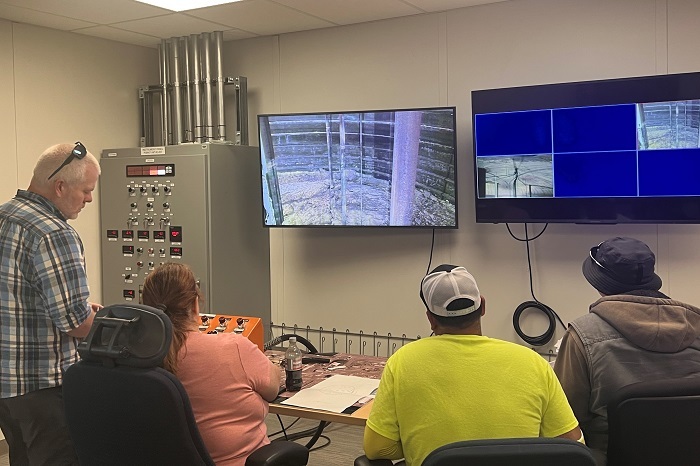 Waste retrievals team members and engineers with U.S. Department of Energy Office of Environmental Management contractor Washington River Protection Solutions recently inspected Tank A-101 and its equipment from inside a control room, in preparation for removing waste from the tank.
The six tanks in A Tank Farm were built in the mid-1950s with a carbon-steel liner surrounded by a layer of thick, steel-reinforced concrete. They were used to store the radioactive and chemical by-products of plutonium processing for the country’s nuclear weapons program.
The waste in Tank A-101 is primarily salt-based, solid waste. It will be broken down using pressurized water directed through robotic equipment, then pumped out and transferred to a newer tank.
Initiating retrieval in Tank A-101 culminates years of preparation that included removing outdated equipment and installing a retrieval system and associated infrastructure. During retrieval, workers will operate the equipment remotely from a nearby control trailer.
“Our retrievals team has extensive waste-removal experience from previous projects,” said Peggy Hamilton, WRPS retrievals manager. “The A Tank Farm will bring new challenges, but I know the team will handle them well as they continue to advance the Hanford cleanup mission.”
Tank A-101 retrieval operations could take approximately 1 ½ years due to the volume of waste to be retrieved and the need to integrate with other operating facilities.
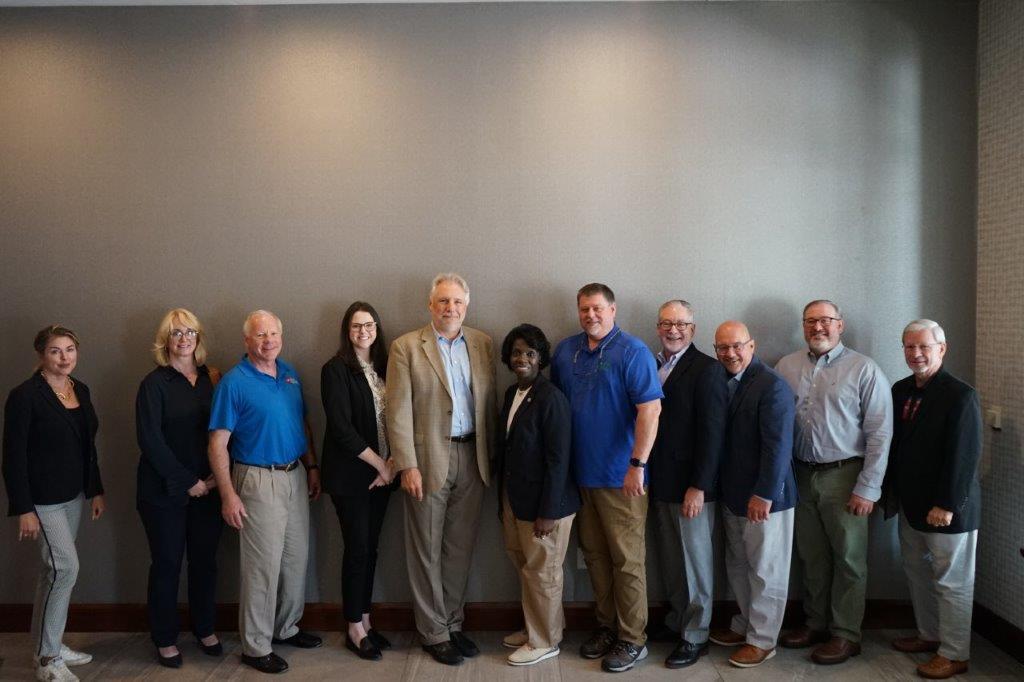 Management representatives from the Oak Ridge Office of Environmental Management (OREM), U.S. Environmental Protection Agency, Tennessee Department of Environment and Conservation, and OREM contractor UCOR serve on a leadership team that sets programmatic goals for the cleanup mission. They gathered for a meeting in Chattanooga, Tennessee, recently to discuss how to maintain cleanup momentum in Oak Ridge.
OAK RIDGE, Tenn. – Leadership from the U.S. Department of Energy (DOE) Oak Ridge Office of Environmental Management (OREM), U.S. Environmental Protection Agency (EPA), Tennessee Department of Environment and Conservation (TDEC) and cleanup contractor UCOR recently gathered for a meeting in Chattanooga, Tennessee, where continued partnership was one of the key topics of the day.
Nearly five years ago, the organizations signed a regulatory partnership framework designed to avoid delays, resolve technical issues and aid decision-making and approvals needed to conduct cleanup operations in Oak Ridge.
“We determined we needed a process that allowed us to be more efficient, and we put that in place,” said Jeaneanne Gettle, EPA Region 4 acting administrator. “As a result, we’ve seen an increase in collaboration and the ability to find effective solutions where we have differences of opinion initially. We have a way to elevate issues that are particularly critical and get resolution.”
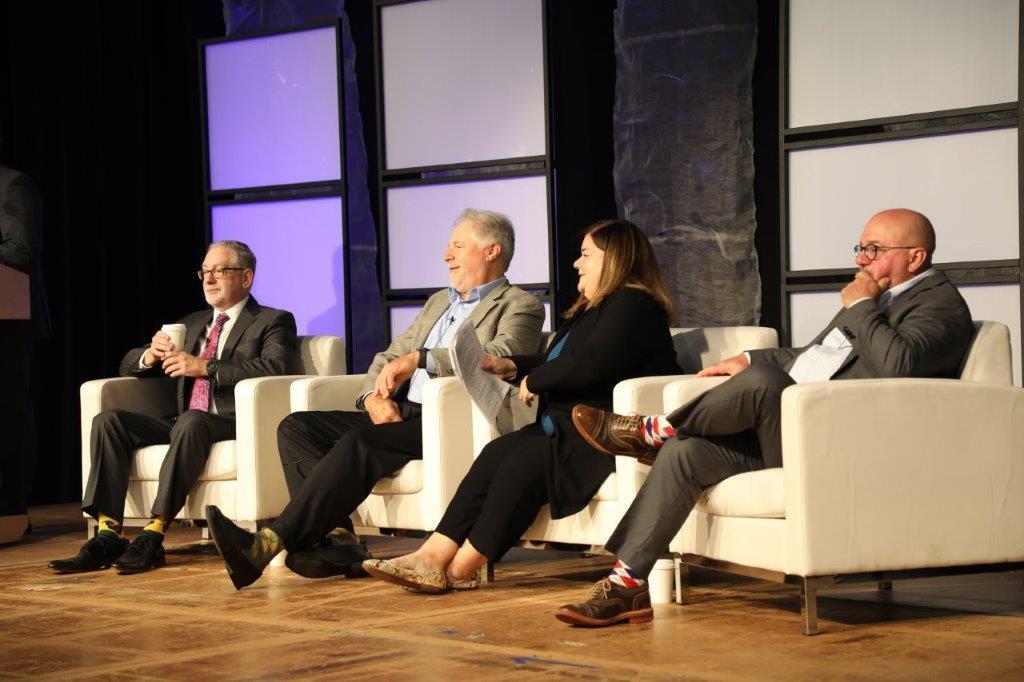 Pictured from left: Oak Ridge Office of Environmental Management Manager Jay Mullis, UCOR President and CEO Ken Rueter, U.S. Environmental Protection Agency Region 4 Acting Administrator Jeaneanne Gettle and Tennessee Department of Environment and Conservation Commissioner David Salyers share insights and perspective in a panel at the Tennessee Environmental Network Show of the South.
Since implementing that process, OREM’s cleanup accounts for 24% of all completed cleanup tasks at federal sites nationwide. That number also equates to 49% of all completed cleanup tasks in EPA’s Region 4, which includes most of the southeastern U.S.
"Nobody is accomplishing across the board what’s happening in Oak Ridge,” said Jay Mullis, OREM manager. “That involves everything from getting cleanup done to brownfield and reindustrialization development, support from the community, and engagement with the regulators. You don’t see that anywhere else.”
The strengthened partnerships are resulting in tangible results and crucial decisions that are allowing OREM to finish cleanup at the East Tennessee Technology Park (ETTP) and continue meaningful progress at the Y-12 National Security Complex (Y-12) and Oak Ridge National Laboratory (ORNL).
One of the most impactful successes from the partnership framework is the approval of three records of decision over the past two years.
One decision, signed in 2022, allowed field work to begin on the Environmental Management Disposal Facility. The facility will provide the waste disposal capacity needed to complete cleanup at Y-12 and ORNL.
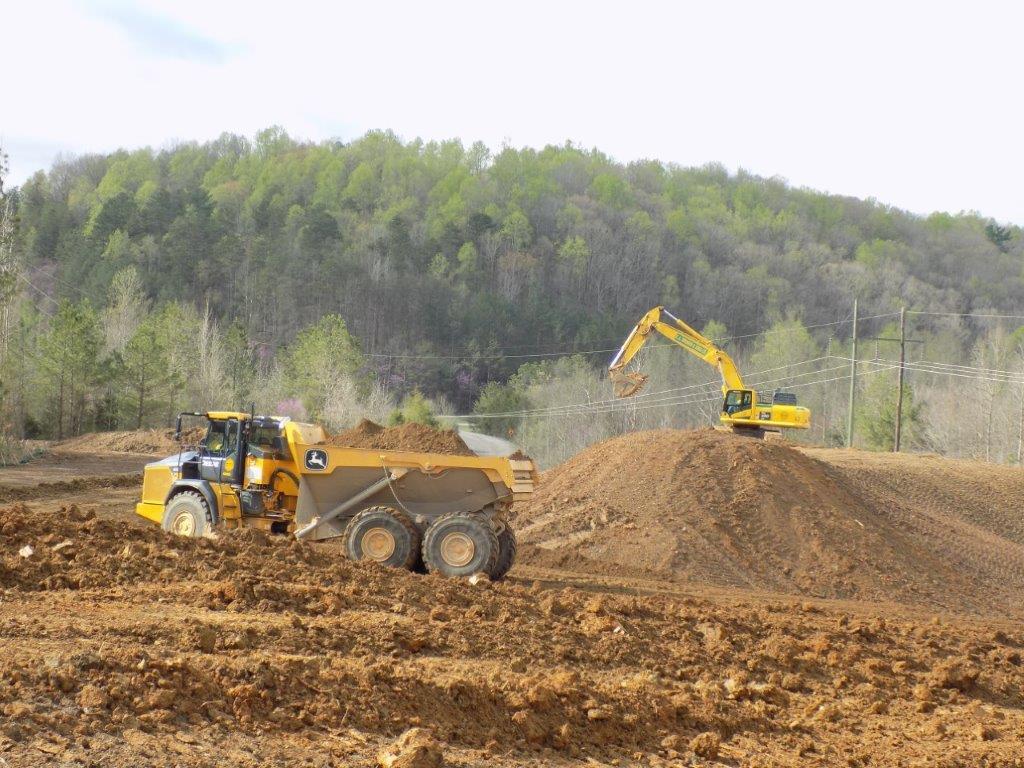 A regulatory partnership framework is helping key Oak Ridge Office of Environmental Management projects move forward, such as the Environmental Management Disposal Facility. Regulators signed a record of decision for the facility in 2022 that enabled field work to get underway.
Two other decisions, signed this spring, provide guidance on the approved remediation methods to address contaminated groundwater at ETTP. That work marks the final phase of cleanup at the former uranium enrichment complex as OREM works to complete its mission at the site and transfer all remaining parcels to the community for beneficial reuse.
These mounting successes have validated the revised approach developed in 2020, and now each organization is working to identify areas for continued improvement to maintain that momentum in the years ahead.
-Contributor: Ben Williams
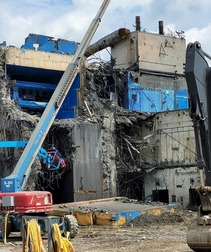
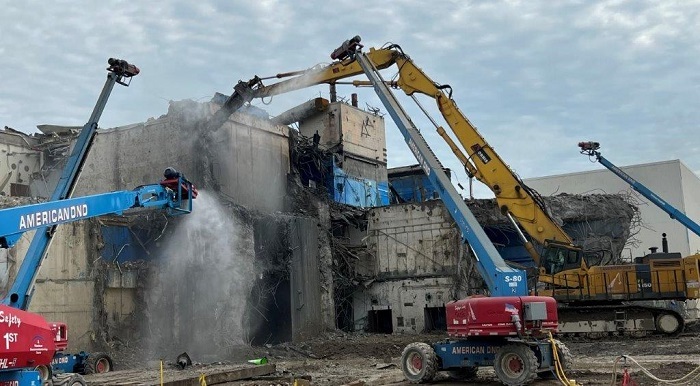 Using an excavator with a hydraulic claw, an operator at the West Valley Demonstration Project removes the Chemical Process Cell Crane Room bridge crane as workers spray water to control dust.
WEST VALLEY, N.Y. — Crews with the U.S. Department of Energy Office of Environmental Management (EM) recently removed a large steel bridge crane from the Chemical Process Cell Crane Room as part of the ongoing demolition of the Main Plant Process Building at the West Valley Demonstration Project (WVDP).
Workers with cleanup contractor CH2M HILL BWXT West Valley (CHBWV) used heavy equipment to safely pull the crane from the former nuclear reprocessing cell and lower it to the ground for packaging.
EM West Valley Project Management Assistant Director Stephen Bousquet commended the team for its work.
“The CH2M HILL BWXT West Valley team used lessons learned to safely remove this large piece of equipment, while reducing employee exposure to job-related hazards. They put their collective knowledge into practice. Their safe and compliant removal of the crane is another important step in the ongoing demolition of the Main Plant,” said Bousquet.
 |
|
The bridge crane is safely placed on the ground at the West Valley Demonstration Project, where it will be reduced in size, packaged and shipped offsite for disposal. |
The crane was equipped with one 13-ton hoist; two 2-ton hoists; and a power-actuated robotic arm for remote work. It was used inside the Chemical Process Cell during fuel reprocessing operations. After work was completed in that cell, the crane was moved to the Crane Room to prevent contamination, a move that also shields workers from a high-dose area to perform maintenance in a low-dose area.
CHBWV President Jason Casper said his employees continue to perform work in a controlled and deliberate manner to ensure safety.
“This and other work at the West Valley Demonstration Project only happens because of the skills and commitment of our employees to complete work in a safe and compliant manner,” said Casper. “This work, safely performed, benefits the ongoing cleanup mission at West Valley and in the complex.”
The bridge crane will be reduced in size, packaged and shipped offsite for disposal.
-Contributor: Joseph Pillittere
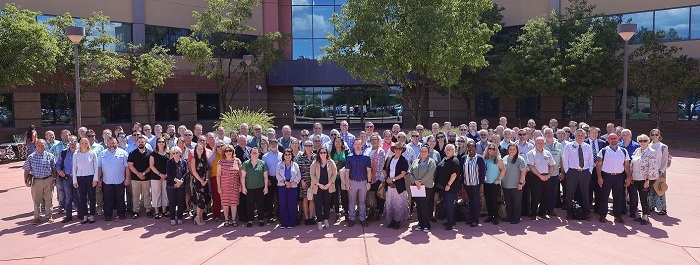 Participants in the recent three-day National TRU Program User’s Group Summit gather for a photo.
ALBUQUERQUE, N.M. — The U.S. Department of Energy Office of Environmental Management’s (EM) Carlsbad Field Office (CBFO) held a three-day National TRU Program (NTP) User’s Group Summit at the National Indian Programs Training Center in Albuquerque.
EM Waste Isolation Pilot Plant (WIPP) team members, along with CBFO staff, Navarro, WIPP management and operations contractor Salado Isolation Mining Company (SIMCO) and Local Access and Transport Area, gathered with top leaders from DOE sites that produce WIPP-destined transuranic (TRU) waste. The purpose of the annual NTP User’s Group meetings is to allow an opportunity for colleagues to participate in focused sharing sessions on best practices and lessons learned to continuously improve how the NTP delivers DOE’s national cleanup mission.
CBFO and SIMCO staff met with individual sites to address their needs and discuss actions to keep shipments flowing to WIPP, among other topics like purchasing materials, the future of the remote-handled waste program and evolving security needs. Discussions also took place to include changes to the site permit and future revisions to the waste acceptance criteria and documented safety analysis documents.
The meeting was well attended with about 100 participants, all part of a dynamic mix of presentations, break-out meetings and networking activities. Southeast New Mexico Community College also presented its programs showcasing Carlsbad’s increased capacity to develop workforce needs for WIPP and the community.
The second day of the summit culminated with an evening reception hosted by the Greater Albuquerque Chamber of Commerce at the Smithsonian- affiliated National Museum of Nuclear Science & History, where WIPP has a large public exhibit. Participants described it as a successful and collaborative meeting.
EM established the NTP to oversee the process of preparing TRU waste from waste generator sites. WIPP provides guidance on the requirements of characterizing and packaging the waste at generator sites, followed by safely transporting the waste to the WIPP facility for emplacement.
|