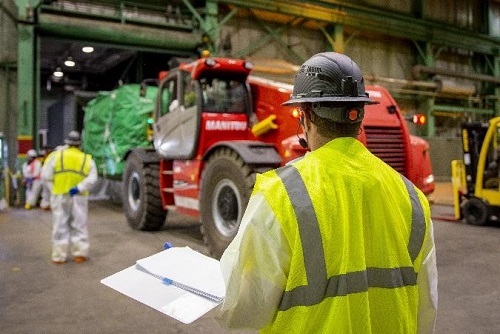
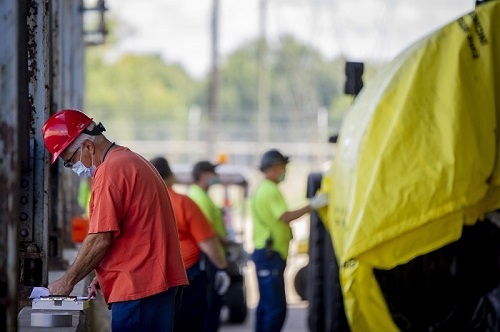
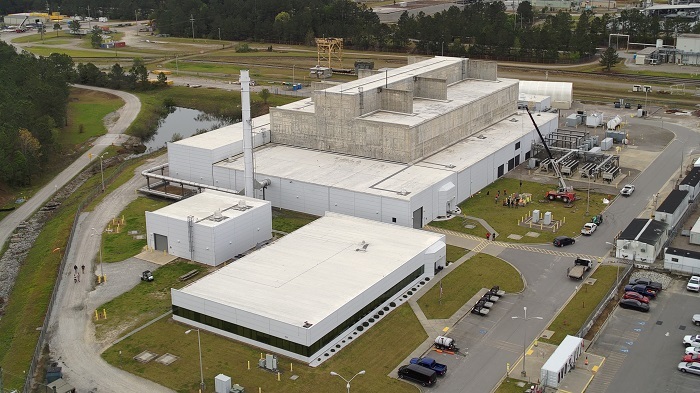
IDAHO FALLS, Idaho – Sixteen years after EM broke ground for the Integrated Waste Treatment Unit (IWTU), the first-of-a-kind facility began treating radioactive liquid waste from underground tanks at the Idaho National Laboratory (INL) Site on the afternoon of Tuesday, April 11.
It was a bittersweet moment for the operators, engineers and other staff members, some of whom have been with the project since its inception.
At 2:30 p.m., the IWTU began treating a blend that was 10% sodium-bearing waste and 90% non-radioactive simulated waste, or simulant. Operators filled the first canister of treated waste at 4:35 a.m. the following morning. During the night, feed nozzles clogged intermittently — an anticipated challenge — but have since been cleared according to operating procedures.
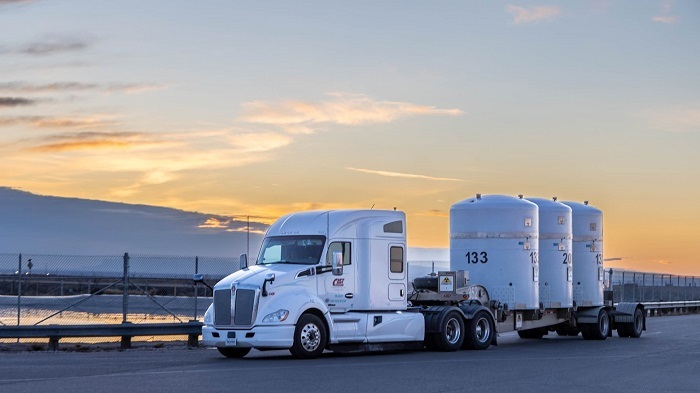
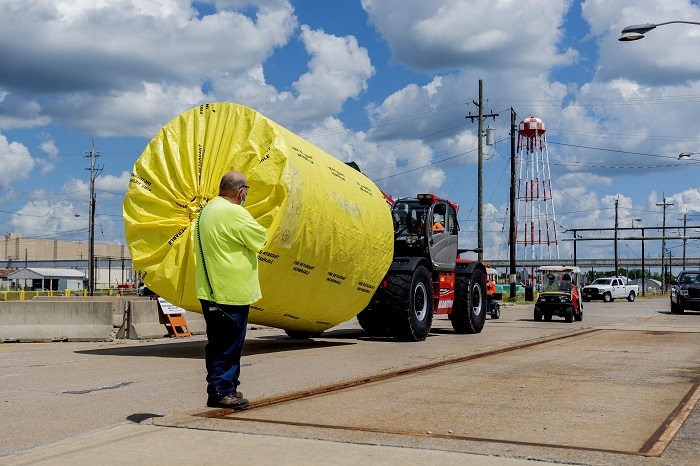
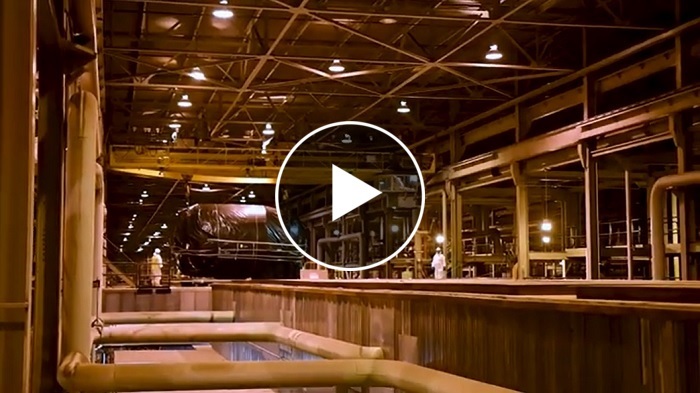
IWTU was constructed between 2007 and 2011 to convert 900,000 gallons of radioactive liquid waste from the tanks at the Idaho Nuclear Technology and Engineering Center (INTEC) to a granular solid resembling coarse sand using steam-reforming technology. The IWTU facility underwent testing, modifications and several simulant test runs in subsequent years in the run-up to radiological operations.
Staff supporting the project remained committed to the mission regardless of the plant’s past technical challenges, which have since been resolved.
“The level of dedication of this staff at both IWTU and INTEC is among the best I’ve witnessed in my 35-plus years in the nuclear industry,” said Bill Kirby, Idaho Environmental Coalition senior director of liquid waste and fuels. “I want to personally thank everyone associated with this project for getting us to this critical point of radiological operations. There will be challenges to come, but I’m confident we have some of the best qualified nuclear facility staff in the DOE complex to resolve those challenges.”
IWTU Nuclear Startup and Operations Director Jimmy Spells, who has been with the project almost exclusively since 2011, was equally appreciative of his team members.
“I was so happy for our employees when we started treating sodium-bearing waste,” he said. “This was the reward that many people deserved for their years of dedicated service to this facility.”
 |
|
Integrated Waste Treatment Unit project engineer Allyson Ferry is pictured in the control room of the treatment facility at the Idaho National Laboratory Site. |
Engineer Allyson Ferry, who joined IWTU staff shortly out of college in 2017, said the startup at first was a little stressful but also rewarding.
“It was really exciting,” she said. “It was nerve-wracking for a bit because everyone was holding their breath, but when we saw it was working, there was a collective sigh of relief and then it was like a normal day.”
Ferry’s first role at the IWTU was to improve the fluidization of billions of tiny beads in the facility’s primary reaction vessel. She helped develop a new system that better fluidizes the beads, which are necessary to convert a liquid waste into a solid under the right temperatures and pressure.
Later, Ferry served on a team to resolve challenges with the process gas filter, which removes fine solids from gases generated in the primary reaction vessel.
“It was a full-circle moment,” she said while monitoring the processes she helped to fix. “It was really rewarding. To see the hard work pay off was a neat experience.”
-Contributor: Erik Simpson
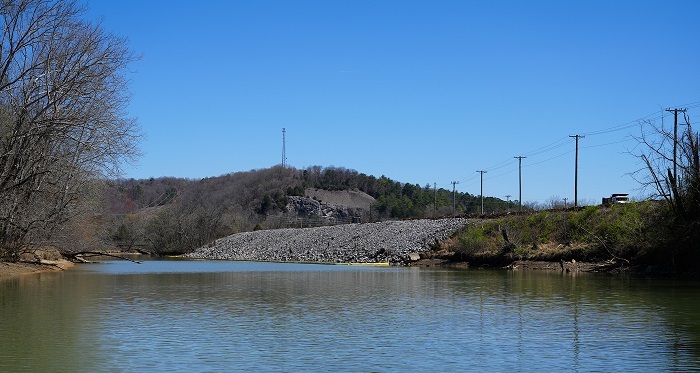 A view of the Poplar Creek shoreline area where crews have finished removing transite material and placing riprap to prevent erosion until vegetation is reestablished.
OAK RIDGE, Tenn. – The Oak Ridge Office of Environmental Management (OREM) and contractor UCOR are in the final stages of cleanup at the East Tennessee Technology Park (ETTP).
With all buildings down, crews are focused on soil remediation and other projects to enable the transfer of ETTP land back to the community.
The latest effort is happening on the banks of Poplar Creek, which winds through the 2,200-acre ETTP site. Workers have removed 200,000 pounds of transite material from the creek bank — another major step forward for the cleanup.
Transite is a type of manufactured material used in the construction of facilities during the early days of operations at the site during the Manhattan Project and Cold War.
“This material was disposed of on the creek bank many years ago,” UCOR Project Manager Don Gagel said. “Our goal was to remove all visible transite as part of a remedial action in that section of ETTP.”
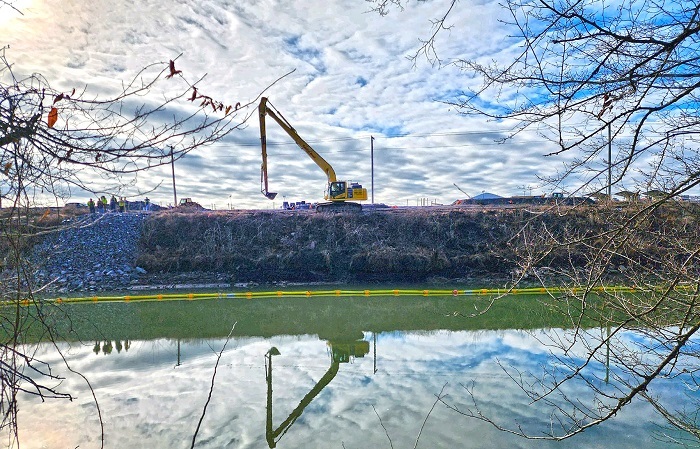 In a recent Oak Ridge Office of Environmental Management project, workers removed 200,000 pounds of transite material along a 400-foot section of the Poplar Creek bank.
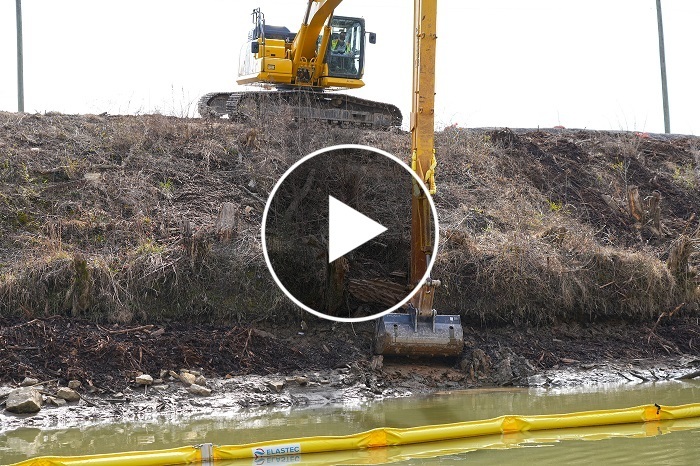 Watch this video to see crews removing transite from a portion of the Poplar Creek bank.
Workers began by clearing vegetation around the site to allow access. Next, they removed transite from a 400-foot section of the bank area. Crews then covered the bank with riprap to prevent erosion until the vegetation is reestablished.
UCOR also recently completed a project on another section of the creek bank, where crews reached the area to perform cleanup from a floating platform.
Additional cleanup of other sections of the creek will take place in coming months as OREM and UCOR work to complete all soil remediation at ETTP next year.
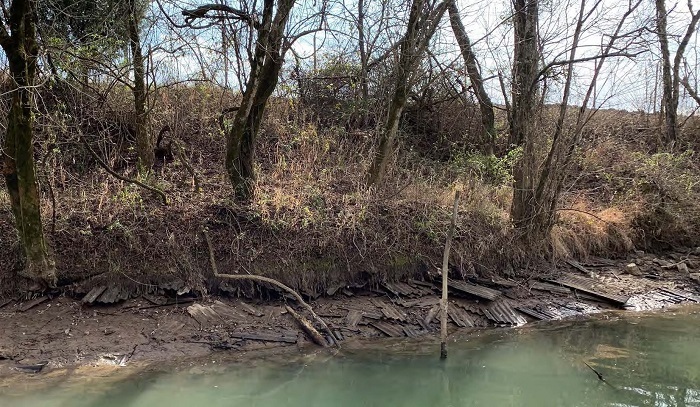 Transite material was disposed of along Poplar Creek in decades past. The manufactured material was used to construct facilities in the early days of operations at the site during the Manhattan Project and Cold War.
Together these projects are moving the site closer to EM’s ultimate vision as a multi-use industrial center, historical park and conservation area.
ETTP is currently home to 25 businesses, with more expected to locate at the site in the near future. The K-25 History Center, adjacent to a Manhattan Project National Historical Park area, has attracted nearly 15,000 visitors from across the nation so far this year.
Also, OREM and UCOR have partnered with the state of Tennessee to enhance conservation and recreation opportunities at the site. One proposed idea is the creation of a blueway to allow visitors to canoe and kayak through the area’s waterways. Blueways are marked routes on navigable waterways such as creeks, rivers, lakes and canals for recreational use.
-Contributor: Wayne McKinney
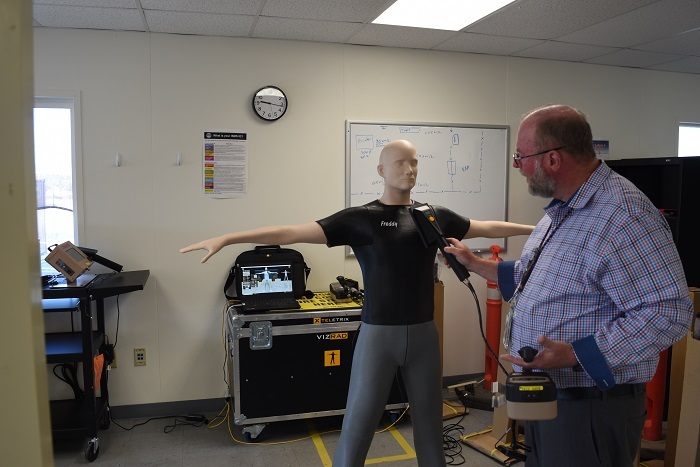 Waste Treatment and Immobilization Plant Radiological Engineer Steven Goodrich demonstrates contamination screening using the VIZRAD Frisk simulator.
RICHLAND, Wash. – An innovative radiological control simulator plays a key role in the training process for technicians at the Hanford Site’s Waste Treatment and Immobilization Plant (WTP). Called VIZRAD Frisk, the simulator allows technicians to get experience screening for contamination.
“Implementing new technologies to enhance training is just one of the many ways WTP staff members are improving operational culture,” said Tom Fletcher, EM federal project director for WTP. “Their constant innovation shows their dedication to the mission and adapting to technical challenges.”
VIZRAD Frisk allows instructors to virtually “paint” simulated contamination onto a life-sized mannequin using a laptop. Technicians then practice their screening techniques on the mannequins using VIZRAD’s specially designed probe. The probe detects signals transmitted by sensors in the mannequin and provides visual readings and audible cues when it detects an area of virtual contamination. The sensors also track the probe’s location, speed and distance, allowing instructors to ensure that technicians are using the proper techniques.
“The VIZRAD system is instrumental in training, as it allows people to learn before we start actual radiological operations,” said Rick Holmes, general manager for Waste Treatment Completion Company, a subcontractor to Bechtel National Inc., which is designing, building and commissioning the WTP for EM’s Office of River Protection. “It allows us to safely and effectively train individuals up to full certification and prepare them for future operations.”
-Contributor: Tyler Oates
IDAHO FALLS, Idaho – EM contractor Idaho Environmental Coalition (IEC) hosted a delegation from Canada’s cleanup program recently to share its environmental remediation and waste management successes and challenges at the Idaho National Laboratory (INL) Site.
Environmental cleanup at the Canadian nuclear facilities is in its infancy compared to the INL Site, which was added to the U.S. Environmental Protection Agency’s (EPA) National Priorities List of Superfund Sites in 1989. EM, the EPA and state of Idaho made all cleanup decisions under the 1991 Federal Facility Agreement and Consent Order.
IEC managers from waste management, decontamination and decommissioning (D&D), radiological protection and operations met in Idaho Falls for a day of presentations and dialogue with managers from Canadian Nuclear Laboratories, located in the provinces of Manitoba and Ontario.
The next day, the Canadian delegation toured INL Site facilities to see EM work in progress. Cleanup continues at just three INL Site facilities: the Radioactive Waste Management Complex, Idaho Nuclear Technology and Engineering Center (INTEC) and Test Area North.
 |
|
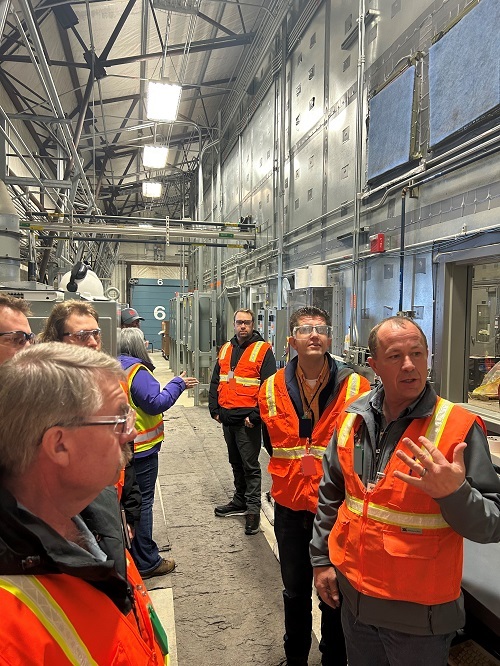
Jason Chapple, bottom right, Idaho Environmental Coalition (IEC) director of Accelerated Retrieval Project (ARP) Operations and Remediation, discusses preparations for demolition of one of the ARP enclosures with a delegation from the Canadian Nuclear Laboratories (CNL) recently. CNL will demolish several facilities as part of a larger cleanup mission at the Chalk River and Whiteshell laboratories. During its visit to the Idaho National Laboratory Site, the Canadian delegation met with IEC directors and staff and toured facilities to aid in its planning for decontamination and decommissioning, and cleanup. |
Next, the group toured the Advanced Mixed Waste Treatment Project (AMWTP), where IEC crews are treating, characterizing, repackaging and shipping transuranic and low-level waste to EM’s Waste Isolation Pilot Plant and other offsite repositories for disposal. The Canadians said they were impressed with AMWTP’s Treatment Facility where crews use robotic and remotely operated equipment to sort and repackage waste. At INTEC, the group viewed how spent nuclear fuel is stored in underground and horizontal concrete vaults as well as a building at INTEC where the fuel is air-cooled in vertical racks. The Canadians saw how a repurposed hot cell at the New Waste Calcining Facility is used to open, treat and repackage remote-handled transuranic waste. That facility converted high-level radioactive liquid waste from INTEC tanks into a stable, granular solid called calcine until May 2000. The IEC tour hosts also took the delegation to the Idaho CERCLA Disposal Facility, the INL Site’s landfill for cleanup program-generated contaminated soil and debris. In the next few years, a new cell will be added to the facility to extend its mission until 2050. CERCLA stands for the Comprehensive Environmental Response, Compensation and Liability Act.
The Canadian visit was the idea of IEC parent company Jacobs and facilitated through Dan Coyne, IEC senior director of Waste and D&D, who spent four years at Canadian Nuclear Laboratories with Jacobs.
“The nuclear industry is a tight-knit community,” he said. “Sharing our lessons learned with our Canadian colleagues not only benefits the industry itself, but it also continues the excellent relationship our two countries have. Everyone wins.”
-Contributor: Erik Simpson
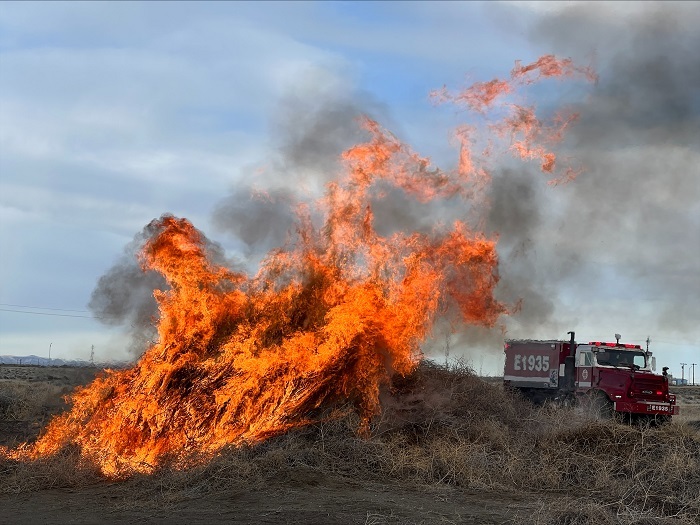 Hanford firefighters routinely hold planned, controlled burns of tumbleweeds on the Hanford Site to eliminate additional fuel ahead of the upcoming fire season and to help slow the spread of wildfires.
RICHLAND, Wash. – Months before the wildland fire season begins, EM Richland Operations Office contractor Hanford Mission Integration Solutions (HMIS) conducts fire prevention efforts on the Hanford Site, getting equipment ready and reducing the potential severity of any wildfires.
These fire prevention methods helped keep the most recent fire season to a minimum, with just 12 acres burned in 2022 and no damage to facilities or disruption of EM’s cleanup mission.
Lightning causes most of the fires on the 580-square-mile site, so to prepare for fire season, Hanford Fire Department (HFD) schedules yearly training sessions coordinating fire response with heavy-machinery operators and with Hanford Emergency Operations Center command support staff and liaisons.
“Hanford firefighters receive training on a wide range of emergencies to protect Hanford workers and facilities,” said Brian Harkins, EM assistant manager for Mission Support. “The Hanford firefighters are an outstanding group of individuals who do a great job protecting the site so the cleanup mission can continue.”
 |
|
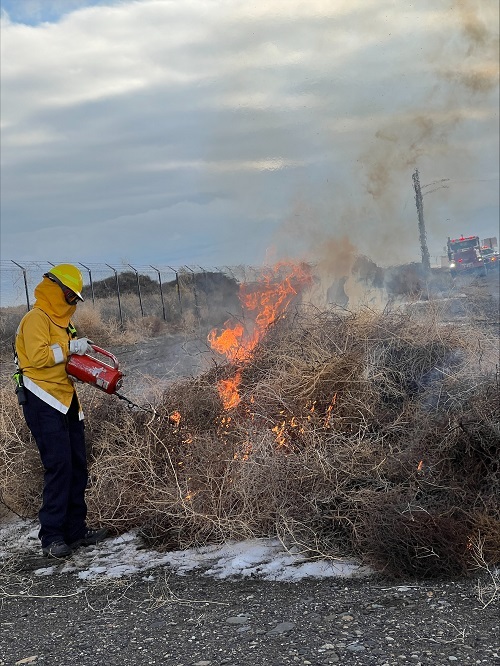
A Hanford firefighter burns excess tumbleweeds on the Hanford Site as part of winter and spring fire prevention efforts to reduce the risk of summer wildfires. |
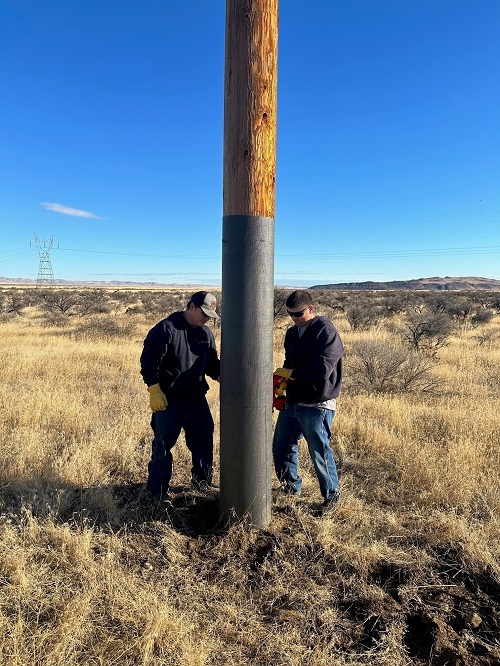
Hanford Mission Integration Solutions employees Riley Downs, left, and Britt Farnsworth apply fireproofing material on utility poles to help prevent any potential fire damage. |
|
 |
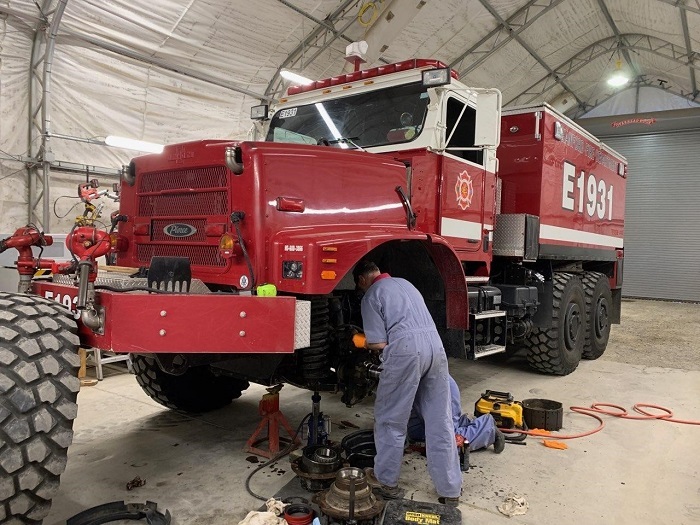 Hanford Mission Integration Solutions mechanics Mark Moore, left, and Kevin Claybrook repair a Hanford Fire Department brush truck in preparation for the 2023 fire season.
Throughout the winter, as conditions safely allow, firefighters schedule planned burns of tumbleweeds and excess brush to slow the spread of a wildfire. Most recently, HFD disposed of nearly 68,000 cubic yards of such vegetation — enough to fill more than three football fields.
Risk-reduction efforts also include wrapping the bottoms of utility poles with fireproofing material to prevent pole loss and unplanned outages in the event of a wildfire. Crews stay up to date on tactics and strategies for fighting fires by walking sections of the site, using wildland maps and aerial images. They also create lengthy fire barriers along site roads to minimize the spread of a wildland fire.
The HMIS fleet services organization coordinates with HFD annually to prepare all wildland fire vehicles to ensure an effective response during the fire season. Hanford Fire also provides mutual aid support to other local emergency responders, the Washington State Department of Natural Resources and U.S. Fish and Wildlife Service.
-Contributor: Robin Wojtanik
WASHINGTON, D.C. – Just in time for Earth Day, DOE named EM’s Portsmouth Site and Idaho Cleanup Project (ICP) as Green Fleet Award recipients last week for their exceptional efforts in ordering the most light-duty zero-emissions vehicles (ZEV) in fiscal 2023.
The ICP at EM's Idaho National Laboratory Site swapped 70% of its light-duty vehicles ordered with ZEVs and Portsmouth replaced 69% of its light-duty vehicles ordered with ZEVs.
ICP and Portsmouth are part of a broader DOE effort to meet Biden Administration fleet electrification goals aiming to achieve a 100% ZEV fleet by 2035, with 100% light-duty vehicle acquisitions by 2027. In fiscal 2023, DOE ordered over 500 ZEVs, or 50% of all light-duty vehicles ordered, far exceeding its initial goal.
The DOE Office of Management is providing a $300,000 grant to both ICP and Portsmouth in recognition of their outstanding sustainability work. A total of seven DOE sites are receiving grants to order additional ZEVs or install electric vehicle charging infrastructure at their locations. Other grant recipients are:
- Los Alamos National Laboratory;
- Lawrence Livermore National Laboratory;
- Argonne National Laboratory;
- SLAC National Accelerator Laboratory; and
- Y-12 National Security Complex.
 |
|
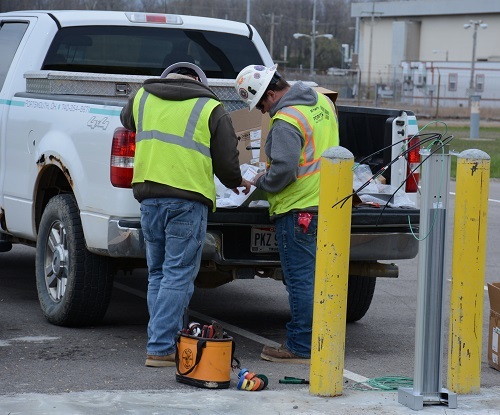
Workers at EM’s Portsmouth Site assemble parts to a new electric vehicle charging station outside the X-1000 Administration Building. |
Many electric vehicle charging stations are being constructed across EM’s Portsmouth Site to accommodate newly purchased government electric vehicles. Employees also will be able to use the stations to charge their own electric vehicles. |
|
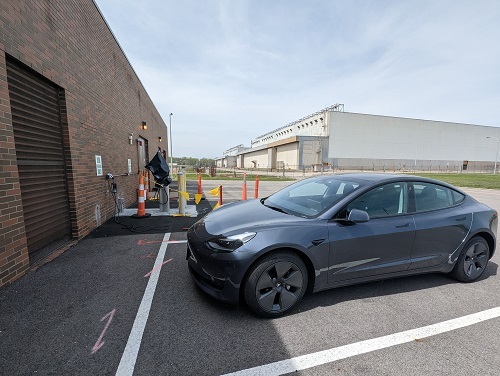 |
All EM sites are working to shift to electric vehicle fleets. Transitioning the Oak Ridge Office of Environmental Management (OREM) fleet is estimated to avoid up to 320 metric tons in annual carbon emissions and $50,000 in fuel costs each year based on the national average cost of gas and electricity.
OREM, in partnership with contractor UCOR, is pursuing a transition to low-speed electric vehicles and zero-emissions heavy equipment for its environmental remediation mission.
Meanwhile, the Savannah River Site (SRS) installed eight fast charging stations and is working to construct more stations. In additional phases of the project, SRS will convert mid- and heavy-duty vehicles to zero-emission engines.
-Contributor: Kimberly Kweder
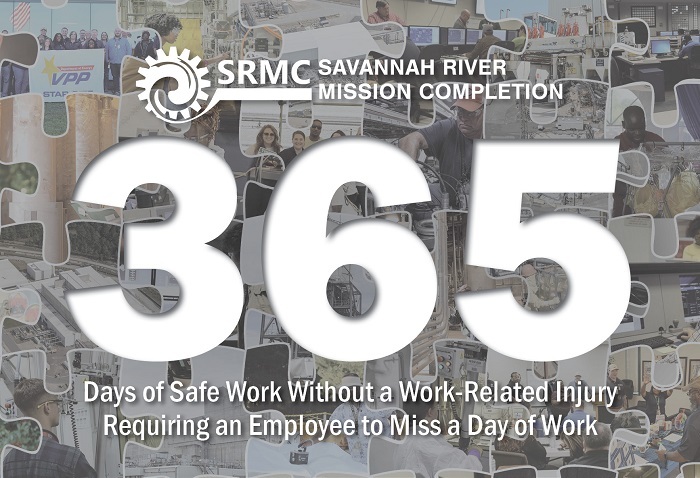 Savannah River Mission Completion, EM’s liquid waste contractor at the Savannah River Site, has surpassed 365 straight days without a work-related injury that resulted in a worker missing a day on the job. The achievement was reached while the company accomplished numerous significant tasks.
AIKEN, S.C. – EM’s liquid waste contractor at the Savannah River Site (SRS) has completed more than 365 days without a work-related injury that required an employee to miss a day on the job.
Savannah River Mission Completion (SRMC), which assumed the SRS liquid waste contract in February 2022, observed the safety milestone on April 4. The achievement was reached amid a number of accomplishments executed safely and without resulting in a missed day of work, including:
Companies of similar size to SRMC incur between 24 and 39 injuries a year resulting in employees being unable to return to work the following day, according to industry averages.
Dave Olson, SRMC president and program manager, said the milestone was reached due to the company’s effective safety culture. Safety is one of the company’s four core values.
“Each day, we challenge ourselves to perform each task safely,” Olson said. “We want our employees to return home in the same condition that they arrived to work.”
Jim Folk, the DOE-Savannah River assistant manager for waste disposition, said all workers at the site adhere to established safety standards.
“Safety is more than an expectation at Savannah River Site; it’s a requirement,” Folk said. “We are entrusted with important missions that we must execute while protecting workers, the public and the environment.”
-Contributor: Jim Beasley
|