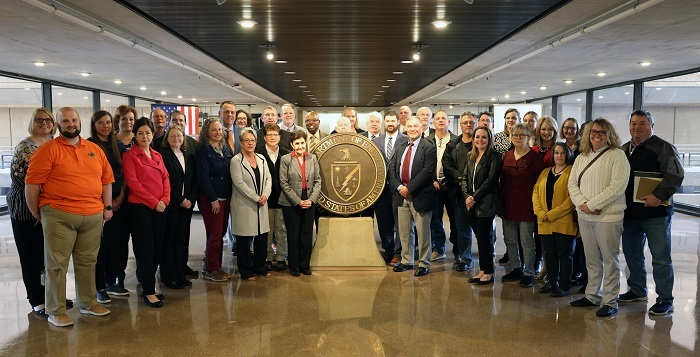
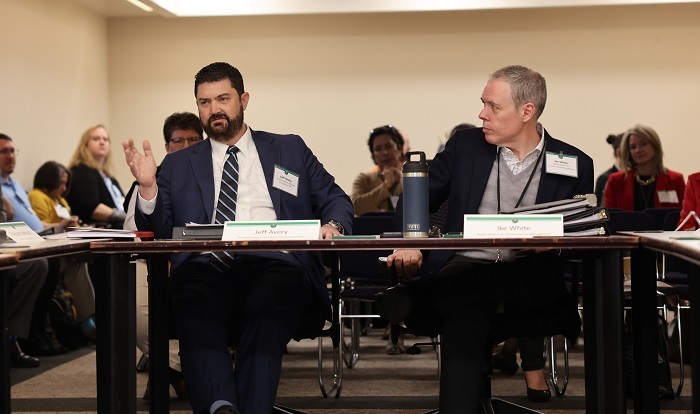
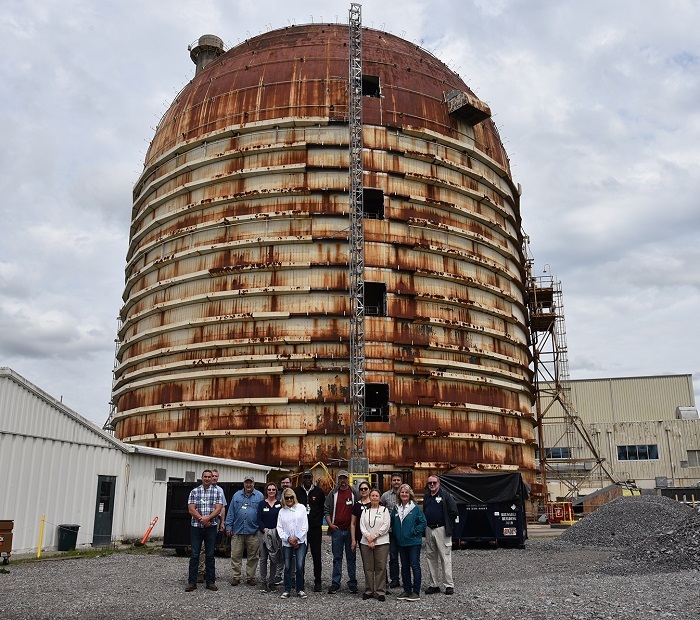
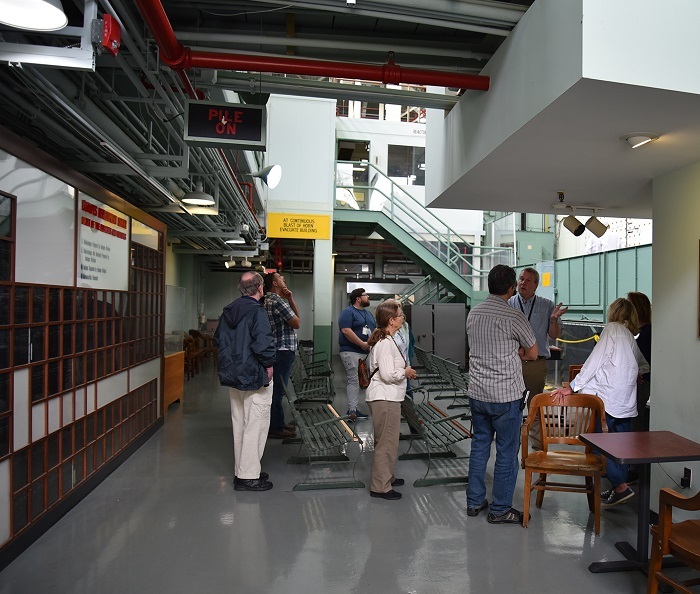
 New members of the Oak Ridge Site Specific Advisory Board toured major cleanup projects across the Oak Ridge Reservation during their recent orientation. They are pictured next to the Experimental Gas Cooled Reactor at Oak Ridge National Laboratory, where deactivation efforts are underway. Oak Ridge Office of Environmental Management Regulatory Affairs Specialist Roger Petrie is also pictured at far left in the background.
OAK RIDGE, Tenn. – New members of the Oak Ridge Site Specific Advisory Board (ORSSAB) are benefiting from a return to an in-person orientation and tour of major cleanup across the Oak Ridge Reservation for the first time since the coronavirus.
“We’re thrilled to be able to hold the new member orientation tour again," said Melyssa Noe, ORSSAB's deputy designated federal officer. "Many of our members have little or no prior knowledge of EM’s work on the Oak Ridge Reservation when they first join the board, and this gives them an opportunity to see that work firsthand and see how it relates to the site as a whole.”
More than a dozen attendees joined board staff and Oak Ridge Office of Environmental Management (OREM) representatives on April 6 for the event, which included an informational overview followed by a guided tour of the 32,000-acre site.
OREM Regulatory Affairs Specialist Roger Petrie discussed the program's history, ongoing projects and future plans before the group loaded a bus and headed to the Oak Ridge National Laboratory (ORNL).
 Oak Ridge Office of Environmental Management Regulatory Affairs Specialist Roger Petrie tells members of the Oak Ridge Site Specific Advisory Board the history and role of the Graphite Reactor at Oak Ridge National Laboratory. The facility is part of the Manhattan Project National Historical Park.
New members viewed a transformation in progress in ORNL’s central campus due to current cleanup projects there. They saw the footprint of the recently demolished Bulk Shielding Reactor, ongoing demolition on the Low Intensity Test Reactor and deactivation work underway at the Oak Ridge Research Reactor.
The tour also took ORSSAB members by Building 3019, the world’s oldest operating nuclear facility, where the nation’s inventory of uranium-233 is stored. They also saw Building 2026, where uranium-233 processing and downblending is taking place to prepare that material for permanent disposal offsite.
At the Experimental Gas Cooled Reactor, which is presently in the decontamination and decommissioning process, the group got a better idea of the scale of the project when they stepped off the bus and walked the area.
For new member Mary Butler, the tour gave her a new appreciation of the sheer scale and challenge of EM’s work in Oak Ridge.
“It’s just mind-boggling how much work has been done already, and how much needs to be done,” she said.
Members also went inside the Graphite Reactor. The facility was built in 1943 to test the feasibility of producing plutonium for use in atomic weapons on a scale larger than laboratory experiments. Once a pilot for the larger B Reactor on the Hanford Site in Washington state, the facility is now part of the Manhattan Project National Historical Park, which features educational displays illustrating its past use.
For the last portion of the tour, the group traveled to the East Tennessee Technology Park.
While there, Petrie identified the areas where soil remediation is wrapping up and other areas where EM will address groundwater to complete all cleanup required at the site.
He also highlighted parcels of land that have been transferred to the community — and those slated for transfer in the near future — for economic development. Petrie also discussed companies that have announced plans to locate and build at the site.
New member Atilio Anzellotti said the tour gave him new insights into the history of the site.
“It’s very educational,” he said. “Living here in Oak Ridge, you hear about those sites, but it’s a mystery. It’s a secret like that, but now you can point there and actually see all the story and the background.”
Tours like the one for the ORSSAB help educate area residents about the scale and importance of EM and DOE’s other missions in Oak Ridge as well.
-Contributor: Sara McManamy-Johnson
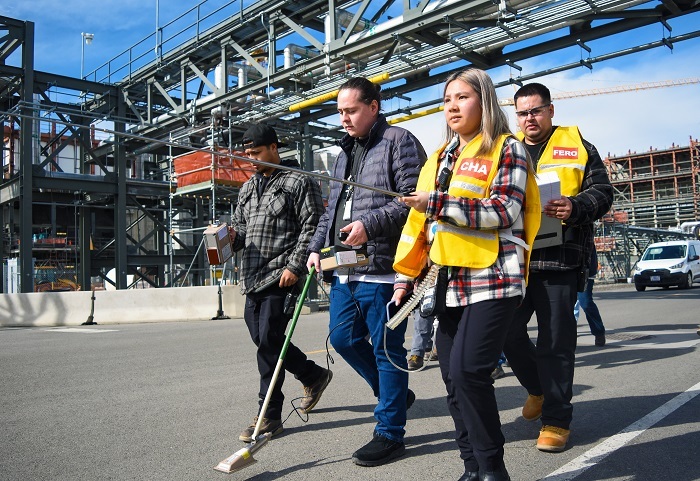 Waste Treatment and Immobilization Plant staff members, from left, Nathan Segura, Liam Ward, Vannie Pham and Fernando Curiel participate in a recent ammonia leak-detection drill.
RICHLAND, Wash. – Hanford Site Waste Treatment and Immobilization Plant (WTP) staff recently performed an emergency preparedness drill simulating a response to an ammonia leak.
It was the most recent in an ongoing series of ammonia related emergency drills before the plant receives ammonia that will be used in the WTP emissions treatment system.
Facility Emergency Response Organization team members with WTP practiced methods for detecting ammonia contamination around the plant to build proficiency with a variety of monitoring devices. Previous ammonia drills simulated receiving ammonia from the supplier and the emergency response to the unlikely event of an uncontrolled release from the ammonia storage tanks.
“These drills are an important piece in our efforts to prepare our team and the site for direct-feed low-activity waste (DFLAW) operations to treat low-activity tank waste,” said Rick Holmes, general manager for Waste Treatment Completion Company, a subcontractor to Bechtel National Inc., which is designing, building and commissioning the WTP for EM’s Office of River Protection. “Our emergency preparedness team has done an excellent job in building a robust preparation process by holding frequent drills and exercises of increasing complexity to build proficiency in responding to a wide variety of emergencies.”
 |
|
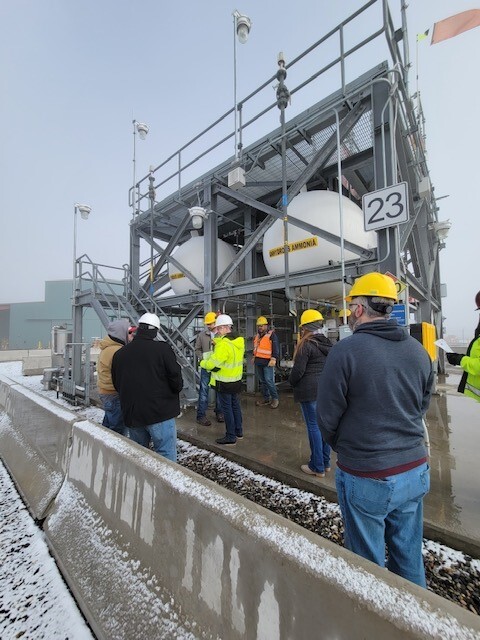
Members of the Hanford Fire Department and contractor Hanford Mission Integration Solutions’ Emergency Preparedness team tour the Ammonia Reagent Facility at the Waste Treatment and Immobilization Plant. |
In addition to performing emergency preparedness drills, WTP staff have also hosted tours of ammonia system facilities for staff from the Hanford Fire Department (HFD) and contractor Hanford Mission Integration Solutions’ (HMIS) Emergency Preparedness team, which play a part in Hanford’s sitewide emergency response.
During their most recent visit, the HFD and HMIS teams shared lessons learned from previous drills and helped brainstorm scenarios for future exercises. The teams also discussed scheduling tours for additional HFD crews to increase familiarity with the WTP ammonia system.
During DFLAW operations, treated waste from Hanford’s underground storage tanks will be fed directly to melters inside the WTP’s Low-Activity Waste (LAW) Facility. The waste will be mixed with glass-forming materials and heated in the melters in a process known as vitrification, then poured into specially designed stainless steel containers for disposal at the Integrated Disposal Facility on the site.
Ammonia will play an important role in protecting both the workforce and the environment at WTP. During the vitrification process, the melters will release pollutants in their exhaust. The LAW Facility emissions treatment systems will use ammonia to create a chemical reaction that eliminates these materials and produces the harmless byproducts of nitrogen, oxygen and water. The WTP is anticipated to receive ammonia later this year following the heatup of the LAW Facility melters.
-Contributor: Tyler Oates
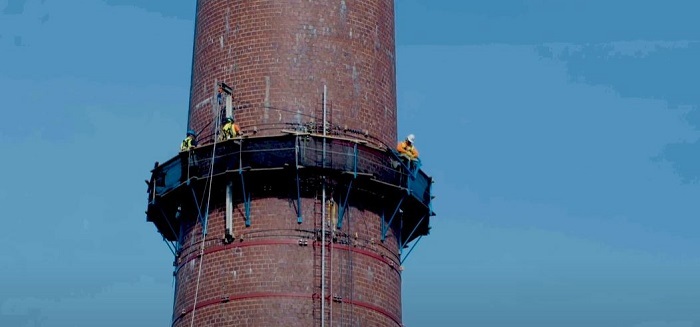 The Oak Ridge Office of Environmental Management’s first climb of the 3039 Stack since 1995 began in February and is expected to be completed in the weeks ahead.
OAK RIDGE, Tenn. – Performing work on tall structures presents unique challenges. But when they’re also aging, they bring an even greater dimension to planning.
That’s the case for EM crews responsible for inspecting the 3039 Stack at Oak Ridge National Laboratory (ORNL).
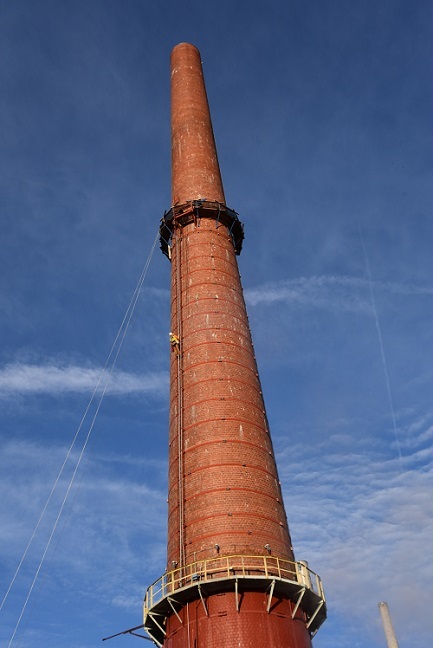
The 250-foot-tall chimney-like structure dates to 1949. It is still in use today, providing ventilation to operations at ORNL. The inspection helps the Oak Ridge Office of Environmental Management (OREM) and contractor UCOR determine what repairs are needed to support the stack’s remaining years.
“We’ve got a 74-year-old stack with some degradation,” UCOR Project Manager Ben Belyea said. “We’re doing an inspection to figure out what the lifespan of the stack is and determine what repairs are required to keep it operational in the future.”
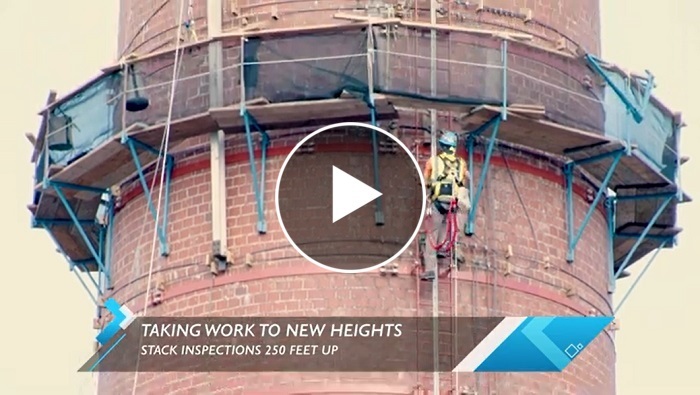 Watch this video of employees climbing the 3039 Stack.
In recent years, OREM and UCOR have used drones to conduct inspections to avoid having employees climb the towering structure, which could cause wear and tear on it.
However, information gathered from aerial photos proved the necessity for a full physical stack inspection. The latest climb, which began in February, is enabling the first physical inspection of the stack since 1995.
OREM expects the 3039 Stack to remain in place for 10 more years before it’s taken down, prompting the need to assess its condition and check for any needed repairs.
"We will find a small portion of the motor joints that need repair," Belyea said. “After reviewing drone footage from a few years ago, we expect to see more repairs required as we move up the structure.”
 |
|
Still in use today, the 250-foot-tall 3039 Stack dates to 1949. It provides ventilation to operations at Oak Ridge National Laboratory. |
After a yearlong planning effort, UCOR selected the International Chimney Corporation (ICC) as the vendor to conduct the inspection.
"Absolute no fear of heights is a good quality,” said Joe Brower, an ICC employee who climbs the stack. “We have good personnel with our company. We train our individuals well, and we have a training stack at our office."
OREM and UCOR considered four options before determining the safest, most effective method to climb the aging structure. The selected method offers hands-free fall protection that increases worker mobility, safety and productivity.
The climb is taking place above a permanently installed platform 50 feet aboveground. Stack inspectors are currently at the 208-foot level. They’ve installed 33 structural bands around the exterior of the stack and 16 ladder sections.
The crews inspect an average five feet of the stack per day. They are scheduled to finish the inspection in the weeks ahead.
-Contributor: Shannon Potter
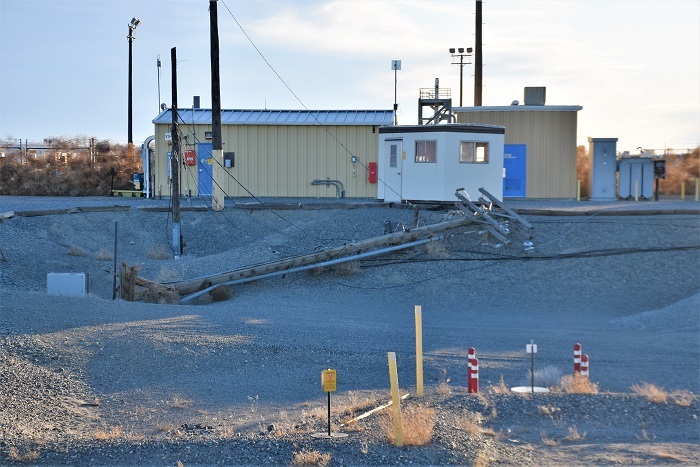 Contractor Hanford Mission Integration Solutions repaired multiple utility poles knocked down by an intense windstorm on the Hanford Site in February.
RICHLAND, Wash. – A well-coordinated effort by EM Richland Operations Office contractor Hanford Mission Integration Solutions (HMIS) quickly restored power, repaired fallen utility poles and replaced transformers following a severe windstorm that hit the Hanford Site in late February.
At the storm’s peak, Hanford meteorologists recorded wind gusts of up to 65 mph at cleanup operations areas and up to 87 mph at higher elevations. The storm temporarily knocked out power to more than 100 Hanford service locations.
“The damage from this storm was unlike anything we’ve seen at the Hanford Site,” said Brian Vance, manager of EM’s Office of River Protection and Richland Operations Office. “The quick response by HMIS and the support from our One Hanford team enabled us to maintain operations with only a brief disruption.”
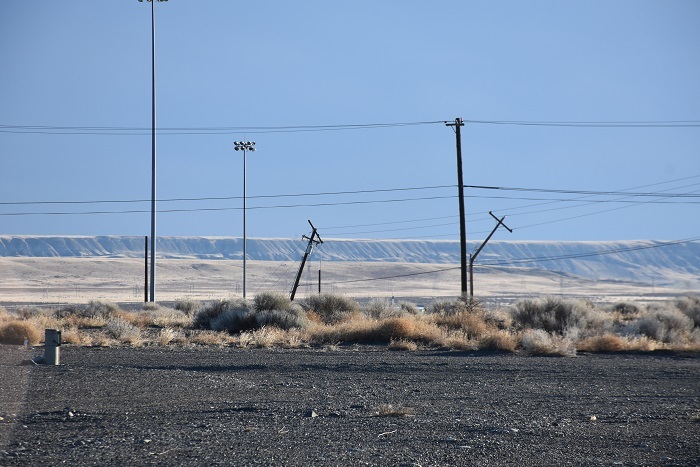 Hanford meteorologists recorded gusts of up to 65 mph in cleanup operations areas during a windstorm that knocked out power to more than 100 service locations on the Hanford Site.
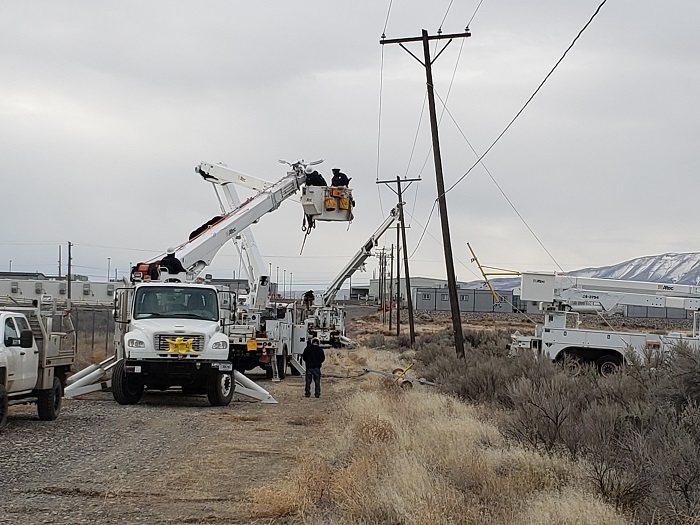 Electrical utilities crews with contractor Hanford Mission Integration Solutions restored power to most of the service locations on the Hanford Site the same day thanks to preparations for a 24/7 operations posture when Hanford starts treating waste from large underground storage tanks.
The fierce winds damaged more than 13 miles of electrical lines. HMIS electrical utilities crews began repairs the morning of the storm to fix eight utility poles that were either broken or leaning. Crews repaired damage to seven pole-top transformers and restored more than 60 other transformers affected by the damage.
HMIS crews restored power to 89 service locations the same day. They resolved the remaining outages and damage in prioritized order thanks to collaboration with additional HMIS teams and the other One Hanford contractors. At some locations, portable generators provided electricity to critical operations until crews restored power.
“Thanks to our preparations for 24/7 waste treatment operations and a forward-thinking risk-management analysis a couple years ago, we had the equipment needed to make the repairs in our warehouses,” said HMIS President Bob Wilkinson. “We were able to get Hanford’s systems back up and running in a few days, where it probably would’ve taken 45 to 90 days a few years ago. I’m incredibly proud of the way our teams responded and how efficiently and effectively we were able to complete this work.”
-Contributors: Shane Edinger, Robin Wojtanik
|