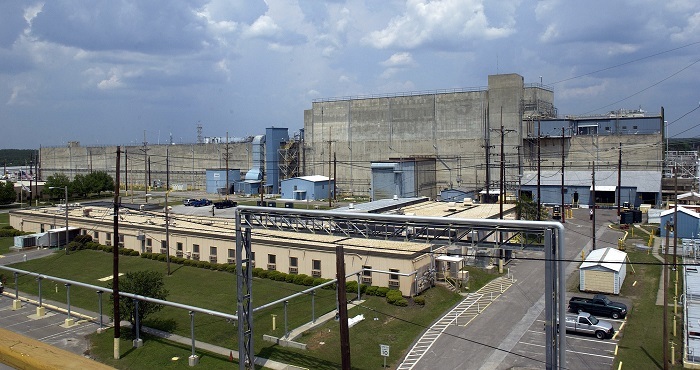
 The H Canyon chemical separations facility at the Savannah River Site.
AIKEN, S.C. - The H Canyon chemical separations facility at Savannah River Site (SRS) is preparing to recycle used highly enriched uranium (HEU) and downblend it to provide much-needed fuel for U.S. advanced nuclear reactors.
The downblended fuel, known as high-assay low-enriched uranium (HALEU), is desirable for use in nuclear power reactor designs because it allows for smaller designs, longer life cores, increased fuel efficiency and less waste.
“The projected demand for HALEU far exceeds the current supply,” said HALEU Program Manager Jeff Hasty with EM contractor Savannah River Nuclear Solutions. “Because of H Canyon’s most recent mission of blending HEU into LEU for commercial fuel reactors, H Canyon has stored HEU solutions available for use.”
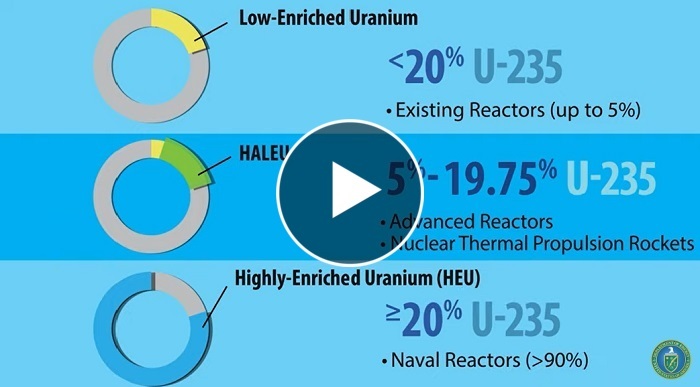 Watch this video to learn more about high-assay low-enriched uranium.
Savannah River National Laboratory (SRNL) completed a series of analyses to show downblending of HEU from H Canyon liquid solutions could meet specifications needed for the advanced reactors. Those analyses helped SRS in initiating the planned HALEU project in H Canyon.
“SRNL plays a major role in the research of the nuclear fuel cycle research and development and is always excited to see our efforts applied in real world applications,” said SRNL Environmental and Legacy Management Deputy Associate Laboratory Director Bill Bates.
H Canyon has begun preparing for the pending mission, which will include equipment repair, training, procedure revisions and an environmental impact analysis. SRNL is also supporting the effort by completing a detailed set of sample analyses to ensure the HALEU meets reactor material specifications and to certify shipping containers for material transport. Downblending is expected to begin in 2025.
“This approval is a win-win,” said Hasty. “H Canyon has a useful path for the stored HEU, and at the same time, HALEU availability is increased for the emerging advanced reactors.”
-Contributor: Lindsey MonBarren
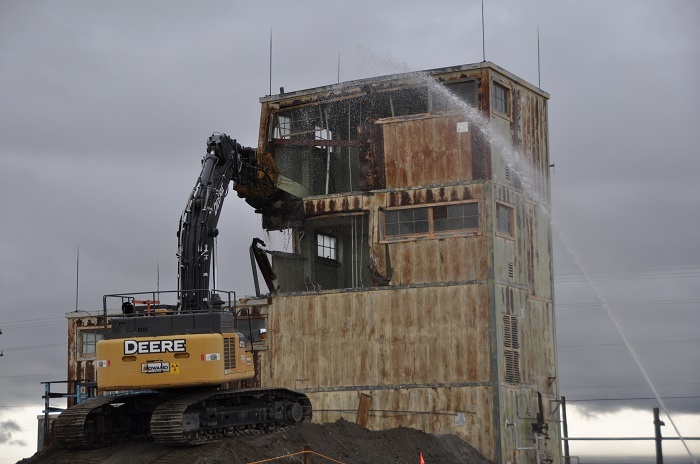
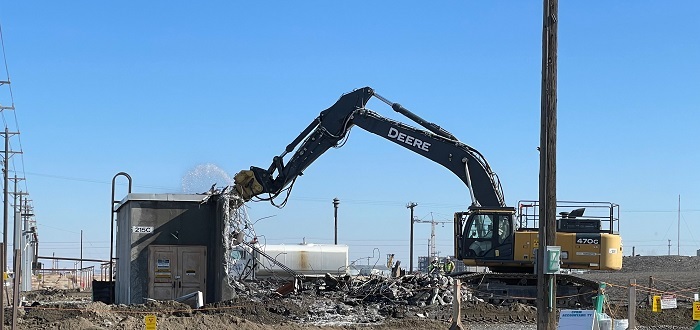
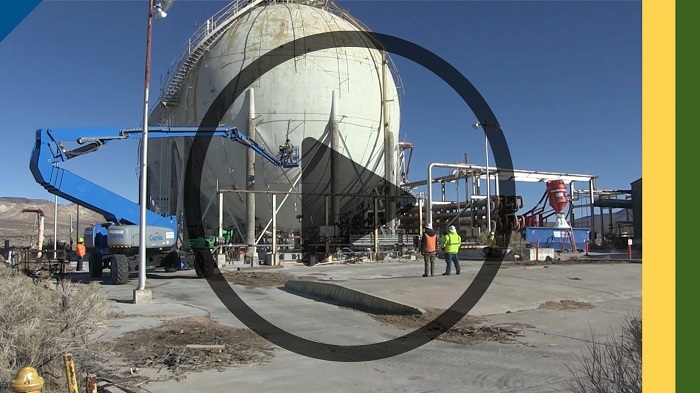 Watch this video to learn more about the EM Nevada Program's preparations to begin demolition of the Engine Maintenance, Assembly, and Disassembly and Test Cell C facilities at the Nevada National Security Site.
LAS VEGAS – The EM Nevada Program is preparing for the next phase of work after successfully completing its top 2022 priority to begin demolition of the Engine Maintenance, Assembly, and Disassembly (EMAD) and Test Cell C (TCC) facilities at the Nevada National Security Site (NNSS).
EM Nevada is getting ready to demolish four buildings at TCC in 2023. That mission goal is among EM’s 2023 priorities focused on reducing the cleanup program’s footprint.
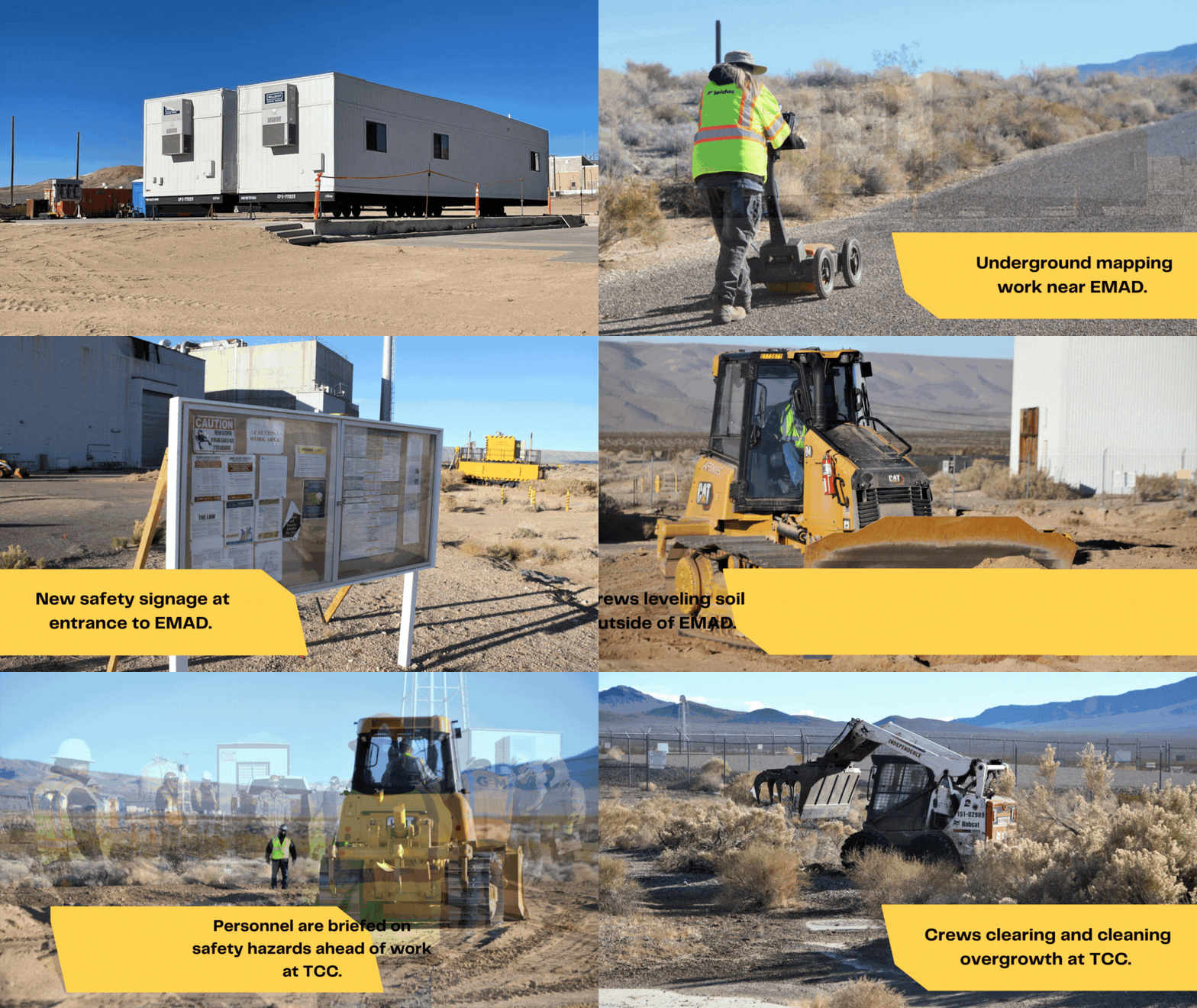 View this collection of photos showing work by EM Nevada Program crews to prepare for the demolition of the Engine Maintenance, Assembly, and Disassembly and Test Cell C facilities at the Nevada National Security Site.
As part of demolition preparatory work, crews placed work trailers at both EMAD and TCC. The trailers will serve as a central point for staff to gather to review daily safety procedures and act as command centers.
Workers also started asbestos abatement at TCC in a few identified areas on the site. They will safely remove and dispose of remaining asbestos in coming months. Identified asbestos areas must be abated before additional demolition at TCC can continue.
Crews also completed an extensive mapping project at EMAD and TCC. Team members used radar technology to create color-enhanced contour maps of the land beneath the sites. The data will help EM Nevada identify underground utilities, which will aid in planning future work activities. It will also provide a much deeper understanding of what lies beneath EMAD, TCC and surrounding land.
At TCC, crews spent a significant amount of time clearing overbrush inside and outside the fence surrounding the facility to identify and remove potential unseen hazards.
TCC and EMAD have ties to historical nuclear propulsion rocket development and testing programs at the NNSS.
Built in 1961, TCC was used to ground test nuclear reactors and engines for rockets. Liquid hydrogen within tanks known as dewars was used to cool reactors after testing took place.
Constructed in 1965 at a cost of more than $50 million, EMAD was then the largest hot cell in the world.
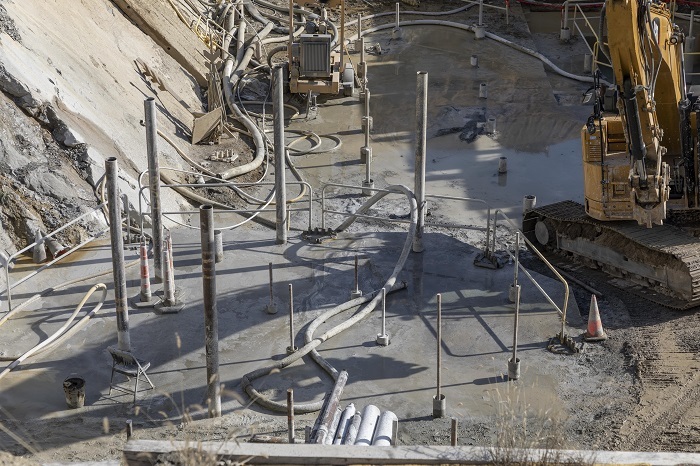 Oak Ridge construction crews installed micropiles to help lay the foundation for the headworks facility site for the Mercury Treatment Facility. They installed 79 micropiles, some going nearly 70 feet down, to provide structural foundation support for the headworks facility.
OAK RIDGE, Tenn. – An Oak Ridge Office of Environmental Management (OREM) team recently hit two milestones in a construction project that’s pivotal to future cleanup at the Y-12 National Security Complex (Y-12).
The Mercury Treatment Facility, now under construction, is the linchpin for OREM’s cleanup strategy at Y-12. It will prevent potential releases of mercury into a nearby creek, enabling large scale demolition to begin in mercury-contaminated areas at Y-12.
“These milestones are notable steps forward, and they pave the way for continued progress on this important project,” said Brian Henry, Y-12 portfolio federal project director.
The vital piece of infrastructure will be comprised of two major components at two locations — a headworks facility and a treatment plant — connected by a pipeline nearly a mile long. OREM contractor APTIM-Northwind (ANW) is leading the project, with support from cleanup contractor UCOR.
The headworks facility will capture creek flow on the west end of Y-12, store excess stormwater collected during large rainfalls, remove grit and pump water through the pipeline to the treatment plant. The treated water will then flow back into the creek on the east end of Y-12.
The Mercury Treatment Facility is designed to treat up to 3,000 gallons of water per minute and includes a 2-million-gallon storage tank to collect stormwater.
Working on two fronts, teams safely installed the initial equipment to the project’s treatment plant site and placed micropiles to help lay the foundation for the headworks facility site. The micropiles are small-diameter pilings consisting of steel-threaded bars grouted into pre-drilled holes that provide foundation support for the headworks facility.
“We installed 79 micropiles, some going nearly 70 feet down, to ensure we had 10 to 15 feet of competent rock. Then we shored up that steel with concrete, grout and compression plates,” said Outfall 200 Mercury Treatment Facility Design Engineer Brian Shaw. “We’ve proof-tested these designs to ensure they are up to the task as we prepare for the headworks building structure.”
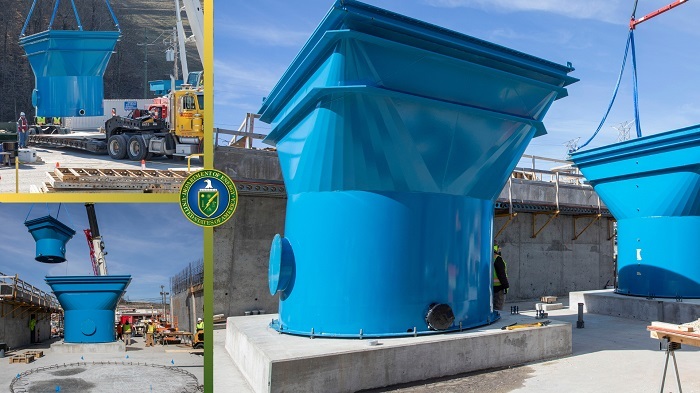 Oak Ridge teams safely hoisted four parts that comprised two massive incline plate clarifiers at the Mercury Treatment Facility treatment plant. It marks the project’s first mechanical installation. The clarifiers remove particles during the treatment process and make the water clearer.
Crews also successfully hoisted and placed two massive incline plate clarifiers, each weighing 16,000 pounds. This marked the project’s first mechanical installation for the treatment facility. The clarifiers remove particles during the treatment process and make the water clearer.
“The clarifier is a key component of the treatment plant system, and that makes the setting of these clarifiers so significant,” says Outfall 200 Mercury Treatment Facility Project Manager Matt Putinas. “Our entire team knows how important this project is for our cleanup work at Y-12.”
ANW Construction Manager Mike Morneau says the installation of that equipment is notable because it allows crews to move forward on structural steel, underground utilities and foundation pours in the months ahead.
“At our project meetings and in our interactions in the field, we’re seeing improved coordination, project sequencing, and execution that is essential to our shared cleanup success,” said Kent Fortenberry, UCOR critical projects director.
-Contributor: Chris Caldwell
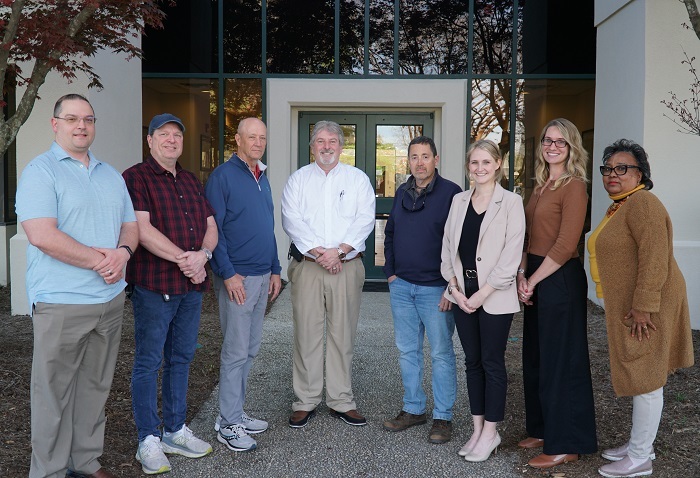 The technology integration team from Savannah River Mission Completion began planning the transfer of applications from the Salt Waste Processing Facility into the Savannah River Site network in August 2022 and completed the task on March 19. The team comprises, from left, Jason Herring, Bob Cain, Dewayne Deal, Keith Harp, Sammy Odum, Samantha Cloessner, Keeli Fricks and Stephanie Conley.
AIKEN, S.C. – With EM’s liquid waste operations at Savannah River Site (SRS) relying heavily on the Salt Waste Processing Facility (SWPF), a team successfully transitioned the facility’s computers, software and security systems into the SRS network earlier this month, without interrupting production.
SRS liquid waste contractor Savannah River Mission Completion (SRMC) has operated SWPF since March 2022, when management was transferred from Parsons Corporation, which built the facility and operated it for the first year.
SWPF is the key facility at SRS for processing about 90% of the liquid radioactive waste stored in the remaining 43 underground waste tanks at SRS. The facility is processing greater volumes of waste than ever before. In slightly more than two years of operation, SWPF has processed nearly 5 million gallons of salt waste.
Under its agreement with EM, Parsons built the SWPF Information Technology (IT) applications on its network. The company provided those applications to SRMC while SRMC operated the facility for the past year. All essential systems, including laboratory functions handling sample analyses, continued to function fully as the transition was underway.
In August, SRMC began the planning effort to transfer the IT functions into the SRS network. SRMC Programs Integration Manager Keith Harp assembled a group of IT experts to create a plan to meet the March 2023 deadline for total transfer of systems to the SRS network.
“Our goal was to fully integrate SWPF, from an IT perspective, into the overall liquid waste system,” Harp said. “We could not have been successful without the significant level of support we’ve received from team representatives from both companies.”
The demanding task involved approximately 500 different pieces of equipment, including network switches, routers, sensors, network jacks, end-user computer equipment, cabinets and enclosures. Recognizing the enormity of the task with approximately 60 IT professionals involved, the team met daily to track priorities, schedules, challenges, solutions and progress.
Offsite vendors AT&T, Microsoft and IBM also provided assistance. They were able to offer input to the project via remote connections and installation of new switches to provide a communication path between an offsite SRMC office and SRS.
The group worked steadily for five months to integrate equipment, hardware, circuitry and cyber functions among multiple locations. No interruptions of service were experienced throughout the entire process, and the team completed its task and satisfied the contractual deadline.
-Contributor: Jim Beasley
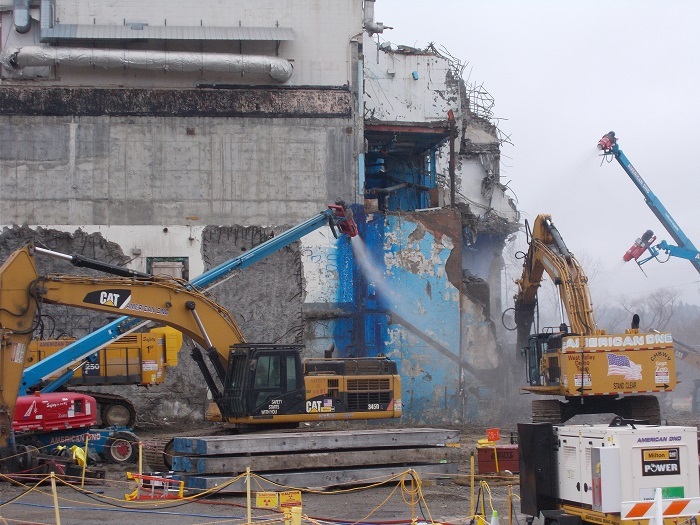 An operator uses an excavator with a hydraulic hammer to deconstruct the Acid Recovery Cell to prepare for the removal of reinforced-concrete floor blocks as part of the deconstruction of the Main Plant Process Building at EM's West Valley Demonstration Project.
WEST VALLEY, N.Y. – EM and prime contractor CH2M HILL BWXT West Valley (CHBWV) recently removed the concrete floor of a cell within the Main Plant Process Building as part of work to demolish the facility at the West Valley Demonstration Project.
Crews used heavy equipment to carefully lift and place each section of the Acid Recovery Cell floor into a container for offsite disposal.
Last summer, workers sawed the approximately 900-square-foot cell floor into more than 20 blocks for safe removal, further reducing the potential spread of contamination and providing an additional level of safety to the West Valley workforce.
“Our team continues to find ways to perform this challenging work in a manner that is protective of our employees, the public and the environment,” EM West Valley Main Plant Project Director Stephen Bousquet said.
Located on the second floor of the Main Plant, the cell contained equipment that concentrated acids used in fuel reprocessing operations in the 1960s and 1970s. During those activities, acid leaks contaminated and damaged the cell’s floor. As a result, grout was placed on the floor to provide shielding during reprocessing operations and then again during EM’s deactivation of the Main Plant.
“Safety is paramount to our deconstruction activities,” Bousquet said. “We take great care to limit the separation of the floor from the grout to minimize the potential for the spread of contamination.”
Crews also will remove the cell’s pump room. During reprocessing operations, that room was used to recover most of the nitric acid used to dissolve the cut or chopped spent fuel transferred from the Main Plant's Chemical Process Cell. It housed pumps, tank, jets and associated piping and equipment.
In other recent work to prepare for the Main Plant teardown, workers pulled three shield windows from the Chemical Process Cell that together weigh more than 75,000 pounds. An EM 2023 priority is to dispose of 9,000 tons of Main Plant demolition waste. The Main Plant is one of the last remaining major facilities at West Valley. Its successful demolition will further reduce environmental risks and position the site for the next phase in cleanup. The demolition is expected to take approximately 30 months to complete. -Contributor: Joseph Pillittere
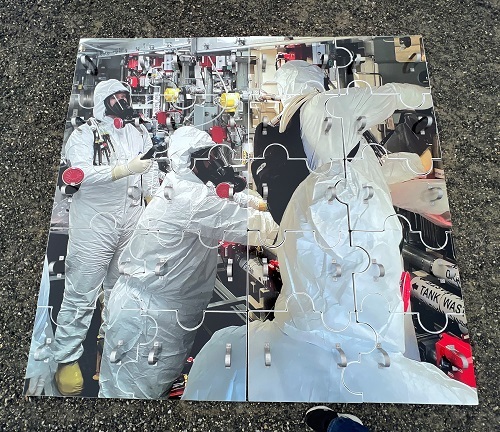
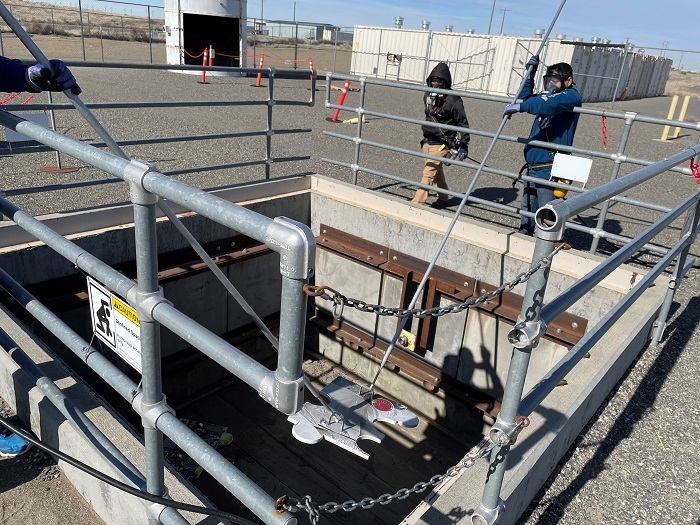 HAMMER Federal Training Center staff collaborated with Hanford Mission Integration Solutions carpenters, sign painters and metal shop employees to build large puzzle pieces for students to use during respiratory protection training on the Hanford Site.
RICHLAND, Wash. – EM Richland Operations Office contractor Hanford Mission Integration Solutions (HMIS) recently revised a respiratory protection course at the Hanford Site’s Volpentest Hazardous Materials Management and Emergency Response (HAMMER) Federal Training Center. The revision uses a scavenger hunt and large puzzle pieces to offer participants an innovative way to experience the benefits and limitations of respiratory protection equipment.
HAMMER instructors train Hanford workers on a range of skills in a controlled environment to maintain safety. In their latest training, instructors test participants on the respirators by having them work in groups going from room to room on a scavenger hunt to find and solve riddles based on learning objectives before their air bottles empty.
“Hanford’s HAMMER Federal Training Center provides realistic training paired with constant improvements to ensure our workforce has the knowledge and skills to complete work safely,” said Angela Stoddard, EM program manager. “The trainers develop innovative educational methods to provide advanced safety training experiences.”
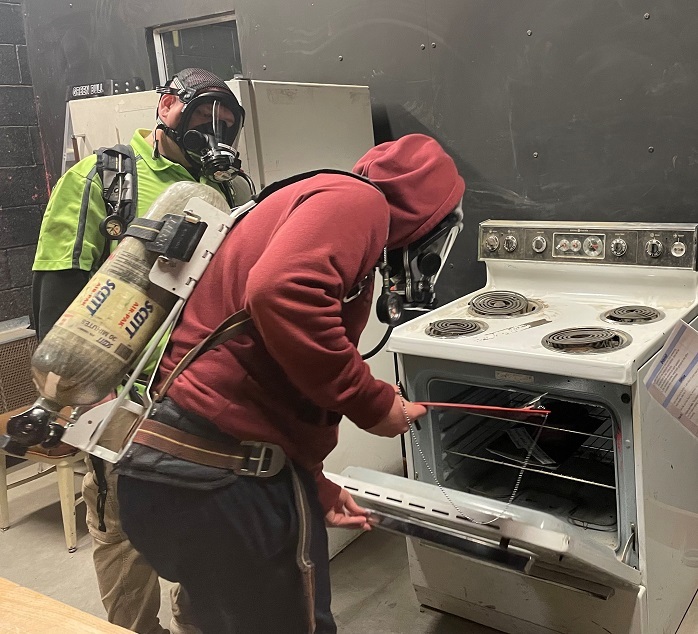 Trainees at the HAMMER Federal Training Center work through a scavenger hunt activity as part of an update to the center’s respiratory protection training program for the Hanford Site.
 |
|
This completed puzzle represents a successful collaboration by participants in respiratory training at the Hanford Site’s HAMMER Federal Training Center. |
Trainers also test respiratory protection proficiency by having trainees complete puzzles while wearing respirators. Using long-reach tools to retrieve puzzle pieces from a small pit, they work together to move and assemble the pieces in another location. To complete the puzzle, participants must communicate and effectively manage their air hoses.
HAMMER has a history of creating unique ways to teach different curricula that help workers retain knowledge and use it in the field. A previous update to a similar course includes an escape room scenario where participants complete challenges before the air in their bottles runs out.
“Using innovative training reinforces learning objectives and provides an opportunity to experience and overcome the equipment limitations, such as communication, mobility and visibility,” said HAMMER Director Paul Vandervert.
-Contributor: Robin Wojtanik
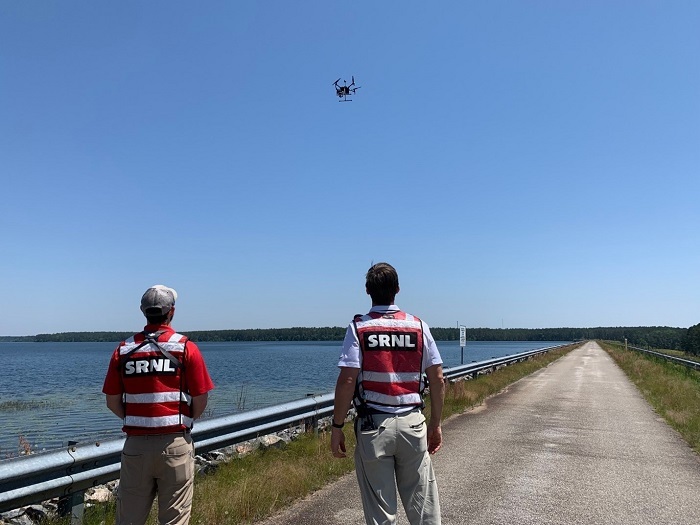 Savannah River National Laboratory Unmanned Aircraft System Program team members operate an aircraft over the Savannah River Site.
AIKEN, S.C. – The Savannah River National Laboratory (SRNL) Unmanned Aircraft System (UAS) Program has received a government-wide aviation safety award from the U.S. General Services Administration and Interagency Committee for Aviation Policy for the second consecutive year.
That 2022 Federal Aviation Safety Award follows a recent award presented by the DOE Office of Aviation Management to the EM laboratory for the best UAS program within DOE, an honor the SRNL UAS Program won for the third consecutive year. The DOE award recognizes excellence in management, operations, maintenance, training, safety and best practices.
Among the uses of camera-mounted drones within the laboratory’s UAS Program is to ensure the structural integrity of protective covers over EM’s remediated waste sites at the Savannah River Site (SRS).
“This award recognizes the rigor the SRNL UAS team puts into having a robust program and maintaining safe operations,” SRNL Strategic Initiatives Executive Director Greg Cefus said. “Earning this award for a second consecutive year demonstrates our team’s unwavering commitment to operational excellence. The SRNL UAS Program plays a key role in supporting national security missions and other missions across the Savannah River Site — from conducting inspections of waste tanks to photographing progress on construction projects for other site contractors.”
The Interagency Committee for Aviation Policy promotes sound policy and fosters the highest safety standards across the U.S. government.
The SRNL UAS team consists of a program manager, operations manager, aviation safety officer, six Federal Aviation Administration-certified pilots, and remote pilot. Another individual serves as ground-control support and as a visual observer.
The laboratory’s UAS Program has 20 UAS aircraft in its fleet, and the team works closely with the DOE-Savannah River Site aviation manager and safety officer to plan and conduct onsite missions under an approved flight readiness review board.
Created in 2017, the SRNL UAS Program provides support to the laboratory, SRS and its various tenants, U.S. armed forces, the federal government, law enforcement and the intelligence community. The UAS Program also supports emergency response, as necessary, to SRS and the local community. Click here for more information about the SRNL UAS Program.
|