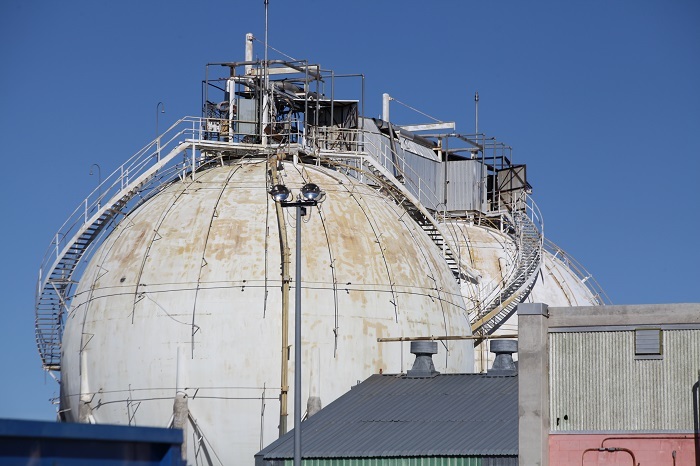
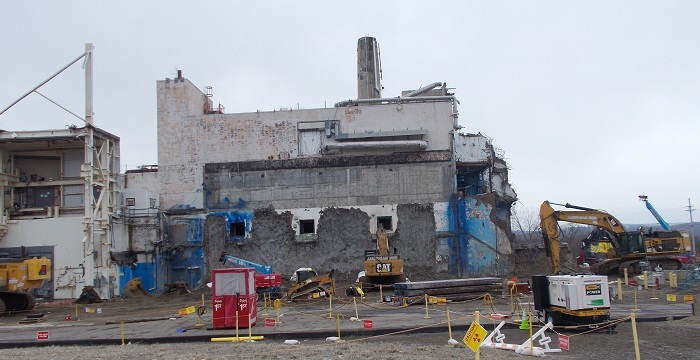
 EM workers safely removed three shield windows with a combined weight of 75,675 pounds from the Main Plant Process Building at the West Valley Demonstration Project. The windows allowed workers to see inside a former reprocessing cell while working remotely. The side of the Main Plant building frame where the windows were located is pictured.
WEST VALLEY, N.Y. – EM and prime contractor CH2M HILL BWXT West Valley (CHBWV) recently removed three shield windows that together weigh more than 75,000 pounds from a former cell in the Main Plant Process Building, allowing for continued progress in the demolition of the facility at EM’s West Valley Demonstration Project site.
“Extensive planning, a deliberate approach and lessons learned led to the successful removal of these shield windows,” EM West Valley Main Plant Project Director Stephen Bousquet said. “Workers prepared these windows with safety in mind to prevent damage during the removal, and to control any potential contamination at its source.”
An EM 2023 priority is to dispose of 9,000 tons of Main Plant demolition waste. Workers have safely completed demolition of seven areas of the facility after launching the project early last fall. The Main Plant is one of the last remaining major facilities at West Valley. Its successful demolition will further reduce environmental risks and position the site for the next phase in cleanup. The demolition is expected to take approximately 30 months to complete.
Shield windows allowed workers to see inside the Chemical Process Cell while performing work remotely using manipulators, or robotic-type arms.
Each window weighed 25,225 pounds, measuring more than 54 inches tall and more than 56 inches wide. With a depth of 63 inches, each window is also thick, made from seven layers of leaded glass with oil to ensure clear visibility.
Prior to the removal operation, workers unbolted the window frames from the building frame, emptied the oil for safe disposal offsite, covered each window with wood and attached a chain to the inside window frames for safe removal.
Decades ago, the Main Plant operated as a commercial reprocessing facility to recover reusable plutonium and uranium from spent nuclear reactor fuel. During spent fuel reprocessing, an operator used the cell to chemically separate the spent fuel from fuel assemblies.
Later, DOE used the cell to store high-level waste canisters, which are currently stored on the Dry-Cask Storage Area at the site until a permanent repository becomes available.
-Contributor: Joseph Pillittere
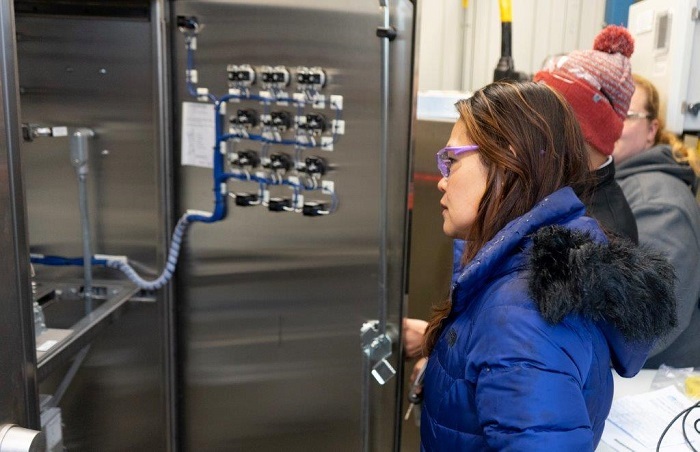 EM contractor Washington River Protection Solutions Engineer Elvie Brown examines equipment at the Plutonium Uranium Extraction Plant to learn more about the stack sampling program, as site contractors prepare for the start of tank-waste treatment under the Direct-Feed Low-Activity Waste Program.
RICHLAND, Wash. – Hanford Site contractors from the EM Office of River Protection and Richland Operations Office recently shared valuable experiences with one another regarding sampling emissions from site exhaust stacks in preparation for the startup of the Direct-Feed Low-Activity Waste (DFLAW) Program.
Once tank-waste treatment begins, new emissions-sampling requirements will be in place at the Waste Treatment and Immobilization Plant, currently under construction by Bechtel National Inc. When operational, crews will collect samples to ensure emissions comply with requirements that protect human health and the environment. Sampling provides evidence of successful filtration.
“This is a great example of contractors partnering at Hanford,” said Brian Harkins, EM assistant manager for Mission Support. “Contractor integration is an important part of advancing the Hanford cleanup mission.”
 |
|
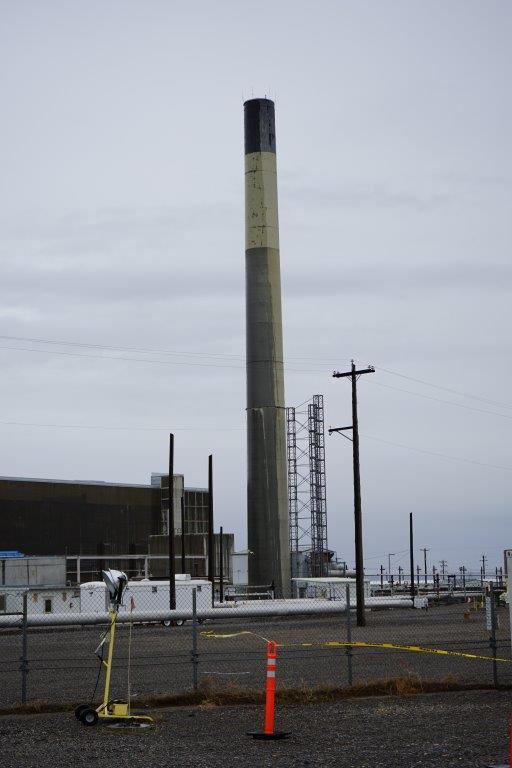
Hanford Site contractors reviewed emissions sampling for the stack at the Plutonium Uranium Extraction Plant as part of an information exchange of good practices. |
Tank operations contractor Washington River Protection Solutions (WRPS) sought feedback on the sampling process from contractor Hanford Mission Integration Solutions (HMIS), site integrator and manager of annual reporting on Hanford Site emissions. HMIS proposed a formal sharing of ideas through a visit to the Hanford Plutonium Uranium Extraction Plant (PUREX), managed by contractor Central Plateau Cleanup Company, which routinely collects samples from the plant’s ventilation system.
Tank-waste processing systems will generate similar emissions, and the demonstration at PUREX provided WRPS a clearer understanding of future requirements and processes.
HMIS provides emission reports for multiple facilities on the site to regulatory agencies, covering all contractors and demonstrating environmental compliance.
-Contributor: Robin Wojtanik
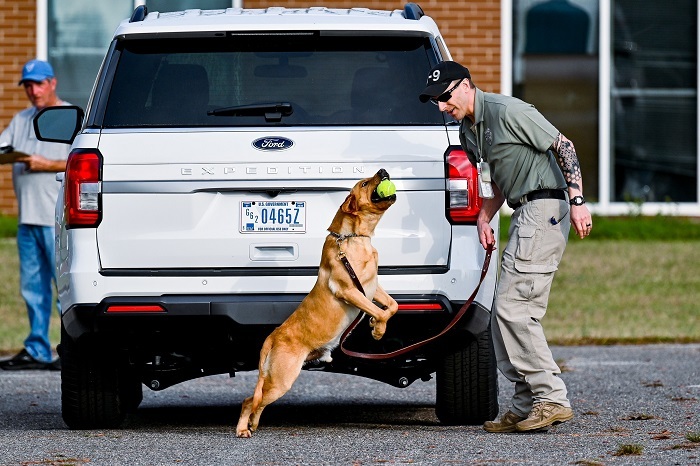 Security Police Officer Ryan Brady, a Centerra canine handler at Savannah River Site (SRS), and his canine, “Dogo,” conduct an explosives search on a vehicle at the United States Police Canine Association Region 2 Spring Detection Trials. The SRS canines are trained to sit when they detect the odor of potential explosive materials and are rewarded with a toy after a successful detection.
AIKEN, S.C. – The award-winning Savannah River Site (SRS) Canine Program recently helped host 41 teams from South Carolina, Georgia and North Carolina as they participated in annual trials of the nation’s oldest and largest police K-9 organization.
The United States Police Canine Association conducted its spring canine detection trials for the region at SRS. The event was jointly hosted by the SRS Law Enforcement Department, Aiken County Sheriff’s Office, Aiken Department of Public Safety and North Augusta Department of Public Safety.
“We have helped host this event with local law enforcement for over 20 years,” said Norris Bunch, supervisor of the canine section of security services contractor Centerra-SRS. “During certification trials, each team is held to a measured level of proficiency that must be maintained for certification, which is attained through proper training and demonstration through various testing events.”
The association held explosive training and certification at SRS and the narcotics training and certification at several locations in Aiken. A cadaver dog team from North Carolina joined the region’s spring trials for the first time this year.
The association is the universally accepted certification authority for canine working teams, and its testing procedures follow currently accepted police canine practices. To test fairly, law enforcement canine professionals serve as evaluators to observe and document canine team performance.
During trials, narcotics and explosives test sources are hidden on vehicles or in packages and the canine teams must successfully locate the items within a designated time period. Certification of a working canine team is an indicator of successful training and that the team is capable of successfully performing its assigned mission, whether it be explosives, narcotics or cadaver detection.
“After certification, handlers and their dogs are retested on an annual basis to ensure they maintain the proper fundamentals of training and technique,” added Bunch. “At the trials, all of our site canine teams once again achieved certification.”
The SRS Canine Program has earned numerous local, regional and national awards over the years and has been called upon to support local law enforcement and federal agencies, when site missions allow.
“We train constantly at SRS to ensure that our working dogs are able to provide critical support to our security mission at the site,” said Bunch. “As part of that training, we conduct internal testing that is based on United States Police Canine Association standards and certification methodology. As a result, we have a very robust canine program that is fully capable of providing explosives and narcotics detection support at any time.”
|