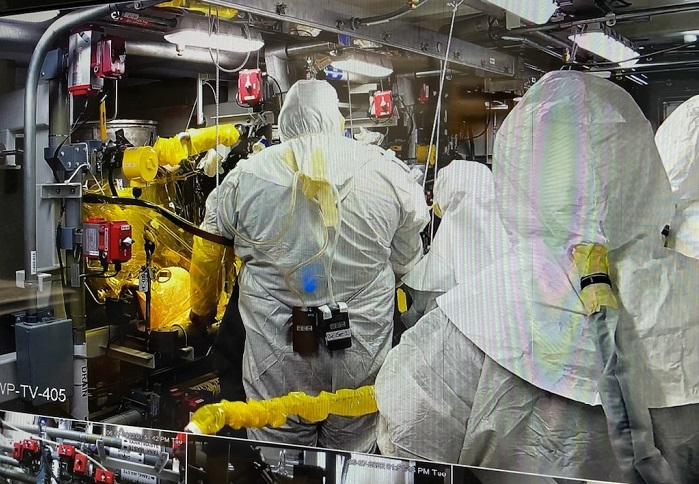
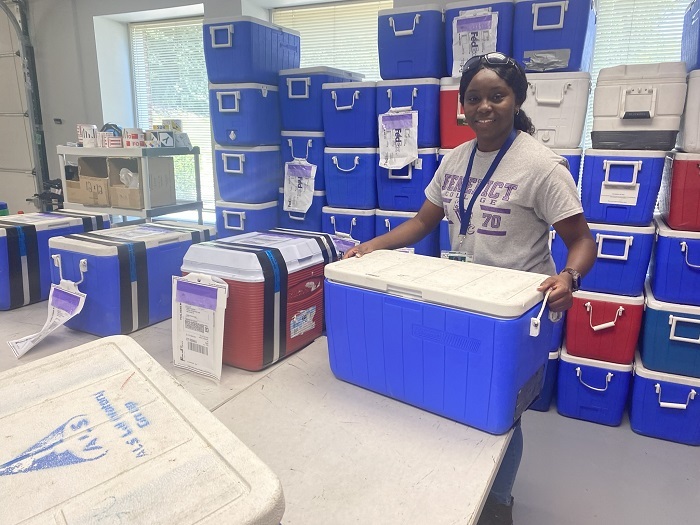
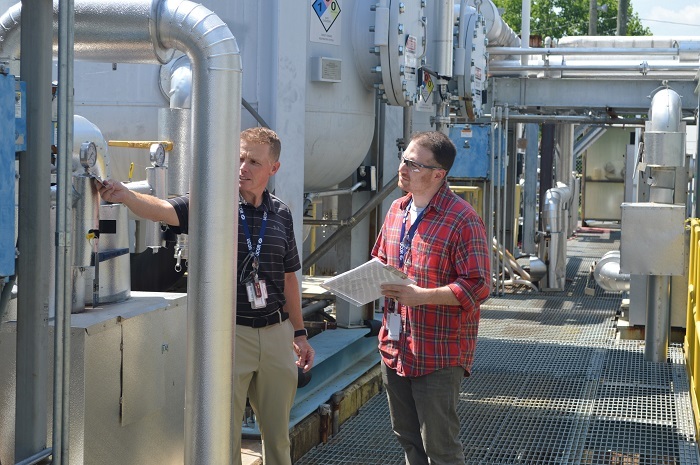
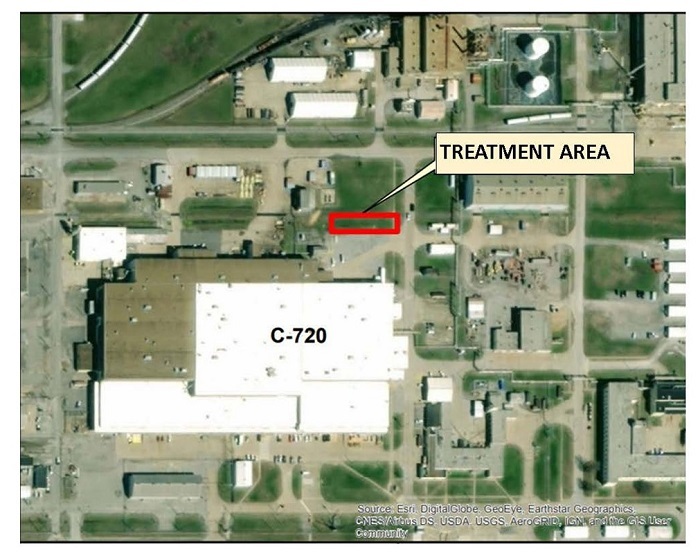
 EM initiated activities to begin bioremediation to address tricholoroethene (TCE) found in the source of the Southwest Groundwater Plume. The area being remedied is located northeast of the C-720 Machine Shop at the Paducah Site.
PADUCAH, Ky. – A new environmental remediation project at EM’s Paducah Site will deploy a biological technology to eliminate underground contaminants that compromise the area’s groundwater. The bioremediation process uses deliberately introduced microorganisms to break down environmental pollutants.
For years, EM and its remediation contractors have used a variety of technologies to successfully reduce offsite migration of such contaminants from the Paducah Site. An increasingly significant part of EM’s strategy targets onsite sources that accumulated over decades.
In the 1990s, an area of subsurface soil contamination was discovered near the site’s C-720 Machine Shop. C-720 supported operation of the gaseous diffusion plant where DOE and later industrial tenants enriched uranium to support national security and commercial energy applications. The machine shop was used for fabrication, assembly, cleaning and repairing equipment.
Soils in the area, spanning about a quarter-acre northeast of the C-720 Building near the Southwest Groundwater Plume, are contaminated with tricholoroethene (TCE). The TCE likely resulted from routine equipment-cleaning and rinsing with solvents at the machine shop. Historically, TCE was a common industrial degreaser.
EM evaluated several options for removing TCE from groundwater at this location and identified bioremediation to be an effective treatment technology based on the properties and characteristics of the soil and its contaminant.
“After many successful years of mitigating technologies reducing migration of offsite groundwater contamination, we will target TCE source reduction at the Paducah Site,” said Portsmouth/Paducah Project Office Manager Joel Bradburne. “We believe bioremediation will advance our mission to decrease source contamination and prepare the site for final cleanup actions.”
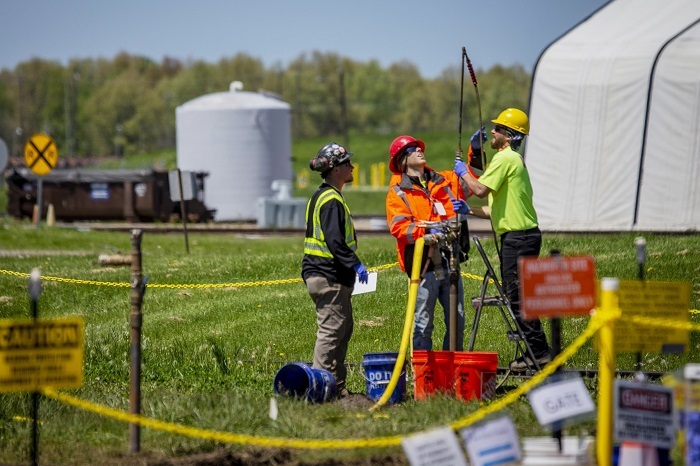 Workers at the Paducah Site perform activities to support removal of tricholoroethene (TCE) contained in the source of the Southwest Groundwater Plume.
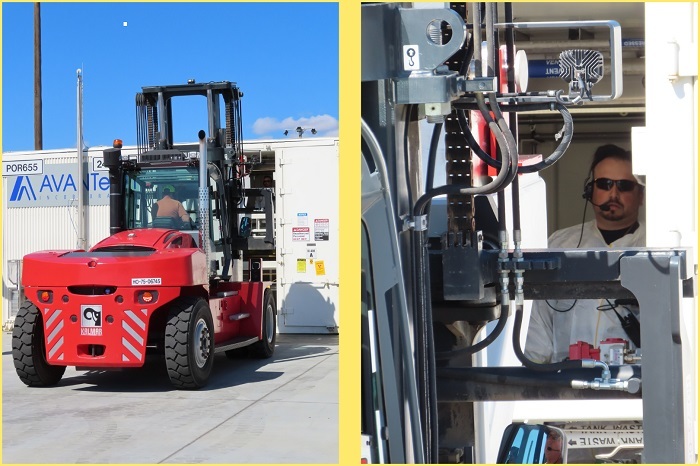
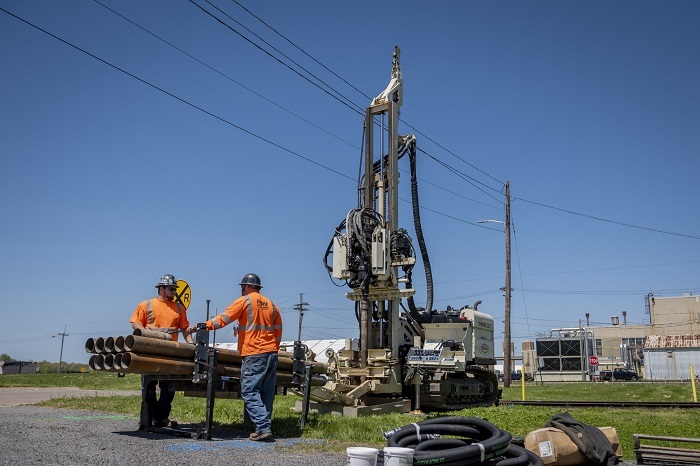 Workers at the Paducah Site support activities to deploy an effective treatment technology called bioremediation to eliminate underground contaminants that compromise the area’s groundwater.
The bioremediation process uses high-pressure water to create horizontal openings, or zones, in the underground. Then 443,000 pounds of a specialized type of iron metal, commonly used in environmental remediation, and 220,000 pounds of sand will be injected into those openings, which allows workers to inject 130,000 gallons of emulsified vegetable oil and 57 gallons of a commercially available TCE-reducing bacteria into the zones. The vegetable oil provides nourishment for bacteria and generates subsurface conditions to degrade the TCE. Groundwater monitoring wells will be used to monitor the progress over several years.
EM’s deactivation and remediation contractor, Four Rivers Nuclear Partnership (FRNP), recently began drilling, sampling and other activities to lay the groundwork for bioremediation to begin.
“Bioremediation combined with natural degradation should cause the contamination to naturally decrease over the next several years,” FRNP Program Manager Myrna Redfield said. “These efforts are critical steps in the success of Paducah’s ongoing cleanup efforts to reduce groundwater contamination.”
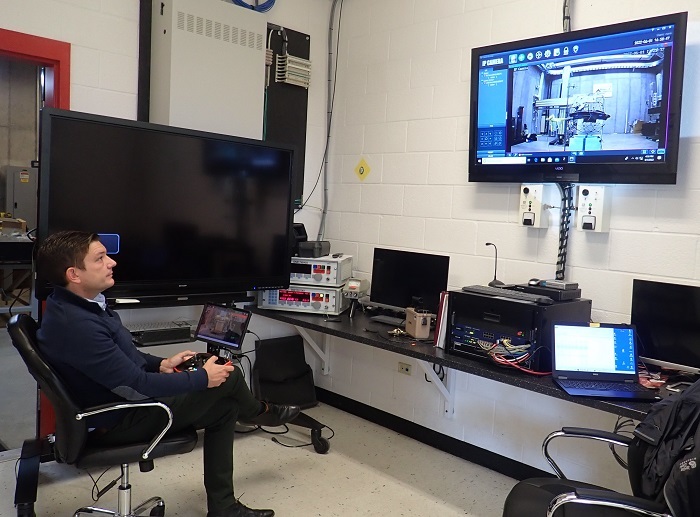 Gaël Brésolin, with drone manufacturer Flyability, Inc., flies a drone remotely inside the Idaho Accelerator Center Imaging Laboratory at Idaho State University. EM has partnered with physicists at the laboratory to test the drone’s ability to operate under high levels of radiation.
IDAHO FALLS, Idaho – EM is testing a commercial inspection drone to map piping and other obstructions as it prepares to position equipment to retrieve granulated high-level radioactive waste called calcine from storage bins enclosed in a concrete vault at DOE’s Idaho National Laboratory Site.
EM’s calcine retrieval project has been developing remotely operated equipment, cameras and retrieval technology in recent years to remove 220 cubic meters of dried calcine from one bin set to another. The emptied bin set would then be closed under federal regulations.
Testing of equipment continues on a full-sized replica of that first bin set to be emptied using simulated calcine material. Some piping and other internal obstacles were added to the mock-up to replicate the actual bin as closely as possible.
Calcine is a dried byproduct of the legacy spent nuclear fuel reprocessing mission at the Idaho Nuclear Technology and Engineering Center (INTEC). In an agreement with the state of Idaho, EM is required to retrieve, treat, repackage and prepare 4,400 cubic meters of calcine to ship for out-of-state disposal by 2035. The material is in storage in six separate bin sets inside concrete vaults at an INTEC facility.
 |
|
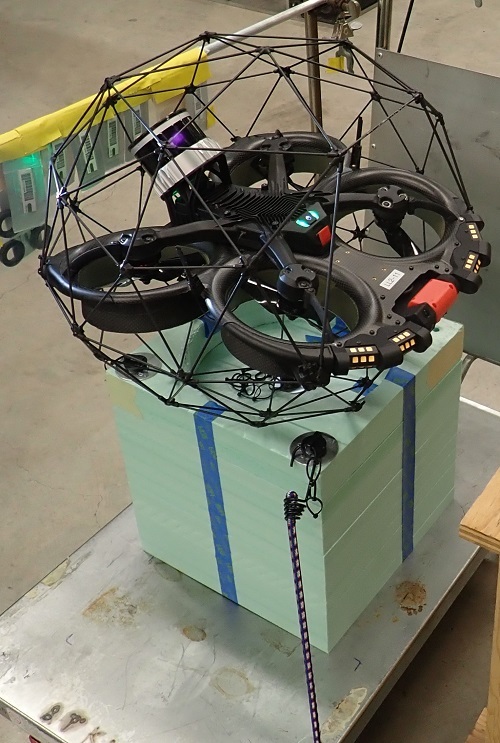
The drone pictured is being considered for use by EM’s calcine retrieval project at DOE’s Idaho National Laboratory Site to map piping and other obstructions inside a concrete vault. Information obtained from the drones would help employees prepare to access vessels containing calcine enclosed in the vault. |
Two years ago, the project used light detection and ranging technology to create a 3D map of obstructions above the storage bins contained within the vault with limited results. Since that technology was limited to a single location during data collection, several “shadow areas,” or blind spots, exist in the 3D map.
Last fall, the calcine retrieval project hired drone manufacturer Flyability, Inc. to test the drone used to inspect confined spaces on the bin set mock-up to map obstructions surrounding the bin set more effectively. The drone is unique because it is currently the only confined space inspection drone equipped with the light detection and ranging technology and contained by a lightweight carbon fiber cage allowing it to safely bounce off obstructions and remain flying.
Earlier this month, Kevin Young, an engineer with the calcine retrieval project, partnered with physicists at the Idaho Accelerator Center Imaging Laboratory (IACIL) at Idaho State University to subject the drone to high levels of radiation to determine how the drone operates under those conditions. It was irradiated while under tethered flight and operated successfully at a dose rate of 10,000 roentgen per hour with an accumulated dose of 4,000 roentgen. A dose rate of 2,000 roentgen per hour is the worst-case estimated field strength the drone is expected to encounter while flying near the surface of the calcine storage bins. Roentgen is a unit of radiation.
The IACIL went online in the 1980s to perform nuclear-based applied research. It was chosen to conduct testing on the calcine retrieval components because it is more cost effective and safer than recovering a portion of actual calcine and conducting testing in a hot cell, which is a radiation containment chamber.
The EM team intends to continue working with the drone manufacturer to enhance the drone’s capabilities and accuracy of 3D-map data collected by the drone.
-Contributor: Erik Simpson
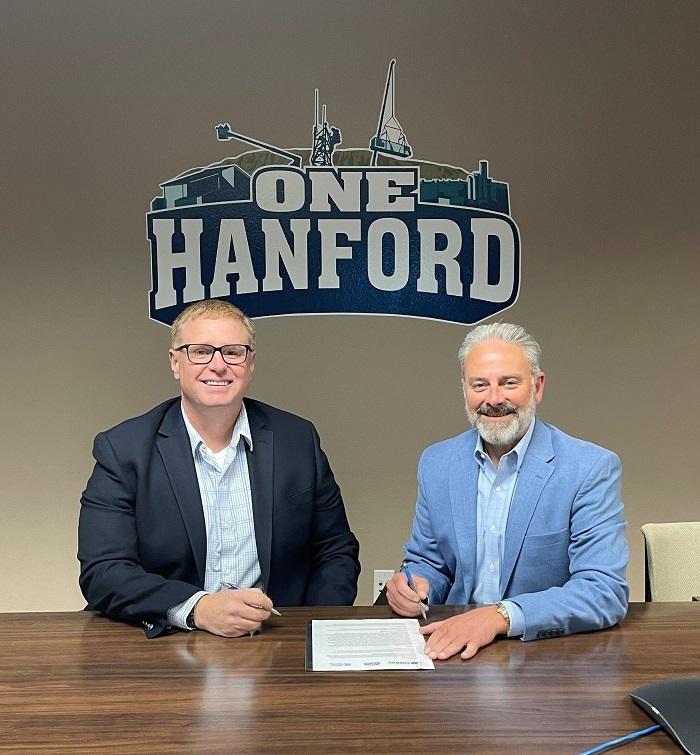 Hanford Site Deputy Manager Brian Stickney and Central Plateau Cleanup Company President John Eschenberg sign the Central Plateau Cleanup Contract Partnering Agreement.
RICHLAND, Wash. – EM Richland Operations Office (RL) and contractor Central Plateau Cleanup Company (CPCCo) recently signed an agreement outlining a partnership to deliver mission success.
Hanford Site Deputy Manager Brian Stickney and CPCCo President John Eschenberg put pen to paper, making the Central Plateau Cleanup Contract Partnering Agreement an official record. The agreement establishes a collaborative approach through open communication and coordination to safely advance the cleanup and risk reduction of Hanford’s Central Plateau and Columbia River corridor.
“This is a critical step in establishing the framework of our partnership with DOE,” said Eschenberg. “The partnering team met in the early days of the contract to iron out the details, and this signed document solidifies our commitment to working hand in hand with the Department. Together, we will continue to identify common goals, develop sound processes, plan meaningful work scope, manage risk and optimize resources for the common good.”
As partners in administering the first end-state contract in the EM complex, RL and CPCCo are responsible for advancing the cleanup and risk reduction at Hanford’s Central Plateau by developing task orders — smaller, agreed-upon chunks of work that drive safe and efficient cleanup progress. Key projects include the “cocooning” of retired nuclear reactors by building enclosures around the structures, demolition of obsolete facilities, remediation of former waste sites, safe storage of waste capsules, low-level waste disposal, groundwater management, and preservation of key historical facilities, including Hanford’s historic B Reactor.
The partnering agreement recognizes that success on these projects can only be achieved by collaborating and communicating with key stakeholders — including other Hanford contractors — to find high-quality solutions to complex cleanup challenges.
“This process began with partnering workshops involving DOE and CPCCo leadership, where we worked collaboratively to develop into a cohesive team focused on safely delivering significant risk reduction on the Central Plateau and along the Columbia River corridor,” Stickney said. “Our collective team is committed to making integrated decisions, resolving issues, removing obstacles and partnering to implement innovative solutions to make that happen. Our goal isn’t the signing of this piece of paper; rather, this is the first in a multistep process to continue delivering meaningful cleanup progress at Hanford.”
-Contributor: Rob Roxburgh
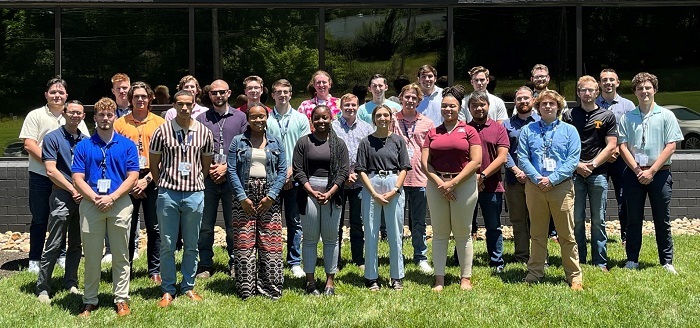
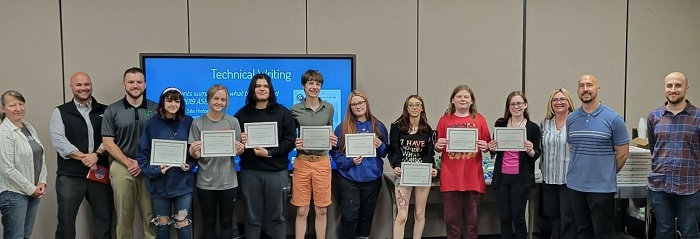 Representatives from EM, Fluor-BWXT Portsmouth and Ohio University congratulated students from Ohio's Western High School who participated in an EM Annual Site Environmental Report Summary project, during a school visit last month.
LATHAM, Ohio - Officials from EM and Ohio University recently joined a class at Ohio’s Western High School to celebrate the 11th cohort of students to complete an EM Annual Site Environmental Report (ASER) Summary project.
As part of a grant administered by EM’s Portsmouth/Paducah Project Office (PPPO) — and in coordination with PPPO’s Portsmouth Site staff and contractors and Ohio University — the project assigns a group of science students to summarize the highly technical ASER to make it more concise and readable for the public.
“The ASER student summary is one of our most valuable outreach programs here,” said Jeremy Davis, PPPO’s acting Portsmouth Site lead. “At the end of the school year, these students often will have become some of the most knowledgeable stakeholders regarding site activities, monitoring and history. We appreciate every student who participated this year and hope they found this information valuable.”
Under the direction of Western High science teacher Andrew Delotell and Jacob White, senior executive in residence for education and evaluation at Ohio University, students learned about the former Portsmouth Gaseous Diffusion Plant, environmental sampling and technical writing during their assignment.
During the 2021-2022 academic year, the students met with subject-matter experts from PPPO, prime cleanup contractor Fluor-BWXT Portsmouth and Ohio University. They wrote six essays regarding Portsmouth Site activities to be published in the "Student Summary of the U.S. Department of Energy Portsmouth Annual Site Environmental Report," to be issued for stakeholders later this year. Students will also be credited as co-authors of the document.
The ASER student summary is produced annually in collaboration with Ohio University’s EM-supported PORTSfuture program. It is one of many successful educational outreach efforts at the Portsmouth Site.
-Contributor: Charles Love
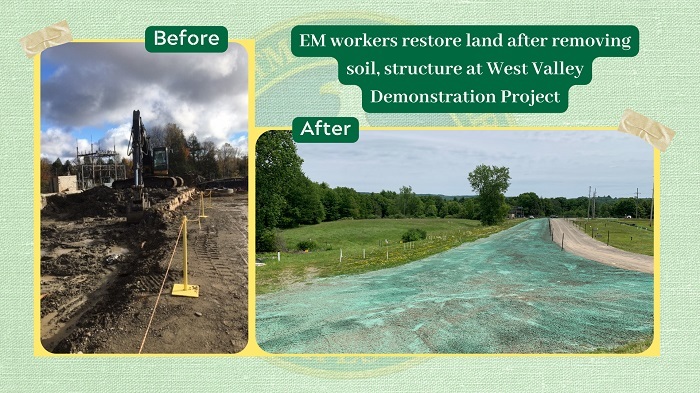
WEST VALLEY, N.Y. – EM and its cleanup contractor at the West Valley Demonstration Project (WVDP) recently finished restoring an area where they removed soil and a structure associated with a project to build a unique groundwater treatment system.
With the help of a recently upgraded rail line, workers with CH2M HILL BWXT West Valley (CHBWV) safely shipped 300 containers of soil and 131 containers of debris generated from the project to construct the system, known as a permeable treatment wall. “This project demonstrated the benefits of using the rail line for waste operations, as well as for increased safety, efficiency and cost savings,” said Steve Bousquet, EM-WVDP deputy federal project director for the Main Plant Process Building demolition. “Our dedicated employees continue to find ways to further improve our cleanup efforts as we look for ways to safely accelerate decommissioning and remediation efforts for the future.”
Workers shipped the soil and debris containers from West Valley to a disposal facility in Clive, Utah. The shipments add to a safe transportation record of more than 25,000 rail miles from January through May 2022.
Upon completing demolition of the structure and shipping the waste from the project, crews used heavy equipment to regrade the area and add topsoil for restoration. They also hydroseeded the land — a technique that spreads a slurry of seeds and liquid on the ground to grow grass and prevent soil erosion.
“Our employees and subcontractors did an excellent job in safely moving this project from paper to completion,” said Linda Michalczak, CHBWV projects manager. “This accomplishment speaks volumes on the importance of solid communication, following procedures, using lessons learned and teamwork.”
The groundwater treatment system was installed to mitigate a plume that originated from historical releases at the Main Plant Process Building. The wall, which will remain in place, is an approximately 785-foot-long trench that contains nearly 2,000 metric tons of zeolite, a naturally occurring mineral formed from volcanic ash. The zeolite strips the contaminant strontium-90 from the groundwater passing through the wall.
The rail line will also be used during the knockdown of the Main Plant Process Building, an EM 2022 priority. -Contributor: Joseph T. Pillittere
|