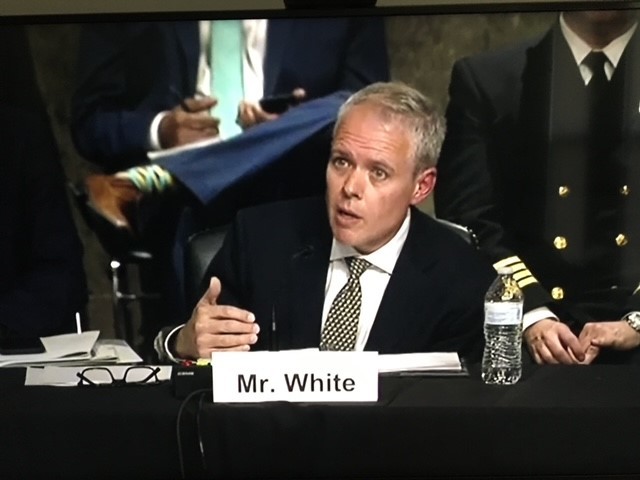
Speakers will include William “Ike” White, EM senior advisor; Candice Robertson, acting EM principal deputy assistant secretary; and other officials from EM headquarters and field sites.
Participants also will include Brent Gerry, mayor of the City of West Richland, Washington, and Rebecca Casper, mayor of the City of Idaho Falls, Idaho.
The annual workshop brings together DOE executives, industry leaders, national and local elected officials, and other stakeholders to discuss EM's progress on the cleanup of the environmental legacy of the nation's Manhattan Project and Cold War nuclear weapons program.
This year’s program theme is “Clearing the Decks to Enable the Next Decade of Cleanup Success.”
Topics to be discussed will include EM successes at field sites over the past year; upcoming EM acquisition plans and schedules; lessons learned toward improving project performance; entering a new era for Hanford tank waste treatment; developing the future EM workforce; and resolving key community and state issues, among others. The Energy Communities Alliance sponsors the workshop in cooperation with EM and the Energy Facility Contractors Group. For further information on the agenda and conference registration, please see EM’s 2022 National Cleanup Workshop website. AIKEN, S.C. – The Savannah River Site’s (SRS) K Area Complex (KAC) nuclear material management facility is undergoing a large number of infrastructure projects at an unprecedented pace to improve the capabilities and flexibility of KAC and its employees and prepare for upcoming missions.
Major infrastructure work is ongoing to support expanded plutonium downblending operations and prepare for the installation of three new surplus plutonium disposition project gloveboxes, and the additional personnel who will operate them.
“SRS is committed to helping the Department of Energy advance its mission of removing plutonium from the state of South Carolina,” said Lee Sims, K Area Facility manager for Savannah River Nuclear Solutions, the managing and operating contractor at SRS. “Most of our facilities are approximately 70 years old, including the decommissioned K Reactor facility where most nuclear material storage and processing activities occur. We are working to modernize and upgrade our facilities to increase efficiencies, ensure safety and maximize productivity. A little investment in infrastructure now will go a long way to ensure a successful future.”
In the next several years, KAC will nearly double its workforce to keep up with changing missions. To work in KAC, employees must navigate a number of security features, including multiple entry control facilities (ECFs) staffed by SRS protective force personnel.
“Although this process can be cumbersome and sometimes takes a few minutes per individual, it is imperative to ensuring the safety and security of the nuclear materials we are entrusted with storing and processing,” K Area Deputy Facility Manager Amanda Barnes said. “Our team recognized early on in the process of planning increased plutonium downblending that once significantly more employees start showing up at the ECFs during shift changes, the lines to get through would start backing up and waste a lot of worker time. To improve personnel access time, the National Nuclear Security Administration (NNSA) has funded projects to build an additional ECF into the protected area and build a larger, more efficient ECF into the Material Access Area (MAA) to facilitate personnel flow.
“We have also completed installation and hook-up of nine new trailers to add additional office spaces and restroom facilities for the current employees and influx of employees to come.”
 |
|
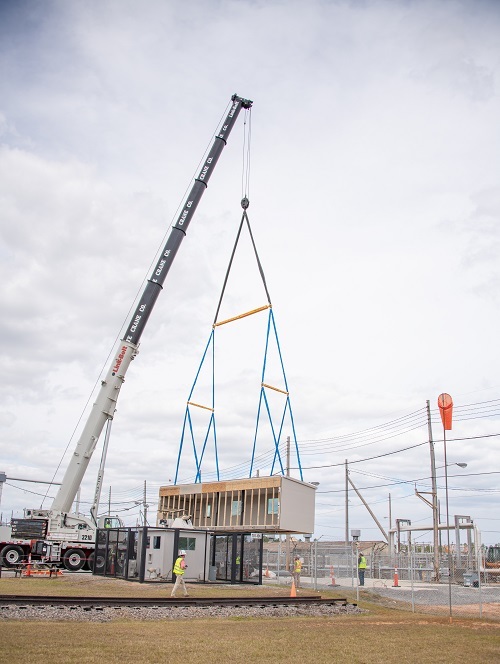
A crane lifts part of a modular building as part of improvements in K Area at the Savannah River Site. |
To improve downblended plutonium storage and processing safety and efficiency, KAC is making modifications to the K Reactor facility to make room for the new MAA entry control and support facilities. This will involve many different SRS departments and careful planning to achieve.
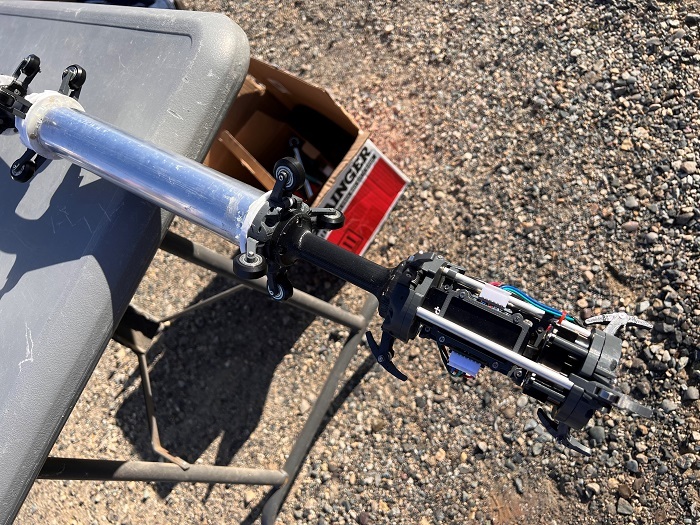
Additionally, KAC is working with the site’s N Area, where maintenance, medical and transportation facilities are found, to retrofit a storage building into an interim facility for storage and inspection of empty criticality control overpack drums. These drums are used by K Area to ship transuranic waste produced in downblend operations to the Waste Isolation Pilot Plant in New Mexico. The building will also be used to test and house robotic equipment developed by Savannah River National Laboratory to inspect empty drums, and an autonomously guided vehicle to handle drums. In addition, KAC is performing critical infrastructure upgrades and repairs to ensure the safety and security of the EM-owned facility as part of EM’s work scope. This work includes replacing the roofs on both the 701-1K and 701-2K ECFs.
“K Area is an integral part of the Department’s nonproliferation and environmental cleanup missions,” said Virginia Kay, with the NNSA's Office of Material Disposition. “The K Reactor at the Savannah River Site was initially built for national security missions during the Cold War. Although it is no longer an operating reactor, the facility continues to support national security missions today. We are pleased with all of the infrastructure work going on in the area and are excited to see the future of the KAC.”
Sims noted that the EM and the NNSA missions meet at K Area.
“We stand ready to work as a team with our customers to fulfill the mission objectives,” Sims said. “With all of this activity going on in the area, it will take the focus and commitment of all of our employees to ensure the highest standards of safety and security. But I truly believe we are up to the task.”
-Contributor: Lindsey MonBarren
 A new concrete transfer pad will support the movement of radioactive capsules from the Waste Encapsulation and Storage Facility to a nearby dry-storage area at the Hanford Site.
RICHLAND, Wash. – In the blink of an eye, as this time-lapse video shows, crews with EM Richland Operations Office contractor Central Plateau Cleanup Company last month completed pouring 11 truckloads — or about 120 cubic yards — of concrete for a new transfer pad outside the Waste Encapsulation and Storage Facility truck port at the Hanford Site. The 18-inch-thick, rebar-reinforced slab is designed to support loads up to a half-million pounds.
The work is part of ongoing upgrades and modifications to get ready for the movement of 1,936 radioactive capsules from an underwater basin in the facility about a quarter-mile to a new dry storage area. Moving the capsules to dry storage will enable the planned deactivation of the aging storage facility and save as much as $6 million in annual operating costs.
Participants in the Deactivation & Decommissioning Technology Development Workshop included, from left, Marion Cofer, Savannah River National Laboratory (SRNL); Todd Phillips, Oak Ridge cleanup contractor UCOR; Rob Hogg, Savannah River Site managing and operating contractor Savannah River Mission Completion; John Mojka, UCOR; Holly VerMeulen, SRNL; Joe Sinicrope, Florida International University (FIU); Jean Plummer, SRNL; Gary Benda, Waste Management Symposia; Jen Wohlwend, SRNL; Leonel Lagos, FIU; Nancy Buschman, EM headquarters; Will Jolin, SRNL; Anna Stanfield, SRNL; and Chris Bannochie, SRNL.
AUGUSTA, Ga. – Scientists, engineers and technical experts from DOE programs learned of progress in technology development during a workshop held April 25-27 in Augusta, Georgia.
The Savannah River National Laboratory (SRNL) hosted the Deactivation & Decommissioning (D&D) Technology Development Workshop at the Georgia Cyber Center. More than 60 people attended in person or virtually.
Nancy Buschman, director of EM’s Office of Infrastructure and D&D, served as lead speaker, discussing the importance of lessons learned, progress in technology development and the integration of technologies into EM.
Other topics during the workshop included decontamination/dismantlement; approaches to mercury-contaminated buildings; artificial intelligence and robotics; and knowledge sharing.
Participants included speakers from EM headquarters; SRNL; Oak Ridge cleanup contractor UCOR; Florida International University; Princeton Plasma Physics Laboratory; EM Consolidated Business Center; Idaho National Laboratory; West Valley Demonstration Project; Environmental Alternatives Inc.; and FIS 360.
|