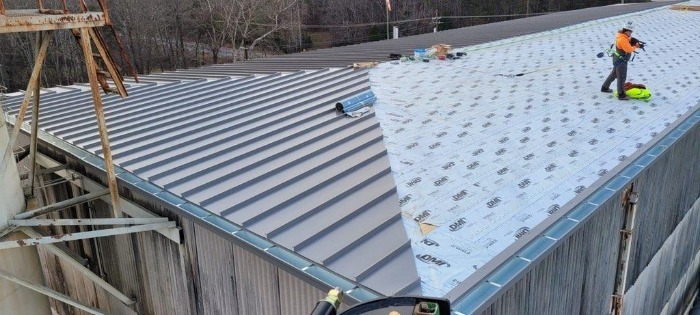
 A small business contractor helped replace the roof at the Molten Salt Reactor Experiment at the Oak Ridge National Laboratory earlier this year as part of a series of projects to keep the building safe and stable as it awaits demolition in the years ahead.
Representing more than 15% of EM’s annual budget, small business prime contractors and subcontractors contribute significantly to the cleanup program’s success at every one of its sites.
That level of annual funding is a result of EM’s strong commitment to small business use and the DOE Small Business First Policy. According to the policy, DOE fosters a dynamic business environment for the small business community, widening the scope of opportunities for small businesses while also strengthening the Department and the American economy. The small businesses include veteran- and women-owned companies, among others.
“All of our partners, from the large management and operations contractors to the small business subcontractors, are integral to our progress as we work to clear the decks and tackle remaining hurdles in our cleanup mission," said Dae Chung, EM Associate Principal Deputy Assistant for Corporate Services. “We value the contributions of small businesses, and we will continue to rely on their unique expertise across the cleanup complex."
In an initiative to develop new markets for small businesses and increase their participation in EM’s larger contracts, the cleanup program has developed special contract clauses focused on optimizing small business use through subcontracting. Most recently, EM expanded small business participation in non-traditional areas through EM’s support of Naval Reactors cleanup work scope.
Small businesses are critical to the advancement of EM’s cleanup and closure efforts. Their focuses include engineering and technical support; installing, upgrading and maintaining site infrastructure; construction and transportation; and waste cleanup, treatment, and characterization.
EM small business prime contractors perform cleanup at locations such as the Nevada National Security Site, the Moab Uranium Mill Tailings Remedial Action Project in Utah, and the former Energy Technology Engineering Center (ETEC) site in California.
At ETEC, the contractor teamed with DOE and the California Department of Toxic Substance Control (DTSC) to overcome cleanup challenges. Its work involved obtaining DTSC approval, partnering with stakeholders and demolishing all remaining DOE buildings at the site, meeting an EM priority for 2021.
Small business subcontractors helped complete cleanup of the East Tennessee Technology Park at Oak Ridge ahead of schedule and under budget. They played crucial roles by providing infrastructure support, welding, and metal fabrication, and delivering nuclear and industrial safety supplies.
A Small Business Administration certified 8(a) and small disadvantaged business construction firm was awarded a contract in 2021 to design and construct the Advanced Manufacturing Collaborative Facility. The new facility, to be located on the campus of the University of South Carolina-Aiken, will support the missions of EM and the Savannah River National Laboratory while enhancing and expanding collaborations with academia, industries and other government agencies.
The EM Carlsbad Field Office relies on safe and compliant transportation of transuranic (TRU) waste between various DOE sites to the Waste Isolation Pilot Plant (WIPP) by a veteran-owned small business commercial motor carrier. Shipments of TRU waste to WIPP started in 1999, and WIPP has safely received more than 13,000 shipments to date.
At the Savannah River Site (SRS), small business subcontracts provided fly ash, a material used to form grout to dispose of decontaminated salt solution in Saltstone Disposal Units. Other critical components, such as enhanced commercial submersible mixer pumps for dissolving salt cake in SRS waste tanks, were procured through small business partners.
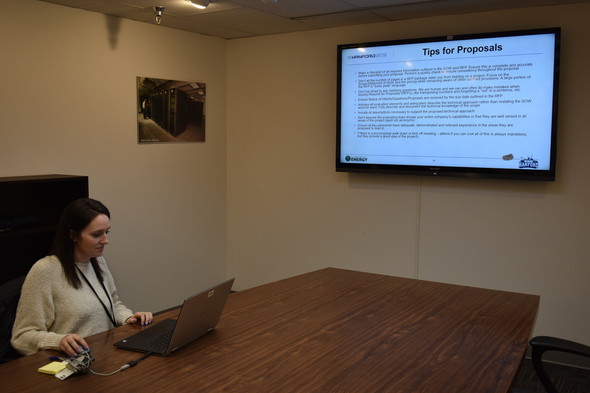 Small business program manager Haley Taylor with Richland Operations Office prime contractor Hanford Mission Integration Solutions shares information about putting together a successful contract proposal with local and regional small businesses during a recent Hanford Site subcontractor quarterly online forum. The small business program managers with Hanford’s prime contractors host the forums to connect with small businesses and share best practices for doing business at the site.
RICHLAND, Wash. – With small businesses a key contract component across the EM complex, prime contractors at the Hanford Site are collaborating to connect with potential subcontractors and offer firsthand assistance to small businesses. Small business program managers are hosting quarterly online forums to connect with local and regional small businesses and share best practices for doing business at the site.
“The feedback has been really positive,” said Robin Whitney, small-business program manager for the Richland Operations Office. “A lot has changed over the past few years, and vendors appreciate the updated information and helpful tips on how to do business at Hanford.”
The highlight of each forum happens when prime contractors preview potential business opportunities over the next three to six months.
 Clockwise from top left: Hanford small business program managers Haley Taylor (Hanford Mission Integration Solutions), Talia Ochoa (Washington River Protection Solutions), Scott Mason (Central Plateau Cleanup Company), Robin Whitney (Richland Operations Office), Kathleen Valencia (Bechtel), Mary Garrard (Hanford Laboratory Management and Integration), Susan Hiller (Richland Operations Office), and Cheryl Daily (HPMC Occupational Medical Services) host quarterly online forums to connect with local and regional small businesses.
“The look ahead helps small businesses know what opportunities are coming up, determine which would be a good fit with their business models and make plans to submit proposals,” said Haley Taylor, small business program manager with Hanford prime contractor Hanford Mission Integration Solutions.
The first forum in June 2021 focused on Hanford’s 5-Year Plan and included an overview of each prime contractor and how to do business with them. Forums held in October 2021 and January 2022 focused on insurance requirements for subcontractors working at Hanford, along with helpful hints on putting together a successful contract proposal. Each virtual event attracted around 150 participants representing 40-70 potential subcontractors.
Forums will continue to be held virtually, with the next scheduled for April.
-Contributor: Shane Edinger
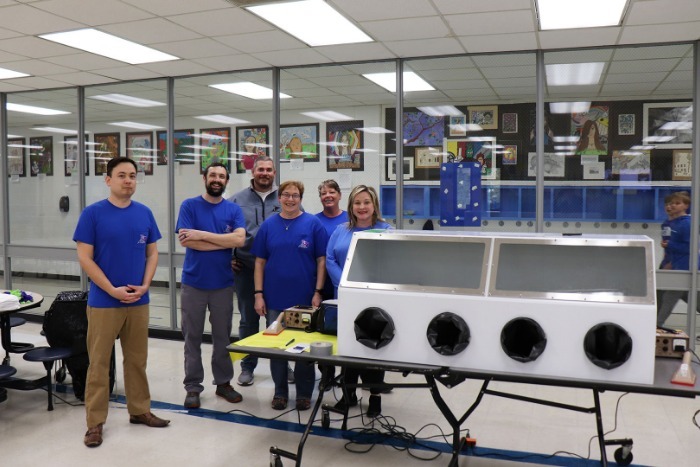 Isotek employees, from left, John Gray, Josh Hensley, Adam Bishop, Linda Gilpin, Katherin Goluoglu and Melissa Hope volunteer to support student learning at Jefferson Middle School’s annual Science, Technology, Engineering, and Mathematics (STEM) Night. Isotek is an Oak Ridge Office of Environmental Management contractor.
OAK RIDGE, Tenn. – Employees from Oak Ridge Office of Environmental Management (OREM) contractor Isotek recently supported a local middle school’s Science, Technology, Engineering, and Mathematics (STEM) Night, which attracted hundreds of students and their family members.
The annual STEM Night has been a major attraction since Jefferson Middle School began hosting it in 2019. The event increases students’ awareness of STEM technologies and careers, and provides hands-on learning activities. It also gives local companies and organizations a unique opportunity to engage with students.
Watch this video to see more of Isotek’s involvement at STEM Night.
About 500 people attended this year’s STEM Night. Isotek was one of more than 20 local groups that set up interactive learning exhibits.
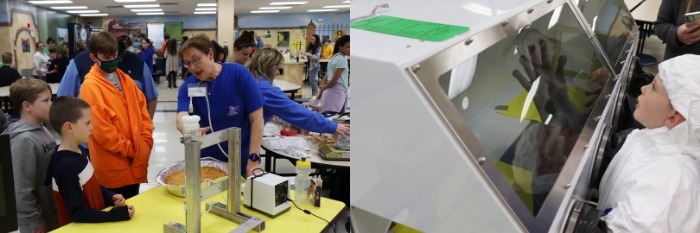 Approximately 500 people attended Jefferson Middle School’s annual Science, Technology, Engineering, and Mathematics (STEM) Night earlier this month. Oak Ridge Office of Environmental Management contractor Isotek demonstrated how its employees use gloveboxes to handle radiological material in a controlled setting. The contractor also featured exhibits focused on controlling nuclear material, weighing material, and extracting medical isotopes to support cancer treatment research.
“We do this to expand the concept of STEM by showing all these different technologies and experiences to kids who might not ever have the opportunity to see it, experience it, or even know that it’s out there,” Jefferson Middle School STEM Coach Alex Goldberg said. “The kids are pretty excited. It’s really great to see.”
Isotek’s exhibition allowed students to experience how the company’s employees conduct processing operations in gloveboxes. Middle school students dressed in protective suits and put their hands in a glovebox designed for practice and training. The experience showed how gloveboxes are used to handle radiological material in a controlled setting.
Isotek also demonstrated how its employees control nuclear material, weigh material and extract rare medical isotopes that support cancer treatment research.
“I just love seeing all the kids get excited,” said Melissa Hope, Isotek nuclear material control and accountability manager.
“We had fun and we’ll be back for Robertsville Middle School’s STEM Night,” said Isotek Data Manager Linda Gilpin, referring to another local STEM Night.
Isotek is responsible for processing, downblending and eliminating the inventory of uranium-233 material stored at Oak Ridge National Laboratory, which is OREM’s highest priority at the site. Through a partnership with nuclear innovation company TerraPower, the contractor is also extracting thorium-229 to support cancer treatment research.
-Contributor: John Gray
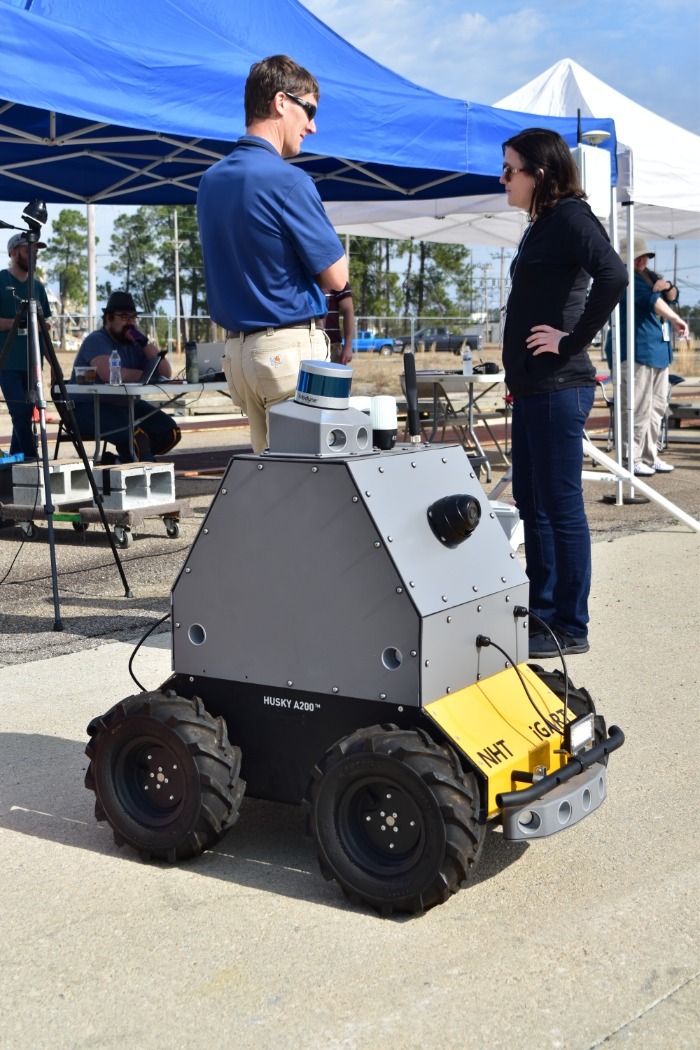 Troy Lorier, with Savannah River National Laboratory’s Global Security Directorate, left, and Anna Erickson, president and CEO of NuHorizon Technologies, discuss the Integrated Ground-based Autonomous Agent for Radiological Tracking (iGART) during a demonstration of the technology at the laboratory. iGART is a ground-based robot that conducts radiological and nuclear inspection. EM is using the demonstration at the Savannah River Site (SRS) to determine if there is an application value for iGART at SRS or other EM sites.
AIKEN, S.C. – Savannah River National Laboratory (SRNL) oversaw the demonstration recently of a new radiological inspection technology called iGART.
The Integrated Ground-based Autonomous Agent for Radiological Tracking, or iGART, was developed by NuHorizon Technologies under a small business innovation research grant. EM is using the demonstration at the Savannah River Site (SRS) to determine if there is value for iGART’s use at SRS or other EM sites.
iGART is a system that integrates a commercial off-the-shelf, 4-wheeled, mobile platform, radiation detectors and 3D vision sensors. Working autonomously or by remote control, the robot detects radiological contamination.
“The purpose of iGART is to identify sources of radiological contamination using a location system and a very sophisticated array of sensors,” said Anamary Daniel, vice president of corporate strategy and government program services for Inspection Experts, which assisted EM in evaluating the technology.
Daniel said iGART technology has potential for indoor and outdoor application in the EM cleanup mission.
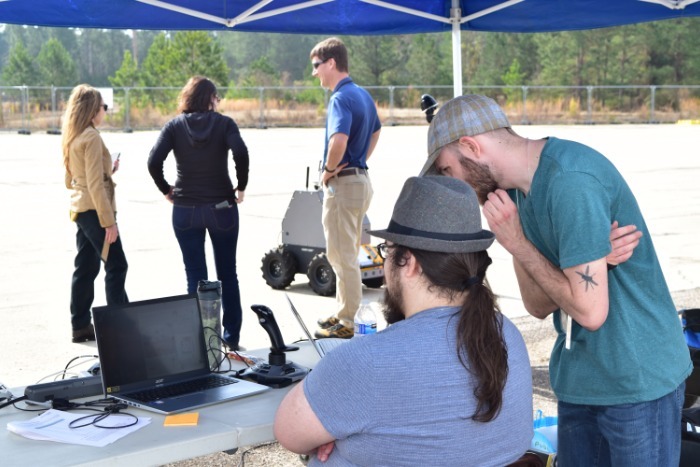 Wade Sheldon, system integrator of NuHorizon Technologies, seated, and Steven Hendry, NuHorizon principal investigator for the Integrated Ground-based Autonomous Agent for Radiological Tracking (iGART) project, review data during a demonstration of the iGART technology.
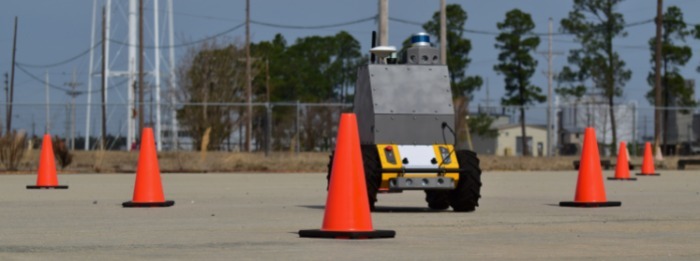 The Integrated Ground-based Autonomous Agent for Radiological Tracking (iGART) maneuvers through a course during a demonstration of the technology at Savannah River National Laboratory.
“Outdoor spaces and large facilities, like the Y-12 National Security Complex at Oak Ridge or any large structure at a DOE site, are very good examples of the application of iGART assisting in characterization surveys,” she said. “Potential benefits of this technology are reduction of worker exposure and efficiency in data collection.”
Daniel continued, “EM has a collaborative, interagency agreement with the Department of Homeland Security (DHS) that enables both agencies to share technological advances that can assist and support in their respective missions. It so happens that DHS sponsored the development of iGART, and this technology has tremendous potential for the Environmental Management mission.”
The technology was conceptualized at one of SRNL’s partner universities, Georgia Tech, making the demonstration at SRS particularly rewarding.
“The idea behind iGART started as a design project in one of the courses and two of the three engineers here were part of the course. The student team designed a small-scale, simplified system which did very well in radiation mapping,” said Anna Erickson, president and CEO of NuHorizon Technologies.
Erickson said it took about five years to get iGART from the classroom idea to the demonstration phase. She also said the robot tested at SRS looks nothing like the conceptual design from the classroom.
“System integration took the bulk of the effort in developing the technology,” said Erickson. “The components (of iGART) may be well known to people, but how to make them talk to each other and work in a coherent manner, this is what was missing.”
-Contributor: Chris O’Neil
|