|
PHOENIX – More than two decades after receiving its first transuranic (TRU) waste shipment, EM’s Waste Isolation Pilot Plant (WIPP) is undergoing major upgrades necessary to continue its mission for decades to come, including improvements to aging infrastructure and construction of the new Safety Significant Confinement Ventilation System (SSCVS).
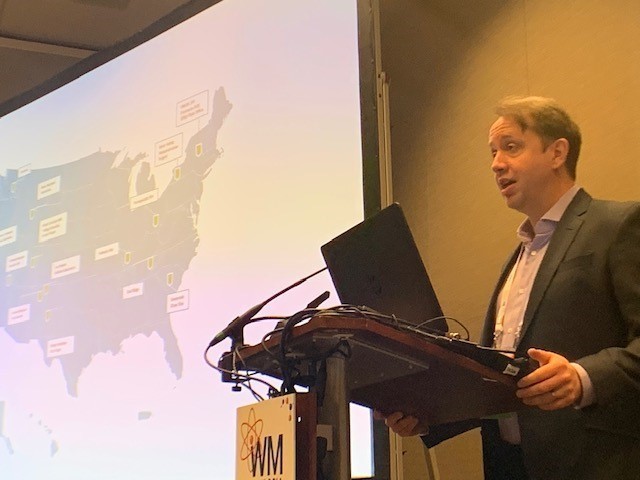
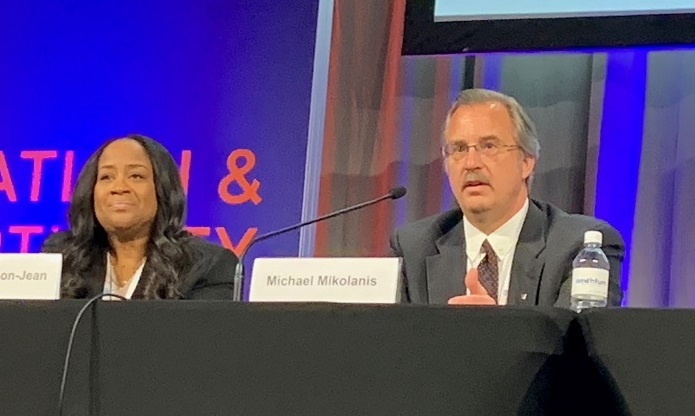
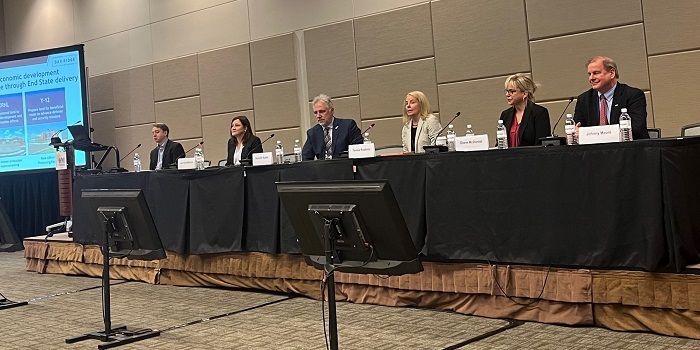
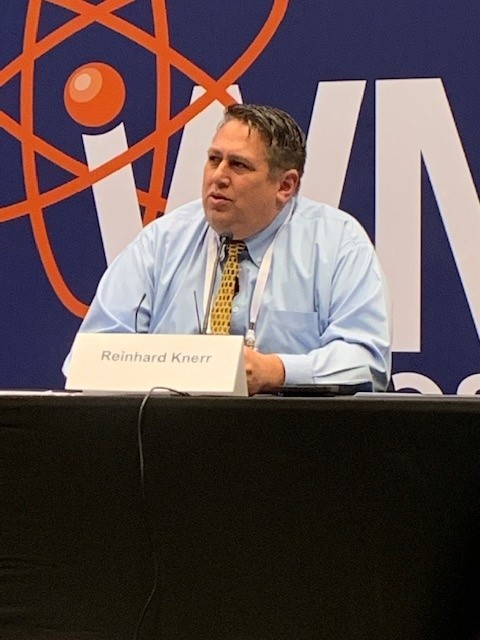
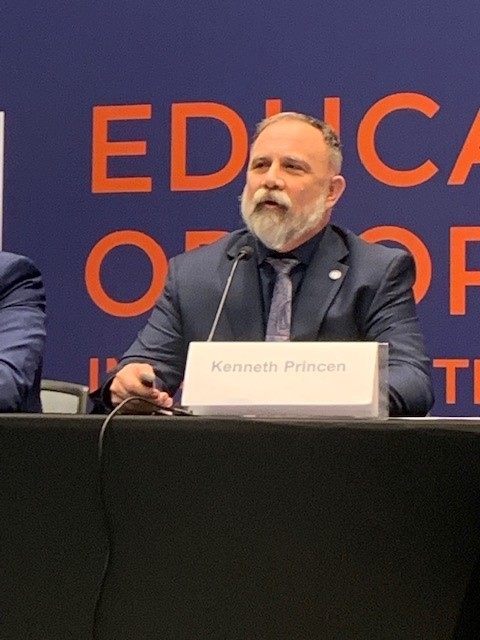
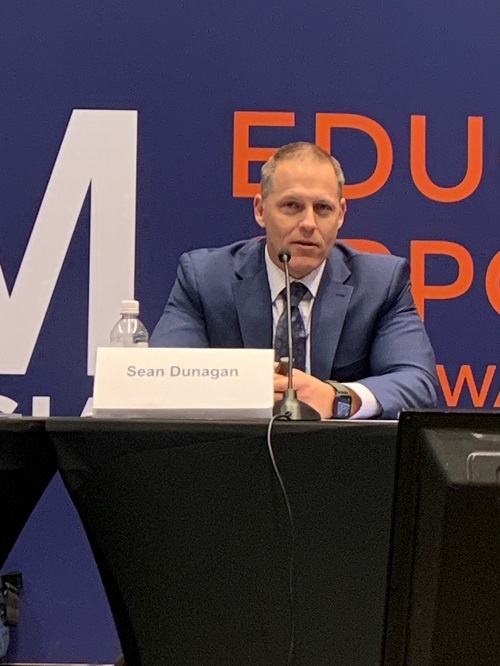
Carlsbad Field Office (CBFO) Manager Reinhard Knerr outlined current and planned projects for the New Mexico waste repository during the 2022 Waste Management Symposia last week. He was joined on the panel by Sean Dunagan, Nuclear Waste Partnership (NWP) president and project manager, and Kenneth Princen, assistant manager for the National TRU Program.
Mining crews have completed excavation of more than 120,000 tons of salt to create Panel 8 and are outfitting the panel with the necessary utilities needed for certification by regulators. In the meantime, WIPP waste handlers continue to fill the last available room in Panel 7, which is set to reach capacity in September.
 |
|
Carlsbad Field Office Manager Reinhard Knerr. |
National TRU Program Assistant Manager Kenneth Princen. |
|
 |
 |
|
Nuclear Waste Partnership President and General Manager Sean Dunagan. |
WIPP has received approximately 40% of the TRU waste authorized by the WIPP Land Withdrawal Act and Knerr indicated many more panels will be needed in the future to complete the facility’s disposal mission. Later this year, CBFO will update the supplemental environmental impact statement for WIPP to create additional panels and anticipates releasing the document for public comment at that time.
Knerr outlined CBFO’s priorities for 2022, which include increasing the number of waste shipments received at WIPP, with priority given to Los Alamos National Laboratory and the Idaho National Laboratory Site; and continuing to make progress on the SSCVS, the largest containment fan system in the DOE complex.
To further modernize the facility, WIPP management and operations contractor NWP has installed fiber-optic cable, replaced underground and surface electrical substations and completed other improvements. In 2022, NWP plans to upgrade firewater loops and transition much of the underground fleet from diesel to battery-electric vehicles.
WIPP continues to prepare to resume remote-handled TRU waste shipments in fiscal year 2025, according to Princen. In the meantime, some remote-handled TRU waste will be shipped in new shielded containers once new package designs are approved by the U.S. Nuclear Regulatory Commission.
Knerr said continued support from the local community and elected officials will be critical as WIPP plans for the future.
“Their support has been invaluable to our success,” he said.
-Contributor: Erik Simpson
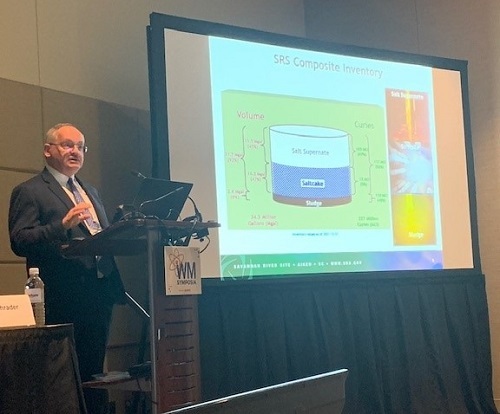
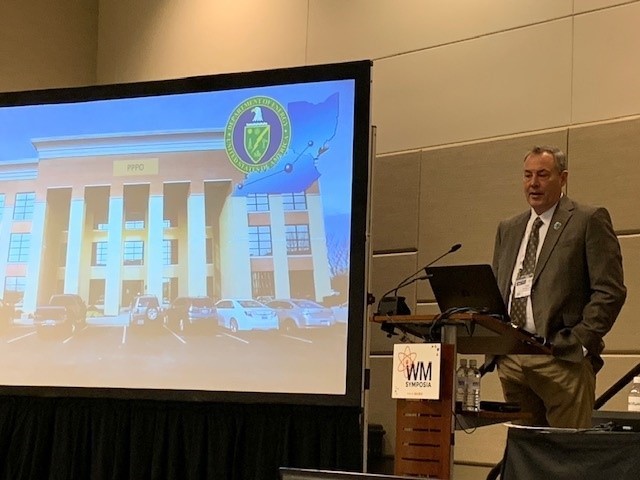
Joel Bradburne, manager of EM’s Portsmouth/Paducah Project Office, speaks during a panel session at the 2022 Waste Management Symposia focused on cleanup progress at the Portsmouth, Ohio and Paducah, Kentucky sites, as well as the depleted uranium hexafluoride plants.
PHOENIX – Managers of the EM sites at Portsmouth, Ohio and Paducah, Kentucky, provided an update at the 2022 Waste Management Symposia last week on cleanup progress at the two locations, as well as on conversion of depleted uranium hexafluoride (DUF6), a byproduct of uranium processing at both plants.
Joel Bradburne, manager of the Portsmouth/Paducah Project Office (PPPO), said the uranium enrichment decontamination and decommissioning (UED&D) strategy mandated through the 1992 Energy Policy Act remains intact and is succeeding.
“It was 30 years ago that the UED&D strategy was created for the cleanup of the federal government’s gaseous diffusion plants (GDP) at Oak Ridge, Portsmouth and Paducah,” remarked Bradburne. “Things have certainly evolved, but the department’s strategy has survived and is continuing to guide D&D success at PPPO.”
The strategy generally sequenced the cleanup at Oak Ridge, Tennessee, then Portsmouth and Paducah.
EM and contractor site leads presented updates on PPPO projects during the panel session. For Portsmouth, the site is set to complete demolition of the X-326 process building this year, which is an EM priority for 2022; and continue efforts to synchronize waste placement and excavated fill as the site continues to prepare the X-333 and X-330 process buildings for future demolition.
At Paducah, a C-400 Cleaning Building remedial investigation/feasibility study report will go to regulators this year, the first step in a Comprehensive Environmental Response, Compensation, and Liability Act (CERCLA) decision that will rid the site of the primary source of trichloroethylene (TCE) at the site.
Paducah is set to remove an additional 1 million pounds of R-114, a hazardous refrigerant used in the former uranium enrichment process, another EM priority for this year.
DOE also will fully restart the DUF6 conversion plants this year after a COVID-19 shutdown opened up an opportunity for safety and modernization actions.
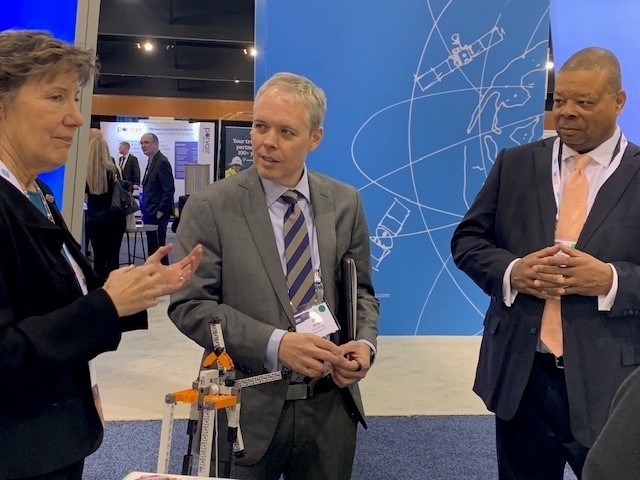
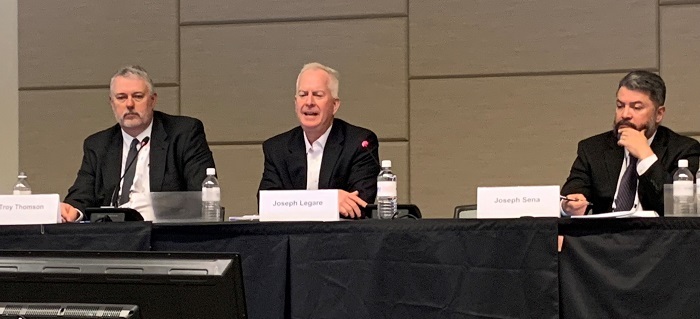 A panel session at the 2022 Waste Management Symposia covered the EM Los Alamos Field Office (EM-LA) cleanup at the Los Alamos National Laboratory site. From left are Troy Thomson, Newport News Nuclear BWXT-Los Alamos (N3B) environmental remediation program manager; Joe Legare, N3B vice president; and Joe Sena, director of N3B water program oversight. N3B is EM-LA's cleanup contractor.
PHOENIX – Recruiting and retaining employees for critical positions such as radiological controls technicians, engineers, and waste handling and waste processing operators is a top priority for the EM Los Alamos Field Office (EM-LA) cleanup contractor, the company’s vice president said during a panel session at the 2022 Waste Management Symposia last week.
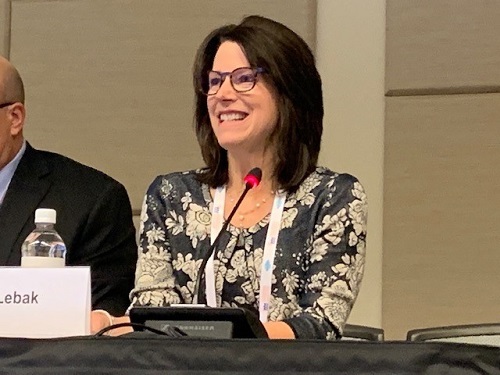
Kim Lebak, president of EM-LA cleanup contractor Newport News Nuclear BWXT-Los Alamos (N3B), kicked off the panel session with an overview of the Los Alamos National Laboratory (LANL) legacy cleanup, which includes remediating contamination, protecting water quality and shipping transuranic waste offsite for disposal.
 |
|
Kim Lebak, president of EM Los Alamos Field Office cleanup contractor Newport News Nuclear BWXT-Los Alamos. |
Joe Legare, N3B vice president, noted that increased competition for resources and the COVID-19 pandemic contributed to a challenging job market. N3B’s strategy to build a pipeline of employees committed to environmental cleanup includes competitive salaries, bonus and referral programs, and N3B boot camps and apprentice programs, Legare said.
Troy Thomson, N3B environmental remediation program manager, focused on EM-LA progress to investigate and remediate locations where radioactive and hazardous materials from nuclear weapons production and research during the Manhattan Project and Cold War at LANL were disposed at the site from the 1940s to the 1980s.
Joe Sena, director of the N3B water program oversight, talked about an interim measure being used to control the migration of a hexavalent chromium groundwater plume beneath LANL until a final remedy is determined. Sena also highlighted the EM-LA surface water and stormwater monitoring program, which includes sampling in canyons in the vicinity of LANL, and groundwater monitoring campaigns, which support the collection of approximately 1,329 groundwater samples.
-Contributor: Stephanie Gallagher
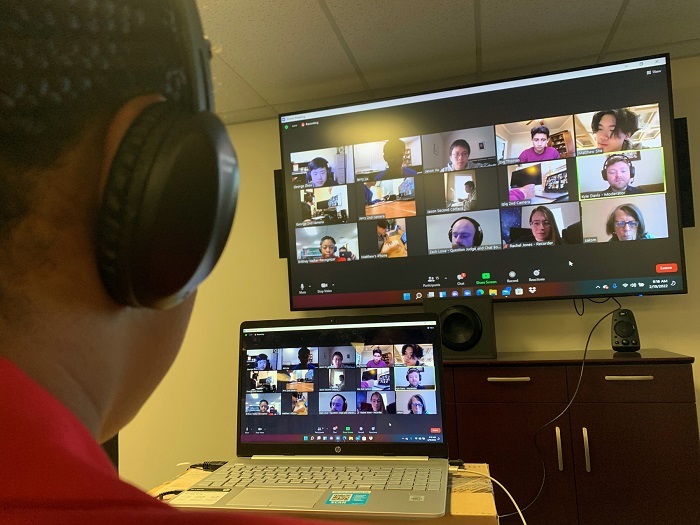 A team from Lakeside High School in Evans, Georgia is this year’s DOE Regional Science Bowl Competition champion, overcoming teams from across South Carolina and the greater Augusta, Georgia area.
AIKEN, S.C. – A team from a high school in Evans, Georgia, won the DOE Savannah River Site (SRS) Regional Science Bowl Competition and will advance to the national tournament this spring.
Future scientists, engineers and mathematicians put their knowledge to the test during the regional competition, which attracted 18 teams from across South Carolina and the greater Augusta, Georgia area earlier this year.
Team #1 from Lakeside High School won the regional event and will take part in the National Semi-Finals Virtual Tournament on May 21.
A team from Governor’s School for Science and Mathematics in Hartsville, South Carolina, came in second, followed by a team from Nation Ford High School in Ft. Mill, South Carolina, and a second team from Lakeside High School, respectively.
Teams competed against each other in virtual “rooms” during the regional competition held online. Students raised their hands to answer questions with limited time — similar to the television show “Jeopardy,” where participants face off during a timed period of fast-paced questions and answers.
In the Science Bowl, questions cover a wide range of academic disciplines, including biology, chemistry, energy, math, physics, and earth and space science.
The teams consist of four to five students and a teacher who serves as an advisor and coach. This year’s regional contest involved students from 13 high schools and is the only academic competition of its kind that tests students’ knowledge in all areas of science and is sponsored by a federal agency.
The competition tests the students’ ability to perform quickly and confidently under pressure, according to Kim Mitchell, the lead for the education outreach division at Savannah River Nuclear Solutions (SRNS), the SRS management and operations contractor.
“Practice is always a critical part of their preparation,” she said. “However, teamwork, along with academic performance, makes a difference as to who succeeds.”
SRS is one of only three DOE sites to have participated each year at the regional level since the start of the Science Bowl competition.
“Preparing my students for Science Bowl has been rewarding as it allows me to mentor and connect with them through science outside the classroom,” said Adam Kraft, a chemistry instructor at Westminster Schools of Augusta. “Students benefit from this competition as it allows for them to grow and stretch as they learn and explore new scientific concepts and skills while finding opportunities for the development of teamwork and leadership skills.”
DOE created the National Science Bowl in 1991 to encourage students to excel in mathematics and science and to pursue careers in these fields.
Volunteers from multiple SRS contractors and the community worked as competition officials during the regional event.
“We greatly appreciate the expertise and experience provided by each official,” Mitchell said. “This event could not be held without their support.”
SRS provides a variety of science and literacy programs to reach tens of thousands of students each year. The primary goals of the outreach programs are to enhance interest in science, mathematics, engineering and technology (STEM) and to support improvements in education in the Central Savannah River Area by using the unique resources available at SRS.
-Contributor: DT Townsend
|