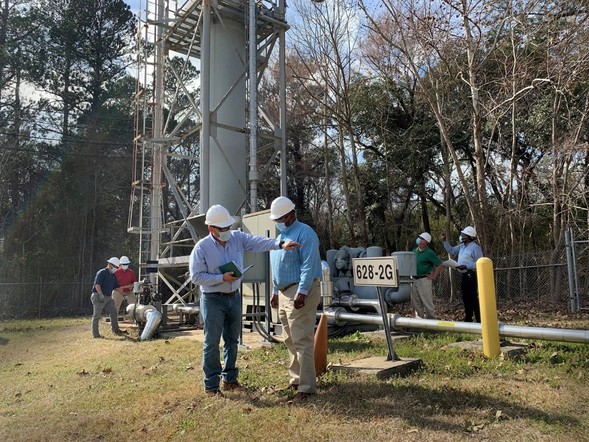
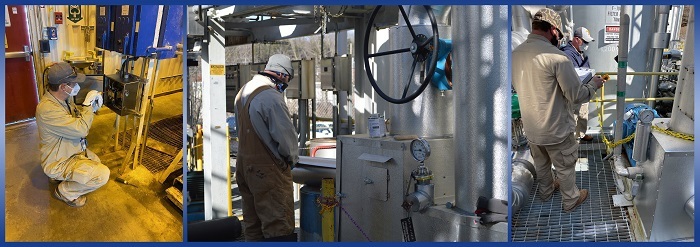
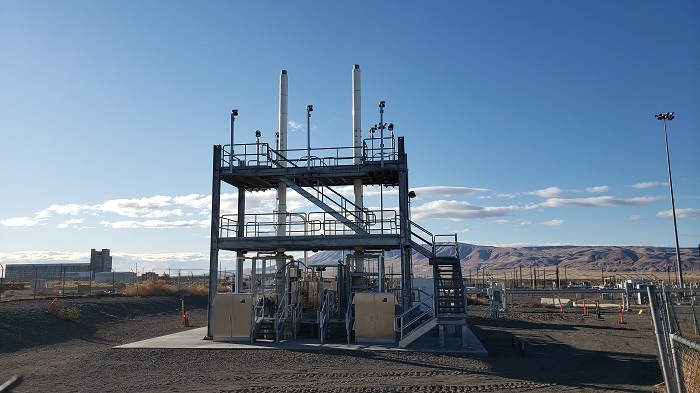
 EM’s Office of River Protection and tank operations contractor Washington River Protection Solutions continue to enhance safety in the Hanford Site’s Tank Farms with the completion of a new exhauster ventilation system in the SY Tank Farm. All six of Hanford’s double-shell-tank farms are now ventilated by upgraded exhauster systems.
RICHLAND, Wash. – The EM Office of River Protection (ORP) and tank operations contractor Washington River Protection Solutions (WRPS) recently began operating a new exhauster ventilation system installed in the SY Tank Farm at the Hanford Site.
The new system replaces the old exhauster ventilation system that had reached the end of its design life.
With the completion of the installation of the new system at the SY Tank Farm, all six of Hanford’s double-shell-tank farms, consisting of 28 tanks, now have upgraded exhauster ventilation systems.
The systems work by continuously drawing air from a waste tank, separating moisture and radioactive particles, then sending filtered air through exhaust stacks into the atmosphere. The systems protect workers by dispersing high-efficiency particulate air (HEPA) above the breathing space of workers. They also prevent the buildup of flammable gases in the tanks.
“DOE and the contractor share a steadfast commitment to safety as we reduce risk to the environment posed by 56 million gallons of waste stored in our large underground tanks,” said Delmar Noyes, EM assistant manager for Tank Farms. “The new SY Tank Farm system is much more reliable and effective than the previous system, which will help ensure continued safe operations in the farm for decades.”
SY Tank Farm is made up of three double-shell tanks built between 1974 and 1976, and the 1-million-gallon-capacity tanks began receiving waste in 1977. The tank farm is still in service and will support future retrievals and waste transfers from single-shell tanks in the western portion of a 10-square-mile industrial area known as the Central Plateau.
The SY Tank Farm project involved installing two new ventilation fans and a pair of 40-foot stacks. Workers then tied into the existing ventilation ductwork.
Tim Moberg, the project’s lead engineer for WRPS, said the project team used lessons learned from the installation of previous ventilation systems in Hanford’s double-shell-tank farms in the new system’s design.
“The SY ventilation system has state-of-the-art components and a remotely operated control system that allows operators to check the status of all equipment in real time,” Moberg said. “Another major benefit is the new system will require fewer entries into the tank farm for both operations and maintenance personnel.”
Moberg, who was part of the project team for the installation and upgrades at each of Hanford’s other double-shell-tank farms, said the team faced several challenges that were addressed through collaboration.
“We had to design around a lot of underground interferences and tie into old electrical systems and existing ventilation lines,” he said. “Teamwork was key to the project’s success. We had excellent communication and collaboration between DOE and our construction, maintenance, engineering, radiological controls, industrial hygiene and safety teams.”
-Contributor: Mark McKenna
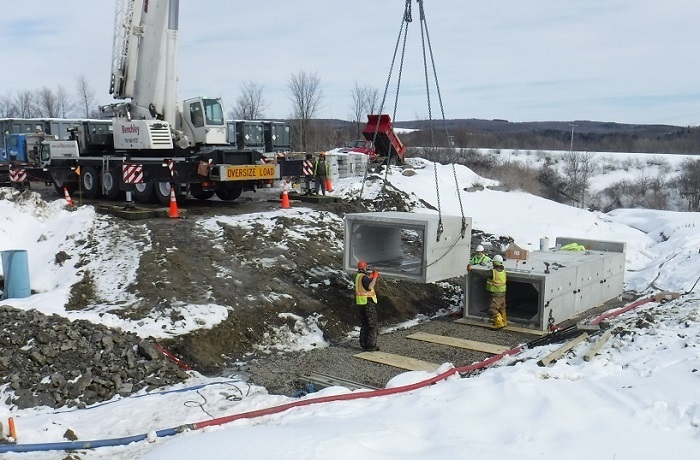 EM crews use a 235-ton crane to safely place concrete sections into position that will form a new culvert for a roadway at the West Valley Demonstration Project. Each section weighs an average of 16,000 pounds.
WEST VALLEY, N.Y. – EM crews replaced a large culvert along a road at the West Valley Demonstration Project ( WVDP) where heavy equipment will transport waste containers during the teardown of the Main Plant Process Building. Starting demolition of that facility is an EM 2022 priority.
Crews with WVDP prime contractor CH2M HILL BWXT West Valley (CHBWV) used a 235-ton crane to place each section of the culvert safely, and an excavator to install the pieces that provide end support for the culvert superstructure.
“The completion of this culvert project was the result of proper planning, teamwork and safe execution from the dedicated individuals who work at the site,” said Paul Fintak, CHBWV subcontractor technical support. “This new culvert will ensure that this roadway remains safe and can handle heavy-duty equipment for current and future cleanup operations.”
The culvert work is the latest in a series of projects to prepare for the Main Plant teardown. In recent months, EM and CHBWV have redesigned an office building and former storage facility to support operations during demolition. In the culvert project, workers installed six precast concrete sections, each weighing an average of 16,000 pounds, along 40 feet of the culvert. The end-support pieces were constructed using 72 blocks weighing between 300 and 2,600 pounds, depending on their engineered function and location.
The roadway will see a continuous flow of heavy-duty fork trucks transporting empty waste containers to the demolition site and bringing full containers to the rail line at the site for shipment to an offsite disposal facility.
WVDP resumed use of the rail line in June to ship soil and other materials from construction of a groundwater treatment system installed to mitigate a groundwater plume that originated from historical releases at the Main Plant.
-Contributor: Joseph Pillittere
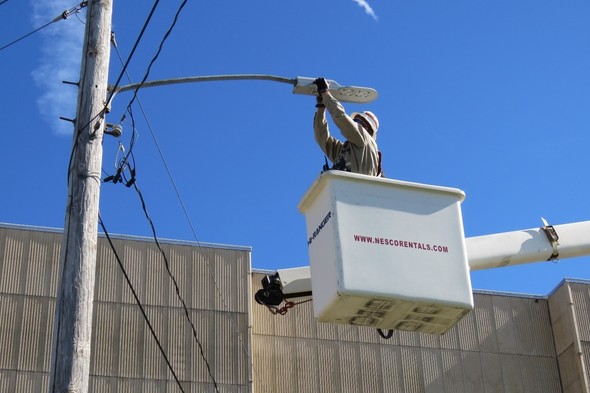 An electrical mechanic for Swift & Staley Inc., the infrastructure contractor for EM’s Paducah Site, finishes the electrical tie to a newly installed streetlight.
PADUCAH, Ky. – Daily cost saving measures continue to provide EM’s Paducah Site with a brighter future.
Employees with Swift & Staley Inc. (SSI), the site’s infrastructure support services contractor, replaced 320 outdoor sodium street lighting fixtures with light-emitting diode (LED) lighting in 2021.
The site uses approximately 800 light fixtures to illuminate the area. The upgrades provide superior illumination to address safety concerns and save costs by reducing electric usage. The replacements will reduce the number of light bulbs replaced each year and decrease the amount of electricity used by approximately half. Old sodium lights needed replacing once a year on average, whereas LED lights are expected to have 10-plus years of service.
The next phase of the site lighting upgrade is planned for this year. It will consist of replacing another 128 fixtures, resulting in further efficiencies.
“DOE will be at this site remediating and removing structures for the foreseeable future,” EM Portsmouth/Paducah Project Office Manager Joel Bradburne said. “These lighting upgrades pay for themselves and allow those resources to be devoted to site remediation.”
Tammy Courtney, SSI vice president and project manager, noted the many benefits of LED lighting, including that it’s environmentally friendly.
“Not only does safely completing this project reduce costs, it also enhances the safety of our workforce with better lighting,” she said.
-Contributor: Amanda Scott
|