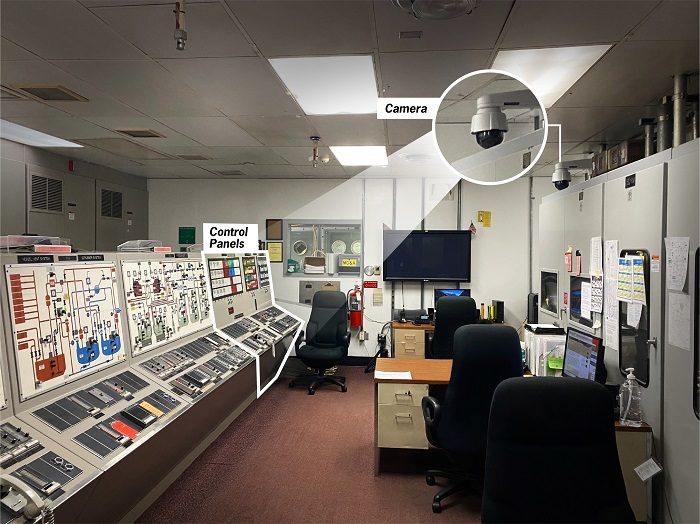
 A newly installed camera in a control room at the HB Line facility at the Savannah River Site monitors control panels for alarms at night.
AIKEN, S.C. – EM contractor employees have creatively changed how they monitor the recently closed HB Line facility at the Savannah River Site (SRS), using existing resources and saving approximately $1.8 million annually.
Workers placed HB Line, which is located atop the H Canyon chemical separations facility, in safe shutdown in 2020. That work included inventory reductions and system and equipment shutoffs.
In 2018, DOE suspended plutonium oxide production at HB Line and directed the facility's shutdown to be reversible so it can operate in the future if needed. As a result, several of the facility’s systems remain operational and require routine surveillance and maintenance along with minimum staffing to facilitate operations and emergency response.
“We recognized early on that we would be able to support the bulk of the facility surveillance and maintenance activities with a days-only shift rotation,” said Nick Miller, the H Canyon facility manager for SRS management-and-operations contractor Savannah River Nuclear Solutions. “However, leaving the facility unmonitored overnight was not an option given the operating equipment and facility conditions. Our answer was to develop a remote monitoring program using cameras, which would allow H Canyon personnel to remotely monitor the HB Line facility at night.”
Installing the camera system in the HB Line control room and training H Canyon operators to monitor the camera while performing their other duties allowed SRS to remove the night shift operators from HB Line and resulted in a reduction of shifts from four to two.
Other H Canyon operators were trained to perform rounds in the HB Line once per night to verify safety and respond to any abnormal conditions. This resulted in the reduction of approximately 14 positions in the HB Line, which results in an annual savings of approximately $1.8 million of taxpayer money. Employees whose positions were eliminated at HB Line were transferred to other SRS missions, including work at H Canyon.
“The H Area team developed a creative solution to the challenging problem and assumed more work responsibilities, all as part of a continuing effort to deliver value to the Department of Energy and to taxpayers,” Miller added. “I am proud to be a part of such a creative and highly capable team.”
-Contributor: Lindsey MonBarren
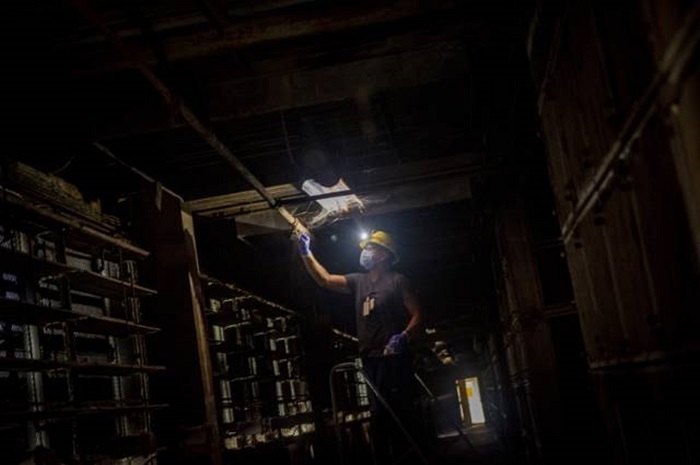 Prior to modifying the sprinkler systems in the C-333 Process Building to a dry hybrid fire suppression system, Paducah Site workers performed a number of surveillance and maintenance activities to keep the system operating safely. Site worker Dallas Goss takes a radiological sample from the high-pressure fire water piping in the C-333 Process Building. The new fire suppression system helps reduce the amount of energy needed to maintain the sprinkler system.
PADUCAH, Ky. – Deactivation workers at EM’s Paducah Site recently completed major modifications to the fire sprinkler system in one of the former gaseous diffusion plant’s four massive uranium-enrichment process buildings.
The purpose of the modifications is to align the building’s fire-suppression requirements from those of a nuclear operation to those appropriate for EM’s current cleanup mission that includes the future demolition of the process buildings.
“These aging systems required a significant amount of maintenance that is no longer going to be necessary,” EM Portsmouth/Paducah Project Office Paducah Site Lead Jennifer Woodard said. “As we reduce the maintenance and power costs, we can invest our time and resources in deactivation projects, which will help us further our cleanup mission.”
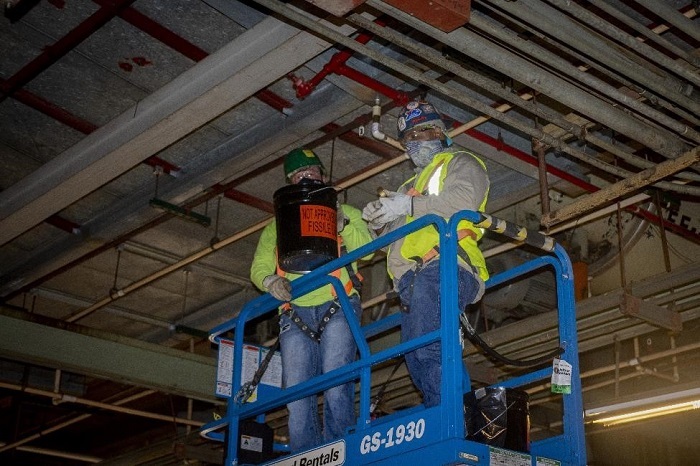 Crews work on sprinkler heads as part of the modifications made to the sprinkler system in the C-333 Process Building. The new dry hybrid fire suppression system helps reduce the amount of energy needed to maintain the sprinkler system.
EM’s Paducah deactivation and remediation contractor, Four Rivers Nuclear Partnership (FRNP), is also modifying the fire suppression systems in the site’s other large process buildings this year. All four of the buildings will continue to be maintained in a safe condition and prepared for future demolition.
“There are workers on our team who performed maintenance on these systems for many years when the plant was still enriching uranium,” FRNP Program Manager Myrna Redfield said. “Their knowledge was invaluable to our ability to transition the fire suppression system to the dry hybrid system that is utilized in C-333 today.”
-Contributor: Dylan Nichols
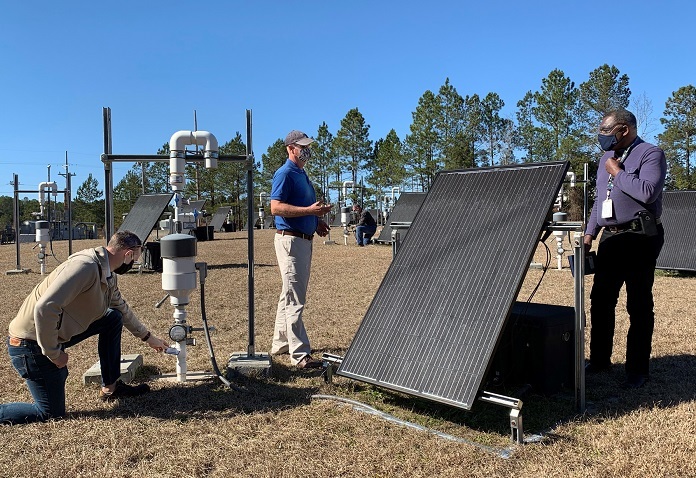 Savannah River Nuclear Solutions engineers discuss a plan to move equipment used to close 19 soil cleanup sites to a storage location. In time, the equipment will be reused at other environmental remediation projects across the Savannah River Site. Shown from left are Will Jolin, John Bradley, and Joao Cardoso-Neto.
AIKEN, S.C. – Workers will soon remove solar-power “plugs” from 19 soil remediation sites at the Savannah River Site (SRS), creating an annual cost savings of $90,000 as the successful soil and groundwater cleanup project comes to an end.
EM contractor Savannah River Nuclear Solutions (SRNS) completed the project at an earthen pit developed in the 1950s to dispose of nonradioactive construction debris, ash, and liquid cleaning products.
Nineteen systems were installed to remove low concentrations of commonly used degreasing solvents from the soil below. Recent soil sampling demonstrated that the site no longer poses a potential threat to the environment, said Will Jolin, SRNS engineer.
“Early cleanup at this location concentrated on using aggressive methods to remove the contaminants from the subsurface and prevent them from migrating to the groundwater,” said Joao Cardoso-Neto, SRNS project manager.
Cardoso-Neto noted that those cleanup technologies required use of large electric pumps, support facilities, and monitoring equipment.
Over the years, that highly mechanized and costly method has removed large quantities of solvent; however, in recent years SRNS has transitioned to more environmentally-friendly passive units, known as microblowers.
Microblowers generate a natural vacuum to exhaust the chemical vapors from the subsurface. Each unit requires only 20 to 40 watts of solar power to run a primary component: a compact, high-speed fan. During a 10-month test, a single unit removed 234 pounds of solvent compounds from the subsurface.
The 19 microblower units have succeeded in removing the remaining trace amounts of solvent within limits set by the South Carolina Department of Health and Environmental Control and the U.S. Environmental Protection Agency.
Approximately 1.5 acres were impacted by the cleanup and closure project near a part of the site designated as A Area.
“With the closure of this project, we can shift the resources, such as solar panels, to other areas at SRS that still require remediation,” said John Bradley, SRNS engineer.
-Contributor: DT Townsend
|