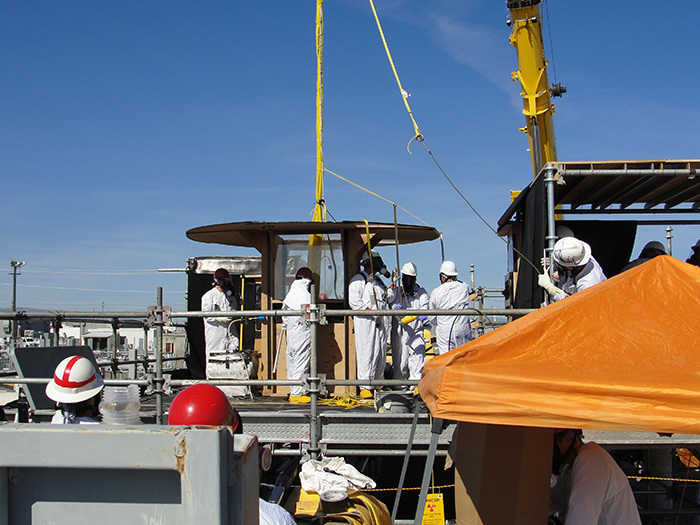
A Hanford Site team created unique tools to remove a radiologically contaminated thermocouple from single-shell tank AX-103. The team built a radiation-shielding box and remote extension tools to allow workers to complete the task more safely.
RICHLAND, Wash. – EMOffice of River Protection tank operations contractor Washington River Protection Solutions (WRPS) recently developed unique tools to remove contaminated pieces of equipment from single-shell waste storage tanks at the Hanford Site.
WRPS developed a special shielding box and remote extension tools to safely remove a thermocouple, a device that measures the temperature of waste, from AX-103, a 1-million-gallon-capacity single-shell tank.
“The project team demonstrated a textbook approach on how to manage a high-hazard evolution by leveraging worker-generated solutions to solve complex challenges. These new tools and techniques will make future long-length equipment removals much safer for our workforce,” WRPS President John Eschenberg said.
Thermocouples are among the more than 75 pieces of long-length equipment WRPS crews have removed to allow for the installation of new equipment to prepare for waste retrieval operations. The waste retrieved from single-shell tanks such as AX-103 is transferred to the double-shell tank system for safe storage until it is processed at Hanford’s Waste Treatment and Immobilization Plant.
Extensive planning and innovation led to the removal of the 54-foot-long thermocouple from tank AX-103 in two sections. This allowed crane operators to control the long, thin device, which needed to be rotated from the vertical to horizontal position for placement into a shielded disposal box.
Workers removed the 7-foot-long top section of the thermocouple according to plan, but the 47-foot-long lower section took longer to remove safely. As workers raised the thermocouple from the tank, radiological surveys indicated higher dose rates where workers were planning to attach the crane rigging. The project team reevaluated the situation and set up additional safeguards.
The team improved the shielded box design so that workers were further away and could use remote reach tools to attach rigging. The team also built a shielded cover that allowed workers to secure the sleeving, all of which made the third attempt successful. The thermocouple is encased in plastic sleeving to prevent the spread of contamination.
“Using the shielding box and remote extension tools allowed workers to complete the thermocouple removal at safer levels,” said Peggy Hamilton, single-shell tank retrieval project manager for WRPS. “The project team showed what can be accomplished by working together, communicating, and not giving in when you run into an obstacle. The team was determined to find a way to protect workers during the thermocouple removal process.”
The thermocouple was one of three inside tank AX-103 and the second removed to date. The third will be removed in coming weeks. Five additional pieces of long-length equipment will be removed from AX-103 prior to installing new waste retrieval equipment.
"The project team was prepared for unexpected conditions, and along with conservative decision-making, reevaluated the situation and established addition engineering controls," Eschenberg said.
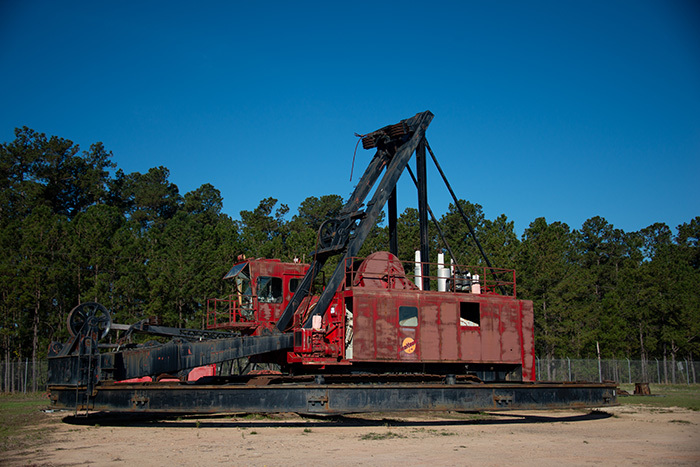
The Savannah River Site (SRS) recently transferred ownership of this 1960s vintage crane to the SRS Community Reuse Organization.
AIKEN, S.C. – The Savannah River Site (SRS) recently transferred ownership of a massive 1960s vintage crane to the SRS Community Reuse Organization (SRSCRO), avoiding the estimated $2 million cost of disposing of the machine in a landfill.
“The crane was no longer needed to support solid waste missions at SRS,” SRS Solid Waste Management Facility Operation Support Manager Robert Minnick said. “With the SRSCRO partnership, SRS was able to essentially recycle the crane instead of throwing it away. Not only did this save the site money, but the transfer avoided the significant cost of disposition in a landfill.”
The Manitowoc 4600 Ringer Crane arrived at SRS in 1993. SRS used the machine to remove off-site components from railcars. It provided the distance needed to protect workers from radiation while being large enough to handle heavy components.
SRSCRO is responsible for disassembling the crane and transporting it offsite. SRS workers surveyed the crane extensively for contamination and cleared it for off-site release and use. Disassembly and transport of the crane components required more than 20 shipments. SRSCRO has sold the crane to a vendor.
“The mission of SRSCRO is to facilitate economic development opportunities associated with SRS technology capabilities and missions,” SRSCRO Executive Director Rick McLeod said. “Proceeds from the sale of this crane will go toward SRSCRO’s directed community programs related to economic and workforce development in the region.”
Minnick said the project was a win-win for all parties involved.
“It took the cooperation of many SRS employees, including people from solid waste management, the Savannah River National Laboratory, radiation protection, site services, asset management, and DOE-Savannah River,” Minnick said. “The can-do attitude and cooperation of all stakeholders is good business and a well-planned project is a safe project.”
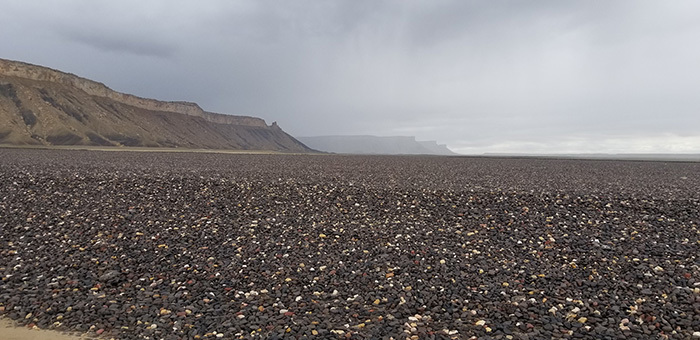
The Moab Project ships mill tailings from its site in Moab, Utah to its permanent disposal cell in Crescent Junction, Utah. Currently, the Moab Project is constructing a rock cover for the cell. Although most of the cover materials are obtained onsite, a substantial quantity of rock is shipped in by truck from about 90 miles away.
Moab Project leaders are reevaluating the cell cover’s design to increase its long-term performance and reduce the cost of transporting the rock to the Crescent Junction Site.
LM monitors 44 permanent disposal cells, landfills, and other impoundments across the U.S. and has expertise on various cell covers. The Moab Project will draw from LM’s knowledge while investigating other cell cover designs, including evapotranspiration covers. Those covers are composed of rock and soil, and topped with vegetation. They soak up precipitation until it evaporates naturally or transpires through plants.
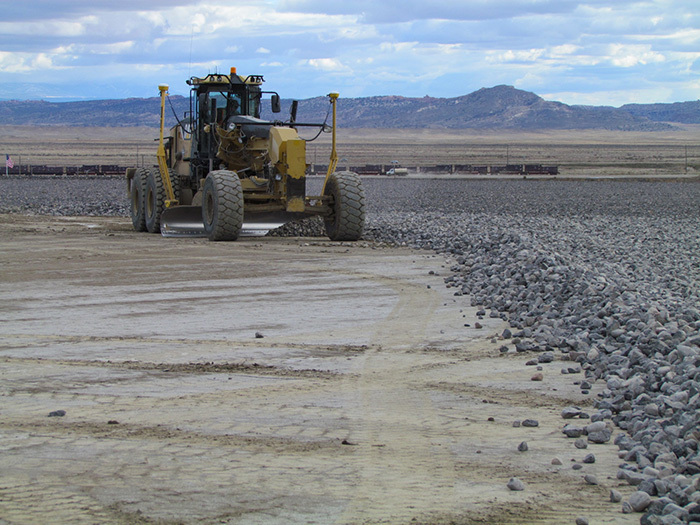
A worker places rock cover at EM’s waste disposal cell in Crescent Junction, Utah. The Moab Uranium Mill Tailings Remedial Action Project is considering transitioning to an evapotranspiration cover to improve performance and reduce costs.
Under the agreement, the Moab Project will make the Moab and Crescent Junction sites available to LM to expand its research capabilities. LM will help EM conduct investigations on the effectiveness of evapotranspiration covers at the Crescent Junction Site, provide recommendations and expertise on cover design, and assist with regulatory approvals.
LM is slated to take over long-term surveillance at the millsite and disposal cell once tailings relocation is complete and the cover has been constructed. The transition is currently anticipated for the 2030s.
The Moab Project is relocating tailings and other contaminated material from a former uranium-ore processing facility to the disposal cell, about 30 miles north. The tailings are a sand-like material that remain from processing uranium ore.
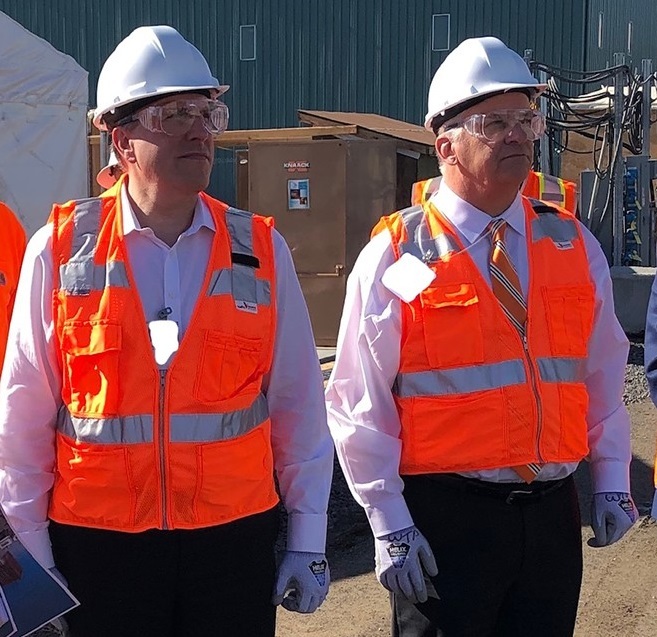
RICHLAND, Wash. – DOEUnder Secretary for Science Paul Dabbar, left, receives a briefing June 19 in the Low-Activity Waste facility at the Hanford Site’s Waste Treatment and Immobilization Plant. EM is on track to begin treating waste at the plant by 2023. Also pictured is Mark Planning, director of intergovernmental and external affairs with DOE's Office of Congressional and Intergovernmental Affairs.
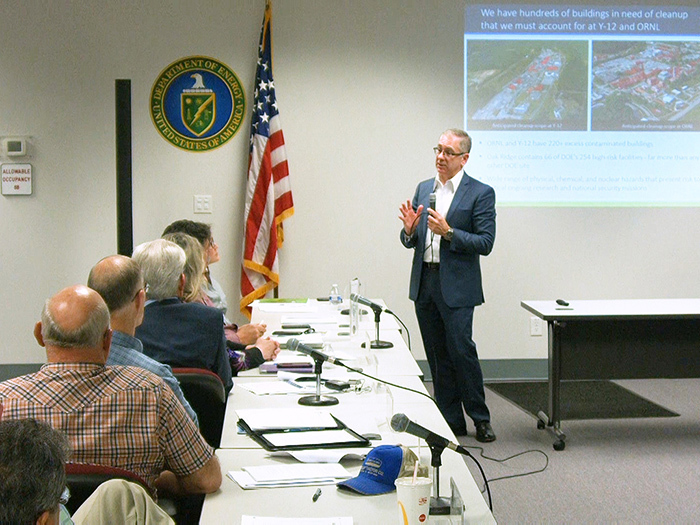
Oak Ridge Office of EM (OREM) Manager Jay Mullis speaks to the Oak Ridge Site Specific Advisory Board at its June meeting about OREM’s near-term plans and the path for Oak Ridge’s future cleanup.
OAK RIDGE, Tenn. – Leadership at the Oak Ridge Site met with the Oak Ridge Site Specific Advisory Board (ORSSAB) recently to educate members about the federal budget process, EM’s near-term plans, and the path for the site’s future cleanup.
Oak Ridge Office of EM (OREM) Manager Jay Mullis and Planning and Execution Division Director Alan Stokes gave presentations and answered questions at the board’s budget workshop, which was open to the public. The board members will use insight and information from the session to provide feedback on OREM's fiscal 2021 budget request, as part of OREM’s community outreach efforts.
Through ORSSAB, a federally chartered citizens’ advisory board, the community can learn more about EM’s current and planned work across the Oak Ridge Reservation. This advisory board meeting also enables board members to share feedback and perspectives with decision-makers in the local cleanup program.
During the meeting, Mullis shared his organization’s four main near-term cleanup goals;
Mullis directed the board members to his organization’s 10-Year Program Plan, which lists those goals along with objectives and performance measures for each. OREM released the document in 2014, and it provides a roadmap through 2024.
“Our program plan ensures everyone within the organization is unified and pursuing the same targets,” said Mullis. “It also informs stakeholders about what we see as our top priorities needed to advance the cleanup mission in Oak Ridge.”
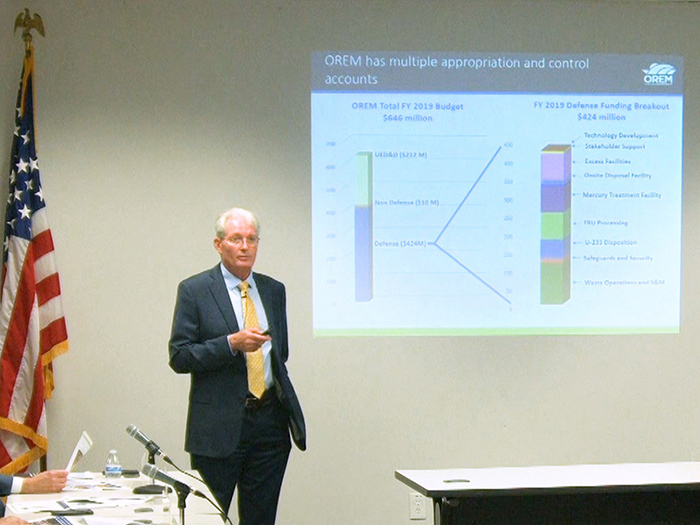
Oak Ridge Office of EM Planning and Execution Division Director Alan Stokes explains the federal budget process and discusses the site’s budget history and planning for future appropriations.
The planning required for achieving those goals is closely linked with the budget process, according to Stokes, who joined Mullis to explain the budget process and discuss the site’s budget history and planning for future appropriations from Congress.
“Oak Ridge’s budget development is an extension of our planning process,” Stokes said.
He said employees in his division have conducted extensive planning to sequence work effectively, develop sound budget requests, and help Oak Ridge successfully conduct its mission. Those efforts involve coordinating and planning for 147 subprojects and 20,000 activities.
Through this workshop, the board members gained insight into OREM’s budget priorities and considerations. Next, they will prepare recommendations for the fiscal 2021 OREM budget. OREM will consider those recommendations as it develops its budget request.
ORSSAB recommendations have played a major role in OREM’s operations since the board was formed in 1995.The board conducts active member recruitment every fall, but accepts applications year round. Applications can be found here.
“They are an incredibly valuable asset to our program” Mullis said of ORSSAB.
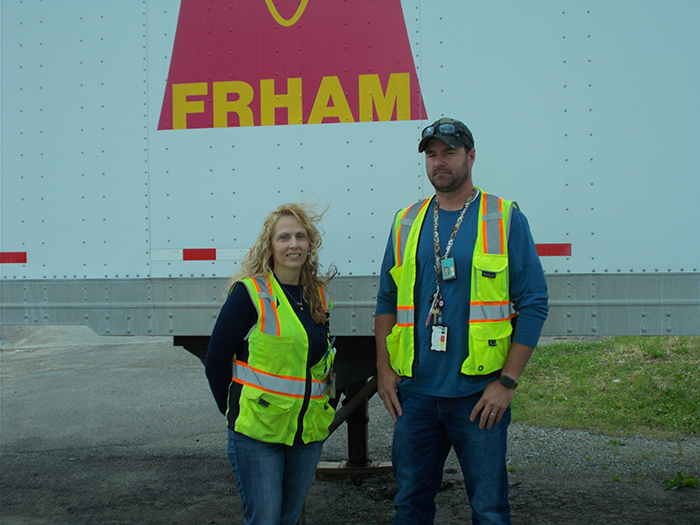
Renea Call, CH2M HILL BWXT West Valley (CHBWV) warehouse manager, and Cole Green, CHBWV demolition readiness manager, stand in front of the West Valley Demonstration Project Site’s personal protective equipment trailer.
WEST VALLEY, N.Y. – The West Valley Demonstration Project (WVDP) Site has saved money, improved safety, and increased efficiency by changing how it orders and provides personal protective clothing for the EM cleanup workforce.
EM and cleanup contractor CH2M HILL BWXT West Valley (CHBWV) worked with a vendor to create a “one-stop shop” for items such as gloves, coveralls, hats, belts and hoods. The arrangement is a first of a kind for an EM site.
CHBWV places an order and the vendor loads a mobile trailer with items for delivery to WVDP, where the trailer remains to supply clothing for future work activities.
“It’s encouraging that site personnel continuously work to identify solutions that can improve day-to-day operations and facilitate changes that will make the work environment more safe and efficient while at the same time uncovering cost-cutting opportunities,” said Jennifer Dundas, EM’s WVDP safety and site program team leader.
Cost savings from use of the trailer is about $2,000 per week. The initiative reduces the number of employees needed for ordering and distributing items to workers. Risk of injury decreases as warehouse workers spend less time offloading, stocking, and delivering items. And the trailer contains a six-month supply of items, eliminating weekly ordering and freight charges.
“As a cleanup site, our goal is to reduce legacy risks and the associated footprint,” said Cole Green, CHBWV’s demolition readiness manager. “The site’s warehouse is no exception, as it, too, has been reduced in size over the years. This new initiative creates more room, which increases our capabilities to store more items. In other words, we’ve made the warehouse bigger by thinking outside its four walls.”
Lessons learned from use of the trailer led to CHBWV to arrange for a different trailer with a side door for better access, lights, and racks for designated storage areas.
“This has had a trickle-down effect on how we stock basic necessities such as paper towels and tissues,” said Renea Call, CHBWV’s Warehouse Manager. “Previously we had to place orders every time we hit our set minimum quantity due to warehouse space limitations. Now, because this initiative allows more stock room in the warehouse, we can place larger orders, saving on volume and freight. It’s a win-win for the site and the taxpayers.”
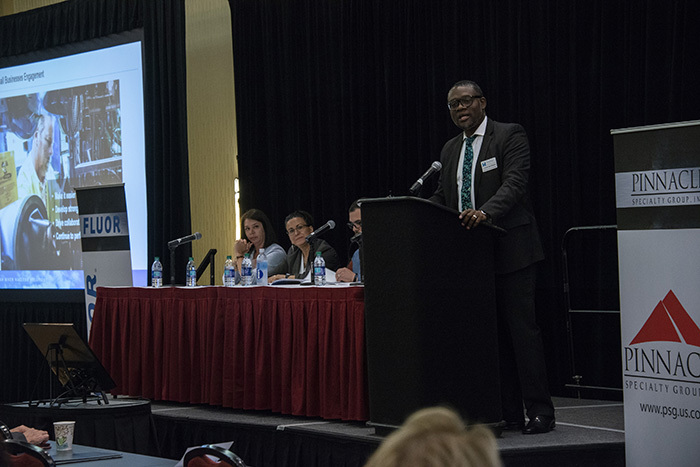
Savannah River Nuclear Solutions Small Business Liaison Officer J. Alex Agyemang spoke on Savannah River Site subcontracting opportunities at the Energy Technology and Environmental Business Association Savannah River Federal Business Opportunities Forum with panelists, from left, Centerra-SRS Procurement Administrator Liz Harris, Savannah River Remediation Supply Chain Management Director Ellen Hansmann, and Savannah River National Laboratory Contracts and Technology Partnerships Manager Matthew Biasiny.
AUGUSTA, Ga. – DOE federal and contractor officials took part in panel discussions on Savannah River Site (SRS) operations, contracting opportunities, and ways to partner with EM’s Savannah River National Laboratory (SRNL) during a recent event held by the Energy Technology and Environmental Business Association (ETEBA).
“The Savannah River Federal Business Opportunities Forum is an excellent way for businesses to interface directly with Savannah River Site prime contractors,” said Liz Harris, procurement administrator with Centerra-SRS, the SRS security contractor. “Centerra-SRS has participated in the event since its inception three years ago and plans to continue to support such a worthwhile event.”
ETEBA is a non-profit trade association representing approximately 160 companies and affiliate members that provide engineering, environmental, construction, and other services to government and commercial clients. The one-day forum informs subcontractors and vendors of upcoming federal procurement and subcontracting opportunities in the region, including DOE, the National Nuclear Security Administration, and the U.S. Army Corps of Engineers (USACE).
The panelists included representatives from DOE Headquarters; DOE Savannah River Operations Office; SRNL; management and operations contractor Savannah River Nuclear Solutions (SRNS); liquid waste contractor Savannah River Remediation (SRR); Centerra-SRS; and USACE.
“Through this forum, ETEBA has provided a platform that brings technical and supply chain leaders and suppliers together,” SRNS Supply Chain Operations Director Jay Johnson said. “It communicates SRS’s future needs to our suppliers who deliver innovations that enable our enduring and future missions.”
The region’s small businesses was among the focuses of the event.
“Savannah River Remediation is committed to the success of our small business subcontractors,” SRR Project Services & Support Director Sandra Fairchild said. “SRR provides significant awards to ETEBA members to complete important and mission-critical work.”
Following the forum, ETEBA held a reverse tradeshow where local suppliers met one on one with buyers and technical experts from government agencies and SRS prime contractors.
“A favorite aspect of the forum continues to be the reverse tradeshow,” ETEBA Executive Director Tim Griffin said. “This year's Savannah River Federal Business Opportunities Forum was a great success, due in great part to the proactive support of DOE-SR and prime contractors at the Savannah River Site.”
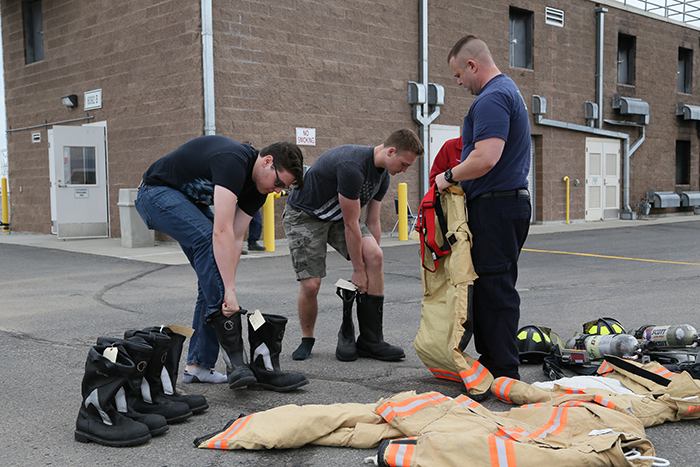
RICHLAND, Wash. - Mission Support Alliance (MSA), contractor for EMRichland Operations Office, recently hosted science, technology, engineering, and math (STEM) students from a local high school at the Volpentest Hazardous Materials Management and Emergency Response (HAMMER) Federal Training Center. The students gained a better understanding of the work at Hanford and the site’s career opportunities, and learned about Hanford Patrol and its training regimen. The Hanford Fire Department provided an overview of fire response and training and walked students through the building at HAMMER where the firefighters practice techniques. Teams from MSA’s cybersecurity and engineering organizations discussed how the Hanford Site uses experts to ensure information and employees are kept safe in the digital world. The visit concluded with the students learning how Hanford is preparing the next generation of workers. STEM tours support the Hanford Site’s Future Workforce initiative, providing outreach to local students and educators interested in careers at the site. In this photo, Hanford Fire Department Capt. Jason Noah instructs two Delta High School students on the proper way a firefighter suits up before entering a burning building.