Oak Ridge Transforming Former Uranium Enrichment Area for Development; SRS Teamwork Leads to Safe Disposition of Contaminated Equipment; and much more!
DOE Office of Environmental Management sent this bulletin at 06/04/2019 02:24 PM EDT
The 291,000-square-foot K-29 was one of five massive gaseous diffusion buildings located at ETTP — comparable in size to more than five football fields. These facilities were used to enrich uranium for defense and commercial purposes until the plant was shut down in the mid-1980s. K-29 was the first to be demolished, and the other four buildings have since come down in a historic, first-ever cleanup of a gaseous diffusion complex.
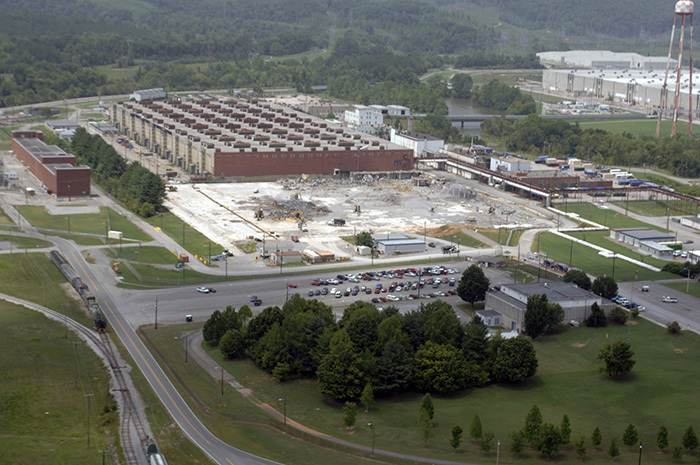
A view of the Building K-29 demolition site as the teardown was nearly finished in 2006. The building was surrounded by Building K-27, the K-731 Switch House, and the Poplar Creek facilities, which are now cleared away.
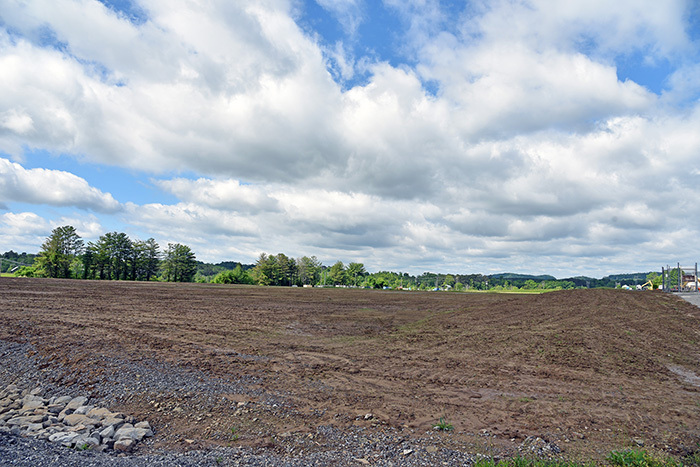
A view of the Building K-29 pad following the recently completed slab removal project.
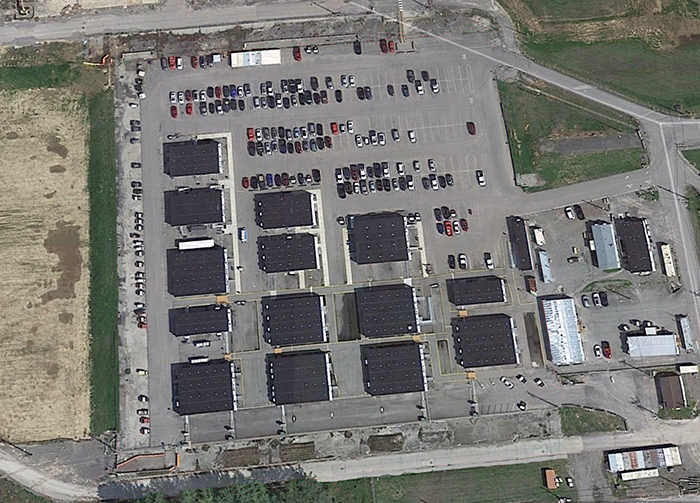
After K-29 was demolished in 2006, the slab was paved over with asphalt. Trailers were placed there to house the large number of cleanup personnel working at the site.
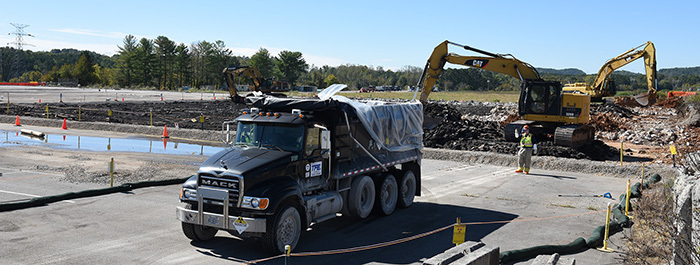
Completion of the slab removal project, which began in October 2018, included removing the trailers, asphalt, and slab to prepare the area for eventual economic development for the community.
When cleanup is completed in the adjacent Poplar Creek area, OREM will begin the regulatory approval process to prepare the 80-acre area for eventual transfer from government ownership to the community for private sector development.
After the Building K-29 demolition, the building’s pad was paved over with asphalt, and trailers were placed there to house the large number of cleanup personnel working at the site.
“Our cleanup of the Poplar Creek and Building K-29 area is opening a large area of land that can provide new opportunities for future development,” said James Daffron, OREM’s acting ETTP portfolio federal project director. “Through our ongoing efforts and progress at ETTP, an area that was once filled with aging and deteriorating facilities has gone through a complete transformation.”
OREM and UCOR are working to complete all demolitions at ETTP in 2020 and to convert the site into a multi-use industrial park.
Since cleanup began there in 1998, OREM has torn down nearly 500 facilities, transferred nearly 1,300 acres for economic redevelopment, and created a 3,000-acre conservation area for public use.
AIKEN, S.C. – EM workers at the Savannah River Site have safely shipped a nuclear waste tank trailer for disposal.
The High Activity Waste Tank Trailer (HAWTT) had been used by Savannah River National Laboratory (SRNL) to transfer liquid waste samples for onsite disposal. It was later replaced by a new trailer and safely stored at SRNL until crews transported it to the site’s Solid Waste Management Facility (SWMF) for disposition.
“The project required extensive pre-planning to ensure that it was done safely because of internal contamination in the inner tank,” said Renee Hoeffner, SWMF project lead. “The equipment is also large at approximately 17 feet high, 9 feet high, and 15 feet long, and weighing 124,000 pounds. This required it to be lifted and moved from the trailer it was shipped on to a railcar for disposal using a crane.”
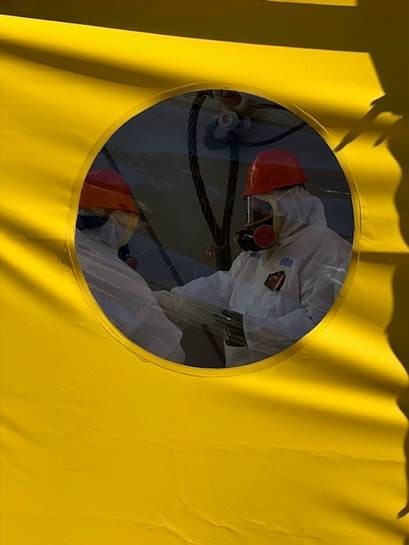
Workers make final preparations before lifting the High Activity Waste Tank Trailer from containment to a railcar.
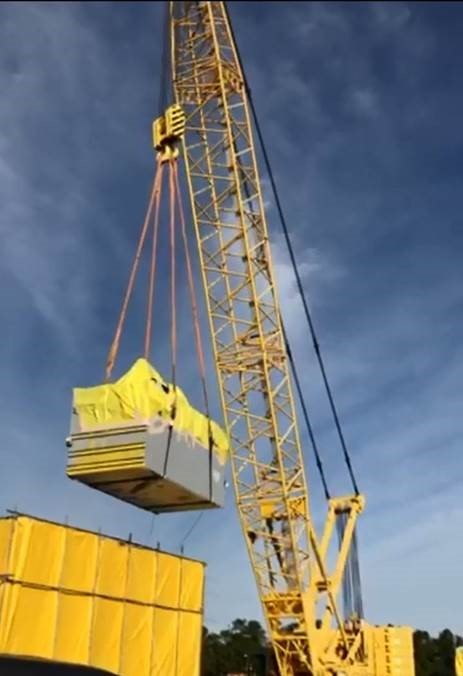
A crane lifts the High Activity Waste Tank Trailer from containment into a railcar.
Workers lifted the HAWTT from the trailer it was carried on so they could conduct a full radiological survey and decontaminate its underside. Next, they loaded it by crane into a shipping package staged on the railcar. Personnel in air-supplied plastic suits completed much of this work inside an enclosed structure.
“The scope of this activity required the interaction of many departments. The impressive, strategic teamwork involved many detailed discussions, scope meetings, and walk-downs with all team members,” Hoeffner said. “Part of our accomplishment came from the agreement to not count the work as successful until it was finished. This way, we were continuously watchful for any changing condition throughout the process.”
The HAWTT was shipped to a company specializing in nuclear services and decontamination to be disassembled for recycling and disposal.
“The team delivered excellent results without compromising safety,” said Verne Mooneyhan, SWMF facility manager. “Our employees were always engaged and proactively looking for hazards and risks in order to mitigate them with the proper controls.”
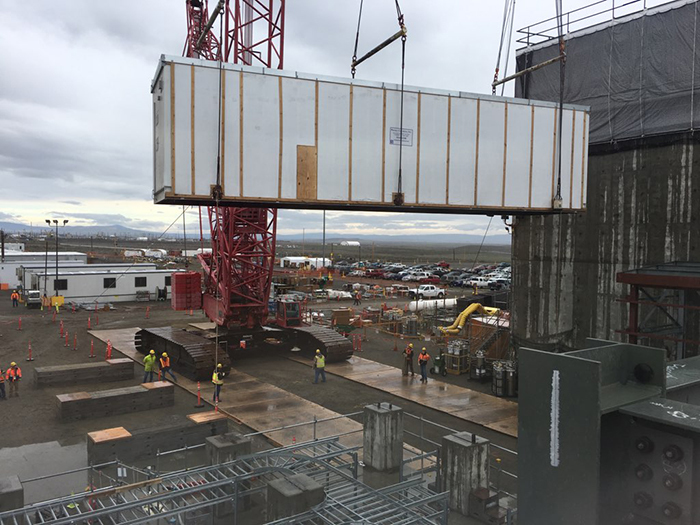
Workers at Hanford’s Waste Treatment and Immobilization Plant safely lower the first of three sections of a 111-ton electrical powerhouse for the plant’s Effluent Management Facility.
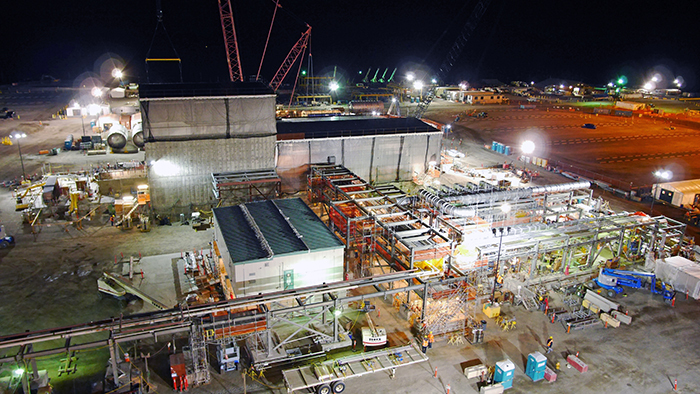
With the powerhouse in place, crews can begin routing permanent plant electricity to the effluent facility, the last major construction project to support the Direct Feed Low-Activity Waste (DFLAW) approach. Through the DFLAW vitrification approach, ORP will begin treating tank waste no later than 2023.
“Receiving the powerhouse is an important step for EMF progress as it allows us to route electrical cables to the building and sets the stage for its first construction turnover to the startup testing phase,” said Jason Young, EM’s ORP Balance of Facilities federal project director.
The Waste Treatment and Immobilization Plant’s Effluent Management Facility will receive and process secondary liquids generated from low-activity waste vitrification. The 13.8-kilovolt powerhouse will provide electricity to facility systems and processing equipment.
The powerhouse contains transformers, motor control centers, and more than 11,000 feet of electrical raceway and cable. The 13.8-kilovolt powerhouse will provide electricity to EMF systems and processing equipment.
The modular-style powerhouse was fabricated in Texas and transported atop a specialized semi-trailer truck to Washington. It arrived in three pre-fabricated sections, which crews then assembled.
“This was an outstanding effort by the entire team,” said Scott Monson, area manager for DFLAW at Bechtel National, Inc., the WTP Project contractor. “The team worked seamlessly from the design phase to working with the fabricator in their shop, then coordinating a 2,100-mile journey to final assembly at the jobsite.”
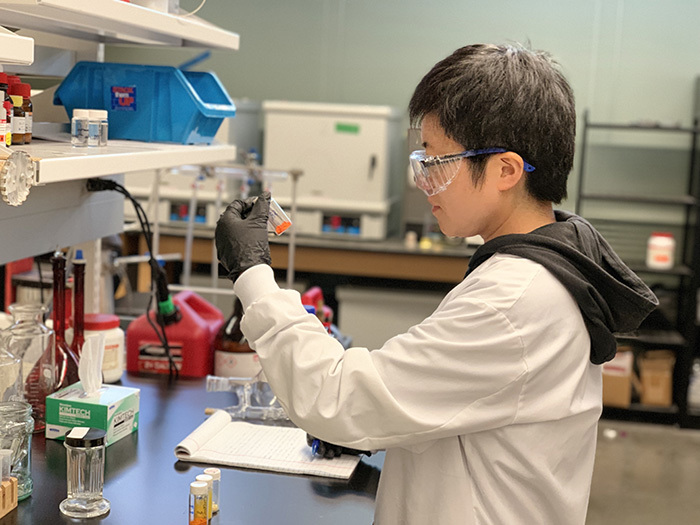
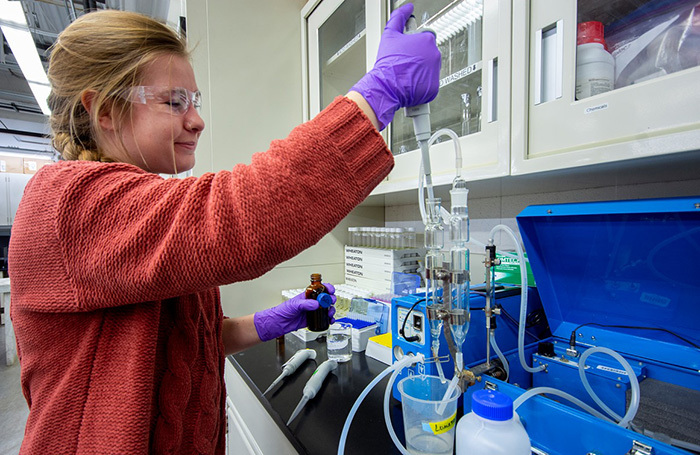
Qi Sun, a postdoctoral scholar at the University of South Florida (USF), checks a material as part of Pacific Northwest National Laboratory-USF research that could benefit legacy waste cleanup.
RICHLAND, Wash. – While useful in small amounts to scan and diagnose thyroid disease, a radioactive chemical called pertechnetate is a bad actor when it’s in nuclear waste tanks.
Pertechnetate is the soluble form of technetium-99, a radioactive byproduct of nuclear weapons production with a very long half-life. Since it is water soluble, it has a high potential for spreading and contaminating the environment if it were to leak out of tanks where radioactive wastes are held — like at the Hanford Site in Washington state.
PNNL materials scientist Praveen Thallapally is familiar with the makeup of Hanford tank waste from previous projects. While collaborating with USF on another project, he learned researchers had developed an organic material with many nano-sized pores, which are about one-billionth of a meter. Thallapally recognized its properties would attract and trap pertechnetate within those pores. Inspired, the research team did extensive testing of the material using simulated waste and recently published its findings in Nature Communications.
“This is the best material reported to date in terms of its affinity towards pertechnetate and record-high extraction efficiencies,” Thallapally said. “After running a pertechnetate simulant through a glass column of the material, the concentration dropped from 1,000 parts per billion to just one part per billion.”
The powdery material has a high surface area with many active sites that specifically attract and bind the pertechnetate. It’s also durable even when exposed to radiation and to the environments found in nuclear waste tanks at EM’s Savannah River and Hanford sites. The material is also reusable: it can release the pertechnetate attached to the material and then adsorb more.
The researchers report that existing commercially available resins are inefficient in capturing pertechnetate and have a much lower surface area that requires a greater quantity of resin to reduce the concentration of the contaminant.
“We believe the material could become highly influential for nuclear wastewater treatment technologies,” Thallapally said of this early-stage research. “In a perfect world, I’d like to see this technology applied to tank waste treatment in hopes of achieving cost savings and accelerating the cleanup schedule. I think it would have a positive impact.”
Funding for this work was provided by the National Science Foundation and USF. Professor Shengqian Ma led the USF team consisting of Qi Sun, Briana Aguila and David Rogers. Researchers from Soochow University, Southwest University of Science and Technology, and Tsinghua University in China also collaborated on the study.
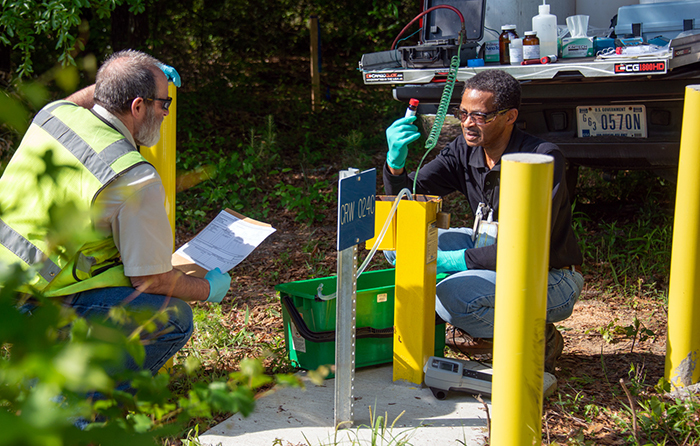
Savannah River Nuclear Solutions employees Terry Killeen, left, and Jimmie Lee take groundwater samples prior to the start of a cleanup project that will inject a 36,000-gallon mixture of emulsified oil, microorganisms, water, and other ingredients into the aquifer beneath the Savannah River Site.
AIKEN, S.C. – EM and the management and operations contractor at the Savannah River Site (SRS) are relying on a low-cost strategy using microorganisms found in nature to safely remove chemicals from a narrow groundwater plume.
"Finishing this phase will aid in the cleanup of another environmental restoration project at SRS, an important step towards returning the site to its natural state," DOE-Savannah River Federal Project Director Karen Adams said.
Workers will inject 36,000 gallons of a mixture that includes microbes known as dehalococcoides, vegetable oil, water, and vitamins B-12 and C through 15 pipes into the groundwater aquifer to get rid of contaminants such as trichloroethylene (TCE).
"Whenever possible, we believe it is best to harness and use nature for our environmental cleanup projects," said Terry Killeen, an environmental geologist with Savannah River Nuclear Solutions (SRNS). "Through extensive study and testing, it has been proven that this microbe, native to this area, actively eats TCE. We provide the oil and microbes and Mother Nature does the rest.”
Killeen said the oil and microbes thoroughly mix with the groundwater and coat particles of sand and clay in the subsurface. The TCE flowing through the area sticks to the oil, where both are ingested by the microbes, resulting in harmless substances consisting of ethene and chloride.
An advantage of this treatment is that it involves a one-time injection of a relatively small amount of oil to treat a large quantity of water over three to five years, Killeen noted. Conservative estimates indicate more than 1 million gallons of groundwater per year will be treated.
Remediating the groundwater using microbes and oil costs 30 to 60 percent less than many traditional types of TCE remediation at SRS, according to Killeen.
During the Cold War, workers often used chemicals such as TCE to remove grease from nuclear components manufactured throughout the DOE complex. Disposal of those chemicals often resulted in groundwater contamination including at the former C Reactor facility at SRS.
Nearly all degreasing chemicals found in the groundwater at or near the C Reactor were removed in a cleanup in 2006. Crews used high voltage electricity to heat the subsurface, vaporizing the TCE, which was then extracted from the groundwater. However, TCE still exists in the estimated mile-long groundwater plume between C Reactor and Castor Creek that will be nearly eliminated through this project.
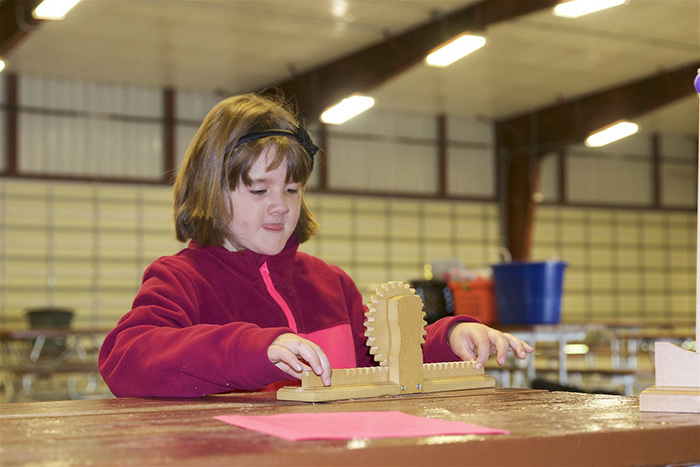
A student learns about gears at the recent Fluor Idaho STEAM Days at the Idaho Falls Zoo.
IDAHO FALLS, Idaho – How can a third-grader lift a zebra? How do you calculate what it takes to feed a tiger? What is the science behind how a bird sings? What are the geometric shapes found in a penguin?
Volunteers at 20 activity stations answered those questions and many more, keeping elementary students engaged in science, technology, engineering, art, and math (STEAM) topics at the recent Fluor Idaho STEAM Days at the Idaho Falls Zoo.
More than 1,800 students participated in the third-annual, two-day event sponsored by Fluor Idaho, EM’s cleanup contractor at the Idaho National Laboratory Site.
“We genuinely appreciate Fluor Idaho, their community involvement, and their interest in helping the Idaho Falls Zoo get kids interested in STEAM-related subjects,” said Sunny Katseanes, the zoo’s education curator. “Companies that get involved really do make a positive difference in smaller towns like Idaho Falls, and working together we help enhance and improve the educational opportunities for our students.”
Fluor Idaho Chief Engineer Joseph Giebel led a group of engineers from the company who worked with the students.
“I think the event is as beneficial to my staff as it is to the students. Watching a light go on when a kid understands an engineering principle, like a pulley, is gratifying, and you realize that the simple lesson they learn today could lead them toward a career in a STEAM discipline.”
RICHLAND, Wash. – To keep up with all he has learned since joining the EMRichland Operations Office (RL), Sean Madderom has a 37-page-and-counting document filled with acronyms.
“You have to find a way to deal with all that information coming in,” said Madderom, the RL electrical utilities program manager. “Each person is going to handle that differently.”
Madderom has been with RL since January 2017 and moved into his current position in June 2017. He is also the RL liaison to the Bonneville Power Administration, which maintains five substations across the 580-square-mile Hanford Site, and oversees the four substations that Hanford contractor Mission Support Alliance operates and maintains.
“Sean demonstrates positive leadership, brings new perspectives, has strong core values, and is a valuable asset to our team,” said Sharee Dickinson, director of the RL infrastructure and services division. “His ability to take on responsibilities and hit the ground running in the electrical utilities program is quite impressive.”
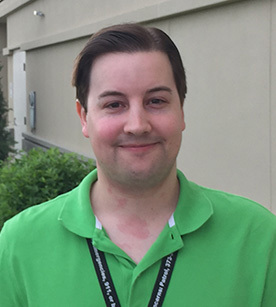
EM Richland Operations Office Electrical Utilities Program Manager Sean Madderom.
Only a few years into his tenure as a federal employee, Madderom has a bachelor’s degree in physics with a minor in mathematics, and a master’s degree in electrical engineering.
“I like to see all the technical work and to be able to work with engineers,” he said. “I also like that it’s practical, and it’s interesting to see how it all gets used in the field.”
Madderom has an eye out for the better way to face the challenge maintaining and improving infrastructure across the Hanford Site.
“I think there are efficiencies to be gained, so I’m curious to see how the new technologies coming in can help us,” he said. “We’re doing good work out here, trying to support the mission. People don’t always think about the lights that are on or the water that is running, but it’s very important.”
Editor's note: In an occasional series, EM Update profiles early career professionals across the EM complex.
OAK RIDGE, Tenn. – The Oak Ridge Office of Environmental Management (OREM) released the third of its four-part video series spotlighting the site’s environmental research. This segment explores how the OREM is funding research to understand and remediate the complex element of mercury. Watch the video here.
Researchers at the Oak Ridge National Laboratory’s Aquatic Ecology Lab are working in partnership with OREM to understand how the element changes and behaves in the environment. This work is clarifying how species accumulate mercury differently, how mercury moves up the food chain, and how to modify the environment to reduce mercury uptakes.
Their research is providing a deeper understanding on the topic, and it is providing a blueprint to OREM for best environmental cleanup practices. These solutions can also be applied to other remediation projects across the country.
Click here for the first segment and here for the second segment in the series.
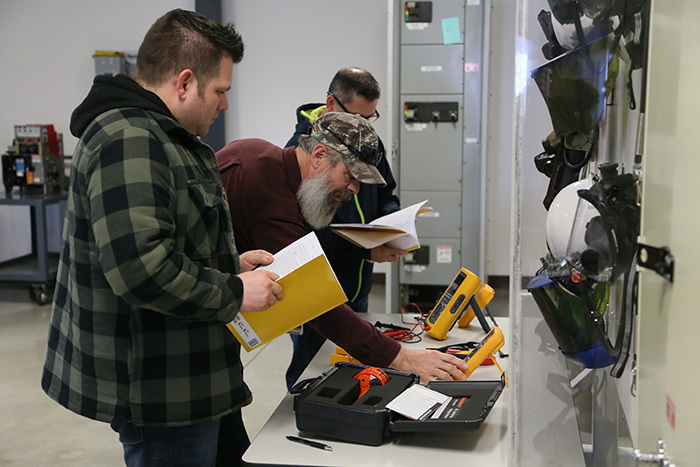
The training resulted from the need for the workers to implement the latest National Fire Protection Association (NFPA) standard on workplace electrical safety.
HAMMER staff revised six existing curricula and developed one new program. As part of the changes, class formats are now more collaborative and focus on practical application. Demonstrations are key to effective training and satisfying the new NFPA training requirements.
“The new program not only demonstrates efficiency but also benefits from the incorporation of a more hands-on approach,” said Jill Conrad, HAMMER program manager for the EM Richland Operations Office.
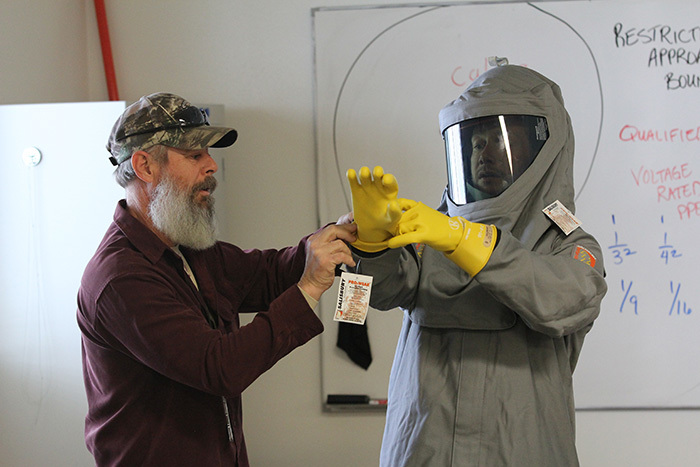
Trainer Gary Lyons, left, assists program manager Owen Peters in demonstrating the proper donning of arc flash personal protective equipment for a National Fire Protection Association class.
So far, students have provided positive feedback on the revised training, hands-on activities, and knowledgeable instructors.
“We have a great group of trainers who are dedicated to making sure the students leave our classes with the confidence and knowledge to take what they learn and successfully apply it in the field,” said Owen Peters, HAMMER electrical training program manager. “We look forward to continuing to engage the workforce on the importance of electrical standards.”
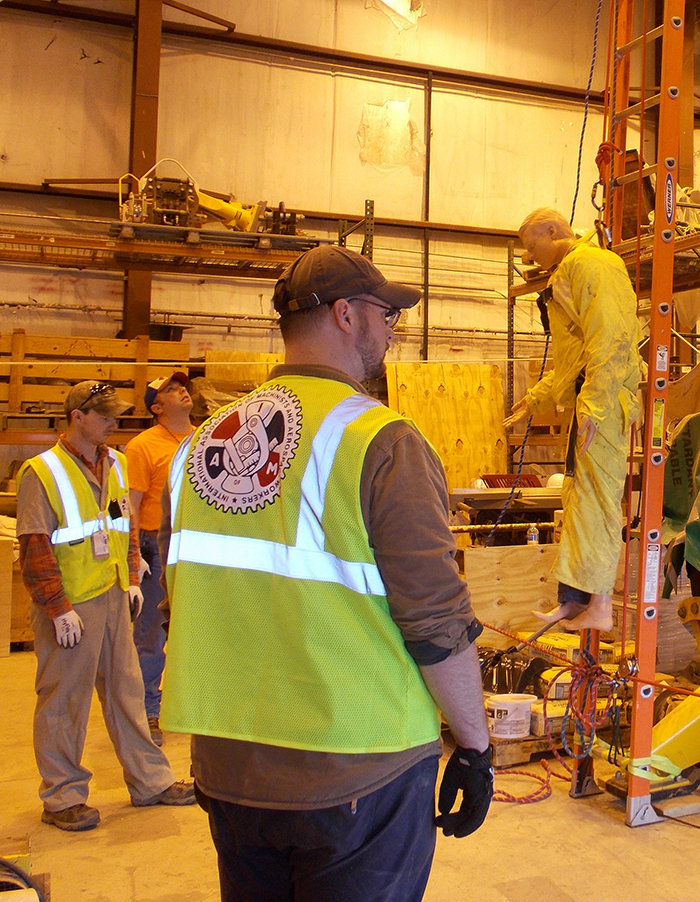
Steve Wedvik, center, works in CH2M HILL BWXT West Valley’s (CHBWV) environmental services division, while also serving as the fire chief for the West Valley Volunteer Hose Company. He held a confined space training for CHBWV employees that drew from his experience in emergency response.
WEST VALLEY, N.Y. – Some cleanup workers are available around the clock to respond in the event of an emergency at EM’s West Valley Demonstration Project or surrounding communities.
Sixteen of cleanup contractor CH2M HILL BWXT West Valley’s (CHBWV) more than 200 employees volunteer at several local fire departments, and some serve as officers for those organizations.
“Volunteers help balance the needs for responding to emergency medical needs, especially in rural areas,” said Kevin Murray, CHBWV’s emergency preparedness manager and volunteer firefighter. “In the event of any emergency, you have volunteer professionals who are trained and ready to provide lifesaving interventions.”
These volunteer firefighters draw on their emergency response expertise to provide safety training to the WVDP workforce.
“We understand the importance and benefit of having trained emergency responders working at West Valley,” EM WVDP Director Bryan Bower said. “We appreciate their continued commitment and effort to protect the health and safety of our workers and communities.”
Ashford Town Supervisor Charlie Davis commended the emergency responders.
“The men and women who volunteer their time to help others is an added benefit for our town and surrounding communities,” Davis said. “These professional volunteers play a vital role in providing pre-hospital care quickly in emergency situations.”
The value of having emergency responders working at WVDP was shown during an incident last year, according to Ken Whitham, vice president of CHBWV’s safety, quality, health and security division.
“This was clearly demonstrated last summer when employees who are also emergency medical technicians provided lifesaving care to an onsite visitor,” Whitham said. “If it wasn’t for their knowledge, training, and past experience, this medical emergency could have had a different outcome.”
CHBWV President and General Manager Scott Anderson added, “The site and community are fortunate to have these individuals to help when the need arises.”