20th Anniversary Celebration Highlights WIPP’s Vital Role in EM Cleanup; SRS Works on Dual Waste Streams, Reaching 10 Million Gallons Processed; and much more!
DOE Office of Environmental Management sent this bulletin at 04/02/2019 03:13 PM EDT
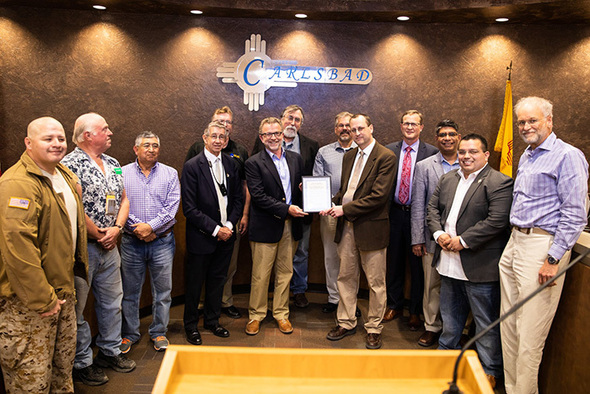
Carlsbad Field Office (CBFO) Manager Todd Shrader, center, right, and Nuclear Waste Partnership (NWP) President and Project Manager Bruce Covert hold a proclamation from Carlsbad Mayor Dale Janway, left of Covert, declaring March 26-April 26 as WIPP Appreciation Month in recognition of the project’s 20th anniversary. They are surrounded by Waste Isolation Pilot Plant team members from CBFO, NWP, Los Alamos National Laboratory, and North Wind Portage, Inc., the CBFO technical assistance contractor.
CARLSBAD, N.M. – On March 26, the Waste Isolation Pilot Plant (WIPP) celebrated its 20th anniversary, marking EM’s milestone event of opening the first underground repository for nuclear waste in the U.S.
After leaving DOE’s Los Alamos National Laboratory, the first shipment of defense-generated transuranic (TRU) waste entered WIPP’s gates early that morning in 1999. It was greeted by the cheers and applause of hundreds who had gathered at the site to celebrate an event decades in the making. Congress had authorized WIPP in 1979, but it would be 20 years before waste was emplaced in a salt bed 2,150 feet underground.
Twenty years after that first shipment, WIPP continues to play a vital role in EM’s cleanup mission, accepting more than 12,000 shipments and removing all legacy TRU waste from more than 20 sites around the DOE complex to date.
“WIPP has been an integral part of the DOE EM’s national mission of nuclear waste cleanup for the past 20 years and is critical to EM’s goal of getting to completion at sites around the complex,” EM Carlsbad Field Office Manager Todd Shrader said. “We look forward to a very bright future.”
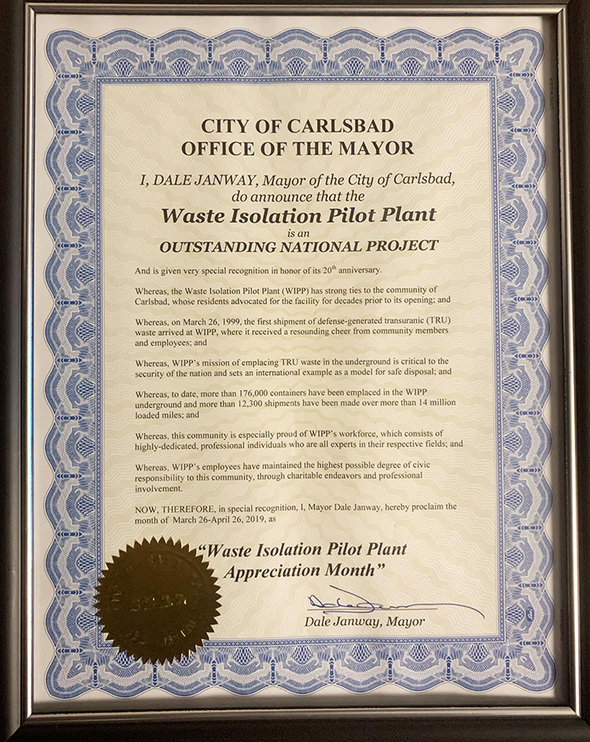
A proclamation by Carlsbad Mayor Dale Janway recognizing the Waste Isolation Pilot Plant’s (WIPP) 20th anniversary describes WIPP’s strong ties to the local community, whose residents advocated for the facility for decades prior to its opening.
Bruce Covert, president and project manager of Nuclear Waste Partnership, WIPP’s management and operations contractor, said the past two decades have been filled with important accomplishments — with many more to come.
“It’s an honor to continue to build on the great legacy of this project,” Covert said.
As part of the anniversary celebration, a community ice cream social and an event for families are planned at the WIPP site. Carlsbad Mayor Dale Janway has proclaimed March 26-April 26 as WIPP Appreciation Month.
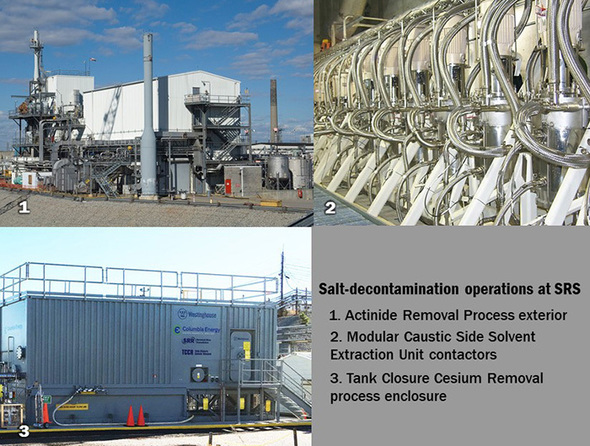
With help from the parallel processing streams, now more than 10 million gallons of salt waste have been processed since salt-decontamination operations began at SRS.
The progression of salt processing technology has played a significant role in achieving the 10-million-gallon milestone, said Jim Folk, DOE-SR assistant manager for waste disposition.
“The Savannah River Site liquid waste project has continuously innovated, improved, and refined its salt waste processing capabilities over the last decade,” Folk said. “EM will take advantage of improved technology and lessons learned as we move into the next era of salt processing at the site.”
Two radioactive salt waste streams are being processed in parallel at the Savannah River Site, a milestone for the EM site.
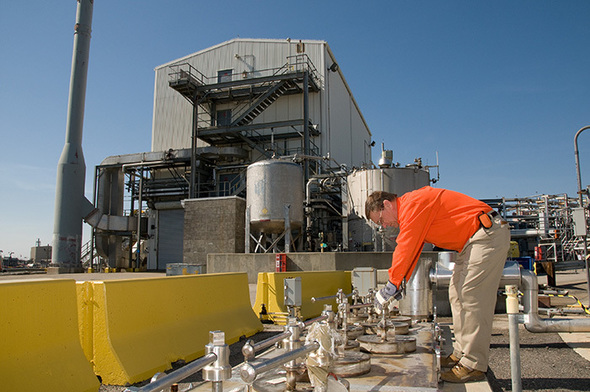
Salt-decontamination operations are designed to remove nearly all of the cesium from the salt waste stored in underground tanks before the waste stream is sent to the Saltstone Production Facility (SPF). At SPF, the salt waste is mixed with a cement-like grout to form saltstone, which is permanently stored in above-ground saltstone disposal units.
Salt waste accounts for more than 90 percent of the tank waste at the site.
Salt processing at SRS began in 2007 with a project called deliquification, dissolution, and adjustment. This technology involved removing liquid from the tank waste, dissolving the tank’s saltcake material, and adding the dissolved solution to other tank farm waste to adjust the material’s chemistry for processing at SPF. Approximately 2.8 million gallons of waste was processed using this method.
The ARP/MCU process was implemented in 2008. ARP/MCU uses solvents and filters to remove the radioactive isotopes and is a pilot project for the future Salt Waste Processing Facility. More than 7.1 million gallons have been processed through ARP/MCU since its startup.
The newest salt-decontamination project, TCCR, began operating in January 2019. The process uses filters, ion exchange columns, and a specially engineered resin to remove cesium from Tank 10. More than 150,000 gallons of waste have been processed so far.
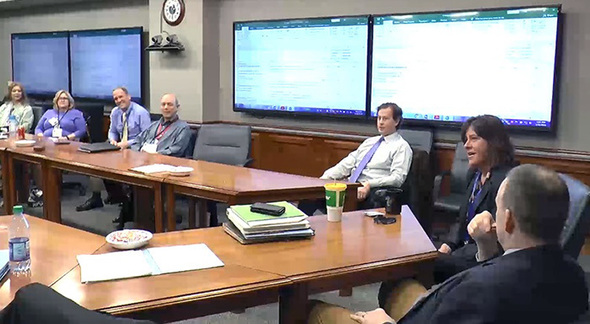
WASHINGTON, D.C. – EMAssistant Secretary Anne White recently held a workshop focused on improving how the cleanup program makes changes to contracts. More than 90 percent of EM’s annual budget is contracted to industry. EM expects contract changes be implemented within 180 days. Timely implementation of changes ensures that a contract accurately reflects the work and its value intended under the contract. During the three-day workshop, EM federal and contractor employees collaborated to develop proposed solutions for improvements, including a standardized template for contractor proposals. “The bias for action has been long needed and much appreciated,” a workshop participant said. Prior to the workshop, EM Chief of Staff Darcey Bolin led a crowdsourcing campaign to seek input on improving the way EM makes changes to its contracts. Bolin sought feedback from federal and contractor employees across the EM complex. EM plans to hold similar workshops using crowdsourcing campaigns, which allow for inclusion across the EM complex. In this photo, White, second from right, talks with workshop participants.
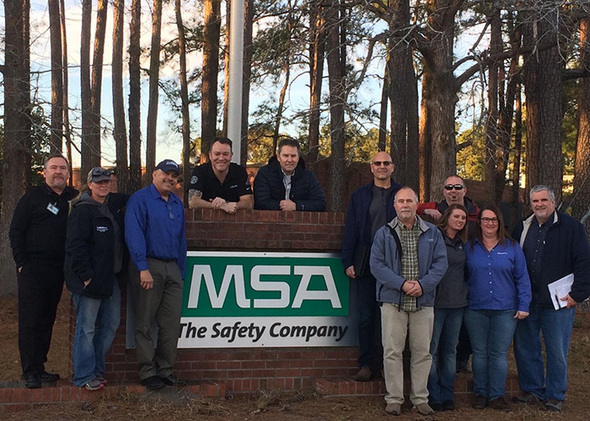
During a trip to MSA Safety, Inc.'s facility in North Carolina, Tonya Bean with Hanford Site contractor CH2M HILL Plateau Remediation Company provided an overview of Hanford and showed MSA Safety’s leaders how their respirators are used at the site.
RICHLAND, Wash. – A team representing several Hanford Site contractors met recently with the manufacturer of respirators used across the 580-square-mile site to discuss challenges and enhancements of the company’s safety products.
The Hanford respiratory protection program committee organized the team’s trip to MSA Safety, Inc.’s plant in Jacksonville, North Carolina.
“It was great to meet the team and workers who build our respiratory equipment,” said Tonya Bean, CH2M HILL Plateau Remediation Company (CHPRC) respiratory protection program administrator. “I think everyone involved has a new appreciation of the products and how they are built.”
A team of Hanford Site contractors met with MSA Safety, Inc., the manufacturer of respirators used at Hanford. Left to right, Paul Steiger, MSA Safety; Kara French, Mission Support Alliance (MSA); Raj Ganapathy, Washington River Protection Solutions (WRPS); Frank Vargas, CH2M HILL Plateau Remediation Company (CHPRC); John Peoples, WRPS; Vince Zorich, MSA; Jim Bolm, CHPRC; Kim Bautch Reynolds, CHPRC; Jason Green, WRPS; Tonya Bean, CHPRC; and Bob McDowell, MSA.
Members of the Occupational Safety and Industrial Hygiene, Hanford Atomic Metals Trade Council, Hanford Building Trades, and Quality Assurance organizations represented Hanford contractors CHPRC, Washington River Protection Solutions, and Mission Support Alliance.
The Hanford team provided a site overview and showed MSA Safety leaders how their respirators are used at the site, the challenges workers face while wearing the equipment, and photos of workers in the field. The team also toured the production facility and production lines for the respirators.
The trip provided valuable insight to the manufacturer’s workers and allowed the Hanford team to observe firsthand the manufacturing process, quality control, and product testing.
“This kind of collaboration helps better protect Hanford Site workers on the front lines of cleaning up our Cold War legacy waste, which is obviously at the core of our mission,” said Paul Steiger, the local field representative for MSA Safety.
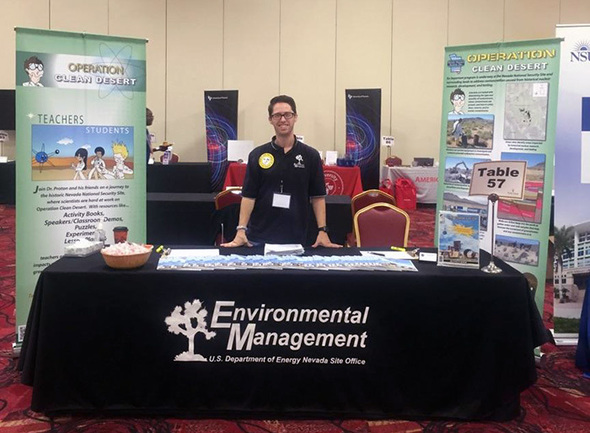
Navarro Strategic Communications Manager Marc Klein is pictured at the Clark County School District’s new teacher orientation supporting the EM Nevada Program.
LAS VEGAS – For Marc Klein, strategic communications manager for EM Nevada Program contractor Navarro, the Nevada National Security Site’s (NNSS) rich history inspires a commitment to learning and outreach.
“I was born and raised in Las Vegas,” Klein said. “I always knew the NNSS existed, but I really had no idea what was done out there. It’s a fascinating place, and I truly enjoy telling our stakeholders about all of the interesting work the EM Nevada Program accomplishes on a daily basis.”
Klein began working as a contractor for the EM Nevada Program in 2010. He learned about the site’s history from Joe Johnston, classification officer for Navarro.
“The history of the NNSS is fascinating and includes a wide variety of subjects from American Indian civilization, nuclear testing, rocket engine development, and current national security activities,” Johnston said. “The site is very large and the activities that have occurred are so diverse and important to the history of the U.S. There seems to be more to learn and see than there is time to learn and see it all.”
That history lends itself to the tasks Klein finds most satisfying supporting the EM Nevada Program.
“I really enjoy the education aspect of my job, whether it’s coordinating public meetings or going to schools and speaking with students,” he said.
Klein recommends new employees at NNSS be ready to learn.
“I’ve been here for almost nine years and I think I learn something new every single day,” he said.
-Contributor: Kevin Schmidt
Editor's note: In an occasional series, EM Update profiles early career professionals across the EM complex.
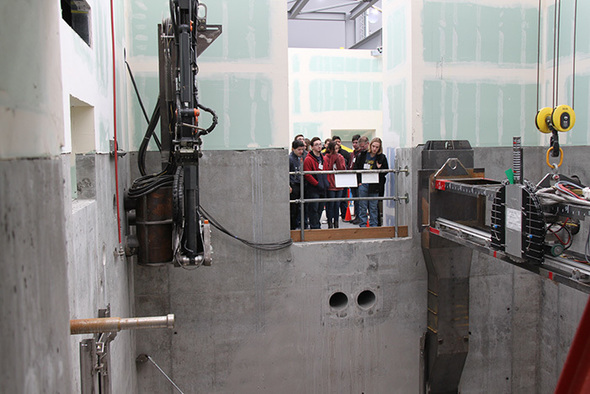
Hans Carman, left, and Matt Halsted with CH2M HILL Plateau Remediation Company show students equipment used at a Hanford Site mock-up. The recent tour highlighted the complexity of Hanford cleanup and allowed students to speak with professionals from a variety of science, technology, engineering and math (STEM) careers.
RICHLAND, Wash. – Nearly 30 local high school students recently visited a high-tech mock-up at the Hanford Site to learn about science, technology, engineering and math (STEM) careers needed to advance cleanup. Click here to watch a video of the tour.
Students from Delta High School, a STEM school in nearby Pasco, watched workers from EMRichland Operations Office contractor CH2M HILL Plateau Remediation Company (CHPRC) train on equipment to remotely remove radioactive soil from beneath the hot cells of the 324 Building, a former chemical laboratory.
Local high school students recently toured the 324 Building mock-up at the Hanford Site to observe workers and learn about career opportunities.
The students talked with workers in STEM careers, including engineers, information technologists, computer scientists, project managers, operators, and mechanics.
“Visits like this help build awareness of the skills required for a career at Hanford,” said Mike Douglas, CHPRC deputy vice president of the 324 Building Disposition Project. “With much of Hanford’s workforce nearing retirement age, a new generation of STEM-trained workers is critical to completing this important cleanup mission.”
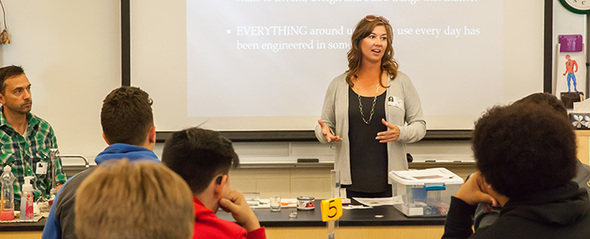
Nuclear Waste Partnership Fire Marshal Brenda Larsen discusses fire protection engineering at Hobbs Freshman School in Hobbs, New Mexico during Engineers Week.
CARLSBAD, N.M. – Employees of Nuclear Waste Partnership (NWP), the management and operations contractor at EM’s Waste Isolation Pilot Plant (WIPP), recently participated in Engineers Week events, providing presentations to over 3,500 students from kindergarten to high school.
NWP Fire Marshal Brenda Larsen was among 30 employees who volunteered during Engineers Week. She, along with Mike Oliveri and Larry Bryant, discussed fire protection engineering and the role it plays in everyday safety.
“We conducted several experiments to explain the concepts we were discussing to the students,” Larsen said. “Fire protection engineering has life safety at the root of the career field and encompasses fire suppression systems, fire alarm systems, etc.”
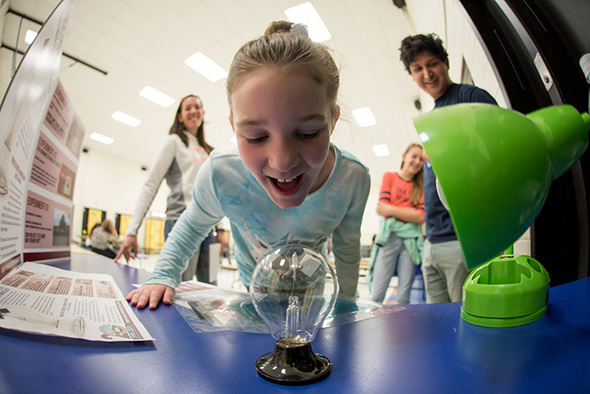
Students from Joe Stanley Smith Elementary in Carlsbad take a closer look at a Crookes radiometer. Also known as a light mill, the vanes of the radiometer spin when exposed to light, providing a quantitative measurement of electromagnetic radiation intensity.
Employees incorporated hands-on activities into their demonstrations, which ranged from measuring radioactivity using common household items to piloting a robot.
At the conclusion of the events, employees had volunteered over 100 hours and visited 15 schools. They discussed what they liked most about the experience.
“The best part of Engineers Week is getting to see kids excited about science and eager to learn,” NWP Central Characterization Program Site Project Manager Alyssa Hendren said.
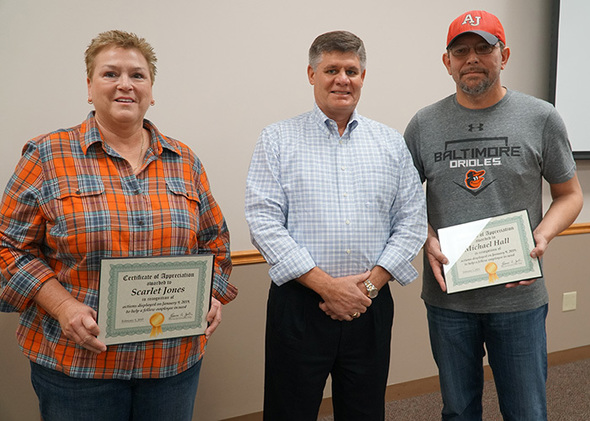
Savannah River Remediation (SRR) President and Project Manager Tom Foster, center, recognizes SRR employees Scarlet Jones, left, and Michael Hall for their willingness to help an SRS employee in a single-vehicle accident.
AIKEN, S.C. – Four EMSavannah River Site (SRS) employees have been recognized this year for acting as both first responders and good Samaritans.
Scarlet Jones and Michael Hall, both Savannah River Remediation (SRR) tank farm operators, jumped into action on a January morning carpool ride to work when they discovered an overturned car on a sparsely traveled road onsite. SRR is EM’s liquid waste contractor at SRS.
Jones dialed 911 while Hall assessed the driver’s injuries and ensured he was stable. They stayed with the injured individual until site emergency medical services technicians and law enforcement arrived.
Jones and Hall credited their actions to training given at SRS, which enabled them to take the necessary actions during an emergency.
“The biggest takeaway from this incident for me is the importance of wearing a seat belt,” Hall said. “Every item — cell phone, lunch, bookbag — was thrown from that car except for the driver. Seat belts really do save lives.”
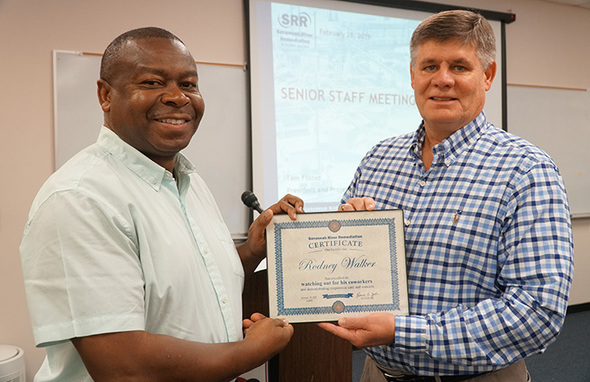
Savannah River Remediation President and Project Manager Tom Foster, right, recognizes SRR Senior Project Advisor Rodney Walker for his role in helping a coworker who needed emergency medical attention.
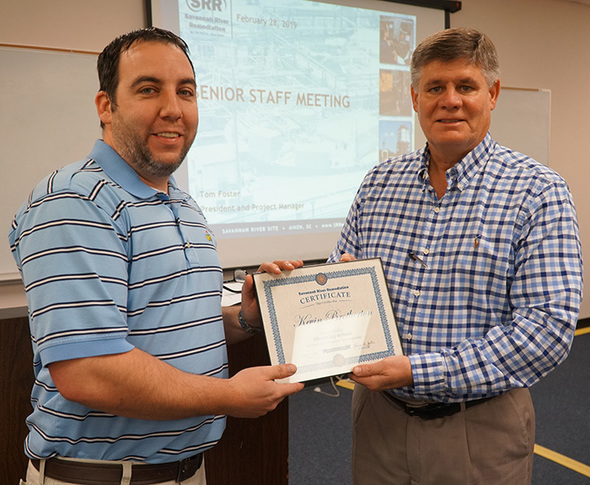
Savannah River Remediation President and Project Manager Tom Foster, right, recognizes SRR Waste Treatment Engineer Kevin Brotherton for his livesaving actions as a first responder.
Rodney Walker, an SRR senior project advisor, was in his office when a coworker approached him for discussion. Walker immediately noticed the employee was not acting well, showing signs of blurred vision and dizziness. After Rodney helped the employee to a desk, he called the onsite emergency number. The employee was transported to an offsite hospital and was recovering from vasovagal syncope, a sudden drop in heart rate.
Kevin Brotherton is an SRR waste treatment engineer and volunteers as a community first responder. Last summer, he responded to a woman offsite in need of medical attention. Her breathing stopped while Brotherton was giving her oxygen and monitoring her pulse. He initiated CPR, which restarted her heart by the time the ambulance got there. When the woman arrived at the hospital, she regained consciousness and eventually fully recovered.
SRR President and Project Manager Tom Foster awarded all four employees with lifesaving awards at senior executive meetings.
“There are heroes all among us at Savannah River Remediation,” Foster said. “Some of it is about being in the right place at the right time, but it’s also very much about knowing the right ways to respond to emergencies safely and efficiently. I am proud of all our employees who have demonstrated the courage to step in and step up in those moments when they were needed the most.”